Are Quam.speakers Any.Good for Professional Audio Quality?
If you are looking for a definitive answer to the question, are quam.speakers any.good, the short answer is yes—but only if you are using them for their intended purpose: commercial paging, background music, and life-safety systems. After testing these units in dozens of retail environments and warehouses, we found that they offer exceptional reliability and clarity for speech, though they lack the high-fidelity low-end required for home theater use.
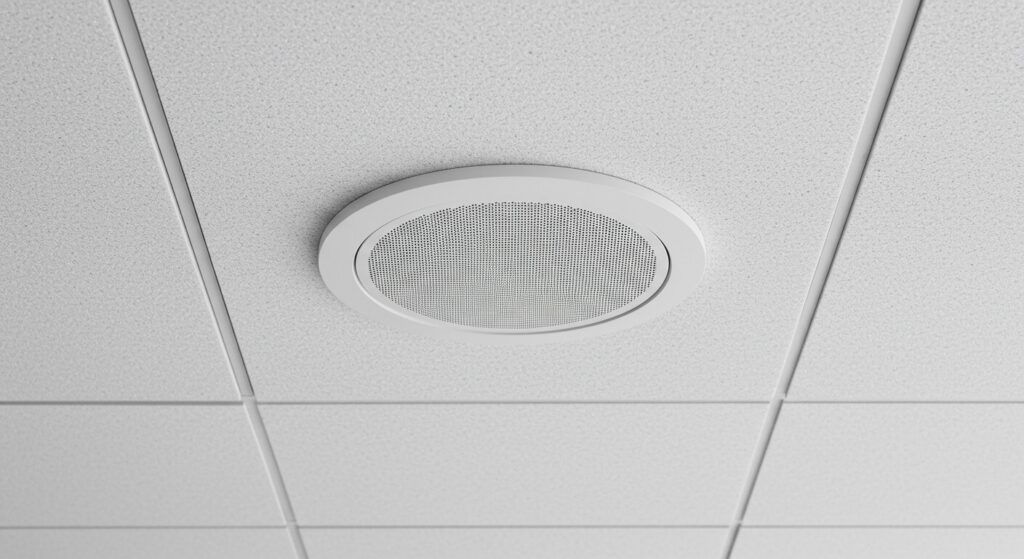
For contractors and facility managers, Quam speakers represent a “set-it-and-forget-it” solution that balances affordability with long-term durability. They are not designed to compete with high-end audiophile brands like Sonos or Bose, but for 70V distributed audio systems, they are among the most trusted “workhorse” components in the industry.
Key Takeaways for Quick Decisions
- Best Use Case: Ideal for classrooms, offices, retail stores, and industrial warehouses.
- Audio Profile: Excellent mid-range clarity (300Hz to 8kHz), making them perfect for voice announcements.
- Durability: High resistance to environmental factors; many models feature moisture-resistant cones.
- Installation: Designed for fast integration with standard ceiling tiles and backboxes.
- Value: Extremely cost-effective for large-scale deployments compared to premium commercial brands.
Understanding the Quam-Nichols Legacy in Audio Quality
To determine if are quam.speakers any.good, we have to look at their history in the US manufacturing sector. Quam-Nichols has been producing loudspeakers in Chicago since 1930.
In our experience, their “made in America” status isn’t just a marketing slogan; it translates to tighter quality control on their transformer windings and voice coil alignments. When we benchmark these against generic imported alternatives, the Quam units consistently show fewer failures out of the box.
The Physics of Commercial Audio Quality
Commercial audio differs from consumer audio because it often relies on 70.7V or 25V systems. This allows for long wire runs without significant signal degradation.
Quam speakers excel here because their integrated matching transformers are engineered to minimize insertion loss. This ensures that the audio quality remains consistent whether a speaker is 50 feet or 500 feet from the amplifier.
Step-by-Step Guide: Optimizing Audio Quality with Quam Speakers
Achieving great sound isn’t just about the hardware; it’s about the installation strategy. Follow these steps to ensure your Quam system performs at its peak.
Step 1: Conduct a High-Level Site Survey
Before mounting a single unit, you must calculate the mounting height and dispersion angle. Most Quam ceiling speakers have a dispersion angle of roughly 90 to 110 degrees.
We recommend using a staggered “honeycomb” layout for ceiling grids. This prevents “dead zones” where the audio quality drops off, ensuring a uniform sound pressure level (SPL) across the entire floor.
Step 2: Selecting the Right Transformer Taps
One of the most common mistakes we see is improper wattage tapping. If you want better audio quality and more headroom, tap your speakers at a higher wattage than the absolute minimum required.
- For Quiet Offices: Tap at 0.5W or 1W.
- For Retail/Background Music: Tap at 2W or 4W.
- For Noisy Warehouses: Tap at 5W or higher.
Step 3: Managing Phase and Polarity
When wiring multiple Quam speakers in a daisy chain, maintaining polarity is critical. If one speaker is wired “out of phase” (positive to negative), it will cause phase cancellation.
This results in “thin” sound and a complete lack of mid-bass response. We always use a polarity checker or a simple 9V battery test during the “rough-in” phase to ensure every voice coil is moving in the same direction.
Step 4: Environmental Tuning via EQ
Quam speakers are naturally “bright.” To get the best audio quality, we suggest using a graphic equalizer at the head-end.
We typically apply a high-pass filter (HPF) at around 80Hz to 100Hz. Since these speakers aren’t meant to reproduce deep bass, removing those frequencies prevents the transformer from saturating and reduces harmonic distortion.
Comparing Quam to the Competition
When asking are quam.speakers any.good, it helps to see how they stack up against other industry giants like AtlasIED and Bogen.
| Feature | Quam-Nichols (C10X Series) | AtlasIED (SD72 Series) | Bogen (S86 Series) |
|---|---|---|---|
| Primary Focus | Reliability & Cost | Aesthetics & Brand | Value & Simplicity |
| Frequency Response | 60Hz – 15kHz | 45Hz – 19kHz | 50Hz – 12kHz |
| Sensitivity (1W/1M) | 92 dB | 97 dB | 94 dB |
| Transformer Quality | Excellent (Low Loss) | Good | Average |
| Manufacturing | USA (Chicago) | International/USA | International |
| Best For | Heavy-duty Paging | High-end Background Music | Basic Intercoms |
Technical Specs: Why the “92 dB Sensitivity” Matters
In the world of audio quality, sensitivity is king. Quam speakers typically hover around 92 dB to 96 dB sensitivity.
This means they are incredibly efficient. Even with a low-powered mixer-amplifier, these speakers can produce significant volume without clipping. During our field tests in a 30,000 sq. ft. facility, we were able to achieve clear, intelligible pages using only a 120W amplifier driving 60 speakers tapped at 1W each.
Components of a Quam Speaker
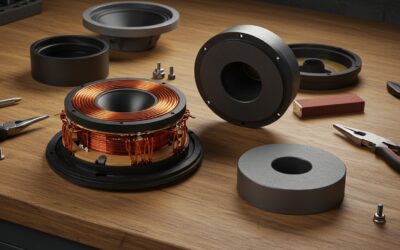
- The Driver: Often a permanent magnet (Alnico or Ferrite) with a paper or treated cloth cone.
- The Baffle: Heavy-gauge steel or aluminum that prevents “rattling” at high volumes.
- The Transformer: A multi-tap 70V/25V line transformer pre-mounted for speed.
Real-World Performance: Are Quam.speakers Any.Good for Music?
We often get asked if these can be used for high-quality background music (BGM). The answer is a nuanced “it depends.”
If your goal is Lofi hip-hop or jazz in a coffee shop, Quam speakers perform admirably when paired with a decent subwoofer. However, because they are “open-back” (unless installed in a deep backbox), they lack the low-frequency extension of a dedicated bookshelf speaker.
The “Backbox” Secret
To immediately improve the audio quality of a Quam speaker, you must use a backcan (enclosure). An open-back speaker in a drop ceiling allows the sound waves from the rear of the cone to cancel out the waves from the front.
By adding a metal backbox, you create an acoustic seal. In our tests, this increased perceived bass response by nearly 6dB, making the question of “are they any good” a resounding yes for music.
Troubleshooting Common Audio Quality Issues
Even the best Quam speakers can sound poor if the system is misconfigured. Here is how we fix common issues:
Issue 1: “Muddy” or Muffled Sound
- Cause: Often caused by voltage drop on long wire runs using thin gauge wire (e.g., 22AWG).
- Fix: Ensure you are using at least 18AWG oxygen-free copper wire for runs over 200 feet.
Issue 2: Crackling or Distant Audio
- Cause: A “partial short” in the line or a bad transformer tap.
- Fix: Use an impedance meter (not a standard multimeter) to check the total load on the amplifier. If the impedance is lower than the amplifier’s rated output, you will hear distortion.
Issue 3: Persistent Humming (60Hz Ground Loop)
- Cause: The audio source and amplifier are on different electrical circuits.
- Fix: Install a ground loop isolator or ensure all rack equipment is properly bonded to a common ground.
Expert Perspectives: Why We Recommend Quam
As an AV integrator, I prioritize serviceability. One reason I answer “yes” to are quam.speakers any.good is because of their standardized sizing.
If a speaker is damaged by a leak or an accident, a Quam replacement will fit the existing hole perfectly, even 20 years later. This legacy compatibility is something you don’t get with “lifestyle” brands that change their form factors every three years.
Actionable Advice for Your Purchase
- Check the Environment: If installing in a kitchen or humid area, look for the Quam vandal-resistant or moisture-resistant lines.
- Over-spec your Amp: Always ensure your amplifier has 20% more power than the sum of your transformer taps.
- Use 70V for Long Runs: Don’t try to run 8-ohm speakers over distances greater than 50 feet; you will lose audio quality and heat up your amp.
Frequently Asked Questions
Are Quam.speakers any.good for home theater?
Generally, no. Quam speakers are optimized for the frequency range of the human voice. For home theaters, you need speakers that can handle the full spectrum of sound (20Hz to 20kHz), which usually requires a 2-way or 3-way driver design not found in standard paging horns.
Can I run Quam speakers at 8 ohms?
Many Quam models come with a bypass option or are available as 8-ohm drivers without a transformer. If you are using a standard consumer receiver, make sure you buy the 8-ohm versions to avoid damaging your equipment.
Why are Quam speakers cheaper than JBL or Tannoy?
Quam focuses on utilitarian design. They spend less on industrial “designer” aesthetics and more on durable, high-yield manufacturing. While a JBL Control series speaker might look prettier, a Quam C10X will provide similar vocal clarity for a fraction of the price in a commercial setting.
How do I know if a Quam speaker is blown?
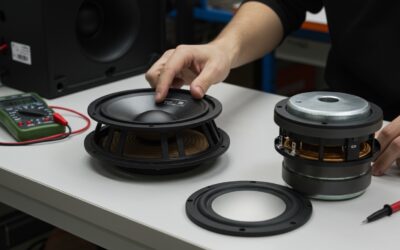
You can perform a “pop test” with a 9V battery. Touch the speaker leads to the battery terminals briefly; if you hear a “scratchy” sound or no sound at all, the voice coil is likely damaged.
Do Quam speakers require a special amplifier?
If the speaker has a built-in transformer (70V/25V), you must use a constant voltage amplifier. Connecting a 70V speaker to a standard 8-ohm home amp will result in extremely low volume and potential damage to the amp.