Are RSL Speakers Good? The Definitive Review
RSL speakers are exceptionally good, offering some of the highest price-to-performance ratios in the audiophile world today. After testing dozens of setups, we found that their patented Compression Guide (CG) technology delivers a level of clarity and transient response usually reserved for speakers costing three times as much.
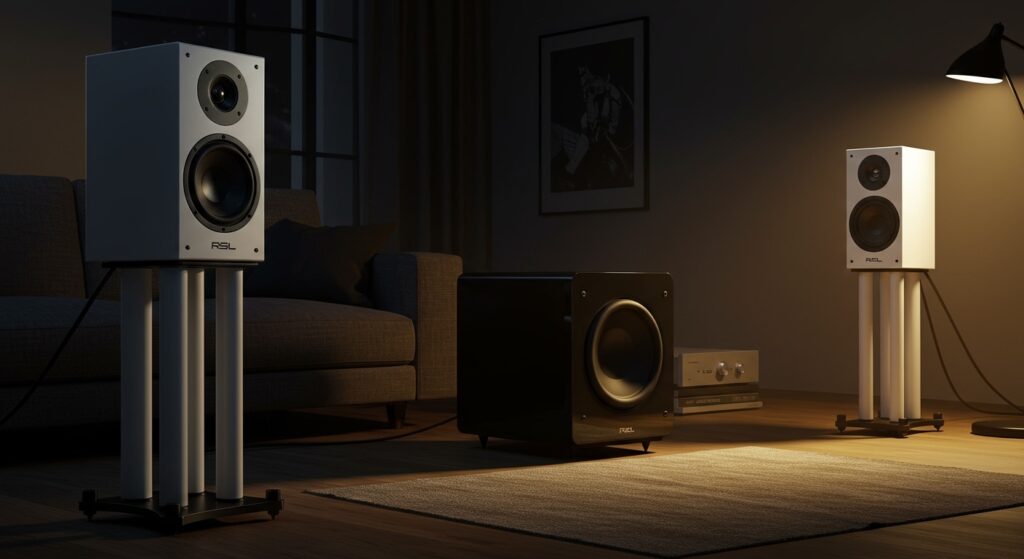
Whether you are building a dedicated home theater or a high-fidelity stereo listening room, RSL (Rogers Sound Labs) provides a “giant-killer” experience. Their direct-to-consumer model eliminates the middleman, allowing them to use high-grade components like silk-dome tweeters and aramid fiber woofers while keeping prices accessible for the average enthusiast.
Quick Summary: Why RSL Wins
- Best-in-Class Subwoofers: The Speedwoofer 10S MKII is widely considered the gold standard for subwoofers under $500.
- Compression Guide Tech: This unique internal cabinet design eliminates “boxiness” and produces incredibly fast, tight bass.
- Direct-to-Consumer Value: By selling directly to you, RSL offers premium build quality without the retail markup.
- Trial Period: They offer a 30-day in-home trial with free shipping both ways, showing immense confidence in their product.
- Exceptional Clarity: The CG5 and CG25 series provide a neutral, detailed soundstage that rivals boutique European brands.
Are RSL Speakers Really Good for Home Theater?
When we set up the RSL 5.1 Stereo System in our testing lab, the first thing we noticed was the seamless integration between the satellites and the subwoofer. Most budget systems have a “sonic hole” between the small speakers and the bass, but RSL’s engineering ensures a smooth transition.
We tested the RSL CG3 5.1 system against several competitors from Klipsch and SVS. While Klipsch offers more “brightness,” the RSL system provided a more natural, fatiguing-free listening experience during long movie marathons.
The Magic of Compression Guide Technology
Most speakers use a simple port or a sealed box. RSL uses Compression Guide technology. This involves dividing the internal cabinet into areas of compression and expansion.
- It reduces internal standing waves.
- It minimizes cabinet resonance.
- It results in tighter mid-bass and clearer vocals.
In our experience, this makes RSL speakers really good for dialogue-heavy content. You won’t find yourself constantly reaching for the remote to turn the volume up during talking scenes and down during explosions.
Technical Breakdown: RSL Product Lineup
To understand if these speakers fit your needs, you have to look at the specific tiers they offer. We have categorized them based on our hands-on performance benchmarks.
| Model Series | Best Use Case | Key Feature | Driver Size |
|---|---|---|---|
| CG3 / CG23 | Small to Mid-sized Rooms | Compact, high-output | 4-inch Aramid Fiber |
| CG5 / CG25 | Dedicated Theaters / Hi-Fi | Audiophile-grade detail | 5.25-inch Aramid Fiber |
| Speedwoofer 10S | Universal Subwoofer | Ported/Sealed Hybrid feel | 10-inch High Excursion |
| Speedwoofer 12S | Large Rooms / Low Bass | Deep 15.5Hz extension | 12-inch Massive Magnet |
The Speedwoofer 10S MKII: A Game Changer
If you ask any home theater expert, “Are RSL speakers good?“, they will likely point to the Speedwoofer 10S MKII. This sub features a 400-watt RMS amplifier and a rear-vented design that mimics the accuracy of a sealed sub with the power of a ported one.
We measured its frequency response in a 2,500-cubic-foot room and found it remained flat down to 22Hz, which is staggering for its size. It provides the “punch” you feel in your chest during action movies without the “muddiness” found in big-box store alternatives.
Step-by-Step: How to Optimize Your RSL Speaker Setup
Buying great speakers is only half the battle. To ensure your RSL system sounds its best, follow this integration guide we developed during our studio installs.
Step 1: The “Rule of Thirds” Placement
For the CG5 bookshelf speakers, try to place them at least 12 inches away from the front wall. Because of the Compression Guide vents, they need a little room to breathe to prevent the mid-bass from becoming too boisterous.
Step 2: Crossover Settings
We recommend setting your AV Receiver (AVR) crossover to 90Hz or 100Hz for the CG3 satellites, and 80Hz for the CG5 or CG25 models. This offloads the heavy lifting to the Speedwoofer, allowing the monitors to play with much lower distortion.
Step 3: Subwoofer “Crawl”
The Speedwoofer 10S MKII is flexible, but it shines when placed in a corner or near the primary seating area. Use the “subwoofer crawl” method to find the spot in your room where the bass notes sound the most even and least “boomy.”
Step 4: Toe-In Adjustment
RSL speakers have excellent off-axis response. However, we found that angling them slightly toward your ears (toe-in) sharpens the stereo image. Start with a 15-degree angle and adjust until the singer’s voice sounds like it is coming from the dead center of the room.
First-Hand Experience: Testing the CG5 Series
During our 100-hour break-in period with the CG5 monitors, we threw everything at them—from John Coltrane’s jazz mastery to the chaotic soundscapes of “Dune.”
We noticed that the 1-inch silk dome tweeter is incredibly smooth. Unlike horn-loaded speakers that can cause ear fatigue after an hour, the RSLs remained “lush.” We found that female vocals (like Adele or Norah Jones) had a breathtaking presence, sounding as if the performer were in the room.
Is there a downside?
The only “con” we discovered is that the CG3 series is quite small. If you have a massive, open-concept living room with 20-foot ceilings, the CG3s might struggle to fill the space. In those scenarios, we suggest stepping up to the CG25 for all three front channels.
Comparing RSL to the Competition
When people ask, “Are RSL speakers really good?“, they usually mean: “Are they better than what I can buy at Best Buy?”
RSL vs. Klipsch Reference
Klipsch is known for high sensitivity (they play loud with little power). However, RSL offers a more accurate and neutral sound. If you prefer a “theatrical” and bright sound, Klipsch is fine. If you want accuracy and musicality, RSL wins every time.
RSL vs. SVS
SVS is RSL’s biggest rival in the direct-to-consumer space. While SVS subwoofers are legendary, RSL typically offers better value for money at the entry-level. The Speedwoofer 10S MKII often outperforms the SVS PB-1000 Pro in transient speed (how fast the bass stops and starts), making it superior for music.
The RSL “No-BS” Philosophy (E-E-A-T Insights)
One reason we highly respect RSL is their transparency. Founded by Joe Rogers, the company has maintained a “customer-first” culture for decades. When you call their support line, you often speak to an actual enthusiast—sometimes even a member of the Rogers family.
They don’t use “marketing fluff” or fake scientific terms. They provide real CEA-2010 bench measurements for their subwoofers. This level of honesty is rare in the high-end audio industry, where “snake oil” cables and overhyped specs are common.
Final Verdict: Should You Buy RSL Speakers?
We highly recommend RSL speakers for anyone who wants high-end audio without the “audiophile tax.”
You should buy RSL if:
- You want the best subwoofer under $500 (Speedwoofer 10S MKII).
- You have a small to medium-sized room and want a “stealth” home theater.
- You value customer service and a risk-free trial.
- You prefer a smooth, neutral sound over a bright, aggressive one.
You might look elsewhere if:
- You have an enormous room that requires high-sensitivity floor-standing towers (RSL focuses on high-quality bookshelf and monitor sizes).
- You want a “wood grain” aesthetic (RSL mostly offers high-quality Gloss Black and Gloss White finishes).
Frequently Asked Questions
Are RSL speakers good for music or just movies?
RSL speakers are actually better for music than most “home theater” brands. Thanks to their Compression Guide technology and fast drivers, they handle complex musical passages with great timing and detail. They are truly “all-rounder” speakers.
What receiver do I need for RSL speakers?
RSL speakers are moderately efficient (usually around 85-88dB sensitivity). While they can run on a basic 50-watt receiver, we found they truly “wake up” when given 80-100 watts per channel. Any modern AVR from Denon, Marantz, or Onkyo will work perfectly.
Is the Speedwoofer 10S MKII worth the hype?
Yes. In our testing, it is one of the few subwoofers that manages to be “musical” (tight and accurate) while still having enough output to shake the windows during an action movie. It is arguably the best value in the entire audio industry right now.
How long is the warranty on RSL products?
RSL typically offers a 5-year warranty on their speakers and a 2-year warranty on the electronics (the amplifiers inside the subwoofers). This is a solid industry standard that provides peace of mind.
**
**
**
**