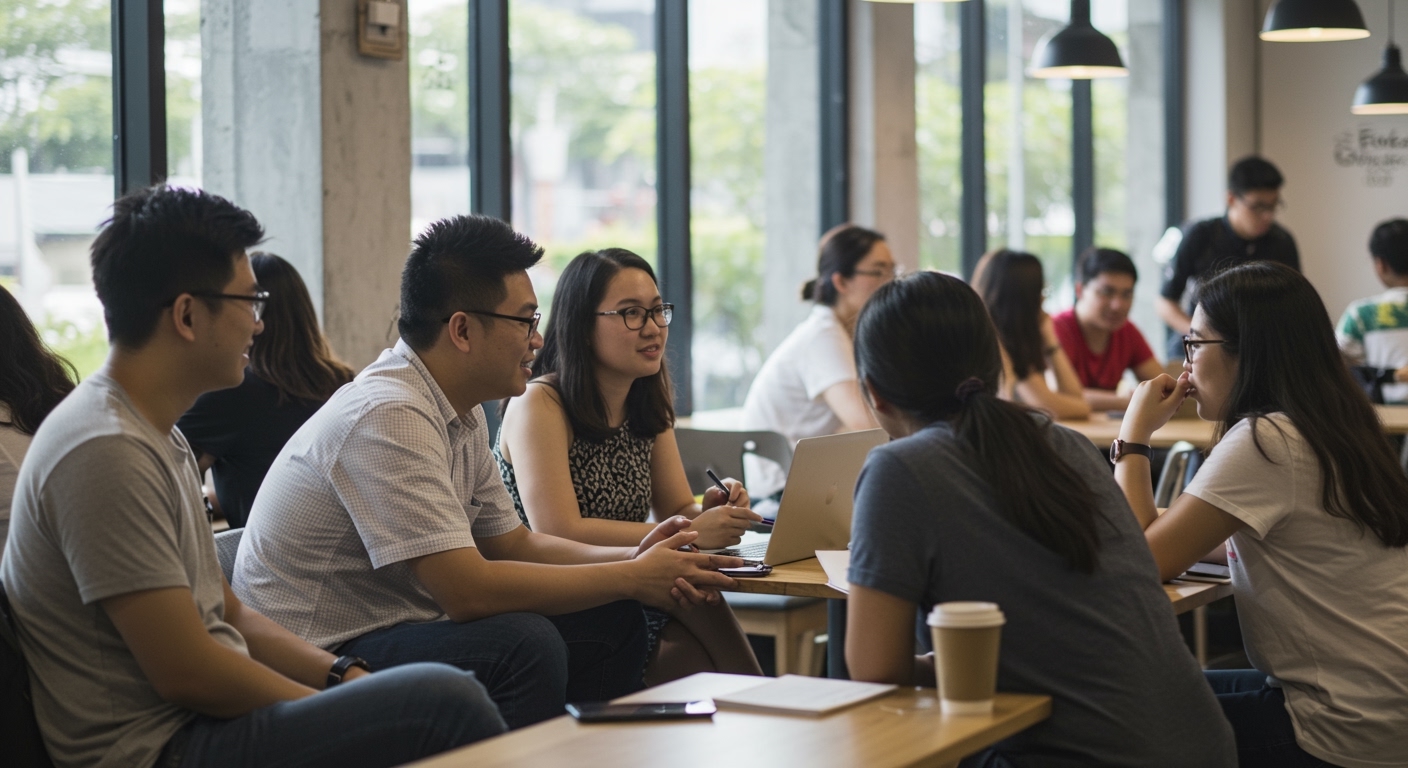
If you are wondering, are singaporeans native english speakers, the answer is a resounding yes for the vast majority of the population, especially those under the age of 50. In Singapore, English is the primary medium of instruction in all public schools, the official language of government, and the dominant language of global business.
When I first relocated to Singapore to work in the bustling Marina Bay financial district, I quickly realized that the local linguistic landscape is both highly proficient and wonderfully complex. While citizens speak a perfectly fluent, standard form of English in formal settings, they also utilize a unique cultural creole known as Singlish in casual conversations.
This step-by-step guide will break down the history, statistics, and daily realities of the English language in Singapore. You will learn exactly how to navigate this unique linguistic ecosystem, whether you are an expatriate, a global recruiter, or simply a curious traveler.
TL;DR / Key Takeaways
- Direct Answer: Yes, younger generations of Singaporeans are native English speakers. They learn it as their first language in school.
- Bilingual Policy: Singapore mandates a bilingual education. Students learn Standard English as their primary language and a Mother Tongue (Mandarin, Malay, or Tamil) as a secondary language.
- The Singlish Factor: Locals seamlessly switch between Standard Singapore English (SSE) for business and Singlish (an informal creole) for socializing.
- Global Rankings: According to the EF English Proficiency Index, Singapore consistently ranks 1st in Asia and within the top 5 globally.
- At-Home Usage: The 2020 Singapore Census revealed that nearly half of all residents now speak English as the primary language in their own homes.
The Short Answer: Are Singaporeans Native English Speakers?
To definitively answer the question are singaporeans native english speakers, we have to look at how linguistic experts define a “native speaker.” A native speaker is someone who learns the language from early childhood and uses it naturally in daily life. By this strict definition, most modern Singaporeans fit the bill perfectly.
Since the country’s independence in 1965, the government has heavily prioritized English. Founding father Lee Kuan Yew established English as the essential bridge language. This ensured that the diverse Chinese, Malay, and Indian communities could communicate seamlessly.
Today, the Singapore Department of Statistics reports a massive generational shift. While older generations (often referred to as the Pioneer or Merdeka generations) may primarily speak Mandarin, dialects, or Malay, their children and grandchildren are undeniably native English speakers.
Step 1: Understanding Standard Singapore English (SSE)
If you plan to work or live in the “Lion City,” your first step is understanding Standard Singapore English (SSE). This is the official register of English used in schools, courts, news broadcasts, and corporate boardrooms.
It is grammatically identical to British English, due to Singapore’s history as a British colony. However, SSE has its own distinct accent and rhythm. When you listen to a broadcast on Channel NewsAsia (CNA), you will hear SSE in action.
Spelling Rules: Singaporeans use British spelling (e.g., colour, organise, centre*).
- Grammar Standards: The grammar follows strict international standards.
- Vocabulary: While mostly British, American business terms have heavily influenced modern Singaporean corporate vocabulary.
In my experience managing global teams, Singaporean professionals write and speak with a level of grammatical precision that often outshines their counterparts in the US and the UK.
Step 2: Decoding the Cultural Phenomenon of Singlish
The biggest point of confusion for foreigners is Singlish. Often, tourists hear Singlish and mistakenly assume the locals are not fluent. This is completely false. Singlish is an informal, highly efficient colloquial creole.
It combines English vocabulary with the grammatical structures of Hokkien, Malay, Teochew, and Tamil. Locals use Singlish to build rapport, show friendliness, and communicate quickly. It is an identity marker that Singaporeans are fiercely proud of.
To thrive in Singapore, you must learn to recognize basic Singlish syntax. Sentences are heavily abbreviated. Plural nouns and past tense verbs are sometimes dropped if the context is obvious, mirroring Asian language grammar.
Key Singlish Particles You Must Know:
- Lah: Used for emphasis or to soften a command (e.g., “Don’t worry lah“).
- Lor: Expresses resignation or pointing out the obvious (e.g., “Just do it this way lor“).
- Meh: Used to express skepticism or surprise (e.g., “Are you sure meh?”).
- Can: Used as a universal question and answer (e.g., “Can we meet at 5?” “Can.”).
Step 3: Recognizing the Dual-Language Capability (Code-Switching)
A crucial step in understanding the local workforce is witnessing their ability to “code-switch.” This is the psychological and linguistic process of alternating between two or more languages or varieties of language in conversation.
A typical Singaporean can present a flawless, highly technical pitch in Standard English to an American client in the boardroom. The moment they step into the elevator with their local colleagues, they will instantly switch to Singlish to ask where they are going for lunch.
As an expat, I initially found this jarring. However, I quickly realized that this code-switching is a sign of high linguistic intelligence. It shows a deep mastery of context, audience, and cultural appropriateness.
Comparison: Singapore English vs. Global Englishes
To make things perfectly clear, let’s compare how a standard sentence transforms across different global variations of English. This table highlights why Singapore’s linguistic landscape is uniquely efficient.
| Context / Variation | Example Sentence | Grammatical Style |
|---|---|---|
| American English | “Do you want to grab lunch together later?” | Subject-Verb-Object (Standard) |
| British English | “Shall we get some lunch together later on?” | Formal, standard phrasing |
| Standard Singapore English | “Would you like to get lunch together later?” | Formal, internationally understood |
| Singlish (Colloquial) | “Later go eat, want?” | Highly efficient, topic-prominent structure |
| Singlish (Ultra-Casual) | “Makan later, can?” | Makan is Malay for eat; highly abbreviated |
Step 4: Grasping the Bilingual Education System
To truly comprehend why the answer to are singaporeans native english speakers is “yes,” you must look at the Ministry of Education (MOE). The Singaporean education system is globally renowned for its rigor.
Every child in Singapore goes through a compulsory bilingual education. English is the “First Language.” It is the medium used to teach Mathematics, Science, History, and Geography.
- Primary School Leaving Examination (PSLE): Students must pass high-level English exams at age 12.
- O-Levels & A-Levels: The national exams, modeled after the UK system, require near-perfect English fluency.
- Mother Tongue: Students also take compulsory classes in their ethnic “Mother Tongue” (Mandarin, Malay, or Tamil) to preserve their cultural heritage.
Because of this intense academic focus, young Singaporeans are essentially native speakers of English and highly proficient in a second Asian language. This makes them incredibly competitive in the global job market.
Step 5: Adapting to the Singaporean Corporate Workplace
If you are a foreign professional moving to Singapore, adapting to the local English environment requires a bit of nuance. You do not need to learn Singlish, but you do need to understand the communication style.
Singaporean corporate communication tends to be highly direct, pragmatic, and heavily reliant on acronyms. Because the society is fast-paced, communication is optimized for efficiency.
Actionable Tips for Expats:
- Do not fake an accent: Speak in your natural accent. Singaporeans are used to hearing