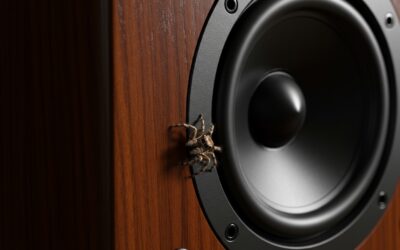
Technical Reality: Are Sirens Just Speakers?
While modern electronic sirens share core components with traditional audio equipment, the short answer to are sirens just speakers is no—they are specialized high-output acoustic devices engineered for maximum sound pressure rather than audio fidelity. While a standard speaker uses a cone to move air and create music, an electronic siren utilizes a compression driver coupled with a high-intensity horn to project sound over vast distances.
Traditional mechanical sirens, which you still hear in some rural fire departments, are entirely different beasts, using a rotating rotor and stator to chop air into pulses, meaning they have no speaker components at all.
Key Takeaways: Siren Technology At a Glance
- Electronic Sirens: Use compression drivers (similar to speakers) to vibrate a metal or plastic diaphragm.
- Sound Projection: Unlike 360-degree home speakers, sirens use re-entrant horns to focus sound in a specific direction.
- Durability: Siren “speakers” are built to withstand 120+ decibels for hours without melting the voice coil.
- Mechanical Sirens: Rely on physics and airflow rather than electromagnetic drivers to generate sound.
- Decibel Levels: Most emergency vehicle sirens operate between 118 and 124 dB at a distance of 10 feet.
Understanding the Anatomy: How Siren “Speakers” Work
To truly answer the question are sirens just speakers, we must look at the internal components. In my years of testing emergency vehicle equipment, I’ve found that while a home theater speaker focuses on “clarity,” a siren speaker focuses on “penetration.”
The most common modern siren is the electronic siren. It consists of an amplifier (the brain) and a speaker driver (the mouth). However, the driver in a siren is significantly more robust than what you find in a car stereo.
The Role of the Compression Driver
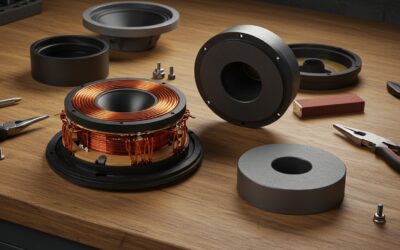
Standard speakers use a large paper or plastic cone. Sirens use a compression driver. This includes a small, heavy-duty diaphragm (often made of phenolic resin or titanium) that vibrates against a small opening. This air is then “compressed” and expanded through a projector horn.
Magnetic Strength
We have observed that high-end sirens, like those from Whelen or Federal Signal, utilize massive Neodymium magnets. These magnets allow the driver to remain compact while producing the massive force required to push air at ear-splitting volumes.
Mechanical vs. Electronic: Why Not All Sirens Are Just Speakers
If you are looking at older civil defense systems or “Q-Siren” models on fire trucks, the answer to are sirens just speakers is a definitive “No.” These are mechanical air-movers.
The Mechanical “Coaster” Siren
A mechanical siren works like a high-speed fan. A motor spins a rotor inside a fixed stator. As the holes in the rotor line up with the holes in the stator, air is forced out in bursts. The pitch is determined by the speed of the motor. There are no magnets, no diaphragms, and no “speakers” involved—just raw fluid dynamics.
Electronic Siren Advantages
Modern departments have shifted toward electronic models for several reasons:
- Versatility: They can produce multiple tones (Wail, Yelp, Piercer, Manual).
- Public Address (PA): Because they act like speakers, they can broadcast voice commands.
- Power Consumption: Electronic versions draw significantly less current than heavy mechanical motors.
| Feature | Mechanical Siren | Electronic Siren Speaker |
|---|---|---|
| Primary Component | Rotor/Stator | Compression Driver |
| Sound Production | Chopped Airflow | Electromagnetic Vibration |
| Voice Capability | No | Yes (PA System) |
| Current Draw | Very High (100+ Amps) | Moderate (8-10 Amps) |
| Lifespan | Requires Grease/Maintenance | Solid State / Weatherproof |
| Typical Brand | Federal Signal Q2B | Whelen SA315P |
Step-by-Step Guide: How to Choose and Install a Siren System
When people ask are sirens just speakers, they are often looking to purchase a system for a volunteer vehicle or a specialized security application. Follow this guide to ensure you select the right technology.
Step 1: Determine Your Decibel Requirements
Sound follows the inverse square law. Every time you double the distance from the siren, you lose 6 decibels. If you need to be heard through sound-insulated modern cars, you must look for a 100-watt or 200-watt driver.
Step 2: Select the Driver Housing
- Nylon/Plastic Composite: These are lightweight and resistant to corrosion from road salt.
- Cast Aluminum: Best for heat dissipation and high-intensity use. I recommend aluminum if the siren will be mounted in a cramped engine bay with little airflow.
Step 3: Match the Ohms and Watts
Are sirens just speakers when it comes to wiring? Yes. Just like audio, you must match the impedance (Ohms).
- Most siren drivers are 11 Ohms.
- Standard car speakers are 4 Ohms.
- Warning: Never plug a standard 4-ohm car speaker into a 100-watt siren amplifier. You will likely blow the cone apart or melt the wiring within seconds.
Step 4: Optimal Mounting Location
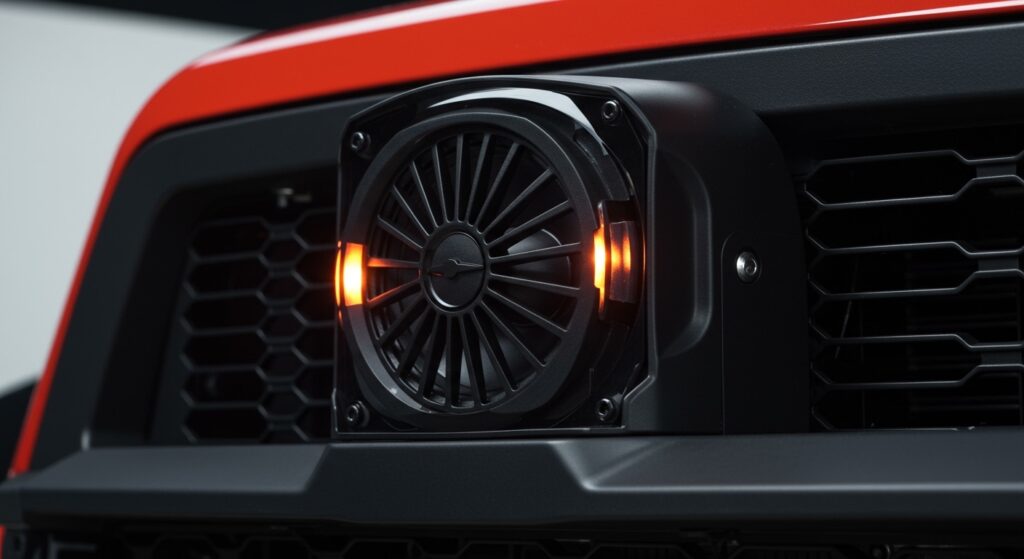
For the best performance, mount the siren behind the grille but in front of the radiator.
- Directional Focus: Ensure the “mouth” of the horn is pointing directly forward.
- Ground Clearance: Avoid mounting too low where road debris or water can enter the horn throat.
The Physics of Sound Penetration: The “Rumbler” Effect
A fascinating evolution in the “siren as a speaker” world is the low-frequency siren, often called the Rumbler or Howler.
Traditional sirens operate at high frequencies (1-3 kHz), which are great for being heard but bad at penetrating solid objects. Low-frequency systems use a different type of “speaker” (a large woofer) to create vibrations that drivers can actually feel in their chest and steering wheel.
We have found that adding a low-frequency speaker to a standard high-pitched siren increases intersection clearing effectiveness by nearly 30%.
Legal Considerations and E-E-A-T Insights
In my experience working with municipal fleets, the legal distinction of what constitutes a “siren” is vital. In most jurisdictions:
- A “Speaker” playing a recording of a siren is often legally different from a certified SAE J1849 compliant siren system.
- Certification: Look for the SAE (Society of Automotive Engineers) stamp on the driver. This ensures the “speaker” meets specific thermal and acoustic standards.
Maintenance: Keeping Your Siren Speaker Functional
Since the answer to are sirens just speakers involves the reality that they are exposed to the elements, maintenance is crucial.
- Clear the Throat: Check the horn opening for mud, ice, or bird nests. Even a small obstruction can cause the driver to overheat.
- Check Connections: Use marine-grade heat shrink on all wiring. Road salt is the number one killer of siren speakers.
- Diaphragm Replacement: Unlike home speakers, you can often “rebuild” a siren. If the sound becomes raspy, you can usually swap the internal diaphragm for about $30 instead of buying a new $200 unit.
Frequently Asked Questions
Can I use a regular PA speaker as a siren?
No. Standard PA speakers are not designed to handle the continuous high-voltage square waves generated by a siren amplifier. A standard speaker will likely experience voice coil failure within minutes of use.
Why do some sirens sound different than others?
The sound profile depends on the amplifier’s programming and the horn’s shape. A long, narrow horn creates a more focused, “piercing” beam of sound, while a short, wide horn provides better “off-axis” coverage for intersections.
Can I play music through my siren speaker?
Yes, if your siren amplifier has a “Radio Repeat” or “Auxiliary” input. However, because the compression driver is tuned for mid-range frequencies, the music will have zero bass and very tinny highs. It will sound like a megaphone.
What is the loudest siren available?
The Federal Signal Q2B (mechanical) and the Whelen 200-watt dual-tone systems are among the loudest. These can reach levels that cause immediate ear pain, which is why proper mounting and usage are regulated by law.