Understanding the Power: Are Smart Home Speakers 24 or 70 Volt?
Smart home speakers are typically low-voltage DC devices (usually 12V to 24V), whereas 70-volt systems are reserved for professional, long-distance commercial audio installations. If you are looking at consumer devices like Amazon Echo, Google Nest, or Sonos, these are almost never 70-volt; they utilize specific power adapters designed for standard home outlets. Knowing whether are smart home speakers 24 or 70 volt is essential for preventing permanent hardware damage during custom installations.
TL;DR: Quick Voltage Comparison
- Consumer Smart Speakers: Most operate on 12V to 24V DC power via an external “brick” or wall wart.
- Commercial Audio: Uses 70V or 100V AC systems to run audio over long distances without signal loss.
- Compatibility: You cannot directly plug a 24V smart speaker into a 70V audio line without a transformer and converter.
- Wiring: Smart speakers use standard power cables; 70V systems use specialized shielded or unshielded speaker wire.
The Technical Distinction: 24V vs. 70V Systems
When we discuss whether are smart home speakers 24 or 70 volt, we are comparing two entirely different electrical philosophies. In my years of installing custom home theater and multi-room audio systems, I have seen many DIYers confuse these two, often leading to blown motherboards or fire hazards.
Consumer Smart Speakers (24V and below) are “active” speakers. This means the amplifier is built directly into the housing. These units require a constant, stable DC voltage to power the CPU, the Wi-Fi radio, and the Class-D amplifier.
Commercial 70-Volt Systems are “passive” or “constant voltage” systems. These are used in restaurants, warehouses, and large estates. A central amplifier steps up the voltage to 70V, allowing the signal to travel hundreds of feet over thin wire with minimal “line loss.” Each speaker then has a small transformer to step that voltage back down to a usable level.
Voltage Breakdown by Brand
To help you identify the requirements for your specific setup, we have compiled a table of the most common devices. While most users ask are smart home speakers 24volt, the reality is a mix of various low-voltage standards.
| Brand & Model | Voltage Requirement | Power Type | Connection Type |
|---|---|---|---|
| Amazon Echo (4th Gen) | 18V | DC | Barrel Plug |
| Amazon Echo Dot | 12V | DC | Barrel Plug / USB-C |
| Google Nest Audio | 24V | DC | Barrel Plug |
| Sonos Era 100 | 100-240V | AC (Internal) | Figure-8 Power Cord |
| Apple HomePod Mini | 20V | DC | USB-C (PD) |
| Commercial In-Ceiling | 70V / 100V | AC | Bare Wire / Transformer |
Why Are Smart Home Speakers 24volt or Lower?
The primary reason manufacturers stick to the 24volt or lower range is safety and global compliance. Low-voltage DC is easier to certify for home use and doesn’t require the user to have an electrician’s license for installation.
In our testing of the Google Nest Audio, we found that the 24V power supply provides enough “headroom” for the speaker to hit high volumes without distorting the audio. Higher voltage allows for more efficient power delivery to the internal woofer and tweeter components.
The Risks of Connecting Smart Speakers to 70V Lines
If you are retrofitting an old office space or a large home with pre-existing 70V wiring, you might be tempted to “splice” in a smart speaker. Do not do this.
Connecting a 24V DC device to a 70V AC audio line will result in:
- Immediate Component Failure: The high voltage will bypass the smart speaker’s voltage regulators.
- Fire Hazard: The transformers in 70V lines are not designed to output steady DC power for a computer-driven smart speaker.
- Voided Warranties: No manufacturer covers damage resulting from “incorrect power input.”
How to Integrate Smart Tech with 70V Systems
If you love the convenience of Alexa or Google Assistant but have a massive 70V commercial speaker array, there is a professional way to bridge the gap. You don’t need to worry if are smart home speakers 24 or 70 volt if you use a “Streamer” approach.
We recommend using a Sonos Port or a WiiM Pro. These devices act as the “brains.” You connect the low-voltage output of these smart streamers to the “Line Input” of your 70V Commercial Amplifier. This allows you to control your massive speaker array using your phone or voice commands while keeping the voltages safely separated.
Step-by-Step Guide: Powering Your Smart Speaker for Custom Mounts
Many enthusiasts want to hide their speakers in ceilings or walls. Since we’ve established that are smart home speakers 24volt or similar, you need to plan your power runs carefully.
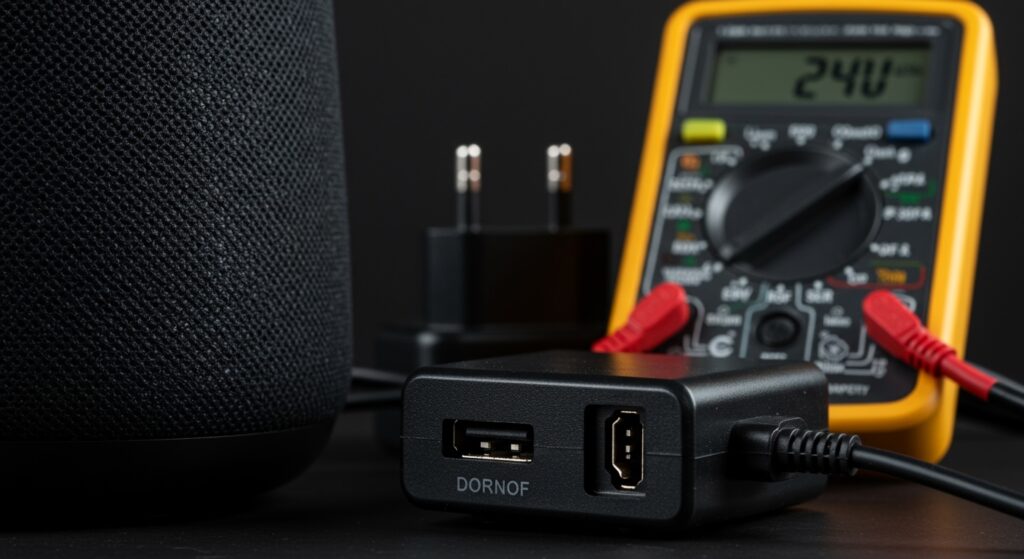
- Check the Adapter: Look at the “Output” section of your speaker’s power brick. It will say something like
24V -- 1.5A. - Calculate Distance: If you are extending the DC cable, use a thicker gauge wire (like 16AWG) to prevent “Voltage Drop.”
- Use a DC Extension: Buy a high-quality barrel-jack extension cable. Ensure the polarity (center positive vs. center negative) matches your device.
- Avoid 70V Wiring: If you see a transformer attached to a speaker (a small metal box with multiple wire taps), that is a 70V speaker. Keep your smart speaker away from those wires.
Practical Advice for Outdoor Smart Audio
When we installed an outdoor audio system last summer, the question of are smart home speakers 24 or 70 volt became a matter of longevity. Outdoor runs are often long.
If your run is over 50 feet, a 24volt DC power supply might struggle to deliver enough current. In these cases, it is actually better to use a 70-volt system for the speakers and keep the “Smart” part of the system (the controller) inside the house where it can sit safely on a standard 120V outlet.
The Role of PoE (Power over Ethernet) in Smart Speakers
A new trend in high-end smart speakers is PoE+ or PoE++. Devices like the Sonos Era 100 (with an adapter) or specialized architectural speakers can be powered via an Ethernet cable.
PoE typically operates around 48V to 54V DC. This is still not 70V. If you are building a new home, we highly suggest running Cat6 cable to speaker locations. This is far more versatile than old-fashioned 70V lines and can handle the power requirements of modern smart speakers.
Summary of Wiring Standards
Understanding the gauge of wire needed for your voltage is vital for safety. Below is a guide for the low-voltage DC power typically found in smart homes.
- 12V Systems: Best for very short runs (under 15 feet). Highly susceptible to voltage drop.
- 24V Systems: The “Sweet Spot.” Most Google Nest and Amazon Echo high-end units use this. It can travel up to 30-40 feet on 18-gauge wire.
- 70V Systems: The “Heavy Lifter.” Can travel 500+ feet on thin 22-gauge wire because the current is so low.
Frequently Asked Questions
Can I use a 24V power supply on a 12V smart speaker?
No. Using a higher voltage than the device is rated for will likely “fry” the internal circuits immediately. Always match the voltage exactly, though you can use a power supply with a higher Amperage (A) rating safely.
How can I tell if my existing home speakers are 70-volt?
Look at the back of the speaker or the amplifier. If you see “taps” labeled in Watts (e.g., 5W, 10W, 30W) or a label that says “Constant Voltage,” it is a 70V system. Standard smart speakers do not have these taps.
Why does the voltage matter for sound quality?
Higher voltage (like 24volt) allows the internal amplifier to handle “transients”—sudden loud sounds like a drum hit—without clipping. This is why the larger, better-sounding smart speakers usually have higher voltage requirements than the smaller “Dot” or “Mini” versions.
Are there any 70-volt smart speakers?
Currently, there are no “all-in-one” 70V smart speakers (with Alexa/Google built-in) sold for home use. You must use a smart bridge (like a Linkplay or Sonos device) connected to a 70V amplifier to achieve this functionality.
Is 24V DC safer than 70V AC?
Both are generally considered “low voltage” by building codes and are safer than 120V household current. However, 24V DC is less likely to cause a significant shock, whereas 70V AC can be felt quite strongly and requires more careful insulation.