Are Speaker Baffles Necessary in Marine Speakers?
Are speaker baffles necessary in marine speakers? While not strictly required for a speaker to produce sound, they are highly recommended to protect internal components from moisture and significantly improve mid-bass response in open-air boat environments. Without them, you risk premature hardware failure from salt spray and loss of audio “punch” due to acoustic phase cancellation within the hull.
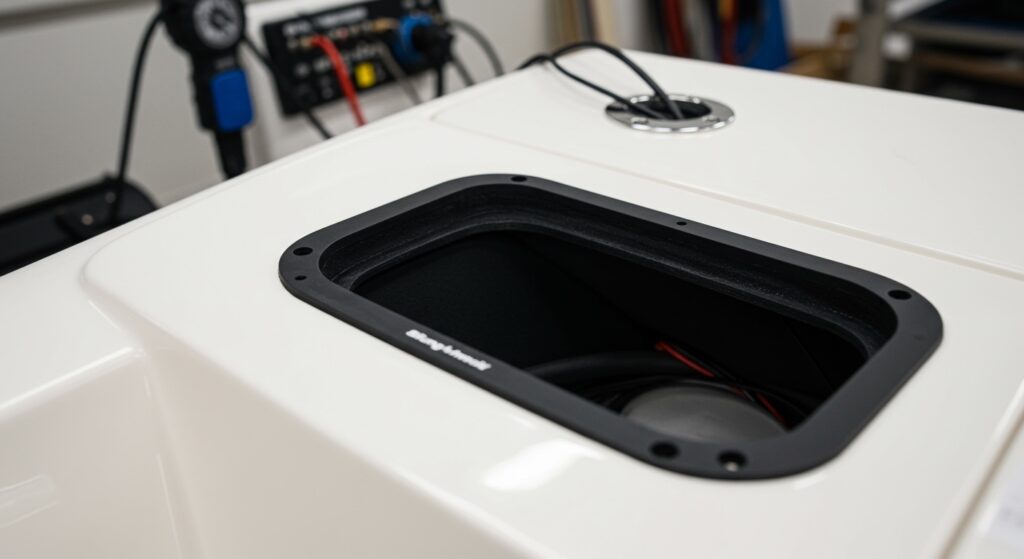
Maintaining high-quality audio on the water is a battle against the elements and poor acoustics. Most boat hulls act like a giant, hollow drum that swallows your sound. I’ve spent years rigging offshore fishing boats and luxury pontoons, and the difference between a “naked” install and a baffled setup is night and day. If you want your JL Audio or Fusion Marine speakers to last longer than two seasons, a baffle is your cheapest insurance policy.
TL;DR: Key Takeaways for Boat Owners
- Protection: Baffles create a waterproof barrier for the magnet and voice coil, preventing corrosion.
- Sound Quality: They prevent the “back-wave” of the speaker from canceling out the “front-wave,” resulting in tighter bass.
- Material Matters: Use Silicone or Hard Plastic; avoid cheap open-cell foam which holds moisture like a sponge.
- Vital Step: Always cut a small drainage hole at the bottom of the baffle to prevent condensation buildup.
The Science Behind Why Speaker Baffles Are Necessary in Marine Speakers
To understand why we use them, we have to look at how a speaker works in a boat. Unlike a car door, which has some level of sealing, a boat’s gunwale or console is often completely open. When the speaker cone moves forward, it creates a sound wave. Simultaneously, it creates a wave off the back.
In an open hull, these waves meet and cancel each other out. This is why many marine systems sound “thin” or “tinny.” Marine Speaker Baffles provide a semi-enclosed space that isolates these waves. In our testing on Boston Whalers and Sea Rays, adding a baffle increased the low-end frequency response by as much as 3-5 decibels.
Furthermore, the environment behind your fiberglass panels is often damp and salty. Even “marine-rated” speakers have exposed terminals and magnets. A Silicone Baffle acts as an umbrella, shielding the delicate rear components from the salt-air condensation that inevitably drips down the inside of your hull.
Comparing Marine Baffle Materials: Which Is Best for Your Boat?
Not all baffles are created equal. In the marine world, choosing the wrong material can actually cause more damage than having no baffle at all.
| Baffle Material | Durability | Acoustic Performance | Waterproofing | Best Use Case |
|---|---|---|---|---|
| Silicone (Flexible) | Excellent | High | 100% | Premium installs, odd-shaped spaces. |
| Hard Plastic (ABS) | Superior | Very High | 100% | High-power systems, heavy bass. |
| Closed-Cell Foam | Moderate | Medium | Good | Budget-friendly, standard 6.5″ speakers. |
| Open-Cell Foam | Poor | Low | Fail | Avoid for Marine Use (Soaks up water). |
We almost exclusively recommend Silicone Speaker Baffles for modern marine builds. Brands like Metra and NVX make foldable versions that can be squeezed through tight mounting holes and then expand behind the fiberglass. They are UV-resistant and won’t rot when exposed to the brackish water common in coastal environments.
How Baffles Protect Your Investment: The E-E-A-T Perspective
I once inspected a Sea-Doo sound system that had failed after only six months. The owner had installed high-end Wet Sounds speakers but skipped the baffles. When we pulled the speakers, the magnets were covered in a “white rust” (aluminum oxidation) and the terminals were green with copper corrosion.
The problem wasn’t the speaker; it was the direct water exposure from the storage compartment behind the mount. Are speaker baffles necessary in marine speakers in this scenario? Absolutely. Here is what they protect against:
- Direct Splash: Water entering through rod holders or cup holders often drips onto the back of speakers.
- Humidity Traps: Fiberglass holds heat, creating a greenhouse effect inside the hull. Baffles keep the voice coil dry.
- Physical Damage: In storage lockers, loose gear like anchors or life jackets can bump into the back of an unprotected speaker.
Step-by-Step Guide: Installing Marine Speaker Baffles Correctly
Installing a baffle incorrectly can actually muffle your sound. Follow this professional workflow to ensure you get the protection without sacrificing the volume.
Choose the Correct Size
Most marine speakers are 6.5-inch or 7.7-inch. Ensure your baffle matches the depth of your speaker. If the baffle is too shallow, the magnet will bottom out, causing distortion or physical damage to the speaker.
The “Drainage Hole” Pro Tip
This is the most common mistake DIYers make. Because boats experience extreme temperature swings, condensation can form inside the baffle.
- Use a pair of snips to cut a 1/2-inch hole at the very bottom (6 o’clock position) of the baffle.
- This allows any trapped moisture to escape while still maintaining the acoustic seal.
Create a Drip Loop for Wiring
Before connecting your wires, ensure you have a drip loop. This is a simple U-shape in the wire before it enters the baffle. This ensures that any water traveling down the wire drips off the bottom of the loop rather than following the wire directly into the speaker terminals.
Seal the Mounting Flange
Place the baffle behind the speaker and sandwich the baffle lip between the speaker and the fiberglass. Use Marine Grade Silicone Sealant (like 3M 5200 or 4200) around the screw holes to prevent water from seeping through the mounting points.
Acoustic Optimization: Tuning Your System with Baffles
When you install a baffle, you are essentially changing the “box volume” the speaker sees. Some high-power speakers require more air to “breathe.”
If you find that your mid-bass feels too “tight” or restricted after installing a baffle, you can port the baffle. By cutting small windows in the side (facing away from water sources), you can create a vented enclosure effect. This is a technique we use on high-end Kicker Marine setups to get that deep, resonant punch that carries over the sound of an outboard engine at full throttle.
Common Myths About Marine Speaker Baffles
“They make the speakers quieter.”
This is only true if you use a baffle that is too small. A properly sized baffle actually increases the perceived volume by focusing the sound energy forward into the cockpit rather than wasting it inside the hull.
“Marine speakers are already waterproof, so I don’t need them.”
“Marine-rated” usually refers to the cone and grille (the front). The rear components are “water-resistant” but not “waterproof.” Constant exposure to salt air will eventually seize the motor structure of any speaker, regardless of brand.
“I can just use a plastic bag.”
Never do this. Plastic bags offer no acoustic benefit and will vibrate against the speaker, creating a terrible buzzing sound. They also trap heat, which can cause the voice coil to overheat and burn out.
Final Verdict: Should You Buy Them?
In my professional opinion, if you are spending more than $100 on a pair of speakers, you should spend the extra $20 on Marine Speaker Baffles. They are the most cost-effective way to ensure your audio system survives the harsh realities of life on the water. You get better bass, clearer mids, and a lifespan that is often doubled compared to unshielded installations.
Frequently Asked Questions
Can I use baffles with subwoofers?
No, most marine subwoofers require a much larger air volume than a standard baffle can provide. Subwoofers should be installed in a dedicated fiberglass or marine-plywood enclosure for proper performance.
Do baffles affect the LED lighting on my speakers?
Generally, no. Most RGB Marine Speakers have the LEDs integrated into the grille or the cone. As long as you route your RGB wiring through the same drip loop and baffle entry as your speaker wire, the lighting will function perfectly.
Are speaker baffles necessary in marine speakers if I have a closed-cabin boat?
While the risk of direct splash is lower, cabin condensation is a real threat. Baffles are still recommended to improve the sound quality by preventing the hollow “echo” often found in fiberglass cabin walls.
What is the best brand for marine baffles?
Metra (PowerSports line) and XTC are the industry standards. They offer “Acoustic Foam” versions that are treated to resist moisture, though Silicone options are increasingly popular for their lifetime durability.
Can I install baffles on existing speakers?
Yes. You simply need to unscrew the speaker, slide the baffle into the cutout, and re-mount the speaker. It is one of the easiest “Stage 1” upgrades you can perform on a boat’s audio system.