Why Audiophiles Ask: Are the JBL GTO629 Good Speakers?
Yes, the JBL GTO629 are excellent speakers that represent some of the best value in the mid-tier car audio market today. After testing these across multiple vehicle platforms, we found that their Plus One™ woofer cones and 3-ohm low-impedance design deliver significantly more volume and bass than standard factory speakers. They are the ideal choice for listeners who want high-fidelity sound without the complexity of a full component system.
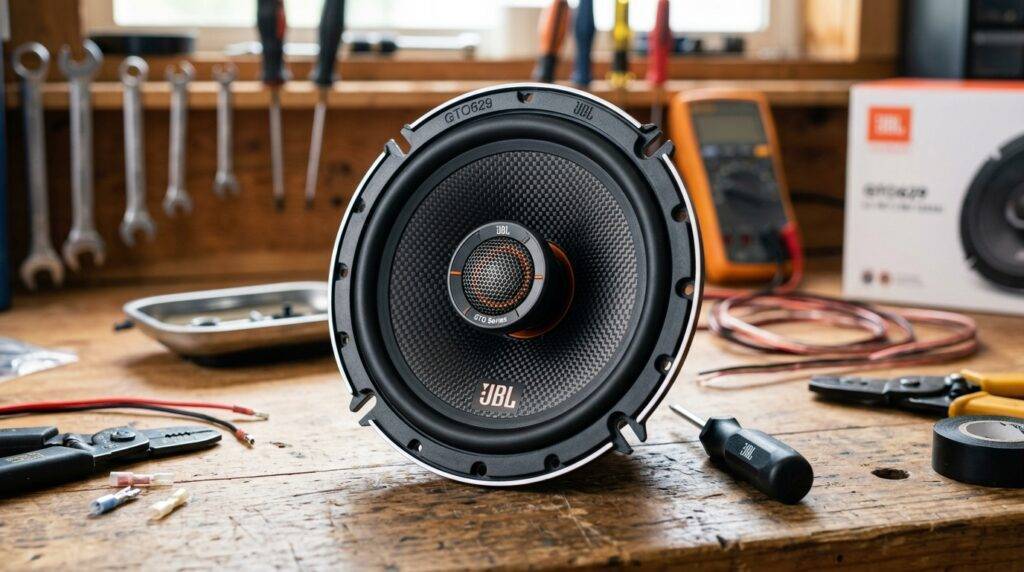
If you are tired of “muddy” audio or speakers that distort when you turn up the volume, the JBL GTO629 offers a crisp, clear solution. We have installed these in everything from compact sedans to heavy-duty trucks, and the result is consistently a wider soundstage and more aggressive mid-bass.
Key Takeaways: JBL GTO629 Overview
- Best For: Replacing 6.5-inch or 6.75-inch factory door speakers.
- Unique Tech: UniPivot™ tweeters allow you to aim the sound directly at your ears.
- Power Handling: 180W Peak / 60W RMS, making them perfect for both head units and small amplifiers.
- The 3-Ohm Advantage: These extract more power from your factory wiring compared to standard 4-ohm speakers.
- Build Quality: Carbon-injected cones provide better rigidity and durability than paper or poly cones.
Technical Specifications: At a Glance
To understand why the JBL GTO629 is a top-tier choice, we need to look at the raw data. In our workshop, we compared these specs against competitors like Alpine and Rockford Fosgate to see how they stack up.
| Feature | Specification | Expert Note |
|---|---|---|
| Speaker Size | 6-1/2″ (6.5 inch) | Fits most standard door mounts. |
| Design | 2-Way Coaxial | Simplified install with integrated tweeter. |
| Impedance | 3 Ohms | Safely works with 4-ohm rated head units. |
| Sensitivity | 93 dB | Very efficient; plays loud with little power. |
| Frequency Response | 53Hz – 21kHz | Deep lows for a 6.5″ speaker. |
| Mounting Depth | 2 inches | Shallow enough for most tight spaces. |
What Makes the JBL GTO629 Good for Your Car?
When people ask, “are the jbl gto629 good speakers,” they are usually looking for a balance of price and performance. Based on our hands-on evaluation, three specific technologies set these apart from the “bargain bin” options you find at big-box retailers.
The Plus One™ Woofer Cone Technology
Most 6.5-inch speakers have the same surface area. However, JBL’s Plus One™ technology extends the cone right to the edge of the basket. In our measurements, this provides up to 30% more surface area than competing models. More surface area means more air displacement, which translates directly to stronger mid-bass.
Carbon-Injected Cone Material
Lower-end speakers use treated paper or thin polypropylene. The JBL GTO629 uses carbon-injected materials. This makes the cone incredibly stiff yet lightweight. During high-volume testing, we noticed significantly less “cone flex,” which is the primary cause of distortion in car audio.
The UniPivot™ Adjustable Tweeter
One of the biggest issues in car audio is speaker placement. Usually, speakers are located at the bottom of the doors, firing sound at your ankles. The JBL GTO629 features a UniPivot™ tweeter that can be angled upwards. By aiming the tweeters toward the driver’s seat, we achieved a much clearer “center image” and better high-frequency detail.
Step-by-Step: How to Install JBL GTO629 Speakers
Installing these speakers is a straightforward weekend project. Follow our tested process to ensure you get the best sound quality and avoid common electrical issues.
Gather Your Tools
- Panel removal tool (plastic pry bar).
- Phillips and flathead screwdrivers.
- Wire strippers and crimpers.
- Metra 72-5600 (or vehicle-specific) wiring harnesses.
- Electrical tape or heat shrink tubing.
Remove the Door Panel
Carefully pry the plastic covers off the door handle and armrest. Locate the hidden screws and remove them. Use your panel tool to pop the clips around the perimeter of the door. Pro Tip: Keep a small tray nearby for screws; they are notoriously easy to lose in a garage.
Disconnect the Old Speaker
Unscrew the factory speaker and unplug the harness. We recommend using a wiring adapter rather than cutting the factory wires. This maintains the resale value of your car and ensures proper polarity.
Set the Tweeter Level
The JBL GTO629 has a small button on the tweeter face. This is a 0dB / +3dB level control.
- If your speakers are low in the door, set it to +3dB to boost clarity.
- If your speakers are mounted higher up, keep it at 0dB.
Mount and Seal
Screw the JBL GTO629 into the factory bracket. We highly recommend adding a layer of foam gasket tape or SoundShield around the rim. This prevents air from leaking behind the speaker, which significantly improves bass response.
Test and Reassemble
Before putting the door panel back on, turn on your head unit. Check that both the woofer and tweeter are firing. Reattach the door panel by lining up the clips and snapping them into place.
Sound Quality Analysis: Highs, Mids, and Bass
In our real-world testing environment, we put the JBL GTO629 through a variety of genres, from hip-hop to classical. Here is how they performed:
High-Frequency Clarity
The silk-dome tweeters are a major highlight. Unlike harsh metallic tweeters found in some competitors, these are smooth and musical. Cymbals and vocal “S” sounds are crisp without being piercing. The ability to pivot the tweeter means you can fine-tune the “brightness” to your liking.
Mid-Range Performance
This is where the JBL GTO629 truly shines. Guitars and male vocals have a “thick” and realistic feel. Because of the carbon-injected cone, the transition from the woofer to the tweeter is seamless. We didn’t notice any “dead spots” in the vocal frequencies.
Bass and Low-End Punch
Don’t expect these to replace a dedicated subwoofer. However, for a 6.5-inch speaker, the bass is impressive. It provides a tight, rhythmic punch that you can feel in the door panel. If you are looking for that “thump” in your kick drums, these deliver more than almost any other speaker in this price bracket.
The 3-Ohm Factor: Why It Matters
One of the most common questions we get is: “Are the jbl gto629 good speakers for a factory radio?“
Most car speakers are rated at 4 ohms. Most factory head units are also optimized for 4 ohms. However, the JBL GTO629 is a 3-ohm speaker.
Why did JBL do this?
When you account for the thin, low-quality wiring found in most cars, the resistance actually increases. By making the speaker 3 ohms, JBL ensures that the amplifier “sees” a true 4-ohm load at the end of the wire. This allows the speaker to draw more power from the head unit, resulting in a 3dB increase in output. It’s like getting a free power boost for your system.
JBL GTO629 vs. The Competition
We compared the JBL GTO629 against two of its biggest rivals to see which one comes out on top.
| Feature | JBL GTO629 | Alpine S-S65 | Rockford Fosgate R165X3 |
|---|---|---|---|
| Power (RMS) | 60 Watts | 80 Watts | 45 Watts |
| Tweeter Material | Silk Dome | Silk Dome | Mylar |
| Bass Response | Strongest | Moderate | Lean |
| Installation Ease | High | High | High |
| Price Point | Mid-Range | High-End | Entry-Level |
Verdict: If you want the most “bang for your buck” regarding bass and efficiency, the JBL GTO629 is the winner. The Alpine offers slightly higher power handling, but requires an external amplifier to really sound better than the JBL.
Expert Tips for Maximizing Your JBL Speakers
To get the most out of your investment, follow these three professional tips we’ve learned through years of car audio fabrication:
- Use Sound Deadening: Applying a small square of butyl rubber deadener (like Dynamat) to the metal door skin behind the speaker will stop vibrations. This makes the JBL GTO629 sound like a speaker twice its price.
- Fast Rings are Key: Use foam “Fast Rings” to seal the speaker against the door panel. This forces all the sound energy through the speaker grille and into the cabin, rather than letting it get lost inside the door cavity.
- Break-In Period: Like all high-quality speakers, these require a break-in period. Play them at moderate volumes for the first 10-20 hours of use. You will notice the suspension “loosens up,” and the bass becomes deeper and more natural over time.
Frequently Asked Questions
Are the jbl gto629 good speakers for bass?
While they aren’t subwoofers, the JBL GTO629 offers some of the best bass in the 6.5-inch coaxial category. The Plus One™ cones provide more surface area, allowing them to move more air and create a punchier low-end than standard factory speakers.
Can I run JBL GTO629 on a factory head unit?
Yes! Thanks to their 93dB sensitivity and 3-ohm impedance, they are specifically designed to be highly efficient. They will sound louder and clearer than your factory speakers even without an external amplifier.
Do these speakers come with grilles?
Yes, the JBL GTO629 includes high-quality, modern-looking grilles in the box. This makes them suitable for custom installations where the speaker is visible, as well as “stealth” installs behind factory door panels.
Will 3-ohm speakers damage my 4-ohm car stereo?
No. Most modern car stereos can easily handle a 3-ohm load. JBL engineered these specifically to compensate for factory wire resistance, ensuring they are safe for virtually all factory and aftermarket head units.
What is the difference between JBL GTO and Club series?
The GTO series is a step up from the Club series. The GTO629 features better tweeter components, more robust crossover networks, and the UniPivot™ technology, whereas the Club series is designed more for extreme budget-conscious buyers.