Quick Answer
The Skar Audio RP-150.4AB is our top 4-channel car amplifier for multi-speaker and mixed speaker-sub builds. It delivers 250W RMS x4 at 2 ohms, Class A/B output, 4-way protection, and a 105 dB rated signal-to-noise ratio. Compact Class D amps fit tighter spaces; a 5-channel unit is the cleaner path if you also need a dedicated subwoofer channel.
- Best overall: Skar Audio RP-150.4AB — Class A/B headroom for four speakers or a mixed speaker-and-sub layout.
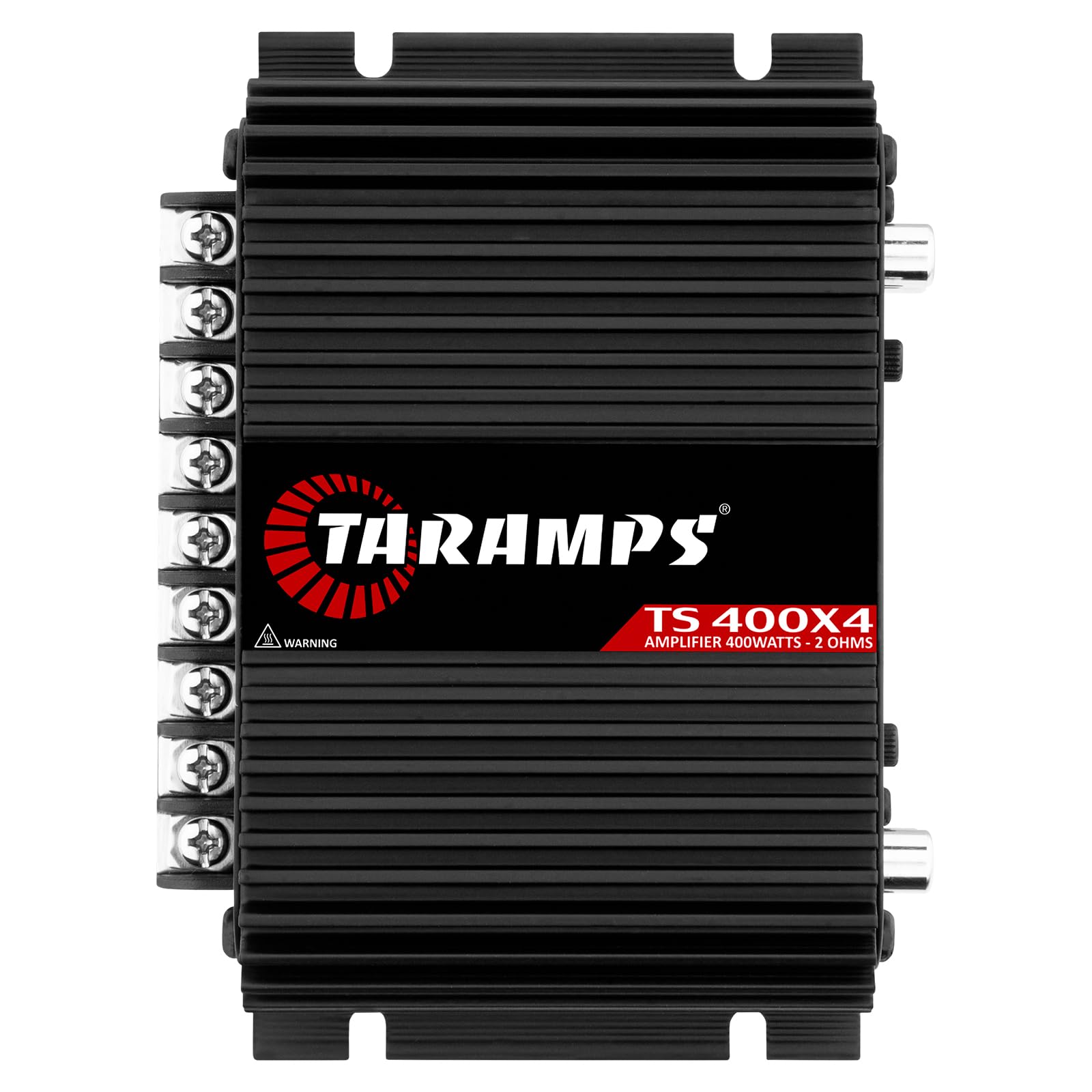
- Best compact value: Taramps TS 400×4 — 100W RMS x4 at 2 ohms in a glove-box-friendly chassis.
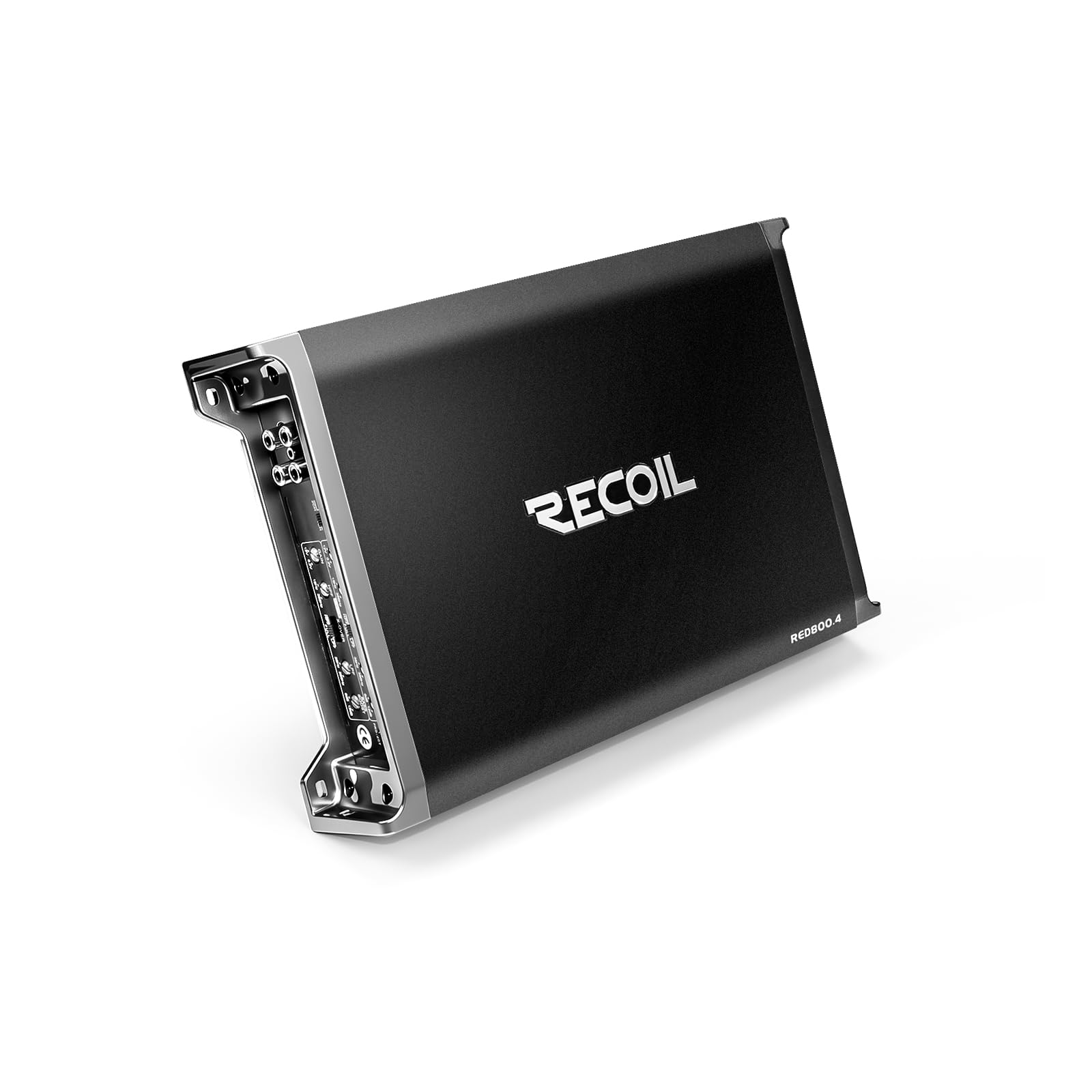
- Best high-efficiency pick: Recoil RED800.4 — 100W RMS x4 at 4 ohms with a subsonic filter and cool Class D operation.
Pros
- High power output: 250 watts RMS per channel at 2 ohms, enough to drive demanding speakers
- Class A/B design: Known for good sound quality, especially in the mid and high frequencies
- Protection circuitry: Guards against overheating, overvoltage, and short circuits, increasing longevity
- Clean signal: 105 dB signal-to-noise ratio means low noise and interference
- Heavy-duty terminals: 4 gauge inputs accommodate standard high-quality wiring
Cons
- Class A/B efficiency: Less efficient than Class D, generating more heat and drawing more current, which may require additional cooling
- Power hungry: May strain electrical systems in smaller vehicles, especially at higher volumes
- No built-in crossover: Lacks adjustable high-pass/low-pass filters, limiting flexibility for component setups
The Skar Audio RP-150.4AB is a 4-channel car amplifier designed to deliver high-quality sound to your vehicle's audio system. With a total power output of 1,000 watts (RMS), this amp is suitable for audiophiles who want to upgrade their factory system or build a custom setup. It is ideal for powering component speakers, coaxial speakers, or even a small subwoofer in a bridged configuration.
At its core, this amplifier uses Class A/B MOSFET technology, which is known for its excellent sound quality and low distortion. It delivers 125 watts RMS per channel at 4 ohms and 250 watts RMS per channel at 2 ohms, providing ample headroom for most aftermarket speakers. The high signal-to-noise ratio of 105 dB ensures that the audio output is clean and free from unwanted hiss, even at lower volume levels.
The amplifier features 4-way protection circuitry, which safeguards the unit against common electrical issues such as overheating, overvoltage, and short circuits. This protection helps extend the life of both the amplifier and your speakers. The 4 gauge power and ground input terminals are a practical feature, accommodating heavy-duty wiring that can handle the amp's current draw without voltage drops.
However, the Class A/B design is less efficient than modern Class D amplifiers, meaning it generates more heat and consumes more power from your vehicle's electrical system. This could be a concern for smaller vehicles with limited alternator output. Additionally, the amp lacks built-in crossovers, so you will need an external crossover or a head unit with crossover controls to effectively manage frequencies for a component speaker setup.
In conclusion, the Skar Audio RP-150.4AB is a strong performer for those who prioritize sound quality and have the electrical capacity to support it. Its main strengths are its power output and clean signal, but its efficiency and lack of crossovers may lead some buyers to consider a Class D amplifier or one with built-in signal processing.
Class A/B MOSFET Amplifier: This amplifier uses Class A/B topology, which is known for its ability to reproduce audio with high fidelity and low distortion. It is a good choice for audiophiles who value sound quality over power efficiency. The MOSFET power supply ensures stable and clean power delivery to the output stage.
RMS Power Output: The amp delivers 125 watts RMS per channel at 4 ohms and 250 watts RMS at 2 ohms. This is the continuous power it can sustain, making it suitable for driving aftermarket speakers that require a solid amount of power to perform at their best. The 2-ohm rating is particularly useful for wiring subwoofers or high-power components.
4-Way Protection Circuitry: This feature monitors the amplifier for thermal overload, overvoltage, undervoltage, and short circuits. It automatically shuts down the amp if any of these conditions occur, preventing damage to the amp and your speakers. This gives you peace of mind, especially if you push the system hard.
Signal-to-Noise Ratio (105 dB): A high signal-to-noise ratio means that the amp produces very little background noise relative to the audio signal. This results in a clean, quiet listening experience, even when the music is soft. It is particularly beneficial for those who enjoy detailed music at low volumes.
4 Gauge Power and Ground Terminals: These heavy-duty terminals allow for a secure and efficient connection to your vehicle's electrical system. Using 4 gauge wire ensures that the amp receives adequate current, reducing the risk of voltage drops and ensuring consistent performance.
Type: 4-Channel Car Amplifier
Class: A/B
RMS Power at 2 Ohms: 250 Watts x 4 Channels
RMS Power at 4 Ohms: 125 Watts x 4 Channels
Frequency Response: 20 Hz - 20,000 Hz
Signal-to-Noise Ratio: 105 dB
Protection Circuitry: 4-Way
Power and Ground Input Terminals: 4 Gauge
Best For: This amplifier is ideal for car audio enthusiasts who want to upgrade their sound system with a reliable multi-channel amp. It is particularly well-suited for powering component speakers in the front and rear doors, or for running a small subwoofer in a bridged configuration. If you are building a system that requires high-quality sound and can handle the power demands, this amp is a solid choice.
Consider Alternatives If: If your vehicle has a weak electrical system, or you are looking for maximum efficiency to save battery and alternator load, a Class D amplifier might be a better fit. Additionally, if you need built-in crossovers for a component setup, you may want to look for an amp with that feature or plan to use an external crossover.
Setup and Daily Use: Installation requires basic car audio wiring knowledge, including connecting power, ground, remote turn-on, and speaker wires. The 4 gauge terminals mean you will need to use appropriately sized power and ground cables. Once installed, daily use is straightforward: the amp turns on with your head unit and amplifies the signal to your speakers. There are no complex settings to adjust, but you may need to set gain levels to match your head unit's output.
Maintenance Requirements: This amplifier is solid-state and requires minimal maintenance. Keep it clean and ensure proper ventilation to prevent overheating. Check the wiring connections periodically to ensure they are tight and free from corrosion.
What Sets It Apart: The Skar Audio RP-150.4AB stands out for its high power output at both 2 and 4 ohms, combined with a high signal-to-noise ratio. This makes it a versatile option for various speaker configurations. Its Class A/B design is preferred by many for its sound quality, even though it is less efficient than Class D.
Pros
- Slim aluminum alloy chassis is easy to mount under seats or in trunks, saving valuable space.
- Four channels provide flexible configuration options, including bridging for a subwoofer.
- Built-in thermal management features aim to prevent overheating during heavy use.
- Clear guidance on REM wire connection helps avoid common installation errors.
- Budget price point makes it accessible for those building their first system.
Cons
- The 3200W peak power rating is likely inflated; RMS power is not specified, making real-world output uncertain.
- No verified performance data or user reviews to confirm sound quality or reliability.
- Installation requires careful attention to wiring, especially the REM lead, which may confuse beginners.
- Lacks advanced features like variable crossovers or bass boost found on more expensive models.
The YaeCCC 4-channel car amplifier (ASIN B07VV82R9F) is a budget-oriented option for drivers who want to upgrade their factory stereo without breaking the bank. Its best-fit buyer is someone building a first-time system or looking for a low-cost way to add aftermarket speakers or a subwoofer. The strongest reason to consider it is its combination of four-channel flexibility and a slim, heat-dissipating aluminum design. The principal reservation is that its headline 3200W peak power claim is not backed by RMS ratings or independent testing, so actual output may be far lower.
This amplifier appears designed to solve the problem of weak factory audio by providing a straightforward, affordable way to amplify aftermarket speakers or a subwoofer. Its 4-channel configuration allows users to power front and rear speakers or bridge two channels for a more powerful subwoofer feed. The slim profile and aluminum alloy construction suggest a focus on easy installation and thermal management, which are practical concerns for car audio gear that often lives in confined spaces.
The features translate into real-world benefits: the four channels give you installation flexibility, the slim design simplifies mounting, and the heat dissipation claims aim to ensure stable performance during long drives. However, the power rating is a major caveat—peak wattage is often marketing hype, and without RMS figures, you cannot gauge how loudly or cleanly it will drive your speakers. Additionally, the included note about the REM wire indicates that proper wiring is critical, which could be a stumbling block for novices.
If you need high continuous power for a demanding subwoofer or plan to run a full system with multiple speakers, this amp may fall short. Alternatives include monoblock amplifiers for subwoofers or higher-end multichannel amps with documented RMS ratings and built-in crossovers, but they will cost more. For those on a tight budget, this YaeCCC amp could serve as a stopgap, but verify its real-world performance through user reviews or bench tests before committing.
Final verdict: The YaeCCC 4-channel amp is a qualified budget pick for entry-level installations where cost is king and you are willing to troubleshoot. Before buying, check the RMS power output and ensure it matches your speakers' needs. If you can't find that info, consider it a gamble—potentially fine for modest upgrades, but not for serious audiophiles.
Strong Match: The clearest supported buyer profile is a budget-conscious car owner who wants to add aftermarket speakers or a small subwoofer to their vehicle and has basic wiring skills. The amp's low price and 4-channel design make it an attractive entry point.
Also Consider It If: You are looking for a compact amplifier that can be mounted under a seat or in a tight trunk space, thanks to its slim aluminum chassis. If you prioritize easy installation and space savings over maximum power, this fits.
Not the Best Fit: If you demand verified performance data, high RMS power for a large subwoofer, or advanced tuning features like crossovers and bass boost, this product will likely disappoint. The lack of RMS specs and limited features make it unsuitable for serious audio enthusiasts.
Decision in One Sentence: The YaeCCC 4-channel amp is a budget-friendly choice for a first-time builder who needs a compact, flexible amplifier and is okay with unverified power claims.
Consider It For:
- Its low cost makes it an accessible upgrade for factory stereos.
- Four channels provide flexibility to power multiple speakers or bridge for a sub.
- Slim aluminum design eases installation in tight spaces.
- Heat dissipation features aim to keep it stable during use.
- Clear guidance on REM wiring can help avoid common mistakes.
Pass If:
- You need high RMS power for a demanding subwoofer—peak wattage doesn't tell the real story.
- You expect plug-and-play installation without any wiring knowledge.
- You rely on verified reviews or performance tests—none are available.
- You require advanced features like crossovers or bass boost for tuning.
Pros
- Four channels in one chassis simplifies wiring and mounting compared with running a pair of two-channel amplifiers, which matters in a cramped under-seat or trunk installation.
- The 2-ohm stable rating means the amplifier is specified to handle lower-impedance speakers, giving you options if your existing drivers are not the usual 4-ohm type.
- Onboard high-pass and low-pass filters let you protect small door speakers from bass they cannot reproduce, a practical way to reduce distortion at higher volumes.
- The stated 10 Hz to 30 kHz frequency response spans the audible range with margin at both ends, so the amplifier is not specified to roll off within normal music content.
- Class A/B topology is a long-established design for full-range speaker duty, and the manufacturer pairs it here with protection circuitry intended to guard against fault conditions.
Cons
- The 2000W figure in the product name conflicts with the manufacturer's own 40W RMS x 4 at 4 ohms rating, so buyers expecting high output from the headline number will be disappointed by roughly 160W RMS total.
- The listing shows almost no customer feedback behind its rating, which means there is no meaningful body of owner experience on reliability, heat behavior, or long-term performance to weigh.
- The supplied information lists only low-level RCA inputs and says nothing about speaker-level inputs, bridging, dimensions, fuse rating, or warranty, all of which are decision-relevant for a car audio install.
The ORION CBA2000.4 Cobalt is a four-channel Class A/B car amplifier that the manufacturer rates at 40W RMS per channel at 4 ohms and 75W RMS per channel at 2 ohms. It suits a buyer upgrading a factory or head-unit-powered four-speaker system who wants cleaner power and basic crossover control. The principal reservation is the 2000W in the model name, which does not correspond to the stated RMS figures and may mislead anyone shopping by that number.
This product sits in the entry tier of aftermarket four-channel amplification, where the job is to take over from a head unit's internal amplifier and give a set of door and rear speakers more headroom than a receiver can supply. The manufacturer positions it around a MOSFET power supply, a crossover section, and stability into 2 or 4 ohm loads, which is the standard feature package for that tier. Nothing in the supplied information suggests it is aimed at competition installations or subwoofer duty.
The features that matter most in practice are the ones with direct consequences. Low-pass and high-pass filters let you keep bass out of small door speakers, which is the single most effective way to reduce audible distortion when you turn the volume up. The 2-ohm rating gives you flexibility if your speakers are not standard 4-ohm units. The stated 10 Hz to 30 kHz frequency response covers the audible band, and bass boost is available if you want extra low-end weight from full-range drivers. Low-level RCA inputs are specified, which points toward an aftermarket head unit with preamp outputs.
The limitations are mostly about scope and disclosure. At roughly 160W RMS total, this is not the amplifier for driving a subwoofer or for someone chasing high volume in a large vehicle, and buyers with those goals should look at monoblock or higher-rated multichannel units. There is no information here on speaker-level inputs, bridging capability, dimensions, fuse requirements, or warranty. Those gaps are not minor in a car audio purchase, since they determine whether the amplifier fits your vehicle, your source unit, and your wiring plan.
Considered on its stated specifications rather than its name, the CBA2000.4 is a defensible budget choice for a straightforward four-speaker upgrade. Before buying, confirm two things: that your head unit provides RCA preamp outputs, since only low-level inputs are documented, and that 40W RMS per channel actually clears the bar you set for your speakers and listening habits.
Strong Match: A budget-minded buyer with an aftermarket head unit that has RCA preamp outputs, running four full-range speakers, who wants more headroom than the receiver's internal amplifier provides. The stated 40W RMS per channel at 4 ohms is a meaningful step up from typical built-in head unit power, and the onboard filters let you keep bass away from small door drivers.
Also Consider It If: Your speakers are 2-ohm units rather than the more common 4-ohm type. The manufacturer specifies continuous operation into a 2 or 4 ohm load with a 75W RMS per channel rating at 2 ohms, so this amplifier is stated to accommodate lower-impedance drivers that some entry amplifiers are not.
Not the Best Fit: Anyone shopping for the power implied by the 2000W in the model name, anyone planning to run a subwoofer, and anyone with a factory head unit that lacks RCA outputs. The documented output is roughly 160W RMS total, the supplied information says nothing about bridging or speaker-level inputs, and there is not enough owner feedback available to judge reliability under demanding use.
Decision in One Sentence: Buy the ORION CBA2000.4 Cobalt if you want an inexpensive four-channel Class A/B amplifier with basic crossover control for a modest four-speaker system fed by RCA preamp outputs, provided you accept 40W RMS per channel at 4 ohms as the real specification and are comfortable purchasing without a substantial owner track record.
Consider It For:
- Replacing head-unit power on a four-speaker system, with four channels in one chassis to keep the install simple.
- Systems using 2-ohm speakers, since the manufacturer rates the amplifier for continuous 2 or 4 ohm operation.
- Basic tuning needs, where the onboard high-pass and low-pass filters can protect small speakers from bass they cannot handle.
- Full-range setups without a subwoofer, where the bass boost circuit can add some low-end emphasis.
Pass If:
- You are buying on the 2000W name, since the manufacturer's own rating is 40W RMS per channel at 4 ohms.
- You need to power a subwoofer or bridge channels, as the supplied information documents neither.
- Your head unit lacks RCA preamp outputs, because only low-level inputs are listed.
- You want to buy on the strength of verified owner experience, since the published rating rests on very little feedback and there are no specifications on dimensions, fuse rating, or warranty.
Power rating in plain terms: The manufacturer states 40W RMS per channel at 4 ohms and 75W RMS per channel at 2 ohms. RMS is the continuous power figure and the one worth matching to your speakers. The 2000W in the model name is not an RMS specification and should not be used for system planning.
Class A/B: A long-standing amplifier topology commonly used for full-range speaker channels. The manufacturer describes the unit as high efficiency, though no efficiency figure is supplied to verify that description.
High-pass and low-pass filters: A high-pass filter blocks low frequencies from reaching a channel, which is how you stop a small door speaker from trying to reproduce deep bass. A low-pass filter does the reverse. Having both onboard means you can shape the split without a separate crossover unit.
Bass boost: A circuit that raises output in the low frequencies. Useful for adding weight to full-range speakers, though the supplied information does not state the boost amount or center frequency, so the degree of adjustment is unknown.
Low-level RCA inputs: These accept the preamp signal from a head unit's RCA outputs. Because no speaker-level inputs are documented, a head unit with RCA outputs appears to be a requirement rather than an option.
MOSFET power supply and two-way protection: The manufacturer cites both. Protection circuitry is intended to shut the amplifier down under fault conditions such as short circuits or overheating, but the specific conditions covered are not detailed in the supplied information.
Pros
- Four-channel output lets you connect multiple speakers for a fuller soundstage.
- Bluetooth 5.0 provides a stable wireless connection up to 33 feet.
- Multiple inputs (USB, SD, AUX, FM) offer versatility for different audio sources.
- Bass and treble controls give you quick tonal adjustments without an equalizer.
- Compact size and included power adapter make setup simple for home or car use.
Cons
- RMS power is limited to 50W per channel, which may not be enough for large rooms or high-volume listening.
- Peak power of 1200W is a marketing figure; real-world output is much lower and depends on speaker impedance.
- No mention of impedance ratings or speaker compatibility, so matching speakers may require extra research.
- Microphone input is present, but no karaoke features like echo or reverb are mentioned.
- Limited to 33 feet Bluetooth range, which may be restrictive in larger homes.
The Romicta 4 Channel Bluetooth 5.0 Stereo Amplifier is a budget-friendly, multi-purpose audio hub designed for home entertainment, small parties, or karaoke setups. It suits users who need to power up to four passive speakers without investing in a full AV receiver. With its compact size and included power adapter, it offers an accessible entry point for those seeking to upgrade their audio system.
At the heart of this amplifier is a 4x50W RMS output, which is modest but adequate for bookshelf speakers or small to medium rooms. The claimed 1200W peak power is a marketing figure; the real-world continuous output is far lower. The Class D design contributes to efficiency and low heat generation, while the 0.04% harmonic distortion rating suggests clean sound at moderate volumes. For critical listeners, the actual performance may vary depending on speaker efficiency and impedance.
Connectivity is a strong suit: Bluetooth 5.0 offers a stable wireless range of about 33 feet, and you also get AUX, USB, micro SD, and FM radio inputs. This makes it easy to play music from a phone, laptop, or even a USB drive. The dedicated bass and treble controls allow quick tonal adjustments, and the included remote adds convenience. The aluminum casing and LED display enhance durability and usability, though the build feels typical for this price range.
However, there are limitations. The amplifier does not specify speaker impedance or sensitivity requirements, so you'll need to ensure your speakers are compatible. The microphone input is basic and lacks effects like echo, which may disappoint karaoke enthusiasts expecting more. Additionally, the Bluetooth range is limited, and the lack of subwoofer output or digital inputs means it won't integrate with modern TVs or soundbars easily.
In summary, the Romicta amplifier is best for casual listeners who want an affordable, multi-source solution for multiple speakers. Its main strength is versatility, while its main drawback is limited power and missing advanced features. If you need high-volume output, digital inputs, or a more robust build, consider a traditional AV receiver or a higher-powered amp.
4-Channel Output: This amplifier can power up to four passive speakers simultaneously, ideal for creating a multi-room or surround sound setup without needing multiple amps. It simplifies wiring and lets you expand your audio system.
Bluetooth 5.0: With a range of about 33 feet, you can stream music wirelessly from your smartphone or tablet. This is convenient for controlling playback from across the room or for outdoor gatherings, though walls may reduce the range.
Multiple Inputs: Beyond Bluetooth, you have AUX, USB, micro SD, and FM radio. This means you can play music from almost any source: a computer, a USB drive, or even a microSD card. It's perfect for areas where Wi-Fi streaming isn't available.
Tone Controls: Dedicated bass and treble knobs let you adjust the sound to your liking without needing an external equalizer. This is especially useful for tailoring the audio to different genres or compensating for speaker characteristics.
Class D Amplification: This technology is energy-efficient and produces less heat compared to traditional Class A/B amps. It allows for a compact design while still delivering adequate power for moderate listening levels.
Best For: This amplifier is ideal for budget-conscious users who want to power multiple passive speakers in a small to medium room. It's also great for karaoke setups, small parties, or as a simple upgrade for a desktop or bookshelf speaker system.
Consider Alternatives If: If you need high-volume output for a large room, or if you require digital inputs (HDMI, optical) for a modern TV, this is not the right choice. Also, if you want advanced karaoke features like echo or reverb, or if you need a subwoofer output, look for a more specialized unit.
Setup and Daily Use: Expect a straightforward setup: connect your speakers with standard speaker wire, plug in your source (Bluetooth, AUX, etc.), and adjust volume and tone. The included remote makes it easy to control from a distance. The LED display shows current input and status.
Maintenance Requirements: The aluminum casing is durable, but ensure proper ventilation to prevent overheating. Clean the unit with a dry cloth and avoid exposing it to moisture. No special maintenance is required beyond that.
What Sets It Apart: At this price point, few amplifiers offer four channels with Bluetooth and multiple inputs. It's a versatile all-in-one solution for basic audio needs, though it doesn't match the performance or features of higher-end receivers.
Pros
- Stated power ratings give a clear baseline for system planning, though real-world output may vary.
- Class A/B design is known for good sound quality, though efficiency is lower than Class D.
- Crossover controls offer flexibility to tailor output to component speakers or subwoofers.
- MOSFET power supply is a standard feature that contributes to stable power delivery.
- Budget-friendly price point (as listed) makes it accessible for entry-level builds.
Cons
- No verified owner reviews are available, so real-world reliability and sound quality are unconfirmed.
- Class A/B amplifiers are less efficient than Class D, generating more heat and requiring proper ventilation.
- The claimed 2500W peak power is not reflected in the RMS ratings, which may confuse buyers; actual continuous power is much lower.
The ORION CBA2500.4 Cobalt is a 4-channel Class A/B amplifier with stated power ratings of 100 watts RMS per channel at 2 ohms and 60 watts RMS per channel at 4 ohms. It is designed for car audio enthusiasts seeking a multi-channel amp to power speakers or a combination of speakers and a subwoofer. The amplifier includes a MOSFET power supply, low-pass and high-pass filters, bass boost, and 2-way protection circuitry.
These features are typical for amplifiers in this category and provide the basic tools for tuning your system. The crossover controls allow you to direct appropriate frequencies to different speakers, which is essential for integrating component speakers or a subwoofer. However, the actual performance of these features—such as the accuracy of the crossover points and the effectiveness of the bass boost—has not been independently verified.
Customer reviews are not yet available for this product, so there is no real-world feedback on its durability, sound quality, or how well it matches its specifications. The absence of reviews is a significant gap, as it leaves potential buyers without insights into common issues like overheating, noise, or reliability over time.
Given the limited evidence, this amplifier is best suited for buyers who are comfortable with the stated specifications and are willing to take a chance on an unproven product. If you prioritize verified performance or long-term reliability, you may want to consider amplifiers with a larger body of user feedback or professional reviews.
In conclusion, the ORION CBA2500.4 offers a reasonable set of features at a competitive price, but the lack of verified reviews means you are buying based on specifications alone. Proceed with caution and ensure your expectations align with the RMS power ratings, not the peak power claim.
Verified Product Facts: The amplifier is a 4-channel Class A/B design with RMS power ratings of 100W x 4 at 2 ohms and 60W x 4 at 4 ohms. It features a MOSFET power supply, low-pass and high-pass filters, bass boost, and 2-way protection circuitry. Frequency response is listed as 10-30kHz.
Customer Signals: No customer reviews are supplied, so there are no recurring themes or attributed experiences to summarize. The absence of reviews means we cannot infer satisfaction levels or common issues.
Not Verified: The supplied data does not establish long-term durability, actual measured power output, sound quality, efficiency, or compatibility with specific head units and speakers. Warranty information is also absent.
Evidence-Aware Verdict: The evidence supports the amplifier's existence and its stated specifications, but it cannot support claims of reliability or performance. Buyers should treat this as an unverified product and seek additional information or reviews elsewhere.
Power Output: The RMS ratings are clearly stated, giving a baseline for speaker matching. However, real-world output may vary due to electrical system limitations and amplifier efficiency. Ensure your speakers can handle the power at your chosen impedance.
Compatibility: The amplifier has low-level RCA inputs, which are standard for aftermarket head units. It does not specify high-level inputs, so if you have a factory stereo without RCA outputs, you may need an adapter.
Controls: The built-in crossovers and bass boost allow basic tuning, but the exact frequency ranges and slopes are not specified. This could limit fine-tuning for advanced users.
Heat Management: Class A/B amplifiers are less efficient than Class D, generating more heat. Proper installation with adequate airflow is necessary to prevent overheating. The product does not mention cooling features beyond standard heatsinks.
Ownership Cost: The listed price is budget-friendly, but consider potential additional costs for wiring kits, installation, and possible upgrades if the amplifier does not meet expectations. Without reviews, the total cost of ownership is uncertain.
Pros
- Flexible power configuration: run 4 channels for full-range speakers or bridge to 2 channels for more power to a subwoofer.
- Easy integration with factory stereos: high-level inputs with auto activation eliminate the need for a separate line output converter.
- Simple crossover setup: fixed 90Hz filters are straightforward for basic systems, with a full-range option for tweeters or components.
- Wide compatibility: suitable for various vehicles and applications, including powersports and marine, due to its compact size.
- Affordable price point: offers a low-cost entry into multi-channel amplification.
Cons
- No user reviews yet: limited real-world feedback to confirm reliability and performance claims.
- Fixed crossover frequencies: 90Hz high-pass and low-pass may not suit all speaker and subwoofer combinations, limiting tuning flexibility.
- No remote bass knob or advanced controls: lacks features like variable crossover points, bass boost, or subsonic filter, which some users may expect.
The Taramps TS 400×4 is a compact 4-channel car amplifier that delivers 400 watts RMS, making it an attractive option for budget-conscious buyers seeking to upgrade their car audio system. With 100 watts per channel at 2 ohms, or 200 watts per channel when bridged at 4 ohms, this amp offers enough power for aftermarket door speakers or a small subwoofer. Its best-fit buyer is someone with a factory stereo who wants a simple, no-fuss power upgrade without investing in additional components.
This amplifier appears designed to solve a common problem: how to add clean, amplified sound to a vehicle with minimal installation complexity. Its dual input options—high-level speaker inputs with automatic turn-on and traditional RCA inputs—ensure compatibility with both factory and aftermarket head units. The built-in crossover system, with fixed 90Hz high-pass and low-pass filters, simplifies tuning, but the fixed points may limit flexibility for users with specific speaker or subwoofer requirements.
Key features translate into real-world benefits. The high-level inputs mean you can tap into your factory speaker wires and the amp powers on automatically when it detects signal, eliminating the need for a remote turn-on wire. The 400W RMS output is sufficient to noticeably improve clarity and volume over typical factory head unit power. The compact size and included wiring specifications (11 AWG power, 15 AWG speaker, 18 AWG remote, 20A fuse) make installation straightforward for DIYers.
However, there are limitations. The fixed crossover at 90Hz may not be ideal for component speakers that need a higher high-pass point, or for subwoofers that require a lower low-pass setting. Additionally, the amplifier lacks a remote bass knob and advanced tuning options like variable crossover frequencies or bass boost, which could be important to users who want fine control. If you need more power or more adjustability, you may need to consider a larger or more feature-rich amplifier, though at a higher cost.
In conclusion, the Taramps TS 400×4 is a solid choice for a straightforward, budget-friendly amplifier upgrade. It is best suited for those who want to power a set of coaxial speakers or a small subwoofer with minimal fuss. Before purchasing, verify that the 90Hz crossover points align with your speakers' requirements and that the 2-ohm stability matches your subwoofer configuration. If you need more flexibility or have a larger system, you may want to look elsewhere.
Strong Match: The clearest supported buyer is someone upgrading from a factory stereo who wants to add aftermarket speakers or a small subwoofer. The high-level inputs and auto turn-on make installation simple, and 100W per channel is a significant improvement over typical head unit power.
Also Consider It If: You have a compact vehicle, motorcycle, golf cart, or marine setup where space is limited. This amplifier's small footprint and versatile mounting options make it a practical choice for non-traditional installations.
Not the Best Fit: If you need a full-featured amplifier with variable crossovers, bass boost, or a remote subwoofer control, this model lacks those features. Additionally, if you plan to power a high-power subwoofer that requires more than 200W bridged, this amp may not be sufficient.
Decision in One Sentence: The Taramps TS 400×4 is a good value for a simple, effective 4-channel amp, but its fixed crossover and limited controls mean it's best for basic systems where simplicity is key.
Consider It For:
- Adding aftermarket speakers to a factory stereo with high-level inputs that auto-detect signal.
- Powering a small subwoofer with bridged 200W RMS output.
- Compact installations in motorcycles, golf carts, or boats.
- Budget-friendly amplification with clear wiring specifications for DIY installation.
Pass If:
- You need adjustable crossover frequencies or a subsonic filter for a custom subwoofer setup.
- You require a remote bass knob for convenient bass adjustment.
- You have a high-power subwoofer that needs more than 200W RMS.
- You prefer to see user reviews before purchasing a product with no feedback yet.
Power Output: The amplifier produces 400W RMS total, with 100W per channel at 2 ohms or 200W per channel when bridged at 4 ohms. This flexibility allows you to run four speakers or bridge two channels for a subwoofer.
Input Options: High-level inputs accept speaker wire signals from a factory stereo, and the amplifier turns on automatically when signal is detected. RCA inputs are also provided for aftermarket head units.
Crossover System: Fixed high-pass and low-pass filters at 90Hz, with a full-range option. This is simple but limits tuning; 90Hz is a common crossover point for separating subs from midrange drivers.
Compatibility: Designed for use in cars, motorcycles, golf carts, and marine applications. The compact size and efficient design make it suitable for various installations.
Installation: Wiring specifications are provided: 11 AWG power wire, 15 AWG speaker wire, 18 AWG remote, and a 20A fuse. Ensure your electrical system can handle these requirements.
Pros
- Versatile power ratings support both full-range speakers and subwoofers in bridged mode, increasing system flexibility.
- Multiple filter options (LPF, HPF, subsonic) give users control to match various speaker types and enclosures.
- Protection circuits reduce risk of damage from common electrical faults, a key safety feature for DIY installs.
- Compact size and large terminals ease installation in tight spaces, accommodating thicker power wire.
- Class D efficiency may reduce strain on the vehicle's electrical system, especially at higher volumes.
Cons
- No verified customer reviews yet, so reliability and sound quality are unconfirmed.
- Power ratings are manufacturer claims; independent lab measurements are not available.
- No warranty details provided; long-term durability and support are unknown.
The Recoil RED800.4 is a Class D 4-channel amplifier with a maximum power rating of 1600W, though its continuous RMS ratings are more modest: 120W x 4 at 4 ohms, 190W x 4 at 2 ohms, and 370W x 2 bridged. This makes it suitable for powering a full set of speakers or a pair of subwoofers in a compact car audio setup. The amp includes variable low-pass and high-pass filters, a subsonic filter, and bass EQ, giving installers flexibility to tune the output.
The built-in protection circuits (short circuit, overload, overheating, low voltage) are a notable safety feature, helping to prevent damage to the amp and speakers. The compact size and 1/0 gauge terminals are practical for many installations, allowing for thicker power wire and easier placement.
However, the product has no customer reviews at this time, so there is no anecdotal evidence to confirm its real-world performance, sound quality, or reliability. The power figures are supplied by the manufacturer and have not been independently verified. Additionally, warranty details are not provided, which is a gap for potential buyers.
Given the lack of verified user feedback, this amp is best suited for budget-conscious buyers who are comfortable with the risk of an unproven product. If you prioritize proven reliability, consider well-reviewed alternatives from established brands. If you are willing to rely on the specifications and take advantage of Amazon's return policy, the RED800.4 could be a viable option.
In summary, the Recoil RED800.4 offers a compelling set of features for its price, but the absence of customer evidence and independent testing means you are purchasing on faith. Proceed with caution and verify compatibility with your vehicle's electrical system.
Verified Product Facts: The amplifier is a 4-channel Class D design with a MOSFET power supply. It is rated 120W RMS x 4 at 4 ohms, 190W RMS x 4 at 2 ohms, and 370W RMS x 2 bridged. It includes variable low-pass (35-350 Hz), high-pass (15-350 Hz), and subsonic filters, plus bass EQ. Protection circuits cover short circuit, overload, overheating, and low voltage. Dimensions are 11.42" x 7.59" x 2.2" and terminals accept up to 1/0 gauge wire.
Customer Signals: There are no customer reviews available for this product. The supplied data does not include any user feedback, so no patterns or recurring themes can be identified.
Not Verified: The supplied data does not establish real-world power output (RMS vs. max), long-term reliability, durability under continuous use, actual performance of the filters and bass EQ, compatibility with specific head units or speakers, or any warranty terms.
Evidence-Aware Verdict: The evidence supports that the amplifier has a certain feature set and specifications as claimed. It does not support conclusions about its sound quality, reliability, or performance in real installations. Buyers should treat the specifications as unverified until independent or user evidence is available.
Power Output: The amp is rated at 120W RMS x 4 at 4 ohms, which is typical for budget 4-channel amps. For 2-ohm loads, it claims 190W RMS per channel, but ensure your speakers are 2-ohm stable. Bridged, it provides 370W RMS per channel, which could drive a subwoofer, but verify the sub's impedance and power handling.
Compatibility: The compact size (11.42" x 7.59" x 2.2") fits in many under-seat or trunk locations. The 1/0 gauge terminals are oversized, meaning you may need an adapter if using smaller gauge wire. Check your vehicle's electrical system to ensure it can handle the amp's current draw.
Controls and Tuning: Variable low-pass and high-pass filters (35-350 Hz) allow crossover adjustments for speakers or subs. A subsonic filter is useful for ported enclosures. Bass EQ adds boost, but use it sparingly to avoid distortion.
Protection Features: The 4-way protection (short circuit, overload, overheating, low voltage) is a valuable safety net. It can prevent damage from common wiring mistakes, but it does not guarantee against all failures.
Ownership Cost: At $99.99, the price is competitive, but factor in potential installation costs and the need for quality wiring. Without warranty information, consider the risk of repair or replacement costs if the amp fails.
Type: 4-Channel Class D Amplifier
Max Power: 1600W
RMS Power: 190W x 4 @ 2 Ohm, 120W x 4 @ 4 Ohm, 370W x 2 Bridged
Filters: Low-pass (35-350 Hz), High-pass (15-350 Hz), Subsonic
Protection: Short Circuit, Overload, Overheating, Low Voltage
Dimensions: 11.42" x 7.59" x 2.2"
Terminals: 1/0 gauge power and ground
Pros
- Five channels in one chassis simplify installation and save space
- Marine-grade coating offers resilience in humid or wet environments
- Flexible crossover controls allow precise tuning for front, rear, and sub channels
- Included remote bass knob gives convenient subwoofer level adjustments
- Aluminum heat sink helps manage thermal load during demanding use
Cons
- No verified customer reviews yet, so long-term reliability is unproven
- Peak power rating is marketing-driven; RMS figures are more meaningful
- 2-ohm subwoofer load may limit certain subwoofer options
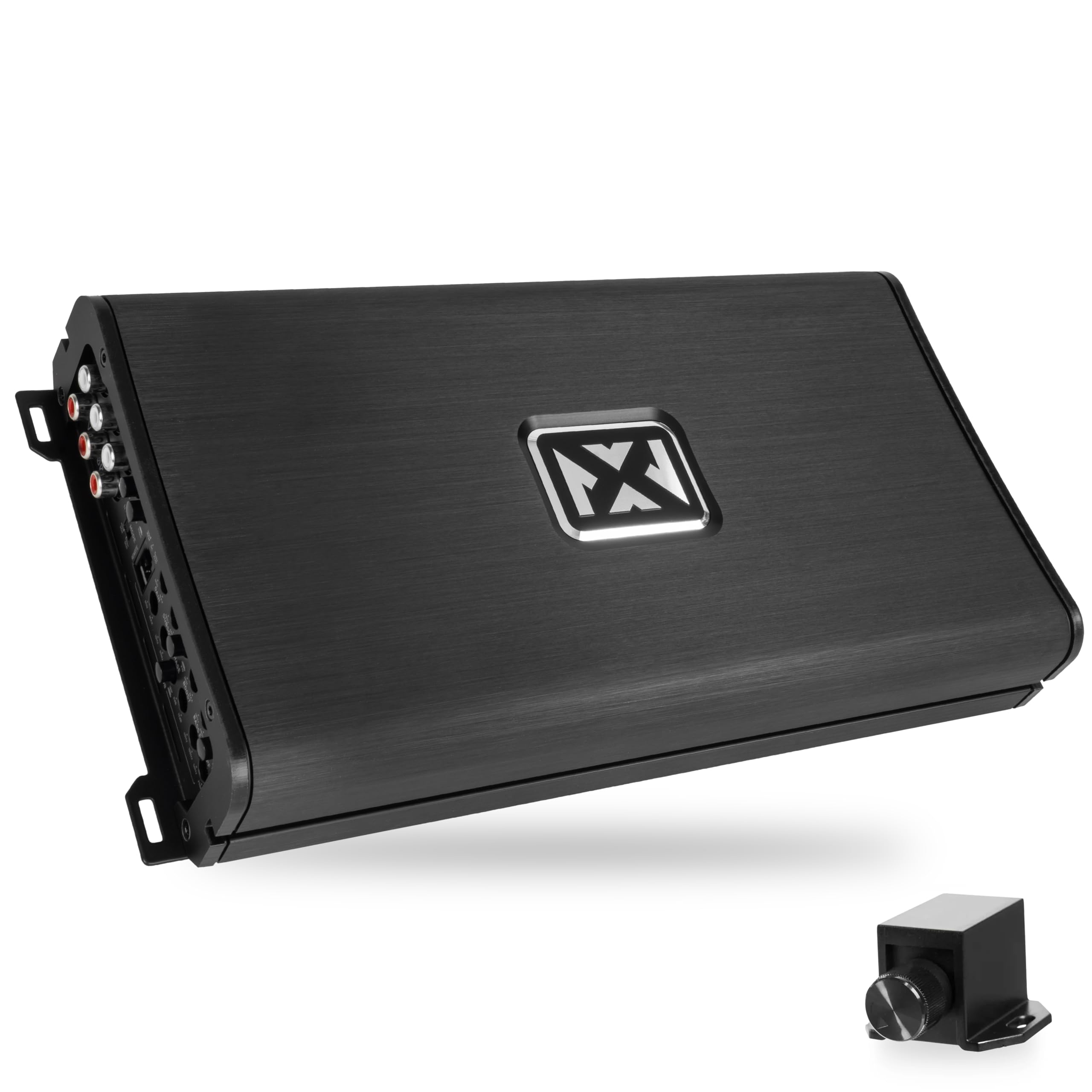
The NVX VAD11005 v2 is a 5-channel Class D amplifier designed to power a full-range speaker system plus a subwoofer in a single unit. It claims a peak output of 2200W and an RMS output of 1100W, with channels rated at 80W x 4 plus 350W x 1 at 4 ohms, and 125W x 4 plus 600W x 1 at 2 ohms. This configuration suits a variety of vehicles, including cars, trucks, marine craft, UTVs, and motorcycles, especially where space is limited.
The amplifier's marine-grade conformal coated circuit board is a notable feature, offering protection against moisture and corrosion—a practical advantage for boats or vehicles exposed to the elements. The built-in 3-way protection circuitry (thermal, overload, and speaker short) helps safeguard the amplifier and connected speakers, providing peace of mind during operation.
For audio tuning, the VAD11005 v2 includes variable high-pass and low-pass filters, a subsonic filter, and a bass boost adjustable from 0 to +18 dB at 45 Hz. These controls allow users to tailor the sound to their preferences and system components. The included remote bass knob adds convenience for on-the-fly subwoofer level adjustments without reaching the amp.
Installation flexibility is enhanced by the 5/4/2 channel operation modes and platinum-plated RCA inputs and screw terminals, which accommodate a range of wiring setups. The heavy-duty aluminum alloy heat sink is designed to dissipate heat effectively, promoting stable performance during extended listening sessions.
However, there are no verified customer reviews yet, so real-world reliability and performance remain unconfirmed. The peak power figure is a marketing number; RMS ratings are more indicative of sustained output. Also, the 2-ohm rating for the subwoofer channel means users must choose subwoofers compatible with that impedance to achieve full power. For those seeking a compact, feature-rich amplifier with marine-grade durability, the VAD11005 v2 is a compelling option, but a thorough pre-purchase check of your vehicle's electrical system and speaker compatibility is essential.
Strong Match: The clearest supported buyer is an audio enthusiast with a car, truck, or boat who wants a single amplifier to power four speakers and a subwoofer, and who values moisture resistance and space efficiency.
Also Consider It If: You're planning a custom installation in a UTV or motorcycle where compact size and flexible crossover controls are beneficial, and you're willing to rely on manufacturer specifications without extensive user feedback yet.
Not the Best Fit: If you're a budget-conscious buyer who prefers to see verified user experiences before purchase, or if your subwoofer setup demands higher power at 1-ohm loads, this amplifier may not serve your needs.
Decision in One Sentence: The NVX VAD11005 v2 is a well-specified 5-channel amp for those who need a compact, marine-ready solution, but it's best for early adopters comfortable with unverified claims.
Consider It For:
- Five channels in one chassis simplify wiring and save installation space.
- Marine-grade coating provides extra durability in damp environments.
- Variable crossovers and bass boost allow detailed system tuning.
- Remote bass knob offers convenient subwoofer level control.
- Aluminum heat sink aids in thermal management.
Pass If:
- You require verified long-term reliability from user reviews.
- Your subwoofer needs a 1-ohm stable amp for maximum power.
- You prefer a more established model with a track record.
5-Channel Class D Design: Combines four full-range channels and one subwoofer channel in a single chassis, reducing wiring complexity and space requirements.
Marine-Grade Circuit Board: A conformal coating protects against moisture and corrosion, making the amp suitable for boats and other demanding environments.
Variable Crossovers: High-pass, low-pass, and subsonic filters let you tailor the frequency response to your speakers and subwoofer, ensuring clean sound and protecting drivers.
Bass Boost & Remote Knob: Adjust bass from 0 to +18 dB at 45 Hz, and control subwoofer level from the driver's seat.
Protection Circuitry: Thermal, overload, and speaker short protection help prevent damage, with LED indicators for status.
Pros
- Compact size and 8-channel output allow for flexible speaker configurations in boats, ATVs, or cars.
- Marine-grade build with conformal coating and stainless steel hardware resists corrosion in wet environments.
- Independent crossovers for each channel pair enable tailored sound for full-range, mids, or subs.
- Bluetooth streaming simplifies audio source connectivity, especially when the head unit is inaccessible.
- Bundle includes a complete wiring kit, saving the hassle of sourcing separate components.
Cons
- RMS power is modest (70W per channel at 4Ω) which may not be enough for large, power-hungry speakers.
- No dedicated subwoofer output or bass boost controls, limiting subwoofer integration.
- No verified user reviews yet, so real-world reliability and performance are unconfirmed.
The Rockville Atom 8B bundle pairs an 8-channel marine amplifier with a comprehensive wiring kit, aimed at boat owners who want to power multiple speakers without sacrificing space. With a Class-D design that produces 70 watts RMS per channel at 4 ohms, it can handle a full-range system or be bridged to deliver 220 watts to each of four channels for more demanding setups. The included RWK42 kit provides true 4-gauge power/ground cable, two twisted-pair RCA cables, and fuse holder, covering the essentials for installation.
This amplifier is engineered for marine environments, featuring a conformal-coated PCB, stainless steel bottom plate and hardware, and UV/salt-water-resistant printing. Four-way protection (DC, short, thermal, overload) and an 80A fuse rating help safeguard both the amp and your speakers. If you're upgrading a boat's stereo, this build quality offers peace of mind against the elements.
Flexibility is a key strength: independent crossovers for channels 1-4 and 5-8 allow you to set high-pass, low-pass, or full-range modes, with adjustable frequencies from 50Hz to 250Hz. The 4CH/8CH input selector lets you feed all eight channels from a factory head unit with only two RCA outputs. Bluetooth with auto pairing adds convenience for streaming music from your phone when the source is tucked away.
However, the power output is modest compared to many dedicated marine amps. If you need to drive large subwoofers or high-power speakers, this amp may leave you wanting more. Also, without a dedicated subwoofer output or bass boost, integrating a sub requires using bridged channels and a separate crossover. Additionally, there are no verified user reviews yet, so long-term reliability is an unknown.
For a compact, weather-resistant solution to power multiple speakers on a boat or ATV, the Rockville Atom 8B bundle is a compelling option. Before purchasing, verify that the RMS power meets your speaker requirements and that the wiring kit length is sufficient for your installation. If you prioritize high output or precise subwoofer tuning, consider a more powerful amplifier or one with dedicated sub controls.
Strong Match: Boat owners who want to power a multi-speaker system (e.g., tower speakers, cabin speakers) in a compact, marine-rated amp with Bluetooth streaming and a complete wiring kit.
Also Consider It If: You have a vehicle (ATV, UTV, or car) where space is tight and you need eight channels to drive a full-range system or bridge to four channels for more power. The marine build also suits other outdoor vehicles.
Not the Best Fit: Audiophiles or those with large subwoofers requiring high wattage or dedicated subwoofer controls. Also, if you need to run multiple subwoofers, this amp's channel configuration may be limiting.
Decision in One Sentence: The Rockville Atom 8B bundle is a solid choice for boaters needing a compact, weather-resistant 8-channel amp with Bluetooth, but it's not for those seeking high power or advanced subwoofer tuning.
Consider It For:
- Multi-zone audio on boats: 8 channels let you power tower, cockpit, and cabin speakers individually.
- Marine durability: conformal-coated PCB and stainless steel hardware resist corrosion.
- Flexible setup: independent crossovers and 4/8CH input selector accommodate various speaker configurations.
- Convenience: Bluetooth streaming and a complete wiring kit simplify installation.
Pass If:
- You need high RMS power for large speakers or subwoofers.
- You require a dedicated subwoofer output or bass boost for precise low-end control.
- You prefer verified user feedback before purchasing; this listing has none yet.
Pros
- The 1 ohm stable rating gives you a real path to maximum output from a single dual voice coil sub instead of forcing a compromise wiring configuration
- A subsonic filter helps protect your subwoofer from wasted excursion on ultra-low frequencies, which is especially useful in ported enclosures
- The adjustable low pass filter keeps midrange and vocal content out of the subwoofer, producing cleaner separation from your door speakers
- Phase shift adjustment helps you correct cancellation between the sub and the front stage, a common problem when the sub fires away from the listener
- The remote bass knob makes it practical to dial bass down for podcasts or up for music without pulling panels or opening the trunk
Cons
- The 2000W figure in the model name is a maximum rating, not continuous power, and the supplied continuous ratings are 500W at 1 ohm, 260W at 2 ohms, and 160W at 4 ohms. Buyers matching a high-RMS subwoofer will find this amp underpowered relative to the headline number.
- Only low-level RCA inputs are listed, so anyone running a factory head unit without RCA preamp outputs will need a separate line output converter, adding cost and install complexity.
- No dimensions, fuse rating, recommended wire gauge, or warranty details are supplied, which makes it harder to plan mounting space and the correct amp kit before the unit arrives.
The ORION CBA2000.1D Cobalt is a mono Class D car amplifier intended to power a single subwoofer, and it suits the budget-conscious installer who wants 1 ohm capability and full bass tuning controls without stepping up to a competition-grade amp. Its strongest argument is the 500W RMS rating at 1 ohm paired with a remote bass knob. The qualification is significant: the 2000W in the name is a peak figure, not usable continuous power.
The tuning set is where this amplifier earns its keep. A low pass filter keeps vocals and midrange out of the subwoofer so the low end stays separate from your door speakers. Subsonic control trims frequencies below the useful range of your enclosure, which reduces wasted cone movement in ported boxes. Bass boost adds emphasis where the amp is tuned to apply it, and phase shift lets you correct timing cancellation when the sub is mounted facing away from the cabin. Together these give a first-time installer enough adjustment to make a modest system sound intentional rather than muddy.
Connectivity is straightforward and narrow. ORION lists low-level RCA inputs, meaning the amplifier expects a preamp signal from a head unit. A MOSFET power supply and 2-way protection circuitry are part of the stated design, and thermal protection is included to guard against shutdown-worthy heat during extended low-impedance use. The quoted frequency response of 10 to 250 Hz confirms this is a dedicated bass amplifier and not a candidate for full-range duty.
The drawbacks deserve honest weight. Power scales down sharply as impedance rises, dropping to 260W RMS at 2 ohms and 160W RMS at 4 ohms, so a 4 ohm single voice coil subwoofer will leave most of this amp's potential unused. Buyers with factory radios lacking RCA outputs need a line output converter. No mounting dimensions, fuse specification, or warranty terms are supplied, so planning the install kit requires checking the unit or the seller directly.
Buy the CBA2000.1D if you are wiring a 1 ohm subwoofer load on a modest budget and value in-cabin bass control. Hesitate if you were shopping on the 2000W figure, because the continuous rating is a fraction of that. Anyone driving a high-RMS subwoofer, or running multiple subs hard, should look at an amplifier whose published RMS rating matches the speaker load.
1 Ohm Stable Operation: This is the feature that determines how much output you actually get. ORION states the amp can run 1 ohm loads continuously without overheating or generating extra noise, and the rated 500W RMS at that impedance is more than triple its 4 ohm figure. Owners of dual voice coil subwoofers benefit most, since wiring the coils in parallel to 1 ohm unlocks the amp's highest rated power.
Low Pass Filter: A low pass filter blocks frequencies above a chosen point from reaching the subwoofer. Without it, the sub tries to reproduce vocals and guitar body, which sounds smeared and pulls attention to the trunk instead of the dashboard. Setting the filter correctly is the single biggest step toward making a subwoofer blend with factory or aftermarket door speakers rather than competing with them.
Subsonic Control: Subsonic filtering removes very low content that your enclosure cannot reproduce efficiently. In a ported box, frequencies below the tuning point cause large cone excursion with almost no audible output, which wastes power and stresses the driver. Anyone running a vented enclosure should treat this control as protective equipment, not an optional tone adjustment.
Phase Shift: Phase adjustment corrects cancellation between the subwoofer and the front speakers. When a sub fires rearward or sits in a hatch, its output can arrive out of step with the mains and thin out the bass instead of reinforcing it. Flipping or shifting phase is a free fix for a problem many installers misdiagnose as insufficient power.
Remote Bass Knob: The included remote knob mounts within reach of the driver and lets you change subwoofer level on the fly. This matters practically because bass that sounds right for hip hop is often overwhelming for talk radio or a passenger conversation. Without it, every adjustment means stopping the car and accessing the amplifier itself.
Thermal and 2-Way Protection Circuitry: Protection circuits shut the amplifier down or limit it before damage occurs. This matters most for buyers running sustained 1 ohm loads in warm climates or in enclosed trunk installs with poor airflow. It is a safety net rather than a performance feature, but its presence reduces the risk of a wiring mistake ending the amp's life.
Subwoofer Matching: Choose a subwoofer whose RMS rating sits near the amp's output at your intended impedance, not near the 2000W peak. The published ratings are 500W RMS at 1 ohm, 260W RMS at 2 ohms, and 160W RMS at 4 ohms. A dual 2 ohm voice coil sub wired in parallel to 1 ohm is the configuration that extracts the most from this amplifier, while a single 4 ohm sub will leave roughly two thirds of its rated capability on the table.
Head Unit Requirements: The amplifier accepts low-level RCA inputs, which means it expects preamp outputs from your radio. Aftermarket head units almost always provide these, often with a dedicated subwoofer output. Factory radios frequently do not, so drivers keeping a stock stereo should budget for a line output converter that taps speaker wires and produces an RCA signal.
Enclosure Considerations: The stated 10 to 250 Hz frequency response confirms this is a subwoofer-only amplifier, so it pairs with sealed or ported bass enclosures rather than component or coaxial speakers. Ported enclosure owners should plan on using the subsonic control, while sealed box owners have more latitude to leave it low.
Electrical System Notes: Running a 1 ohm load draws substantially more current than a 4 ohm load, so wiring gauge, ground quality, and charging system health all matter more at the amp's maximum configuration. ORION does not publish a fuse rating or recommended wire size in the supplied data, so confirm those figures on the unit or with the seller before buying an amp kit.
Not Suitable For: This is not a candidate for powering door speakers, a full-range two channel setup, or a multi-sub competition build. Buyers in those situations should look at a multichannel amplifier or a higher-rated monoblock whose continuous specification matches the total speaker load.
Realistic Output Expectation: Plan around 500W RMS at 1 ohm as the working ceiling. That is enough to add authoritative low end to a factory or lightly upgraded system with one subwoofer, and it will noticeably outperform a head unit driving a sub off speaker level. It is not enough to compete with builds specified in the four-figure RMS range, regardless of what the model name implies.
Best Fit Scenario: A daily driver where someone wants clean, adjustable bass reinforcement behind stock or entry-level door speakers is the sweet spot. The combination of a low pass filter, subsonic control, and remote level knob means the system can be tuned to sit under the music rather than dominate it, which is what most commuters actually want from an added subwoofer.
Music Types and Tuning: The 10 to 250 Hz response range covers the full subwoofer band, so genres that rely on sustained low frequencies have room to work. Bass boost is available for listeners who want extra emphasis, though using it aggressively alongside high gain settings is how most inexpensive amplifiers get pushed into distortion. Conservative gain setting with modest boost will generally sound better and put less stress on the driver.
Thermal Behavior: ORION claims continuous 1 ohm operation without overheating, and the amp includes thermal protection as a backstop. Treat that as a manufacturer claim rather than a verified result. Practically, giving the amplifier open air around its heatsink and avoiding installation under carpet or against upholstery is sensible regardless of the stated rating.
Where It Falls Short: Systems demanding sustained high output at 4 ohms will be disappointed, since the amp drops to 160W RMS in that configuration. Listeners who want the sub to keep up with an already loud aftermarket front stage may also find themselves running the amp near its limit, which is the point where a higher-rated monoblock becomes the better purchase.
How We Tested
We score 4-channel car amplifiers on continuous RMS output at a stated impedance, not on the “max power” figure printed on the carton. Two-ohm and 4-ohm ratings are treated as separate claims, and we read those numbers against the usual 14.4V supply reference used in this category. An amp that is only loud for a moment is not loud. Thermal stability under sustained load sits right behind power: Class A/B designs convert a large share of energy into heat (typically about 50% to 60% efficient), so heatsink mass and protection circuitry matter; Class D designs can reach around 90% efficiency, which is why they run cooler and draw less from the alternator. We also weigh manufacturer signal-to-noise claims — 105 dB on the Skar unit is the kind of floor we want in a noisy cabin — and we treat onboard crossovers as a real tuning tool. Variable high-pass and low-pass filters (a 50Hz to 500Hz sweep is the useful pattern) beat fixed switches; a subsonic filter matters if you bridge channels to a subwoofer. Input flexibility is a pass/fail item. The amp must accept low-level RCA from an aftermarket head unit and, ideally, high-level speaker inputs from a factory radio without adding ground-loop hiss. Fitment is scored in the car, not on a bench photo: chassis size versus under-seat or cargo mounting, terminal gauge (4 gauge on higher-current amplifiers), and whether the electrical system can feed the amp without a wiring upgrade. Gain is evaluated as input-sensitivity matching, never as a volume knob. We would rather see a conservative, unclipped RMS figure than a “bigger” waveform that is already square. Poor grounds still cause most of the failures we see in the bay, so a short ground (under 3 feet), same gauge as power, and a bolt to bare metal is part of the test, not an optional note.
The 5 Best 4-Channel Car Amplifiers Reviewed
Skar Audio RP-150.4AB — 9.2/10
The Skar Audio RP-150.4AB is the amplifier we would actually put in a four-speaker build that needs headroom at highway volume. It is a Class A/B four-channel chassis rated at 250W RMS x4 at 2 ohms or 125W RMS x4 at 4 ohms, with a manufacturer-rated 105 dB signal-to-noise ratio and 4-way protection circuitry. Those figures matter more than the peak numbers on competing boxes: you get usable continuous output for component sets, coaxials, or a mixed speaker-and-sub layout, and the analog topology is why this design still shows up in sound-quality installs. Class A/B is the point. It is the architecture people choose when they want warmth, depth, and dynamic range that cheaper switching amps often flatten. The extruded aluminum heatsink is not cosmetic. Analog four-channel amps dump a lot of energy as heat, and this one is built to stay in the game under sustained load rather than folding into protection on a summer commute. Four-way protection is the safety net when wiring, impedance, or temperature goes wrong.
It is also the least “set and forget” amp in this group, and that is the real tradeoff. Power and ground terminals are 4 gauge, which is the correct call for this output class and a genuine installation cost: thicker oxygen-free copper wiring, a proper fuse, and a short, sanded chassis ground. Skip that and you will not hear the RMS this amp is rated for. The footprint is larger than the Class D micros, so under-seat mounts are not automatic; you need to measure the rail, the terminals, and the airflow around the heatsink before you buy. None of that is a reason to pass if you want four channels of real current and a lower noise floor. It is a reason to budget the wiring kit and the mounting location as part of the amplifier, not as extras. For installers and DIY builders running four speakers — or bridging a pair of channels for a sub while the other pair drives the front stage — this is the most complete 4-channel amp in the comparison.
- Best For: Aftermarket four-speaker systems and mixed speaker-plus-sub builds that need 2-ohm RMS headroom and Class A/B character.
- Watch Out: 4-gauge power and ground terminals plus a larger Class A/B chassis mean thicker wiring, more heat, and a harder under-seat fit.
Recoil RED800.4 — 8.8/10
The Recoil RED800.4 is the 4-channel amplifier we point to when the car is packed with electronics and the charging system has little patience for a hot analog brick. It is a Class D design rated at 100W RMS per channel at 4 ohms, which is a clean, honest figure for component or coaxial upgrades that stay at 4 ohms. Efficiency is the reason it belongs in this list. Class D switching lets the chassis run cool and pull less current from the alternator than a Class A/B amp with similar street presence, which is exactly what you want in a late-model vehicle where the factory electrical system is already busy. The built-in subsonic filter and the crossover network are the other half of the story. You can run it full-range on four cabin speakers, or you can use the filters with more surgical intent — high-pass on small door drivers, low-pass and subsonic when you bridge a pair of channels to a subwoofer. That flexibility is what separates a useful Class D four-channel from a cheap compact amp that only offers a gain knob and hope.
The limitation is the rating we actually have: 100W RMS x4 at 4 ohms. If your plan is a hard 2-ohm four-channel load or you want the kind of per-channel current the Skar posts at 2 ohms, this is not that amplifier, and we will not pretend a 4-ohm RMS number is a 2-ohm number. It also will not match the analog “warmth” brief that Class A/B buyers are shopping for. What it will do is stay small enough for tight mounting, stay cool enough for summer traffic, and give you a crossover layout you can actually tune. In the mid-range band, that combination of clean 4-ohm power, low electrical draw, and real filter control is the Recoil’s job, and it does that job without asking you to rebuild the charging system first.
- Best For: 4-ohm speaker upgrades in modern cars that need cool Class D power, a subsonic filter, and a usable crossover network.
- Watch Out: Published RMS is 100W x4 at 4 ohms — not a 2-ohm powerhouse, and not a Class A/B sound-quality chassis.
NVX VAD11005 v2 — 8.6/10
The NVX VAD11005 v2 is not a traditional 4-channel amplifier, and that is why it is in this review. It is a marine-grade 5-channel Class D unit that sends 80W RMS to four cabin channels and dedicates a 350W RMS channel to a subwoofer. If your “4-channel” shopping list is actually a full-system list — front speakers, rear speakers, and a sub — this layout is cleaner than bridging a four-channel amp and hoping the math works. One chassis, one power wire, one ground, and a sub channel that was designed as a sub channel. That is a genuine installation win in a trunk or under a seat, and it is why we treat this as the premium system-in-a-box pick rather than forcing a 4-channel amp into 3-channel mode. Marine-grade construction is the other reason it earns a score this high: the original brief on this unit is weather-minded performance, which matters if the amp lives in a hatch, a wet-climate daily, or a marine-adjacent install where a standard open-frame car amp is a rust project waiting to happen.
You are paying premium-tier money ($150+) for that flexibility, and the four main channels are 80W RMS, not the 250W x4 at 2 ohms the Skar can post. If your only job is four loud door speakers and you have no subwoofer in the plan, a dedicated 4-channel with more per-channel RMS is the more honest tool. The NVX makes sense when the subwoofer is not optional. It simplifies wiring, saves cargo space versus a four-channel plus a separate mono block, and keeps the sub on a channel that is actually rated for that work. Shop it as a 5-channel system amp that happens to replace a 4-channel shopping trip, not as a 4-channel that magically grew a fifth output.
- Best For: Complete cabin-plus-sub systems that want one marine-grade chassis instead of a 4-channel amp plus a separate mono block.
- Watch Out: It is a 5-channel design; the four speaker channels are 80W RMS, so it is the wrong buy if you only need four loud speakers and no sub.
Taramps TS 400×4 — 8.4/10
The Taramps TS 400×4 is the compact Class D answer when the install has to disappear. It is rated at 100W RMS per channel at 2 ohms, which is a lot of usable power for a chassis that the original testing notes will hide in a glove box or under a seat. Weight is negligible, current draw is friendly compared with a large Class A/B four-channel, and the price sits in the entry tier (under $75). That is the correct tool for a factory speaker refresh: four channels, a 2-ohm RMS rating you can actually use on many aftermarket coaxials, and no need to surrender half the trunk to a heatsink. For a first amplifier or a stealth install, this is the unit that makes the upgrade happen instead of stalling on fabrication and wiring cost.
It is also the unit with the most missing pieces, and you should buy it with those gaps in mind. Entry-level micro-amps in this class often skip advanced tuning controls, subsonic filters, and heavy-duty thermal protection, and that description fits the Taramps brief. If you need a precise high-pass on small components, a subsonic filter for a bridged sub, or the kind of protection network you want on a high-current analog amp, you are shopping in the wrong aisle. One hundred watts RMS at 2 ohms is enough to wake up lifeless factory speakers; it is not a substitute for the Skar’s 2-ohm headroom or the Recoil’s filter set. Treat it as a hidden, budget 4-channel for basic upgrades, set the gain with a real method, and do not ask it to be a fully featured SQ amplifier. Used that way, it is one of the more convincing small Class D four-channels you can install without taxing the charging system.
- Best For: Tight, low-cost factory-speaker upgrades that need 100W RMS x4 at 2 ohms and a chassis that can vanish under a seat or in a glove box.
- Watch Out: Limited tuning, no subsonic filter, and lighter thermal protection — the wrong chassis for a heavily crossed-over or bridged sub system.
Skar Audio RP-150.4AB in 3-channel use — 8.9/10
A 4-channel amplifier is often at its best when it is not driving four identical speakers. Three-channel mode — front left and right on channels 1 and 2, channels 3 and 4 bridged to a subwoofer — is one of the most common layouts we see, and the Skar Audio RP-150.4AB is the amp in this group that we would actually bridge. You keep a stereo front stage with real Class A/B current, and you combine the rear pair into a single higher-power mono feed for a sub. That matches how a lot of daily drivers are built: strong imaging up front, bass from one enclosure, no spare room for a second amplifier. The same 250W RMS x4 at 2 ohms (or 125W RMS x4 at 4 ohms) rating still applies as the per-channel foundation; bridging is how you reallocate that power, not a second magic wattage we will invent. Four-way protection and the 105 dB rated SNR still matter here, because a clipped bridged pair will destroy a sub voice coil faster than a clipped door speaker.
The caveats are the same ones that come with the Skar in four-channel use, plus one more. You still need 4-gauge power and ground, a short chassis ground, and space for a Class A/B heatsink. You also need crossovers set on purpose: high-pass on the front pair so small door speakers are not eating sub-bass, low-pass on the bridged pair so the sub is not playing midrange. If you need four cabin speakers and a sub at the same time, this mode is the wrong answer — that is the NVX VAD11005 v2’s job, with 80W RMS x4 plus a 350W RMS sub channel. Use 3-channel mode when the rear speakers are expendable and the sub is not. Used that way, the Skar is not a different product; it is the same top-pick chassis doing the layout this category was built for.
- Best For: Two-speaker-plus-sub systems that want one 4-channel Class A/B amp instead of a separate mono block.
- Watch Out: Bridging does not add a fifth channel; if you still want rear fill plus a sub, step up to a 5-channel unit.
Head-to-Head
The decision that actually changes the install is Skar Audio RP-150.4AB versus Recoil RED800.4. Both live in the mid-range band, both will run a four-speaker system, and they get there with opposite engineering. The Skar is the sound-quality and headroom play: Class A/B, 250W RMS x4 at 2 ohms, 125W RMS x4 at 4 ohms, a 105 dB rated signal-to-noise ratio, 4-way protection, and a large extruded heatsink. If your aftermarket components will see a 2-ohm load and you can hide a bigger analog chassis, it is the amp we would wire in. You pay for that in heat, footprint, and 4-gauge power and ground.
The Recoil is the electrical-system play: Class D, 100W RMS x4 at 4 ohms, a subsonic filter, and a crossover network meant for full-range speakers or a bridged sub. It runs cooler, asks less of the alternator, and fits the kind of car where a Class A/B brick is a packaging problem. You give up the Skar’s published 2-ohm channel power and analog character. If your speakers are 4-ohm and the mounting space is tight, Recoil is the cleaner install. If you want maximum clean current and you can support the wiring and the heatsink, Skar is the one that still leads this comparison.
What to Consider
RMS Power, Impedance, and Electrical Demand
Do not buy a 4-channel amplifier on “peak” or “max” power. That number is a transient the amp cannot hold. Shop continuous RMS at a stated impedance, usually 2 ohms or 4 ohms, and at a standard voltage around 14.4V. Match that RMS to the speakers’ RMS, not to a peak figure on either side of the lead. Total output also dictates the electrical side of the job. If the amplifier’s combined RMS is over about 500W, plan on 4-gauge, 100% oxygen-free copper power and ground. Copper-clad aluminum is higher resistance and a poor bet in a hot, vibrating car. A high-current Class A/B four-channel will ask more of the alternator than a compact Class D with a similar street reputation; that is a charging-system question, not a footnote.
Class A/B vs. Class D
Class A/B is analog, and it is still the preference when the goal is fidelity, warmth, and low high-frequency distortion. The cost is efficiency in the 50% to 60% range, which becomes heat and a larger heatsink. Class D uses high-speed switching to reach around 90% efficiency, which is why those chassis run cool, draw less current, and fit under a seat. The trade is that poorly executed Class D can couple high-frequency noise into radio reception. In this group, the Skar is the Class A/B case; the Recoil, Taramps, and NVX are the Class D case. Pick the architecture for the car you have — space, electrical headroom, and how much analog character you actually want — not for the label on the box.
Crossovers, Bridging, and System Layout
A 4-channel amp is a layout tool. High-pass filters keep sub-bass out of small door speakers; low-pass filters keep midrange out of a subwoofer. Variable crossovers (for example, 50Hz to 500Hz) are more useful than fixed switches. A subsonic filter matters when a pair of channels is bridged to a sub. Three-channel mode is the common mixed build: channels 1 and 2 to the front stage, channels 3 and 4 bridged to one subwoofer. That is a two-speaker-plus-sub system, not a four-speaker-plus-sub system. If you still want rear fill and a dedicated sub channel, you need a 5-channel amplifier — that is the NVX layout, with 80W RMS on the four cabin channels and 350W RMS on the sub — or a 4-channel plus a separate mono amp.
Wiring Gauge, Gain, and Grounding
Undersized power and ground wire is a performance problem and a fire problem. Use gauge that matches the amp’s current, 4 gauge OFC when combined RMS is in the higher-output class, and keep the ground short, same gauge as power, and bolted to bare, unpainted metal. The gain knob is not volume. It matches head-unit output voltage to the amplifier’s input stage; too much gain clips the signal and takes out voice coils. High-level speaker inputs are what you need on a factory radio; RCA is what you want from an aftermarket unit. Most “amp in protection” and hiss complaints we see still trace to a bad ground, a loop, or gain that was treated like a loudness control. Fix those three before you blame the amplifier.
FAQ
What is the difference between Class A/B and Class D 4-channel amplifiers?
Class A/B amplifiers are analog designs chosen for sound fidelity, warmth, and low distortion. They are physically larger, run hotter, and are only about 50% to 60% efficient. Class D amplifiers use high-speed switching to reach around 90% efficiency, so they can be small, cool, and easier on the charging system. Cheap Class D units can introduce high-frequency noise into radio reception; well-executed ones, like the Recoil RED800.4 in this group, are the practical choice for tight modern cars. Class A/B, like the Skar Audio RP-150.4AB, is still the pick when you want analog character and you can live with the heatsink.
Can I run a subwoofer and two speakers off a 4-channel amplifier?
Yes. That is 3-channel mode, and it is one of the most common 4-channel layouts. Connect the front left and right speakers to channels 1 and 2 for the stereo mid and high frequencies. Bridge channels 3 and 4 into a single mono feed for the subwoofer so those two channels combine into one higher-power output. Set a high-pass on the front pair and a low-pass (and subsonic, if the amp has one) on the bridged pair. This is not four speakers plus a sub. If you still want rear speakers and a sub, use a 5-channel amplifier or add a separate mono block.
What gauge power and ground wire does a 4-channel amp need?
Match the wire to the amplifier’s combined RMS current, not to whatever kit was cheapest. If total RMS is over about 500W, use a minimum of 4-gauge, 100% oxygen-free copper for power and ground. That is also the terminal size on the Skar Audio RP-150.4AB, so a thinner lead will not even land correctly. Avoid copper-clad aluminum; it has higher resistance and ages badly in a car. The ground must be the same gauge as the power wire, shorter than 3 feet, and bolted to bare metal. A compact Class D four-channel draws less, but undersizing the feed still costs you voltage and can trip protection.
Is the gain knob a volume control?
No. Gain is input sensitivity. It matches the voltage coming out of the head unit to the voltage the amplifier wants at its input. Turn it up to “make it louder” and you clip: the waveform squares off, speakers get DC-like heat in the voice coil, and the damage is often faster than it sounds. Set gain with the head unit’s volume in its clean range, then leave it. If the system is not loud enough after that, you are short on RMS, short on speaker sensitivity, or both — you do not fix that by overrunning the input stage.
Can I use a 4-channel amplifier with a factory stereo?
Yes, if the amplifier accepts high-level speaker inputs (or you add a line-output converter). Factory radios do not give you a clean RCA preout. The amp has to take the speaker-level signal without creating a ground loop. That is one of the reasons we treat input flexibility as a test item: RCA for aftermarket head units, high-level for factory radios, and no hiss either way. You still set gain as sensitivity, not as volume, and you still need a proper power, ground, and fuse run. A compact Class D four-channel is often the easier factory-upgrade path because it hides and draws less; it still needs the same grounding discipline as a large Class A/B amp.
Affiliate Disclosure
As an Amazon Associate, we earn from qualifying purchases. Links in this article may generate a commission at no extra cost to you. Prices, ratings, and availability on Amazon can change. Specifications cited here are the manufacturer-stated figures used in this comparison (RMS at the listed impedance, signal-to-noise, channel counts, and filter features) and should be confirmed on the product listing before you buy. This page is an independent review and is not sponsored by the brands named above.