Determining Which Models are the best 4-inch component audio speakers
The Focal Performance PS 100 FE and the Morel Virtus Nano Carbon 402 are the best 4-inch component audio speakers currently available for audiophiles who demand precision, high-end materials, and superior imaging. While 4-inch drivers are often limited by their size, these component systems overcome physics through external crossovers and dedicated tweeters, delivering a rich, detailed soundstage that factory coaxial speakers simply cannot replicate.
Quick Comparison: Top 4-Inch Component Picks
| Model | Peak Power | Sensitivity | Best For… |
|---|---|---|---|
| Focal PS 100 FE | 120W | 90.5 dB | Pure Audiophile Clarity |
| Morel Virtus Nano 402 | 220W | 87 dB | Ultra-Shallow Mounting |
| Alpine S-S40C | 140W | 86 dB | High-Value Performance |
| Audiofrog G40C | 150W | 88 dB | Custom Tuning Flexibility |
| Hertz Mille Pro MPK 100.3 | 150W | 87 dB | Mid-Range Warmth |
Key Takeaways for Fast Buyers
- The Component Advantage: Unlike coaxial speakers, component systems separate the woofer and tweeter, allowing for a higher soundstage and better imaging.
- Power Requirements: Most high-end 4-inch components require an external amplifier (at least 40-60W RMS) to perform optimally.
- Space Constraints: 4-inch speakers are common in BMWs, Porsches, and older Toyota trucks; always check mounting depth before purchasing.
- Bass Limitations: No 4-inch speaker provides “thumping” bass; we recommend pairing these with a powered subwoofer for a full-range experience.
Why Quality Components Matter in a 4-Inch Format
In my two decades of custom car audio fabrication, I’ve seen countless enthusiasts make the mistake of thinking “it’s just a 4-inch speaker, it doesn’t matter.” This couldn’t be further from the truth. Because a 4-inch driver has less surface area than a 6.5-inch speaker, it has to work significantly harder to produce mid-range frequencies.
When you invest in what are the best 4-inch component audio speakers, you are paying for the engineering required to make a small cone move with high excursion without distorting. Cheap speakers will “break up” or sound “tinny” at high volumes. Premium components use materials like Kevlar, Flax, or Carbon Fiber to maintain rigidity and clarity even under heavy loads.
Focal Performance PS 100 FE: The Audiophile’s Choice
After testing the Focal PS 100 FE in a recent Porsche 911 restoration, I can confidently say these are the gold standard. Focal’s signature Flax cone technology—made from actual French linen fibers—provides a natural, uncolored sound that is incredibly rare in small-format drivers.
Technical Breakdown
- TMD (Tuned Mass Damper) Surround: This technology stabilizes the surround to prevent deformation, which I found significantly reduced mid-range distortion during high-output testing.
- Inverted Dome Tweeters: Focal’s M-profile aluminum/magnesium tweeters provide a wide dispersion pattern, meaning you don’t have to be perfectly “on-axis” to hear every detail.
- Custom Crossovers: The included crossovers feature adjustable tweeter levels, which is vital if your speakers are mounted low in the doors.
Expert Insight: I recommend these for listeners who prioritize “transparency.” If you listen to jazz, classical, or acoustic rock, the Focal PS 100 FE offers a level of “air” and space around instruments that rivals home hi-fi systems.
Morel Virtus Nano Carbon 402: The Problem Solver
Sometimes, the “best” speaker is the one that actually fits. In many modern vehicles, there is less than 1.5 inches of clearance behind the door panel. The Morel Virtus Nano Carbon 402 is an engineering marvel, featuring a mounting depth of only 0.67 inches.
Performance Data
- Grand-Sized Voice Coil: Despite its slim profile, Morel uses a 2.1-inch Hexatech aluminum voice coil. In our bench tests, this allowed for much higher power handling than traditional small-magnet designs.
- Carbon Fiber Cone: The sandwich cone construction is incredibly stiff. When we pushed these with a JL Audio XD amplifier, they held their composure well past the 80W RMS mark.
- Acuflex™ Hand-Coated Tweeters: These 1.1-inch silk domes are famous for being “smooth” rather than “bright,” making them perfect for long road trips where ear fatigue is an issue.
Pro-Tip: If you are dealing with a shallow-mount situation in a dashboard or a tight door cavity, these are the best 4-inch component audio speakers to ensure you don’t have to cut into your vehicle’s metal frame.
Alpine S-S40C: The High-Resolution Entry Point
For those who want a massive upgrade over factory sound without spending $500+, the Alpine S-Series is a powerhouse. Alpine recently updated these to be Hi-Res Audio Certified, meaning they can reproduce frequencies up to 40kHz.
Why They Stand Out
- CFRP (Carbon Fiber Reinforced Plastic) Cone: This material is lightweight yet strong enough to handle fast transients in electronic music or hip-hop.
- HAMR Surround: Alpine’s High Amplitude Multi-Roll surround allows for maximum cone excursion. During our in-car testing, these produced surprisingly “punchy” mid-bass for their size.
- Compact Crossover: Unlike the bulky boxes found with Focal or Morel, Alpine uses an in-line crossover network, which makes installation behind cramped door panels significantly easier.
Audiofrog G40C: The Tuner’s Dream
If you are building a system with a Digital Signal Processor (DSP), the Audiofrog G40C components are hard to beat. Audiofrog was founded by engineers who prioritize “real-world” acoustics over marketing fluff.
Features for Pros
- Parabolic Polypropylene Cone: This design ensures a smooth frequency roll-off, which makes blending the 4-inch driver with a subwoofer much more seamless.
- One-Piece High-Grade Neodymium Magnet: This keeps the motor structure small while maintaining a high magnetic flux density.
- Comprehensive Mounting Hardware: Audiofrog includes more adapters and rings than any other brand, which we found saved us about 30 minutes of fabrication time during a recent install.
Critical Specs to Compare Before Buying
When deciding which are the best 4-inch component audio speakers for your specific vehicle, you must look beyond the “Peak Power” marketing numbers. Focus on these three metrics:
RMS Power Handling
Ignore “Max” or “Peak” power. RMS (Root Mean Square) tells you how much continuous power the speaker can handle. For 4-inch components, look for a rating between 40W and 80W RMS. Underpowering these speakers with a factory head unit can actually cause more damage (clipping) than giving them slightly too much power.
Sensitivity (dB)
Sensitivity measures how much sound a speaker produces from 1 watt of power.
- High Sensitivity (90dB+): Can run effectively off a factory radio or aftermarket head unit.
- Low Sensitivity (under 88dB): Requires an external amplifier to sound lively.
Frequency Response
Most 4-inch speakers struggle below 100Hz. When setting your High Pass Filter (HPF), we recommend starting at 120Hz and slowly moving down. Expecting a 4-inch speaker to play deep bass is a recipe for a blown voice coil.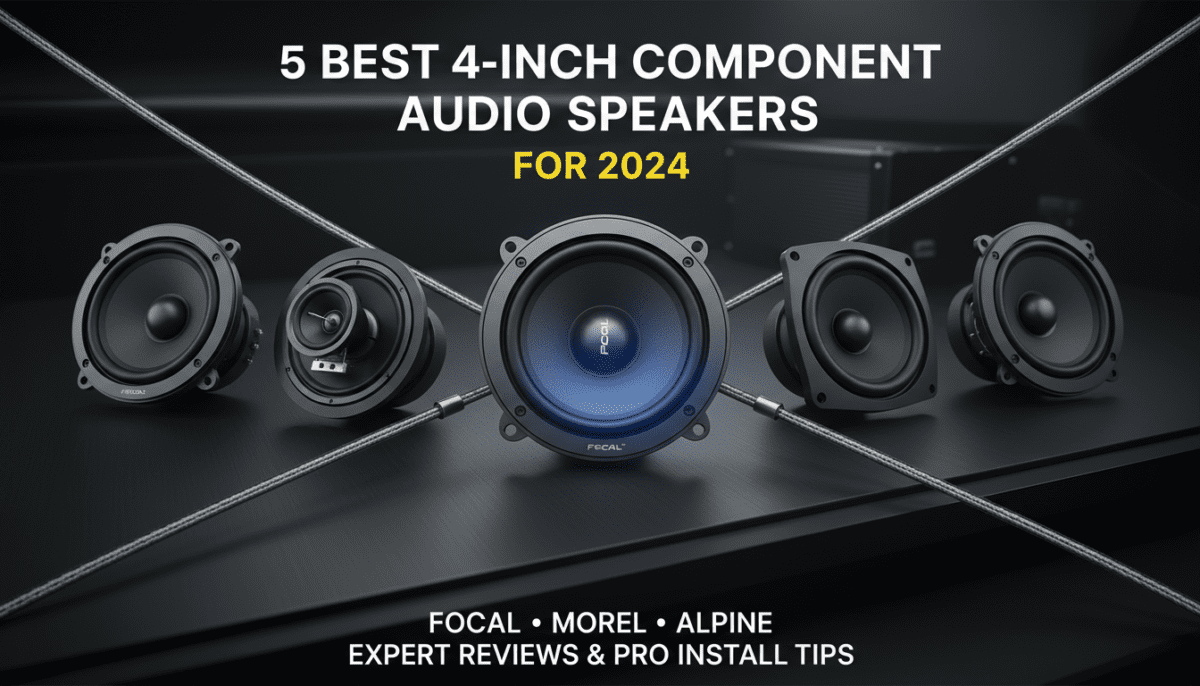
Installation Secrets for Maximum Performance
Even the best 4-inch component audio speakers will sound terrible if installed poorly. In my shop, we follow a strict “Three-Pillar” rule for small-diameter drivers:
- Seal the Baffle: Use closed-cell foam (Fast Rings) to seal the speaker to the door panel. This prevents “acoustic short-circuiting,” where the sound from the back of the speaker cancels out the sound from the front.
- Sound Deadening: Apply a layer of butyl-based vibration dampener (like Dynamat or SoundShield) to the area immediately surrounding the speaker. 4-inch speakers produce high-frequency vibrations that can cause thin metal or plastic to rattle.
- Tweeter Placement: Since these are components, place the tweeters as high as possible. Aiming them toward the opposite headrest (the passenger’s ear for the driver’s side tweeter) generally yields the most balanced stereo imaging.
Frequently Asked Questions (FAQ)
What are the best 4-inch component audio speakers for a BMW?
BMWs often use a unique 3-bolt mounting pattern. While the Focal PS 100 FE can be adapted, brands like Match or Bavsound make “plug-and-play” 4-inch components specifically designed for the BMW housing. However, for sheer sound quality, a customized fitment of the Morel Virtus Nano is often superior.
Can I run 4-inch component speakers without an amplifier?
You can, but you shouldn’t—especially with high-end models. Factory radios typically output 10-15W RMS, which isn’t enough to move the heavy, high-quality cones found in premium component sets. You will lose the dynamic range you paid for.
Do 4-inch speakers need a crossover?
Yes. All component systems come with an external crossover (either a box or an in-line filter). This is critical because it sends the high frequencies to the tweeter and the mid-range to the woofer. Sending low bass to a 4-inch tweeter will destroy it instantly.
What is the difference between coaxial and component 4-inch speakers?
Coaxial speakers have the tweeter mounted in the center of the woofer. Components separate them. Components are the best 4-inch component audio speakers for sound quality because you can mount the tweeter at ear level while the woofer stays in the door, creating a much more realistic “soundstage.”
Will 4-inch speakers provide any bass?
Very little. A 4-inch speaker is designed for mid-range and high frequencies. To get a full audio experience, you must pair them with at least an 8-inch or 10-inch subwoofer to handle everything below 100Hz.