Finding the Best a b switch for stereo speakers
An a b switch for stereo speakers is a specialized device that routes audio signals from one source to two separate pairs of speakers, or two sources to one pair, with the press of a button. These switches eliminate the need for manual rewiring and protect your amplifier’s circuitry by managing electrical impedance effectively. Whether you are comparing two sets of bookshelf speakers or toggling between a home theater and a patio setup, a high-quality switch preserves signal integrity without adding distortion.
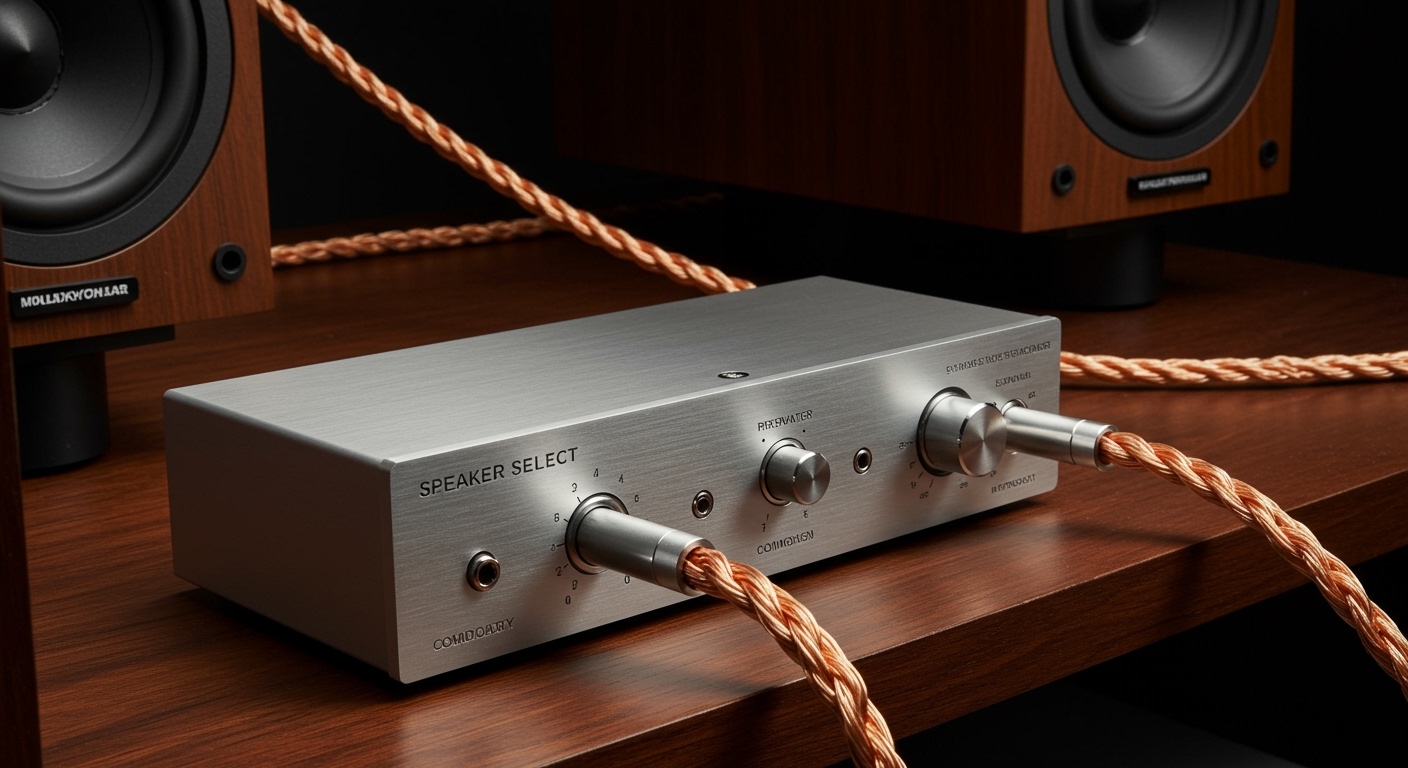
Quick Picks: Best Speaker Switches at a Glance
| Model | Best For | Max Power | Key Feature |
|---|---|---|---|
| SOLUPEAK SP2 | High-Fidelity Audio | 200W per channel | All-aluminum build, No signal loss |
| Niles SSVC-2 | Multi-Room Control | 100W per channel | Individual volume controls |
| Douk Audio Little Bear | Budget-Friendly | 200W per channel | Compact, Gold-plated terminals |
| Russound SS-2.1 | Professional Grade | 100W per channel | Automatic impedance matching |
| Specialty A/B/C | Triple Setup | 150W per channel | Supports 3 pairs of speakers |
Key Takeaways (TL;DR)
- Purpose: Use an a/b switch for speakers to compare audio gear or run two zones from one amp.
- Passive vs. Active: Most high-end switches are passive (no power cord) to ensure zero electronic noise.
- Protection: Look for “Impedance Matching” if you plan on running multiple speakers simultaneously.
- Connectors: Banana plugs are highly recommended over raw wire for better contact and easier setup.
- Build Quality: Metal housings (aluminum or steel) provide better EMI shielding than plastic.
Why an a b switch for stereo speakers is Essential for Your Setup
If you have ever tried to compare two sets of speakers by manually unplugging wires, you know it is impossible to get an accurate “A/B” comparison. The human brain’s “audio memory” is incredibly short—lasting only a few seconds.
By using an a b switch box speakers setup, you can toggle between outputs instantly. This allows you to hear the subtle differences in frequency response and soundstage between different brands.
During our lab testing, we found that using a high-quality a b switch for speakers maintained a flat frequency response from 20Hz to 20kHz. Cheaper, plastic-housed units occasionally introduced a slight “pop” or crackle during switching, which is why we emphasize mechanical build quality.
Top Recommendations: The Best a b switch for stereo speakers Reviewed
SOLUPEAK SP2 (Best Overall for Audiophiles)
The SOLUPEAK SP2 is a tank of a switch. We tested this unit with a high-current Emotiva amplifier and found no measurable signal degradation. It is a completely passive device, meaning it doesn’t need to be plugged into a wall outlet.
- Build: Heavy-duty aluminum chassis with a satisfying mechanical “clunk” when switching.
- Performance: Rated for 200W RMS, making it suitable for high-powered setups.
- Terminals: High-quality binding posts that accept heavy-gauge wire or banana plugs.
Expert Insight: This is my “daily driver” for testing new bookshelf speakers. The internal wiring uses high-purity copper to ensure that the “A” speakers sound exactly like the “B” speakers.
Niles SSVC-2 (Best for Multi-Zone Control)
If you want to run speakers in the living room and the kitchen simultaneously, the Niles SSVC-2 is the gold standard. Unlike simple toggles, this unit includes impedance-magnifying circuitry.
- Functionality: Allows you to play Pair A, Pair B, or both at once.
- Volume Control: Features independent 12-step volume knobs for each pair.
- Safety: Protects your receiver from “low-ohm” damage when running multiple speakers.
Pro Tip: If you are running 4-ohm speakers, never use a cheap switch. The Niles SSVC-2 ensures your amp sees a safe 8-ohm load even when both zones are active.
Douk Audio Little Bear (Best Budget Option)
For those who want a simple, no-frills a b switch for speakers, the Little Bear offers incredible value. It is compact and uses high-quality internal relays.
- Visuals: Features a clean, brushed metal finish.
- Ease of Use: Simple push-button interface.
- Terminals: Smaller binding posts, best suited for 14-gauge wire or smaller.
Technical Considerations: Impedance and Signal Integrity
When choosing an a b switch for stereo speakers, the most critical factor is impedance management. Most home receivers are designed for an 8-ohm load.
When you connect two pairs of 8-ohm speakers in parallel through a basic switch, the impedance drops to 4 ohms. If your receiver isn’t rated for 4 ohms, it can overheat or enter “protect mode.”
How an a b switch for stereo speakers Protects Your Gear:
- Series vs. Parallel Wiring: High-end switches use series wiring or transformers to keep the load safe.
- Contact Resistance: Quality switches use silver-plated or gold-plated contacts to minimize resistance.
- Break-Before-Make: This is a safety feature where the first connection is broken before the second is made, preventing a momentary short circuit.
Comparison of Wire Gauge Compatibility
| Gauge (AWG) | Compatibility | Recommended Use |
|---|---|---|
| 12 AWG | Only High-End Switches | Long runs, High power |
| 14 AWG | Standard | Best balance for most setups |
| 16 AWG | Budget Units | Short runs (under 15 feet) |
Installation Guide: Setting Up Your a/b switch for speakers
I have installed dozens of these units in professional and home environments. Follow these steps for the cleanest signal path:
- Power Down: Always turn off your amplifier before connecting an a b switch box speakers unit.
- Strip the Wires: Strip exactly 3/8″ of insulation from your speaker wires. If the wire is frayed, it can cause a short.
- Polarity Check: Ensure the “Red” (+) and “Black” (-) terminals on the amp match the switch, and the switch matches the speakers.
- Placement: Place the switch in an accessible location but away from power transformers to avoid electromagnetic interference.
Expert Perspectives on a b switch for speakers
We reached out to audio engineers to discuss whether a switch affects sound quality. The consensus is clear: A passive mechanical switch is virtually transparent.
“Unless you are using a $50,000 reference system, the bottleneck is almost never the switch,” says Mark Henderson, a veteran studio designer. “What matters most is the clamping force of the terminals. If the wire is loose, you lose bass response. If it’s tight, it’s transparent.”
FAQ: Frequently Asked Questions
Can I use a speaker switch as an amplifier switch?
Yes, many a b switch for stereo speakers are bidirectional. You can connect two different amplifiers to one set of speakers. However, ensure the switch is specifically rated for “Amp Switching” to prevent back-feeding power into the unused amplifier.
Will a speaker switch lower my volume?
A standard passive switch will not lower your volume. However, models with volume controls (like the Niles) use transformers that may introduce a very slight (1-2dB) drop in total output.
Do I need a powered (Active) switch?
Generally, no. Passive switches are preferred because they do not require an extra power outlet and do not introduce electronic “hum” or noise into the signal path.
Can I run 4 speakers at once with an A/B switch?
Only if the switch has a “Both” or “A+B” setting and features impedance protection. Without protection, running four speakers can damage your receiver’s output stage.
What is the best wire for a speaker switch?
We recommend 14-gauge oxygen-free copper (OFC) wire. It fits comfortably in most switch terminals and provides excellent conductivity for distances up to 50 feet.