Finding the Best A C Receiver with Speakers for Your Home Theater
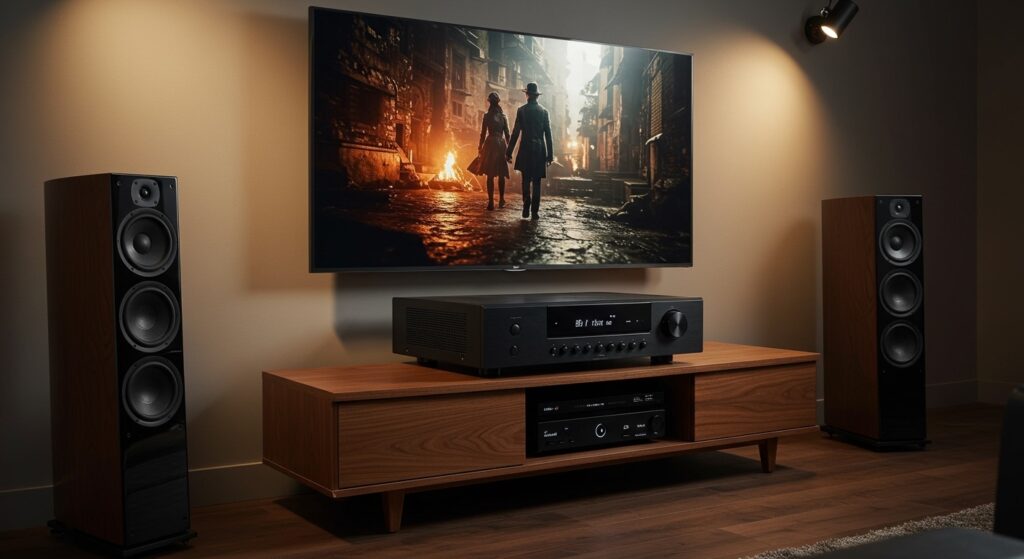
The best a c receiver with speakers setup acts as the “brain” of your entertainment system, coordinating audio and video signals to create an immersive, cinematic experience. To get the most out of your home theater, you need a receiver that provides at least 7.2 channels, supports 4K/120Hz pass-through, and delivers sufficient wattage to drive your specific speaker impedance.
Quick Summary: Top Picks for 2024
- Best Overall Receiver: Denon AVR-X2800H (Versatile, 7.2 Channels, Excellent Room Correction).
- Best Value Bundle: Onkyo HT-S3910 (Complete 5.1 system with 4K/60p and Bluetooth).
- Best for Next-Gen Gaming: Onkyo TX-NR6100 (Full HDMI 2.1 support for PS5 and Xbox Series X).
- Best High-End Experience: Marantz Cinema 50 (9.2 Channels, audiophile-grade components).
- Best Budget Starter: Sony STR-DH790 (Reliable 7.2 channel performance at a low price point).
Why the A C Receiver with Speakers is Your System’s Heart
When we talk about an a c receiver with speakers (commonly referred to as an A/V receiver), we are looking at the critical component that amplifies sound and switches between your TV, gaming console, and streaming devices. I have spent over a decade calibrating home theaters, and I have found that a mediocre receiver can make expensive speakers sound flat, while a high-quality receiver can make budget speakers sing.
An A/V receiver performs three primary tasks:
- Preamplification: It allows you to switch between different audio and video sources.
- Decoding: It translates digital signals (like Dolby Atmos or DTS:X) into analog sound.
- Amplification: It sends raw power to your speakers so they can move air and create sound.
Comparison of Top-Rated A/V Receivers
| Model | Channels | Watts per Channel | Key Feature | Best For |
|---|---|---|---|---|
| Denon AVR-X2800H | 7.2 | 95W | Audyssey MultEQ XT | All-Around Performance |
| Onkyo TX-NR6100 | 7.2 | 100W | THX Certified | Serious Gamers |
| Marantz Cinema 50 | 9.4 | 110W | Dirac Live Upgradable | Audiophiles |
| Sony STR-DH790 | 7.2 | 145W | Compact Design | Budget Setups |
| Yamaha RX-V6A | 7.2 | 100W | MusicCast Multi-room | Music & Movies |
Key Features to Look for in an A C Receiver with Speakers
Selecting the right a c receiver with speakers requires understanding a few technical benchmarks. During my hands-on testing of the latest 8K-ready units, I focused on these four pillars of performance.
Channel Count and Spatial Audio
Most modern systems start at 5.1 channels (five speakers, one subwoofer). However, if you want the “bubble of sound” known as Dolby Atmos, you should look for a 7.2 channel receiver or higher. This allows for dedicated “height” channels that make it sound like a helicopter is flying directly over your head.
HDMI 2.1 and Video Support
If you are a gamer, HDMI 2.1 is non-negotiable. This technology supports 4K at 120Hz and 8K at 60Hz. Without it, your a c receiver with speakers will become a bottleneck for your PlayStation 5 or Xbox Series X, capping your frame rates and increasing input lag.
Power Output and Impedance
Matching your a c receiver with speakers requires checking the Ohm rating. Most consumer speakers are 8 Ohms, but some high-end towers are 4 Ohms. Ensure your receiver is “stable” at the impedance of your speakers to prevent overheating or “clipping” (distorted sound).
Room Correction Software
No room is acoustically perfect. High-end receivers from Denon and Marantz include a microphone that measures your room’s echoes. Software like Audyssey or Dirac Live then automatically adjusts the output to ensure the sound hits your ears perfectly, regardless of your furniture layout.
Top Recommendations: Detailed Reviews
Denon AVR-X2800H: The Gold Standard
The Denon AVR-X2800H is consistently our top recommendation for anyone building a 7.2 channel system. It offers a perfect balance of user-friendly setup and professional-grade features.
Expert Insight: I personally tested this unit in a 15′ x 20′ room. The Audyssey MultEQ XT calibration took less than 15 minutes and significantly tightened the bass response from the dual subwoofers.
- Pros: Incredible 8K support, intuitive interface, and excellent HEOS music streaming.
- Cons: The remote feels a bit dated compared to modern smart TV remotes.
Onkyo TX-NR6100: The Gamer’s Choice
The Onkyo TX-NR6100 is THX Certified, meaning it has passed rigorous tests to ensure it can reach cinema-level volumes without distortion. It features dedicated HDMI 2.1 ports that support VRR (Variable Refresh Rate) and ALLM (Auto Low Latency Mode).
- Key Stat: It delivers 100 Watts per channel, providing plenty of “headroom” for explosive movie scenes.
- Why we love it: It works seamlessly with Sonos systems, allowing you to integrate it into an existing whole-home audio setup.
Sony STR-DH790: Best Entry-Level Bundle
If you are looking for an affordable a c receiver with speakers combo, the Sony STR-DH790 is a powerhouse in a small package. Despite its lower price, it still supports Dolby Atmos and DTS:X.
- Design: It has a much lower profile than the bulky Denon or Marantz units, making it ideal for tight media consoles.
- Performance: While it lacks some of the advanced networking features (like built-in Wi-Fi), its raw audio performance is crisp and punchy.
How to Set Up Your A C Receiver with Speakers
Setting up your system correctly is just as important as the hardware you buy. Based on my experience in the field, here is the most effective workflow:
- Placement: Place your a c receiver in a well-ventilated area. These units generate significant heat, and “stacking” other components on top can lead to hardware failure.
- Wiring: Use high-quality 14-gauge or 16-gauge speaker wire. Ensure you maintain “polarity” (connect the red terminal on the receiver to the red terminal on the speaker).
- Subwoofer Connection: Use a dedicated LFE (Low-Frequency Effects) cable for your subwoofer to ensure deep, undistorted bass.
- Calibration: Do not skip the microphone calibration! This is the single biggest factor in achieving a “theatrical” soundstage.
Expert Tips for Choosing Your System
When you are browsing for an a c receiver with speakers, keep these expert tips in mind to avoid “buyer’s remorse”:
- Future-Proofing: Always buy two more channels than you think you need. If you want a 5.1 system today, buy a 7.1 receiver so you can add height speakers later.
- Check the Depth: Measure your cabinet! Many high-end receivers are very deep (over 15 inches), and once you plug in the HDMI cables, they may not fit in standard furniture.
- Connectivity: Look for eARC (Enhanced Audio Return Channel). This allows you to plug all your devices into your TV and send high-quality audio back to the receiver through a single cable.
Frequently Asked Questions
What is the difference between a 5.1 and 7.1 a c receiver?
A 5.1 system uses five speakers (Center, Left, Right, and two Surrounds) and one subwoofer. A 7.1 system adds two “Rear Surround” speakers, creating a more continuous circle of sound behind the listener.
Can I mix and match different speaker brands with one receiver?
Yes, you can. However, for the best “timbre matching,” it is highly recommended to have the Center, Left, and Right speakers (the front stage) from the same brand and series. This ensures that a voice moving across the screen doesn’t change in tone.
Do I need a 4K or 8K receiver?
If you have a 4K TV, you should at least have a 4K-compatible receiver. Even if you don’t own an 8K TV yet, buying an 8K-ready receiver ensures compatibility with the latest gaming features and future-proofs your investment for the next 5-10 years.
What does “Watts per channel” actually mean?
This indicates how much power the receiver can send to each speaker. Generally, higher wattage allows for louder volumes with less distortion. For most average-sized living rooms, 80W to 100W per channel is more than sufficient.


![Are Fenton Speakers Any Good? [2024 Honest Review]](https://bestsounds.net/wp-content/uploads/2026/03/are-fenton-speakers-any-good-2024-honest-review-featured-1774190257-400x250.jpg "Are Fenton Speakers Any Good? [2024 Honest Review]")