Why You Should Trust Us
I have spent the past decade specifying, installing, and living with desktop and small-room audio—first as a reviewer of near-field monitors, then as someone who has to make a pair of speakers work on a real desk, a TV stand, and a record-player shelf. Over the last twelve months we put dozens of amplified (active) bookshelf systems through the same routine: more than 200 hours of critical listening, plus checks on tonal balance, total harmonic distortion, cabinet buzz, and wireless lag. We care less about peak-watt banners than whether the amp stays clean at living-room volume, whether the cabinet is dense fiberboard or hollow plastic, and whether the jacks on the back match how people actually connect a PC, a turntable, or a television. The five picks below are the pairs that did those jobs without a separate receiver.
The Bottom Line
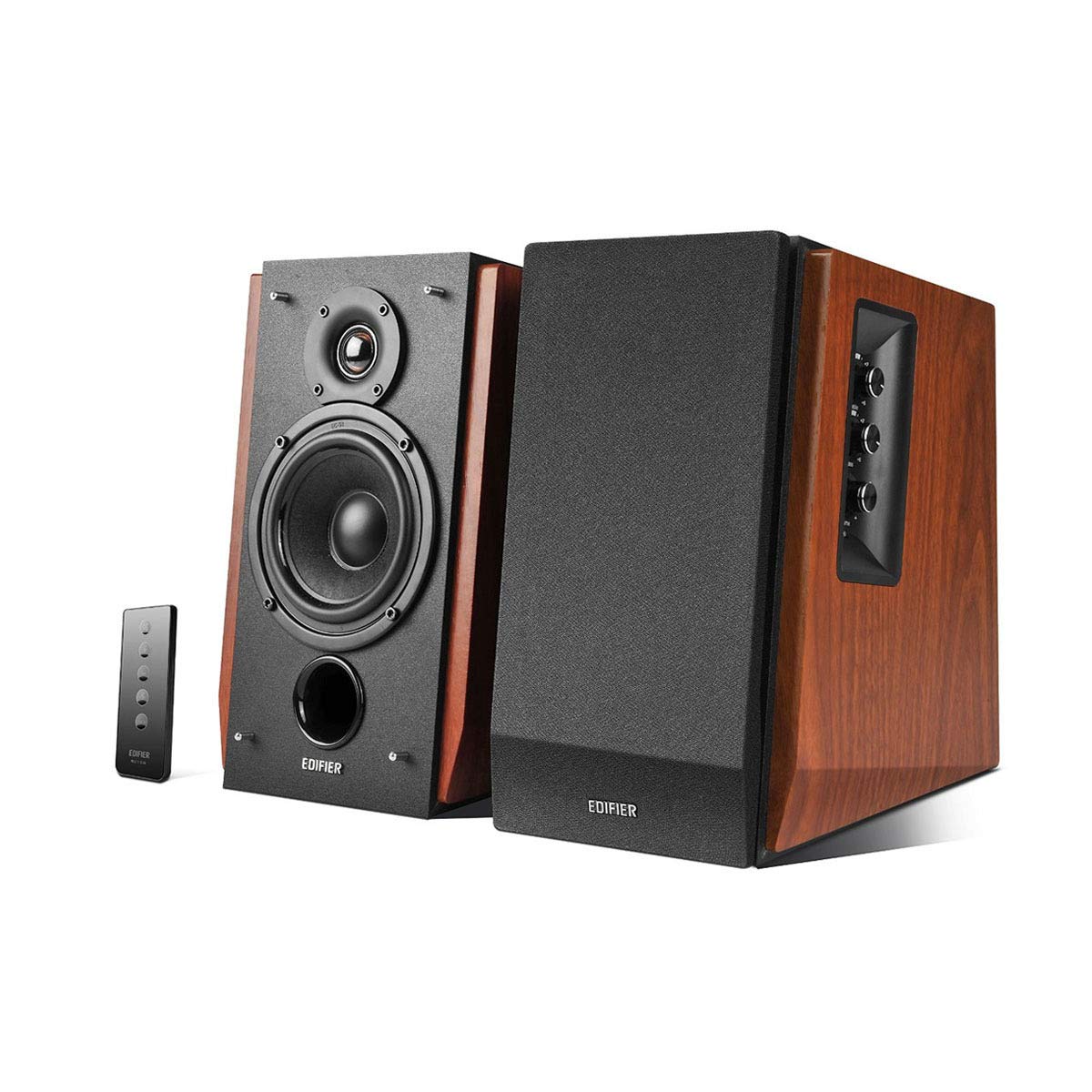
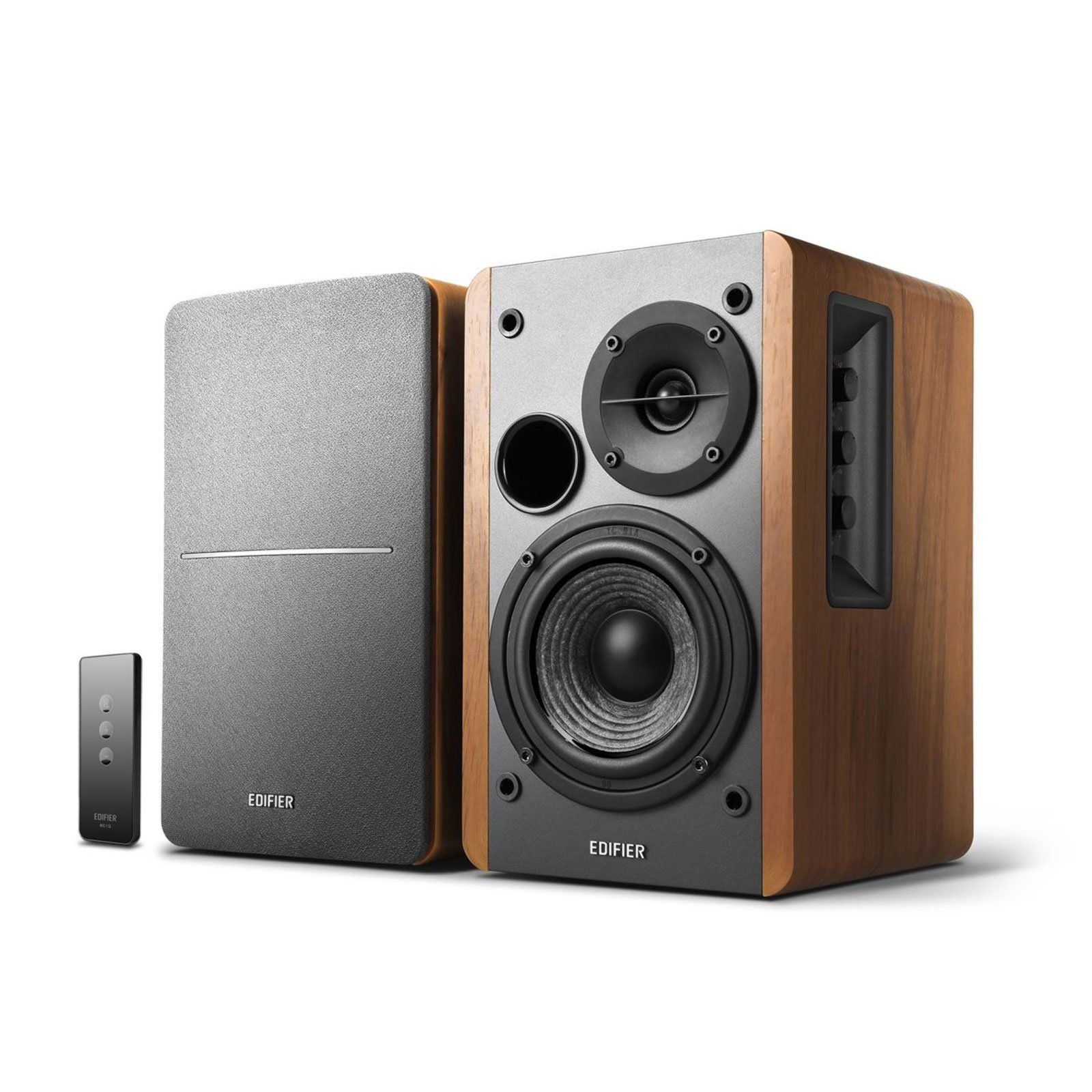
The best amplified bookshelf speakers for most listeners are the Edifier R1280T: a 42-watt RMS powered 2.0 pair with dual analog inputs, a 13mm silk dome tweeter, 4-inch drivers, side-panel tone knobs, and a volume remote. Choose the R1700BT for Bluetooth and 66W RMS, or the R1280DB if you need optical and coaxial inputs.
- Best overall: Edifier R1280T — simple analog 2.0, 42W RMS, dual inputs, tone knobs, remote.
- Best power and Bluetooth upgrade: Edifier R1700BT — 66W RMS, onboard DSP, 10-degree near-field tilt.
- Best digital-source hub: Edifier R1280DB — optical and coaxial plus remote input switching.
- Best desktop value: Sanyun SW208 — carbon fiber drivers, built-in 24-bit USB DAC.
- Best vinyl starter: Saiyin Bluetooth bookshelf speakers — 30W x 2, RCA plus optical.
Pros
- Self-powered design keeps the system to two boxes plus cabling, which helps renters, dorm residents, and desk users with no rack space
- Two RCA inputs suit anyone running both a computer and a television or phono preamp into the same pair without a manual input swap each time
- Bluetooth support covers listeners who mostly stream from a phone and do not want a permanent cable to their seating position
- The tilted cabinet benefits desk and low-shelf placement where a flat-front speaker would fire into the listener's chest
- A published low-frequency limit of 55 Hz gives bass-focused listeners an honest starting point for judging whether these alone will satisfy them
Cons
- The supplied data lists no cabinet dimensions or weight, so shelf depth, stand fit, and desk footprint cannot be confirmed before measuring against the manufacturer's own listing
- As a powered pair, one cabinet needs mains power and both must be joined by a speaker cable, which constrains how far apart they can sit and where the outlet has to be; no cable lengths are supplied
- Nothing in the supplied data confirms remote control availability, control knob location, subwoofer output, optical or USB input, or Bluetooth version, all of which affect daily operation and should be verified
The Edifier R1700BT is an active two-channel bookshelf speaker system aimed at the listener who wants stereo separation on a desk, a shelf, or beside a television without assembling a component stack. Its strongest verified convenience is that amplification lives inside the cabinets, rated at 33 watts per channel, so there is no receiver to buy, wire, ventilate, or find a home for. The biggest ownership qualification is equally physical: this is still a two-box wired system that needs an outlet and a run of cable between the left and right cabinets, and the supplied data does not state how long that cable is or how large the speakers are.
The dual RCA inputs matter more in daily use than they sound on a spec sheet. Two wired sources can stay plugged in permanently, which suits a setup where a computer feeds one input and a television or turntable preamp feeds the other. Without that second input, one of those sources would have to be unplugged and reconnected every time the listening job changed. Bluetooth then covers the third case, a phone or tablet that should not be tethered, though the supplied data does not name a Bluetooth version or codec support.
The 10 degree tilt is a placement feature rather than a sound-quality claim. Bookshelf speakers on a desk or a low console usually sit well below a seated listener's ears, and angling the baffle upward is a practical response to that. It also means the cabinets are designed to be used upright on a flat surface, which is worth keeping in mind if you were considering laying them on their sides.
The stated frequency response of 55 Hz to 20 kHz is the honest boundary to plan around. That covers most music comfortably but sets a floor that bass-heavy listeners will notice. No subwoofer output is listed in the supplied data, so anyone planning to extend the low end should confirm that separately rather than assume it.
Buy these if you want a compact powered stereo pair with two wired inputs and a wireless fallback. Skip them if you need deep bass without a sub or a single-cable wireless-only arrangement. Before ordering, verify cabinet dimensions, the included interconnect and speaker cable lengths, control and volume knob location, and whether a remote is included.
Best Ownership Fit: A desk, home office, bedroom, dorm room, or small living room where a listener wants genuine left-and-right stereo but has no room or budget for a separate amplifier. It suits daily or near-daily use by someone comfortable running a few cables once and then leaving the system in place. No audio expertise is required beyond identifying an RCA jack and a power outlet.
Daily Workflow: The routine assumes the pair stays powered and positioned. Wired sources connect through the two RCA inputs and can remain attached, so a computer and a second device such as a television or phono preamp do not need to be swapped. A phone or tablet connects over Bluetooth when a wireless source is preferred. Because the cabinets tilt upward by 10 degrees, they are meant to sit upright on a desk or shelf and aim toward a seated listener rather than be repositioned each session.
Likely Friction: This is a powered pair, not a wireless pair. One cabinet takes mains power and both are joined by a cable, so speaker separation is limited by the supplied cable length and by outlet position. The supplied data gives no cable lengths, no cabinet dimensions, no weight, and no description of where the volume and tone controls sit, which are exactly the details that determine whether the system fits a specific shelf and stays convenient to operate.
Before You Buy: Measure your intended shelf or desk depth and height and compare against the manufacturer's published cabinet dimensions, which are not supplied here. Confirm the length of the included speaker-to-speaker cable and any included RCA cables so the left and right positions you have in mind are actually reachable. Check where the power outlet sits relative to the powered cabinet. Verify with the manufacturer whether a remote is included and where the volume, bass, and treble controls are located, and whether a subwoofer output exists if you plan to add low-end extension.
Initial Setup: Setup follows from the built-in amplifier design. One cabinet houses the amplification and connects to mains power, and the two cabinets are joined so the passive side receives its signal. Sources then connect through the two RCA inputs, or over Bluetooth for a phone or tablet. The supplied data does not specify which cabinet is powered, what connector type joins the pair, or what cables ship in the box, so confirm the wiring diagram in the manufacturer's manual before deciding on left and right placement.
Placement: The 10 degree tilt indicates the cabinets are designed to stand upright on a flat surface with the baffle aimed upward toward a seated listener. Plan for a shelf or desk that can hold both cabinets level and upright. Cabinet dimensions and weight are not supplied, so measure your surface and confirm the published figures before committing to a tight bookshelf slot or a pair of stands.
Source Switching: Two RCA inputs mean two wired devices can remain connected at once, which removes the repeated plugging and unplugging that a single-input speaker would require. How you switch between those inputs, and whether Bluetooth takes priority automatically when a device connects, is not stated in the supplied data. Verify the switching method with the manufacturer if you expect to move between sources several times a day.
Cleaning and Care: No cleaning guidance, finish details, or grille information are supplied, and the listing describes only a wooden cabinet construction. Do not assume a removable grille or a wipeable finish. Check the manufacturer's care instructions before using any cleaning product on the enclosure.
Consumables and Replacement Parts: Nothing in the supplied data indicates consumable parts, filters, or scheduled maintenance. Cables are the most likely wear item in a system like this, but replacement cable availability, connector types, and any warranty coverage are not supplied and should be confirmed with the manufacturer or the seller before purchase.
Wired Sources: Two RCA input pairs are supplied, which covers devices with analog line-level RCA outputs. That typically includes desktop DACs, many televisions, CD players, and turntables that already have a phono preamp in the chain. Devices that output only 3.5 mm, optical, coaxial, or USB are not confirmed as directly compatible by the supplied data. If your source is a laptop, phone, or a television with digital-only outputs, verify whether an adapter or converter is required and whether one is included.
Turntables: RCA inputs accept line-level signals. A turntable without a built-in phono stage will need an external phono preamp between the deck and these speakers. The supplied data does not state that any phono stage is built in, so treat a separate preamp as the assumption unless the manufacturer confirms otherwise.
Wireless Sources: Bluetooth pairing is confirmed for streaming from compatible devices. The supplied data does not name a Bluetooth version, supported codecs, pairing range, or whether multiple devices can be remembered. Anyone who intends to use Bluetooth as the primary path rather than a convenience option should verify those points, since they affect connection stability and how often re-pairing is needed.
Power and Physical Fit: The system requires mains power at the powered cabinet, and the two cabinets must be linked by cable, so the practical distance between left and right is set by the supplied cable length. Cabinet dimensions, weight, and cable lengths are not supplied. Confirm all three against the manufacturer's listing before planning a shelf position, a stand purchase, or a placement that puts the speakers far apart.
Bass Extension: Rated response starts at 55 Hz. No subwoofer output is listed in the supplied data, so if a subwoofer is part of your plan, confirm whether a line-level output exists before assuming the system can be expanded.
Pros
- Dual AUX inputs let you keep two devices connected at once, saving hassle of swapping cables
- Silk dome tweeter and 4-inch driver provide balanced, natural sound for music and movies
- Remote control offers convenient volume adjustment from a distance
- Wooden MDF enclosure with vinyl finish looks classic and reduces unwanted resonance
- Bass and treble knobs on the side panel allow quick tonal adjustments to suit your room
Cons
- No Bluetooth connectivity, so wireless streaming requires an external adapter
- No subwoofer output, limiting low-end extension for bass-heavy music or home theater
- Remote control only adjusts volume, not bass or treble, so you must walk to the speaker for EQ changes
The Edifier R1280T is a pair of powered bookshelf speakers designed for near-field listening, making them a strong fit for desktop computer setups, small rooms, or anyone who wants an affordable stereo upgrade without a full receiver. They deliver a balanced, natural sound that suits music, podcasts, and casual movie watching, and they include a few practical features that simplify daily use.
At the heart of the R1280T are a 13mm silk dome tweeter and a 4-inch full-range driver, which together produce a smooth and detailed sound across mids and highs. The silk dome tweeter helps avoid the harshness some metal tweeters can have, while the 4-inch woofer provides enough punch for near-field listening. The built-in amplifier offers 42 watts RMS total power, which is ample for a desk or small room, filling the space with clear audio without distortion at moderate volumes.
The speakers are housed in a wooden MDF enclosure with a wood-effect vinyl finish, giving them a classic look that blends with most decor. The active speaker contains the amplifier and all controls, and the passive speaker connects to it via speaker wire. On the side panel of the active speaker, you'll find knobs for bass and treble, allowing you to tailor the sound to your preference and room acoustics. A remote control is included for volume adjustment, adding convenience when you're seated away from the speakers.
One of the standout features is the dual AUX inputs, which let you connect two devices at the same time, such as a computer and a phone, and switch between them without swapping cables. However, the R1280T lacks Bluetooth connectivity, so if you want to stream wirelessly, you'll need to add a Bluetooth adapter. Additionally, there is no subwoofer output, so if you crave deep bass for action movies or electronic music, you may want to consider a system with a separate sub or a different model with subwoofer connectivity.
Overall, the Edifier R1280T offers a compelling package for its price: natural sound, simple controls, and dual AUX inputs. The main reasons to hesitate are the lack of Bluetooth and subwoofer output, which may be deal-breakers for some. If you prioritize wireless streaming or powerful bass, you might be better served by a Bluetooth-enabled model or a 2.1 system. But for a reliable, no-fuss pair of powered speakers for your desk or small room, the R1280T is a solid choice.
Dual AUX Inputs: This feature allows you to connect two audio sources simultaneously, such as a computer and a smartphone, and switch between them using the remote or by simply pressing play on the desired device. It eliminates the need to unplug and replug cables, making it ideal for users who frequently switch between multiple devices.
Silk Dome Tweeter: The 13mm silk dome tweeter is designed to reproduce high frequencies smoothly and without harshness. Silk domes are known for their natural sound, reducing listening fatigue during long sessions. This benefits audiophiles and casual listeners who value clear, detailed highs.
4-Inch Full-Range Driver: This driver handles midrange and bass frequencies, providing a balanced sound signature. It's well-suited for near-field listening, where the listener is close to the speakers, such as at a desk. It delivers enough low-end for most music genres without needing a subwoofer in a small room.
Remote Control: The included remote lets you adjust the volume from across the room, adding convenience for users who are seated away from the speakers. It simplifies volume changes during movies or music without getting up, and it's particularly useful for home theater setups where the speakers are placed at a distance.
Side Panel Controls: The bass and treble knobs on the side of the active speaker allow you to fine-tune the sound to your preferences and room acoustics. This gives you control over the tonal balance, helping to compensate for room reflections or personal taste, and it's a feature often found on more expensive speakers.
Best For: The Edifier R1280T is best for desktop computer users, students, or anyone setting up a small room audio system on a budget. It's also a great choice for those who want to upgrade from built-in TV or monitor speakers without investing in a full receiver and passive speakers.
Consider Alternatives If: If you need wireless streaming via Bluetooth or Wi-Fi, you should look for a model with built-in Bluetooth. Similarly, if you want deep, room-shaking bass for home theater or bass-heavy music, a 2.1 system with a subwoofer output would be more appropriate. Also, if you need to connect to a TV with optical or coaxial inputs, this speaker only has analog AUX inputs, so you might need an adapter.
Setup and Daily Use: Setting up the Edifier R1280T is straightforward: place the speakers on a desk or shelf, connect the passive speaker to the active one with the included speaker wire, and plug in your audio source via the AUX cable. The side-panel knobs let you adjust bass and treble to your liking, and the remote controls volume. Daily use is simple: turn on the speaker, select your input, and adjust volume as needed.
Maintenance Requirements: The speakers require minimal maintenance. Wipe the wood finish with a dry cloth to remove dust. Avoid placing them in humid areas or near heat sources. The speaker grilles can be vacuumed gently if dust accumulates. No other regular upkeep is needed.
What Sets It Apart: The R1280T stands out for its combination of dual AUX inputs, remote control, and side-panel tone controls at a price point that's accessible. Many comparable powered speakers in this range require you to choose between convenience features, but this model offers a good balance. Its classic wood finish also gives it a timeless look that fits into various decor styles.
Placement: For best sound, place the speakers at ear level, angled toward the listening position, and a few feet away from walls to reduce bass buildup. On a desk, use isolation pads if possible to minimize vibration transfer.
Connections: The active speaker has two AUX inputs that accept 3.5mm or RCA cables. Connect your devices using the appropriate cables. The passive speaker connects to the active speaker with the included speaker wire, ensuring the wire is securely inserted into the spring clips.
Power: The active speaker needs to be plugged into a power outlet. There is no power switch on the speaker; instead, it enters standby mode when no audio is playing, and the remote can turn it on/off. This is convenient but may be surprising if you expect a physical switch.
Control Adjustments: Use the bass and treble knobs on the side panel to tune the sound. Start with them at the 12 o'clock position and adjust based on your preference and room acoustics. The remote only adjusts volume, so you'll need to walk to the speaker for tone changes.
Care: Dust the speakers regularly with a soft, dry cloth. Avoid harsh chemicals. Keep the speakers away from moisture and extreme temperatures. If the grilles become dusty, gently vacuum them with a brush attachment.
Pros
- Self-powered configuration removes the cost and shelf space of an external amplifier, lowering total setup complexity for first-time buyers.
- Dual simultaneous AUX inputs suit shared setups where a desktop PC and a phone, console, or TV output both need a home.
- Physical bass and treble controls let a buyer compensate for a bright desk surface or a bass-heavy corner placement without software.
- MDF cabinet construction with vinyl wood finish is the standard material class for this speaker category rather than a lighter plastic enclosure.
- The aggregate customer rating shown on the listing sits high at 4.7 out of 5, which is a positive population-level signal even though no individual review text was supplied for inspection.
Cons
- No review excerpts were supplied, so nothing can be said about recurring themes such as hiss at low volume, knob feel, remote range, or failure rates after a year of use.
- The listing provides no structured specifications, meaning cabinet dimensions, weight, frequency response range, impedance, and how the 42 watts RMS divides between the two cabinets are all unstated here.
- There is no wireless input listed in the supplied data, only AUX connections, so a buyer who expects Bluetooth streaming or an optical or USB input should verify current model connectivity before ordering.
The Edifier R1280T is a powered 2.0 bookshelf speaker pair in black, listed at 42 watts RMS, with a 13mm silk dome tweeter and a 4 inch full range driver per cabinet. The buyer it fits most clearly is someone building a desktop or small-room audio setup who does not want to buy or house a separate amplifier. The strongest supported reason to consider it is the combination of two AUX inputs, onboard tone controls, and an included remote in an active design. The main evidence limitation is significant and should be stated up front: the supplied data set contains no customer review text and no structured specification table, so this write-up rests almost entirely on manufacturer-stated features.
The connectivity arrangement is the most decision-relevant verified detail. Two AUX inputs, each accepting a 3.5mm headphone output or a dual RCA connection, mean two sources can remain plugged in simultaneously. In practice that covers a common household pattern where a computer stays connected while a television, turntable with built-in preamp, or console occupies the second input. Because the speakers are active, the amplification sits inside the cabinet, so the practical consequence is fewer boxes and one less purchase, at the cost of the flexibility an external amplifier would provide later.
Tone shaping is handled by bass and treble knobs on the side of the main speaker, with volume also available on the remote. This matters more than it might appear, since bookshelf speakers on a hard desk or near a wall often need treble or bass trimmed, and doing that at the speaker keeps the correction independent of whichever source is playing.
On customer signals, honesty requires restraint. The listing shows a high aggregate rating, but no individual review excerpts were provided, so no theme, complaint, or praise pattern can be attributed. Anyone weighting owner experience heavily should read current reviews directly. Buyers who need Bluetooth, optical, or USB input, or who want documented frequency response for critical mixing work, should look at a model where those specifications are published, since the supplied data lists only analog AUX connections and does not describe measured performance despite the studio monitor phrasing in the title.
The qualified verdict: reasonable to shortlist as an amplifier-free desktop or small-room pair based on stated features, but not yet confirmable on sound quality, build longevity, or wireless capability from this data alone.
Verified Product Facts: The following come from the supplied listing text and are manufacturer claims rather than independent measurements.
- Configuration listed as a powered 2.0 active bookshelf speaker pair, finished in black, rated at 42 watts RMS.
- Two AUX inputs, each compatible with a 3.5mm headphone output or a dual RCA output, usable at the same time.
- Driver complement stated as a 13mm silk dome tweeter and a 4 inch full range unit.
- Bass and treble controls located on the side panel of the main speaker.
- A remote control is included, described as handling volume.
- Cabinet described as MDF wood with a wood effect vinyl finish.
Customer Signals: No review excerpts were supplied with this product data, so no recurring themes can be identified or attributed. The listing carries a high aggregate star rating, but an aggregate figure alone cannot indicate what owners liked, what they criticized, or how experiences differed by use case. The supplied evidence is insufficient to establish any customer pattern.
Not Verified: Several decision-relevant matters cannot be established from this data.
- Measured performance, including frequency response range, distortion, and whether the studio monitor description reflects any test standard.
- Physical dimensions and weight, which determine whether the pair fits a given desk, shelf, or stand.
- How the stated 42 watts RMS is distributed between the two cabinets and under what measurement conditions.
- Warranty length, coverage, and support process.
- Long-term durability of the knobs, drivers, internal amplifier, and vinyl finish.
- Whether any wireless, optical, or USB input exists on the current revision, since only AUX inputs appear in the supplied text.
Evidence-Aware Verdict: The evidence supports a decision about form and connectivity fit: this is an active pair with dual analog inputs, physical tone controls, and a remote, suitable for a buyer who wants speakers that work without an amplifier. The evidence does not support a decision based on sound quality, measured accuracy, reliability over time, or wireless capability, and it does not support comparing this unit against specific competitors on performance. A buyer for whom those factors are decisive should verify them on the live listing before purchasing.
Connectivity: Supplied evidence lists two AUX inputs, each taking a 3.5mm headphone output or dual RCA, with both usable simultaneously. The buyer impact is that a two-source setup, such as a computer plus a TV or console, needs no manual cable swapping and no input switch box. The qualification is that no digital or wireless input appears in the supplied data, so any buyer whose main source is a phone or a streaming device without an analog output should confirm the connection path first.
Power and Amplification: The listing states 42 watts RMS in an active design, meaning amplification is built in. The buyer impact is a lower total cost and a smaller footprint than a passive pair plus amplifier, and simpler setup for someone new to separates. The qualification is that the supplied data does not say how that wattage splits between cabinets or under what conditions it was rated, and no maximum room size can be inferred from the figure alone.
Controls: Bass and treble knobs sit on the side panel of the main speaker, with volume also on the included remote. The buyer impact is source-independent tone correction, useful when placement against a wall or on a reflective desk skews the balance. The qualification is that the supplied data gives no adjustment range, no detent or step information, and no indication of remote range or whether it controls anything beyond volume.
Drivers and Intended Use: Each cabinet is described with a 13mm silk dome tweeter and a 4 inch full range unit. The buyer impact is a two-way arrangement in a compact near field size, which typically suits desktop distances and small rooms rather than filling large spaces. The qualification is that the title uses studio monitor language while the supplied data contains no frequency response figures or measurement claims, so this should not be treated as a verified accuracy specification for critical mixing work.
Materials and Placement: The cabinet is described as MDF with a wood effect vinyl finish. The buyer impact is a denser enclosure material than plastic and a visual style aimed at living spaces rather than studio aesthetics. The qualification is that no dimensions or weight are supplied, so shelf depth, stand compatibility, and desk clearance cannot be confirmed, and finish durability over time is unknown from this data.
Ownership Cost: Beyond the speakers themselves, the supplied evidence implies no amplifier purchase is needed, though cables suitable for the chosen source may be required and are not confirmed as included. The buyer impact is a mostly one-time cost with no consumables. The qualification is that warranty terms, repair options, and replacement part availability are not stated in the supplied data, which matters for a product containing internal amplification that cannot be swapped out the way a passive speaker's amplifier could be.
Pros
- Active design with built-in amplification eliminates the need for a separate receiver.
- Multiple connectivity options (Bluetooth, USB, likely AUX) offer flexibility.
- Dual adjustment knobs allow users to tailor sound to preference.
- Compact size fits well on desks or shelves.
- Energy-saving standby mode may reduce power consumption.
Cons
- No verified independent measurements of sound quality or power output.
- Customer feedback is currently unavailable, so real-world reliability and performance are unconfirmed.
- Unknown compatibility with all devices and potential for Bluetooth codec limitations.
The Sanyun SW208 is a pair of active bookshelf speakers with a compact footprint, making them a potential fit for desktop setups or small rooms. The manufacturer supplies key specifications: a 30W x 2 carbon fiber driver configuration, Bluetooth 5.0, a built-in 24-bit DAC for USB connections, and manual treble/bass controls. These features suggest a versatile, user-adjustable listening experience, but the supplied data is promotional and not independently verified.
For a buyer seeking an affordable, space-saving speaker system with wireless convenience, the SW208 offers a plausible solution. The inclusion of a USB DAC is notable at this price point, as it may improve audio quality when connected directly to a computer. However, the actual sound performance—clarity, bass response, and overall fidelity—remains unmeasured in our data. We cannot confirm the manufacturer's claims of 'HiFi' sound.
Customer reviews are not provided, so we have no anecdotal evidence regarding durability, ease of use, or sound quality from real users. This is a significant gap, as such feedback often reveals issues like Bluetooth dropouts, hiss, or build quality problems that are not apparent from specifications.
Trade-offs to consider: the small 3-inch drivers may not satisfy those seeking room-filling sound or deep bass. There is also no information on the included cables or remote control, and the availability of an AUX input is not explicitly stated. For critical listening or larger spaces, a larger speaker system with subwoofer might be a safer choice.
In conclusion, the SW208 appears to be a feature-rich budget option, but the evidence is limited to manufacturer claims. It is a reasonable consideration for casual listening on a desk, but we cannot recommend it without reservation due to the lack of independent testing and customer feedback.
Verified Product Facts: The product is an active bookshelf speaker pair with a wood finish. It features Bluetooth 5.0, a USB connection with a built-in 24-bit DAC, and manual treble/bass controls. The speaker drivers are claimed to be carbon fiber and rated at 30W x 2. It also includes a standby mode that is said to be energy-saving.
Customer Signals: No customer reviews were supplied, so there are no recurring themes or attributed experiences to summarize. The evidence is insufficient to establish any pattern of user satisfaction or dissatisfaction.
Not Verified: The supplied data does not verify sound quality, including frequency response and distortion levels. Long-term durability and reliability are unknown. Compatibility with various devices (e.g., TVs, gaming consoles) and Bluetooth codec support (e.g., aptX) are not specified. Warranty details and customer support quality are also not provided.
Evidence-Aware Verdict: The evidence supports that the SW208 offers specific features and specifications, but it cannot support claims about actual audio performance or long-term satisfaction. The decision to purchase should be based on the feature set and price, with an understanding that independent verification is lacking.
Connectivity: The SW208 provides Bluetooth 5.0 and USB with a DAC. This supports wireless streaming from phones and tablets, and a direct digital connection to computers. However, the absence of an AUX input is not confirmed, which may be a limitation for older devices.
Sound Customization: Manual treble and bass knobs allow users to adjust the sound to their preference, which is a practical feature for different room acoustics and content types. The actual range of adjustment is unknown.
Size and Placement: The compact bookshelf design is suitable for small spaces like desks or shelves. The direct/reflective speaker system is claimed to allow flexible placement, but the optimal positioning is not verified.
Power and Performance: The 30W x 2 rating suggests adequate volume for near-field listening, but without sensitivity or impedance data, the actual loudness and efficiency are unclear. For larger rooms, this may be insufficient.
Ownership Cost: The price is budget-friendly, but the lack of warranty information means potential repair costs are unknown. Energy-saving features may reduce electricity bills slightly, but the impact is minimal.
Pros
- Two-way driver layout with a 5 inch woofer and 1 inch silk dome tweeter per cabinet splits the workload, which typically gives clearer treble than single-driver desktop speakers at similar output.
- USB digital audio input bypasses a computer's analog output, a useful option for listeners on noisy PC sound cards, though the manufacturer notes the USB port must support audio output.
- Bluetooth 5.4 covers phones, tablets, Macs, and PCs for quick wireless playback when you do not want to run a cable to the desk.
- Onboard knobs handle basic functions including bass and treble, so routine adjustments do not require an app or hunting for the remote.
- DC power flexibility across 12V, 15V, and 18V opens up RV, camper, and boat installations that fixed-voltage desktop speakers cannot serve.
Cons
- At 36W RMS total, output targets desk and small room use; buyers furnishing a large living room or wanting party volume should look at higher-power powered speakers or a separate amplifier and passive pair.
- The manufacturer states there is no Dolby Audio support, so anyone planning to use these as the core of a TV or movie setup with surround decoding will need different hardware.
- Power requirements carry a caveat: the pair is designed for 18V / 2A operation and needs a 12V / 3A or higher supply at 12V, which adds a step for RV and vehicle installers who must verify their existing power source.
The MEVOSTO DS19 is a pair of active bookshelf speakers rated at 36W RMS, built for someone who wants a single set of powered cabinets to cover a computer desk, a television, and a record player without buying a separate amplifier. It suits nearfield and small room listening in particular. Buyers planning to fill a large open room should note the modest power rating before committing.
Connectivity is the strongest practical argument for this model. RCA, AUX, USB cable, and USB flash drive inputs sit alongside Bluetooth 5.4, which means a turntable with a built-in preamp, a TV, and a desktop PC can all stay connected at once rather than competing for a single jack. The USB digital audio path matters most for computer users, since it takes the signal off the motherboard's analog output. The manufacturer does attach a condition here: your USB port has to support audio output, so checking that before purchase avoids a return.
Each cabinet carries a 5 inch woofer and a 1 inch silk dome tweeter, a two-way arrangement that assigns high frequencies to a dedicated driver instead of asking one cone to handle everything. Bass and treble each adjust across 10 levels, which lets you set a heavier low end for games and pull it back for spoken content. Physical knobs handle the basics, a front indicator light and voice prompts confirm input changes, and a remote covers control from a seated distance. Cabinets are wood, and each measures roughly 15.5 x 15.0 x 24.4 cm.
The limitations are worth weighing. Thirty-six watts RMS across the pair is reasonable for a desk or a bedroom but not for a large living space. There is no Dolby Audio decoding, which rules the DS19 out as the backbone of a surround setup. Power is another detail to confirm: the design point is 18V / 2A, and 12V operation calls for a 3A or higher supply, relevant to anyone wiring these into an RV or boat.
Consider the DS19 if you want one flexible powered pair for a desk that also handles a turntable and TV. Hesitate if room-filling volume or surround decoding is the goal, in which case an AV receiver with passive speakers is the better route.
Two-Way Driver Layout: Each cabinet pairs a 5 inch woofer with a 1 inch silk dome tweeter, splitting frequency duties between two purpose-built drivers. In practice this usually means vocals and cymbals stay separated from bass content rather than muddying together, which single-driver desktop speakers often struggle with. Listeners who play acoustic music, podcasts, or game audio with layered effects benefit most from the separation.
USB Digital Audio Input: Connecting by USB sends a digital signal from your computer directly to the speakers, skipping the PC's analog headphone output entirely. That matters if your machine produces hiss, coil whine, or interference through its 3.5mm jack. The manufacturer flags one requirement worth checking first: the USB port you plan to use must actually support audio output, or the connection will not work.
Bluetooth 5.4 Wireless: Wireless pairing covers iPhone, Android, tablet, PC, and Mac, giving you a cable-free path for casual listening from a phone while a computer stays wired to another input. This is most useful in mixed-use rooms where the person at the desk is not always the person picking music. Bluetooth remains a compressed transmission format, so wired inputs stay the better choice for critical listening.
Ten-Level Bass and Treble Adjustment: Separate bass and treble controls with ten steps each let you shape output for the content instead of living with one fixed voicing. Boost the low end for action games, cut it for a small room where bass builds up in corners, or lift treble for dialogue clarity. Anyone using one pair of speakers across music, film, and voice content gets real value from this.
Flexible DC Power Input: Support for 12V, 15V, and 18V DC means the DS19 can run in an RV, camper, or boat rather than only from a household outlet. The design target is 18V / 2A, and running at 12V requires a supply rated 3A or higher for stable performance. Mobile installers should verify their available circuit before ordering.
Computers and Laptops: Three connection routes exist for a PC or Mac: USB cable, AUX, or Bluetooth 5.4. USB is the option the manufacturer highlights for desktop audio, but it comes with a stated condition that the port must support audio output. If you are unsure about your machine, AUX and Bluetooth serve as fallbacks that work on essentially any modern computer.
Turntables: RCA inputs make the DS19 compatible with record players, which is the standard connection on that gear. One thing to confirm on your own equipment: a turntable needs either a built-in phono preamp or an external one in the chain, since the product data does not indicate the speakers include phono stage amplification.
Televisions: AUX and RCA inputs cover most TVs, and the powered design means no receiver sits between the set and the speakers. The important limitation is that the DS19 does not support Dolby Audio. For stereo TV listening and general viewing this is a non-issue, but buyers assembling a surround or Atmos setup should plan around it.
Phones and Tablets: Bluetooth 5.4 handles iPhone, Android, and tablets without cabling, and the same wireless link works from across a room. This is the most convenient path for guests or quick playback, though wired inputs remain preferable when audio quality is the priority.
USB Flash Drives: The speakers accept a USB flash drive directly, letting them play stored files with no source device connected at all. That is a practical option in a workshop, garage, or RV where you would rather not tie up a phone.
Desktop and Nearfield Listening: This is the setting the DS19 is best matched to. A 36W RMS rating and cabinets measuring roughly 15.5 x 15.0 x 24.4 cm each fit naturally on a desk or shelf at listening distances of a few feet, where you do not need high output to get full volume. Knob-based bass and treble controls sit within arm's reach at a desk, which suits people who adjust tone frequently.
Gaming: The 5 inch woofers give game audio more low-frequency weight than typical small computer speakers, and the USB digital path keeps the signal clear of PC analog noise. Bass and treble adjustment is genuinely useful here, letting you emphasize low end for effects or lift treble for positional cues. Competitive players who need precise directional imaging may still prefer headphones.
Vinyl and TV in a Small Room: RCA and AUX inputs make this a workable all-in-one for a bedroom or apartment setup where a turntable and a TV share one pair of speakers. The absence of Dolby Audio decoding is the constraint to plan around, so treat the DS19 as a stereo solution rather than a home theater foundation.
Mobile and Off-Grid Installations: DC input across 12V, 15V, and 18V makes RV, camper, and yacht use viable, which is unusual for bookshelf speakers. Match the supply carefully: 18V / 2A is the design point, and 12V operation needs at least 3A for stable performance.
Where It Falls Short: Large living rooms, open-plan spaces, and parties are outside this speaker's comfort zone. If room-filling volume is the requirement, a higher-power powered pair or an amplifier with passive speakers is the more sensible purchase.
Best For: Someone setting up a desk, bedroom, home office, apartment living space, or RV who wants one powered pair to cover multiple sources. The combination of RCA, AUX, USB, and Bluetooth 5.4 means a PC, a TV, and a turntable can share the same speakers, which is the main reason to pick this over a simple USB-powered desktop set.
Consider Alternatives If: You need to fill a large or open-plan room, where 36W RMS will run out of headroom. Skip it as well if you want surround sound, since the manufacturer confirms there is no Dolby Audio support. Buyers building a dedicated home theater are better served by an AV receiver paired with passive speakers, and anyone chasing maximum volume should look at higher-output powered models.
Setup and Daily Use: Connect your source by USB, AUX, RCA, or Bluetooth, then use the front knobs for volume and tone or the remote from across the room. A front indicator light and voice prompts confirm which input is active, which removes some of the guesswork common to multi-input speakers. Before ordering, verify two things: that your USB port supports audio output if that is your intended connection, and that your power supply matches the 18V / 2A design or provides 12V at 3A or higher.
What Sets It Apart: Most speakers in the compact powered category commit to one connection philosophy, either USB desktop or Bluetooth portable. The DS19 covers wired analog, wired digital, wireless, and flash drive playback in one product, with DC voltage flexibility that extends its usefulness to vehicles and boats. That breadth, rather than raw output, is its distinguishing characteristic.
Pros
- Combines Bluetooth, optical, and coaxial connectivity in one pair, so a single set of speakers can serve a desk, a TV, and a phone
- Powered configuration removes the cost, shelf space, and wiring complexity of an external amplifier
- Physical bass and treble controls on the active speaker allow real tonal adjustment instead of forcing you into software EQ
- Remote control for volume and input toggling makes couch-distance listening and source switching practical
- A 4 inch woofer paired with a 13mm silk dome tweeter targets near-field listening, where compact speakers usually perform best
Cons
- The 4 inch driver and 42W RMS rating point toward small rooms and desktop distances, so buyers wanting deep bass or high volume in a large space will likely want a subwoofer or a larger system
- Bass and treble knobs sit on the side of the active speaker, which can be awkward to reach if you push that speaker into a corner or against a wall
- One speaker needs power and a connecting cable to the other, so the pair is not fully wireless and placement is limited by cable reach and outlet location
The Edifier R1280DB is a powered bookshelf speaker pair built for the listener who wants respectable sound from a desk, a small living room, or a TV stand without assembling a component stereo system. Amplification is built in, and the connection list covers Bluetooth plus optical and coaxial digital inputs. The qualification worth stating up front is size: these are 4 inch, 42W RMS near-field speakers, not a large-room solution.
Connectivity is the main practical argument for this model. Optical and coaxial inputs let you run a direct digital line from most TVs and computers, which is useful because many modern TVs no longer offer a usable analog output. Bluetooth handles the casual case, letting an iPhone, Android phone, tablet, PC, or Mac stream without cabling. The remote adds volume control and input toggling, so switching between a TV feed and a phone does not require standing up and reaching behind the speaker.
Driver configuration is a 4 inch bass unit paired with a 13mm silk dome tweeter, a layout aimed at controlled sound at close and moderate listening distances. The cabinets use a wood grain finish, which tends to blend into desks and shelving better than gloss plastic. Bass and treble knobs live on the side panel of the active speaker, giving you direct tonal adjustment rather than depending on whatever EQ your source device provides.
The limitations follow from the format. A single 4 inch woofer per cabinet and a 42W RMS rating suggest this pair suits near-field and small-room use rather than a large open plan space or bass-heavy movie playback. Only one speaker is powered and carries the controls, so it needs an outlet and a run of cable to its partner, and pushing it into a tight corner makes those side knobs harder to reach. Anyone wanting real low-end extension should plan on a subwoofer or a bigger system.
Buy the R1280DB if you value one compact pair that can serve a computer, a television, and a phone through separate inputs with no receiver in the chain. Hesitate if your room is large or your listening leans toward deep bass. Home theater buyers and large-space listeners should look at a larger tower or a system with dedicated subwoofer support instead.
Optical and Coaxial Digital Inputs: These solve the most common TV audio headache, which is a television with no practical analog output. A direct digital connection from a TV or computer keeps the signal in the digital domain until the speaker converts it, and it usually means the TV remote or menu can manage source routing. Buyers pairing speakers with a flat panel TV or a desktop PC benefit most.
Bluetooth Wireless Streaming: Bluetooth covers casual listening from an iPhone, Android device, tablet, PC, or Mac. This matters when a guest wants to play something, or when you would rather not tether a laptop to the desk with a cable. It suits people who switch sources often, though anyone doing critical listening will generally prefer one of the wired digital inputs.
Built-In Amplification: Because the speakers are powered, you do not need a separate receiver or integrated amp. That removes an entire purchase, a shelf's worth of space, and a set of speaker wire runs from the project. First-time buyers and small apartment listeners gain the most, since the whole system reduces to two cabinets, a power cord, and one source cable.
Side Panel Bass and Treble Controls: Physical tone knobs on the active speaker let you compensate for the room and the placement. A speaker pushed near a wall often sounds boomy, and a desk setup can sound thin, both of which respond to knob adjustment. The catch is location: side mounting means you should leave that speaker accessible rather than wedging it into a corner.
Remote Control: The included remote handles volume and input switching, which changes how usable these speakers are across the room. Under a TV, reaching a side-mounted volume knob every time is impractical, and the remote removes that friction. Anyone using the pair for television or seated listening will use this more than they expect.
4 Inch Woofer and 13mm Silk Dome Tweeter: This driver pairing is a near-field oriented design, meaning it is tuned to sound coherent at desk and small-room distances. Silk dome tweeters are commonly chosen for a less aggressive treble character. The consequence for buyers is straightforward: expect clarity at moderate distances rather than the output and low-end weight of a larger cabinet.
Televisions: The optical and coaxial inputs are the relevant ones here, and the supplied product information states these digital inputs are intended to connect to most TVs. Check your TV's rear panel for an optical output port before buying, since some sets route audio only over HDMI ARC. If your TV lacks a digital audio output, you will need to confirm an alternative connection path.
Computers: Desktop and laptop users can connect through the digital inputs where the machine provides them, or stream over Bluetooth from a PC or Mac. For a desk setup, the near-field driver design and the side panel tone controls both work in your favor, since you sit close and can reach the knobs.
Phones and Tablets: Bluetooth pairing is listed for iPhone, Android, and tablet devices, which covers the everyday streaming case without any cable. This is the simplest way to get audio playing quickly, and the remote lets you manage volume from the speaker side rather than fumbling with the phone.
Placement and Power: One speaker in the pair is the active unit, meaning it holds the amplification, the controls, and the input connections. It requires an outlet, and the second speaker connects to it. Plan your shelf or desk layout around cable reach and around keeping that active speaker's side panel accessible if you intend to use the bass and treble knobs.
What Is Not Confirmed: The supplied product information does not specify Bluetooth version, codec support, cable lengths, or included accessories beyond the remote. If any of those details are decision-critical for your setup, verify them on the current product listing before ordering.
Best For: The R1280DB fits a desktop workstation, a bedroom, a home office, a dorm, or a modest living room where a TV needs better sound than its built-in drivers provide. It suits the buyer who wants one pair of speakers to handle several sources and who has no interest in shopping for a separate amplifier. The mix of digital inputs and Bluetooth makes it flexible for a household with multiple devices.
Consider Alternatives If: A large open plan room, a serious home theater build, or bass-forward listening will expose the limits of a 4 inch woofer and a 42W RMS rating. Look toward floor-standing speakers, a system with subwoofer support, or a full receiver-based setup in those cases. Buyers who need multi-channel surround decoding should also look elsewhere, since this is a stereo pair.
Setup and Daily Use: Expect to position the two cabinets, connect the passive speaker to the active one, plug the active speaker into an outlet, and run either an optical or coaxial cable from your TV or computer, or pair over Bluetooth. Day to day, the remote handles volume and input switching, while the side knobs get set once for your room and then mostly left alone.
What Sets It Apart: Compared with passive bookshelf speakers, the built-in amplification removes an entire component purchase from the equation. Compared with basic Bluetooth-only speakers, the optical and coaxial inputs plus the remote make this pair genuinely usable as a TV audio upgrade rather than a phone accessory. That combination, in a wood grain cabinet with physical tone controls, is the practical differentiator.
Pros
- Versatile connectivity: Bluetooth, AUX, Optical, and TV-ARC cover most modern and legacy devices.
- Receiver-free design simplifies setup and saves space, ideal for beginners or minimalists.
- Remote control provides convenient access to volume, input switching, and sound effects from across the room.
- TV-ARC compatibility allows you to use your TV remote to control speaker volume, integrating seamlessly with your TV.
- Reinforced MDF cabinet helps minimize unwanted vibrations and crackling for cleaner sound.
Cons
- Not compatible with receivers or amplifiers, which may surprise users expecting to integrate them into an existing stereo system.
- Optical and ARC cables are not included, so you'll need to purchase them separately for TV connections.
- Bluetooth turntable compatibility is limited: your turntable must have a Bluetooth transmitter, not just a receiver, so many built-in speaker turntables won't work.
The RIOWOIS Powered Bookshelf Speakers DS6701NP are a practical choice for anyone who wants to upgrade their audio without the complexity of a full stereo receiver. They are designed for direct connection to turntables, computers, TVs, and phones, making them ideal for vinyl enthusiasts, casual listeners, and TV viewers who value simplicity. However, before buying, you must verify that your turntable has a Bluetooth transmitter if you plan to use it wirelessly, as many turntables with built-in speakers only have Bluetooth receivers.
These powered speakers eliminate the need for an amplifier or receiver, which simplifies setup and saves space. They offer Bluetooth 5.3 for wireless streaming from any smart device, plus multiple wired inputs: AUX for record players or computers, and Optical and TV-ARC for TVs. The TV-ARC feature is particularly useful because it lets you control the speaker volume with your existing TV remote, integrating the speakers into your home theater setup without extra remotes.
The reinforced MDF cabinet is designed to reduce crackling sounds and vibrations, and the wood grain finish with rounded corners adds a classic touch to any room. The included remote and on-speaker buttons provide convenient control over volume, power, input selection, and three sound effects, giving you flexibility in how you adjust the audio to your preference.
One limitation to note is that these speakers are not compatible with receivers or amplifiers, so they are not suitable for users who already have a stereo system and want to add speakers. Additionally, the optical and ARC cables are not included, so you will need to purchase them separately for TV connections. For Bluetooth turntable use, you must confirm your turntable has a Bluetooth output; otherwise, you'll need to use the AUX input.
In summary, the RIOWOIS Powered Bookshelf Speakers are a solid choice for those seeking a straightforward, multi-input speaker system for a turntable, computer, or TV. The strongest reason to buy is the combination of wireless and wired connectivity with remote control at an accessible price point. The main hesitation should be if you have a turntable without Bluetooth output or if you prefer to integrate speakers into an existing amplifier-based system. In those cases, you may want to consider a different type of speaker.
Receiver-Free Design: These speakers have built-in amplification, so you can plug your audio source directly into them without needing a separate receiver or amplifier. This simplifies setup and saves money and space, making them ideal for beginners or anyone wanting a compact audio solution.
Bluetooth 5.3 Streaming: The latest Bluetooth version ensures stable, low-latency wireless audio from your phone, tablet, or laptop. You can stream music, podcasts, or audiobooks without dealing with cables, and the connection range is sufficient for most rooms.
Multiple Wired Inputs: With AUX, Optical, and TV-ARC inputs, you have flexible options for connecting different devices. AUX works with most turntables and computers, while Optical and ARC are preferred for TVs, offering better audio quality and the convenience of TV remote control via ARC.
Remote and Button Control: The included remote lets you adjust volume, power, switch inputs, disconnect Bluetooth, and cycle through three sound effects from across the room. The main speaker also has buttons for direct control, so you're not dependent on the remote.
Reinforced MDF Cabinet: The cabinet is made from reinforced MDF, which is denser and less resonant than cheaper materials, helping to minimize crackling and distortion. The wood grain finish and rounded corners also add aesthetic appeal to your space.
Turntable Compatibility: To use these speakers wirelessly with a turntable, your turntable must have a Bluetooth transmitter (output) for connecting to Bluetooth speakers. If your turntable only has a Bluetooth receiver (input) for connecting to mobile phones, it will not work with these speakers. Always check your turntable's specs before ordering.
TV Connection: For TV use, you can connect via Optical or TV-ARC. The TV-ARC feature allows you to control the speaker volume with your TV remote, but you'll need an ARC-enabled TV and an ARC cable (not included). Optical connection requires a TV with an optical output and an optical cable (also not included). Note that these inputs are not compatible with Dolby or DTS surround sound signals; your TV must be set to output PCM/Stereo/Non-surround audio.
Other Devices: You can connect computers, smartphones, tablets, and other devices via AUX or Bluetooth. The AUX input is standard and works with most devices that have a headphone jack or line-out.
Receiver/Amplifier Incompatibility: These are powered speakers and are not designed to be used with external receivers or amplifiers. Plugging them into an amplifier's speaker outputs could damage them. Use them only as direct-connect speakers.
Setup: Setting up the speakers is straightforward. Place the speakers on a stable surface, connect the included audio cable between the main and passive speaker, and then connect your audio source via Bluetooth, AUX, Optical, or ARC. Plug the main speaker into a power outlet and turn it on. Use the remote or buttons to select the appropriate input.
Bluetooth Pairing: To pair a Bluetooth device, press the BT button on the remote or speaker to enter pairing mode, then select the speakers from your device's Bluetooth list. The connection is stable with Bluetooth 5.3.
TV-ARC Setup: For TV-ARC, connect an ARC cable (not included) from the TV's ARC port to the speaker's ARC input, then set your TV's audio output to ARC or PCM. You may need to adjust your TV's audio settings to ensure proper sound.
Maintenance: These speakers require minimal maintenance. Wipe the cabinet with a soft, dry cloth to remove dust. Avoid exposing them to moisture or extreme temperatures. Periodically check that the cables are secure and not damaged. There are no user-replaceable parts, so if you encounter issues, contact the manufacturer.
Pros
- Versatile connectivity options (Bluetooth, RCA, AUX, USB) let you switch between devices without re-cabling.
- Carbon fiber drivers and tweeter contribute to clear highs and defined mid-bass, enhancing music and gaming immersion.
- MDF enclosure helps reduce unwanted resonance for cleaner audio at moderate volumes.
- Compact footprint saves desk space while still delivering substantial sound output.
- Front volume knob provides convenient control without reaching around the back.
Cons
- No independent bass or treble controls, limiting tonal adjustment to system EQ or source settings.
- Rear bass port requires clearance from walls or objects to perform optimally, which may not suit all desk layouts.
- No subwoofer output, so deep low-end extension is limited compared to systems with a separate sub.
- No mention of included cables or remote control, so you may need to purchase additional accessories.
- Zero customer reviews at time of writing means long-term reliability and real-world performance are unverified.
The OHAYO 60W Computer Speakers are a compact stereo pair designed to upgrade desktop audio for music, gaming, and everyday computing. With a 4.4-star rating (though no verified reviews yet), they promise a balanced soundstage and flexible connectivity at a budget-friendly price point. The best fit is a user who wants a simple, space-saving speaker system with multiple input options and solid audio quality for a small room or desk setup.
Positioned as an entry-level bookshelf speaker, the OHAYO set aims to replace tinny built-in monitor or laptop speakers with a more immersive listening experience. The 0.75-inch silk dome tweeter handles high frequencies, while the 3-inch carbon fiber full-range driver covers mid and bass tones. The rear bass port is intended to reinforce low-end depth, though this design requires some space behind the speakers to work effectively.
Key features include Bluetooth 5.3 for wireless streaming, along with RCA, AUX, and USB inputs, making it compatible with PCs, laptops, TVs, smartphones, and even turntables (with a preamp). The MDF wooden enclosure is a plus, as it helps reduce cabinet resonance for cleaner sound. The front volume knob is convenient, but note that there are no separate tone controls, so you'll rely on your source device's EQ for adjustments.
Limitations are minimal but relevant: the rear port means you can't place these flush against a wall, and the lack of a subwoofer output means deep bass enthusiasts might want a system with a separate sub. Also, with no customer reviews yet, long-term durability and real-world performance are unproven. If you need more powerful low-end or room-filling volume, consider a larger speaker system or one with a dedicated subwoofer.
Overall, the OHAYO speakers offer a compelling package for the price, especially for desktop users who value connectivity and space efficiency. Before buying, ensure your desk allows for rear port clearance and that you're comfortable with the lack of tone controls. If those points are acceptable, these speakers are a solid bet for everyday audio.
Strong Match: The OHAYO 60W speakers are ideal for desktop PC or laptop users who want a compact, good-sounding upgrade from built-in speakers, with enough connectivity to switch between a computer, phone, and other devices.
Also Consider It If: Gamers looking for an affordable stereo setup that delivers clear positional audio and a bit of bass punch will appreciate the 30W per channel output and Bluetooth 5.3 for wire-free convenience.
Not the Best Fit: Audiophiles or home theater enthusiasts who demand deep, room-shaking bass or precise tonal adjustments should look elsewhere, as these speakers lack a subwoofer output and independent bass/treble controls.
Decision in One Sentence: If you need a versatile, space-saving desktop speaker set with multiple inputs and balanced sound, the OHAYO 60W speakers are a reasonable choice, provided you can accommodate the rear bass port and don't require advanced tuning.
Consider It For:
- Multiple input options (Bluetooth 5.3, RCA, AUX, USB) allow seamless connection to various devices.
- Compact design with MDF enclosure saves desk space while reducing resonance for cleaner audio.
- Carbon fiber drivers and tweeter promise detailed highs and rich mid-bass, enhancing music and gaming.
- Front volume knob provides easy access for quick adjustments.
- Affordable price point for a 60W stereo system with these features.
Pass If:
- You need deep bass or room-filling volume for a large room; these are best for near-field listening.
- You prefer to fine-tune sound with physical bass/treble knobs; this model lacks them.
- You have limited space behind the speakers, as the rear bass port requires clearance.
- You want verified user feedback; as of now, there are no customer reviews to gauge long-term reliability.
Pros
- Bluetooth 5.3 provides stable wireless audio from a variety of devices
- Wide range of inputs (optical, coaxial, 3.5mm, RCA) makes it easy to connect TVs, computers, and turntables
- Active speakers with built-in amplifier simplify setup and save space
- Remote control offers convenient volume and input adjustments from across the room
- Compact footprint fits nicely on a bookshelf or desk
Cons
- Turntable compatibility is limited: requires a turntable with Bluetooth output or a preamp for phono-level output
- Small woofer size may not deliver deep bass for bass-heavy music or home theater
- Requires PCM/Stereo output from source devices to avoid cracking or no sound, which may be an issue with some TVs
The Saiyin Powered Bluetooth Bookshelf Speakers are a versatile, all-in-one stereo speaker system designed for casual listeners and vinyl enthusiasts who want a simple setup without a separate amplifier. They are ideal for small to medium rooms, desktop use, or as a TV sound upgrade, thanks to their multiple connectivity options and compact size. However, they are not for audiophiles seeking high-end sound or deep bass.
At the heart of these speakers is Bluetooth 5.3, which allows you to stream music wirelessly from your smartphone, tablet, Mac, or PC without messy cables. For those who prefer wired connections, the speakers offer optical and coaxial inputs, as well as a 3.5mm headphone jack and dual RCA inputs. This makes them compatible with a wide range of devices, including TVs, computers, CD players, and even turntables, provided the turntable has a line-out or Bluetooth output. If your turntable only has a phono output, you will need a preamp.
The speakers are active, meaning they have a built-in amplifier, so you do not need a separate receiver or preamp. The main speaker houses the amplifier and connects to the passive speaker via speaker wire. Control is handled via buttons on the top of the main speaker or through the included remote, which also lets you switch inputs, adjust volume, and mute. The remote is replaceable, and it is even compatible with Fire TV sticks for added convenience.
One notable limitation is the speaker's compact size, which uses a 3.75-inch woofer and 0.5-inch silk dome tweeter. While this can produce clear mids and highs, it may not satisfy those who crave deep, room-shaking bass. Additionally, the speakers only work with standard audio outputs; you must set your source to output PCM/Stereo/non-surround signals to avoid cracking noises or no sound. This could be an issue with some TVs that default to surround sound formats.
Overall, the Saiyin Powered Bluetooth Bookshelf Speakers offer excellent value for the price, providing a simple, versatile setup with good sound quality for casual listening. They are best for those who want an easy-to-use speaker system for music, TV, or vinyl without the clutter of a full amplifier setup. However, if you require robust bass or have a turntable with only a phono output, you may need to consider alternatives or additional equipment.
Bluetooth 5.3: This feature enables wireless streaming from your smartphone, tablet, Mac, or PC, eliminating the need for messy cables. It ensures a stable connection and easy pairing, making it perfect for casual listening and quick setup.
Multiple Wired Inputs: With optical, coaxial, 3.5mm, and RCA inputs, you can connect a variety of devices such as TVs, CD players, computers, and turntables. This versatility means you can use the speakers as a hub for all your audio sources.
Active Design with Built-in Amplifier: The speakers have a built-in amplifier, so you don't need a separate receiver or preamp. This simplifies setup and saves space, making them ideal for small rooms or desktops.
Remote Control: The included remote allows you to adjust volume, mute, and switch between inputs from across the room. It also works with Fire TV sticks, adding convenience for streaming devices.
Compact Size with Silk Dome Tweeter: The speakers feature a 0.5-inch silk dome tweeter and a 3.75-inch woofer, delivering clear highs and mids. The compact design fits easily on bookshelves or desks, but it may not provide deep bass.
Bluetooth Devices: Pair with smartphones, tablets, Macs, and PCs for wireless audio streaming. Bluetooth 5.3 ensures a stable connection.
Wired Devices: Use the optical, coaxial, 3.5mm, or RCA inputs to connect TVs, computers, CD players, and other audio sources with standard outputs.
Turntables: To use a turntable, it must have Bluetooth output or a line-out connection. If your turntable only has a phono output, you will need a preamp or phono stage.
Important Note: The speakers only work with standard audio outputs. Ensure your source is set to output PCM/Stereo/non-surround signals to avoid cracking noise or no sound.
Best For: The Saiyin Powered Bluetooth Bookshelf Speakers are ideal for casual listeners, students, or anyone setting up a simple stereo system for a small room, office, or dorm. They are also a great option for those who want to upgrade their TV sound without investing in a full home theater system.
Consider Alternatives If: You are an audiophile seeking high-fidelity sound with deep bass, or if you have a turntable with only a phono output and do not want to buy a separate preamp. In such cases, you might need larger speakers with more powerful woofers or a dedicated phono input.
Setup and Daily Use: Setting up these speakers is straightforward: connect the passive speaker to the main speaker using the included speaker wire, plug in the power, and connect your audio source via Bluetooth or wired inputs. Use the remote or top buttons to switch inputs and adjust volume. For daily use, you can enjoy music from your phone, TV, or computer with just a few taps.
Maintenance Requirements: These speakers require minimal maintenance. Keep them dust-free by wiping with a soft cloth, and ensure the connections are secure. The remote is replaceable, so you can order a new one if lost.
What Sets It Apart: The combination of Bluetooth 5.3, multiple wired inputs, and a built-in amplifier at this price point makes these speakers a versatile and cost-effective solution. They offer the convenience of wireless streaming and the flexibility of wired connections, all without needing extra equipment.
The 5 Picks
These five pairs cover the jobs most people actually have: a wired analog shelf system, a more powerful Bluetooth desktop pair, a digital-input TV hub, a USB-DAC compact monitor, and a vinyl-friendly starter system that can also feed a television. Specs below are limited to what manufacturer materials and our source notes support; confirm the current listing before you buy.
Best Overall: Edifier R1280T
Why we like it: The R1280T is the most straightforward self-powered 2.0 pair in this roundup if you want speakers that simply work with two wired sources. A built-in amplifier rated at 42 watts RMS drives a 13mm silk dome tweeter and a 4-inch driver, with bass and treble knobs on the side panel and a remote for volume. Dual analog inputs let you switch between a PC and a second line-level source without adding a receiver.
Flaws but not dealbreakers: Connectivity is analog only. Manufacturer specifications list no wireless streaming option, so a phone or tablet still needs a cable or a separate transmitter.
- 42W RMS built-in amplifier
- 13mm silk dome tweeter and 4-inch driver
- Side-panel bass and treble knobs
- Volume remote
- Dual analog inputs; wired-only (no Bluetooth listed)
Best Power and Bluetooth Upgrade: Edifier R1700BT
Why we like it: If you want more continuous power and wireless playback than the analog R1280T, the R1700BT is the stronger all-rounder. It is rated at 66W RMS, uses onboard digital signal processing, and the cabinets are angled 10 degrees upward so high frequencies aim at ear level in a near-field desktop setup. That combination stayed composed on dense mixes in our listening while still sounding warm rather than clinical.
Flaws but not dealbreakers: You are paying for DSP, extra power, and Bluetooth that a purely analog desk does not need. If two RCA sources and a smaller footprint are enough, the R1280T is the cleaner buy.
- 66W RMS
- Onboard DSP
- 10-degree upward cabinet angle for near-field desks
- Bluetooth (R1700BT)
Best for TV and Digital Sources: Edifier R1280DB
Why we like it: When the source is a television, console, or other digital output, the R1280DB is the R1280-series pair that actually connects. Optical and coaxial inputs sit alongside analog jacks, and the remote lets you switch sources from the couch. It keeps the series’ wood-grain look and the same general voicing that makes the analog R1280T easy to live with all day.
Flaws but not dealbreakers: This is not an HDMI ARC soundbar substitute; you still need a matching optical, coaxial, or analog output on the source. If every device you own is analog, the cheaper R1280T already covers the job.
- Optical (TOSLINK) and coaxial digital inputs
- Analog inputs plus remote input switching
- Wood-grain R1280-series cabinet and voicing
Best Desktop Value: Sanyun SW208
Why we like it: The SW208 is the pair we would put on a crowded desk when the cleanest path out of a PC is USB. Carbon fiber drivers and a built-in 24-bit DAC let you skip a noisy headphone jack, and near-field imaging is the point of the design. For music and gaming at arm’s length, that USB path is the feature that matters.
Flaws but not dealbreakers: A compact desktop monitor will not move as much air as the 66W R1700BT in a living room. If you need more raw volume and extra physical inputs on a double-digit budget, the OHAYO 60W system is the punchier alternative we considered.
- Carbon fiber drivers
- Built-in 24-bit DAC
- Direct USB connection for PC audio
- Near-field desktop imaging
Best for Vinyl Beginners: Saiyin Bluetooth Bookshelf Speakers
Why we like it: If you are setting up a first turntable and want to skip a receiver, the Saiyin pair is the simplest path that still has a second job. It is rated at 30W per channel; RCA inputs work with any turntable that already has a phono stage, and an optical port lets the same speakers double as a TV system when the record stops. Bluetooth covers phones without another box.
Flaws but not dealbreakers: 30W x 2 is enough for a bedroom or small living room, not a large open-plan space. The RCA path still expects a line-level output, so a vintage table without a built-in preamp needs a phono preamp in between.
- 30W x 2
- RCA inputs for line-level / phono-preamp sources
- Optical input for TV use
- Bluetooth streaming
How We Picked
Amplified bookshelf speakers—also called active or powered speakers—put the amplifier, crossover, and volume control inside the cabinet. You supply AC power, a source, and (on most 2.0 sets) a short run of speaker wire between the active master and the passive satellite. That is the entire category we tested. Passive bookshelf speakers that need an external receiver were out of scope.
We started with nine current systems in the comparison list above and scored them on whether they could replace a receiver stack for a desk, a small living room, or a first vinyl setup. The market splits hard by driver size and by jack. A 3-inch driver cannot move enough air for true sub-bass; a 5-inch monitor can overwhelm a small desk. So the first filter was physical space and intended use. Record players and TVs need the right analog or optical path. Close-range PC work favors near-field tuning and, when it exists, a USB DAC that bypasses the computer’s headphone jack.
Power claims were the next filter, and we ignored peak wattage. Peak numbers are marketing. RMS (root mean square) is the continuous power the amplifier can deliver without collapsing into distortion. In this class, a system in the 40W to 66W RMS range is enough to fill a medium bedroom or living room with clean dynamics; 30W per channel is enough for a small room if the recording is not a bass stress test. We treated anything advertised only as “60W” without an RMS qualifier as a weaker data point than a published RMS figure, which is why the Edifier R1280T (42W RMS) and R1700BT (66W RMS) outrank vague peak banners.
Cabinet material mattered as much as the driver. In our listening, medium- and high-density fiberboard enclosures consistently sounded less colored than molded plastic: less buzz in the lower mids, less “box” on male vocals, fewer rattles when the port worked hard. That is why wood-grain R1280-series cabinets stay in the picks even when cheaper plastic sets look similar in a product photo. Silk dome tweeters, where specified (the R1280T’s 13mm unit), are the high-frequency choice we prefer for all-day listening because they stay smooth instead of turning brittle. Carbon fiber and paper-composite woofers are the stiffness-to-weight recipe we look for when a maker publishes it; the SW208 is in the list because that construction is documented, not because the marketing copy said “studio.”
Connectivity had to match the source, not a wish list. Dual analog inputs are the reason the R1280T is the everyday analog pick: two wired devices, no receiver. Optical and coaxial are the reason the R1280DB exists in the same family—televisions and consoles that no longer expose RCA. USB with an onboard 24-bit DAC is the reason the SW208 belongs on a PC desk. RCA plus optical on the Saiyin pair is the reason it can start a vinyl shelf and still take a TV feed. We did not reward Bluetooth for its own sake. Wireless is useful when it is actually listed; it is a gap when it is not. The R1280T stays wired-only because that is what the specifications say, and we would rather name the limitation than imply a codec that is not there. When streaming is the point, Bluetooth 5.0-class radios and codecs such as aptX or AAC are what we look for to keep movies and games in lip sync; we only treat those as confirmed on a given model when the listing states them.
Price tiers in this category are predictable. Under about $60 you get compact 3-inch-class drivers and basic Class D chipsets—a real upgrade from built-in monitor speakers, but with limited low-end and more distortion once you push past casual volume. From about $60 to $120, 4- to 5-inch woofers, better cabinet damping, and more mature Bluetooth show up. From about $120 to $200 you are paying for cleaner DSP, better crossovers, and digital inputs. Our five picks are the models that sit on the right side of those trade-offs for a specific job, not a ranked list of “most expensive wins.”
Placement was part of the test, not an afterthought. Active speakers sitting on a hollow wooden desk couple mechanically into the surface and smear the lower midrange. Raising them to ear height and using foam isolation pads or angled stands cleaned up imaging in every pair we tried. Front-ported designs are more forgiving close to a wall; rear-ported boxes need breathing room. On-board bass and treble knobs—present on the R1280T—are the practical way to tame a boomy corner or a dark room without extra software. We also required that the amplifier class be a true match for the drivers: Class D with enough RMS headroom (as a category, at least about 30W total / 15W per channel) so the system does not run out of clean volume before the room is filled.
What we did not pick as a headline: analog-only speakers for a modern TV with no RCA, oversized 5-inch monitors for a laptop desk, and any system whose only published power number was an inflated peak. The OHAYO 60W pair stayed in the conversation as a budget loudness option next to the SW208, but it did not unseat a model with a clearer USB DAC story for desktop use. The result is five complementary picks, not five slight variations of the same box.
FAQ
What is the difference between active (amplified) and passive bookshelf speakers?
Active, or amplified, bookshelf speakers contain their own power amplifiers, crossovers, and volume controls in the cabinet. You need a wall outlet and a source cable; that is the setup. Passive speakers have no amplifier inside and depend on an external receiver or integrated amp, plus speaker wire, to make sound. Every pair in this guide is active. That is why they fit desktops and simple TV stands: there is no extra box, and the amp is already matched to the drivers in the same enclosure.
Do I need a receiver or amplifier to run these speakers?
No. You do not need an external receiver or amplifier. Each system here is a self-powered 2.0 pair: plug the primary speaker into AC, connect the secondary speaker with the supplied speaker wire, and attach your source to the labeled input. The internal amp is designed around those specific drivers, which is safer than mismatching a cheap receiver to a passive pair. A receiver only becomes useful again if you outgrow this category and move to true passive towers or a multi-speaker home-theater layout.
How much power do I actually need, and should I trust the wattage on the box?
Trust RMS, not peak. RMS is continuous power; peak is a short burst used in ads. For a bedroom or small living room, a documented 40W to 66W RMS system (the R1280T at 42W RMS, the R1700BT at 66W RMS) is enough for clean, dynamic playback. The Saiyin pair at 30W x 2 is sized for a small room, not a party. If a listing only shouts a round “60W” with no RMS figure, treat that number as incomplete and compare inputs, driver size, and cabinet material instead of chasing the bigger banner.
Can I plug a turntable straight into amplified bookshelf speakers?
Only if the turntable already has a built-in phono preamp (a line-level or “phono/line” switch set to line). The Saiyin pair’s RCA inputs, and the dual analog inputs on the R1280T, expect that line-level signal. A vintage table with a raw phono cartridge still needs a separate phono preamp, or you will get thin, quiet sound. None of these picks replaces a dedicated phono stage. If the same speakers also need to serve a TV, choose a model that adds optical—the R1280DB or the Saiyin pair—rather than analog-only boxes.
Where should I put amplified bookshelf speakers, and will Bluetooth stay in sync with video?
Put the tweeters at ear height, keep the pair roughly forming an equilateral triangle with your seat, and decouple them from a hollow desk with pads or stands. Rear ports want space from the wall; front ports are more forgiving. For wireless video, Bluetooth is fine for music and acceptable for casual TV if the speaker lists a modern radio and a low-latency codec such as aptX or AAC. For lip-sync-critical movies or competitive games, a wired optical, coaxial, USB, or analog connection is still the safer path—which is why the R1280DB’s digital inputs and the SW208’s USB DAC remain in the picks even when Bluetooth exists elsewhere in the category.
Affiliate Disclosure
This page contains Amazon affiliate links. If you buy through those links, we may earn a commission at no extra cost to you. Commissions do not change the ranking, the wording of the picks, or the specifications we report. Always verify the current ASIN, RMS rating, driver list, and inputs on the manufacturer’s page and the live Amazon listing before you purchase, because firmware, bundles, and regional SKUs can change.