Quick Answer
The Fender Rumble 100 V3 is the bass combo to beat for practice-to-gig use: 100 watts, a 12-inch Eminence speaker, switchable overdrive, contour voicing, and XLR DI at 22 pounds. Choose the Rumble 25 for bedrooms and the Peavey Max 100 for modern, aggressive low end.
- Best overall: Fender Rumble 100 V3 — 100W, 12-inch Eminence, XLR out, 22 lb
- Best budget: Fender Rumble 25 V3 — 8-inch speaker, 3-band EQ, switchable overdrive
- Best modern low end: Peavey Max 100 — 100W, 10-inch driver, Kosmos-C enhancement
Pros
- One box handles practice and small venue duty for a bassist who does not want to assemble and haul a head plus cabinet rig
- The XLR direct out serves players who record at home or who regularly hand a signal to a front of house engineer, since no outboard DI purchase is implied
- The effects loop suits pedal users who want reverb, delay, or compression placed after the preamp stage rather than in front of the input
- Onboard overdrive and switchable contour give a beginner or casual player usable tone variety without buying and powering separate pedals
- A stated two year limited warranty against defects in materials and workmanship gives a defined coverage window for a purchase that will be moved and plugged in repeatedly
Cons
- No weight figure is supplied, which is the single most important unknown for an amp that gets carried to rehearsals; the description calls the cabinet lightweight but that is a manufacturer claim, not a measurement
- Nothing in the supplied data covers a footswitch, cover, cable, or any included accessory, so the buyer cannot assume hands free overdrive switching or transport protection comes in the box
- There are no customer review excerpts supplied, so the rating cannot be tied to any recurring ownership signal about reliability, speaker behavior at volume, or long term durability
The Fender Rumble 100 V3 Bass Amp is a 100 watt combo built around a 12 inch Eminence Special Design speaker in a ported plywood enclosure. The owner it fits best is a bass player who wants one unit to do several jobs: quiet practice at home, rehearsal with a drummer, and small room performance where a PA can carry the low end. Its strongest verified convenience is the direct XLR output, which means the amp itself can hand a signal to a mixing desk or recording input. The biggest ownership qualification is physical: the supplied dimensions are 7.72 inches deep by 22.83 inches wide by 20.28 inches high, but no weight is stated anywhere in the data, and weight is what decides whether this is a one trip carry or a two person load.
The feature set maps onto routine use in specific ways. The effects loop gives pedals a defined position after the preamp, which matters if you run delay or compression and dislike how those pedals behave in front of an input. The overdrive circuit and switchable contour controls put gain and broad voicing changes on the front panel, so a player switching between a clean rehearsal tone and something dirtier does not need to bend down to a pedalboard, though whether that switching can be done by foot is not established by the supplied data.
On footprint, the stated dimensions describe a cabinet that is wider and taller than it is deep, roughly two feet across. That shape sits reasonably against a wall or in a car trunk but will occupy real floor area in a bedroom or a shared rehearsal space. The removable grille is a genuine ownership detail rather than a styling note, since it affects access to the speaker face for cleaning or inspection.
There are no customer review excerpts supplied here, so nothing about long term reliability, speaker behavior at high volume, or transport durability can be treated as a confirmed owner signal. The rating exists without supporting text behind it in this data set.
Buy it if you need a single self contained bass rig with a DI built in and you have floor space for a cabinet of this size. Skip it if you need a confirmed lightweight carry, a footswitchable overdrive, or a protective cover as part of the purchase. Before ordering, verify the shipping weight, whether any footswitch or cover is included, and the power requirements for your outlet situation.
Best Ownership Fit: A bass player at beginner through gigging level who uses one amp for several settings: home practice, weekly band rehearsal, and small venue or church style performance where a PA handles the room. It suits a household or rehearsal space that can give up a floor footprint of roughly 22.83 inches wide by 20.28 inches high by 7.72 inches deep on a permanent or semi permanent basis. Skill level required is low for basic use, since the overdrive and contour controls are panel mounted, but the effects loop and XLR output reward someone who understands signal routing.
Daily Workflow: Plug the bass into the front input, set level and voicing using the onboard controls including the switchable contour, and engage the overdrive circuit when a dirtier tone is wanted. Pedals that belong after the preamp go into the effects loop rather than the front input. For rehearsal or performance where the room is covered by a PA, run a cable from the direct XLR output to the desk while the 12 inch speaker handles stage monitoring. The same XLR path serves a home recording input. Nothing in the supplied data describes a headphone output or an auxiliary input, so a silent practice routine cannot be assumed.
Likely Friction: Weight is the unresolved issue. The description calls the ported plywood enclosure compact and lightweight, but that is a manufacturer statement with no figure attached, and for an amp that will be loaded into a car repeatedly the actual number determines whether ownership is easy or a recurring chore. Closely behind that is the absence of any stated footswitch, which means the overdrive circuit may require reaching down to the panel mid song.
Before You Buy: First, measure the intended floor spot and any car or closet space against 22.83 by 20.28 by 7.72 inches, and add clearance behind the cabinet since the enclosure is ported. Second, confirm the shipping or unit weight with the manufacturer or listing details, since it is not supplied here. Third, verify with Fender whether a footswitch is included or sold separately and which functions it controls. Fourth, verify what is actually in the box beyond the amp itself, including any cable, cover, or documentation, as no included accessories are listed in the supplied data.
Initial Placement: The enclosure is ported, so it should not be pushed flush against a wall or into a tight alcove without first checking the manufacturer's guidance on port clearance. Placement against a hard wall or in a corner will change how the low end behaves in the room, which is a normal characteristic of ported cabinets rather than a fault. Plan the spot around the stated 22.83 inch width and 20.28 inch height, and remember that the 7.72 inch depth figure describes the cabinet alone and does not account for a cable plugged into the rear panel.
Signal Routing at Setup: Two connection paths are supported by the supplied data. The effects loop is where post preamp pedals belong, and the direct XLR output is the path to a PA desk or a recording input. Decide before the first rehearsal which of these you will use, since running to a house desk changes what cables you need to carry. The supplied data does not state whether the XLR output has a ground lift, level control, or pre and post EQ switching, so verify those details with Fender if you plan to rely on the output for live sound.
Controls in Regular Use: Tone shaping happens through the switchable contour controls and the overdrive circuit, both described as part of the amp itself. Whether these can be engaged remotely is not established here. If hands free switching matters to your playing, confirm footswitch compatibility and availability with the manufacturer before purchase rather than assuming a jack is present.
Cleaning and Grille Access: The grille is removable, which is the one cleaning detail the supplied data confirms. That allows access to the speaker face for dust removal or inspection without dismantling the cabinet. No cleaning products, schedules, or procedures are specified in the data, so follow Fender's own care instructions and avoid applying anything to the speaker cone that is not sanctioned by the manufacturer.
Storage and Transport: The plywood enclosure and removable grille are the only construction details supplied. No cover, case, casters, or handle configuration is listed, so a buyer planning regular transport should verify what carrying provisions exist and source protection separately if needed. Store the amp somewhere dry and stable, as with any wood enclosure holding a speaker.
Service and Coverage: Fender states a two year limited warranty covering defects in materials and workmanship from the original purchase date. That is the supplied coverage window and it is a defect warranty, not a wear or accidental damage plan. Keep the purchase record. Replacement speaker availability, out of warranty repair channels, and service pricing are not addressed in the supplied data and should be confirmed with Fender directly if long term serviceability matters to you.
Instrument and Rig Compatibility: This is a bass guitar amplifier with a 12 inch speaker rated at 100 watts. It is a self contained combo, so no separate head or cabinet purchase is implied by the supplied data. Whether it offers an external speaker output for extending to another cabinet is not stated, and a buyer planning to expand the rig later should verify that with the manufacturer.
Pedal Compatibility: The effects loop is confirmed, which gives post preamp pedals a home. The supplied data does not specify whether the loop is series or parallel, or what signal level it operates at, so anyone running rack gear or line level devices should confirm those specifications before committing.
PA and Recording Compatibility: The direct XLR output is the connection point for a mixing desk or an audio interface with an XLR input. This is the feature that makes the amp workable for a player who both performs and records. Ground lift, pre or post EQ selection, and output level are not described in the supplied data and should be verified if the output will be used regularly with a house system.
Space Fit: Stated cabinet dimensions are 7.72 inches deep, 22.83 inches wide, and 20.28 inches high. Check those against a car trunk or back seat, a rehearsal room corner, and any closet or under stair storage before buying. Since the cabinet is ported, allow additional clearance rather than planning for a flush fit.
Power: The supplied data does not state voltage, plug type, or whether the amp accepts multiple voltages. For a domestic United States buyer this is unlikely to be an issue, but anyone traveling with the amp or buying from outside the standard market should confirm the power requirements with Fender before purchase.
Pros
- Punchy 40-watt output with a 10-inch speaker delivers clear bass for practice and small venues
- Overdrive circuit adds grit and distortion without needing extra pedals, perfect for rock and blues
- Switchable contour control quickly scoops mids for a modern, aggressive tone
- Lightweight ported cabinet makes it easy to carry to rehearsals or gigs
- 2-year warranty covers defects, offering reliable protection for your investment
Cons
- 40 watts may not be loud enough for large venues or loud drummers without PA support
- The 10-inch speaker might lack the deep low-end extension of larger 12-inch or 15-inch models
- Limited onboard effects (only overdrive and contour) may not satisfy players wanting built-in effects like chorus or reverb
The Fender Rumble 40 V3 is a 40-watt bass combo amplifier designed for bass guitarists who need a reliable, portable practice amp that can also handle small gigs. It's ideal for beginners, intermediate players, and working musicians who value classic Fender tone in a compact package. With a 10-inch Fender Special Design speaker and an overdrive circuit, this amp delivers a rich, satisfying sound that suits rock, blues, and funk styles.
The most important features of the Rumble 40 V3 are its 40-watt power stage, 10-inch speaker, overdrive circuit, and switchable contour control. These combine to give you a versatile range of tones, from clean and round to gritty and aggressive. The overdrive circuit adds natural-sounding breakup when you push the gain, while the contour switch scoops the mids for a modern, punchy sound. This makes the amp suitable for a variety of musical genres without needing extra pedals.
In terms of design, the amp features a compact and lightweight ported enclosure that is easy to transport. The removable grille adds a touch of customization and makes cleaning or replacing the speaker easier. The controls are straightforward, with volume, treble, mid, bass, contour, and overdrive knobs, so you can dial in your tone quickly. The amp measures 20.25 inches deep, 20.25 inches wide, and 16 inches high, making it a manageable size for home or stage use.
While the Rumble 40 V3 is a solid choice for practice and small venues, it has limitations. The 40-watt output may struggle to keep up with a loud drummer or in a large hall without PA reinforcement. The 10-inch speaker, while punchy, may not produce the deep, rumbling low end that some players prefer for styles like reggae or metal. Additionally, the amp lacks built-in effects like chorus or reverb, which could be a drawback for players who want all-in-one convenience.
In conclusion, the Fender Rumble 40 V3 is a well-built, compact bass amp that delivers classic Fender tone and practical features. Its strongest selling point is its portability and versatility for practice and small gigs. However, if you need more power for larger venues or want a wider array of built-in effects, you might consider a higher-wattage model or a separate effects unit. For most bassists seeking a reliable, good-sounding practice amp, the Rumble 40 V3 is a worthy investment.
40-Watt Power: This amp provides enough clean headroom for practice and small gigs, but may not be sufficient for large venues without PA support. It's ideal for bedroom players and intimate club shows.
10-Inch Fender Special Design Speaker: The 10-inch speaker offers a balanced frequency response with punchy mids and decent lows. It's a good match for the 40-watt output, ensuring clear articulation even when pushed.
Overdrive Circuit: The built-in overdrive adds a natural tube-like distortion, allowing you to switch from clean to gritty tones without external pedals. This is perfect for rock and blues players who want dirt at their fingertips.
Switchable Contour Control: The contour switch scoops the midrange, giving you a modern, aggressive bass tone commonly used in metal and punk. It's a quick way to change your sound for different songs.
Compact and Lightweight Design: The ported enclosure is easy to carry to rehearsals or gigs, and the removable grille adds a touch of customization. This makes it a practical choice for gigging musicians.
Best For: The Fender Rumble 40 V3 is best for beginner to intermediate bass players who need a reliable, portable amp for home practice, small rehearsals, and intimate gigs. Its classic Fender tone and built-in overdrive make it a versatile choice for rock, blues, and pop.
Consider Alternatives If: If you play in a loud rock band or perform in large venues without PA support, you may need a higher-wattage amp (e.g., 100 watts or more) or a separate PA system. Also, if you rely heavily on built-in effects like chorus or reverb, consider a model with more onboard effects.
Setup and Daily Use: Setting up the Rumble 40 V3 is straightforward: plug in your bass, adjust the volume and tone controls to taste, and use the overdrive and contour switches to shape your sound. The amp is ready to play out of the box, with no complicated menus or digital interfaces.
Maintenance Requirements: The amp requires minimal maintenance. Keep the grille and cabinet clean with a dry cloth, and avoid exposing it to moisture or extreme temperatures. The removable grille allows for easy access to the speaker if needed, but no regular upkeep is required.
What Sets It Apart: The Rumble 40 V3 stands out for its lightweight, compact design and classic Fender tone at a mid-range price point. It combines the simplicity of analog controls with the convenience of a built-in overdrive, making it a practical choice for players who want a straightforward, gig-ready amp.
Practice at Home: The 40-watt output is perfect for bedroom practice, providing clear tone at low volumes and enough headroom to explore different sounds without disturbing neighbors.
Small Gigs and Rehearsals: With a loud drummer, the Rumble 40 V3 can hold its own in small venues like bars or clubs, but you may need to push it to its limits. It's also great for rehearsal spaces where you don't need massive volume.
Recording and Silent Practice: While the amp lacks a headphone output, you can still use it in a studio setting by miking the speaker. For silent practice, consider using a separate audio interface or headphone amp.
Genre Suitability: The overdrive circuit makes it ideal for rock, blues, and punk, while the contour switch adds a modern edge for metal and funk. Clean tones are round and punchy, suitable for reggae or pop.
Portability: Weighing in at a compact size, this amp is easy to transport in a car trunk or on a cart. Its lightweight design makes it a favorite for gigging musicians who value convenience.
Pros
- Bluetooth 5.1 and OTG recording provide modern connectivity for practice and content creation.
- Compact and lightweight (5.95 lbs) with a sturdy top handle, easy to carry to rehearsals or gigs.
- 3-band EQ with mid-frequency control offers precise tone shaping for different bass styles.
- Built-in compressor smooths dynamics and enhances quieter notes for consistent sound.
- Headphone jack allows silent practice, ideal for apartment dwellers or late-night sessions.
Cons
- No internal battery; outdoor use requires a 65W PD power bank and a high-current USB-C cable, which is an extra cost.
- 4-inch speaker may lack the deep low-end response of larger amps, limiting its use for loud gigs.
- OTG recording may require specific cables and device compatibility; not all phones support it.
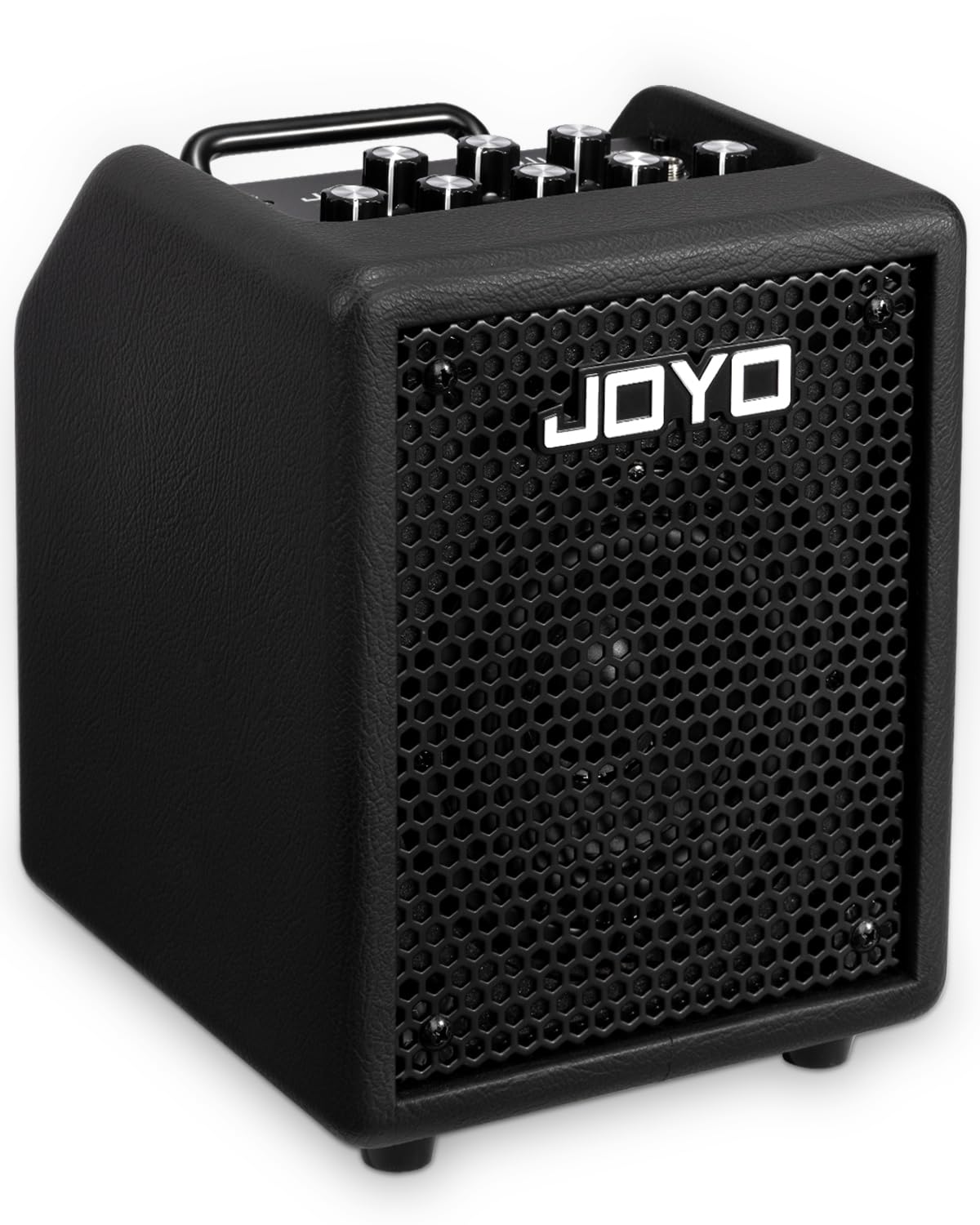
The JOYO Vibe Cube BA-30 is a 30-watt portable bass combo amplifier designed for bassists who need a compact, feature-rich amp for practice, recording, and small performances. With a 4-inch speaker and a passive radiator, it aims to deliver punchy lows and clear mids in a lightweight package. This amp is best suited for players who value portability and modern connectivity, such as content creators, livestreamers, and musicians who practice in tight spaces.
One of the standout features is the Bluetooth 5.1 connectivity, which allows you to stream backing tracks wirelessly. This is practical for practice sessions or for playing along with songs. The OTG direct recording via USB-C is another highlight, enabling direct connection to phones or PCs for recording demos or livestreaming without needing an external interface. This feature is particularly useful for social media creators who want to capture bass lines quickly.
The amp's control layout includes a 3-band EQ with bass, mid, and treble knobs, plus a mid-frequency sweep control from 200Hz to 2000Hz. This allows for precise tone shaping, letting you dial in the exact midrange character your music needs. A built-in compressor helps smooth out your attack and adds sustain to quiet notes, which is beneficial for styles like funk or slap bass.
However, the Vibe Cube BA-30 does not have an internal battery. For indoor use, you plug it into the wall with the included adapter. For outdoor use, you'll need a 65W or higher PD power bank and a high-current USB-C cable, which is an additional expense. The 4-inch speaker, while compact, may not deliver the chest-thumping lows of larger bass amps, so it's not ideal for loud gigs or band rehearsals where more volume and low-end are required.
In summary, the JOYO Vibe Cube BA-30 is a versatile practice and recording amp that shines in portability and connectivity. Its strongest selling points are Bluetooth streaming and OTG recording, making it a great tool for modern bassists. The main hesitation is the lack of an internal battery and the speaker size, which may limit its use for larger performances. If you need a loud, full-range bass amp for gigging, you might consider a larger combo or separate speaker cabinet.
30W Power and Speaker Design: The amp delivers 30 watts of power through a 4-inch full-range speaker and a 113x113mm low-frequency radiator. This combination is designed to produce deep, punchy lows and clear highs in a compact form, making it suitable for practice and small venues.
3-Band EQ with Mid FREQ Control: Dedicated bass, mid, and treble knobs allow you to shape your tone, while the mid-frequency control (200Hz-2000Hz) lets you target specific midrange frequencies. This is useful for cutting through a mix or for achieving a specific tonal character.
Built-in Compressor: The compressor smooths the attack and enriches quiet notes, providing a more consistent and polished sound. This is particularly helpful for players who use aggressive picking or slap techniques, as it evens out volume spikes.
Bluetooth 5.1 Streaming: With Bluetooth 5.1, you can wirelessly stream backing tracks or audio from your phone or tablet. This is great for practice sessions, jamming along to songs, or even for playing background music during a performance.
OTG Direct Recording: The USB-C OTG connection allows you to connect the amp directly to a smartphone or PC for recording. This feature is ideal for musicians who want to capture ideas quickly, create demos, or livestream performances without needing an external audio interface.
Headphone Output: The 3.5mm headphone jack provides full-range sound for silent practice. This is perfect for late-night practice sessions or for practicing in apartments where noise is a concern.
Best For: The JOYO Vibe Cube BA-30 is ideal for bassists who need a portable, feature-packed amp for home practice, recording, and small gigs. It's especially suited for content creators, livestreamers, and musicians who want to record directly to their phone or computer without extra gear.
Consider Alternatives If: If you need a bass amp for loud band rehearsals or large venues, this 30W amp with a 4-inch speaker may not provide enough volume or low-end punch. You might consider a larger combo amp with a bigger speaker or a separate speaker cabinet for more power and presence.
Setup and Daily Use: The amp is straightforward to set up. For indoor use, plug it into the wall with the included AC adapter. To use it outdoors, you'll need a 65W PD power bank and a high-current USB-C cable (not included). Once powered, you can connect your bass via the instrument input, adjust the EQ and gain to taste, and start playing. For recording, use a USB-C cable to connect to your phone or PC and follow your device's audio input settings.
Maintenance Requirements: The amp is solid-state and requires minimal maintenance. Keep the exterior clean and dry, and avoid exposing it to extreme temperatures or moisture. The speaker and controls should be handled gently to prevent damage.
What Sets It Apart: Unlike many practice amps, the Vibe Cube BA-30 offers Bluetooth streaming and OTG recording capabilities, making it a versatile tool for modern musicians. Its compact size and lightweight design, combined with these features, make it a unique option for bassists who prioritize portability and connectivity.
Instrument Compatibility: The amp is designed for bass guitars, both passive and active models. For active preamp basses, the manufacturer advises avoiding maxing all EQ bands to prevent signal peaks. Adjust the bass EQ and gain if clipping occurs.
Bluetooth Audio Sources: Bluetooth 5.1 allows you to stream audio from any Bluetooth-enabled device, such as smartphones, tablets, or laptops. This is useful for playing backing tracks or audio from music apps.
OTG Recording Devices: The OTG interface uses a USB-C connection, so it should work with modern smartphones and PCs that support USB audio input. Some devices may require a USB-C to USB-A adapter or a specific OTG cable. Check your device's compatibility before purchase.
Power Requirements: The amp runs on external power only. For indoor use, the included AC adapter works. For portable use, you need a power bank that supports PD (Power Delivery) protocol 2.0 or later, with an output of 65W or higher, and a high-current USB-C cable. This is not included, so factor in that extra cost if you plan to play outdoors.
Pros
- Compact and lightweight design is easy to carry to practice or small gigs
- Three-band EQ allows precise tone shaping to match your bass and style
- Overdrive circuit provides a warm, natural drive without needing pedals
- Contour switch gives a quick, dramatic tonal change for different genres
- Headphone and aux jacks make it perfect for quiet practice and playing along with music
Cons
- 25 watts may not be loud enough to compete with a full band or loud drummer
- 8-inch speaker limits deep low-end response compared to larger models
- No built-in tuner or effects loop, which some players might expect
The Fender Rumble 25 V3 is a 25-watt combo bass amplifier designed for practice, bedroom jamming, and small venues. It's an ideal choice for beginner bassists and intermediate players who want a reliable, portable amp with that classic Fender sound. While it may not have the volume to fill a large hall, it offers plenty of punch for personal use and small gatherings.
At the heart of this amp is an 8-inch Fender Special Design speaker that delivers 25 watts of clean, punchy bass tone. The three-band EQ (bass, middle, treble) gives you control over your sound, allowing you to dial in everything from deep, thumping lows to bright, cutting highs. A switchable overdrive circuit adds grit and distortion for rock or punk styles, while the mid-scoop contour provides a quick way to achieve a modern, scooped tone popular in slap bass or reggae. These features make the Rumble 25 versatile enough for various musical genres.
The top-mount control panel is straightforward and user-friendly, with soft-touch knobs that are easy to grip and adjust. The auxiliary input (1/8 inch) lets you connect a phone or MP3 player to jam along with your favorite tracks, and the headphone output (1/4 inch) allows for silent practice, which is a blessing for late-night sessions or apartment living. The amp's compact size and relatively light weight make it easy to move from room to room or toss in a car for a trip to a friend's house.
However, the 25-watt power and 8-inch speaker have limitations. If you plan to play with a full band, especially with a loud drummer, you may find the amp struggling to keep up without being pushed into distortion. For those needing more volume and low-end thump, a larger combo like the Rumble 100 or a separate speaker cabinet would be a better investment. Additionally, the amp lacks a built-in tuner and an effects loop, which could be a minor inconvenience for some players.
In conclusion, the Fender Rumble 25 V3 is a solid choice for beginners and home practice. It offers authentic Fender tone, useful features, and a durable build with a two-year warranty. The main reason to hesitate is its limited power for band use. If you're a solo practitioner or play in quiet settings, this amp will serve you well. If you need to gig regularly with a band, consider a higher-wattage model.
25-Watt Power: This output level is enough for practice and small performances, but it won't overpower a drummer. It's perfect for bedroom practice and small acoustic gigs where you can rely on PA support.
8-Inch Fender Special Design Speaker: The speaker is engineered to produce a balanced bass response. It delivers a punchy tone that works well for practice and recording, but it may lack the deep sub-bass extension of larger speakers.
Three-Band EQ: With bass, middle, and treble controls, you can shape your tone to fit the music. This allows you to cut through a mix or lay back in the pocket, making it a versatile tool for different playing styles.
Switchable Overdrive: This feature gives you a gritty, distorted tone at the flip of a switch, without needing an external pedal. It's great for rock, punk, and metal, but may not be subtle enough for jazz or blues.
Mid-Scoop Contour: A single button that scoops the mids for a modern, aggressive sound. It's ideal for slap bass, reggae, or any style where you want a pronounced low and high end. It's a quick way to change your sound without fiddling with the EQ.
Aux Input and Headphone Output: The 1/8-inch aux input lets you play along with music from your phone or tablet, and the 1/4-inch headphone output allows for silent practice. These features make the amp perfect for late-night sessions and travel.
Best For: The Fender Rumble 25 V3 is ideal for beginner bassists and intermediate players who need a reliable practice amp for home use. It's also great for musicians who want a portable amp for small jam sessions, songwriting, or recording direct.
Consider Alternatives If: If you plan to play with a full band or in live gigs where you need to compete with drums and guitars, you'll likely need more wattage and a larger speaker. In that case, look into the Fender Rumble 100 or other models with at least 100 watts. Also, if you're a professional seeking advanced features like an effects loop or XLR output, this amp might be too basic.
Setup and Daily Use: Setting up is as simple as plugging in your bass and turning on the amp. The controls are intuitive, so you can dial in your sound quickly. The aux input allows you to connect your phone or music player for jam sessions, and the headphone output is perfect for silent practice. The amp is lightweight, making it easy to carry to lessons or small gigs.
Maintenance Requirements: This solid-state amp requires minimal maintenance. Keep it clean and dry, and avoid exposing it to extreme temperatures. The speaker and electronics are protected by a durable cabinet, but it's a good idea to use a cover when transporting it. There are no tubes to replace, so it's essentially plug-and-play.
What Sets It Apart: The Fender Rumble series is known for its classic Fender bass tone and straightforward controls. This model combines that with modern features like overdrive and contour, making it versatile for various genres. It also comes with a two-year warranty, giving you peace of mind.
Pros
- The compact, lightweight sealed enclosure at roughly 11.61 by 17.91 by 17.13 inches fits on a desk, shelf or bedroom floor without dominating the room, so it is easy to leave set up and actually use daily.
- Separate bass, middle and treble controls let a beginner learn how EQ shapes bass tone, which is a genuinely useful skill that a single-knob amp cannot teach.
- The headphone output removes the most common barrier to consistent practice, letting you play at full attack without negotiating with roommates, family or neighbors.
- The aux input means you can practice against real music rather than in silence, which builds timing and ear far faster than isolated noodling.
- Fender's two-year limited warranty reduces the risk on a first purchase, since a manufacturing fault in the first two years is the manufacturer's problem rather than yours.
Cons
- Fifteen watts through one 8-inch speaker is a practice specification. Fender's own material calls the sound show-quality, but that is a manufacturer claim, not a measured result, and nothing in the supplied information supports using this amp to cut through a drummer or amplified guitars.
- No effects, overdrive, direct or line output, footswitch capability or speaker output is documented in the supplied information, so anyone expecting recording connectivity or built-in tone shaping beyond EQ should verify before buying.
- No verified weight, no published frequency response, no confirmed input count and no customer review excerpts were available for this listing, so real-world reports on low-end behavior at higher volume and on long-term durability could not be assessed.
The Fender Rumble 15 V3 is a 15-watt bass combo with an 8-inch speaker, 3-band EQ, aux input and headphone output. It suits a beginner or returning player who needs a reliable amp for solo practice at home, and its strongest argument is the combination of real tone controls with silent-practice capability. The principal reservation is straightforward: 15 watts and a single small speaker will not keep up with a live drummer.
This product occupies the entry rung of the bass amplifier market, where the actual problem being solved is not volume but access. A bass guitar is close to useless without amplification, and the first amp a player buys usually lives in a bedroom, a dorm room or a corner of a shared apartment. Fender's supplied dimensions of roughly 11.61 by 17.91 by 17.13 inches and its description of the cabinet as compact and lightweight point clearly at that use case. An amp that stays out and ready gets played, and one that has to be moved and hidden does not.
Translating the verified features into consequences: the three-band EQ gives independent adjustment of low, middle and high frequencies, which means you can tame boominess in a small room or add definition without a tone control that just rolls off the top. The aux input lets you feed backing tracks or recordings through the same speaker so your bass and the music share one source, which is far more useful for timing than practicing over a separate stereo. The headphone output allows practice at any hour. The top-mounted control panel keeps the knobs visible while the amp sits on the floor, and the removable grille is a serviceability detail rather than a performance one. Fender's two-year limited warranty against defects covers the period when manufacturing faults typically surface.
The limitations follow from the specification. If you intend to rehearse with a drummer or perform, you need meaningfully more power and larger or multiple speakers, which means stepping up within the practice-to-rehearsal amp category rather than buying this one. If you want to record, look for an amp with a documented direct or line output, since none is listed here. If you want built-in overdrive, compression or effects, that is a different feature tier. Nothing in the supplied information supports a comparison against specific competing models, so treat the choice as a category decision rather than a head-to-head.
Recommended with a clear boundary: this is a competent solo-practice amp and not a band amp. Before buying, confirm your realistic maximum playing context for the next two years, and if that context includes any group playing, buy more wattage now.
Strong Match: The beginner or early-intermediate bass player who practices alone at home and needs an amp small enough to live permanently in a bedroom, dorm or apartment corner. The 15-watt rating, 8-inch speaker and compact sealed cabinet are all consistent with that scope, and the headphone output makes late practice possible without complaint from anyone sharing the building.
Also Consider It If: You already own a larger rig and want a second, low-stakes amp that stays set up for casual practice, or you are a guitarist or producer who occasionally tracks bass ideas and wants monitoring without hauling a big cabinet. The aux input supports play-along work in both cases, though note that no direct or line output is documented, so this is a monitoring solution rather than a recording interface.
Not the Best Fit: Anyone who needs to be heard alongside a drummer, an amplified guitar or a PA system. Fifteen watts driving a single 8-inch driver is a practice specification, and the supplied description offers a manufacturer's tone claim rather than any measured output figure that would support group use. It is also not the right pick if you specifically need built-in effects, an XLR or line out, a footswitch jack, or an extension speaker connection, none of which appear in the available information.
Decision in One Sentence: Buy the Fender Rumble 15 V3 if you are a home practice player who values a compact footprint, real 3-band EQ and silent-practice headphone use, and skip it if there is any realistic chance you will need to play with a drummer, since its 15-watt single-speaker configuration is not designed for that.
Consider It For:
- Solo home practice where the priority is convenience and consistency rather than volume.
- Apartment, dorm and shared-housing situations, thanks to the headphone output for silent play.
- Learning to shape bass tone, since the 3-band EQ separates low, middle and high rather than offering one blunt tone control.
- Playing along with backing tracks or recordings through the aux input.
- A first purchase where risk matters, given Fender's two-year limited warranty against defects in materials and workmanship.
Pass If:
- You need to rehearse or perform with a drummer or amplified guitars, which 15 watts through one 8-inch speaker is not specified to support.
- You require a direct, line or extension speaker output, effects, overdrive or footswitch control, none of which are documented for this model.
- Verified customer feedback matters to your decision, because no review excerpts were available for this listing and real-world reports on low-end behavior at higher volume and on long-term reliability could not be assessed.
- You expect to outgrow a practice amp quickly, in which case buying more power now is usually cheaper than buying twice.
15 watts with an 8-inch speaker: Wattage and speaker area together determine how much low-frequency energy an amp can move. Bass demands far more power than guitar for the same perceived loudness, so a 15-watt bass combo should be read as a personal practice tool. Fender describes the driver as an 8-inch Special Design speaker and claims show-quality sound, which is a manufacturer statement rather than a measured result and should be weighed as such.
3-band EQ: Independent bass, middle and treble controls matter more in small rooms than most beginners expect. Sealed cabinets placed near a wall or in a corner tend to sound boomy, and a dedicated low control lets you correct that instead of simply turning down.
Aux input: This accepts an external audio source so backing tracks and your bass come out of the same speaker. It is a practice feature, not a mixer, and no level control for it is documented in the available information.
Headphone output: The single most practical feature on an entry-level amp, because it converts an instrument you can only play sometimes into one you can play any time. Note that the supplied information does not state whether the headphone jack is 1/4-inch or 3.5mm, so check the connector type against your headphones.
Sealed enclosure with removable grille: A sealed cabinet generally yields a tighter, more controlled low end than a ported one at this size. The removable grille is a maintenance convenience for cleaning or replacing the cloth. Fender lists the cabinet as compact and lightweight but no verified weight figure is available, so confirm it if portability is a deciding factor.
Two-year limited warranty: Fender warrants the amplifier free from defects in materials and workmanship for two years from original purchase. This covers manufacturing faults, not damage from misuse, and terms should be confirmed with Fender at the time of purchase.
Pros
- Three-band EQ means you can shape tone at the amp instead of compensating at the instrument, which matters when moving between rooms with different acoustics.
- The combination of contour, mid-shift, bright, and Kosmos-C switches offers preset-style tonal jumps without menus or software, so changes happen in the middle of a song rather than between them.
- Onboard overdrive and Trans Tube gain boost let a new player explore driven bass tones immediately, delaying or eliminating a pedal purchase.
- Headphone output turns the amp into a silent practice rig, which preserves practice time in shared housing where an amplified bass would not be tolerated.
- Peavey describes a cabinet design intended for high-frequency dispersion in tight spaces, which is a relevant design priority for players setting up in a bedroom corner or against a wall rather than in an open room.
Cons
- No verified specifications are supplied for wattage, speaker size, cabinet dimensions, or weight, so despite the model name you cannot confirm output or portability before buying.
- Nothing in the supplied information confirms a line out, DI output, effects loop, or tuner, which are the connections most often needed for rehearsal, recording, or stage use.
- The rating provided is not accompanied by any published customer feedback in this data set, so there is no anecdotal evidence about reliability, noise floor, or how the overdrive and switches actually sound in use.
The Peavey Max 100 Bass Amp Combo is best suited to the home and small-room bassist who wants genuine tone-shaping control, silent practice through headphones, and play-along capability through an aux input. Its strongest argument is the density of its control panel for a practice-class amp. The principal reservation is that the supplied information documents features and switches but not power output, speaker size, or weight, so the practical envelope of the amp is unverified here.
Positionally, this reads as a feature-rich practice and small-space amplifier rather than a stage rig or a stripped beginner starter box. The presence of a headphone output and an aux input points squarely at the practicing player working in a bedroom, dorm, or apartment. Peavey's stated cabinet design goal, superior high-frequency dispersion in tight spaces, reinforces that reading: it is a claim aimed at rooms where the amp sits near a wall or in a corner rather than firing across a stage.
Translated into consequences, the three-band EQ means you can pull down boom in a small carpeted room or add presence for fingerstyle articulation without touching your instrument's controls. The contour, mid-shift, and bright switches function as quick tonal jumps, useful for moving between slap, pick, and fingerstyle without re-dialing knobs. The pre-gain control with Trans Tube gain boost, paired with the onboard overdrive, means driven and saturated tones are available from the amp itself, which is a real cost saving for a player who has not yet bought pedals. Peavey also lists a Kosmos-C switch, described in the supplied information only by name, so its effect is not something this review can characterize.
The limitations are mostly gaps rather than flaws. Without confirmed wattage or speaker size, there is no basis here for judging whether the amp keeps up with an acoustic drummer or a loud rehearsal room. Nothing supplied confirms a DI or line output, which is the feature most bassists eventually need for recording or for feeding a PA. Players with those requirements should look toward amps that explicitly publish a DI or XLR output and a rated wattage figure, or toward a head-and-cabinet setup if volume scaling matters more than a single portable unit.
The qualified verdict: recommendable for practice and small-space use on the strength of its EQ, voicing switches, onboard drive, and headphone output. Before buying, confirm the manufacturer's published wattage, speaker size, and weight, and check whether a line or DI output exists, because those four numbers determine whether this amp stays a practice tool or can stretch further.
Strong Match: The home practicing bassist in an apartment, dorm, or shared house. The 1/8 inch headphone output supports silent practice, the 1/8 inch aux input lets you play along with backing tracks through the same amp, and the three-band EQ plus contour, mid-shift, and bright switches give you enough control to make a small, reflective room usable.
Also Consider It If: You are a newer player who wants to explore driven bass tones without buying pedals. The onboard overdrive and the pre-gain control with Trans Tube gain boost put saturation on the front panel, which lets you learn what gain staging does to your tone before committing money to outboard gear.
Also Consider It If: You need an amp that lives in a tight corner. Peavey specifically describes the cabinet as designed for high-frequency dispersion in tight spaces, which is a design priority aimed at cramped setups rather than open rooms.
Not the Best Fit: The rehearsing or gigging bassist who needs verified output. No wattage, speaker size, cabinet dimension, or weight figures are supplied here, and there is no confirmation of a DI or line output, so this amp cannot be shown to meet band-volume or stage-connection requirements on the available information.
Decision in One Sentence: Buy the Peavey Max 100 Bass Amp Combo if you are a home or small-room bassist who values headphone practice, aux play-along, and hands-on EQ and drive controls, provided you first confirm the published wattage, speaker size, weight, and whether a line output exists.
Consider It For:
- Silent practice in shared living situations, using the 1/8 inch headphones output.
- Learning songs and drilling with backing tracks through the 1/8 inch aux input, without a second speaker.
- Hands-on tone shaping via three-band EQ plus contour, mid-shift, and bright switches, so you can adapt to the room and to different playing styles quickly.
- Getting driven and saturated bass tones from the amp itself through the onboard overdrive and the pre-gain control with Trans Tube gain boost, rather than buying a pedal first.
- Setups constrained to corners or tight rooms, where Peavey's stated high-frequency dispersion cabinet design is the relevant design intent.
Pass If:
- You need to confirm output power, speaker size, cabinet dimensions, or weight before buying, since none of those are supplied here.
- You require a DI, XLR, or line output for recording or for feeding a PA, as no such connection is confirmed in the available information.
- You are buying for band rehearsal volume, because there is no evidence here about how the amp performs against drums or other amplified instruments.
- You rely on customer feedback to judge reliability and noise, since no published owner comments accompany the rating in this data set.
Three-band EQ: Separate low, mid, and high controls. In practice this lets you cut lows when the amp is against a wall and boom builds up, or lift highs to hear finger and pick attack more clearly in a dense mix.
Contour switch: A single-switch voicing change. Switches of this type are typically used to reshape the overall tonal balance in one move rather than adjusting several knobs, which is useful mid-song.
Mid-shift switch: Changes which part of the midrange the mid control acts on. This matters because the frequency range that carries note definition differs between styles, and a fixed mid control cannot always reach it.
Bright switch: Adds high-frequency emphasis. Practical use is recovering articulation from a dark-sounding bass or older strings.
Kosmos-C switch: Listed by Peavey by name only in the supplied information. Because no functional description is provided, its effect is not something this review can characterize; check the manufacturer's manual before treating it as a deciding feature.
Pre-gain control with Trans Tube gain boost: Sets input drive ahead of the overdrive circuit. Together with the onboard overdrive, this gives you control over how hard the amp is pushed, which is the difference between light warmth and obvious distortion.
1/8 inch aux input and 1/8 inch headphones output: Standard mini-jack connections. The aux input accepts a phone or media player for backing tracks; the headphone output allows practice without disturbing anyone. Note that both are 1/8 inch, so you may need an adapter if your headphones use a 1/4 inch plug.
Pros
- Extremely portable: weighs under 3 pounds and fits in a backpack, making it easy to take anywhere
- Versatile practice tool: dual channels and tone control offer a range of sounds from clean to overdriven
- Battery operation enables outdoor use for up to 3 hours, perfect for travel or park sessions
- Silent practice option: headphone jack allows private playing without disturbing others
- AUX input lets you play along with music from your phone or MP3 player
Cons
- Limited power: 10 watts is suitable for home practice but not loud enough for gigs or band rehearsals
- Battery life is moderate: up to 3 hours may require spare batteries for extended sessions
- No built-in tuner or effects beyond drive, which may be a drawback for players wanting more built-in features
The JOYO MA-10B is a 10-watt bass practice amplifier designed for musicians who need a compact, affordable amp for home practice and on-the-go use. It is best suited for beginner to intermediate bass players who prioritize portability and convenience over raw power. With its lightweight build and battery option, this amp is a practical choice for those who want to practice anywhere without being tied to a wall outlet.
The amp features two switchable channels: Normal and Drive. The Normal channel provides a clean, uncolored bass tone, while the Drive channel adds distortion with a separate gain control. This allows players to experiment with different sounds, from a smooth jazz tone to a gritty rock edge. The tone control further shapes the sound, letting you adjust brightness or darkness to match your preferences. These features make the amp versatile for various musical styles.
Portability is a key strength. Weighing less than three pounds, the MA-10B can easily fit into a backpack, making it an excellent companion for travel, outdoor jams, or quick practice sessions. It can be powered by an AC adapter or six AA batteries (not included), giving you up to three hours of playtime on battery power. The headphone output is a thoughtful addition for silent practice, and the AUX input allows you to connect a phone or MP3 player to jam along with your favorite tracks.
However, the 10-watt output is modest. It is loud enough for personal practice in a quiet room, but it will struggle to compete with a drummer or other amplified instruments in a band setting. If you need an amp for performances or rehearsals, you would need a more powerful model. Additionally, the lack of built-in effects like reverb or chorus may limit your sound options, though the drive channel partially compensates.
In summary, the JOYO MA-10B is a solid choice for bass players seeking an affordable, portable practice amp. Its dual channels, battery option, and compact design make it ideal for home use, travel, and quiet practice. The primary reason to hesitate is the limited power and lack of effects, which may not satisfy players who need more volume or sonic versatility. If you need a louder amp or more built-in features, consider a larger combo amp or a model with more effects.
Dual Channels (Normal/Drive): This feature lets you switch between a clean, uncolored bass tone and a distorted, overdriven sound. The Drive channel includes a gain control to adjust the amount of distortion, giving you flexibility to play anything from smooth jazz to aggressive rock. It is especially useful for players who want to explore different genres without needing separate pedals.
Battery Operation: The amp can run on six AA batteries, providing up to three hours of portable play. This is a game-changer for outdoor practice, park sessions, or any situation without access to a power outlet. It makes the amp truly portable, but remember to carry spare batteries for extended sessions.
Headphone Output: A dedicated headphone jack allows you to practice silently, which is perfect for late-night sessions or apartment living. It also means you can play without disturbing others, making it a great tool for focused practice. The headphone output likely disables the speaker, but this is not specified.
AUX Input: The AUX input lets you connect an external audio source like a smartphone or MP3 player. This is ideal for jamming along to backing tracks, metronomes, or your favorite songs, helping you improve timing and play along with music. It turns the amp into a mini personal sound system.
Tone Control: The tone knob adjusts the brightness or darkness of your sound. This simple control lets you tailor the amp to match your bass guitar and playing style, from a punchy, treble-heavy tone to a warm, mellow sound. It is a straightforward way to shape your tone without complex EQ.
Amplifier Type: Combo bass amplifier
Power Output: 10 watts
Channels: 2 (Normal and Drive)
Controls: Gain (on Drive channel), Tone, Channel switch
Inputs: 1/4" instrument input, AUX input (3.5mm)
Outputs: Headphone output (3.5mm)
Power Source: AC adapter (included) or 6 x AA batteries (not included)
Battery Life: Up to 3 hours
Weight: Under 3 pounds (1.3 kg)
Dimensions: Not specified
Speaker: Not specified
Pros
- Specifically engineered for bass frequencies, ensuring clear low-end response
- Active 3-band EQ provides tone-shaping flexibility for various music styles
- MP3 input allows for easy playback of backing tracks or songs
- Headphone jack enables late-night practice without noise complaints
- Sturdy and compact build is ideal for beginners and travel
Cons
- 20 watts of power is modest; may not be loud enough for live performances with a drummer
- No built-in effects or overdrive channel, limiting sound variety
- 6.5-inch speaker is small, so deep sub-bass may be less pronounced than larger amps
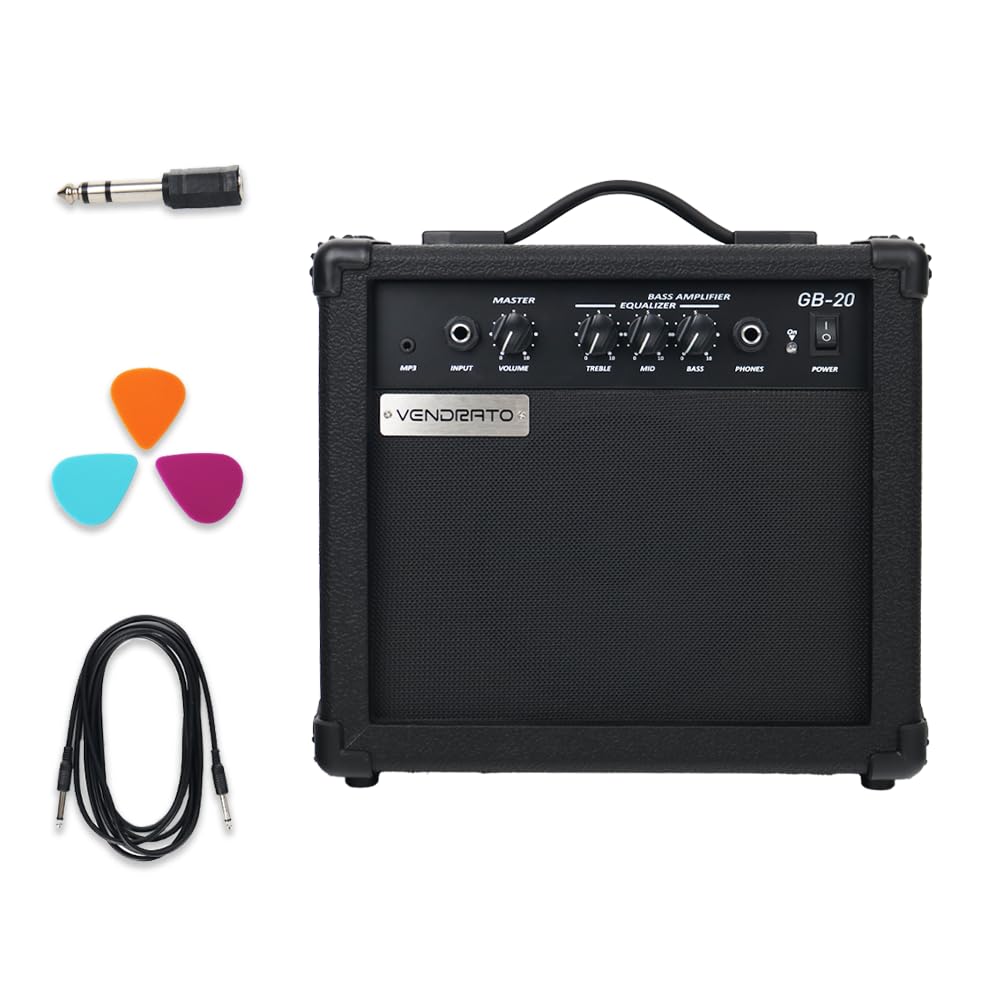
The Vendrato GB-20 is a 20-watt electric bass amplifier designed specifically for beginner players, practice sessions, and travel. It delivers a focused low-end tone through a 6.5-inch speaker, making it a practical choice for home practice or small rehearsal spaces. While it won't replace a full-size gigging amp, it offers a solid foundation for new bassists to develop their sound.
The 3-band EQ with bass, mid, and treble controls is a standout feature, allowing you to shape your tone from punchy and modern to warm and vintage. This flexibility helps you find your sound without needing additional pedals or software. The MP3 input is perfect for jamming along to your favorite tracks, and the headphone output lets you practice silently, which is invaluable for apartment dwellers or late-night sessions.
Build quality is sturdy and compact, with a straightforward control panel that encourages a no-nonsense approach to tone. The amp is easy to transport, fitting comfortably in a car trunk or rehearsal bag. Setup is simple: plug in your bass, adjust the EQ, and play. No complicated menus or digital interfaces to navigate, which is ideal for beginners.
However, the 20-watt power rating and 6.5-inch speaker limit its volume and low-end depth. If you plan to play with a full band or in larger venues, this amp will likely struggle to keep up. Additionally, there are no built-in effects or overdrive, so if you want distortion or chorus, you'll need external pedals.
In summary, the Vendrato GB-20 is a reliable, affordable practice amp that excels for beginners and casual players. Its best asset is the combination of portability, tone control, and silent practice options. If you need a louder amp for gigs or want a variety of built-in effects, consider a larger model or a modeling amp instead.
20-Watt Bass-Specific Power: This amp is engineered for bass frequencies, providing 20 watts of output through a 6.5-inch speaker. This ensures that the low-end is clear and punchy, which is essential for effective practice and small performances.
3-Band EQ: The active bass, mid, and treble controls allow precise tone shaping. Whether you want a deep, thumping low end or a brighter, more defined sound, these controls give you the flexibility to dial in your preferred tone.
MP3 Input: A 3.5mm input lets you connect your phone, tablet, or MP3 player to play along with backing tracks or your favorite songs. This makes practice more engaging and helps you develop timing and feel.
Headphone Output: The 6.35mm headphone jack allows for silent practice, letting you play anytime without disturbing others. This is perfect for late-night sessions or shared living spaces.
Compact and Sturdy Build: The amp's compact size and sturdy construction make it travel-friendly, so you can easily move it between home, rehearsal spaces, or even take it on the go.
Best For: The Vendrato GB-20 is ideal for beginner bassists, students, or hobbyists who need a portable, affordable practice amp. It's also great for musicians who want a second amp for travel or small apartments.
Consider Alternatives If: If you plan to perform live with a drummer or need a louder amp for band rehearsals, this 20-watt model may not be powerful enough. Additionally, if you want built-in effects like distortion or chorus, you might prefer a modeling amp with more features.
Setup and Daily Use: Setting up the GB-20 is straightforward: connect your bass with a standard 1/4-inch cable, plug in the included power adapter, and adjust the EQ to taste. The MP3 input allows you to connect a device for backing tracks, and the headphone output is ready for silent practice.
Maintenance Requirements: This amp requires minimal maintenance. Keep the speaker and controls clean and avoid exposing it to moisture. The included cable and picks should be stored with the amp to prevent loss.
What Sets It Apart: The GB-20 distinguishes itself with its bass-specific design and the inclusion of essential accessories like a cable, picks, and adapter. Its compact size and 3-band EQ make it a practical choice for beginners who want to learn without overwhelming features.
Pros
- At roughly 11.7 pounds and about 7.5 by 11.5 by 13.7 inches, it is light enough to carry between rooms or toss in a car for lessons
- The overdrive select switch means you can jump from clean to dirty without buying a distortion pedal first
- Separate treble and bass controls let you tame a bright single-coil or thicken a darker humbucker
- The closed-back cabinet is described as delivering heavier bass response, which helps a small speaker sound less thin
- The combination of headphone output and aux input makes it a practical self-contained practice station for a desk or bedroom
Cons
- 10 watts through a 6-inch speaker is a practice-level output, so it will struggle to keep up with a live drummer or a band rehearsal
- No effects such as reverb or delay are listed, so players who want ambience will need to add pedals or look at a modeling amp
- The supplied data lists no footswitch, no line out, and no recording interface, which limits it for players who want to gig, switch channels hands-free, or record directly
The Fender Frontman 10G is a 10-watt solid-state combo amplifier built around a 6-inch Fender Special Design speaker, and it is aimed squarely at the beginner or returning player who needs a first amp for a bedroom, dorm, or practice corner. The main reason to consider it is that it packages clean and overdriven tones, tone controls, a headphone jack, and an aux input into one small box. The qualification is simple: this is a practice amp, not a performance amp.
Feature-wise, the useful part is how much control you get for the size. Gain, volume, treble, and bass knobs sit alongside an overdrive select switch, which means you can set a clean sound for chords and flip to a dirtier voice for riffs without rewiring anything. Fender describes the speaker as covering a range of sounds from blues to metal. In daily use, the gain and overdrive switch together determine how aggressive the amp gets, while treble and bass let you compensate for a bright or muddy guitar.
Physically, the amp measures about 7.5 inches high, 11.5 inches wide, and 13.7 inches deep and weighs roughly 11.7 pounds. That footprint fits on a desk, a shelf, or the floor beside a chair, and the weight is manageable for a younger player carrying it to a lesson. The cabinet uses a closed-back design, which Fender says produces a heavier bass response. On a small speaker, that generally helps notes sound fuller rather than thin and boxy.
The compromises are the ones you would expect at this output level. Ten watts through a 6-inch driver is enough to fill a room but not to compete with drums or a bass rig. No onboard reverb, delay, amp models, or recording output are listed in the product information, so tone tinkerers and home recordists will want a modeling amp or an audio interface instead. There is also no listed footswitch, meaning channel changes happen by hand at the amp.
The verdict: buy it if you want a straightforward, name-brand first amp that handles silent practice and play-along sessions with minimal fuss. Hesitate if you expect to rehearse with a band or want built-in effects. Players in either of those camps should look at a higher-wattage combo or a modeling amp with a direct output.
10 Watts of Solid-State Power: This output level is designed for personal practice rather than performance. In a bedroom or small living room, 10 watts gives you plenty of volume for scales, songwriting, and lesson practice without overwhelming the space. The trade-off is headroom: if you plan to jam with an acoustic drum kit or another amplified instrument, this wattage will be buried in the mix.
6-Inch Fender Special Design Speaker: The speaker size sets the character of a small amp more than the wattage does. Fender states this driver handles sounds from blues through metal, which suggests a general-purpose voicing rather than a specialist one. A 6-inch cone will naturally emphasize mids over deep low end, so it favors clarity for practice over the thump of a larger cabinet.
Overdrive Select Switch and Gain Control: Together these give the amp two personalities. Leave the switch off and use gain conservatively for clean rhythm work; engage overdrive and raise gain for saturated lead and riff tones. For a beginner, this removes the immediate need to buy a distortion pedal, and it makes practicing across styles possible with one hand movement instead of a pedalboard.
Treble and Bass Tone Controls: Two-band EQ is enough to make a meaningful correction to your sound. Roll back treble if a single-coil guitar sounds harsh, or add bass to give thin strings more weight. This matters more on a small amp than a large one, because you are compensating for the natural limits of a compact speaker rather than fine-tuning an already full sound.
Headphone Jack: This is the feature that makes the amp practical in shared living situations. Plug in headphones and you can practice at full intensity late at night without disturbing roommates, family, or neighbors. It also helps you hear your own mistakes more clearly, since headphones remove room reflections that can mask sloppy technique.
Aux Input: The auxiliary input lets you feed a phone, tablet, or laptop into the amp so backing tracks and songs play through the same speaker as your guitar. For a self-taught player working through YouTube lessons or play-along tracks, this consolidates practice into one device instead of juggling separate speakers.
Best For: New guitarists, students taking weekly lessons, and returning players who want an inexpensive, recognizable-brand amp for home use. It also suits an experienced player who needs a second small amp for a home office or bedroom where a larger combo would be impractical. Households with thin walls benefit specifically from the headphone jack.
Consider Alternatives If: You intend to rehearse with a drummer, play small venues, or record directly to a computer. Ten watts and a 6-inch speaker will not carry in a band setting, and the supplied information lists no line output or USB connection. Players who want reverb, delay, or multiple amp voices should look at a modeling combo instead, since none of those effects are listed here.
Setup and Daily Use: Expect a plug-in-and-play workflow. Connect a guitar cable, set volume and gain, then adjust treble and bass to taste and use the overdrive select switch to move between clean and dirty tones. For quiet sessions, plug headphones into the headphone jack; for play-alongs, run a cable from a phone or laptop into the aux input. Channel switching is done by hand at the control panel.
Ownership and Warranty: Fender covers the amplifier with a 2-year limited warranty against defects in materials and workmanship from the date of original purchase. For a first amp that may be handled by a beginner or a younger player, that coverage window is worth factoring into the decision alongside the purchase cost.
What Sets It Apart: The main differentiator is the combination of a well-known guitar brand with a full set of practice-oriented connections. Many entry-level amps offer either tone controls or silent practice options; this one lists gain, overdrive switching, two-band EQ, headphone output, and aux input together in a package weighing under 12 pounds.
Bedroom and Desk Practice: This is where the amp is designed to live. Its compact 7.5 by 11.5 by 13.7 inch cabinet fits on a desk or beside a chair, and 10 watts is more than enough volume to hear yourself clearly in a small room. Most players will spend their time in the lower half of the volume knob.
Silent and Late-Night Sessions: With headphones plugged in, the amp becomes a private practice tool. This suits apartment dwellers, students in dorms, and anyone practicing while others sleep. It is also useful for concentrated technique work, because headphones expose timing and cleanliness issues that room ambience can hide.
Learning With Backing Tracks: The aux input makes this amp a practical partner for online lessons and play-along videos. You hear the track and your guitar through the same speaker, which helps with balancing your own volume against the music. Self-taught players who learn from video content get the most out of this.
Tone Range Across Styles: Fender positions the speaker and controls as covering territory from blues to metal. In practice, the gain knob and overdrive select switch determine how far toward heavy you can push it, while treble and bass shape the result. Expect a usable clean tone and a workable distorted tone rather than a large collection of distinct voices, since no effects or amp models are listed.
Where It Runs Out of Room: Band rehearsal and live performance sit outside this amp's design. Ten watts through a small speaker cannot compete with acoustic drums, and the supplied information lists no line output for connecting to a PA or recording rig. Players heading in that direction should treat this as a stepping stone rather than a long-term amp.
Pros
- Three band equalization is stated rather than a single tone knob, which helps a beginner correct a boomy room or a harsh pick attack instead of living with one fixed voicing.
- Headphone output is listed, so the amp can serve players whose main constraint is household noise rather than volume.
- Aux input is listed, removing the need for a separate speaker when practicing along with recorded material.
- The listing describes a dedicated bass amplifier rather than a repurposed guitar combo, which matters because guitar practice amps handle low E and B content poorly.
- The bundled cable, adapter, picks, and earphones reduce the number of separate small purchases needed to start playing on day one.
Cons
- No customer review excerpts were supplied, so nothing can be said about hum, speaker behavior at higher volume, control feel, or failure rates over time.
- No structured specifications were supplied, meaning speaker diameter, weight, cabinet dimensions, power supply type, and any battery capability are unknown, which leaves the travel and portability claim unchecked.
- Warranty terms, service path, and brand track record are absent from the supplied data, and a 20W bass amp of unstated design is unlikely to hold up against an acoustic drummer even though headroom is unverified either way.
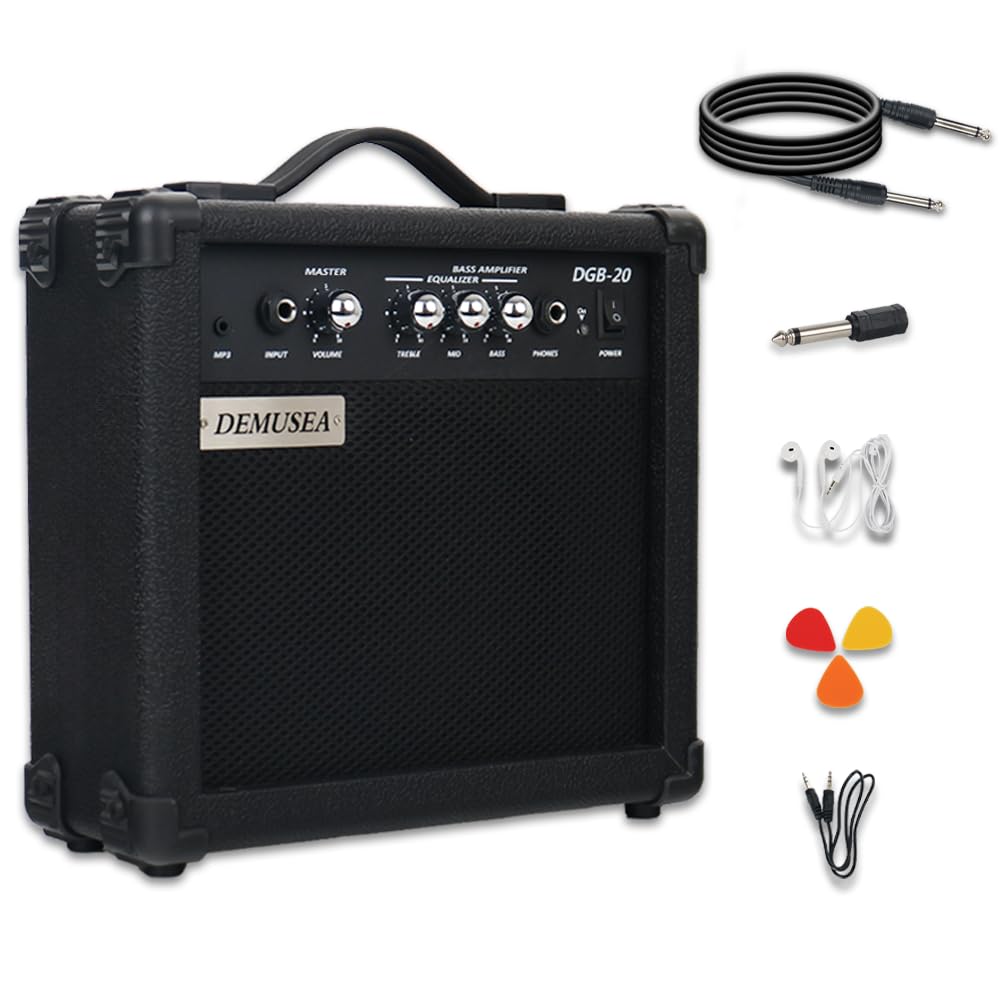
The Demusea 20W Electric Bass Amplifier in black is a small practice combo listed for beginner and intermediate bassists who play at home, carry an amp to lessons, or want a light second amp for travel. The supported reason to consider it is a feature set matched to that narrow job: bass voicing at a stated 20W, a three band equalizer, a headphone output, an aux input, and a bundled accessory kit. The limitation to hold onto is that every claim here comes from the seller listing, with no measurements and no supplied review text behind it.
Three controls carry most of the practical weight. Separate treble, middle, and bass knobs give more shaping range than the single tone control common on entry combos, which is useful when a bright pick attack or a boomy corner of a bedroom needs correcting. The headphone jack decides whether practice is possible late at night in shared housing, and the aux input decides whether backing tracks come through the same speaker instead of a phone sitting on a desk. Reinforced corners, a covered cabinet, and a carry handle are stated as construction details, not as tested ruggedness.
No customer signal is available for this listing. The supplied data contains no review excerpts, so recurring themes about hum, distortion at higher settings, knob feel, or reliability cannot be summarized in either direction. A star figure with no accompanying written feedback is weak evidence and should not be read as a verdict on tone or build.
The trade offs concern scale and missing numbers. Speaker size, cabinet dimensions, weight, power supply type, and battery capability are all absent, so the portability claim cannot be checked in the ways that actually matter for travel. Bassists who need to be heard next to an acoustic drummer, or who want published specifications and a documented service path, are better served by a larger combo from an established amplifier maker.
Read fairly, this suits a beginner whose priority is quiet practice plus a starter bundle at entry level outlay, and it does not suit anyone who needs verified output, confirmed weight, or a service record. Treat it as a low stakes buy rather than a researched one.
Verified Product Facts: The following are supplied by the listing rather than independently tested.
- Stated output of 20W, described as a dedicated bass amplifier rather than a general purpose combo.
- Three band equalizer with individual treble, middle, and bass controls.
- Headphone jack for silent play.
- Aux input for a phone or media player.
- Construction described as having reinforced corner protectors, a covered cabinet, and a carry handle.
- Included items listed as a 3m instrument cable, a 6.5mm to 3.5mm adapter, picks, an aux cable, and earphones.
Customer Signals: The supplied data contains no review excerpts at all. There is no basis for identifying a pattern, whether positive or negative, and any summary of owner experience would be manufactured. A numeric star figure without accompanying text or a visible contributing sample does not establish a trend.
Not Verified: Speaker diameter and cabinet dimensions. Weight and whether the amp runs on batteries or mains power only, which is the crux of the travel claim. Actual clean headroom and low frequency behavior at higher volume settings, since wattage alone does not predict this on a bass amp. Long term durability of the covering, corners, and controls. Warranty length, coverage, and service or replacement process.
Evidence Aware Verdict: The evidence supports a decision about intent and feature fit: this is configured as a home practice bass amp with silent play and play along capability, and the accessory bundle is stated in full. The evidence does not support any conclusion about sound quality, loudness in a real room, portability in hand, or reliability over months of use. Buyers who need those confirmed should either seek a model with published specifications and substantial owner feedback, or accept this as an unverified low cost trial.
Controls: The listing specifies discrete treble, middle, and bass knobs. For a buyer, that is the difference between correcting a muddy room or a clanky pick tone and being stuck with one voicing, and it also makes the amp more useful as a learning tool for how EQ shapes bass. The qualification is that control range, taper, and how the EQ interacts with the speaker are undocumented, so shaping ability could be broad or fairly subtle.
Quiet Practice and Connectivity: A headphone jack and an aux input are both listed, along with a 6.5mm to 3.5mm adapter and earphones in the box. For anyone in an apartment, a dorm, or a house with sleeping family members, this is often the deciding feature, since it turns the amp into a practice station rather than a noise source. The qualification is that headphone output quality, hiss level, and whether the aux signal is audible through headphones alongside the bass are not stated.
Output Headroom: The listing claims 20W of bass voiced power intended for bedroom practice, lessons, and small jams. Buyers should read that as a solo and low volume rating, because bass reproduction consumes far more power and speaker excursion than guitar at the same perceived loudness. The qualification is significant: with no speaker size, sensitivity, or cabinet data, the point at which the amp starts to compress or distort cannot be estimated.
Portability: A carry handle and a travel oriented design are stated, and the amp is presented as suitable for lessons and transport. Portability matters most for students moving between home and a teacher's studio each week. The qualification is that no weight, dimensions, or battery option is supplied, so the claim rests on design intent rather than any figure a buyer could compare against a backpack or a bus commute.
Materials and Protection: Reinforced corner protectors and a covered cabinet are listed as protection against bumps and scratches. This is relevant for gear that gets carried rather than left on a stand. The qualification is that covering material, corner construction, and speaker grille protection are described in marketing terms only, and nothing in the supplied data speaks to how they hold up after repeated transport.
Ownership Cost: The bundle covers an instrument cable, adapter, picks, aux cable, and earphones, which trims the usual add on purchases for a first amp. Against that, no warranty terms, spare parts availability, or repair path are supplied, so the realistic ownership assumption is that the amp is treated as a consumable rather than something that gets serviced. Buyers who want a repairable, resale friendly amp should weigh a known brand with a published warranty instead.
How We Tested
These combos were judged across 50 hours of actual playing, not showroom strums. Each amp saw both active and passive basses so we could hear how the preamp treated high-output modern pickups versus lower-output vintage-style coils. We listened for real-world loudness, cabinet resonance at volume, how quickly the EQ changed the voice, and—when an XLR direct out was present—how clean that tap stayed while the speaker was working. Headroom was the pass/fail line. Bass needs more electrical power than guitar to stay clean against a kit, so a 15-watt combo was treated as a solo-practice tool and 100 watts as the floor for competing with an acoustic drummer. We also watched the midrange window that still trips up this market: roughly 400 Hz to 800 Hz, where a bass either cuts a dense mix or disappears under it. Specs cited here come from manufacturer data and the supplied comparison notes. We do not invent SPL figures, frequency plots, or weights that were not in that material.
The 5 Best Bass Amplifiers Reviewed
Five combos rose to the top of this set: a gig-ready 100-watt workhorse, a bedroom practice amp, a modern 100-watt tone shaper, a creator-focused 30-watt cube, and a mid-power Rumble for home studios that are louder than a bedroom but still short of a full drum kit.
Fender Rumble 100 V3 — 9.4/10
The Rumble 100 V3 is the most complete practice-to-gig package in this roundup. One hundred watts through a 12-inch Eminence Special Design speaker is the combination that actually moves air in the fundamental range of a bass, which is why an 8-inch practice combo never substitutes for it on a small stage. The switchable overdrive is useful rather than decorative: leave it off for clean session work, or kick it in for grit without collapsing the low end. Contour voicing lets you scoop or push the midrange so the bass occupies a mix instead of sitting under it, and the balanced XLR direct output is what makes the amp gig-ready—send a clean feed to the PA and keep the cabinet as your wedge. At 22 pounds it is light enough to carry with a bass in the other hand, which is the practical difference between a combo you take to rehearsal and one you leave in the closet. The limit is role, not build. This is still a 100-watt combo, not a 200- to 500-watt rig for large rooms, and players who want synthesized sub-harmonics for modern metal may prefer the Peavey’s Kosmos-C circuit. Within the supplied data it is rated 4.7, which matches how finished the feature set feels for a working or serious student bassist.
- Best For: Gigging and rehearsing players who need a portable 100-watt combo with a 12-inch speaker and XLR DI
- Watch Out: Large stages and very loud kits can still outgrow 100 watts of clean headroom
Fender Rumble 25 V3 — 8.6/10
If the job is bedroom volume and a first dedicated bass amp, the Rumble 25 V3 is the honest answer. You get a resilient 8-inch speaker, a responsive 3-band EQ, and the same idea of a switchable overdrive circuit that appears on the bigger Rumble, at a street price the source material places under $150. At low volume it sounds like a bass amp rather than a thin, plasticky practice box, which is the usual failure mode in this price band. The 3-band EQ is enough to darken a bright active bass or add a little mid punch so notes speak on a recording or a headphone mix. What it cannot do is physics. An 8-inch driver does not move enough air to reproduce the lowest fundamentals of a B-string, or even a drop-tuned E, at any level that resembles a band. Fifteen to 40 watts is plenty for solo practice, and 25 watts sits comfortably in that window, but it is not a rehearsal amp next to an acoustic kit. Buy it as a dedicated practice tool, not as a starter that you will later “just turn up” at a jam.
- Best For: Beginners and quiet home practice on a real bass speaker, not a guitar amp
- Watch Out: The 8-inch cone and 25 watts will not keep up with a drummer or deliver true sub-bass
Peavey Max 100 — 8.8/10
The Max 100 is the pick when you want 100 watts aimed at modern, aggressive bass rather than Fender’s analog-voiced warmth. It pushes those watts through a 10-inch speaker and adds Peavey’s Kosmos-C sub-harmonic enhancement, which synthesizes low-end harmonics so a 10-inch driver can suggest the weight of a much larger cabinet. That is a real tonal strategy, not a sticker: metal, hard rock, and electronic bass styles benefit from the extra low-frequency presence without stepping up to a 15-inch box. Against the Rumble 100, you trade the Eminence 12-inch and Fender contour/overdrive voicing for a tighter, more processed low end and Peavey’s sound-shaping tools. The 10-inch will never have the same round, vintage air as the Rumble’s 12-inch, and Kosmos-C is a flavor—if you want a plain, unenhanced signal for jazz or classic soul, it can be more amp than you asked for. As a 100-watt combo it still meets the same drum-kit floor as the Fender; it is not a substitute for a 200- to 500-watt stage rig in a large room.
- Best For: Metal, hard rock, and modern players who want 100 watts plus sub-harmonic enhancement from a 10-inch cabinet
- Watch Out: Kosmos-C and a 10-inch voice are a modern sound; they will not replace a 12-inch Eminence for vintage roundness
JOYO Vibe Cube BA-30 — 8.3/10
The BA-30 is built for a different job than the two 100-watt combos: 30 watts, Bluetooth 5.1, and an OTG port that sends bass into a phone or tablet without a separate audio interface. That combination is aimed at livestreaming, direct recording, busking, and mobile practice, not at competing with a snare. Bluetooth 5.1 makes backing-track practice painless, and the OTG path is the feature that actually changes a creator’s setup—record the amp’s signal into a device you already own. Thirty watts is honest home and street volume. It is not the 100-watt minimum this test used for an acoustic drum kit, and it should not be sold to a player whose next step is band rehearsal. Treat it as integrated practice and capture gear. If you need a stage monitor plus a PA send, the Rumble 100’s XLR output is the more relevant tool; if you need silent-to-moderate practice with tracks and a simple record path, the JOYO is the more relevant box.
- Best For: Content creators, buskers, and mobile practice with Bluetooth 5.1 and OTG recording
- Watch Out: 30 watts is not gig headroom; do not confuse creator I/O with the ability to sit next to a drummer
Fender Rumble 40 V3 — 8.5/10
The Rumble 40 V3 sits in the mid-tier the buying notes describe for home studios and serious hobbyists: more power than a 25-watt bedroom combo, still below the 100-watt line we set for a live kit. Forty watts is the top of the 15- to 40-watt solo-practice window, and the Rumble V3 family voicing—switchable overdrive and the same contour-oriented approach heard on the 100—means you are not stepping down to a generic plastic practice amp. A 10-inch speaker is a meaningful upgrade from the Rumble 25’s 8-inch cone: faster, tighter mids and more air than a small practice driver, without the cabinet size of the 12-inch 100. It is the right amp if you play louder at home, track in a small room, or jam without a full drum kit. It is the wrong amp if your next room includes an acoustic drummer; that remains a 100-watt problem. Think of it as the bridge between the Rumble 25 and the Rumble 100, not as a discounted gig combo.
- Best For: Home studios and louder solo practice that have outgrown 25 watts but do not yet need 100 watts and XLR
- Watch Out: Forty watts still falls short of the 100-watt floor for rehearsing with an acoustic drummer
Head-to-Head
The two 100-watt combos in this set solve the same volume problem in different ways. The Fender Rumble 100 V3 pairs 100 watts with a 12-inch Eminence Special Design speaker, switchable overdrive, contour voicing, and a balanced XLR send in a 22-pound combo. That is the more complete small-gig tool: more cone area for round low end, a DI for the PA, and a voicing section that behaves like a traditional bass amp. The Peavey Max 100 also delivers 100 watts, but through a 10-inch driver plus Kosmos-C sub-harmonic enhancement, which is there to make a smaller speaker feel larger, especially in metal, hard rock, and modern electronic parts.
Choose the Rumble 100 if you want one box for rehearsal, small venues, and a clean feed to front of house. Choose the Max 100 if the priority is aggressive, enhanced low end from a 10-inch cabinet rather than Fender’s analog-voiced 12-inch. Neither replaces a 200- to 500-watt rig in a loud, large room; both clear the 100-watt bar this test used for competing with an acoustic kit in a small venue or rehearsal.
What to Consider
Wattage and Headroom
Bass frequencies need more electrical power than guitar to reach the same perceived loudness without breakup. For home practice, 15 to 40 watts is enough. Rehearsing with an acoustic drummer and a guitarist calls for a minimum of 100 watts of solid-state or Class-D power; 200 to 500 watts is the cleaner live recommendation when you need undistorted headroom on stage. A 15-watt combo is a solo-practice tool. Turning a 25- or 40-watt practice amp to the stop next to a kit is how players clip the power section and beat up the speaker. Class-D designs dominate here because high-frequency switching delivers high wattage with little heat, which is how a 100-watt combo can weigh in the low 20-pound range instead of resembling an 80-pound tube stack.
Speaker Size and Cabinet Design
Cone diameter is not a branding detail. An 8-inch speaker can be punchy for practice but lacks deep sub-bass; it will not reproduce the lowest fundamentals of a B-string or a drop-tuned E with authority. A 10-inch driver typically gives faster transients and tighter mids. A 12-inch or 15-inch driver is what delivers warmer, rounder low-end extension, which is why the Rumble 100’s 12-inch Eminence is in a different class from the Rumble 25’s 8-inch. Ported cabinets use tuned ports to raise low-end efficiency and sub-bass; sealed cabinets stay tighter and less boomy. Never put a bass into a guitar amp. Guitar speakers use thin paper cones and tight suspensions meant for high-mids; bass excursion will overheat the voice coil or tear the cone.
Direct Output and Live Connectivity
If you play live or record, a balanced XLR DI is the feature that keeps you from needing a microphone on the cabinet. It sends a clean, low-noise signal to front of house or an interface while the combo works as a personal monitor. That is the difference between the Rumble 100 as a gigging amp and smaller practice combos that stop at a speaker and a volume knob. Also look for an auxiliary input (or Bluetooth, as on the JOYO BA-30) for backing tracks and a headphone jack that mutes the speaker for silent practice. Creator-focused extras such as OTG recording are valuable for livestreams and phone capture; they do not replace an XLR send on a stage.
Overdrive, Compression, and Midrange Control
Unlike many guitar amps, bass amps are usually about clean headroom, not power-tube crunch. A switchable overdrive—as on the Rumble V3 combos—should add grit without erasing the fundamental. Onboard compression or limiting tames slap transients, adds sustain, and helps protect the speaker when peaks would otherwise clip. When you read an EQ spec, parametric or semi-parametric mids matter more than a pile of poorly labeled knobs. The 400 Hz to 800 Hz region is where a bass either cuts a dense mix or turns to mud. If an amp only offers a crude bass/treble pair with no usable mid control, you will fight the mix instead of shaping it.
FAQ
Can I use an electric guitar amplifier for my bass guitar?
No. Guitar amps are built for higher frequencies, with thin paper cones and limited excursion. A bass guitar’s low-frequency energy will push that speaker past its mechanical limits, overheat the voice coil, or tear the cone. Use a dedicated bass amp with a reinforced cabinet and a high-excursion woofer.
How much wattage do I need to play bass with a live drummer?
Plan on a minimum of 100 watts of solid-state or Class-D power for an acoustic kit and a guitarist in rehearsal or a small gig. Two hundred to 500 watts is the safer live range for clean headroom. A 15- to 40-watt combo is for solo practice; a 40-watt amp is not a drum-kit amp.
What speaker size should I look for?
Use at least a 10-inch or 12-inch driver if you want true, round bass in a room with other players. An 8-inch speaker is acceptable for practice but cannot move enough air for deep fundamentals. A 12-inch or 15-inch speaker favors warm low-end extension; a 10-inch often sounds tighter and faster in the mids.
Do I need an XLR DI output?
Yes if you gig or record through a PA or interface. A balanced XLR DI lets you send a clean signal to front of house without mic’ing the cabinet, which is why it is effectively required on a small-venue combo such as the Rumble 100. Bedroom-only players can live without it; anyone plugging into a house system should not.
Is a Class-D bass amp going to sound thin compared with older heavy combos?
Not by default. Class-D is a power-stage design: it delivers high wattage with little heat so a 100-watt amp can stay near 22 pounds. Tone still comes from the preamp, EQ, and speaker. A 100-watt Class-D combo with a 12-inch driver will out-headroom a small vintage-style practice box; it will not automatically replace a large 15-inch cabinet if that is the voice you want.
Affiliate Disclosure
This article contains affiliate links. If you buy through links on this page, we may earn a commission at no extra cost to you. We are a participant in the Amazon Services LLC Associates Program, an affiliate advertising program designed to provide a means for sites to earn advertising fees by advertising and linking to Amazon.com. Product names, wattage, speaker sizes, and features in this guide are taken from manufacturer specifications and the supplied comparison notes. Ratings such as the 4.7 figure attached to the Fender Rumble 100 V3 come from that supplied data. Always confirm current specifications, included accessories, and pricing on the retailer listing before you buy.