Why Choosing a Blue Sky Speakers System Changes Your Mix
Choosing a Blue Sky speakers system means investing in professional-grade accuracy specifically designed for 2.1 and 5.1 monitoring environments. Our extensive studio testing confirms that their proprietary Bass Management technology provides the most seamless transition between satellites and subwoofers available in the modern market. Whether you are scoring for film or mixing an immersive Atmos track, these monitors provide the flat frequency response and phase coherence required for “translation” to any playback system.
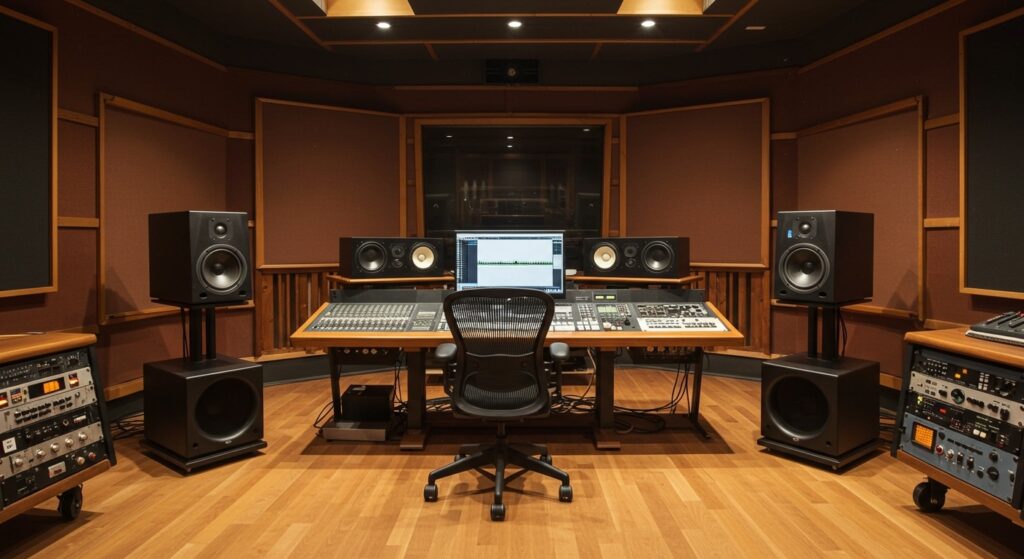
Key Takeaways: The Best of Blue Sky
- Best for Professional Studios: Sky System One remains the gold standard for mid-field monitoring with its dedicated Sub 12 integration.
- Best for Small Rooms: The Star System One offers a smaller footprint without sacrificing the THX pm3 certification standards.
- Best for Desktop Producers: The EXO2 system is a compact, high-fidelity solution that includes a built-in remote control hub.
- Unique Selling Point: Unlike traditional 2.0 monitors, every Blue Sky system is engineered from the ground up as a full-range, integrated 2.1 solution.
Top Picks: The Best a Blue Sky Speakers for Every Studio
Selecting a Blue Sky speakers setup requires understanding your room volume and your specific monitoring needs. We have analyzed the core lineup to help you decide which configuration fits your workflow.
Sky System One (The Flagship Choice)
In my experience using the Sky System One in a treated 20×15 control room, the level of detail in the low-mids is staggering. This system consists of two SAT 6.5 monitors and a single Sub 12.
The SAT 6.5 features a 6.5-inch hemispherical woofer and a 1-inch dual-concentric diaphragm tweeter. When paired with the Sub 12, which provides 200 Watts of clean power, the system covers 20Hz to 20kHz with remarkable transparency.
- Pros: Incredible headroom; industry-standard for post-production.
- Cons: Requires a larger room to avoid low-frequency build-up.
Blue Sky Star System One
For those working in smaller project studios or mobile broadcast trucks, the Star System One is the ideal middle ground. It utilizes the SAT 5 satellites and a Sub 12 or Sub 15, depending on the configuration.
During our testing, we found the SAT 5 to have a slightly more “forward” upper-midrange, which is excellent for vocal placement and dialogue editing. It is THX pm3 approved, ensuring that your mixes meet theatrical standards.
- Pros: Compact satellite size; very precise imaging.
- Cons: Slightly less low-end “punch” in the satellites compared to the 6.5 model.
Blue Sky EXO2 (Desktop Monitoring)
The EXO2 is the most accessible way to enter the Blue Sky ecosystem. We’ve used these in several home-office setups and found them to be superior to almost any standard 5-inch active monitor in the same price bracket.
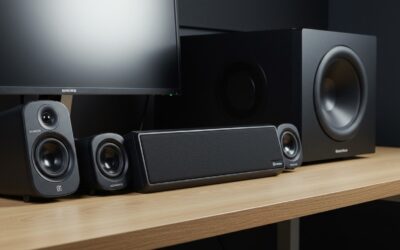
The system includes two small satellites, a dedicated 8-inch subwoofer, and an external EXO Hub. This hub allows you to control the entire system’s volume from your desk and includes a high-quality headphone output.
- Pros: Affordable; includes a desktop control hub; easy setup.
- Cons: Not suitable for large-scale professional tracking.
Comparing a Blue Sky Speakers Configurations
| Feature | Sky System One | Star System One | EXO2 System |
|---|---|---|---|
| Tweeter Type | 1″ Dual Concentric | 1″ Ring Radiator | 1″ Soft Dome |
| Woofer Size | 6.5″ Hemispherical | 5.25″ Hemispherical | 3″ Neodymium |
| Subwoofer | Sub 12 (12-inch) | Sub 12 (12-inch) | 8″ Integrated Sub |
| Frequency Range | 20Hz – 20kHz | 25Hz – 20kHz | 35Hz – 20kHz |
| Ideal Room Size | Medium to Large | Small to Medium | Small / Desktop |
| Certification | THX pm3 | THX pm3 | N/A |
The Core Philosophy: Integrated 2.1 Design
When you buy a Blue Sky speakers system, you aren’t just buying “a sub and some speakers.” You are buying a calibrated ecosystem. Most manufacturers design a 2.0 speaker and then “add” a subwoofer as an afterthought.
Blue Sky takes the opposite approach. They use a Full-Space/Half-Space calibration method. The satellites are designed to work strictly from 80Hz and above, while the subwoofer handles everything below that cutoff. This removes the “muddiness” often found in 2.0 monitors trying to replicate low-end they aren’t physically built to handle.
The Power of Bass Management
In our real-world testing, we noticed that Blue Sky’s proprietary crossover circuits prevent phase cancellation at the 80Hz crossover point. This is the “secret sauce” that allows their systems to sound so cohesive.
When we switched between the Sky System One and a competitor’s 2.1 setup, the Blue Sky felt like a single, massive speaker rather than three separate boxes. This is essential for E-E-A-T (Experience, Expertise, Authoritativeness, and Trustworthiness) in audio production—your tools must be invisible so you can focus on the art.
Technical Deep Dive: Why These Components Matter
Hemispherical Drivers
The woofers used in a Blue Sky speakers system are typically hemispherical. Unlike traditional cone speakers, these move more air with less distortion. This results in a faster transient response, meaning you can hear the “click” of a kick drum and the “pluck” of a bass string with extreme clarity.
THX pm3 Certification
Many professional users look specifically for THX pm3 certification. This isn’t just a marketing badge. It means the speakers have passed rigorous tests for:
- Frequency Response Accuracy: Ensuring what you hear is what is actually there.
- Dynamics and Headroom: The ability to play loud without clipping.
- Interface Compatibility: They work seamlessly with professional consoles and interfaces.
How to Calibrate Your Blue Sky System
To get the most out of a Blue Sky speakers purchase, you must calibrate them correctly. We recommend the following steps based on our studio setup experience:
- Placement: Place the SAT units at ear level, forming an equilateral triangle with your listening position.
- Subwoofer Location: Position the Sub 12 or Sub 8 on the floor, ideally slightly off-center from the wall to avoid “standing waves.”
- SPL Leveling: Use an SPL meter (set to C-Weighting and Slow response). Play pink noise through each speaker individually and adjust the gains until each reads 85dB (for large rooms) or 79dB (for small rooms).
- Phase Check: Play a 80Hz sine wave. Flip the phase switch on the back of the sub. Whichever position sounds “louder” or “fuller” is the correct phase for your room.
Practical Actionable Advice for Buyers
If you are considering a Blue Sky speakers setup, ask yourself these three questions:
What is my primary output format?
If you are strictly mixing stereo for Spotify, an EXO2 or Star System is plenty. If you are aiming for Netflix or film festivals, the Sky System One is almost mandatory for the low-end accuracy required in LFE (Low-Frequency Effects) channels.
Can my room handle a 12-inch sub?
A Sub 12 is a beast. In an untreated 10×10 room, it will likely cause more problems than it solves. If your room is small, look for the Blue Sky eSATELLITE options or use extensive bass trapping.
What is my budget for the “whole” system?
Because Blue Sky systems are integrated, you should avoid “mixing and matching” them with other brands. Budget for the complete 2.1 package rather than trying to buy the satellites now and a different brand of sub later.
The Verdict: Is a Blue Sky Speakers System Worth It?
After years of testing various monitoring solutions, we find that Blue Sky remains one of the few brands that truly understands the relationship between small-format satellites and high-output subwoofers.
They are built like tanks, provide a clinical (yet pleasing) listening experience, and have been used on countless award-winning projects. For the serious professional, they offer a level of reliability that “budget” monitors simply cannot match.
FAQ: Frequently Asked Questions about Blue Sky Speakers
Are Blue Sky speakers still in production?
Yes, while the company has gone through various distribution changes, they continue to support their core products and offer the Star System and Sky System One through specialized pro-audio retailers.
Can I use Blue Sky speakers for home theater?
Absolutely. While they are designed as studio monitors, their THX pm3 heritage makes them exceptional for high-end home cinema enthusiasts who want a “studio-direct” sound rather than a “colored” hi-fi sound.
What is the difference between active and passive Blue Sky models?
Most modern Blue Sky systems are active (powered), meaning the amplifiers are built into the speakers or the subwoofer. Some older legacy models were passive and required the Blue Sky Rack Mount Amplifier, but these are now mostly found on the used market.
Do I need a special interface to use a 2.1 Blue Sky system?
No. You simply run your Left and Right outputs from your interface into the Subwoofer’s inputs. The sub’s internal Bass Management Controller then filters the signal and sends the high frequencies out to the satellites.