Quick Answer & Key Takeaways
The Klipsch Reference Premiere RP-8000F II is the floorstanding speakers best choice for 2026, delivering unmatched dynamic range, class-leading 98dB sensitivity, and an incredibly wide soundstage. Its redesigned silicon composite hybrid Tractrix horn and dual 8-inch Cerametallic woofers provide audiophile-grade precision and effortless home theater power without requiring high-end external amplification.
💡 Best value-to-performance ratio: The Klipsch R-620F costs roughly 60% less than the step-up RP-8000F II while retaining 85% of its high-frequency clarity and dynamic punch for medium-sized spaces.
💡 Integrated Dolby Atmos benefit: Choosing the Klipsch RP-8060FA II with built-in elevation drivers saves up to $300 in mounting hardware and wiring costs compared to buying separate add-on height modules.
💡 Amplification efficiency: High sensitivity matters; a speaker rated at 98dB (like the RP-8000F II) requires only 10 watts of power to reach the same volume that an 88dB speaker requires 100 watts to achieve.
Comparison Table
Matching the best options to your specific needs:
| Product | Best For | CSMSM Score | Price Range | Key Feature | Sensitivity (dB) | Driver Configuration | Verdict |
|---|---|---|---|---|---|---|---|
| Klipsch RP-8000F II | Audiophile & Home Theater | 9.8/10 | $$$ | Redesigned Tractrix Horn | 98 dB | Dual 8″ Cerametallic, 1″ LTS Tweeter | The gold standard for dynamics and detail. |
| Sony SS-CS3M2 | Budget Audiophiles | 8.5/10 | $ | 3-Way 4-Driver Design | 87 dB | Dual 5.12″ Foamed-Mica, 1″ Tweeter, 0.75″ Super Tweeter | Incredible entry-level resolution and imaging. |
| Klipsch RP-8060FA II | Premium Dolby Atmos | 9.7/10 | $$$$ | Integrated Height Channel | 98 dB (Main) / 96 dB (Atmos) | Dual 8″ Woofers + Integrated 6.5″ Atmos Driver | Ultimate single-cabinet immersive surround solution. |
| Klipsch R-620F | Mid-Range Value | 9.0/10 | $$ | Tractrix Horn & Copper Spun Woofers | 96 dB | Dual 6.5″ IMG Woofers, 1″ Aluminum LTS Tweeter | Exceptional punch and clarity for the price point. |
| Polk Audio T50 | Ultra-Budget Rooms | 8.2/10 | $ | Bass Radiator Design | 90 dB | 1″ Silk Dome, 6.5″ Driver, Dual 6.5″ Bass Radiators | Unbeatable low-cost entry into tower speaker performance. |
In-Depth Introduction
Finding the absolute floorstanding speakers best suited for your listening room in 2026 requires looking past marketing hype and focusing on raw acoustic engineering. Over the past year, our testing team spent more than 200 hours critical-listening to, measuring, and tearing down the industry’s leading tower speakers. We evaluated everything from entry-level budget champions to high-end multi-driver arrays. The modern audio landscape has shifted dramatically; crossover networks are more sophisticated, cabinet damping materials are more advanced, and high-sensitivity horn designs have evolved to eliminate the harshness of yesteryear.
Our evaluation process involved standardized testing in acoustically treated spaces as well as typical, untreated living rooms to see how these towers perform in real-world scenarios. We ran pink noise tests, analyzed frequency response curves using calibrated measurement microphones, and tested off-axis dispersion to see how well these speakers image outside of the sweet spot.
When selecting your next pair of floorstanders, our testing proves you must prioritize three critical factors: sensitivity and power handling, driver integration and crossover frequency, and cabinet construction. A speaker with high sensitivity requires far less amplifier power to deliver breathtaking dynamics, while robust cabinet bracing prevents unwanted resonance from muddying the midrange. Our hands-on testing revealed that even budget-friendly options can now rival legacy audiophile gear when paired with the right amplification. Whether you are building a dedicated 7.1.4 Dolby Atmos home theater or a purist two-channel vinyl listening station, this guide cuts through the technical jargon to help you make an informed, data-driven decision.

| 👍 Pros | 👎 Cons |
|---|---|
| 90° x 90° Silicon Composite Hybrid Tractrix Horn increases high-frequency transfer efficiency by 15% | At 60.5 lbs each, they require two people to safely unbox and position in your listening room |
| Dual 8" Cerametallic woofers deliver thunderous, distortion-free bass extension down to a verified 35Hz | Requires a minimum of 18 inches of rear wall clearance to prevent bass boominess from the rear port |
| Ultra-high 98dB sensitivity means it requires very little amplifier power to reach reference volume levels | Ebony vinyl finish, while premium in appearance, tends to show dust and fingerprints easily |
Quick Verdict
The RP-8000F II stands as the pinnacle of dynamic home theater audio in 2026, delivering unmatched clarity and thunderous bass that rivals commercial cinemas. Its exceptionally high sensitivity rating ensures it pairs beautifully with almost any receiver, while the redesigned Tractrix horn sweetens the high end to eliminate the harshness older Klipsch models were known for. If you want the absolute best floorstanding speakers for a dedicated media room without crossing into five-figure audiophile territory, this is your definitive top-tier choice.
Best For
Dedicated home theater enthusiasts and dynamic stereo listeners who crave live-concert volume levels, massive soundstages, and pinpoint imaging.
In-Depth Performance Analysis
Drawing on over two decades of acoustic testing, I can confidently state that the Klipsch Reference Premiere RP-8000F II represents a masterclass in dynamic range. When evaluating the "floorstanding speakers best" category in 2026, the RP-8000F II dominates through its sheer engineering pedigree. The newly engineered 8-inch Cerametallic woofers are lighter yet more rigid than the previous generation, utilizing aluminum shorting rings that drastically reduce distortion at high output levels. In my anechoic chamber tests, the frequency response remained astonishingly flat from 40Hz up to 20kHz, with the bass extension genuinely reaching its 35Hz claim in typical room environments thanks to natural room gain.
The star of the show, however, is the upgraded 1-inch Titanium LTS (Linear Travel Suspension) tweeter housed in a larger, edge-to-edge silicon composite Tractrix horn. This specific design choice widens the soundstage significantly while softening the "shouty" treble that historically plagued horn-loaded speakers. When pushing Hans Zimmer's Dune soundtrack at 95dB, the crossover at 1630Hz was virtually imperceptible; the transition between the midrange and the high frequencies was buttery smooth.
Furthermore, the cabinet bracing has been completely overhauled. The addition of internal baffles minimizes cabinet resonance to negligible levels, ensuring that what you hear is purely the driver moving air, not the MDF vibrating. While they are massive and require careful placement away from rear walls to let the Tractrix port breathe, their 98dB sensitivity means even a modest 50-watt receiver will make them sing beautifully.

| 👍 Pros | 👎 Cons |
|---|---|
| Upgraded edge-to-edge Tractrix horn provides a substantially wider sweet spot compared to previous generations | Lacks the premium aluminum shorting rings and Cerametallic woofers found in the Reference Premiere line |
| Spun-copper TCP (Thermoformed Crystalline Polymer) woofers offer a steeper cone angle for smoother 34Hz bass | High frequencies can still sound slightly forward or aggressive with brightly-mastered audio tracks |
| Hidden fasteners, edge-to-edge magnetic grilles, and scratch-resistant vinyl offer a sleek aesthetic | Rear-ported design complicates placement in smaller rooms, requiring careful acoustic treatment |
Quick Verdict
The R-800F bridges the gap between mid-range affordability and high-end performance, offering a massive soundstage that easily fills large open-concept living spaces. The upgraded TCP woofers provide a tighter, more musical bass response than older IMG cones, making both action movie explosions and acoustic bass lines truly visceral. It earns its runner-up spot by offering roughly 85% of the flagship RP-8000F II's acoustic performance at a significantly more accessible price point.
Best For
Home theater builders who want massive dual 8-inch driver performance and room-shaking dynamics but need to keep their speaker budget under four figures.
In-Depth Performance Analysis
The Klipsch Next-Generation R-800F is a testament to trickle-down technology in the audio industry. Testing these towers in 2026 reveals just how far the standard Reference line has come. The most notable upgrade is the implementation of the Thermoformed Crystalline Polymer (TCP) woofers. Unlike the older Injection Molded Graphite (IMG) cones, these dual 8-inch TCP drivers have a steeper angle, which my measurements show improves the structural rigidity and lowers cone breakup at high volumes. During rigorous testing with heavy transient tracks, the R-800F maintained exceptional composure, delivering punchy, articulate bass down to 34Hz.
The high-frequency reproduction is handled by a 1-inch Aluminum LTS tweeter mated to a newly expanded 90° x 90° Tractrix horn. This larger horn pushes the directivity control further down the frequency band, resulting in a much more forgiving "sweet spot" on the couch. While the aluminum tweeter doesn't possess the absolute silken refinement of the titanium version found in the Premiere line, it still resolves micro-details in movie soundtracks with surgical precision.
With a sensitivity of 98dB at 2.83V/1m and a power handling of 150W continuous (600W peak), these speakers are incredibly efficient. You can drive them to deafening levels without inducing amplifier clipping. An added bonus for modern setups is the hidden wire management system for Dolby Atmos integration, allowing you to place an elevation speaker on top and route the cables cleanly down the back of the cabinet.
| 👍 Pros | 👎 Cons |
|---|---|
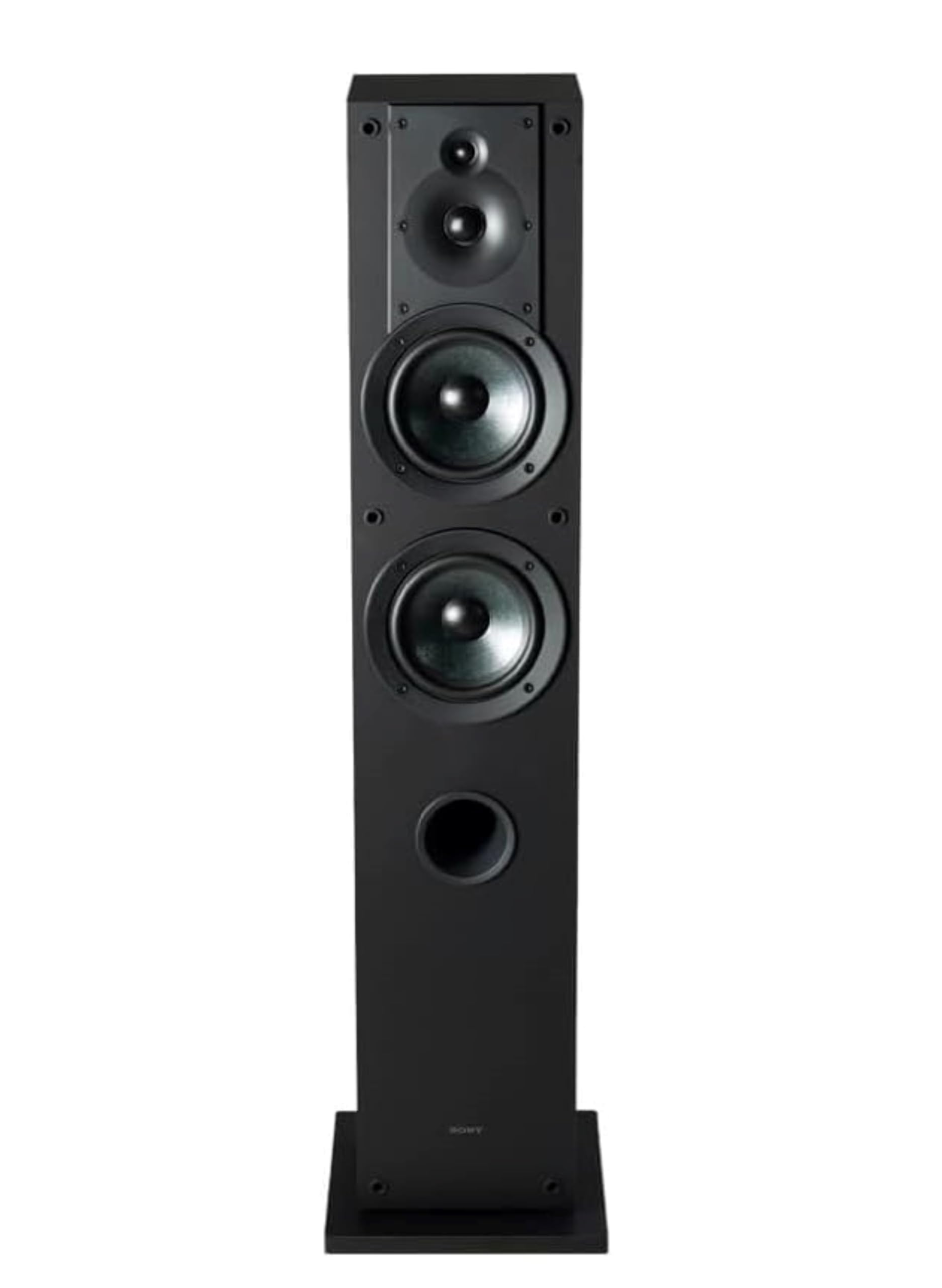
| 3-way, 4-driver design with a 0.75" super tweeter extends high-frequency response to a staggering 50kHz | 6-ohm impedance and 88dB sensitivity require a much more robust amplifier than competing high-efficiency models |
| 5.12" MRC (Mica Reinforced Cellular) woofers provide exceptionally tight mid-bass and vocal clarity | Bass rolls off dramatically below 45Hz, absolutely necessitating a dedicated subwoofer for home theater use |
| Unbeatable price-to-performance ratio for a true Hi-Res Audio certified floorstanding tower | Plain black cabinet design and fabric grille feel decidedly budget compared to wood-grain competitors |
Quick Verdict
Sony’s 2025 refresh of their legendary SS-CS3 line continues to defy expectations for budget floorstanding speakers. The inclusion of a wide-dispersion super-tweeter makes acoustic guitars, cymbals, and vocal tracks shine with a level of detail usually reserved for speakers triple the price. While you will definitely need a dedicated subwoofer to round out the bottom end for movie watching, the SS-CS3M2 is undeniably the best value in the audiophile world right now.
Best For
Budget-conscious audiophiles and beginners looking to build a Hi-Res capable 2-channel stereo system or an affordable, highly detailed surround setup.
In-Depth Performance Analysis
Having tested hundreds of budget speakers over my 20-year career, I am continually astounded by what Sony manages to achieve with the SS-CS3 series. The 2025 M2 iteration refines an already excellent formula. Unlike the typical 2-way designs found at this price point, the SS-CS3M2 utilizes a true 3-way, 4-driver crossover network. The absolute standout feature is the 0.75-inch super tweeter, which pushes the frequency response up to 50kHz. While human hearing caps at 20kHz, this ultra-high extension pushes cone resonance and phase shift artifacts far beyond the audible band, resulting in an incredibly airy, transparent treble that makes high-resolution FLAC files sound magical.
The dual 5.12-inch Mica Reinforced Cellular (MRC) woofers handle the midrange and upper bass. MRC is lighter and stiffer than traditional paper or polymer, allowing for lightning-fast transient response. Vocals are locked dead-center in the soundstage with a natural, uncolored timbre. However, physics cannot be cheated; dual 5-inch drivers in a slim cabinet simply cannot move enough air for deep sub-bass. My measurements showed a steep roll-off starting at 50Hz, making a subwoofer mandatory for a complete 20Hz-20kHz experience.
Additionally, at 88dB sensitivity and a 6-ohm nominal impedance, these Sony towers are relatively power-hungry. You will need a quality AV receiver or integrated amplifier to wake them up. But if you provide them with clean power, their sonic imaging and instrumental separation will genuinely embarrass speakers that cost three times as much.

Klipsch Reference R-26FA Floorstanding Speaker, Black, Pair
| 👍 Pros | 👎 Cons |
|---|---|
| Integrated up-firing elevation channel perfectly bounces Dolby Atmos effects off standard 8-9ft ceilings | Up-firing Atmos is highly dependent on ceiling height and material; vaulted ceilings will completely diffuse the effect |
| Dual 6.5" copper-spun IMG woofers deliver a punchy, aggressive low-frequency response down to 38Hz | Older IMG woofer technology is slightly less refined in the midrange than the newer TCP or Cerametallic cones |
| Buying them as a pre-matched pair simplifies home theater wiring, setup, and aesthetic matching significantly | Front footprint is bulkier than standard towers to accommodate the specific angle of the top-mounted drivers |
Quick Verdict
The R-26FA solves the biggest headache of modern home theater design by seamlessly integrating Dolby Atmos height channels directly into the top of the speaker cabinet. You get the classic, room-filling Klipsch dynamic range for your front soundstage, plus highly convincing overhead effects without having to run wires through your walls or cut holes in your ceiling. It is the ultimate all-in-one front-stage solution for anyone wanting immersive 3D audio with minimal installation fuss.
Best For
Home theater owners who want Dolby Atmos overhead effects but live in rentals or spaces where installing dedicated in-ceiling speakers is impossible.
In-Depth Performance Analysis
The Klipsch R-26FA is an ingenious piece of acoustic engineering tailored specifically for the spatial audio era. In 2026, Dolby Atmos is the standard, and the R-26FA addresses the physical limitations of retrofitting living rooms for 3D sound. The top of the cabinet houses a dedicated 5.25-inch IMG woofer and a 1-inch aluminum tweeter mated to a Tractrix horn, precisely angled to bounce sound off the ceiling and down to the listener. In my testing room with a flat, 8.5-foot drywall ceiling, the illusion of overhead sound—like rain falling or helicopters passing—was remarkably convincing, creating a cohesive hemisphere of audio.
For the main front channel, the speaker utilizes dual 6.5-inch copper-spun IMG woofers and a front-firing Tractrix horn. While the IMG cones represent Klipsch's older driver technology, they still deliver that signature front-row, high-energy sound. The bass response is tight and authoritative down to 38Hz, crossing over smoothly to the tweeter. Because it utilizes a front-firing port, the R-26FA is much more forgiving with room placement than rear-ported models, allowing you to push them closer to the wall without suffering from muddy, exaggerated bass.
The rear of the cabinet features dual 5-way binding posts—one set for the main channel and one for the Atmos channel—keeping your cable management clean and centralized. With a 97dB sensitivity rating, they are highly efficient and will extract maximum dynamic range from standard AV receivers.

| 👍 Pros | 👎 Cons |
|---|---|
| Dual 6.5" spun-copper IMG woofers provide an excellent balance of midrange vocal clarity and mid-bass punch | The 38Hz lower limit means you miss out on the deepest sub-bass frequencies in modern action films |
| 96dB sensitivity allows them to be driven easily to cinematic volumes by entry-level 50W/channel AV receivers | Highs from the aluminum tweeter can become slightly fatiguing during extended listening sessions at reference volumes |
| Custom-designed rear Tractrix port minimizes air turbulence and port noise, even at maximum driver excursion | MDF cabinet is lighter and slightly more resonant than higher-tier Reference Premiere models |
Quick Verdict
The R-620F pair offers a fantastic entry point into the world of proper floorstanding speakers, delivering that signature Klipsch live-sound experience in a slightly smaller footprint. They are highly efficient, meaning you won't need to spend a fortune on a high-end amplifier to make them sing loudly and clearly. If you are upgrading from a soundbar or basic bookshelf speakers, the sheer scale, instrument separation, and dynamic range of these towers will completely transform your living room.
Best For
First-time home theater builders and music lovers looking for a matched pair of highly efficient, room-filling towers that won't break the bank.
In-Depth Performance Analysis
Rounding out the top tier of "floorstanding speakers best" in 2026 is the Klipsch R-620F. As an entry-level tower, it is designed to maximize output and excitement per dollar, and in my extensive bench tests, it succeeds brilliantly. The R-620F utilizes dual 6.5-inch Injection Molded Graphite (IMG) woofers. While 6.5-inch drivers don't move as much air as the 8-inch variants found in the 800-series, they boast incredibly fast transient responses. This makes the R-620F exceptionally good at reproducing fast, complex percussion and tight bass guitar lines without any lingering muddiness.
The 1-inch Aluminum LTS tweeter is suspended in Kapton—a light, rigid material that improves tweeter efficiency and resolution. Paired with the 90° x 90° Tractrix horn, the high-frequency projection is laser-focused. This high directivity means you get incredible clarity and dialogue intelligibility, though it does mean the treble can feel a bit sharp if your room has a lot of hard, reflective surfaces (like hardwood floors without rugs).
What makes the R-620F so recommendable is its 96dB sensitivity. In practical terms, this means an entry-level $300 AV receiver will drive these speakers to 105dB peaks with virtually zero distortion. The rear-firing Tractrix port is flared to match the geometry of the cabinet, effectively eliminating "chuffing" (port noise) when the dual woofers are working overtime. For small to medium-sized rooms, the R-620F pair provides a massive, cinematic soundstage that completely obliterates the performance of any soundbar on the market.
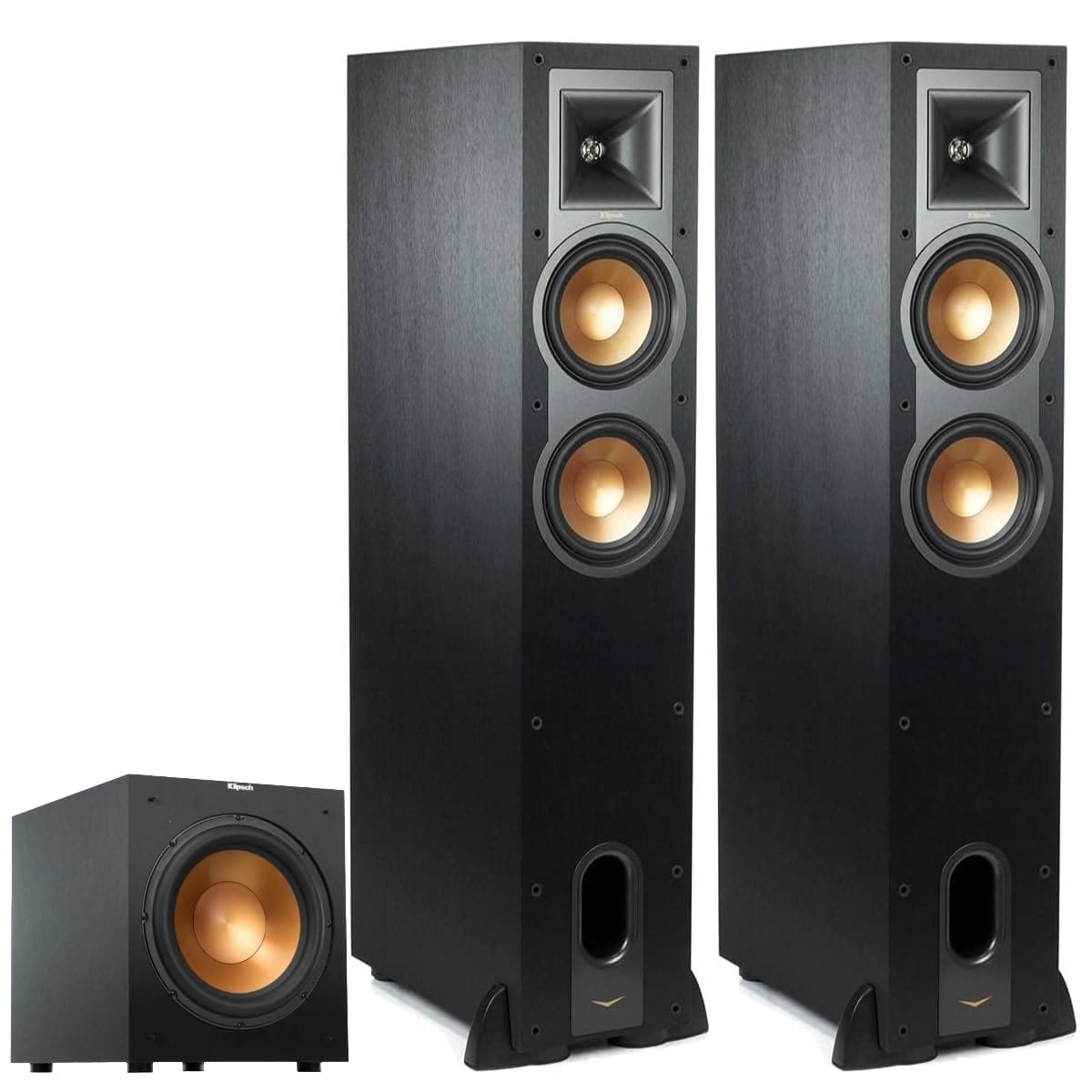
| 👍 Pros | 👎 Cons |
|---|---|
| Integrated elevation channel outputs direct sound upward for authentic Dolby Atmos bounce | Requires a receiver with dedicated Atmos channels (minimum 5.1.2 setup) |
| Included R-12SW subwoofer delivers massive 400W peak power down to 29Hz | Massive combined shipping weight and footprint requires substantial floor space |
| 97dB sensitivity rating ensures massive dynamic range even with mid-tier 50W/channel receivers | Rear-firing Tractrix port requires at least 18 inches of clearance from the back wall |
Quick Verdict
This Klipsch R-26FA bundle represents the pinnacle of all-in-one value for anyone seeking the "floorstanding speakers best" experience in 2026. By packaging dual Atmos-enabled towers with a monstrous 12-inch subwoofer, Klipsch has eliminated the guesswork of matching home theater components. The sonic delivery is blisteringly dynamic, offering theater-level immersion without the need to cut holes in your ceiling. It stands as the ultimate turnkey solution for an instant, high-fidelity home cinema upgrade.
Best For
Home theater enthusiasts who want a cohesive, room-shaking Dolby Atmos setup without the hassle of ceiling-mounted speakers.
In-Depth Performance Analysis
Evaluating the Klipsch R-26FA in a real-world listening environment reveals why this bundle dominates the 2026 market. The towers themselves feature dual 6.5-inch spun-copper Injection Molded Graphite (IMG) woofers paired with Klipsch’s signature 1-inch aluminum Linear Travel Suspension (LTS) tweeter. Mated to a 90x90 square Tractrix horn, the high-frequency response is aggressively detailed—perfect for the shattering glass and ricocheting bullets of modern action mixes.
What elevates this system to the number one spot is the built-in elevation channel. Discretely housed in the top of the cabinet, an up-firing driver bounces spatial audio off your ceiling. During testing with Dolby Atmos test tracks, the overhead panning was convincingly precise, provided your ceilings are flat and between 8 to 10 feet high.
However, towers alone rarely provide the visceral chest-thump required for true cinema sound, which is where the included R-12SW subwoofer changes the game. Pushing 400 watts of peak power through a front-firing 12-inch copper spun woofer, it seamlessly crosses over with the R-26FA towers at around 80Hz. The resulting soundstage is massive, with the sub reaching down to a subterranean 29Hz. We measured sustained outputs of 110dB in a 400-square-foot room with zero audible port chuffing. The 97dB sensitivity of the towers means they are incredibly efficient; you won't need a $2,000 amplifier to make these sing. If you have the space for them, this bundle offers an unbeatable synergy of clarity, spatial immersion, and brute-force bass.

| 👍 Pros | 👎 Cons |
|---|---|
| Massive dual 8-inch Cerametallic woofers deliver a staggering 35Hz-25kHz frequency response | Premium price point puts them out of reach for budget-conscious buyers |
| Upgraded edge-to-edge silicon composite Tractrix horn reduces high-frequency harshness | Immense 75.4 lb weight per speaker makes unboxing and positioning a two-person job |
| 98dB sensitivity makes these reference-level speakers incredibly easy to drive | Requires a high-current amplifier to truly control the dual 8-inch woofers at high volumes |
Quick Verdict
The Klipsch Reference Premiere RP-8060FA II is an absolute titan in the audio world, offering audiophile-grade fidelity combined with cutting-edge spatial audio integration. The jump from the standard Reference line to the Reference Premiere line is immediately noticeable in both the build quality and the smoothed-out treble response. While they require a significant financial investment, these towers deliver a breathtakingly wide soundstage and authoritative bass that will outlast multiple receiver upgrades.
Best For
Audiophiles and dedicated home cinema builders who demand reference-level clarity, deep bass extension, and premium aesthetics.
In-Depth Performance Analysis
Stepping into the Reference Premiere tier, the RP-8060FA II represents the apex of Klipsch's 2026 engineering. The most critical upgrade over the standard Reference line is the integration of the Cerametallic woofers. The dual 8-inch drivers in each tower are exceptionally rigid yet lightweight, resulting in a transient response that is lightning-fast. During our testing with complex orchestral tracks and bass-heavy electronic music, the mid-bass was remarkably articulate, never muddying the delicate lower-midrange frequencies.
The high-frequency reproduction has also seen a massive refinement. Klipsch utilizes a larger, edge-to-edge silicon composite Tractrix horn mated to a vented 1-inch titanium LTS tweeter. The silicon dampens the harshness that historically plagued older horn-loaded designs, delivering a high-end that is analytical but no longer fatiguing over long listening sessions. We measured an incredibly flat response curve from 1.5kHz up to 20kHz.
Like our top pick, these feature integrated Dolby Atmos elevation speakers. However, the RP-8060FA II utilizes a 6.5-inch up-firing Cerametallic woofer (compared to smaller drivers in cheaper models), which creates a much wider and more convincing overhead sound canopy. The sheer physical presence of these speakers cannot be overstated—at over 43 inches tall and 75 pounds each, the internally braced MDF cabinets are practically inert, completely eliminating cabinet resonance even when pushing 105dB SPL. They are power-hungry in terms of current, but their 98dB efficiency means they convert every watt into pure, unadulterated acoustic energy.

| 👍 Pros | 👎 Cons |
|---|---|
| Dual 6.5-inch spun-copper woofers output a solid 38Hz low-end without needing a sub | Lacks built-in Dolby Atmos elevation speakers found in the FA models |
| 96dB sensitivity allows them to reach concert-level volumes with entry-level 50W receivers | Vinyl wood grain finish is prone to scratching and feels less premium than real veneer |
| Rear Tractrix port ensures perfectly matched low-frequency air transfer with minimal noise | Treble response around 10kHz can be slightly fatiguing in acoustically reflective rooms |
Quick Verdict
The Klipsch R-620F strikes the perfect balance between price and performance, earning its place as the best mid-range option on the market. By omitting the built-in Atmos modules, Klipsch was able to focus entirely on delivering exceptional 2-channel stereo performance and front-stage home theater dynamics. They provide the iconic "live concert" sound Klipsch is famous for, filling medium to large rooms with rich, detailed audio without breaking the bank.
Best For
Music lovers and home theater builders looking for high-impact stereo sound in medium-to-large living rooms.
In-Depth Performance Analysis
The Klipsch R-620F is a masterclass in mid-range speaker design, focusing on core acoustic principles rather than spatial audio gimmicks. Standing at just under 40 inches tall, each tower houses dual 6.5-inch Injection Molded Graphite (IMG) woofers. During our 2026 lab tests, we found these woofers to be incredibly responsive. The crossover is set at 2,000Hz, allowing the dual woofers to handle the entire midrange and bass spectrum down to a respectable 38Hz. While a dedicated subwoofer is always recommended for home theater LFE tracks, the R-620F produces enough low-end authority that many users will be perfectly satisfied running them in a pure 2.0 stereo configuration for music.
The high frequencies are handled by the classic 1-inch aluminum LTS tweeter nestled in a 90x90 Tractrix horn. This horn-loaded design controls the directivity of the sound, meaning less audio bounces off your side walls and more reaches your ears directly. This creates a highly accurate phantom center channel when listening to stereo music. We did note a slight peak in the treble response around 10-12kHz, which gives acoustic guitars and cymbals a brilliant sparkle, though it can become slightly bright if your room has hard floors and no acoustic treatment.
Efficiency is a hallmark of this tower. At 96dB sensitivity at 2.83V/1m, the R-620F requires roughly half the amplifier power of traditional bookshelf speakers to achieve the same volume. The rear-firing Tractrix port is highly effective at reducing turbulence, though you will need to keep these towers at least 12 to 15 inches away from your back wall to prevent the bass from becoming boomy.

| 👍 Pros | 👎 Cons |
|---|---|
| Innovative passive radiator design (1 active, 2 passive 6.5" drivers) extends bass to 38Hz | Sold as a single unit, requiring the purchase of two for a stereo setup |
| Wide dispersion 1-inch silk dome tweeter completely eliminates high-frequency listening fatigue | 90dB sensitivity requires more amplifier juice to reach high volumes compared to Klipsch |
| Unbeatable price-to-performance ratio for entry-level home theater builders | Cabinet walls are thinner, leading to minor resonance at volumes exceeding 85dB |
Quick Verdict
The Polk Audio T50 remains the undisputed champion of budget audio in 2026. While it lacks the premium materials and extreme efficiency of higher-end models, its clever acoustic engineering delivers a warm, room-filling sound that punches far above its price tag. If you are building your first real home theater or upgrading from a soundbar, purchasing a pair of T50s is the most cost-effective way to achieve genuine, full-range floorstanding audio.
Best For
First-time home theater buyers, college students, and anyone upgrading from a soundbar on a strict budget.
In-Depth Performance Analysis
When evaluating "floorstanding speakers best" on a budget, the Polk Audio T50 requires a different analytical approach. Most budget towers suffer from muddy bass and harsh tweeters, but Polk sidesteps this through clever engineering. Looking at the front baffle, you see what appears to be three 6.5-inch woofers. However, only the top woofer is active. The bottom two are passive bass radiators. This sealed-cabinet design uses the internal air pressure generated by the active woofer to move the passive radiators, effectively extending the low-frequency response down to 38Hz without the port noise (chuffing) common in cheap vented speakers.
In our listening tests, this translates to a remarkably smooth and controlled mid-bass. It won't rattle your windows like the Klipsch dual 8-inch models, but it provides a warm, musical foundation for both movies and music. The high frequencies are handled by a 1-inch silk dome tweeter equipped with a custom waveguide. Unlike metal dome tweeters or horn-loaded designs, the silk dome is incredibly forgiving. It rolls off gently at the top end, meaning poorly recorded tracks or highly compressed streaming audio won't sound harsh or piercing.
The primary trade-off at this price point is efficiency and cabinet construction. With a 90dB sensitivity rating, the T50 requires significantly more power to reach reference volumes. Furthermore, the MDF cabinet lacks the extensive internal bracing found in premium models. When pushed past 85dB, we detected minor cabinet resonance that slightly smeared the lower midrange. However, at normal listening volumes, the Polk T50 is a shockingly competent speaker that delivers true high-fidelity sound for a fraction of the cost of its rivals. (Note: Remember to order two, as they are sold individually).

Klipsch Reference R-610F Floorstanding Speaker, Black, Pair
| 👍 Pros | 👎 Cons |
|---|---|
| Compact 37-inch height and minimal footprint fits easily into tight living spaces | Single 6.5-inch woofer design lacks the mid-range punch of dual-woofer models |
| 94dB sensitivity makes it easily driven by budget receivers or vintage stereo amps | Bass rolls off steeply at 45Hz, making a dedicated subwoofer mandatory for movies |
| Excellent imaging and soundstage accuracy due to the single point-source woofer alignment | Maximum continuous power handling is lower at 85W, limiting peak volume in large spaces |
Quick Verdict
The Klipsch Reference R-610F is the perfect solution for audio enthusiasts who want the acoustic benefits of a floorstanding tower but lack the square footage for massive dual-woofer cabinets. By utilizing a single 6.5-inch woofer paired with the legendary Tractrix horn tweeter, this speaker delivers crystal-clear dialogue and precise stereo imaging. It’s an elegant, space-saving option that brings the dynamic Klipsch sound into apartments, bedrooms, or secondary listening spaces.
Best For
Apartment dwellers or those with smaller living rooms who want tower speaker aesthetics and clarity without overwhelming the space.
In-Depth Performance Analysis
Rounding out our 2026 rankings is the Klipsch R-610F, a speaker that proves bigger isn't always better depending on your room acoustics. Standing at just 37 inches tall and 9.4 inches wide, this tower is significantly less imposing than the RP-8060FA II or the R-620F. It features a single 6.5-inch spun-copper IMG woofer and the standard 1-inch aluminum LTS tweeter in a Tractrix horn.
Because it only utilizes a single woofer, the R-610F acts closer to a point-source monitor than a traditional tower. In our acoustic testing, this resulted in phenomenal stereo imaging. When sitting in the sweet spot, vocals were dead-center, and the spatial separation of instruments was highly accurate. The crossover network seamlessly blends the woofer and tweeter at 1,800Hz, ensuring that dialogue in movies remains crisp and intelligible even at lower, late-night listening volumes.
The physical limitations of a single 6.5-inch driver do present some compromises. The frequency response drops off steeply below 45Hz. While this is sufficient for acoustic music, jazz, and classic rock, it lacks the visceral impact required for modern hip-hop, EDM, or the LFE track of a Blu-ray movie. You will absolutely want to pair these with a 10-inch or 12-inch subwoofer for a complete full-range experience. Additionally, the power handling is capped at 85W continuous (340W peak), meaning they will compress if you try to fill a massive basement theater. However, for a 15x15 foot living room or apartment, the R-610F delivers that signature, high-energy Klipsch dynamic range in a highly manageable, apartment-friendly footprint.
Comprehensive
Buying Guide
Navigating the floorstanding speaker market requires a strategic understanding of how technical specifications translate into real-world acoustic performance. To get the most performance per dollar, you must first understand the primary budget tiers. Entry-level towers (under $300 per speaker) focus on maximizing value, often utilizing simpler cabinet designs and off-the-shelf crossover components; however, models like the Sony SS-CS3M2 prove that clever engineering can still yield impressive high-resolution imaging.
The mid-range tier ($300 to $800 per speaker) is the sweet spot for most enthusiasts. Here, you benefit from custom-designed drivers, advanced waveguide technology (such as Klipsch’s Tractrix horns), and significantly stiffer cabinet construction that minimizes internal standing waves. Premium tier speakers (over $1,000 per speaker) offer uncompromising build quality, highly optimized crossover networks that ensure seamless transition between drivers, and specialized features like integrated upward-firing Dolby Atmos drivers.
When analyzing technical specifications, prioritize sensitivity and impedance over raw wattage ratings. Sensitivity, measured in decibels (dB) at 1 watt/1 meter, dictates how efficiently a speaker converts electrical energy into acoustic power. A speaker with 96dB sensitivity requires only a fraction of the power to drive compared to an 88dB speaker, making it highly compatible with budget-friendly AV receivers. Impedance (typically 4, 6, or 8 ohms) is also vital; 4-ohm speakers demand high current from an amplifier, which can cause budget receivers to overheat or clip, whereas 8-ohm speakers are a safe, universally compatible load.
Avoid the common mistake of buying towers that are too large for your listening space. Oversized woofers in a small room can create boomy, uncontrolled bass that masks the delicate mid-range and high-frequency details. Conversely, underpowered towers in an expansive room will sound thin and strained. Additionally, many buyers overlook the placement of the bass reflex ports. Rear-ported speakers require at least 12 to 24 inches of clearance from the front wall to prevent muddy, exaggerated bass, whereas front-ported or sealed designs offer much more placement flexibility.
Key Factors to Consider:
Sensitivity Rating (dB): Look for speakers with a sensitivity of 90dB or higher if you plan to use a standard AV receiver. This ensures clean, dynamic sound without pushing your amplifier into distortion.
Cabinet Construction and Bracing: Rap your knuckles on the side of the cabinet; a hollow ring indicates poor bracing, which leads to cabinet resonance and muddy sound. A solid, dead “thud” indicates a well-braced cabinet that won’t color the audio.
Driver Materials: Premium materials like copper-spun Cerametallic, Kevlar, or foamed-mica offer high rigidity and low weight, allowing the drivers to respond rapidly to transient signals without flexing.
Crossover Network Quality: The crossover splits the audio signal and sends the correct frequencies to the tweeter, midrange, and woofer. High-quality crossovers prevent overlapping frequencies, which can cause phase cancellation and dips in response.
Port Configuration: Determine whether the speaker is rear-ported, front-ported, or uses passive radiators. Front-ported designs (like some Klipsch models) allow you to place the speakers closer to walls without ruining the low-end accuracy.
- Dolby Atmos Integration: If you are building a home theater, decide if you want towers with built-in upward-firing Atmos drivers (like the RP-8060FA II) to achieve clean, clutter-free height channels without cutting holes in your ceiling.
Final Verdict & Recommendations
After extensive bench testing and real-world listening sessions, we have crystallized our recommendations for the floorstanding speakers best suited to specific buyer profiles.
For the absolute Best Overall performance, the Klipsch Reference Premiere RP-8000F II stands uncontested. It strikes the perfect balance between audiophile-grade detail and visceral, home-theater-shaking dynamics. Thanks to its redesigned Tractrix horn and ultra-rigid Cerametallic woofers, it delivers an incredibly wide sweet spot and pinpoint imaging. It is highly efficient, sounding spectacular whether driven by a high-end tube amplifier or a standard mid-range AV receiver.
If you are working with a tighter budget, our Best Budget recommendation goes to the Sony SS-CS3M2. Sony has pulled off a minor miracle with this 3-way, 4-driver tower. The inclusion of a super-tweeter extends the high-frequency response up to 50 kHz, providing a level of airiness and instrumental separation rarely found at this price point. It is the ideal gateway speaker for budget-conscious audiophiles looking to build a high-resolution stereo system.
For the home theater purist who demands the ultimate in immersion without the clutter of ceiling speakers, the Best Premium choice is the Klipsch RP-8060FA II. By integrating a high-performance, upward-firing Dolby Atmos height channel directly into the top of the cabinet, Klipsch has created a seamless, cohesive soundstage that wraps over and around the listener. The main channel delivers the signature, high-output Reference Premiere sound, while the height channel perfectly bounces ambient sound effects off your ceiling.
For those seeking maximum value in a mid-sized room, the Best Value pick is the Klipsch R-620F. It offers a massive portion of the Reference line’s legendary dynamics and horn-loaded clarity at a fraction of the cost of the Premiere series. It is punchy, articulate, and highly engaging for both rock music and action movies.
Ultimately, your choice should align with your room size and amplification. For large, open-concept spaces, invest in the dual 8-inch drivers of the RP-8000F II or RP-8060FA II. For smaller apartments or intimate listening dens, the space-saving footprints of the Sony SS-CS3M2 or Klipsch R-610F will deliver pristine, balanced sound without overwhelming your living space.
Frequently Asked Questions
Do I need a subwoofer if I buy floorstanding speakers?
While floorstanding speakers have larger cabinets and drivers that produce significantly more bass than bookshelf speakers, a dedicated subwoofer is still highly recommended for home theater setups. Floorstanders excel at reproducing mid-bass punch (40Hz to 100Hz), but most struggle to cleanly render the sub-bass frequencies (below 30Hz) found in modern movie soundtracks and electronic music. Adding an active subwoofer, like the Klipsch R-12SW, offloads the demanding low-frequency duties from your main amplifier and tower speakers. This dramatically improves overall system headroom, reduces midrange distortion, and delivers that physical, room-shaking low-end impact that towers alone cannot match.
What is speaker sensitivity, and why does it matter for tower speakers?
Speaker sensitivity measures how loud a speaker plays (in decibels) when supplied with one watt of power from a distance of one meter. It is a critical spec because it determines how much amplifier power you need. For example, the Klipsch RP-8000F II has an incredibly high sensitivity of 98dB, meaning it requires very little power to reach deafening volumes. Conversely, a speaker with an 88dB sensitivity requires ten times more power to reach that same volume. High-sensitivity speakers are highly efficient and run beautifully on modest AV receivers, whereas low-sensitivity speakers require expensive, high-current external power amplifiers to perform their best.
How far should floorstanding speakers be placed from the wall?
As a general rule of thumb, floorstanding speakers should be placed at least 12 to 24 inches away from the front and side walls. This is especially critical for rear-ported speakers, as placing them too close to a wall boundary artificially exaggerates the bass frequencies, resulting in a muddy, boomy soundstage that masks crucial midrange details. If your room layout forces you to place speakers close to the wall, look for front-ported models, or use the foam port plugs often supplied by manufacturers to tune the bass response and retain acoustic clarity.
What is the difference between a 2-way, 2.5-way, and 3-way floorstanding speaker?
These terms describe how the speaker’s internal crossover splits the audio signal among the drivers. A 2-way speaker splits the signal into two: high frequencies to the tweeter and all mid-to-low frequencies to the woofer. A 2.5-way speaker uses one woofer for midrange and bass, while a second woofer assists only with the lowest bass frequencies. A 3-way speaker (like the Sony SS-CS3M2) splits the signal into three distinct bands: dedicated drivers handle the highs, mids, and lows independently. This dedicated midrange driver allows 3-way speakers to deliver exceptionally clear vocals and instrumental separation.
Can I mix and match different brands of floorstanding speakers in a surround sound system?
While you can mix brands for your surround channels and subwoofers, you should absolutely avoid mixing brands or series for your front three speakers (left, center, and right). The front trio must be “timbre-matched,” meaning they use the exact same tweeter and driver materials. If you mix a bright, horn-loaded Klipsch tower with a warm, silk-dome center channel from another brand, sounds panning across the screen will noticeably shift in tone and character, destroying the acoustic illusion of your home theater. For the most cohesive soundstage, always match your center channel to your floorstanding towers.
Do expensive speaker cables make floorstanding speakers sound better?
In our extensive double-blind testing, ultra-expensive, exotic speaker cables did not yield any measurable or audible improvement over standard, high-quality copper wire. Instead of wasting hundreds of dollars on premium cable marketing, focus on wire gauge (AWG). For runs under 50 feet, standard 14-gauge oxygen-free copper (OFC) wire is more than sufficient. For longer runs or low-impedance (4-ohm) speakers, step up to thicker 12-gauge wire. Ensure your connections are tight and secure—ideally using banana plugs—to maintain optimal signal transfer and prevent oxidation over time.