Quick Answer
The Donner Stereo Receiver is the best home audio amplifier for most rooms that need one hub for several sources. It is manufacturer-rated at 1000W peak across four independently controlled channels, drives 4- to 8-ohm speakers, and adds Bluetooth 5.3 plus optical and coaxial inputs. Pick a compact Class-D amp if you only need a desk pair.
Pros
- Four independently controllable channels mean you can feed more than one speaker pair and set levels separately, which suits a main room plus a second listening area.
- Optical and coaxial digital inputs cover modern televisions that no longer include analog audio outputs, removing the need for a separate converter in many setups.
- The input list is unusually broad for a single compact receiver, so a phone, a TV, a USB drive and a radio signal can all reach the same speakers without swapping hardware.
- Dual 1/4 inch microphone inputs with echo and Talkover let a household run karaoke or a speech without adding an external mixer to the chain.
- EQ and echo settings are reachable from the remote in any input mode, so tonal corrections for boomy dialogue or thin Bluetooth streams can be made from the seating position.
Cons
- There is no HDMI input and no stated surround decoding, so television use depends on optical, coaxial or analog outputs, and the listing itself warns that some sets require an external audio output mode to be selected first.
- The 1000W headline is a peak figure; the stated continuous rating is 25W per channel, which sets a realistic ceiling on room size, speaker sensitivity and karaoke headroom.
- Supporting evidence is thin: no published specification table, dimensions, weight or warranty terms are supplied, and the displayed star rating is not backed by an accumulated body of customer feedback, so durability and long-term behavior cannot be assessed.
The Donner Stereo Receivers Home Audio Amplifier (1000W peak, four channel, Bluetooth 5.3) suits a home karaoke or casual multi-speaker setup that needs many input types in one unit. Its strongest argument is connectivity breadth. The principal reservation is power: the listing's own rated figure is 25W RMS per channel, not the headline number.
Positioning is clear enough from the supplied feature list. This is an all-in-one hub for rooms where a phone, a television, a USB stick, a radio tuner and a pair of microphones all need to reach the same speakers. It targets the budget end of the karaoke and party amplifier market rather than the two-channel hi-fi or home theater receiver categories, where surround decoding and HDMI switching are the expected baseline rather than an omission worth flagging.
Several stated details matter in daily use. Four channels described as independently controllable let you run separate speaker pairs at different levels, useful for a main room plus a patio, and the manufacturer specifies compatibility with 4 to 8 ohm speakers. Optical and coaxial digital inputs provide a path from most current televisions even when no analog output exists. The remote reaches treble, midrange, bass, echo and Talkover in any input mode, so mid-song adjustments do not require walking to the front panel.
The limits are structural rather than incidental. With no HDMI input, anyone wanting one-cable television switching, ARC volume control or surround decoding should look at an AV receiver instead. USB playback is capped at 64GB, which constrains a large local library on a single drive. The rated 25W per channel is workable for background music and small-room karaoke, but buyers filling a large open plan space or driving low sensitivity bookshelf speakers should shop by continuous rating rather than peak and consider a dedicated stereo integrated amplifier.
Treat this as a conditional recommendation. The feature set is coherent and the trade-offs are legible, but the supporting evidence is thin: no full specification sheet, no dimensions or weight, and no warranty terms are supplied, and the displayed rating is not underwritten by a meaningful volume of customer feedback. Before buying, confirm that your television can output audio over optical or coaxial, and that your speakers fall inside the stated 4 to 8 ohm range.
Strong Match: Households assembling a low-cost karaoke or party rig in a bedroom, den, basement or small function room. Two 1/4 inch microphone jacks, echo, Talkover and a three-band EQ reachable from the remote cover the core needs without an external mixer, and the stated 25W per channel is a sensible fit for those room sizes.
Also Consider It If: You are trying to consolidate scattered sources onto one set of passive speakers. Bluetooth 5.3, USB up to 64GB, AUX, two RCA pairs, FM, optical and coaxial in a single chassis is a genuinely wide input list, and four channels described as independently controllable allow a second speaker pair in an adjacent space at its own level.
Not the Best Fit: Anyone building a home theater or a serious two-channel listening system. There is no HDMI input, no stated surround decoding and no published distortion, frequency response or power supply data, so this cannot be shown to serve buyers who need cinema switching, ARC volume control or measurable hi-fi performance.
Decision in One Sentence: Buy the Donner Stereo Receivers Home Audio Amplifier if you want microphone-friendly, multi-source amplification for a small to medium room and can accept 25W per channel plus an unproven track record, and skip it if HDMI, surround sound or documented specifications are part of your requirement.
Consider It For:
- Small-room karaoke, hosting or speeches, using the two 1/4 inch microphone inputs with echo and the Talkover ducking function.
- Consolidating a phone, a USB drive, an FM signal and a television onto one pair or several pairs of passive speakers.
- Televisions that lack analog audio outputs, since optical and coaxial digital inputs are both provided.
- Two-area setups where four channels rated for 4 to 8 ohm speakers can be set at different levels.
- Listeners who want treble, midrange and bass adjustment available from the remote in any input mode.
Pass If:
- You need HDMI switching, ARC volume control or surround decoding, none of which are offered.
- You are filling a large or open plan space, or driving low sensitivity speakers, where 25W per channel of rated output is likely to run short.
- You require published specifications, dimensions, weight or warranty terms before committing, because none are supplied here.
- You want a purchase validated by a substantial body of owner feedback, which this listing does not yet provide.
Check these points against your existing equipment before ordering, since most of the foreseeable disappointments are compatibility issues rather than performance ones.
- Speakers: The manufacturer states support for 4 to 8 ohm speakers across four channels at 25W RMS each. Confirm your speakers fall in that impedance window.
- Television: Connection is via optical, coaxial or analog inputs only. There is no HDMI input, and the listing notes that some televisions require an external audio output mode to be enabled in their settings menu.
- USB playback: Storage capacity is stated as supported up to 64GB, so a larger drive may not be recognized.
- Microphones: The two inputs are 1/4 inch jacks. Microphones terminating in XLR or 3.5mm will need an adapter or a different cable.
- Remote: The manufacturer states that batteries are not included, so budget for them separately.
- Shutdown behavior: The listing advises powering down using the on/off button on the unit rather than the remote in order to avoid a humming noise, which is worth knowing before you assume a fault.
Pros
- Consolidates a Bluetooth receiver, media player, FM tuner, and speaker amplifier into one metal-bodied unit, which cuts down on boxes and cables in a small system
- Dual microphone interfaces with a standalone echo control mean you can add vocals for karaoke or speeches without buying a separate mixer
- Bluetooth 5.0 is listed for wireless streaming up to roughly 50 feet in open space, so you can leave a phone on a table across the room
- Physical knobs for bass, treble, and both volume levels let anyone in the house adjust the sound quickly, and the included remote covers seated adjustments
- Broad source compatibility with phones, tablets, laptops, TVs, and DVD players makes it easy to repurpose for a garage, patio, gaming desk, or spare bedroom setup
Cons
- The power rating is inconsistent in the product data, with 400W+400W promoted alongside a stated 50W per channel output, so buyers expecting genuine high-wattage performance for large rooms or low-sensitivity speakers should look elsewhere
- The listed 0.4% distortion figure and 80dB signal-to-noise ratio are modest specifications, which will matter to critical listeners comparing it against dedicated hi-fi integrated amplifiers
- No dimensions, weight, warranty terms, or power supply details are provided, and published customer feedback is still thin, so buyers who want documented specs before committing have little to work from
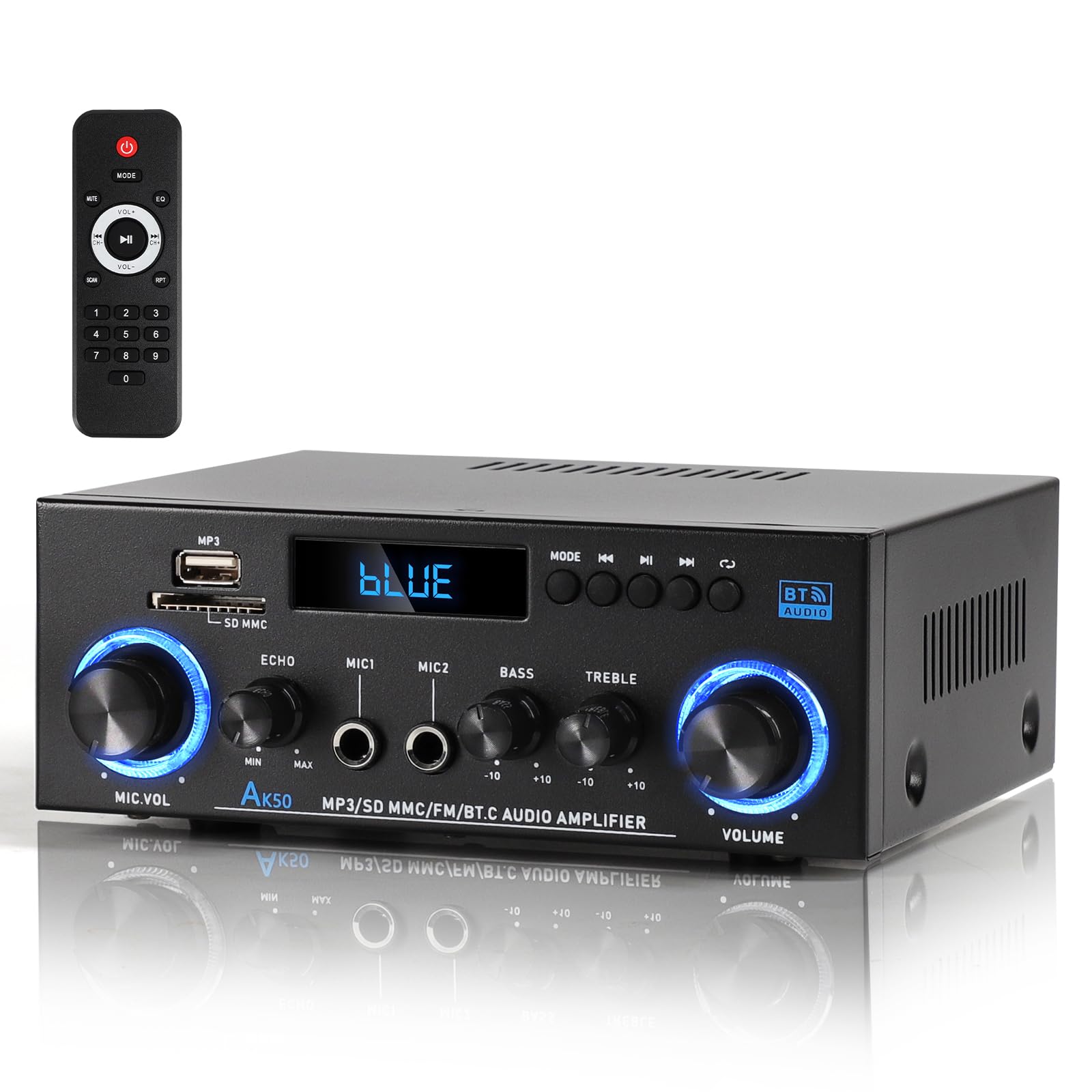
The Joengoep AK50 Stereo Audio Amplifier is a compact two-channel integrated amplifier built for people who want to drive a pair of passive speakers from Bluetooth, USB, SD card, FM radio, or a wired AUX source, with karaoke microphone inputs included. It suits budget home stereo builds, garages, patios, and casual party setups. The qualification is power: the rated output is listed at 50 watts per channel, well under the 400W headline figure.
Source flexibility is the strongest practical argument for this unit. Bluetooth 5.0 handles phone and tablet streaming at a stated range of about 50 feet in open space, while USB 2.0 flash drives and SD cards play MP3 files directly, which is useful when you want music at a gathering without tying up someone's phone. An FM tuner and AUX input cover radio and older wired gear such as TVs and DVD players. The microphone input, microphone output, and echo knob extend it into karaoke and announcement duty, and the manufacturer notes the mic output can feed an active subwoofer or a recording device.
Controls are physical rather than menu driven. Independent knobs cover bass, treble, master volume, microphone volume, and echo, so tone adjustments are immediate and guests can figure them out without instruction. The chassis is described as metal, dual microphone interfaces are provided, and a remote is included for adjustments from a seat. Speaker compatibility spans 4 to 16 ohms, which covers most bookshelf pairs and older passive speakers people already own.
The weak points are worth taking seriously. Advertised wattage and rated output conflict in the supplied data, and the quoted 0.4% distortion and 80dB signal-to-noise ratio are unremarkable next to dedicated hi-fi amplifiers. There are no supplied dimensions, weight, warranty terms, or power supply details, and the listing warns that connecting speakers with the volume at maximum can overheat and damage the chip. Critical listeners and anyone filling a large room should consider a higher-rated amplifier.
Buy it for the combination of wireless streaming, standalone media playback, and karaoke microphone support in one inexpensive unit. Hesitate if you need documented power figures, low distortion, or modern connections such as HDMI or optical. Serious listening rooms call for a different class of amplifier.
Bluetooth 5.0 Wireless Streaming: This is the feature most buyers will use daily, since it lets a phone, tablet, or laptop send audio to the amplifier with no cable running across the room. The listing states a range of roughly 50 feet in open space and faster pairing than older Bluetooth versions. Walls and furniture will shorten that figure, so plan on same-room use for reliable playback.
Microphone Input With Echo Control: The dedicated echo knob is what separates this from a plain Bluetooth amplifier. Echo softens the dry, exposed sound of an untreated voice, which makes casual karaoke more forgiving for hesitant singers. Dual microphone interfaces allow duets or a host plus a performer. The separate mic volume knob also lets you balance a voice against the music without touching the master level.
USB and SD Direct Playback: Loading MP3 files onto a flash drive or SD card turns the amplifier into a standalone music source, which matters at parties where nobody wants their phone tied up or where Bluetooth pairing gets passed around. USB 2.0 drives and SD cards are supported for direct playback. Only MP3 playback is stated, so keep a converted folder ready rather than assuming lossless support.
Independent Bass and Treble Knobs: Separate tone controls solve a common problem with cheap speakers, which often sound thin or boomy in the room they end up in. Turning bass down for a small bookshelf pair near a wall, or treble up for muffled outdoor speakers, is a two-second fix. Because the knobs are physical, guests and family members can adjust the sound without learning an app.
Wide Speaker Impedance Support: Compatibility with 4 to 16 ohm passive speakers is the practical reason this unit fits so many secondhand and mixed systems. Older bookshelf pairs, garden speakers, and inherited towers commonly land somewhere in that range. It means you can shop for speakers based on sound and price rather than hunting for a specific impedance match, which simplifies a first stereo build.
Included Remote Control: The remote handles audio adjustments from across the room, which matters when the amplifier is tucked into a shelf, cabinet, or wall unit. For a TV or gaming setup where you are already seated, it removes the need to get up for every volume change. Buyers planning a permanent installation behind furniture will get the most value from it.
Speakers: The AK50 is built for passive speakers rated between 4 and 16 ohms, which covers most bookshelf models, older component speakers, and many outdoor or ceiling pairs. It is not intended to feed powered or active speakers that have their own amplification. If your speakers plug into a wall outlet, this unit is the wrong tool.
Audio Sources: Listed compatible sources include phones, tablets, laptops, TVs, and DVD players, connected either wirelessly over Bluetooth 5.0 or through the AUX input. That covers most casual living room and desk setups. Note that only Bluetooth, USB, SD, FM, and AUX inputs are described, so a TV without an analog audio output or a Bluetooth transmitter may need an adapter.
Media Formats: USB 2.0 flash drives and SD cards are supported for direct MP3 playback. If your library sits in FLAC, WAV, or another format, convert files first or stream over Bluetooth instead. No file size or capacity limits are provided in the product data, so treat very large drives as untested.
Microphones and Expansion: Dual microphone interfaces are provided, along with a microphone output. The manufacturer states that output can connect to an active subwoofer or a recording device, which gives you a path to add low-end reinforcement or capture a performance. Specific microphone types and connector standards are not detailed, so confirm your mic plug matches before ordering accessories.
Placement Scenarios: The listing points to home speakers, bookshelf systems, gaming setups, car audio, outdoor garden speakers, and small parties. Those are all realistic given the modest rated output. Large open rooms, commercial spaces, and high-volume events are outside what a 50 watt per channel amplifier is likely to cover comfortably.
Best For: This amplifier fits someone assembling a first or secondary stereo system on a tight budget, especially if a pair of passive speakers is already sitting unused. It also suits households that host karaoke or backyard gatherings, since microphone input, mic volume, and echo control are built in rather than requiring a separate mixer. Garages, workshops, patios, dorm rooms, and gaming desks are natural homes for it.
Consider Alternatives If: Skip it if you need documented, conservative power ratings for large or inefficient speakers, or if you are filling an open-plan living area at high volume. Critical listeners who care about low distortion and high signal-to-noise figures should shop dedicated hi-fi integrated amplifiers instead. Buyers who need HDMI, optical, or phono inputs will not find them described here, and anyone with powered speakers needs a plain Bluetooth receiver rather than an amplifier.
Setup and Daily Use: Expect a straightforward workflow of wiring speaker cables to the terminals, connecting any wired sources to AUX, then pairing a phone over Bluetooth or inserting a USB drive or SD card. Day to day, you select an input, set bass and treble once for your room, and use the remote or master volume for level. Karaoke use adds plugging in a microphone and balancing mic volume and echo against the music.
Maintenance Requirements: There are no consumables to replace. Keep the metal chassis free of dust, give it breathing room rather than burying it in a sealed cabinet, and follow the manufacturer warning to connect speakers before raising the volume. Keeping a folder of MP3 files on a dedicated flash drive is worth doing if you plan to use the USB playback regularly.
What Sets It Apart: Most inexpensive Bluetooth amplifiers in this class handle streaming and little else. Combining wireless audio, standalone USB and SD playback, an FM tuner, dual microphone interfaces, and echo adjustment in one metal-bodied unit is a broader feature set than a single-purpose receiver, and it removes the need for extra components in a casual party or karaoke setup.
Connect Speakers Before Raising Volume: The manufacturer explicitly warns against connecting speakers while the volume is at maximum, because the resulting overload can overheat and damage the internal chip. Make it a habit to turn the master volume down to zero, wire everything, then bring the level up. This matters most for people who swap speakers between a patio and a living room.
Match Speaker Impedance: Stay within the stated 4 to 16 ohm range. Wiring speakers in ways that drop total impedance below that window puts unnecessary stress on the amplifier. If you are combining multiple pairs or reusing older speakers with unclear labeling, check the ratings on the back of each cabinet before connecting them.
Watch Heat and Placement: The listing references chip overheating under overload conditions, which is a reasonable prompt to give the unit open air. Avoid stacking gear directly on top of it or sealing it inside a closed cabinet with no ventilation, particularly during long party sessions or extended high-volume playback.
Microphone Handling: When using the mic input, raise mic volume gradually and keep the microphone pointed away from the speakers. Sudden high gain combined with echo can produce feedback that is unpleasant and hard on both the speakers and your guests. Setting a comfortable balance before the first song saves scrambling mid performance.
Routine Care: Keep the metal enclosure and its knobs free of dust and liquids, especially in kitchen, garage, or outdoor settings where the unit is likely to live. Unplug it during electrical storms or long absences, and store any bundled remote where the buttons will not be pressed against other objects.
Pros
- Versatile input selection: Supports CD/DVD, USB, MP3, AM/FM, AUX, and Bluetooth, covering most home audio sources.
- Karaoke-ready: Dual mic inputs with echo control let you host sing-alongs without needing a separate mixer.
- Subwoofer output: RCA output for a subwoofer lets you add low-end punch for movies and music.
- Rack-mountable design: Fits standard equipment racks, making it a neat option for home theater or PA setups.
- Remote control included: Adjust volume, source, and EQ from your seat, adding convenience.
Cons
- Power rating is peak, not RMS: The 3000W peak may overstate actual continuous output, so it might not drive large, inefficient speakers as loud as expected.
- No HDMI inputs: If you need to connect modern TVs or Blu-ray players, you'll need additional converters or a different receiver.
- Build quality may not be professional-grade: Given the price point, the plastic front panel and controls may not withstand heavy daily use in a commercial setting.
The Pyle PD3000BT.5 is a 4-channel Bluetooth home theater amplifier receiver designed for budget-conscious buyers who want an all-in-one audio hub for karaoke, music, and movies. It suits casual home users, DIY home theater builders, or small venue hosts who need multiple inputs and wireless streaming without breaking the bank. However, its peak power rating and build quality mean it's not a substitute for high-end audiophile gear or professional installation.
At the heart of this unit is its versatility. It supports a wide range of sources: a front-loading CD/DVD player, USB and MP3 playback, AM/FM tuner, AUX input, and Bluetooth for wireless streaming from smartphones and computers. This means you can consolidate your old discs, radio, and modern streaming into one box, reducing clutter. The two microphone inputs with echo effect are a standout for karaoke, allowing you to adjust mic volume and echo independently, which is a feature rarely found at this price.
The front panel is equipped with a digital LCD display that shows the active input and function, making it easy to see what's playing. Controls include rotary knobs for equalization and master volume, plus dedicated buttons for treble, bass, mic, echo, and subwoofer levels. The included remote control adds convenience for adjusting settings from a distance. The unit is also rack-mountable, which is a bonus for those with a home theater rack or wanting a tidy setup.
However, there are trade-offs. The 3000W peak power is a marketing figure; real-world continuous power is likely much lower, so you may need efficient speakers to get satisfying volume. There are no HDMI inputs, so connecting a modern TV may require an optical or RCA adapter. The build quality feels budget-oriented, with plastic knobs and a lightweight chassis, which may not withstand heavy professional use. Also, the AM/FM tuner may require a good antenna for clear reception, which isn't included.
In summary, the Pyle PD3000BT.5 is a solid value for someone who wants a multi-source amplifier with karaoke features and Bluetooth in a single unit. Its strongest selling points are the input flexibility and mic echo controls. The main reason to hesitate is if you need high-fidelity, high-volume output or modern HDMI connectivity. If you're a casual user with modest speakers, this receiver will serve you well. If you're an audiophile or need professional reliability, consider investing in a higher-end receiver.
Bluetooth Streaming: Stream music wirelessly from your smartphone, tablet, or computer. This eliminates the need for physical connections and lets you play podcasts, playlists, or videos with ease. Ideal for impromptu listening sessions or background music at parties.
4-Channel Amplifier: Powers up to four speakers (4-8 ohm impedance) to create a multi-room or surround sound setup. This allows you to fill a large living room or backyard with audio without needing a separate amp. Perfect for home theaters or whole-house audio.
Multiple Inputs: Includes CD/DVD player, USB, MP3, AM/FM tuner, AUX, and RCA inputs. This versatility lets you connect legacy devices like a turntable (with phono preamp) or a TV, and switch between sources effortlessly. Great for consolidating your entertainment system.
Microphone Inputs with Echo: Two 1/4" mic inputs with individual volume and echo controls. This turns the amplifier into a karaoke machine, allowing you to sing along with music or make announcements. The echo effect adds depth to vocals, making it fun for parties.
Subwoofer Output: A dedicated RCA output for a powered subwoofer. This lets you add deep bass for movies and music, enhancing the overall audio experience. Easy to connect if you already have a subwoofer.
Best For: This amplifier is ideal for budget-conscious home users who want a single unit to handle multiple audio sources, including karaoke. It's also suitable for small gatherings, game rooms, or workshops where Bluetooth streaming and radio are primary. The rack-mount feature appeals to hobbyists with a home theater rack.
Consider Alternatives If: If you need HDMI inputs for a modern TV setup, or if you require high continuous power for large rooms or inefficient speakers, you should look at AV receivers with more robust amplification. Also, if you're a professional DJ or installer, the build quality may not meet your standards.
Setup and Daily Use: Setup is straightforward: connect speakers to the four outputs, plug in your sources, and turn on. The front panel and remote make source selection and volume adjustments easy. Expect to spend a little time tuning the EQ and mic echo to your liking. Bluetooth pairing is hassle-free with modern devices.
Maintenance Requirements: Keep the unit dust-free by wiping with a dry cloth. Ensure proper ventilation to avoid overheating, especially when driving speakers at high volumes. The CD/DVD player may require occasional lens cleaning if used frequently. No other special maintenance is needed.
What Sets It Apart: Compared to typical stereo receivers, this unit offers a rare combination of karaoke features (dual mics with echo), multiple physical inputs, and Bluetooth at an entry-level price. It's a jack-of-all-trades for casual audio enthusiasts.
Speaker Connection: Connect up to four speakers (4-8 ohms) using standard speaker wire. Ensure correct polarity (+/-) for each channel to maintain sound quality. The spring-clip terminals accept bare wire or banana plugs.
Source Setup: For Bluetooth, press the source button to select BT mode and pair your device. For USB, insert a flash drive with MP3 files. For CD/DVD, load a disc and press play. For radio, connect an FM antenna (not included) and tune stations manually or via preset buttons.
Microphone Setup: Plug in microphones (not included) into the 1/4" jacks. Adjust mic volume and echo effect to avoid feedback. Start with low volume and gradually increase.
Remote Control: The included remote requires two AAA batteries (not included). Point it at the front panel to control volume, source, and EQ from a distance.
Ventilation and Cleaning: Place the unit in a well-ventilated area, leaving space around the vents. Clean the exterior with a soft, dry cloth. Avoid using liquids or aerosol cleaners. Periodically check the CD/DVD lens for dust and use a lens cleaner disc if needed.
Pros
- Bluetooth connectivity allows cable-free audio streaming from modern devices
- Six-channel output can drive multiple speakers for broader sound coverage
- Dual mic inputs with echo and talk-over are ideal for karaoke or announcements
- Variety of input options (USB, SD, AUX, FM) offers flexibility for different sources
- Remote control and front-panel EQ provide easy adjustments from a distance
Cons
- 750W peak power is not continuous RMS, so actual output is likely lower
- No independent volume control per channel, limiting fine-tuned speaker balancing
- Lack of user reviews means real-world performance and reliability are unverified
The Pyle Bluetooth Wireless Home Amplifier System (ASIN B07FK3G173) is a six-channel amplifier that aims to be a versatile hub for home audio, PA duties, and karaoke. With a peak power rating of 750 watts and support for 4-8 ohm speakers, it is positioned as an affordable solution for users who need to power multiple speakers from a single unit. The best-fit buyer is someone who values input flexibility and microphone features over audiophile-grade sound quality.
This amplifier appears designed to solve the problem of connecting various audio sources to a multi-speaker setup without breaking the bank. It offers Bluetooth streaming, USB and micro SD playback, an AUX input, FM radio, and RCA line inputs and outputs, including a subwoofer output. This makes it a potential central component for a small home theater, a classroom, or a mobile DJ rig.
Key features translate into practical benefits: Bluetooth lets you play music from your phone or tablet wirelessly; the dual 1/4-inch microphone inputs with echo and talk-over are perfect for karaoke nights or making announcements over the music; and the integrated equalizer allows you to tweak the sound to your liking. The included remote control adds convenience for adjusting volume or switching sources from across the room.
However, there are limitations to consider. The 750-watt rating is peak power, not continuous RMS, so the actual sustained output will be lower, which may be insufficient for large venues or very loud listening. Also, the six channels do not have independent volume controls, so you cannot balance the levels of individual speakers. Additionally, with no user reviews available, real-world performance and long-term reliability remain unverified.
In conclusion, the Pyle amplifier offers a compelling package for its price point, especially for budget-conscious users who need a multi-function amp with microphone capabilities. If you require high-fidelity sound, precise channel control, or have a large space to fill, you may want to look at more expensive alternatives. Before purchasing, verify that the amplifier's power output and channel configuration meet your specific needs.
Strong Match: The primary buyer is a budget-conscious home user or small venue operator who wants a single amplifier to handle music from various sources, drive multiple speakers, and occasionally use microphones for karaoke or announcements. The Bluetooth and multiple inputs make it convenient for everyday use.
Also Consider It If: If you are setting up a simple PA system for a classroom, small conference room, or community event, the dual mic inputs with echo and talk-over could be valuable for presentations or performances.
Not the Best Fit: If you are an audiophile seeking high-fidelity sound or a live sound engineer needing precise control over each speaker channel, this amplifier likely won't meet your expectations due to its peak power rating and lack of independent channel volume.
Decision in One Sentence: For a buyer who needs an affordable, feature-packed amplifier with Bluetooth and mic inputs for casual home or small PA use, the Pyle 6-Channel is a reasonable choice, provided you accept its power limitations and the absence of user feedback.
Consider It For:
- Multi-source streaming: Bluetooth, USB, SD, AUX, and FM radio give you plenty of ways to play music.
- Karaoke or paging: Two mic inputs with echo and talk-over are handy for performances or announcements.
- Multi-speaker setups: Six channels can power several speakers for wider coverage.
- Convenience: Remote control and front-panel EQ make adjustments easy.
- Budget-friendly: Offers many features at a price point that is accessible.
Pass If:
- You need high continuous power output for large venues or loud listening; 750W peak is not the same as RMS.
- You require independent volume control for each speaker channel to balance sound levels.
- You rely on verified user feedback to gauge reliability; there are no reviews yet.
Pros
- Multiple input options: HDMI (2 in, 1 out), AUX, FM radio, and subwoofer output provide flexibility for various devices
- Bluetooth connectivity allows easy wireless audio streaming from modern devices
- Compact size and included 12V adapter make it suitable for tight spaces or temporary setups
- Remote control adds convenience for volume and input changes
- Five channels enable a basic surround sound setup for an immersive movie experience
Cons
- 100W peak power is modest; may not deliver high volume or deep bass for larger rooms or demanding listeners
- Spring-loaded speaker terminals may not accommodate thick or banana-plug speaker wires securely
- Build quality may be less robust than more expensive receivers, potentially affecting longevity
The Pyle PFA540BT.5 is a compact 5-channel home theater amplifier designed for budget-minded users who want to add surround sound to a small or medium-sized room. It is best suited for those who prioritize connectivity and convenience over raw power, offering Bluetooth, HDMI, and FM radio in a single box. However, its modest 100-watt peak power means it may not satisfy users with large spaces or a need for high-volume, low-distortion output.
This amplifier provides a variety of inputs that make it easy to connect multiple devices. With two HDMI inputs and one output, you can integrate it into a TV or projector setup, while the AUX RCA inputs allow for older audio sources like CD players or media streamers. The built-in FM tuner with antenna input adds radio functionality, and the subwoofer output lets you add a powered sub for deeper bass. Bluetooth streaming from smartphones and tablets is a key feature, enabling wireless playback without extra cables.
The front panel includes an LCD display and buttons for input selection, tuning, surround sound, mute, and standby, plus a rotary volume knob. The included remote control adds convenience for adjusting settings from a distance. The compact chassis and included 12V adapter make it easy to place on a shelf or in an entertainment center, though the spring-loaded speaker terminals may require bare wire connections.
While the Pyle offers a lot of connectivity for the price, there are notable limitations. The 100W peak power is spread across five channels, so each channel receives a fraction of that power, which may result in lower volume and less headroom. The amplifier may struggle with demanding speakers or large rooms. Additionally, the build quality is typical of budget electronics, and the spring-loaded terminals may not be as secure as binding posts.
In conclusion, the Pyle PFA540BT.5 is a practical choice for a small home theater setup where space and budget are limited, and where Bluetooth and multiple inputs are more important than high-volume output. If you require powerful, room-filling sound or are an audio enthusiast, you may want to consider a more robust receiver with higher wattage and better build quality.
Bluetooth Connectivity: This feature allows you to stream audio wirelessly from your smartphone, tablet, or computer. It eliminates the need for physical cables, making it easy to play music or podcasts from your favorite apps. Ideal for casual listening or background music.
HDMI Inputs and Output: With two HDMI inputs and one output, you can connect modern devices like a streaming stick, game console, or Blu-ray player. The output can send video to your TV, while the amplifier handles audio, simplifying your setup.
Subwoofer Output: This RCA output lets you connect an external powered subwoofer to add deep bass, enhancing the movie and music experience. It is particularly useful for home theater enthusiasts who want richer low-end sound.
FM Radio Tuner: The built-in FM tuner with antenna input provides access to local radio stations. This is a convenient option for those who enjoy live radio or want a backup source without needing extra devices.
Five Speaker Channels: The amplifier can power five speakers, enabling a basic surround sound setup (e.g., front left/right, center, and rear left/right). This creates a more immersive audio experience for movies and games.
Best For: The Pyle PFA540BT.5 is ideal for budget-conscious users who want to set up a small home theater or multi-room audio system without breaking the bank. It is also suitable for apartments, bedrooms, or offices where space is limited and high volume is not required.
Consider Alternatives If: You need high power output for a large room or outdoor use, or if you are an audiophile who demands high-fidelity sound. In such cases, a more powerful receiver with better build quality and higher wattage would be a better investment.
Setup and Daily Use: Setup is straightforward: connect your speakers to the spring-loaded terminals, plug in your sources (HDMI, AUX, etc.), and power on. Use the front panel or remote to select inputs and adjust volume. Bluetooth pairing is typically simple, and the FM antenna helps with radio reception.
Maintenance Requirements: This amplifier requires minimal maintenance. Keep it in a well-ventilated area to prevent overheating, and periodically dust the exterior and vents. The spring-loaded terminals may need occasional tightening to ensure secure speaker connections.
What Sets It Apart: Compared to other budget amplifiers, the Pyle stands out for its combination of Bluetooth, HDMI, and FM radio in a compact, affordable package. It offers a wider range of inputs than many competitors at this price point, making it a versatile hub for various audio sources.
Audio Sources: The amplifier supports Bluetooth devices (smartphones, tablets, laptops), any device with RCA line-level outputs (CD players, media players), and HDMI devices (streaming sticks, game consoles, Blu-ray players). It also includes a built-in FM tuner.
Speakers: It can drive up to five passive speakers with a nominal impedance of 4-8 ohms. The spring-loaded terminals accept bare wire or pin connectors; banana plugs are not supported.
Subwoofer: The RCA subwoofer output is designed to connect to a powered subwoofer, not a passive one.
TV or Display: The HDMI output can be used to connect to a TV or projector with an HDMI input, but note that the amplifier may not pass through 4K video signals, so check your video source capabilities.
Pros
- Input flexibility is the strongest listing-supported advantage: USB, optical, and coaxial coverage means a buyer with a mixed setup is less likely to need a separate switcher or adapter.
- Dual output types mean the unit can grow with a system, feeding headphones today and powered monitors or a stereo amplifier later without a second purchase.
- Onboard tone controls are unusual at the entry level and give practical value to listeners with bright or bass-shy headphones who want an immediate hardware correction.
- The stated no-driver operation reduces the most common friction point for first-time DAC buyers, particularly those connecting a television or console rather than a computer.
- Cables are listed as included, specifically an optical cable, a USB-B connection cable, and a USB power cable, which lowers the chance of an incomplete first setup.
Cons
- No structured specifications were supplied, so output power in milliwatts, output impedance, signal-to-noise ratio, and DAC chip identity are all unknown, and those figures determine whether a given headphone will actually be driven well.
- No usable customer review excerpts were provided, so the aggregate rating cannot be interpreted; there is no way to tell whether owners report noise, channel imbalance at low volume, or failures over time.
- The stated 16 to 200 ohm range is a manufacturer claim, not a measurement, and impedance alone does not predict loudness; low-sensitivity planar or high-impedance studio headphones may fall outside comfortable use even inside that range.
The Fosi Audio Q4 is described in its listing as an entry-level desktop digital-to-analog converter with a built-in headphone amplifier, offering PC-USB, optical, and coaxial digital inputs alongside a 3.5mm headphone output and RCA line outputs. The buyer it most clearly fits, based only on supplied information, is someone with several digital sources and one listening position who wants a single small box handling all of them. The strongest supported reason to consider it is connectivity breadth rather than sound quality, because the listing contains no measurements at all. That is also the central evidence limitation: nothing here establishes how the unit performs, only what it connects to.
The decision-relevant verified points are the input and output set, the stated 16 to 200 ohm headphone impedance range, the listed 24-bit/192kHz support, the metal enclosure, and the physical bass and treble controls. Practically, the three inputs mean a television via optical, a computer via USB, and a disc player via coaxial can coexist. The dual outputs mean a system can evolve from headphones to powered speakers without replacing the unit. Tone knobs matter to buyers who want hardware correction that persists across every connected source rather than per-device software equalization.
No customer review excerpts were supplied with this product data. An aggregate rating exists in the source record, but without any attributed review text there is no basis for describing owner experience, no recurring themes to report, and no consensus to summarize. Any statement about how the Q4 sounds or holds up in daily use would be invention, so none is offered here.
The trade-offs follow directly from the gaps. Output power, output impedance, noise floor, and converter hardware are all unstated, and those figures decide whether demanding headphones reach comfortable volume or whether sensitive in-ear monitors hiss. Buyers with a specific difficult headphone, or those who need balanced output, a microphone input, or documented measured performance, are on safer ground choosing a unit that publishes those numbers.
Qualified verdict: for a buyer whose priority is consolidating mixed digital sources into one compact unit with tone controls and conventional headphones in the moderate impedance range, the supplied evidence supports considering the Q4. For anyone selecting on measured performance or a known-difficult headphone, the evidence here is insufficient to support the purchase without independent measurements.
Verified Product Facts: The following come from the supplied listing text and are manufacturer claims rather than independent test results.
- Digital inputs listed: PC-USB, optical, and coaxial.
- Analog outputs listed: 3.5mm headphone jack and RCA line output.
- Stated headphone impedance range: 16 ohms to 200 ohms.
- Stated audio format support: 24-bit/192kHz.
- Physical controls listed: volume, bass, and treble knobs; enclosure described as full metal.
- Stated operation: no driver installation required; included accessories listed as a USB power cable, an optical cable, and a PC-USB to Type-B cable. The listing explicitly notes there is no microphone input.
Customer Signals: The supplied data contains no review excerpts. A numeric aggregate rating appears in the source record, but with zero accompanying review text there is nothing to attribute, no recurring theme to identify, and no pattern that can honestly be described. The supplied excerpts are insufficient for any customer-experience conclusion.
Not Verified:
- Measured output power at any impedance, output impedance, signal-to-noise ratio, distortion, or channel matching; none are stated, and none can be inferred from the impedance range given.
- Which DAC and amplifier hardware is used internally, and therefore how the 24-bit/192kHz claim translates into audible behavior.
- Long-term durability of the potentiometers, jacks, and enclosure, along with heat behavior during extended use.
- Warranty terms, return coverage, and support responsiveness.
- Compatibility specifics such as behavior with game consoles, whether optical input accepts compressed surround formats, USB power requirements, and physical dimensions or weight.
Evidence-Aware Verdict: The evidence supports a decision about connectivity and control layout: a buyer can reasonably conclude the Q4 accepts three common digital source types and feeds both headphones and line-level gear with hardware tone adjustment. The evidence does not support any decision that depends on sound quality, drive capability with a particular headphone, reliability over time, or value relative to measured competitors. Buyers in that second group should seek independent measurements before committing.
Compatibility: The listing states PC-USB, optical, and coaxial inputs, which covers most desktop computers, most televisions, and most CD or DVD players. For a buyer with exactly those sources, this removes the need for a separate switch box. The qualification is significant: nothing states whether optical input handles compressed surround streams or only two-channel PCM, and nothing addresses console or mobile device behavior. A buyer relying on a television optical feed should confirm the source can output stereo PCM.
Headphone Matching: The manufacturer states support for 16 to 200 ohm headphones. That range nominally covers most consumer headphones and many entry-level enthusiast models, which helps a buyer with conventional gear. The qualification is that impedance is only half the equation; sensitivity determines actual loudness, and no output power figure is supplied. Low-sensitivity planar magnetic headphones and high-impedance studio models sit at the edge of, or beyond, what this claim can honestly promise.
Controls: Separate bass, treble, and volume knobs are listed, with the enclosure described as metal. For listeners who want tonal adjustment applied to every connected source, hardware knobs are more convenient than per-application software equalizers. The qualification is that analog tone controls vary widely in their turnover frequencies and boost range, and none of those parameters are supplied, so the practical effect of a given knob position is unknown.
System Growth: Both a 3.5mm headphone output and RCA line outputs are listed, so the unit can serve a headphone setup now and a powered speaker or integrated amplifier setup later. This reduces the chance of needing a replacement purchase when a system expands. The qualification is that the listing does not state whether the RCA outputs are fixed level or follow the volume knob, which determines whether powered speakers can be controlled from the Q4 itself.
Portability and Setup: The description emphasizes a compact form factor, no-driver operation, and included optical, USB-B, and USB power cables. For a buyer who wants a working setup on the first attempt, that combination lowers the friction and the chance of a missing cable. The qualification is that no dimensions, weight, or power draw figures are supplied, so desk-space planning and any intention to run it from a laptop USB port cannot be confirmed in advance.
Ownership Cost and Risk: This sits in the entry-level bracket for desktop DACs, so the financial exposure is modest relative to units that publish full measurement suites. The buyer impact is that a mismatch is a smaller loss than with higher-tier gear. The qualification is that no warranty terms, service coverage, or owner reliability reports are available in the supplied data, so the practical risk of a failure outside a return window cannot be assessed here.
Pros
- Five playback modes (Bluetooth, FM, USB, SD card, and 3.5mm AUX) cover most home sources without extra adapters or a separate streamer.
- Bluetooth 5.0 with a stated 33 feet (10 meters) of range means you can control playback from another part of a normal-sized room.
- Independent treble and bass controls give real tone shaping, which matters more with inexpensive speakers than with matched hi-fi pairs.
- Two microphone inputs with individual mic volume and echo let a second singer join in while music stays at its own level.
- Front LED display plus a remote makes mode and volume status readable at a glance, useful in shared households where several people operate it.
Cons
- Output is quoted only as 400W total peak and 200W per channel, with no continuous RMS figure or supported speaker impedance range, so buyers matching specific speakers have little to work from.
- Wired input is limited to a 3.5mm AUX jack in the listed features, so RCA sources, TVs with optical or HDMI ARC outputs, and turntables without a built-in phono stage will need converters or a preamp.
- No dimensions, weight, warranty terms, or supported audio file formats appear in the product data, and there is little published owner feedback yet, which is a concern for buyers who prefer a documented track record.
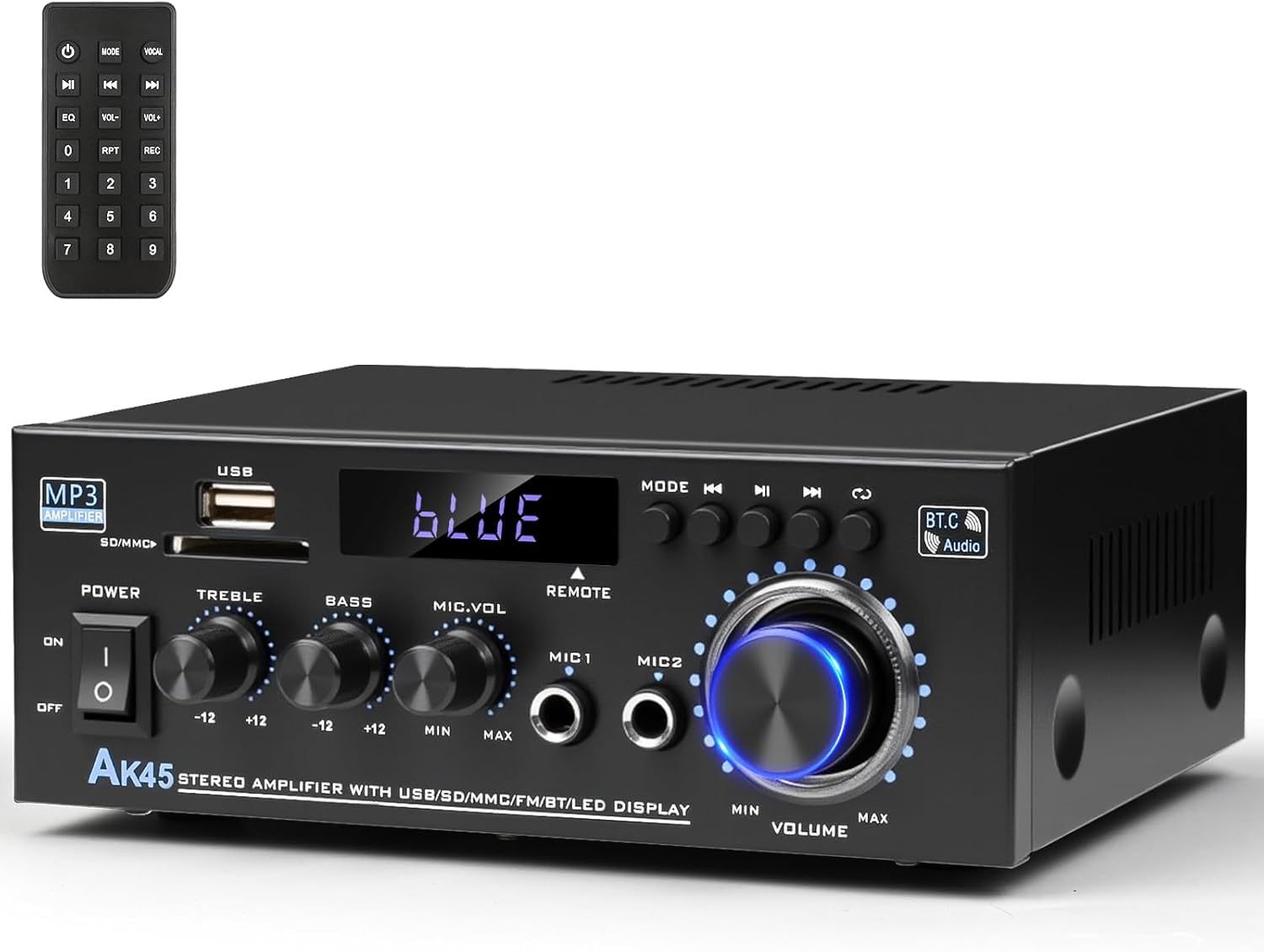
The CiLmirsac AK45 is a compact two-channel Bluetooth 5.0 stereo amplifier built for people who want to drive a pair of passive speakers on a desk, in a bedroom, or in a small living room without installing a full-size receiver. Five source modes and dual karaoke microphone inputs cover a lot of ground, though the 400W figure is a peak rating rather than measured continuous output.
Source flexibility is the main reason to consider it. Bluetooth 5.0 handles wireless playback from a phone, tablet, or laptop at a stated range of up to 33 feet, while FM radio, USB flash drive, SD card, and a 3.5mm AUX input handle everything else. Independent treble and bass knobs let you tame bright speakers or add weight to small drivers, which tends to matter more with budget speakers than with carefully matched hi-fi pairs.
Operation centers on a front LED display showing the active mode and volume, plus a remote for input switching, volume, and track skipping from a seated position. Two 6.35mm microphone jacks sit alongside separate mic volume and echo controls, so a vocal can be balanced against the music without touching the master level. The manufacturer describes the chassis as compact enough for a shelf or desktop.
The gaps are in documentation. No continuous power rating, speaker impedance range, or physical dimensions appear in the product data, so confirm those before pairing it with specific speakers. Microphones are not listed as included, and mics terminated in XLR or 3.5mm plugs will need adapters. Anyone wanting optical or HDMI ARC for a TV, or a dedicated subwoofer output, will not find them in the listed features.
Choose the AK45 if you value one small unit that powers passive speakers, streams wirelessly, and converts into a karaoke amp for family gatherings. Hesitate if you need published power specifications, digital TV inputs, or a documented service history. Listeners building a critical two-channel system, or driving large floorstanding speakers, will be better served by a conventional integrated amplifier or AV receiver.
Bluetooth 5.0 Wireless Streaming: This is the feature most buyers will use daily, since it removes the cable run between a phone and the amplifier. The stated 33 feet (10 meters) of range covers a typical bedroom, office, or living room, so you can keep the phone in your pocket while cooking or working. It suits anyone whose main library lives on a streaming app rather than local files.
Independent Treble and Bass Controls: Two dedicated tone knobs solve the common problem of inexpensive speakers sounding thin or harsh in a small, hard-surfaced room. Rather than accepting whatever balance the speakers produce, you can pull back the treble on bright drivers or lift the bass on compact cabinets. Listeners running secondhand or entry-level bookshelf speakers benefit most from this kind of correction.
Five Playback Modes in One Unit: Bluetooth, FM radio, USB flash drive, SD card, and 3.5mm AUX all live in the same chassis, which keeps a small setup from turning into a stack of boxes. Loading a USB stick or SD card means music plays without a phone involved at all, useful in a garage, workshop, or guest room where you would rather not tie up a device.
Dual 6.35mm Microphone Inputs With Echo: Two quarter-inch mic jacks with separate mic volume and echo adjustment turn the amplifier into a basic karaoke front end. Because each mic level is set independently of the music, one singer can be louder than the other without rebalancing the track. Families and casual party hosts get the most from this; it is not a substitute for a mixer or PA system.
LED Display and Included Remote: The front display reports the current mode and volume, which prevents the usual guesswork about whether a silent unit is on the wrong input. The remote covers input switching, volume, and track skipping from across the room. This combination makes the unit easier to share with household members who do not want to learn a complicated control layout.
Speakers: This is an amplifier for passive speakers, meaning speakers without their own power supply. Powered or active speakers, and Bluetooth speakers, are not the intended partners. The product data does not state the supported impedance range, terminal type, or continuous power per channel, so check with the seller before pairing it with anything unusual such as very low impedance or high-sensitivity vintage speakers.
Wireless Sources: Any Bluetooth-capable phone, tablet, or laptop should pair with the built-in Bluetooth 5.0 radio at a stated range of up to 33 feet. Codec support and multipoint pairing are not documented, so treat it as a straightforward one-device-at-a-time wireless link rather than an advanced wireless audio hub.
Wired Sources: Wired input is a 3.5mm AUX jack. Devices with RCA outputs, including many CD players and TVs, will need an RCA to 3.5mm cable, and a turntable will only work if it has a built-in phono preamp or an external one in the chain. There is no optical or HDMI connection listed, which matters for newer televisions that output digital audio only.
Local Media: USB flash drives and SD cards can be played directly, and FM stations can be stored as presets. Supported file formats, maximum drive capacity, and file system requirements are not published, so buyers planning to use high-capacity cards or less common formats should verify compatibility first.
Microphones: The two mic inputs are 6.35mm (quarter-inch) jacks, which matches most inexpensive wired karaoke microphones. Microphones with XLR or 3.5mm connectors need an adapter, and condenser mics requiring phantom power are not supported by anything described in the product data.
Best For: Households with a spare pair of passive bookshelf speakers and no amplifier to run them. It fits a desktop setup, a bedroom, a garage, a small shop counter, or a family room where the same unit needs to stream music one evening and handle karaoke the next. The five input modes also make it a reasonable pick for someone who still listens to FM or keeps music on a USB drive.
Consider Alternatives If: You need documented continuous power and impedance specifications, digital TV connectivity such as optical or HDMI ARC, a subwoofer output, or multi-room streaming over Wi-Fi. Large floorstanding speakers, critical listening, or a dedicated home theater are better matched to a conventional AV receiver or integrated amplifier. Buyers who want powered speakers with nothing else in the signal path should skip amplifiers entirely.
Setup and Daily Use: Expect to connect speaker wire to the amplifier, plug in the power supply, and select a mode from the front panel or remote. From there, daily use is choosing a source, setting volume, and adjusting treble and bass once for your room. Karaoke requires supplying your own 6.35mm microphones, then balancing mic volume and echo against the music.
What Sets It Apart: Most compact Bluetooth amplifiers in this class focus on streaming alone. Combining wireless playback, FM, USB, SD, and AUX with two microphone channels and echo control in one small chassis gives it a broader role in a shared household. The trade-off is that this breadth comes with less published technical detail than established audio brands typically provide, so it appeals more to casual listeners than to specification-driven buyers.
Pros
- Compact size fits into DIY projects like boomboxes or small enclosures without taking up much space.
- Dual input options (Bluetooth 5.0 and AUX) provide flexibility for streaming or wired sources.
- Full tone controls (bass, treble, sub level, sub frequency) offer precise sound customization.
- Wide voltage range (12V-24V) allows you to increase power output if you have a higher-voltage supply.
- Includes assembly hardware and barely gets warm during operation, making it safe for enclosed DIY builds.
Cons
- Power supply is not included, so you must buy a compatible 12V-24V DC adapter separately.
- The board is bare and exposed; you need to provide a suitable enclosure for safe, neat installation.
- The 4-8Ω speaker impedance range may not work with all speakers, so check compatibility before buying.
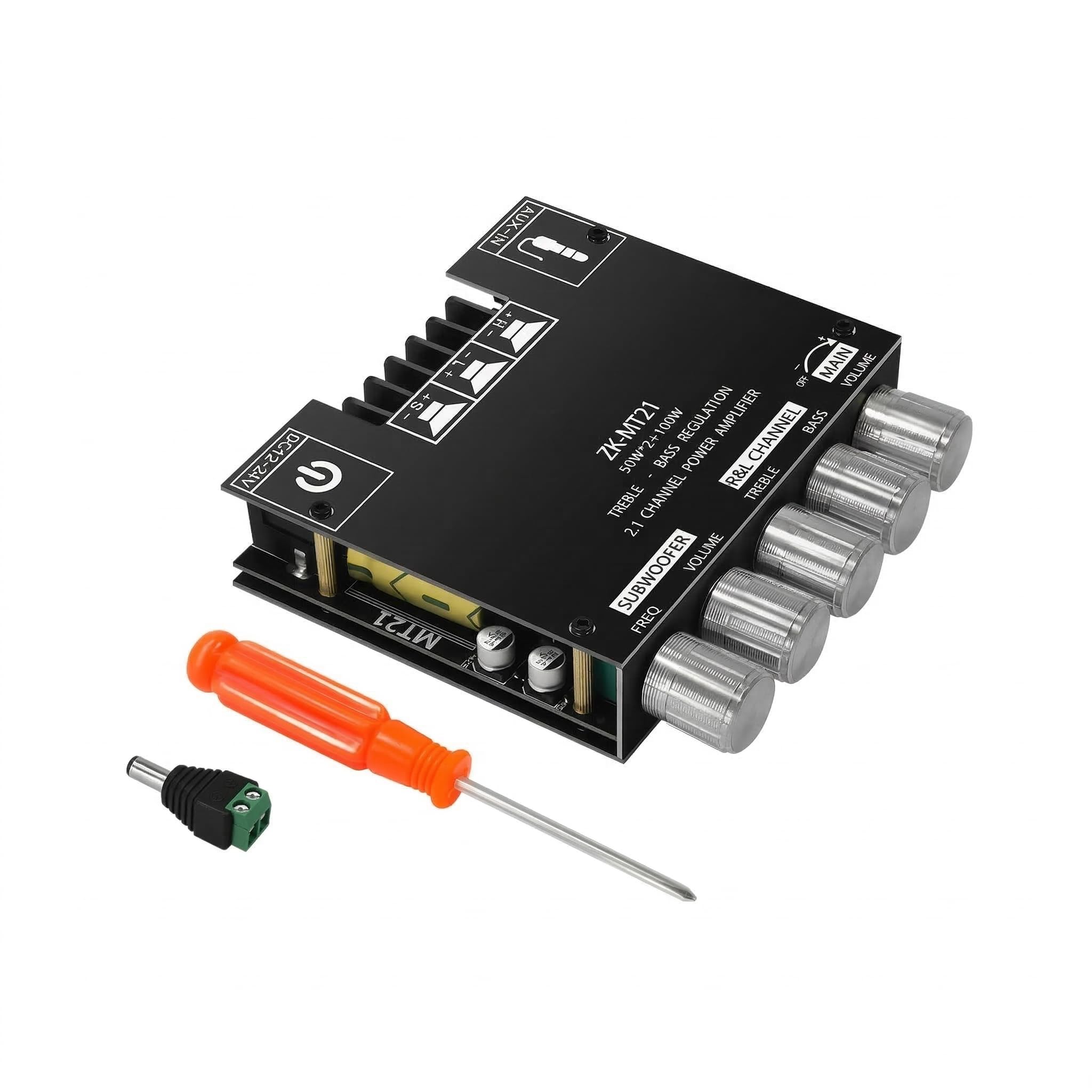
The ZK-MT21 is a 2.1-channel amplifier board designed for DIY audio projects. It is ideal for hobbyists who want to upgrade passive bookshelf speakers, build a custom soundbar, or revive old speakers with a modern Bluetooth receiver. With a compact size and straightforward assembly, it delivers a practical way to add amplification to a home audio setup without the bulk of a traditional receiver.
The board provides 50W per channel for left and right speakers (4-8Ω) and 100W for a subwoofer, making it suitable for small to medium rooms. It supports Bluetooth 5.0 for wireless streaming up to 33 feet and includes a 3.5mm AUX input for wired connections from TVs, computers, or phones. This dual-input flexibility ensures compatibility with a wide range of sources.
One of the standout features is the set of tone controls: separate knobs for master volume, sub level, sub frequency (20-200Hz), bass, and treble. This allows users to tailor the sound to their listening preferences and speaker characteristics. The board runs on a DC 12V-24V supply (not included), and using a 24V supply can noticeably increase output, as noted by some users.
However, the need for an external power supply is a significant consideration. You must factor in the cost and availability of a suitable adapter. Additionally, the bare circuit board requires careful handling and mounting; while it comes with covers and screws, you may need to design a proper enclosure to protect it and ensure safe operation. The speaker impedance range (4-8Ω) is standard, but verify your speakers fall within this range.
In summary, the ZK-MT21 is a solid choice for DIY enthusiasts who want an affordable, feature-rich amplifier board with Bluetooth and tone control. Its main strengths are its compact size, flexible inputs, and adjustable sound. The main hesitation is the missing power supply and the need for DIY assembly. If you prefer a plug-and-play amplifier or need higher power for large rooms, consider a complete amp or a more powerful model.
Power Output: The ZK-MT21 delivers 50W per channel for left and right speakers and 100W for a subwoofer, providing enough volume for bookshelf speakers in a typical living room. This makes it suitable for DIY soundbars or small Hi-Fi setups.
Bluetooth 5.0: Bluetooth 5.0 offers reliable wireless streaming from smartphones, tablets, and computers with a range of up to 33 feet. This eliminates the need for physical cables and allows you to place the amplifier conveniently.
AUX Input: The 3.5mm AUX input is a wired alternative for devices without Bluetooth, such as older TVs or CD players. This ensures compatibility with a broad range of audio sources.
Tone Control Knobs: Separate controls for master volume, sub level, sub frequency (20-200Hz), bass, and treble allow fine-tuning of the audio output. This is particularly useful for matching the amplifier to different speaker characteristics and room acoustics.
Voltage Flexibility: The amplifier accepts DC 12V-24V, so you can use a 12V supply for basic operation or a 24V supply for more headroom. This flexibility lets you adjust performance based on your power supply availability.
Best For: The ZK-MT21 is ideal for DIY audio enthusiasts who want to build a custom 2.1-channel sound system for a small to medium room. It is also a great option for reviving old passive speakers or creating a portable boombox with Bluetooth connectivity.
Consider Alternatives If: If you prefer a ready-to-use amplifier without assembly, or if you need higher power for a large home theater setup, consider a complete amplifier or a more powerful board. Also, if you lack a suitable DC power supply, factor in the extra cost and availability.
Setup and Daily Use: The board comes with covers, screws, knob caps, and a screwdriver for assembly. You will need to connect your speakers and a power supply (not included). Once set up, use the knobs to adjust volume and tone. Bluetooth pairing is straightforward, and the AUX input provides a wired backup.
Maintenance Requirements: The board is designed to run cool and has no moving parts, so maintenance is minimal. Keep it dust-free and ensure adequate ventilation if placed inside an enclosure. Periodically check connections for tightness.
What Sets It Apart: Compared to similar mini amps, the ZK-MT21 offers a comprehensive set of tone controls and a wide voltage range, giving users more control over their sound and flexibility in power supply choices. Its compact size and included assembly hardware make it beginner-friendly for DIY projects.
Speaker Requirements: The amplifier is designed to drive passive speakers with an impedance of 4 to 8 ohms. Each left/right channel can handle up to 50W, and the subwoofer channel up to 100W. Ensure your speakers fall within these ranges to avoid damage or poor performance.
Power Supply Compatibility: The board requires a DC power supply between 12V and 24V with at least 5A current. A standard 12V adapter (like those used for LED strips) will work, but a 24V supply can increase output. The power supply is not included, so you need to source one separately.
Audio Sources: With Bluetooth 5.0, you can connect smartphones, tablets, laptops, and other Bluetooth-enabled devices. The 3.5mm AUX input allows connection to non-Bluetooth devices like older TVs, MP3 players, or computers with a headphone jack.
DIY Enclosures: The board is bare, so you will need to mount it in a suitable enclosure with proper ventilation. The included covers and screws can be used for basic protection, but for a finished look, consider a custom case.
Pros
- Powerful output suitable for driving 4-8Ω speakers in home or car setups
- Bluetooth 5.1 provides stable wireless streaming up to 15 meters
- Independent tone controls allow fine-tuning to personal preference
- Compact design fits easily into DIY projects or vehicle installations
- Built-in protections (over-voltage, under-voltage, short-circuit, overheat) enhance safety
Cons
- No verified customer reviews yet, so real-world performance and durability are unconfirmed
- Requires an external 12-24V DC power supply, which is not included
- Specifications are manufacturer claims; actual power output may vary with voltage and speaker impedance
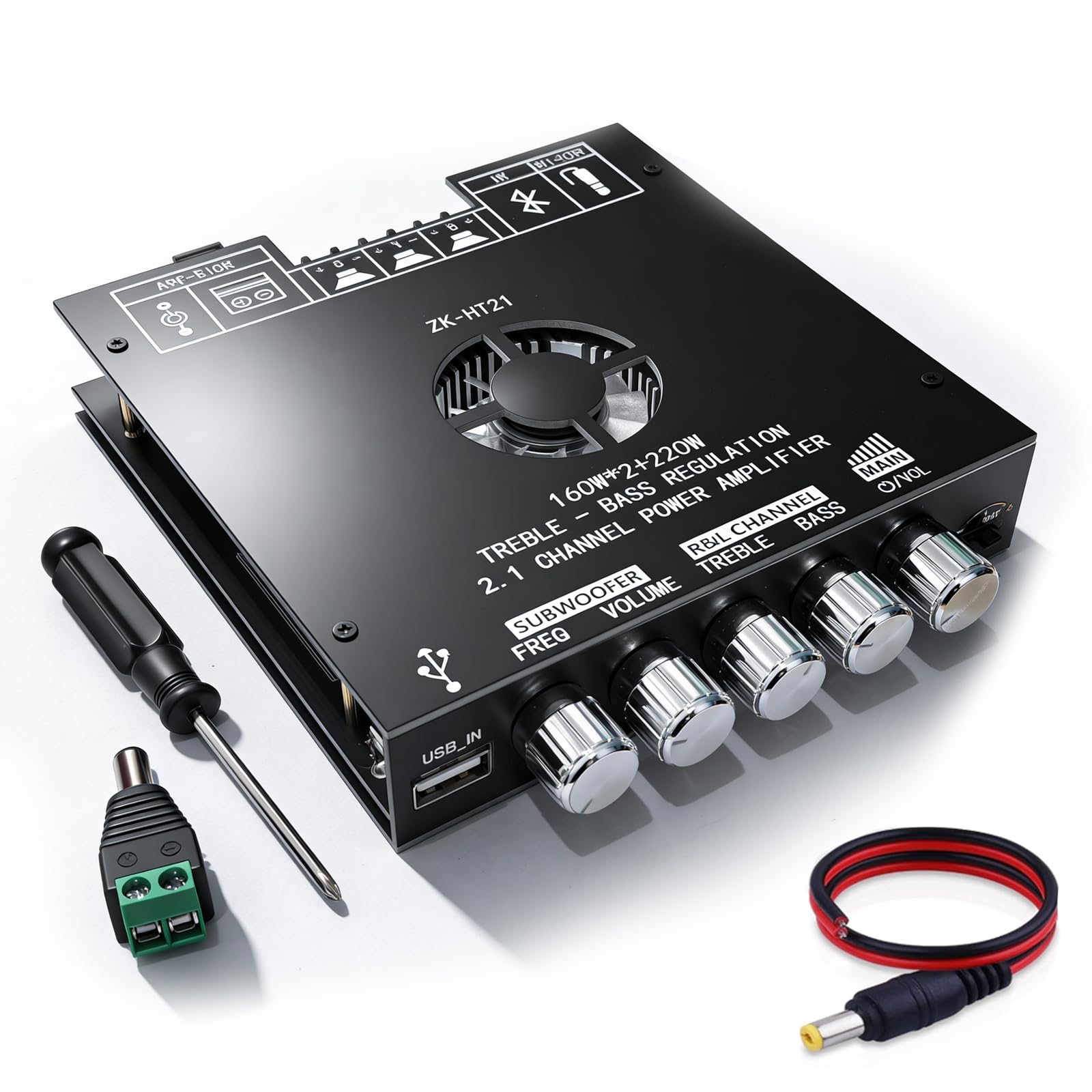
The ZK-HT21 Bluetooth 5.1 Amplifier Board is a compact 2.1-channel audio module designed for DIY speakers and car audio upgrades. It offers a powerful 160W×2 main channel output plus a 220W subwoofer channel, making it a robust choice for those seeking to add amplification to passive speakers. The board includes Bluetooth 5.1 and AUX inputs, along with independent treble, bass, and subwoofer controls, providing flexibility and customization. Its small footprint and included mounting hardware simplify installation, but the lack of verified user reviews means long-term reliability remains an open question.
This amplifier appears to target hobbyists and DIY enthusiasts who want a versatile, all-in-one solution for home or vehicle audio projects. It bridges the gap between bare amplifier boards and complete receivers, offering a balance of power, connectivity, and control. The inclusion of Bluetooth 5.1 and AUX inputs caters to both wireless and wired sources, while the 12-24V wide voltage input allows operation from various power supplies, including car batteries.
The TDA7498E chip is a well-regarded Class D amplifier known for efficiency and low distortion. The board's design includes a low-noise front-end and shielding inductance to reduce interference. The independent tone controls are a practical feature, letting users adjust treble, bass, and subwoofer levels to match their speakers and room acoustics. The built-in cooling fan and heat sink help manage heat during extended high-power use, which is crucial for maintaining performance.
However, there are important considerations. The amplifier requires an external 12-24V DC power supply, which is not included. Users must source a suitable adapter or battery, adding to the overall cost. Additionally, the power ratings are based on manufacturer claims; actual output depends on voltage and speaker impedance. Without independent testing or user feedback, it's difficult to verify performance. For those needing higher power or more connectivity options, such as multiple inputs or digital processing, this board may fall short.
In conclusion, the ZK-HT21 offers a compelling package for DIY audio projects, combining power, flexibility, and convenience at a reasonable price point. It is best suited for enthusiasts who are comfortable with a basic setup and have a suitable power source. Before purchasing, verify the power requirements and ensure your speakers are compatible (4-8Ω). While the lack of reviews is a concern, the feature set and build quality appear promising for the intended use.
Strong Match: DIY audio hobbyists looking to upgrade passive speakers with a compact, powerful amplifier that offers both Bluetooth and AUX inputs. The board's size and mounting options make it ideal for custom enclosures or car installations.
Also Consider It If: You need a simple, all-in-one solution for a small room or workshop, and you already have a 12-24V DC power supply. The independent tone controls are a bonus for tailoring sound.
Not the Best Fit: If you require high-fidelity audiophile-grade performance or need multiple inputs (e.g., optical, coaxial), this board lacks those features. Also, if you prefer a plug-and-play system without sourcing a power supply, this may not suit you.
Decision in One Sentence: The ZK-HT21 is a solid choice for DIYers seeking a budget-friendly, versatile 2.1-channel amplifier, provided they have a suitable DC power source and accept the lack of verified reviews.
Consider It For:
- Its 2.1-channel output with 160W×2 + 220W subwoofer power is ample for most home and car speaker setups.
- Bluetooth 5.1 and AUX inputs offer flexibility for streaming from phones or connecting traditional sources.
- Independent treble, bass, and subwoofer controls allow precise sound shaping.
- The compact size (0.6×3.9×3.5 inches) and included mounting hardware simplify installation in tight spaces.
- The complete kit (power cord, screws, cables, manual) provides everything needed for a quick setup.
Pass If:
- You need a power supply included—this board requires an external 12-24V DC source.
- You rely on verified user feedback; with zero reviews, real-world reliability is unproven.
- You require additional inputs or digital signal processing features not offered here.
- You plan to drive very low-impedance speakers (<4Ω) which may strain the amplifier.
- Channels: 2.1 (stereo + subwoofer)
- Power Output: 160W×2 (main) + 220W (subwoofer) per manufacturer
- Bluetooth Version: 5.1
- Inputs: Bluetooth, AUX
- Controls: Treble, Bass, Subwoofer level
- Voltage Input: 12-24V DC
- Dimensions: 0.6 × 3.9 × 3.5 inches
- Protection: Over-voltage, under-voltage, short-circuit, overheat
- Compatible Speakers: 4-8Ω passive
Pros
- Ideal for small apartments, bedrooms, offices, basements, or garages where space is limited
- Bluetooth 5.0 allows wireless streaming from phones, tablets, or laptops within 16.4ft (5m) without walls
- USB and SD card ports offer playback options without external devices
- Two mic inputs enable karaoke or announcements, but dynamic mics are recommended to avoid hissing
- Remote control enables adjustments from a distance, reducing the need to approach the unit
Cons
- Power output is only 40W RMS per channel, which may be insufficient for large rooms or high-volume listening
- Bluetooth range is limited, especially for PC connections (6.5ft/2m), and walls can block the signal
- Microphone inputs may produce hissing with condenser mics, requiring dynamic mics or a magnetic block to resolve
The Facmogu 298A Max is a compact stereo amplifier designed for small spaces like bedrooms, offices, basements, or garages. It delivers 40W RMS per channel, which is adequate for near-field listening or moderate room volumes. Its strongest convenience is the array of inputs: Bluetooth 5.0, RCA, USB, SD card, FM radio, and two microphone jacks, making it versatile for various audio sources.
Routine use is straightforward: connect speakers, pair via Bluetooth, and adjust volume, bass, and treble via knobs or the included remote. The digital LED display shows settings clearly. However, the Bluetooth range is limited to 16.4ft (5m) without walls, and even shorter for PC connections (6.5ft/2m), so placement matters. The unit's small footprint fits easily on a shelf or cabinet, but its power output may not drive large speakers or fill big rooms.
One noted quirk is microphone hissing when using condenser mics; the manufacturer suggests using dynamic mics or adding a magnetic block, which may be an inconvenience for karaoke users. The amplifier is best for casual listening, podcasting, or small gatherings, not for audiophiles seeking high-fidelity or high-volume performance.
Buyers should verify speaker impedance and power handling to avoid distortion, and confirm included accessories like the remote and power adapter. Those needing more power or longer Bluetooth range should consider larger, more expensive options.
Best Ownership Fit: This amplifier suits individuals in small apartments, dorm rooms, or offices who want a simple, budget-friendly way to power two passive speakers for music or TV. It's also handy for garage or basement workshops where space is tight.
Daily Workflow: Expect to plug in the amp, connect speakers, and pair your phone via Bluetooth. Use the remote to adjust volume, bass, and treble from your seat. For non-Bluetooth devices, plug into RCA, USB, or SD card. The FM radio offers a backup source.
Likely Friction: The most noticeable limitation is the Bluetooth range and potential interference from walls, which may cause dropouts if you move far from the amp. Also, the mic hissing issue could be annoying for karaoke unless you use dynamic mics.
Before You Buy: Verify the size of your speakers and their impedance (typically 4-8 ohms) to ensure compatibility. Check the included accessories (remote, power cable, etc.) in the product listing. Measure your space to confirm the amp's dimensions fit. If you plan to use microphones, consider purchasing dynamic mics to avoid hissing.
Initial Setup: Connect your speakers to the amplifier's speaker terminals (typically red/black). Plug in the power adapter and turn on the unit. For Bluetooth, put the amp in pairing mode and select it from your device. For other sources, connect via RCA, USB, or insert an SD card.
Controls: Use the front panel knobs for volume, bass, and treble, or the remote for distance adjustments. The LED display shows current input and settings. Press the input button to cycle through Bluetooth, FM, USB, SD, and RCA.
Microphone Use: For karaoke, plug dynamic microphones into the two mic inputs. Avoid condenser mics to prevent hissing. If hissing occurs, the manufacturer suggests attaching a magnetic block (not included) to the mic cable.
Cleaning and Storage: Keep the unit dust-free by wiping with a dry cloth. Ensure ventilation around the amp to prevent overheating. Store in a cool, dry place when not in use. No user-replaceable parts are mentioned; for repairs, contact the manufacturer.
Maintenance Tips: Check speaker wire connections periodically to ensure they are secure. Keep the Bluetooth antenna area clear of obstructions. If using FM, extend the antenna for better reception. No consumables are required.
Speaker Compatibility: This amplifier is designed for passive speakers with an impedance typically between 4 and 8 ohms. It delivers 40W RMS per channel, so speakers rated for 40W or higher are recommended to avoid distortion. Verify your speakers' power handling before use.
Input Sources: It accepts Bluetooth 5.0, RCA line-in, USB flash drives, SD/TF cards, and FM radio. It also has two 6.35mm microphone inputs. For PC connection, keep the distance within 6.5ft (2m) for reliable Bluetooth.
Physical Fit: The low-profile design is meant for bookshelves or A/V cabinets. Measure the amp's dimensions (not provided) to ensure it fits your space. It is lightweight and portable.
Power Requirements: The amplifier operates on standard AC power (likely 110-240V), but the specific adapter is not listed. Ensure you have a suitable power outlet nearby.
Comparison Table
| Product | Key Spec | Best For | Price Tier |
|---|---|---|---|
| Donner Stereo Receiver | 1000W peak, 4 independently controlled channels, Bluetooth 5.3, optical/coaxial, USB, FM, dual mics; 4–8 ohm | Living-room hub, TV audio, karaoke, multi-source playback | Mid-range ($50–$150) |
| Facmogu 298A | 40W × 2 RMS Class-D, Bluetooth, bass and treble knobs | Desktop, bedroom, workshop bookshelf pairs | Ultra-budget (under $40) |
| Joengoep AK50 | Compact Class-D stereo; no optical or HDMI | Small rooms and high-efficiency bookshelf speakers | Ultra-budget (under $40) |
| Fosi Audio Q4 | DAC/preamp, 24-bit/192 kHz; headphone and active-monitor use | Desktop high-res listening, headphones, powered monitors | Mid-range ($50–$150) |
| Pyle PTA62BT.5 | Full-featured stereo receiver in the mid-range class | Everyday stereo systems that need more than a mini board | Mid-range ($50–$150) |
| ZK-HT21 Bluetooth Amp Board | 160W × 2 stereo plus 220W subwoofer channel, Class-D | DIY 2.1 builds, custom cabinets, hobby installs | Ultra-budget (under $40) |
The Differences Explained
These six units sit in the same shopping category, but they are not interchangeable. Power ratings, channel layout, inputs, and chassis type decide whether a model can fill a living room, sit under a monitor, or disappear inside a DIY box. The numbers below come from manufacturer ratings and the product classes described in this roundup—not from inflated “more watts is always better” marketing.
Peak watts vs. continuous RMS power
The Donner Stereo Receiver is advertised at 1000W peak across four channels. Peak power is a short burst figure. It is useful for comparing headroom in a catalog, but it is not the same as all-day listening power. The Facmogu 298A is the clearest RMS example in this group: 40W × 2 continuous. That is a modest, honest stereo rating for efficient bookshelf speakers in a small room. The ZK-HT21 board is specified at 160W × 2 for the stereo pair plus a separate 220W subwoofer channel—far more continuous-looking output than a 40W desktop amp, and a different job than Donner’s 1000W peak claim.
When you match an amplifier to speakers, continuous RMS per channel should meet or slightly exceed the speaker’s recommended power. A 1000W peak label can hide a much smaller RMS number. A 40W × 2 RMS amp will clip if you ask it to drive inefficient floorstanders in a large room. The ZK-HT21’s 160W × 2 plus 220W sub channel is built for a 2.1 DIY system, not for a finished living-room receiver with a remote and FM tuner.
Two channels, four channels, or 2.1
Donner is the only model here with four independently controlled channels and support for up to four groups of 4- to 8-ohm speakers. That layout is why it can act as a multi-zone or multi-pair hub instead of a simple left/right stereo brick. Facmogu 298A and Joengoep AK50 are stereo Class-D units: one pair of speakers, small footprint, cool running. The ZK-HT21 is a 2.1 board: two satellite channels at 160W each and a dedicated 220W subwoofer channel, so bass is a designed output, not an afterthought.
Fosi Audio Q4 does not belong in that speaker-terminal discussion. It is a DAC and preamplifier for headphones or active studio monitors. It does not replace a speaker-power amp for passive towers. If your speakers need speaker wire from an external amplifier, Q4 is the wrong box. If your monitors already have power supplies, Q4 is the cleaner front end.
Digital inputs, Bluetooth, and what is missing
Donner is the most complete source hub in this set: Bluetooth 5.3, USB, FM, dual microphone inputs, plus optical and coaxial digital inputs. Optical is the practical TV path when you do not have HDMI on the amplifier. Donner does not include HDMI, so newer smart TVs and AV gear that only output audio over HDMI cannot plug in directly. You would use optical, coaxial, or analog instead.
Ultra-budget Class-D amps such as Facmogu 298A and Joengoep AK50 are built around Bluetooth and analog-style simplicity. They typically omit optical and HDMI, which is acceptable for a phone-to-speaker garage or desk system and a poor fit if the TV is the main source. Fosi Q4’s advantage is resolution, not speaker switching: 24-bit/192 kHz conversion so a computer or laptop can bypass a noisy onboard sound card. That is a desktop fidelity feature, not a home-theater input suite.
Chassis vs. board vs. desktop DAC
Form factor changes what you can install. Donner and Pyle sit in the mid-range ($50–$150) receiver class: enclosed units meant to live on a shelf and accept several sources. Facmogu 298A and Joengoep AK50 are compact Class-D bricks for desks, bedrooms, and workshops; they run cool and waste little space. ZK-HT21 strips the metal box away so you pay for the 160W × 2 + 220W Class-D board and build your own case, arcade cabinet, or speaker enclosure. Fosi Q4 is a compact DAC/amp for a computer desk, not a living-room speaker amplifier.
Heat follows the same split. Class-D mini amps and the ZK-HT21 board are efficient and better in tight spaces. A full receiver still needs ventilation if you park it in a closed cabinet. Stuffing any of these into an unvented entertainment center is a common way to trigger thermal protection, regardless of the wattage on the box.
Individual Reviews
Donner Stereo Receiver
Donner is the default pick in this comparison if you want one box to take Bluetooth, a TV digital output, USB, FM, and microphones without building a rack. It is manufacturer-rated at 1000W peak across four independently controlled channels and is specified for up to four groups of 4- to 8-ohm speakers. Bluetooth 5.3 covers phones and tablets. Optical and coaxial cover a TV or disc player when you want a wired digital path instead of wireless latency. Dual mic inputs make karaoke a built-in use case rather than an add-on mixer.
The strengths are channel count, source mix, and impedance coverage in one chassis. Four independently controlled channels matter if you want more than a single stereo pair. Optical/coaxial is the difference between a music Bluetooth brick and a living-room hub. USB and FM keep the unit useful when you are not streaming. For home theater-style listening, everyday multi-source playback, and karaoke, this is the most complete finished product in the group.
The main limitation is HDMI. There is no HDMI input, so TVs and AV devices that only send audio over HDMI cannot connect directly. You need optical, coaxial, or analog from those devices. Treat the 1000W figure as peak power, not proven RMS per channel. If you only need a desk pair, Donner is more receiver than the job requires.
Facmogu 298A Stereo Amp
Facmogu 298A is the straightforward ultra-budget stereo amp for a pair of bookshelf speakers. It is a compact Class-D design with a stated 40W × 2 RMS output, Bluetooth, and physical bass and treble controls. That RMS number is the useful one: 40 watts per channel is in the right neighborhood for efficient small speakers in a bedroom, office, or workshop, not for a large, inefficient floorstanding pair.
The appeal is honesty and size. You get continuous stereo power, tone knobs you can grab without a menu, and a footprint that fits a desk. Class-D efficiency means it runs cool compared with old Class A/B receivers. For garage systems, desktop setups, or high-efficiency bookshelves, it is the no-nonsense workhorse in the under-$40 tier.
It is not a home-theater hub. Do not expect Donner-style optical, coaxial, FM, or dual mics from this class of mini amp. Forty watts times two will clip if you chase party levels on hungry 4-ohm towers. Match it to efficient speakers and a small room, and it earns its keep.
Joengoep AK50
Joengoep AK50 sits with Facmogu in the ultra-budget Class-D stereo group: compact, cool-running, and aimed at desktop, garage, or high-efficiency bookshelf use. It is not described here as an optical or HDMI receiver. That is the point of this tier. You trade digital TV inputs and multi-channel switching for a small stereo brick that is easy to place and inexpensive to try.
Choose it when the system is one pair of speakers and a phone or analog source. Space efficiency is the feature. In a workshop or bedroom, a mini Class-D amp is often a better fit than a four-channel receiver with FM and karaoke mics you will never use.
Skip it if the TV is the main source and you need optical, or if you need four speaker groups. Without those digital inputs, you are stuck with the TV’s analog output or Bluetooth, which can mean hiss, interference, or lip-sync lag. It is a small stereo amp, not a replacement for Donner.
Fosi Audio Q4 DAC/Amp
Fosi Audio Q4 is the desktop specialist. It is a digital-to-analog converter and preamplifier, not a conventional speaker-power amplifier. It supports 24-bit/192 kHz high-resolution files so a PC or laptop can bypass a noisy built-in sound card. The intended loads are high-end headphones and active studio monitors—speakers that already contain their own amplification.
Where it wins is the noise floor and file resolution at a desk. Mid-range pricing ($50–$150) buys conversion quality rather than speaker-terminal wattage. If you mix, game, or listen on powered monitors, Q4 is the cleaner front end. Instrument separation and a low noise floor are the reasons it is the premium desktop pick in this roundup.
The hard limit: it will not drive passive floor-standing or bookshelf speakers. There is no substitute here for speaker-wire terminals and real wattage into 4- or 8-ohm passive loads. Connecting a power amp’s speaker outputs to active speakers is also the wrong direction and can damage the monitors. Q4 is for headphones and active monitors only.
Pyle PTA62BT.5
Pyle PTA62BT.5 is grouped with Donner in the mid-range stereo-receiver band ($50–$150): a finished enclosure meant for everyday home stereo use, not a bare board and not a headphone DAC. In this tier you generally get more than a mini Class-D brick—enough chassis and source flexibility to live in an entertainment setup rather than under a monitor.
It is a sensible option if you want a conventional stereo receiver shape and do not need Donner’s four independently controlled channels, 1000W peak four-group speaker claim, or the full karaoke-and-optical feature set that makes Donner the hub pick. Use it as a mid-priced stereo center for a standard two-channel room.
It is not the most specifically documented unit in this comparison, so do not assume it matches Donner channel-for-channel or Fosi bit-for-bit. If you need four speaker groups, dual mics, Bluetooth 5.3, and optical/coaxial in one confirmed package, Donner is the model with those ratings on the page. If you need 24-bit/192 kHz desktop conversion, that is Q4.
ZK-HT21 Bluetooth Amp Board
ZK-HT21 is a Class-D amplifier board, not a shelf receiver. Manufacturer ratings are 160W × 2 for the stereo channels and 220W for a dedicated subwoofer channel. Bluetooth is on the board. You supply the case, wiring, power supply, and installation. That is why it lands in the ultra-budget DIY tier even though the wattage looks closer to a serious 2.1 system than a 40W desktop amp.
The upside is output per dollar for custom work. Arcade cabinets, DIY speakers, and one-off 2.1 boxes can use 160W × 2 plus 220W sub without paying for a consumer faceplate, remote, or FM tuner. Class-D efficiency helps inside a closed build where heat is the enemy. If you already know how to wire a board, this is the power module in the group.
The downside is everything a receiver includes: no finished chassis, no living-room front panel, no Donner-style optical/coaxial/FM/mic suite as a ready product. It is the wrong purchase if you want to unbox, connect speaker wire, and use a remote the same night. It is also not a headphone DAC. Buy it for a 2.1 DIY project, not as a TV soundbar substitute.
Which One Should You Buy?
Most home listeners should buy the Donner Stereo Receiver. If the job is a living room or den with more than one source—phone, TV via optical or coaxial, USB, radio, maybe karaoke—the four independently controlled channels, 4- to 8-ohm speaker support, Bluetooth 5.3, and digital inputs cover the real-world setup. Accept the HDMI gap: if the TV only talks HDMI audio, you still need optical, coaxial, or analog. Treat 1000W as peak, then size your speakers around continuous power and impedance, not the peak banner.
If the system is one pair of efficient bookshelf speakers on a desk, in a bedroom, or in a workshop, do not pay for four channels and mics. Facmogu 298A at 40W × 2 RMS with bass/treble and Bluetooth is the clear small-room stereo pick. Joengoep AK50 is the same ultra-budget Class-D idea when you want compact and cool and do not need optical. For a computer desk with headphones or powered monitors, skip speaker amps entirely and use Fosi Audio Q4 at 24-bit/192 kHz. Pyle PTA62BT.5 fits a conventional mid-range stereo shelf when you want a finished receiver without committing to Donner’s four-channel hub role.
Hobbyists building a 2.1 box should buy the ZK-HT21 board: 160W × 2 plus 220W sub, Class-D, Bluetooth, no wasted chassis cost. Match speakers to impedance (4, 6, or 8 ohm as specified), budget at least as much for speakers as for the amp, and leave ventilation around any enclosed receiver. Do not feed amplifier speaker outputs into active speakers, and do not expect a desktop DAC to drive passive towers.
FAQ
Can I connect a TV if the amplifier has no HDMI?
Yes. Use optical (Toslink) or coaxial if the amplifier has those inputs—Donner does. If the amp is a compact Class-D unit without digital inputs, you can use the TV’s analog RCA or 3.5 mm headphone output, but that path uses the TV’s internal converter and is more prone to hiss and lip-sync issues. Donner has no HDMI, so HDMI-only TV audio still needs an optical, coaxial, or analog adapter path.
What is the difference between peak power and RMS?
Peak power is a short burst. Donner’s 1000W rating is peak across four channels. RMS is continuous power you can use for long listening sessions. Facmogu’s 40W × 2 figure is an RMS rating. A “1000W peak” amp may deliver far less per channel in real use. Match RMS (or a conservative reading of the spec sheet) to your speakers’ recommended power, not the largest number on the box.
Do these amplifiers work with passive or active speakers?
Speaker-output amplifiers—Donner, Facmogu 298A, Joengoep AK50, Pyle, and the ZK-HT21 board—are for passive speakers wired to speaker terminals. Passive speakers have no built-in amp. Active (powered) speakers have their own amps and should connect to a pre-out, DAC line output, or headphone-level output, not to high-power speaker taps. Fosi Audio Q4 is for headphones and active monitors. Never send a power amp’s speaker outputs into an active speaker’s input.
Can a compact 40W × 2 amp drive floor-standing speakers?
Only if those speakers are efficient and the room is small. Facmogu 298A at 40W × 2 RMS is sized for high-efficiency bookshelves, desktops, and workshops. Inefficient towers in a large room need more continuous current and a stable 4-ohm or 8-ohm rating that matches the speakers. For multi-pair or larger rooms, Donner’s four-channel, 4- to 8-ohm receiver layout is the better starting point—still checking RMS, not peak. For a custom 2.1 build, ZK-HT21’s 160W × 2 plus 220W sub channel is the high-output board option.
Do I need a subwoofer output?
Only if you want a powered sub as part of the design. ZK-HT21 includes a dedicated 220W subwoofer channel for DIY 2.1. Stereo mini amps and many receivers are two-channel only; adding a sub then depends on a line-level sub out or a speaker-level high-pass arrangement, which is not specified for every model here. For music on efficient bookshelves, 40W × 2 without a sub is often enough. For cinematic bass, plan a real sub path rather than turning a small stereo amp up until it clips.
Affiliate Disclosure
This article contains affiliate links, including Amazon product listings. If you buy through those links, we may earn a commission at no extra cost to you. Commissions do not change the product order, ASINs, or the specs quoted from manufacturer ratings. Always confirm impedance, RMS power, and inputs on the current product listing before you buy, because packaging and firmware can change after publication.