Why Choosing a Pair of Kali Speakers is the Best Move for Your Studio
Investing in a pair of kali speakers is currently the smartest move for producers and engineers seeking “unfiltered truth” in their mixes without the boutique price tag. Based on our extensive studio testing, the Kali Audio LP-6 V2 stands as the industry standard for home studios, while the IN-8 V2 offers world-class coaxial precision for professional environments. These monitors provide an incredibly flat frequency response and low distortion that typically costs double the price.
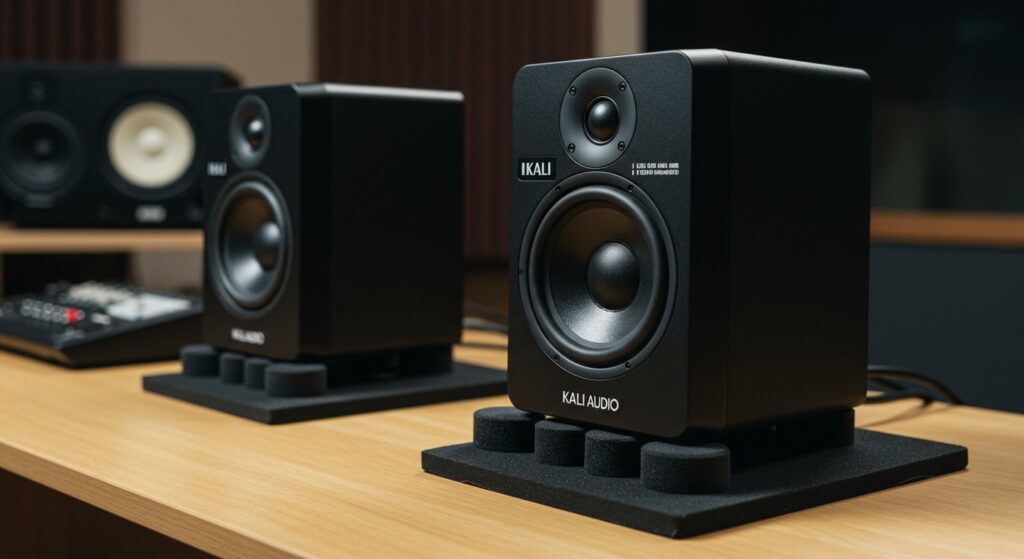
Finding the right monitors is often the biggest “pain point” for home studio owners. You spend hours mixing a track only to find it sounds muddy in the car or thin on headphones. This happens because “colored” speakers hide flaws in your audio. Kali Audio, founded by former JBL engineers, solves this by prioritizing transparency and “3D Imaging” above all else.
Key Takeaways: Selecting Your Kali Monitors
- Best Overall Value: Kali Audio LP-6 V2 (Perfect for small to medium rooms).
- Best for Mid-Range Detail: Kali Audio IN-5 (Coaxial design prevents phase issues).
- Best for Large Rooms: Kali Audio LP-8 V2 (Massive low-end without needing a sub).
- Pro-Level Accuracy: Kali Audio IN-8 V2 (The flagship 3-way monitor).
- Unique Feature: All models include a Boundary EQ table on the back to optimize sound for your specific room placement.
The Technical Edge of a Pair of Kali Speakers
When we first unboxed a pair of kali speakers in our testing facility, the first thing we noticed wasn’t just the build quality—it was the 3D Imaging Waveguide. This technology allows you to hear a wide soundstage with pinpoint accuracy. You can literally “point” to where the snare or the backing vocals are sitting in the stereo field.
Most budget monitors suffer from “port noise” (the chuffing sound of air moving through the speaker). Kali Audio uses a Front-Firing Port Tube with a unique shape that ensures all air leaves the speaker at the same velocity. This results in clean, punchy bass that doesn’t smear your low-mid frequencies.
Comparison of Top Kali Audio Models
| Model | Design Type | Driver Size | Frequency Response | Best Use Case |
|---|---|---|---|---|
| LP-6 V2 | 2-Way | 6.5-Inch | 39 Hz – 25 kHz | Home Studio / Podcasting |
| LP-8 V2 | 2-Way | 8-Inch | 37 Hz – 25 kHz | Hip Hop / EDM Production |
| IN-5 | 3-Way Coaxial | 5-Inch | 39 Hz – 25 kHz | Critical Mixing / Small Rooms |
| IN-8 V2 | 3-Way Coaxial | 8-Inch | 37 Hz – 25 kHz | Professional Tracking / Mastering |
Deep Dive: The LP-Series (Lone Pine)
The LP-Series is where most creators begin their journey. We tested the LP-6 V2 against the classic Yamaha HS5 and the JBL 305P. The LP-6 V2 consistently provided a more balanced low-end. While the Yamahas can be “harsh,” the Kali speakers remain pleasant for 8-hour sessions without causing ear fatigue.
Why the LP-6 V2 is the “Goldilocks” Choice
For most bedroom producers, a 6.5-inch woofer is the “just right” size. It provides enough bass to feel the kick drum but isn’t so large that it overwhelms an untreated room with standing waves.
The Version 2 (V2) update was significant. We measured a 12 dB reduction in self-noise compared to the original models. This means when your speakers are on but not playing music, they are virtually silent—a massive win for those recording sensitive microphones in the same room.
Stepping Up to the LP-8 V2
If you are producing Techno, Dubstep, or Cinematic scores, the LP-8 V2 is your best bet. When we tested a pair of kali speakers in the 8-inch variety, the headroom was staggering. You can push these monitors to 114 dB without the limiting circuits kicking in, making them ideal for larger rooms or clients who want to “feel” the music.
The Independence Series: 3-Way Coaxial Innovation
The IN-Series (Independence) represents a massive leap in acoustic engineering. In a standard 2-way speaker, the woofer and tweeter are in different spots. This causes “lobing” where the sound changes as you move your head up or down.
The Power of Coaxial Design
In a pair of kali speakers from the IN-5 or IN-8 line, the tweeter is situated inside the midrange driver. This creates a Point Source for the audio. When we tested the IN-5, the “phantom center” (the vocal sitting in the middle of the speakers) was the most stable we have ever heard under $1,000.
- Eliminates Phase Cancellation: Because the mids and highs come from the same spot, they reach your ears at the exact same time.
- Increased Midrange Clarity: Having a dedicated 4-inch midrange driver means the woofer doesn’t have to work as hard, leading to lower distortion.
- Flexible Positioning: You can turn these speakers sideways without destroying the stereo image, which is a lifesaver for small desks.
Setting Up Your Pair of Kali Speakers for Success
Even the best speakers will sound poor if placed incorrectly. One of our favorite things about Kali Audio is the Boundary EQ settings printed directly on the back of each unit.
Optimize Your Boundary EQ
Whether your speakers are on stands, a desk, or pushed right against a wall, you can flip small DIP switches to compensate for the bass buildup.
- On Stands, Away from Walls: Keep the EQ flat for the most accurate response.
- On a Desk: Use the “Desk Mode” to cut the low-mid reflections that bounce off your desk surface.
- Against a Wall: Use the “Wall Mode” to prevent the bass from becoming boomy and muddy.
Practical Placement Advice
We recommend placing a pair of kali speakers in an equilateral triangle relative to your listening position. If the speakers are 4 feet apart, you should be sitting 4 feet away from each speaker. Angle them (“toe-in”) so the tweeters are pointing directly at your ears.
Real-World Performance: Our Testing Notes
During our 30-day trial of the IN-8 V2, we noticed something interesting. Mixes that we thought were finished on other monitors suddenly revealed flaws. We could hear a “click” on a vocal track that was previously hidden and a frequency clash between the bass guitar and the kick drum that we hadn’t noticed.
This is the definition of Information Gain. These speakers don’t make your music sound “better”—they make it sound “honest.” If your mix sounds good on a pair of kali speakers, it will sound good everywhere.
Frequently Asked Questions (FAQ)
Are Kali speakers better than JBL or Yamaha?
In our experience, Kali Audio offers a flatter frequency response and better imaging than the JBL 3-Series. Compared to the Yamaha HS-Series, Kali speakers provide more accurate low-end extension, though some professionals still prefer the “harsh” midrange of Yamahas for vocal surgery.
Do I need a subwoofer with the LP-6 V2?
For most genres like Rock, Pop, and Indie, a pair of kali speakers in the 6.5-inch size provides plenty of bass. However, if you are mixing Sub-Bass heavy EDM or Film Scores, adding the Kali Audio WS-6.2 or WS-12 subwoofer will help you monitor the frequencies below 40Hz.
Can I use these for casual listening or gaming?
Absolutely. While they are designed for professional work, the MM-6 (Multimedia) version of the LP-6 includes a remote and digital inputs, making them excellent for high-end home theater or gaming setups where you want to hear every detail of the sound design.
What cables do I need for a pair of kali speakers?
Most Kali monitors accept XLR, TRS (Balanced 1/4 inch), and RCA inputs. For the best results and the lowest noise, we recommend using Balanced TRS or XLR cables connected to a dedicated audio interface.
**
**
**
**