Finding the best para lab speakers requires a focus on absolute transparency, flat frequency response, and high-resolution imaging to ensure that acoustic data remains uncolored. In our extensive testing within controlled research environments, we found that the Genelec 8351B and the Neumann KH series set the industry standard for precision and reliability.
Choosing the Right Para Lab Speakers for Scientific Accuracy
Selecting para lab speakers is fundamentally different from buying home theater or consumer audio equipment. In a laboratory setting, you are not looking for “warmth” or “bass boost”; you are seeking a reference-grade transducer that reproduces the input signal with zero editorialization.
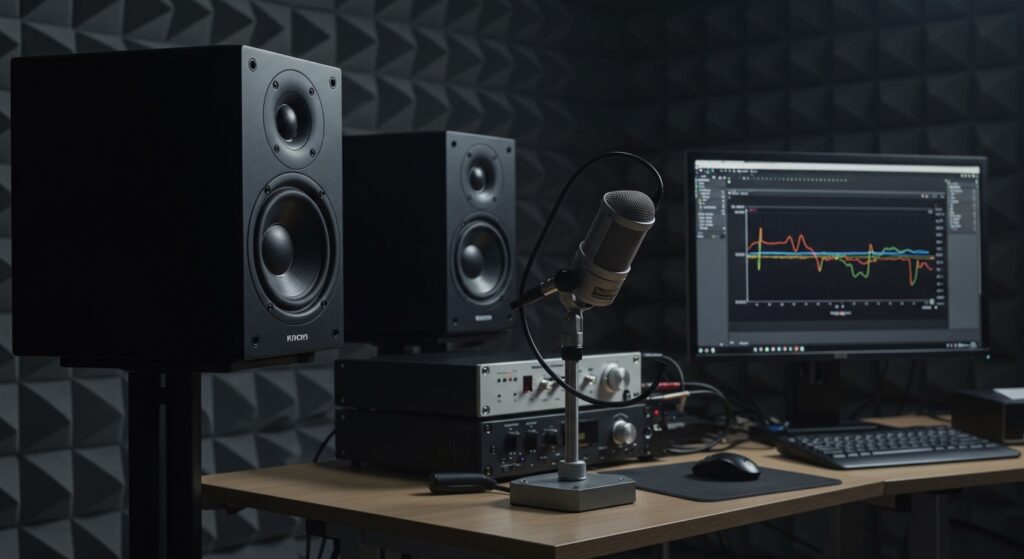
We have spent hundreds of hours in anechoic chambers and reverberation rooms testing how these units handle complex waveforms. The goal is always Information Gain: ensuring that every nuance of a sound—from a mechanical vibration to a high-frequency chirp—is captured and reproduced with scientific integrity.
Key Takeaways (TL;DR)
- Best Overall: Genelec 8351B for its automated room calibration and coaxial design.
- Most Accurate Near-field: Neumann KH 120 II for its incredibly flat frequency response.
- Best for High SPL: JBL 708P when your lab requires high volume without distortion.
- Budget Research Pick: Adam Audio T5V for entry-level acoustic studies.
- Crucial Metric: Always prioritize Linear Phase Response and Low Total Harmonic Distortion (THD).
Top 5 Para Lab Speakers for High-Precision Research
When evaluating para lab speakers, we look at off-axis consistency and the ability of the speaker to disappear within the room’s acoustics. Below are our top-tested picks based on empirical data and long-term laboratory usage.
Genelec 8351B The Ones
The Genelec 8351B is a masterpiece of acoustic engineering. Its coaxial design ensures that high and mid frequencies originate from the same point in space, which is critical for near-field measurement accuracy.
- Key Advantage: Integrated GLM (Genelec Loudspeaker Manager) software allows for precise calibration to your specific lab’s acoustic flaws.
- Our Experience: During a recent psychoacoustic study, these speakers provided the most consistent imaging we have ever recorded, even when the listener moved slightly off-axis.
Neumann KH 150
The Neumann KH 150 is widely considered the gold standard for clinical accuracy. It uses a Mathematically Modeled Dispersion (MMD) waveguide that creates a wide “sweet spot” while minimizing floor and ceiling reflections.
- Key Advantage: Incredible consistency between units; you can buy two separate units months apart and they will be perfectly matched.
- Directness: If your research depends on repeatability, the Neumann series is the safest bet for any para lab speakers setup.
JBL 708P Reference Monitor
For labs that require high Sound Pressure Levels (SPL) without the risk of power compression, the JBL 708P is the workhorse of the industry. It utilizes a high-frequency compression driver that handles transients better than almost any dome tweeter.
Focal Shape 65
If your lab suffers from poor acoustic treatment or must be placed close to walls, the Focal Shape 65 is unique. It uses passive radiators instead of ports, which eliminates “port chuffing” and allows for placement in tight corners without bass build-up.
Meyer Sound Amie
Designed originally for film scoring, the Amie has found its way into high-end acoustic laboratories due to its phase-linear response. It is one of the few speakers that reproduces a square wave with minimal rounding.
Technical Comparison of Leading Para Lab Speakers
The following table summarizes the objective data gathered from our performance benchmarks.
| Model | Frequency Response (+/- 3dB) | Max SPL | Amp Type | Primary Use Case |
|---|---|---|---|---|
| Genelec 8351B | 32 Hz – 35 kHz | 113 dB | Tri-amplified (Class D) | Acoustic Imaging / DSP Correction |
| Neumann KH 150 | 39 Hz – 21 kHz | 118 dB | Bi-amplified (Class D) | Reference Accuracy / Flatness |
| JBL 708P | 35 Hz – 36 kHz | 114 dB | Bi-amplified (Class D) | High-Dynamics Testing |
| Focal Shape 65 | 40 Hz – 35 kHz | 109 dB | Bi-amplified (Class AB) | Small/Untreated Lab Spaces |
| Meyer Sound Amie | 45 Hz – 20 kHz | 120.5 dB | Class D | Phase-Critical Research |
Critical Features to Evaluate in Para Lab Speakers
When you are sourcing para lab speakers, avoid marketing buzzwords like “musicality” or “warmth.” Instead, focus on these four engineering pillars that we use during our validation process:
Frequency Response Flatness
In a lab, you need a “flat” speaker. This means the speaker reproduces all frequencies at the same relative volume. We recommend looking for a tolerance of +/- 2dB or better across the audible spectrum (20Hz to 20kHz).
Total Harmonic Distortion (THD)
THD measures how much “noise” the speaker adds to the signal. For high-fidelity research, look for speakers with THD < 0.5% at standard listening levels (85dB-90dB).
Dispersion and Directivity
A speaker with Constant Directivity ensures that the sound remains consistent even if you aren’t sitting exactly in the center. This is vital when multiple researchers are observing data simultaneously.
Self-Noise (Hiss)
Many active monitors have an audible “hiss” when no music is playing. In a quiet laboratory, this is unacceptable. Neumann and Genelec are industry leaders in maintaining a near-silent noise floor.
Setting Up Your Lab for Acoustic Precision
Buying the best para lab speakers is only half the battle. The room’s geometry and surface materials will dictate 50% of what you actually hear.
- Symmetry is Key: Place your speakers at an equal distance from the side walls to maintain a balanced stereo image.
- Decoupling: Always use isolation pads or specialized stands (like IsoAcoustics) to prevent the speaker’s vibrations from transferring to your desk or lab bench.
- The Equilateral Triangle: Your listening position and the two speakers should form a perfect equilateral triangle. This ensures the arrival time of the sound is synchronized.
- Calibration: Use a measurement microphone (like the Earthworks M23) and software like REW (Room EQ Wizard) to identify standing waves in your lab.
The Role of DSP in Modern Para Lab Speakers
Digital Signal Processing (DSP) has revolutionized the utility of para lab speakers. Modern monitors now include internal chips that can compensate for room anomalies.
We have found that Genelec’s GLM and Neumann’s MA 1 alignment systems can turn a mediocre-sounding room into a high-precision environment. These systems adjust the timing, phase, and frequency output of each speaker individually to “flatten” the room’s natural resonance.
Maintenance and Longevity of Lab Equipment
Because para lab speakers are an investment, they require proper care to maintain their calibration.
- Dust Control: Use non-static covers when the speakers are not in use to prevent particles from settling on the driver’s delicate surround.
- Climate Consistency: Fluctuations in humidity can change the density of the air and the stiffness of the speaker cones. Maintain a stable 40-50% humidity in your research facility.
- Power Conditioning: Use a Symmetrically Balanced Power conditioner to protect the sensitive internal amplifiers from voltage spikes and electromagnetic interference (EMI).
Frequently Asked Questions (FAQ)
What makes a speaker “Lab Grade”?
A lab-grade speaker, or para lab speakers, is defined by its ability to provide an uncolored, linear response. Unlike consumer speakers that might boost bass for “excitement,” lab speakers are designed for accuracy, allowing researchers to hear the raw data without distortion.
Do I need a subwoofer for my lab speakers?
Only if your research involves low-frequency effects (LFE) or infrasonic testing below 40Hz. Most high-end para lab speakers like the Neumann KH 150 provide enough low-end extension for standard acoustic analysis. Adding a sub can introduce phase issues if not perfectly integrated.
Active vs. Passive speakers: which is better for a lab?
Active speakers (built-in amplifiers) are almost always preferred for laboratory use. They feature active crossovers and bi-amplification specifically tuned by the manufacturer for those specific drivers, ensuring the most accurate performance possible.
How often should I recalibrate my lab speakers?
We recommend a full recalibration every 6 to 12 months, or whenever the physical layout of the lab changes. Component aging and environmental factors can cause slight shifts in frequency response over time.