At a Glance
| Pick | Product | Key Spec | Price Range |
|---|---|---|---|
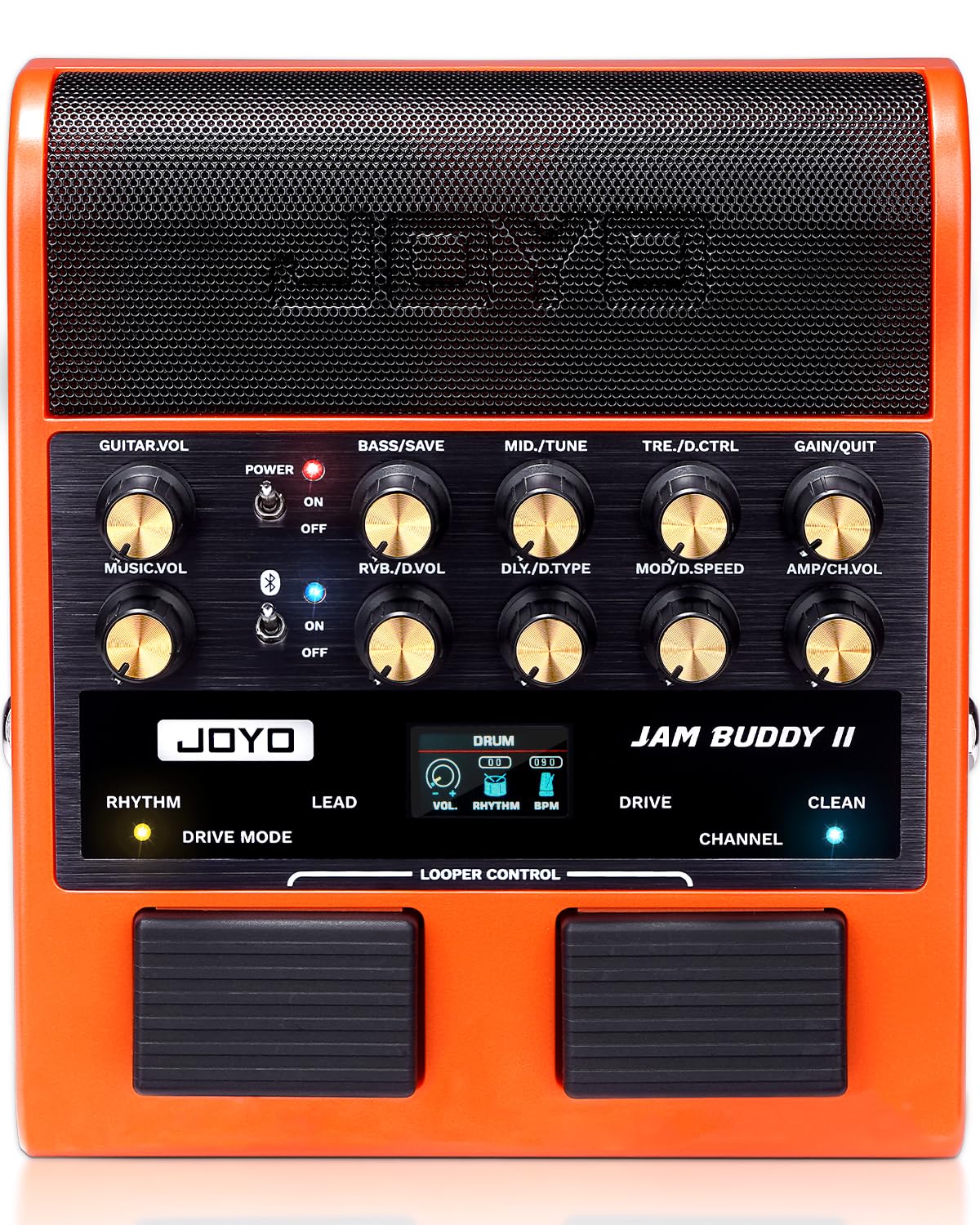
| Best Overall | JOYO JAM Buddy II | 14 amp models, 10W stereo, 940g, Bluetooth + USB-C OTG | Mid ($98.99) |
| Best Budget | LEKATO AG-04 | 5W, dual 3-inch stereo speakers, up to 6-hour battery | Entry (under $50) |
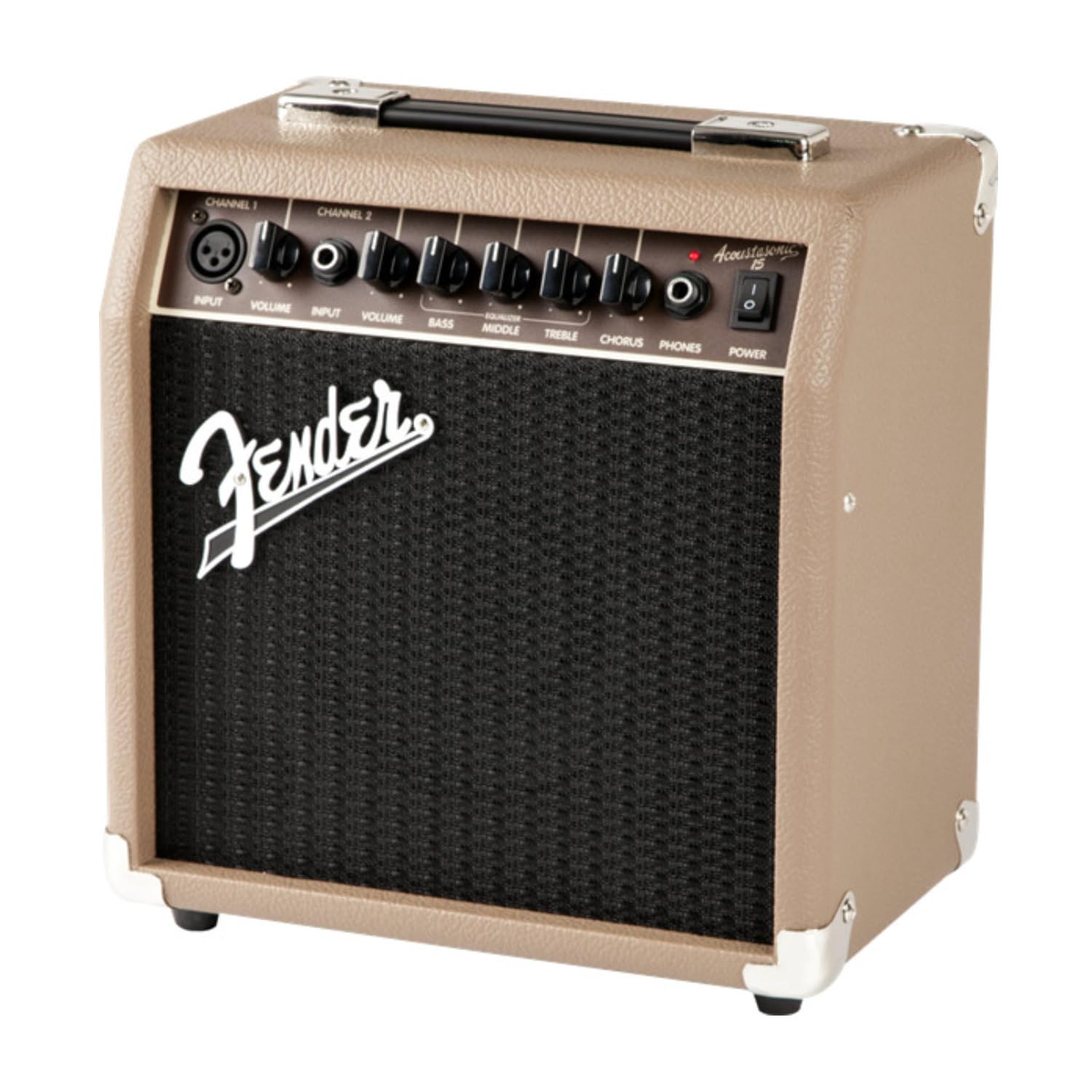
| Best Premium / Busking | Fender Acoustasonic 40 | Dual 6.5″ speakers with whizzer cones, dual-channel XLR/1/4″ | Premium (over $150) |
Pros
- Portable and lightweight (940g) for travel or small spaces.
- All-in-one functionality reduces gear footprint for beginners or apartment dwellers.
- OTG recording and Bluetooth add modern connectivity for content creation.
- Drum machine and looper enhance solo practice without extra equipment.
- LED display and multi-function knob simplify parameter control.
Cons
- Rated battery life (5h) may be limiting for extended sessions; actual performance unverified.
- No included power adapter details; charging method and time (3h) need confirmation.
- Speaker output (10W) may not be loud enough for live performance with a drummer.
The JOYO JAM Buddy II is a portable guitar amp and multi-effects pedal combo designed for guitarists who need a compact, all-in-one practice solution. It is best suited for beginners, apartment dwellers, or traveling musicians who want to practice quietly, record ideas, or play along with backing tracks without hauling a full rig. Its strongest convenience is the combination of a battery-powered amp, effects, drum machine, looper, and Bluetooth connectivity in a palm-sized unit weighing only 940g.
In routine use, the 14 amp models and 9 effects let you switch from clean to high-gain tones, while the dedicated 3-band EQ and gain controls allow fine-tuning. The 36 drum patterns and 30-second looper provide a practice foundation, and the one-tap memory function saves your custom settings across three channels, which is handy for quick recall during practice or performance. The OTG USB-C interface enables direct recording to a phone or computer, and Bluetooth lets you stream backing tracks, with separate volume knobs to balance guitar and audio levels.
However, some ownership frictions are not fully addressed by the supplied data. The battery life is rated at up to 5 hours on a 3-hour charge, but real-world performance may vary. The built-in speakers are only 2-inch drivers, so expect practice-level volume rather than stage-level projection. The unit includes a phone mount, but other accessories like a power adapter or cables are not specified, so you may need to purchase those separately.
Customer reviews are not yet available for this product, so long-term durability and reliability cannot be confirmed. The manufacturer's claims about sound quality and battery life should be taken as specifications, not independent proof.
Who should buy: guitarists who prioritize portability and practice features. Who should avoid: those needing a loud amp for live gigs or who expect professional-grade effects. Before buying, verify the included accessories, charging method, and whether the OTG interface works with your specific phone or computer.
Best Ownership Fit: This unit suits a home practice space, a dorm room, or a traveler's backpack. It is ideal for beginners or intermediate players who want a versatile practice tool without a large footprint.
Daily Workflow: Plug in your guitar, select an amp model and effects, and use the drum machine or looper for practice. Connect your phone via Bluetooth for backing tracks, or use the headphone output for silent practice. The USB-C OTG port allows quick recording to a phone or computer.
Likely Friction: The 5-hour battery life may require frequent charging if you practice for extended periods. The small speakers may not satisfy those expecting full-range sound, and the lack of a detailed manual in the description means you may need to explore the interface.
Before You Buy: Verify the included accessories (power adapter, cables, phone mount) and whether the unit can be powered via USB-C. Check the dimensions to ensure it fits your intended space. Confirm compatibility with your guitar type and recording devices. Also, clarify the warranty and support options from JOYO.
Setup: The JAM Buddy II is ready to use out of the box: connect your guitar to the input, power on, and select a channel. The LED display and multi-function knob (press and rotate) control parameters. For Bluetooth, pair your phone as you would with any speaker.
Charging: The unit charges via a USB-C port (likely, but verify). The manufacturer states a 3-hour charge time for up to 5 hours of play. There is no mention of a power adapter, so check if one is included or if you need to use your own.
Cleaning: Wipe the exterior with a dry cloth. Avoid moisture near the speakers or ports. No special cleaning instructions are provided.
Storage: Store in a dry place, ideally in a padded bag to protect the speakers and controls. The unit is compact, so it can fit in a gig bag or drawer.
Maintenance: No user-serviceable parts are mentioned. If issues arise, contact JOYO support. Verify the warranty terms and service availability in your region.
Pros
- Portable and lightweight: easily fits in a backpack, ideal for musicians on the go.
- Rechargeable battery: 6-hour runtime means you can play without hunting for an outlet.
- Headphone jack: allows private practice without disturbing others, a must for apartment dwellers.
- Bluetooth streaming: jam along with your favorite tracks wirelessly, enhancing practice sessions.
- Dual speakers: provide a fuller sound than typical single-speaker mini amps.
Cons
- 5W power is best for personal practice, not for performing with a band or in large venues.
- Small speaker size limits bass response, so it may sound thin for low-tuned guitars or bassists.
- No external power adapter included; you'll need your own 5V 2A charger for charging.
Who it's for: The LEKATO AG-04 mini guitar amplifier is a portable, rechargeable practice amp designed for electric guitarists who want a compact solution for home, travel, or street performances. It suits beginners, hobbyists, or anyone needing a lightweight amp for quiet practice or on-the-go jamming.
Key features: The amp offers two sound modes, Clean and Overdrive, controlled by a simple switch, with three knobs for gain, tone, and volume. This lets you shape your tone without extra pedals. A built-in 2000mAh battery provides up to 6 hours of play, so you can practice outdoors or in a park without worrying about power. The Bluetooth 5.0 connection lets you stream backing tracks from your phone or tablet, making practice more engaging.
Design and usability: The amp features dual speakers for a fuller sound than many single-speaker mini amps, and the retro woven mesh adds aesthetic appeal. Its compact size and lightweight build make it easy to carry in a backpack. The Type-C charging port is convenient and fast, though you'll need to supply your own 5V 2A adapter. The 3.5mm headphone jack is a practical addition for silent practice.
Limitations: As a 5W amp, it's not designed for loud volumes or gigging with a band. The small speaker size limits bass response, so it may not satisfy players who prefer deep, punchy tones. Additionally, the amp relies on its internal battery; if you forget to charge it, you can't just plug it into the wall for immediate power.
Verdict: The LEKATO AG-04 is a solid choice for guitarists who prioritize portability and convenience in a practice amp. Its battery life, Bluetooth, and headphone output make it versatile for daily practice. However, if you need a louder amp for performances or want richer bass, you should look at larger, more powerful models.
Clean and Overdrive Modes: This switch lets you toggle between a pristine, clean tone and a gritty, distorted sound. It's perfect for practicing different genres without needing external pedals, making it ideal for beginners exploring rock or blues.
Dual Speakers: Unlike many mini amps that have a single speaker, this one uses two to create a wider, more immersive soundstage. This enhances your practice experience, making it feel less boxy and more like a real amp.
Bluetooth 5.0: Stream music or backing tracks from your phone or tablet wirelessly. This is great for jamming along to songs, practicing with metronome apps, or playing over your favorite tracks, all without cables.
Rechargeable Battery: The built-in 2000mAh battery delivers up to 6 hours of play, which is more than enough for a long practice session or a day of street performing. The Type-C charging is fast and universal, so you can use your phone charger.
Headphone Jack: Plug in headphones for silent practice, so you can play late at night without disturbing others. This is a lifesaver for apartment dwellers or those who live with family.
Best For: This amp is ideal for electric guitarists who need a portable practice solution. It's perfect for students, travelers, or anyone who wants to play in small spaces like apartments or dorm rooms. The battery and Bluetooth make it great for outdoor practice or impromptu jam sessions.
Consider Alternatives If: If you need an amp for live performances, band rehearsals, or want a fuller, louder sound with deep bass, this 5W amp won't suffice. Look for a larger amp with at least 20W and a bigger speaker. Also, if you prefer analog controls and don't need Bluetooth, there are cheaper basic practice amps.
Setup and Daily Use: Out of the box, you'll need to charge the amp fully using a 5V 2A adapter (not included). Then, plug in your guitar with a standard 1/4-inch cable, turn it on, and adjust the gain, tone, and volume to your liking. To use Bluetooth, pair your device via the amp's Bluetooth function. The headphone jack automatically mutes the speakers when plugged in.
Maintenance Requirements: This amp is mostly maintenance-free. Keep it clean by wiping it with a dry cloth. Avoid exposing it to extreme heat or moisture. The battery will degrade over time, but it's replaceable (though not user-friendly to replace). Charge it regularly to prolong battery life.
What Sets It Apart: Compared to other mini amps, this one stands out for its dual speakers, which provide a more substantial sound, and its combination of Bluetooth and headphone output, making it versatile for both silent and shared practice.
Pros
- The dual clean and drive channels with independent GAIN and TONE controls cover the two sounds most beginners actually need, which spares you from buying a separate overdrive pedal early on.
- USB-C charging removes proprietary adapters and disposable 9V batteries from the equation, so one common cable keeps the amp running.
- A dedicated headphone jack means late-night or apartment practice is possible without disturbing anyone, which is often the deciding factor for a bedroom player.
- The separate AUX volume knob is a small but genuinely useful control, because it lets you sit your guitar above or below a backing track instead of fighting a single shared level.
- At a listed 580g and roughly the footprint of a small book, it is light enough that portability is real rather than nominal, supporting travel and outdoor practice use.
Cons
- There is no meaningful published customer review pool behind the displayed rating, so the score should be treated as provisional rather than as evidence of consistent quality or reliability.
- The manufacturer's coverage claim of over 165ft and the stated frequency response of 100Hz to 20kHz at plus or minus 3dB are supplier specifications with no independent verification supplied, and a 100Hz low-end limit suggests the cabinet will not deliver much weight on low strings or bass guitar.
- No speaker size, cabinet material, amplifier circuit detail, input impedance, or charging time is provided, and there is no information on whether the drive channel is analog clipping or a simple gain stage, which leaves the tone character unknowable from the listing.
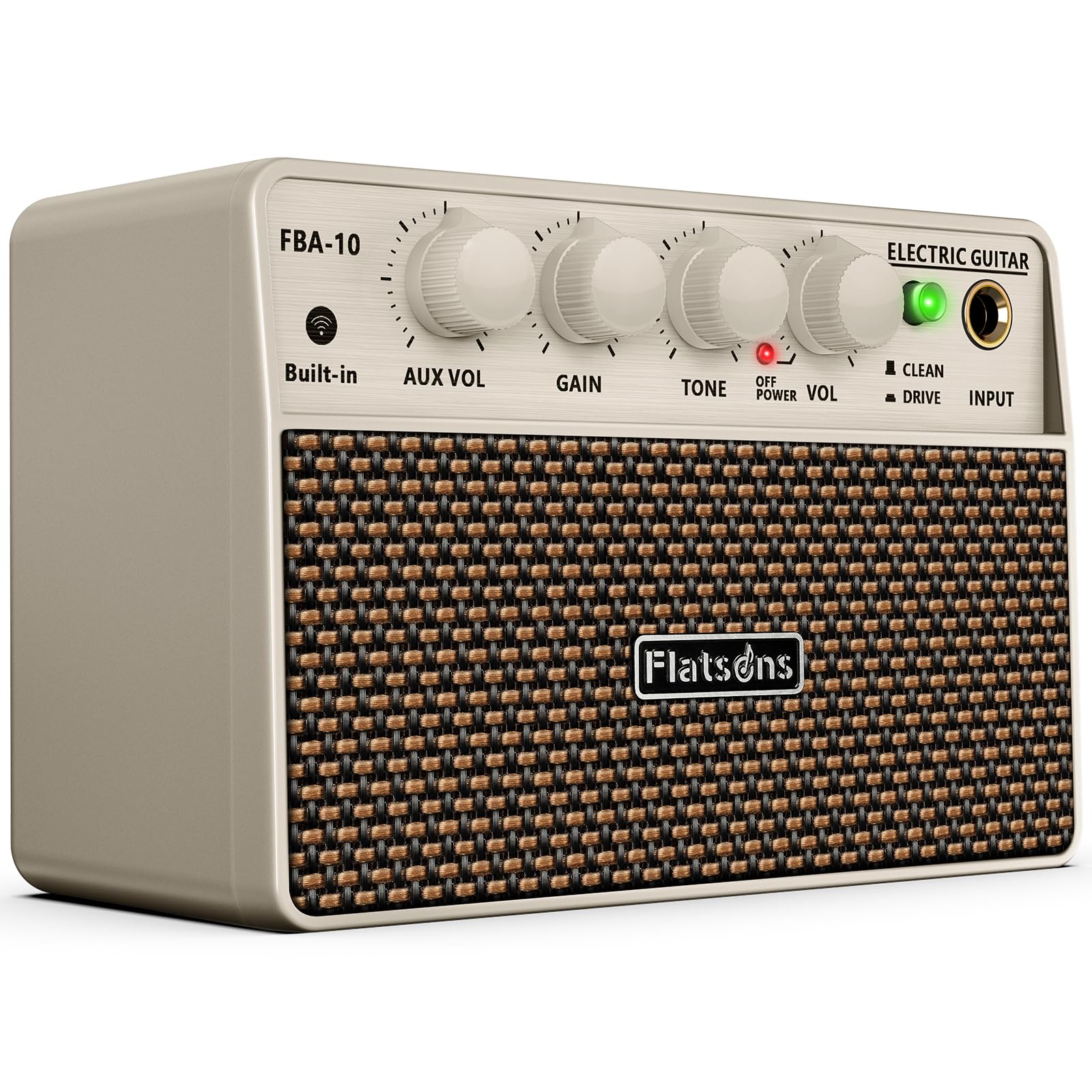
The Flatsons FBA-10 is a 10W rechargeable mini amp aimed at the guitarist who wants sound without setup, and its strongest argument is the combination of a 580g body, USB-C charging, a headphone output, and clean and drive channels in one unit. The principal reservation is evidential rather than technical: the listing displays a rating with no substantive published review pool behind it, so nothing here has been corroborated by buyers or by independent measurement.
This product sits in the crowded battery-powered practice amp category, a segment that exists because most electric guitar playing happens on a sofa, in a bedroom, or in a hotel room rather than on a stage. The design brief is visible in the feature list. It has to run without mains power, weigh little enough to carry casually, stay quiet when a household demands quiet, and provide backing tracks without a second device. The FBA-10 addresses each of those in turn, which suggests a product built to a familiar and well-understood specification rather than one attempting anything unusual.
Translated into daily use, the specifications matter in specific ways. The single-button CLEAN and DRIVE switch with separate GAIN and TONE controls means a learner can practice chord clarity and then move to a distorted riff without swapping gear. The 3.5mm headphone jack converts the amp into a silent practice rig, which is frequently the difference between playing daily and not playing at all. The AUX input with its own volume knob lets you set your guitar against a track rather than accepting whatever balance a shared control produces, and 5.3 wireless streaming removes one more cable from that arrangement. Six hours of stated playtime is enough for a travel day, and USB-C means you recharge from equipment you already carry.
Limitations point elsewhere for certain players. The stated 100Hz low-end figure implies a small cabinet, so anyone playing bass guitar or wanting authentic low-tuned weight should look at a larger-format amp instead. Players who want amp modeling, built-in effects beyond a drive channel, a looper, or recording output should shop for a modeling practice amp or an audio interface, since none of those features appear in this listing. Anyone who needs to be heard over a live drummer needs a substantially larger amplifier regardless of what any coverage figure suggests.
The qualified verdict is that the FBA-10 is a reasonable buy for a beginner or traveling player who values portability and silent practice over tonal refinement, provided you treat the tone claims as unproven. The most important pre-purchase check is confirming the return window and the terms of the stated 12-month guarantee before ordering, because with so little independent evidence available, your ability to return the unit is the real protection you are buying.
Strong Match: The beginner or intermediate electric guitarist who practices mostly at home and needs a small amp that will not annoy housemates. The headphone jack, the AUX input with independent volume, the clean and drive channels, and the light 580g body together describe a straightforward bedroom practice setup, and USB-C charging keeps it running without special hardware.
Also Consider It If: You travel or play outdoors and want something that runs off its own battery. A stated six hours of playtime and a 152 x 75 x 99mm footprint mean the amp can live in a backpack, which serves hotel rooms, dorms, park sessions, and casual outdoor playing rather than any performance requiring real volume.
Not the Best Fit: Players chasing a specific amplifier voice, recorded tone, or rehearsal-level volume. The listing supplies no speaker size, no cabinet detail, no circuit description, and no recording output, and the 100Hz low-end figure indicates limited bass, so bassists, tone-focused players, and anyone rehearsing with a drummer are shopping in the wrong category.
Decision in One Sentence: Buy the Flatsons FBA-10 if you are a home or traveling guitarist who values silent practice and portability over verified tone quality, but treat every performance claim as an unverified manufacturer statement and confirm your return options first.
Consider It For:
- Silent apartment or late-night practice through the 3.5mm headphone output.
- Play-along practice, using either the AUX input with its dedicated volume knob or 5.3 wireless streaming from a phone or tablet.
- Travel and outdoor use, given the stated 580g weight, 152 x 75 x 99mm size, and up to six hours of battery life.
- A beginner who wants both a clean sound and a driven sound without buying a separate pedal, using the single-button channel switch plus GAIN and TONE controls.
- Anyone who prefers charging from a standard USB-C cable rather than managing 9V batteries or a proprietary adapter.
Pass If:
- You want purchase confidence built on customer feedback, since the displayed rating is not backed by a substantive published review pool.
- You need documented low-end response for bass guitar or low tunings, because the stated frequency response begins at 100Hz.
- You require modeling, onboard effects, a looper, or a recording output, none of which appear in the supplied information.
- You need to know speaker size, cabinet construction, charging time, or the nature of the drive circuit before committing, as none of these details are disclosed.
The following figures are supplied by the manufacturer and have not been independently verified.
- Model: Flatsons FBA-10, White, ASIN B0FD9KTDW4.
- Rated power: 10W.
- Stated frequency response: 100Hz to 20kHz at plus or minus 3dB.
- Channels: CLEAN and DRIVE, switched by a single button.
- Controls: GAIN, TONE, and a separate AUX VOL.
- Connections: 3.5mm headphone output, AUX input, 5.3 wireless audio.
- Power: USB-C rechargeable battery, up to 6 hours of stated playtime.
- Dimensions and weight: 152 x 75 x 99mm, 580g.
- Cabinet finish: two-tone woven grille, described by the manufacturer as improving sound transmission, a claim with no supporting measurement provided.
- Support terms as stated by the seller: a 12-month product guarantee and ongoing technical support; verify current terms directly before purchase.
- Not disclosed: speaker diameter, cabinet material, input impedance, charging time, battery capacity, and whether the drive channel is produced by analog clipping or a gain stage.
Pros
- Portability: Small size and light weight make it easy to carry anywhere, perfect for travel or quick practice sessions
- Bluetooth connectivity: Allows you to play along with music from your phone, enhancing practice sessions
- Built-in effects: Offers a variety of tones without needing external pedals, convenient for experimenting with sound
- Rechargeable battery: Long battery life (up to 6 hours) and USB charging provide freedom from wall outlets
- Affordable price point: Provides an entry-level option for beginners without a large investment
Cons
- Limited power: The 5W speaker may not be loud enough for live performance or jamming with a drummer
- Missing specifications: No details on speaker size, frequency response, or weight, making it hard to assess sound quality and portability precisely
- Bluetooth limitations: Does not support Bluetooth headphones or speakers, only audio input for playback
Bottom line: The LEKATO Mini Electric Guitar Amp (JA-05G) is a compact, battery-powered practice amplifier with Bluetooth and four built-in effects. It's best suited for beginners or guitarists who need a highly portable practice solution, but its small speaker and limited power mean it's not for performance use.
Product position: This amp is designed to solve the problem of practicing anywhere without the hassle of cords, bulky equipment, or finding a power outlet. It targets the casual player who wants a grab-and-go amp for quick sessions, travel, or quiet practice at home. The inclusion of Bluetooth and multiple effects adds versatility, making it a modern take on the classic mini practice amp.
Important features: The built-in effects (clean, distortion, overdrive, reverb) are easily switchable, allowing you to explore different tones without external pedals. The Bluetooth function lets you stream backing tracks or songs from your phone, which is great for play-along practice. The rechargeable battery offers up to 6 hours of use, and the compact design with a 6.35mm plug means you can simply plug in your guitar and play, even hanging the amp on your guitar strap for convenience.
Limitations and alternatives: The 5W speaker is adequate for personal practice but will not deliver the volume or bass response needed for performing or jamming with others. If you need more power or a fuller sound, consider a larger practice amp (e.g., 10-20W) or a modeling amp with more effects. Also, note that the Bluetooth function is only for audio playback, not for connecting to headphones or external speakers, so you'll need to use the built-in speaker.
Final verdict: The LEKATO Mini Amp is a great value for its price, offering portability, effects, and Bluetooth in a tiny package. It's ideal for beginners or as a travel companion. Before purchasing, ensure that the power output meets your needs and that you're comfortable with the lack of detailed specifications. If you prioritize volume and sound quality over portability, you may want to look elsewhere.
Strong Match: The clearest buyer is a beginner electric guitar player who wants a simple, affordable amp for daily practice at home or in a dorm room. The built-in effects and Bluetooth make it easy to experiment and play along with songs.
Also Consider It If: You are a traveler or frequent mover who needs a compact amp that fits in a backpack. Its lightweight, battery-powered design means you can practice in parks, hotel rooms, or anywhere without access to power outlets.
Not the Best Fit: If you are a gigging musician or need an amp for rehearsals with a band, the 5W speaker will not provide sufficient volume or headroom. Also, if you rely on headphone output for silent practice, this amp lacks that feature, so you'll need to use the speaker.
Decision in One Sentence: The LEKATO Mini Amp is a practical choice for casual practice on a budget, but its limited power and lack of headphone jack mean it's not for serious performance or silent practice.
Consider It For:
- Portability: Its small size and light weight make it easy to take anywhere.
- Bluetooth play-along: Stream music from your phone to practice with backing tracks.
- Built-in effects: Get a variety of tones without needing extra pedals.
- Rechargeable battery: No need to buy batteries or find an outlet, with up to 6 hours of use.
- Affordable entry: A low-cost way to get a functional amp for beginners.
Pass If:
- You need more volume: The 5W speaker is not suitable for performing or jamming with others.
- You require headphone output: This amp does not have a headphone jack, so silent practice isn't possible.
- You demand detailed specs: The lack of information on speaker size and sound quality may be a concern for audiophiles.
- You want to use Bluetooth headphones or speakers: The Bluetooth only supports audio input, not output.
Built-in Effects: The amp offers four effects: clean, distortion, overdrive, and reverb. These are selectable via a control, allowing you to shape your tone without additional pedals. This is especially useful for beginners exploring different sounds.
Bluetooth Audio: You can connect your phone or other Bluetooth devices to play music through the amp. This is great for practicing along with your favorite tracks, but note it does not support Bluetooth headphones or speakers.
Rechargeable Battery: The built-in battery provides up to 6 hours of playtime on a full charge, using a 5V 2A charger. This makes it convenient for outdoor practice, but avoid using chargers with higher voltage as it may damage the product.
Plug and Play: The 6.35mm input jack allows you to plug in your guitar directly. The amp is lightweight and can be hung on your guitar strap, giving you freedom of movement during practice.
Pros
- Beginner-friendly: easy switch and simple controls
- Compact design for easy placement in a bedroom or studio
- Headphone jack allows silent practice without disturbing others
- Rugged casing claimed for transport protection
- Suitable for practice and small performances per manufacturer
Cons
- No independent durability or long-term reliability evidence
- Exact dimensions and weight not provided, so fit verification is needed
- No included accessories or cables mentioned, so you may need to buy separately
The Donner DEA-20 is a 20-watt electric guitar amplifier designed for practice, rehearsals, and small stage performances. Its most convenient feature is the clean/overdrive switch, which lets you change your tone instantly without fiddling with multiple knobs—perfect for beginners who want to explore different sounds. The built-in reverb adds depth to your playing, and the treble and bass controls allow you to shape your tone.
For daily use, the headphone output is a standout: you can practice quietly without disturbing others, and the 6.5-inch speaker provides enough volume for a bedroom or small room. The rugged casing is claimed to protect the amp during transport, but we have no independent verification of its durability.
One thing to note: the product data doesn't include dimensions or weight, so you'll need to check if it fits your space or is easy to carry. Also, there's no mention of included cables or a power cord, so you may need to purchase those separately.
Overall, this amp is best suited for a beginner or someone who needs a compact, easy-to-use practice amp with basic effects. If you're a gigging musician who needs a rugged, road-ready amp, you may want to look elsewhere or verify the build quality with the manufacturer.
Before buying, confirm the amp's measurements and power requirements, and check whether it comes with a power cable and instrument cable.
Best Ownership Fit: This amp fits a beginner guitarist who wants a simple, compact practice amp for home use, or a player who needs a lightweight backup for small gigs.
Daily Workflow: You'll plug in your guitar, use the clean/overdrive switch to select your tone, adjust treble and bass, and set the reverb level. The headphone jack lets you practice silently, and the amp can be easily moved from room to room.
Likely Friction: The lack of specified dimensions and weight means you can't be sure it will fit your intended space or be easy to carry. Also, without a stated power cord or included cables, you may need to buy those separately.
Before You Buy: Verify the amp's dimensions and weight to ensure it fits your space. Check if a power cable and instrument cable are included. Confirm the power requirements (voltage) for your region. If you plan to use it for gigs, ask the manufacturer about the durability of the casing.
Setup: The amp is ready to use out of the box, but you'll need to connect your guitar to the input jack and plug in the power. No assembly is required.
Controls: The clean/overdrive switch, treble, bass, and reverb controls are straightforward. The headphone output is on the front or top panel (exact location not specified).
Maintenance: No specific maintenance instructions are provided. Typically, you should keep the amp clean and dry, and avoid exposing it to moisture. The speaker may need occasional cleaning with a soft brush.
Consumables: No consumables are mentioned, but you may need to replace the power cord if lost or damaged.
Pre-Purchase Verification: Since the manual is not included in the product data, check with the manufacturer for detailed setup and maintenance instructions, as well as any warranty information.
Pros
- Stereo speaker setup delivers a wider, more immersive sound than mono amps
- Built-in effects and EQ eliminate the need for separate pedals
- Mic channel with dedicated controls lets you shape vocals for outdoor performance
- USB-C OTG recording allows direct capture to phone or PC without extra gear
- Battery power and speaker stand mount make it easy to perform anywhere
Cons
- Guitar input is optimized for active pickups; passive pickups may require an external preamp for adequate volume
- Bluetooth and AUX cannot be used simultaneously, limiting streaming options
- USB-C port does not charge your phone, so you'll need a separate power source for your device
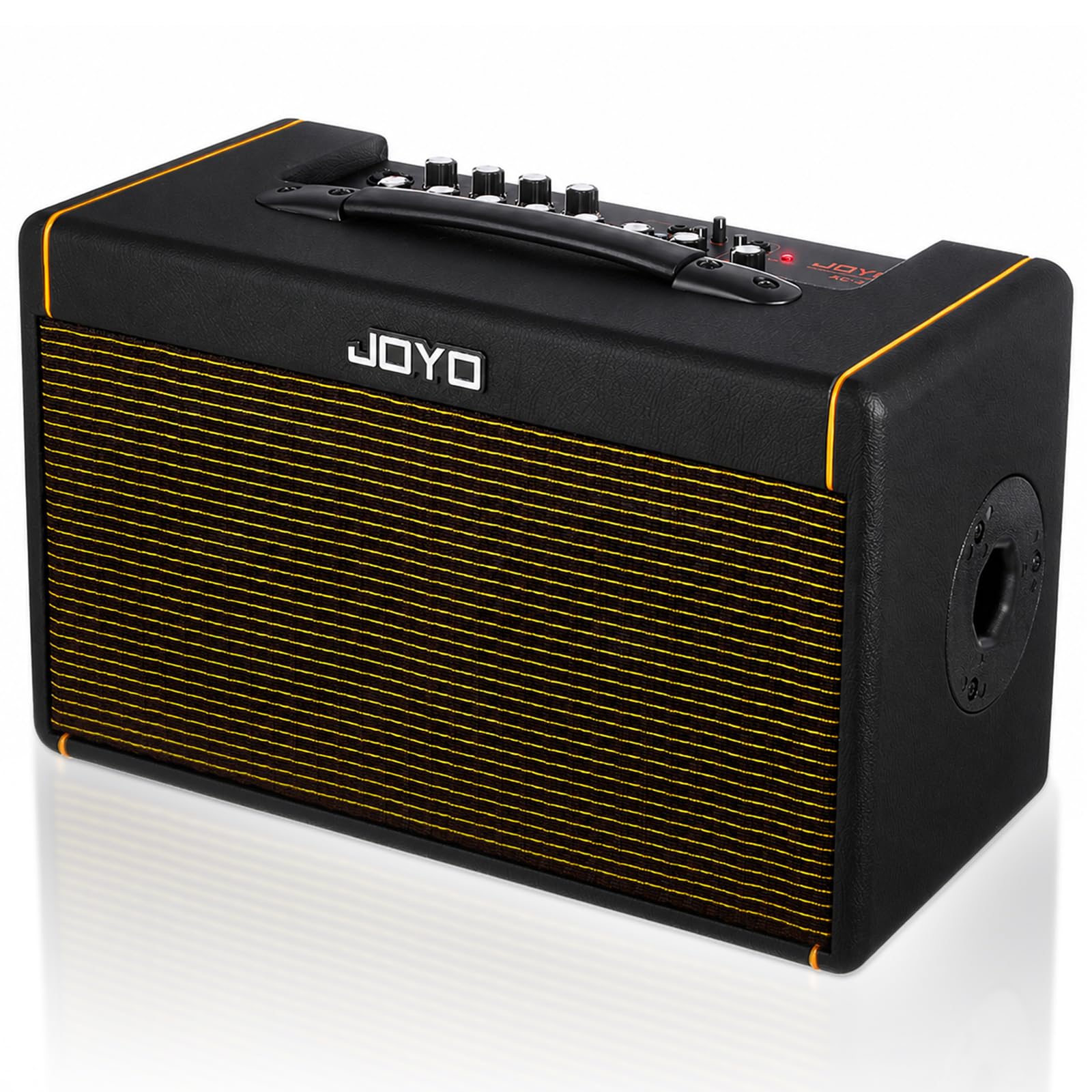
The JOYO AC-40S is a 40-watt stereo acoustic guitar amplifier designed for musicians who need portable, battery-powered sound for outdoor performances, busking, and live gigs. It's an excellent choice for singer-songwriters who want a single unit to amplify both guitar and vocals, with built-in effects and Bluetooth streaming for backing tracks or breaks. However, it's important to note that the guitar input is optimized for active pickups, so if your acoustic-electric guitar has passive pickups, you may need an external preamp to get sufficient volume.
The amp's key strength is its stereo sound, driven by two 6.5-inch speakers. This creates a wider, more immersive audio image compared to typical mono acoustic amps, making it ideal for capturing the nuances of fingerpicking or strumming. The guitar channel features a 3-band EQ (bass, mid, treble) plus three built-in effects: chorus, delay, and reverb. These can be stacked or used individually, giving you a versatile tone-shaping toolkit without the need for external pedals. The intuitive knob-based controls are straightforward, allowing quick adjustments during a performance.
For vocalists, the dedicated mic channel offers independent bass, treble, and reverb controls, so you can tailor your voice to cut through outdoor noise. The amp is optimized for dynamic microphones, which are durable and don't require phantom power, making them practical for street performing. Additionally, the AC-40S includes Bluetooth 5.0 for wireless streaming, an AUX input for wired connections, and a USB-C OTG port for direct recording to your phone or PC. This versatility makes it a useful tool for practice, recording, and even as a standalone Bluetooth speaker.
Portability is a major plus: the built-in rechargeable battery provides up to 6 hours of playtime at moderate volume, and you can keep playing while it charges via the AC adapter. The amp also has a standard speaker stand mount, so you can elevate it for better sound projection. At 18.9 pounds, it's manageable for transport, and the leather grip adds comfort. However, the battery life may be shorter at higher volumes, and the lack of phantom power means condenser mics won't work, which could be a limitation for some users.
In summary, the JOYO AC-40S is a well-rounded, portable amp that excels for acoustic performers who need a self-contained solution for outdoor gigs. Its stereo sound, built-in effects, and battery operation are its strongest selling points. The main reason to hesitate is if you have a guitar with passive pickups, as you'll likely need an extra preamp. If you primarily play at home or in small indoor settings, you might consider the smaller AC-20S model instead.
Stereo Sound with Dual 6.5" Speakers: The AC-40S uses two speakers to create a stereo image, which makes your guitar sound wider and more three-dimensional than a single-speaker amp. This is especially beneficial for fingerstyle players who want to highlight the spatial qualities of their playing.
3-Band EQ and Built-in Effects: The guitar channel includes bass, mid, and treble controls, allowing you to shape your tone precisely. The built-in chorus, delay, and reverb effects let you add depth and ambiance without needing external pedals, saving space and setup time.
Independent Mic Channel: The mic input has its own bass, treble, and reverb controls, so you can tailor your vocals to the performance environment. This is crucial for outdoor gigs where you might need to cut through ambient noise or reduce wind rumble.
Bluetooth 5.0 and AUX Input: You can stream backing tracks from your phone via Bluetooth or connect a device with an AUX cable. This makes the amp a versatile practice tool and a decent Bluetooth speaker for breaks.
USB-C OTG Recording: The USB-C port allows direct recording to your phone or PC without an audio interface. This is a great feature for capturing song ideas or live performances on the go.
Active Pickups Required: The guitar input is optimized for acoustic-electric guitars with active pickups (those with a battery). If your guitar has passive pickups, the signal may be too weak, resulting in extremely low volume even at maximum gain. You would need an external preamp to boost the signal.
Dynamic Microphones Only: The mic channel is designed for standard dynamic microphones, which do not require phantom power. Condenser microphones that need phantom power are not supported, so you'll need a dynamic mic for vocals.
Bluetooth and AUX Cannot Be Used Simultaneously: You can stream via Bluetooth or connect via AUX, but not both at the same time. Plan your connections accordingly.
USB-C Does Not Charge Your Phone: The USB-C port is for recording only and will not charge your phone, so keep a separate power bank if needed.
Best For: This amp is ideal for solo acoustic performers, singer-songwriters, and street buskers who need a portable, battery-powered solution with built-in effects and vocal support. It's also great for small outdoor gigs, patio performances, and open-air events where electricity is unavailable.
Consider Alternatives If: If your acoustic guitar has passive pickups and you don't want to invest in an external preamp, you might consider an amp with a higher input sensitivity or a model that works with passive pickups. Also, if you primarily play indoors at low volumes, the smaller AC-20S might be more appropriate.
Setup and Daily Use: The controls are straightforward: plug in your guitar and mic, adjust EQ and effects, and set volume levels. You can stream music via Bluetooth for practice or between sets. The battery charges via the included power adapter, and you can play while charging.
Maintenance Requirements: Keep the amp clean and dry, especially after outdoor use. Store it in a padded case to protect the speakers and controls. The battery will eventually need replacement, but it's designed for long life.
What Sets It Apart: The combination of stereo sound, battery power, built-in effects, and USB-C recording in a single unit is uncommon. This makes it a versatile all-in-one tool for mobile performers.
Pros
- Dual 6.5" speakers provide a fuller sound than single-speaker amps in its class
- The XLR input lets you plug in a microphone, making it a mini PA for intimate performances
- Built-in reverb is a convenient feature that adds depth without needing external effects
- Fender's 2-year warranty reflects confidence in build quality and offers protection
- Compact size makes it easy to carry to rehearsals or small gigs
Cons
- 40 watts may not be sufficient for loud band settings or larger venues without PA support
- No separate EQ controls for the microphone channel, limiting vocal tone shaping
- Lack of effects other than reverb might be limiting for players wanting more sound variety
The Fender Acoustasonic 40 is a 40-watt acoustic guitar amplifier designed for practice, small performances, and singer-songwriter setups. It features dual 6.5-inch speakers, a built-in reverb, and both instrument and microphone inputs. This amp is best suited for acoustic guitarists who need a portable, all-in-one solution for coffeehouse gigs or home use. Its strongest asset is its dual-speaker design, which produces a wider soundstage than typical single-speaker practice amps, and the XLR input adds vocal capability.
The Acoustasonic 40 appears to be engineered to serve the solo performer who wants a single amp for both guitar and voice. Its 40-watt power rating is adequate for small rooms, and the dual speakers help project sound more evenly. The built-in reverb is a practical feature for adding space to the guitar tone without additional pedals.
Key features include a 1/4-inch input for an acoustic guitar and an XLR input for a microphone, allowing you to mix both signals. The reverb is dedicated to the instrument channel, which is a thoughtful touch. The amp's dimensions (9.8D x 17.6W x 15.5H inches) make it easily portable. The 2-year warranty from Fender provides assurance of quality.
However, the 40-watt power may be insufficient for louder band scenarios or outdoor performances without external PA reinforcement. The microphone channel lacks dedicated EQ, so you cannot shape the vocal tone independently. Additionally, the only built-in effect is reverb, so players seeking chorus or delay will need external pedals.
For solo acoustic acts or intimate venues, the Fender Acoustasonic 40 is a reliable companion. Before purchasing, consider your typical performance settings and whether the 40-watt output and basic effects meet your needs. If you require more power or channel flexibility, you might explore higher-wattage acoustic amps or separate PA systems.
Strong Match: Acoustic guitarists who primarily play solo or in small venues like coffee shops, small bars, or house concerts. The dual inputs and reverb make it ideal for singer-songwriters who need to amplify both guitar and vocals.
Also Consider It If: You are a beginner or intermediate player looking for a practice amp with quality Fender tone and built-in effects. The compact size and 40-watt output are suitable for home practice and small jam sessions.
Not the Best Fit: If you play in a loud rock band, need to cover large venues, or require advanced effects and EQ control for your microphone, this amp may not meet your needs.
Decision in One Sentence: The Fender Acoustasonic 40 is a great choice for solo acoustic performers and practice, thanks to its dual speakers, XLR input, and reverb, but it falls short for high-volume gigs or complex tonal shaping.
Consider It For:
- Dual 6.5" speakers deliver a fuller, more immersive acoustic tone than single-speaker amps.
- The XLR input allows you to plug in a microphone, turning the amp into a compact PA for solo performances.
- Built-in reverb adds depth to your guitar sound without the need for external effects.
- Fender's 2-year warranty provides peace of mind and demonstrates brand confidence.
- Compact dimensions (9.8D x 17.6W x 15.5H) make it easy to transport to gigs or rehearsals.
Pass If:
- You need more than 40 watts of power to keep up with a loud band or outdoor venues.
- You require independent EQ for the microphone channel to shape vocal tone.
- You want a variety of built-in effects (e.g., chorus, delay) beyond reverb.
Pros
- Battery operation with a stated 4 to 6 hour runtime suits buskers, campground players, and teachers who work in rooms without a convenient outlet.
- Two 4-inch drivers in a stereo configuration rather than a single speaker, which JOYO frames as width over raw volume, fits home players filling a small practice space instead of a hall.
- Guitar effects and vocal reverb built into the panel benefit the solo singer-guitarist who wants fewer boxes to set up, patch, and pack down each time.
- USB-C OTG recording is a real workflow saver for content creators filming covers on a phone, since guitar and vocals capture in sync without an interface purchase.
- The auto-muting headphone jack helps apartment dwellers and shared households practice late without rearranging the rest of the rig.
Cons
- The guitar input is voiced for active pickups with an onboard battery. JOYO states that a passive pickup may produce a signal too weak to drive the channel, leaving volume very low even at maximum, which turns an external preamp into a mandatory extra purchase and one more thing to power and carry.
- The mic input does not supply phantom power, and the supplied data never states the connector type, so condenser microphone users need an outboard supply and every buyer should confirm cable requirements before ordering.
- Ownership specifics are missing across the board: no dimensions, charge time, battery replaceability, warranty, service path, or in-box accessory list. Two stated behaviors also affect routine use, since Bluetooth and AUX cannot run at the same time and the USB-C port records without charging the connected phone.
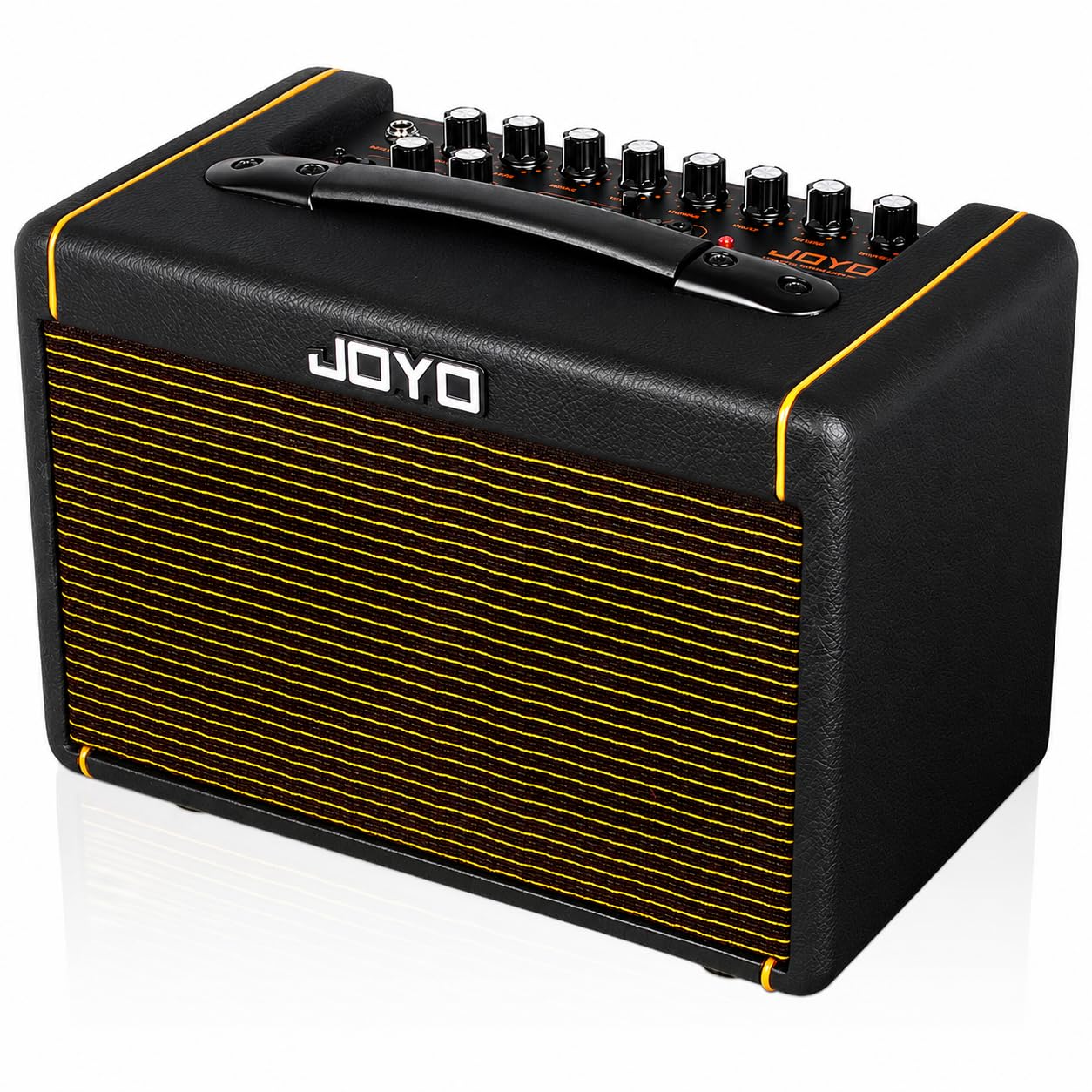
The JOYO AC-20S is a 20W stereo acoustic amplifier built around two 4-inch speakers, aimed at the player whose amp has to travel: bedroom practice midweek, a patio or coffee shop set on the weekend. Its strongest ownership advantage is self-contained portability, with a rechargeable battery JOYO rates at 4 to 6 hours, a 12 lb cabinet, and a carry handle. The biggest qualification sits in the fine print about pickups.
If your acoustic-electric has an onboard preamp with a battery, the guitar input was designed for it. If the pickup is passive with no battery, JOYO says the signal may be too weak, leaving volume very low even at maximum, so you would need an external preamp in front of the amp. That is a check to make before buying, not after.
In routine use the two channels stay usefully separate. The guitar side carries a three-band EQ plus chorus, delay, and reverb, usable alone or stacked, so tone shaping happens on the panel instead of on a pedalboard you also have to carry. The vocal side gets reverb only, which keeps operation simple but limits repair options for a thin vocal. The mic input does not supply phantom power, so a condenser needing 48V requires its own supply.
Backing tracks arrive over Bluetooth 5.0 or the AUX jack, though not both at once, and plugging in headphones mutes the speakers for quiet practice. The USB-C port handles OTG recording to a phone or computer, useful for filming covers, but it will not charge the phone doing the filming, so longer shoots need a second power source for the device.
No customer review text was supplied, so cabinet toughness, real runtime, and recording quality remain manufacturer claims rather than confirmed owner experience. Buy it if you want one battery-powered box for guitar, voice, and backing tracks with no interface in the chain. Skip it if you play a passive pickup with no preamp, need phantom power, or need to cover more than a small room. Verify pickup type, cabinet dimensions, and included cables first.
Best Ownership Fit: A solo acoustic player or singer-guitarist with an acoustic-electric that has an onboard preamp, practicing regularly at home and playing occasional small rooms, patios, parks, or campsites. JOYO positions the 20W stereo output at home practice and small shows, and points buyers who need street-corner or larger-venue volume toward the higher-powered AC-40S instead. Skill level is beginner friendly, since the controls are panel knobs rather than menus.
Daily Workflow: Charge the battery, carry the 12 lb cabinet by its handle, plug the guitar into the guitar channel and a microphone into the vocal channel, then set the three-band EQ and add chorus, delay, or reverb on the guitar side with reverb on the vocal side. Backing tracks come in over Bluetooth 5.0 or the AUX jack, one at a time. For recording, connect USB-C to a phone or PC and capture guitar and vocals together. For silent sessions, plug in headphones and the speakers mute on their own.
Likely Friction: The pickup requirement is the friction that changes the purchase. JOYO states the guitar channel is voiced for active pickups and that a passive pickup without a battery may not drive it, so some buyers inherit an extra preamp, extra cable, and extra battery to manage. Second in line is the USB-C behavior: it records but does not charge the phone, so a filming session drains the device that is capturing it. The supplied data also gives no charge time, so downtime between sessions is unknown.
Before You Buy: Check whether your guitar has an onboard preamp with a battery, and price an external preamp if it does not. Confirm the mic input connector type and confirm your microphone does not require phantom power, since the amp does not provide it. Ask JOYO or the listing for cabinet dimensions and shelf or case clearance, since none are supplied here. Confirm what ships in the box, including the charger, any cables, and any USB-C recording cable that matches your phone port, and ask whether the internal battery is user-replaceable and what the warranty covers.
Power and First Session: The amp runs on an internal rechargeable battery that JOYO rates at 4 to 6 hours, and it can be played while plugged in and charging, which means a long rehearsal does not have to pause. Charge time, charger type, and battery chemistry are not supplied, so confirm those in the manual before planning around a same-day turnaround between gigs.
Signal Chain Setup: The guitar channel expects an acoustic-electric with an active pickup system. If your instrument uses a passive pickup, JOYO says you must place an external preamp between guitar and amp or the level will remain extremely low at full volume, which adds one device and one more cable to the setup routine. The microphone channel carries no phantom power, so plan on a microphone that does not need it or an outboard supply.
Panel Operation: Tone shaping is done with a three-band EQ of bass, mid, and treble on the guitar channel, with chorus, delay, and reverb available individually or stacked. The vocal channel offers reverb only. There is no menu system described, so setup is knob-based and repeatable session to session.
Connections for Playback and Recording: Bluetooth 5.0 and the AUX input both feed backing tracks but cannot be used simultaneously, so decide which source you rely on and keep the cable in the bag as a backup. The USB-C port supports OTG recording to a phone or PC and does not pass charge back to the connected device. Confirm which USB-C cable and which phone operating systems are supported before relying on it for a shoot.
Cleaning, Storage, and Transport: The supplied data describes a carry handle and a 12 lb cabinet but includes no cleaning instructions, grille care, storage temperature guidance, or long-term battery storage advice. Treat those as manual items rather than assumptions, and ask the manufacturer directly for care instructions if the amp will live in a car, a garage, or an unheated practice space.
Parts and Service to Verify: No information is supplied on replacement batteries, replacement speakers, spare power supplies, protective covers, or the warranty and repair path. If long-term serviceability matters to you, confirm with JOYO whether the battery can be replaced and whether parts are sold separately before purchase.
Guitar Compatibility: JOYO states the guitar input is voiced for acoustic-electric guitars with active pickups, meaning a pickup system with an onboard battery-powered preamp. A passive pickup with no battery may not produce enough signal, and JOYO warns the volume will be extremely low even at maximum. The workaround JOYO names is an external preamp placed between guitar and amp. Verify your instrument before ordering, because this determines whether the amp works out of the box or requires a second purchase.
Microphone Compatibility: The mic channel gets its own reverb but no phantom power, so microphones that require 48V will need an external supply. The connector type on the mic input is not stated in the supplied data, so confirm whether your cable matches before you plan a set around it.
Phone and Computer Compatibility: The USB-C port supports OTG recording to a phone or PC, capturing guitar and vocals in sync for covers, song ideas, or streaming. It does not charge the connected device. Supported operating systems, required cable, latency, and recording resolution are not supplied, so confirm those points against your specific phone or laptop if recording is a primary reason for buying.
Audio Source and Listening Options: Bluetooth 5.0 and AUX input both work for backing tracks but not at the same time. A headphone connection mutes the speakers automatically, which suits shared living spaces and late practice.
Room and Space Fit: JOYO frames 20W in stereo, from two 4-inch drivers, as suited to home practice and small shows, and directs buyers who need street-corner or larger-venue coverage to the AC-40S. The stated weight is 12 lb with a handle. Cabinet dimensions, depth, and footprint are not supplied, so measure your shelf, stand, or case space and request dimensions before committing.
Pros
- Two channels with separate volume controls allow you to blend guitar and vocals for solo performances
- Built-in chorus effect saves you from buying a separate pedal, making setup quicker
- Compact and lightweight design (13.4 lb) makes it easy to transport to gigs or practice spaces
- Headphone output enables silent practice, ideal for late-night sessions without disturbing others
- Fender's 2-year limited warranty adds reliability and support for the purchase
Cons
- 15 watts of power may not be loud enough for larger venues or keeping up with a full band
- 6-inch speaker may lack the full low-end response needed for deeper acoustic tones or bass-heavy styles
- No EQ controls beyond volume, limiting tone shaping compared to more advanced amps
The Fender Acoustasonic 15 is a 15-watt combo amplifier designed specifically for acoustic-electric guitars and microphones. It suits singer-songwriters, buskers, and players who need a simple, portable amp for practice, small gigs, or coffeehouse performances. If you want a grab-and-go solution with basic features and reliable Fender build quality, this amp is a strong contender.
Its standout feature is the two-channel flexibility: a dedicated instrument channel and a microphone channel, each with its own volume control. This lets you plug in both your guitar and a vocal mic and blend them independently, making it ideal for solo acts. The built-in chorus effect on the instrument channel adds lush dimension to your sound without needing external pedals, simplifying your pedalboard and setup.
The custom 6-inch Fender Special Design speaker is voiced to enhance the natural sparkle of acoustic instruments. This means the amp aims to reproduce the bright, detailed tones of acoustic guitars, which is a priority for many players. The lightweight 13.4 lb cabinet and classic brown and wheat cosmetics reflect Fender's iconic style, and the headphone output allows for silent practice, a practical feature for apartment dwellers or late-night sessions.
However, the 15-watt output and 6-inch speaker have limitations. This amp is not designed to compete with a full band or fill a large venue; it's best for intimate settings or practice. The lack of EQ controls beyond volume means you have limited tone shaping, so you may need to rely on your guitar's built-in EQ or external pedals. Also, the 6-inch speaker may not deliver deep bass response, which could be a drawback for players who prefer a fuller low end.
Overall, the Fender Acoustasonic 15 is a solid choice for acoustic players who value portability and simplicity. Its strongest selling points are the dual channels and built-in chorus, which make it a convenient all-in-one solution for solo performances. However, if you need more power, more tone-shaping options, or a larger speaker for fuller sound, you might want to explore higher-wattage acoustic amps or those with more comprehensive EQ. For its intended use, it delivers practical performance in a compact package.
Two-Channel Flexibility: Dedicated instrument and microphone channels each have their own volume control. This means you can plug in your guitar and a mic, adjust each level independently, and blend them to suit your mix. For singer-songwriters and solo performers, this is essential because it lets you balance vocals and guitar without complicated setup.
Custom 6-inch Fender Special Design Speaker: This speaker is voiced specifically to bring out the natural sparkle of acoustic instruments. Acoustic guitars produce a lot of high-frequency detail, and this speaker is tuned to emphasize that brightness, helping your guitar sound clear and present in a mix.
Built-in Chorus Effect: The chorus effect on the instrument channel adds a lush, spacious dimension to your sound. Instead of buying a separate chorus pedal, you can engage this effect directly on the amp, saving money and simplifying your signal chain. It's great for adding depth to strumming or fingerpicking.
Headphone Output: The headphone jack lets you practice silently without disturbing others. This is perfect for late-night practice sessions, hotel rooms, or anywhere you can't play loudly. It also allows you to practice with the full amp sound without needing to crank the volume.
Lightweight Design: At 13.4 lb, this amp is easy to carry. Whether you're walking to a gig, storing it in a car trunk, or moving it between rooms, the portability is a practical advantage for gigging musicians and hobbyists alike.
Best For: This amp is ideal for acoustic guitarists who play solo or in small, quiet settings. Singer-songwriters, buskers, and hobbyists who need a portable, reliable amp for practice or intimate performances will find it fits their needs. The two channels make it particularly useful for those who want to amplify both guitar and vocals without a separate PA system.
Consider Alternatives If: If you need to play with a full band, in large venues, or at outdoor events, a 15-watt amp with a 6-inch speaker will likely not provide enough volume or low-end punch. You may want to look at higher-wattage acoustic amps (e.g., 30W+) or those with larger speakers (8 inches or more) for fuller sound. Also, if you require extensive tone shaping such as EQ, reverb, and multiple effects, this amp's simplicity might be limiting.
Setup and Daily Use: Setup is straightforward: plug your acoustic-electric guitar into the instrument channel and your microphone into the mic channel. Adjust each volume control to balance the mix. The built-in chorus can be engaged with a simple switch. For silent practice, plug in headphones. The amp is small and can sit on a table or stand, making it easy to position.
Maintenance Requirements: As a solid-state amp, there's minimal maintenance. Keep it clean and dry, avoid exposing it to extreme temperatures or moisture, and ensure the speaker is not damaged. The amp's exterior can be wiped with a dry cloth. The 2-year warranty covers defects, but normal wear and tear is expected.
What Sets It Apart: Fender's reputation for quality and the specific voicing of the speaker for acoustic instruments set this amp apart from generic practice amps. The dual channels and built-in chorus are features typically found on more expensive models, making this a value-packed option for its price range. However, it lacks the power and tonal flexibility of larger acoustic amps.
Practice and Rehearsal: The Fender Acoustasonic 15 is perfect for home practice. Its 15 watts are sufficient for a bedroom, and the headphone output allows you to practice without disturbing anyone. The chorus effect can inspire creativity during practice sessions.
Solo Performances: For intimate gigs like coffeehouses, small bars, or house concerts, this amp can deliver adequate volume to project your guitar and vocals. The two channels are a key advantage here, letting you run both guitar and mic through a single amp, simplifying your setup.
Buskers: Buskers who need a portable, battery-free amp that can be carried easily will appreciate the 13.4 lb weight. The dual channels allow you to amplify your instrument and voice, and the chorus adds a professional touch to your sound. However, in noisy street environments, the 15-watt output might struggle to be heard clearly.
Recording: While not a studio tool, the amp can be used for recording demos or practice takes. The line out (if available) or mic placement in front of the speaker can capture a decent acoustic tone. The chorus effect can add dimension to recordings, but you may prefer a clean signal for more flexibility in mixing.
Pros
- Lightweight and portable: At just over 6.6 pounds with a belt clip, it's easy to carry to practice or move around the house.
- Headphone output: Allows silent practice, perfect for late-night sessions or apartments where volume is an issue.
- Aux input: Connect an MP3 player or phone to jam along with backing tracks or songs, improving practice efficiency.
- Tone shaping controls: Gain, volume, treble, bass, and middle knobs give you flexibility to dial in different sounds.
- Durable build: Hard rubber edges protect the amp from minor impacts, adding to its longevity.
Cons
- Limited power: 20 watts may not be loud enough for rehearsals with a drummer or live performances.
- No built-in effects: Lacks reverb, chorus, or other effects that some players may want for versatility.
- Small speaker size: The compact speaker may not reproduce deep bass frequencies as well as larger amps.
GLARRY Electric Bass Combo Amp is a 20-watt practice amplifier designed for bassists who need a compact, portable solution for home practice and quiet sessions. It's best suited for beginners or players who want a reliable amp for daily practice without the bulk and power of larger backline amps. Its lightweight build and headphone output make it a convenient choice for apartment dwellers or anyone who needs to keep volume down.
The amp includes a set of essential tone controls: gain, volume, treble, bass, and middle. These allow you to shape your sound from a clean, punchy tone to a more overdriven edge, giving you the flexibility to explore different styles. The 1/4-inch headphone jack enables silent practice, which is a great feature for late-night sessions. Additionally, the 1/8-inch aux input lets you connect an MP3 player or smartphone to play along with your favorite tracks, making practice more engaging and effective.
Portability is a strong point. Weighing in at just over 6.6 pounds, it's easy to carry, and the belt clip adds convenience for hands-free transport. The cabinet is protected by hard rubber edges, which help shield it from bumps and scrapes during travel or general use. This durable construction suggests the amp can handle the wear and tear of regular practice.
However, the 20-watt power output is modest. It's ideal for bedroom practice and small rooms, but it may not have enough volume to compete with a drummer or in a live rehearsal setting. The compact speaker size also means deep bass frequencies might not be as pronounced as with larger amps. Players seeking a full, room-filling sound may need to consider a higher-wattage model or one with a larger speaker.
In summary, the GLARRY 20W bass combo amp is a practical choice for beginners and casual players who prioritize portability and quiet practice. Its headphone and aux inputs are valuable features for daily use. The main trade-off is its limited power and speaker size, so if you plan to play with a band or need more volume, you may want to look at larger amps. For its intended purpose as a practice amp, it offers good value.
Tone Controls: The amp provides gain, volume, treble, bass, and middle knobs. These let you adjust the character of your sound, from clean and bright to gritty and warm. Beginners can experiment with these to learn how different settings affect their tone, and more experienced players can dial in specific sounds for various musical genres.
Headphone Output: The 1/4-inch headphone jack routes the amp's output to headphones, allowing you to practice silently. This is perfect for late-night practice or when you don't want to disturb others. It also means you can practice anywhere without needing to set up a full amp.
Aux Input: The 1/8-inch auxiliary input lets you connect an external audio source like an MP3 player or smartphone. You can play along with backing tracks, songs, or metronomes, which is a great way to improve timing and musicality. This feature turns the amp into a mini practice station.
Portability: Weighing only 6.61 pounds and featuring a belt clip, this amp is designed for easy transport. You can clip it to your belt and walk to practice or move it around the house without straining. This makes it a convenient option for musicians on the go.
Durable Construction: The amp is built with hard rubber edges that protect it from impacts and scratches. This adds to its longevity, especially if you carry it frequently or have a busy space where bumps are common.
Best For: The GLARRY 20W bass combo amp is ideal for beginner bassists, students, and hobbyists who need a compact, portable amp for home practice. Its headphone and aux inputs make it especially suitable for those who practice in shared living spaces or need to keep volume low.
Consider Alternatives If: If you plan to play with a full band, perform live, or need a sound that can fill a large room, this 20-watt amp may not provide enough volume or low-end punch. In such cases, look for a higher-wattage amp with a larger speaker.
Setup and Daily Use: Setting up the amp is straightforward: plug in your bass, adjust the volume and tone controls, and you're ready. For silent practice, plug in headphones. To play along with music, connect an MP3 player or phone to the aux input. The amp's compact size means it can sit on a desk or floor without taking up much space.
Maintenance Requirements: The amp requires minimal maintenance. Keep it clean and dry, and avoid exposing it to extreme temperatures. The rubber edges help protect it from damage, but you should still handle it with care when transporting.
What Sets It Apart: Compared to other practice amps in its class, the GLARRY stands out for its combination of portability, headphone output, and aux input at an accessible price point. It offers essential tone controls that allow for sound shaping, making it a versatile tool for practice.
Practice at Home: With its 20-watt output, the amp is well-suited for bedroom practice. It produces enough volume to hear yourself clearly without overwhelming the room, and the headphone option ensures you can practice at any hour.
Quiet Rehearsals: For solo practice or sessions with one other acoustic instrument, the amp can hold its own. However, when paired with a drummer or other amplified instruments, it may struggle to be heard.
Jamming with Tracks: The aux input is a standout feature for practicing along with recordings. You can connect your phone or MP3 player and play over your favorite songs, which is an excellent way to develop your ear and timing.
Travel and Portability: The lightweight design and belt clip make it easy to take to lessons, friend's houses, or outdoor jam sessions. You can carry it on your belt or in a backpack without much hassle.
Recording: While not a feature of the amp, the headphone output can be used to connect to an audio interface for quiet recording. This is a bonus for home recording enthusiasts.
Pros
- Extremely portable form factor: 1.98 pounds with dimensions near 3.11 x 5.98 x 3.46 inches supports backpack travel and desk-side practice.
- Modern connectivity: NAM support, USB-C, Bluetooth playback, and a headset mic input combine practice, playback, and recording in one unit.
- Built-in tone tools: CabRig and XpressFX reduce the need for separate pedal or plugin purchases for many users.
- Long battery claim: the advertised 18+ hours is high for a modeling amp and suits all-day sessions if it holds up in practice.
- Ruggedness claim: IP66 dust resistance is uncommon in this category and suits workshop, outdoor, or travel use.
Cons
- No customer review evidence: the supplied data includes a rating but no review text, so real-world sound quality and reliability remain unverified.
- Small-driver sound limits: two 60 mm drivers cannot be assumed to match the low-end or projection of a conventional amp speaker.
- App dependence: NAM capture access runs through TONE3000, and app stability, update support, and any future costs are not documented in the supplied data.
The Blackstar Beam Mini Portable Guitar Amp (with NAM, USB-C, and Bluetooth) targets guitarists who want a compact practice and recording amp with modern modeling features. Its strongest supported draw is connectivity: the amp promises access to 200,000+ NAM captures through the TONE3000 app, alongside Bluetooth music playback, a headset mic input, and USB-C. The main evidence limitation is that no customer review text was supplied with the product data, and the 4.4 out of 5 rating cannot be cross-checked against owner experiences, so none of the tone claims have independent confirmation yet.
The most decision-relevant features are the audio architecture and controls. Dual 60 mm full-range drivers, passive bass radiators, and Super Wide Stereo are meant to produce bigger, room-filling sound from a 1.98-pound cabinet measuring roughly 3.11 x 5.98 x 3.46 inches, suggesting a stereo speaker form factor rather than a traditional amp-in-a-box design. The dynamic SpeedDial with Light Beam display is designed for quick tone changes, and built-in CabRig plus XpressFX provide IR-based cabinet simulation and effects, which matters if you record directly or want one device for practice tones.
Portability is clearly a design priority. The manufacturer claims up to 18 hours of battery life, IP66 dust resistance, and Bluetooth playback, which suits traveling guitarists, bedroom practice, and outdoor jamming. Those claims are supplier-issued, not independently measured, so real battery duration at volume and the robustness of the IP66 rating remain open questions.
The trade-offs are size and software dependence. Two 60 mm drivers cannot physically match a 12-inch speaker's low-end punch, and the NAM capture experience relies on the TONE3000 app's stability and ongoing support. If your priority is a rich, traditional guitar amp feel, a conventional combo amp with a larger speaker is the safer class of product. If your priority is a feature-dense, app-connected portable unit, the Beam Mini's spec list is competitive.
Overall, the Beam Mini is a compelling option on paper for portable, connected practice and recording. The qualified verdict is to buy on its specifications if you accept that sound quality, battery life, app reliability, and durability are unverified until owner reports accumulate. The supplied data cannot support a claim that this is the best portable amp, only that it is feature-complete on paper.
Verified Product Facts: The supplied data confirms the Beam Mini identity, black color, a weight of 1.98 pounds, dimensions of roughly 3.11 x 5.98 x 3.46 inches, and Musical Instruments as the product group. It also lists these features as claims: dual 60 mm full-range drivers with passive bass radiators, Super Wide Stereo, SpeedDial with Light Beam display, CabRig and XpressFX, Bluetooth playback, headset mic input, USB-C, 18+ hour battery, and IP66 dust resistance.
Customer Signals: No review text was supplied, and the provided 4.4 out of 5 rating cannot be checked against written owner experiences. The supplied material is insufficient to establish any pattern about real-world tone, build quality, or reliability.
Not Verified: The supplied data cannot establish measured sound output or low-end response from the 60 mm drivers, actual battery life under normal playing, long-term durability of the controls and cabinet, TONE3000 app stability and continued support, or warranty and support terms. It also cannot confirm how smoothly the amp loads and plays NAM captures in daily use.
Evidence-Aware Verdict: The evidence supports treating the Beam Mini as a compact, feature-dense portable amp with strong modern connectivity on paper. It does not support conclusions about sound quality, reliability, battery endurance, or app performance, and the absence of owner review text means early buyers are accepting unverified field performance.
Portability: Supplied data lists 1.98 pounds and dimensions near 3.11 x 5.98 x 3.46 inches, which supports easy transport and desk or bedside practice. The advertised 18+ hour battery supports this goal, but actual endurance at practicing volumes is an unverified manufacturer claim.
Compatibility: The amp explicitly supports NAM captures through TONE3000, Bluetooth music playback, and a headset mic input. Guitar, phone, and headset connectivity are claimed, but the supplied data does not confirm specific operating system requirements, Bluetooth codec support, or whether all NAM files load without conversion.
Controls: The dynamic SpeedDial with Light Beam display is promoted for fast tone changes. The practical benefit is less menu diving, but the quality of the control interface cannot be judged without unit-level testing or owner reports.
Sound Architecture: Dual 60 mm drivers with passive bass radiators and Super Wide Stereo are designed for broad coverage from a small body. Buyer impact is bigger-than-expected sound, but bass weight and amp-in-the-room feel are limited by driver size and remain unverified.
Recordability: Built-in CabRig IR-based cabinet simulation and XpressFX, plus a headset mic input, suggest direct recording and headphone practice are central use cases. The quality of the IRs and effects is subjective and has no supplied evidence behind it.
Ownership Cost: The one-time amp price is the headline, but the NAM experience depends on the TONE3000 app, whose long-term support, update cadence, and any future content costs are not disclosed in the supplied data.
Color: Black.
Dimensions: Approximately 3.11 x 5.98 x 3.46 inches.
Weight: 1.98 pounds.
Product Group: Musical Instruments.
Binding: Electronics.
Pros
- Buskers and outdoor players get a self-contained battery-powered setup for instrument and vocals
- Acoustic duos and small bands can share one amp across two instruments, two mics, and two devices
- Singer-songwriters can practice with phone playback over Bluetooth without a separate speaker
- Vocalists using condenser mics can skip an external preamp thanks to built-in phantom power
- Players who want effects and per-channel EQ can avoid carrying a pedalboard to small gigs
Cons
- The listed dimensions are too small to contain dual 6.5-inch woofers, so the actual footprint cannot be confirmed from the data
- Independent customer feedback is not available in the listing, leaving battery runtime and sound at performance volume unverified
- No supplied details on included cables, control layout, phantom power routing on specific inputs, or a battery replacement path
The Coolmusic BP40D is an 80W powered acoustic guitar amplifier that doubles as a portable Bluetooth speaker with a rechargeable battery. It suits a practicing musician or small acoustic ensemble that wants one self-contained box for instrument, vocals, and backing tracks at home, outdoors, or in small venues. Its strongest verified convenience is flexible power: a rechargeable battery rated for 6 to 8 hours and the ability to run directly from AC mains. The biggest qualification is that the listing carries no independent customer reviews and contains conflicting size data, so key ownership details need confirmation before purchase.
The six-input layout is the main capacity feature: four instrument inputs and two auxiliary inputs. The manufacturer states this supports two instruments, two microphones, and two phones or computers at once, covering a small band or duo without an external mixer. Two independent 3-band EQ sections allow separate tonal shaping per channel, and built-in reverb, chorus, and delay effects reduce the need for external pedals.
In routine use, battery power and Bluetooth work together. A player can practice with accompaniment from a phone or tablet anywhere, then plug into AC when an outlet is nearby. The mic inputs offer 48V phantom power for condenser microphones and accept dynamic mics as well, per the manufacturer. The 6 to 8 hour runtime is a manufacturer figure that depends on volume, and the control layout and phantom power input mapping are not fully documented in the supplied data.
Ownership friction begins with size. The unit weighs about 15.9 pounds, which is manageable but not ultraportable, and the listed dimensions of roughly 4 by 6 by 4.6 inches cannot physically contain dual 6.5-inch woofers, so the real footprint must be verified from the manual or photos. No supplied data covers included cables, the charging adapter, cleaning guidance, or battery replacement, and an amplifier of this type is generally not user-serviceable.
A good candidate is a solo singer-songwriter, acoustic duo, teacher, or hobbyist who wants one rechargeable unit for instrument, vocals, effects, and Bluetooth playback. A poor match is someone who needs a confirmed compact footprint, relies on published customer feedback, or expects a documented battery replacement path for long-term use. Before buying, verify cabinet dimensions, the included power supply and cables, control labeling, and which inputs provide phantom power.
Best Ownership Fit: A household, performer, or small band that wants a single battery-powered box for guitar, vocals, and backing tracks: singer-songwriters, acoustic duos, music teachers, and occasional outdoor players. It suits someone comfortable with a multi-input setup. At roughly 15.9 pounds it is a carry-around stage amp, not a backpack micro amp.
Daily Workflow: A typical routine begins with charging the internal battery for about 5 hours to reach the manufacturer's rated 6 to 8 hours of run time, or plugging into AC when available. The player connects an instrument and optional mic to the inputs, pairs a phone or tablet over Bluetooth for accompaniment, shapes each channel with the independent 3-band EQs, and dials in reverb, chorus, or delay. Between sessions the unit is carried, recharged, and stored like any powered speaker.
Likely Friction: The biggest supported unknown is physical size: the listed dimensions are far too small for the dual 6.5-inch woofers, so buyers cannot confirm the real footprint from the data. In addition, there is no customer feedback in the listing to validate battery runtime, phantom power behavior, or sound quality, and no documentation on battery replacement for long-term ownership.
Before You Buy:
- Confirm actual cabinet dimensions and weight against your vehicle, stand, or travel case, since the listed dimensions conflict with the driver sizes.
- Verify what ships in the box, including the AC adapter and any cables, because contents are not stated.
- Ask whether phantom power applies to both mic inputs and where the EQ and effect controls sit; the listing does not specify this.
- Ask the manufacturer about battery replacement, since no replacement path is documented and rechargeable batteries age with use.
Setup: The supplied data describes capabilities, not a step-by-step process. Expect to power the unit from the internal battery after a 5-hour charge or from AC mains, pair a Bluetooth device, and connect instruments and mics to the six inputs. The exact power switch, channel assignments, EQ layout, and effect controls are not documented, so verify them with the included manual or the manufacturer before planning a performance around them.
Microphone Inputs: The mic inputs carry 48V phantom power for condenser microphones and also accept dynamic mics, per the manufacturer. Confirm which input jacks provide phantom power before connecting condenser mics, and never route phantom power to devices that do not need it.
Cleaning: No cleaning guidance is supplied. General practice for powered speakers is wiping the enclosure and grilles with a dry or lightly damp cloth while the unit is off and disconnected from power, avoiding moisture near inputs and controls. Treat this as general advice, not a manufacturer instruction.
Storage: No storage guidance is supplied. For battery-powered gear, buyers often store the unit partially charged in a dry, moderate environment, but the manufacturer's recommended battery storage state is not documented here; ask before long idle periods.
Replacement and Service: The listing claims a 24-month product guarantee and technical support, but states no user-serviceable parts and no battery replacement path. A rechargeable amp this size will eventually need battery service, so confirm the service process with the manufacturer before committing to the unit.
Power and Battery: 80W continuous amplifier; internal rechargeable battery rated for 6 to 8 hours depending on volume after a 5-hour charge; also runs from AC mains.
Speakers: Dual 6.5-inch woofers and dual 2-inch tweeters, per the manufacturer.
Inputs: Four instrument inputs and two auxiliary inputs; the manufacturer states the unit can connect two instruments, two microphones, and two phones or computers. Mic inputs include 48V phantom power for condenser mics and also accept dynamic mics.
Controls and Effects: Two independent 3-band EQ sections and built-in reverb, chorus, and delay. Front panel layout is not documented in the supplied data.
Connectivity: Bluetooth compatible with most phones, tablets, and laptops, per the manufacturer.
Physical Data: Listed weight about 15.9 pounds. The listed dimensions of roughly 4.0 by 6.2 by 4.6 inches appear inconsistent with dual 6.5-inch woofers; verify actual size before purchase.
Pros
- Easy to use: The color display and simple controls make it beginner-friendly, so you can dial in tones without fuss.
- Versatile sounds: 30 presets cover multiple genres, from clean to high-gain, giving you a variety without extra pedals.
- Classic Fender tone: The 8-inch Fender Special Design speaker is voiced for the brand's signature sound.
- Headphone output: Allows quiet practice without disturbing others, perfect for late-night sessions.
- USB output: Connects to a computer for recording or using amp modeling software (as indicated by the USB feature).
Cons
- Limited power: 25 watts may not be enough for gigging with a full band or playing over a loud drummer.
- Small speaker: The 8-inch speaker lacks the low-end punch and projection of larger 12-inch models.
- Presets may need tweaking: While presets are convenient, some users may want more control over individual effects and amp models.
The Fender Mustang LT25 is a 25-watt digital modeling combo amplifier designed for guitarists who want a simple, versatile practice amp. With an 8-inch Fender Special Design speaker and 30 preloaded presets, it's an excellent choice for beginners and intermediate players who want a variety of tones without a pedalboard. However, its modest power and speaker size mean it's not suited for live performances or loud band settings.
The standout feature is the 30 presets, which cover a wide range of musical styles from clean country to high-gain rock. This allows you to easily switch between sounds, making it ideal for exploring different genres and finding your own tone. The presets are ready to play out of the box, but you can also tweak them using the simple controls and color display.
The user interface is a key strength. The 1.8-inch color display and straightforward knob layout make it easy to navigate, even for those new to modeling amps. You can scroll through presets, adjust volume, gain, and EQ, and even connect headphones for silent practice. The USB output also lets you connect to a computer for recording or using editing software, adding to its versatility.
While the LT25 is great for home use, it has limitations. The 25-watt power is sufficient for bedroom practice and small jam sessions, but it may not have enough headroom to keep up with a full band or a loud drummer. The 8-inch speaker also tends to sound boxy at higher volumes and lacks the low-end punch of larger speakers. For gigging musicians, a larger, more powerful amp would be a better investment.
Overall, the Fender Mustang LT25 is a solid choice for beginners and hobbyists who value convenience and variety. Its 30 presets, easy interface, and classic Fender tone make it an inspiring practice tool. If you need an amp for live performances or want a more powerful sound, consider a higher-wattage model with a bigger speaker. For home practice and learning, the LT25 delivers great value.
30 Preloaded Presets: This amp comes with 30 ready-to-play presets spanning a wide range of musical genres, from blues and rock to metal and country. This lets you instantly switch between different amp models and effects, making it easy to find a sound that fits your style without needing extra pedals. Ideal for beginners who want to explore various tones.
1.8-inch Color Display: The color display provides a clear, intuitive interface for navigating presets and adjusting settings. It shows the current preset name and allows you to tweak parameters with the dedicated knobs. This makes the amp more user-friendly than many other modeling amps, especially for those who are not tech-savvy.
8-inch Fender Special Design Speaker: This custom-voiced speaker is designed to deliver the classic Fender sound, known for its clean, bright tones and smooth overdrive. It's compact yet provides a full-bodied tone that works well for practice and small rooms. The speaker is a key component in achieving the authentic Fender character.
USB Output: The USB port allows you to connect the amp directly to a computer for recording or using it as an audio interface. This is a great feature for home recording enthusiasts who want to capture their guitar playing without needing extra gear. It also opens up possibilities for using software to edit presets or access additional tones.
Headphone Output: The headphone jack lets you practice silently, which is perfect for late-night sessions or when you don't want to disturb others. It also allows you to practice without worrying about volume, making it a convenient feature for apartment dwellers or those with limited space.
Best For: The Fender Mustang LT25 is best for beginners and intermediate guitarists who want a versatile, easy-to-use amp for home practice and small jam sessions. Its 30 presets and simple interface make it an excellent learning tool, allowing you to experiment with different sounds without a steep learning curve.
Consider Alternatives If: If you plan to play with a full band, perform live, or need a powerful amp for large venues, this 25-watt model will likely not have enough volume or headroom. In that case, consider a higher-wattage amp with a larger speaker, such as a 40-watt combo or a separate head and cabinet setup.
Setup and Daily Use: Setting up the LT25 is straightforward: plug in your guitar, turn it on, and select a preset. The color display makes it easy to scroll through presets and adjust volume, gain, and EQ. For daily practice, you can easily switch between presets to match your mood or the song you're playing. The headphone output is handy for quiet practice, and the USB connection allows for recording or editing presets on your computer.
Maintenance Requirements: As a solid-state amplifier, the LT25 requires minimal maintenance. Keep the amp clean and dry, and avoid exposing it to extreme temperatures or moisture. Periodically check the speaker and connections for any issues. The 2-year limited warranty covers defects in materials and workmanship, giving you peace of mind.
What Sets It Apart: The Mustang LT25 stands out for its combination of Fender's legendary clean tones, a user-friendly color display, and a generous selection of presets. Compared to other modeling amps in its class, it offers a more intuitive interface and a strong focus on classic Fender sounds, making it particularly appealing to players who value that vintage vibe.
Power: 25 Watts
Speaker: 8-inch Fender Special Design
Presets: 30 preloaded
Display: 1.8-inch color display
Outputs: USB and headphone
Warranty: 2-year limited
Dimensions (H x W x D): 12.75 x 14.5 x 8.25 inches
Pros
- Broad tonal range: 25 amp models plus 25 effects cover clean to high-gain sounds for varied practice.
- Bluetooth audio with video sync makes playing along to songs and videos simple.
- Compact and light at 0.44 pounds, with a rotating plug that suits most guitars and basses.
- Built-in tuner, integrated display, and parameter modify control allow on-device adjustments.
- Bi-directional USB recording captures takes directly to a computer or mobile device.
Cons
- Rechargeable battery is rated for roughly four hours, so longer sessions need a mid-day charge.
- Headphone-only design means you must supply wired ear buds or wireless headphones; there is no speaker for playing out loud.
- Deeper preset management runs through the Fender Tone app, so the full workflow includes a phone or computer.
The Fender Mustang Micro Plus is a pocket-size headphone amplifier for guitarists and bassists who want varied tones for silent practice, travel, and quick recording. Its case rests on portability plus options: 25 amp models, 25 effects, and 100 editable presets in a device that weighs 0.44 pounds. The main qualification is that it makes sound only through wired or wireless headphones, not through a built-in speaker.
The tone engine is the centerpiece. Twenty-five amp models span clean to high-gain styles, and 25 effects layer on top, with 100 preset slots you can edit and save. A built-in tuner, integrated display, and parameter modify control let you shape sound directly on the device, while the adjustable Global EQ helps match output to your headphones or listening environment. For practice, that means moving from a jazz tone to a metal tone without touching a pedalboard or full amp stack.
The rotating input plug connects to most guitars and basses, so there is no cable between the instrument and the amp. Bluetooth audio streaming with video sync lets you play along to songs and videos in real time, and bi-directional USB recording captures takes straight to a computer or mobile device. At about 0.44 pounds, the unit rides in a gig bag pocket easily, and the rechargeable battery is rated for more than four hours of play time per charge.
The trade-offs are practical rather than fatal. The roughly four-hour battery covers a typical practice session but can run short on a long recording afternoon, so recharging becomes part of the daily workflow. Because the unit has no speaker, you must carry wired ear buds or wireless headphones to hear anything. Players who prefer tweaking sounds on a larger screen will also use the Fender Tone app for deeper preset editing, which adds a phone or computer to the setup.
The Fender Mustang Micro Plus earns a recommendation for guitarists and bassists who want a broad tonal palette in a genuinely portable, silent practice rig with Bluetooth jamming and USB recording. The main reason to hesitate is battery life on marathon sessions, and the primary reason to skip it is the need for audible, speaker-based volume; players who want to fill a room with sound should choose a traditional amplifier instead.
25 Amp Models with 25 Effects: The unit packs 25 amplifier models covering clean to high-gain sounds plus 25 effects, giving practice sessions the range of a much larger rig. You can save your own combinations across 100 editable preset slots, which matters most if you switch musical styles often and want to recall a saved sound instantly.
Bluetooth Audio with Video Sync: Bluetooth streams audio from a phone so you can play along to your own music, and video sync keeps the timing tight when you jam over videos. This turns the amp into a practice partner that follows your media, which helps players who learn by playing along with their favorite tracks.
Rechargeable Battery with 4+ Hours Play Time: The internal battery is rated for more than four hours per charge, which covers portable practice and travel sessions without hunting for wall power. Since the battery is built in and rechargeable, you avoid replacing cells over time, though long studio days may still call for a mid-session charge.
Fender Tone App Compatibility: Connecting to the Fender Tone app opens a deeper editing workspace for managing tones and presets on a phone or computer. The on-device parameter modify control still handles quick adjustments at the guitar, so you can either make fast tweaks on the unit itself or settle in for detailed editing in the app.
USB Recording: Bi-directional USB recording captures your playing directly to a computer or mobile device, which is useful for rough demos and quick sessions without a separate audio interface. It also removes the need to mic an amp, so recorded takes come straight from the tone you dialed in.
Rotating Input Plug: The rotating input jack connects to most guitars and basses and lets the unit sit at a comfortable angle away from your strumming hand. Because the same input works for guitar and bass, one device can cover both instruments, and the compact body keeps the entire rig pocket-size.
Best For: The Fender Mustang Micro Plus suits guitarists and bassists who practice in shared spaces, travel with an instrument, or want a quiet way to work on tone without firing up a full amplifier. It also fits players who like recording quick ideas directly to a phone or computer without building a dedicated interface setup.
Consider Alternatives If: If you need audible, speaker-based volume for a room, a traditional combo amplifier is the better product type because this unit produces sound only through headphones. Players whose sessions routinely run past the roughly four-hour battery should also check how easy recharging is in their practice spot before committing.
Setup and Daily Use: The workflow stays simple: plug the rotating input into the guitar or bass, connect wired ear buds or wireless headphones, and start from the factory presets. Bluetooth pairs the unit with a phone for streaming audio, and the USB connection handles recording to a computer or mobile device when you want to capture a take.
Maintenance Requirements: The main recurring ownership task is recharging the internal battery, rated at more than four hours per charge; no routine servicing or consumables are described in the product materials. The input plug takes the most physical wear since it connects directly to the instrument, so reasonable care when plugging and unplugging helps it last.
What Sets It Apart: The defining angle is the combination of 25 amp models, 25 effects, and 100 editable presets inside a battery-powered, headphone-only body that also does Bluetooth streaming and USB recording. Where a traditional practice amp requires a speaker, cables, and wall power, this unit trades all of that for a pocket-size rig that goes wherever the guitar goes.
Brand: Fender
Model: Mustang Micro Plus
Color: Black
Dimensions: 3.15 x 1.50 x 1.21 inches
Weight: 0.44 pounds
Power Output: 100 watts (as stated by the manufacturer)
Battery: Rechargeable, rated for more than four hours of play time
Connectivity: Bluetooth audio streaming and bi-directional USB
Product Group: Musical Instruments
Pros
- Battery operation, a compact wooden cabinet and a carry strap mean the amp can move to a porch, park or borrowed rehearsal room without planning around a power outlet.
- Running guitar and vocals through one unit cuts the solo performer setup to a single box and two cables, which shortens load in and reduces failure points.
- Onboard reverb and mic EQ handle first level tone shaping at the amp, so a beginner can get a usable vocal sound before buying any pedals.
- Bluetooth playback lets the same purchase serve as a practice tool and a general music speaker, which raises the value of the unit for occasional players.
- A three year replacement warranty is claimed by the manufacturer, which is a long window for this class of product and reduces the downside if the claim is honored.
Cons
- No brand or model number is supplied with the listing, so parts, service and any warranty claim depend entirely on the individual seller rather than a company you can research.
- The listing contradicts itself on connections, since the title advertises three inputs while the description describes two channels, and no specification sheet confirms jack types, XLR support, line out or a headphone output. Chorus appears in the title but is never described.
- The displayed rating arrives without published review text, and no weight, dimensions, battery capacity or measured output data are provided, so real world volume, portability and durability cannot be assessed from the available evidence.
The 30 watt rechargeable Bluetooth acoustic guitar amp (ASIN B08MTVC27F) fits a singer-guitarist who wants one battery powered box for practice and small rooms; its draw is a guitar plus microphone layout with mic EQ, reverb and Bluetooth backing tracks. The reservation is documentation: no brand, no spec sheet, and a rating with no published reviews.
The position it aims at is reasonably clear. This is a coffee shop, classroom and back patio class of amplifier rather than a stage rig or a reference monitor. Thirty watts through a 6.5 inch driver, a wooden shell, a strap and an internal battery point toward players who rehearse away from outlets, teach in borrowed rooms, or want a single unit that covers guitar, vocals and phone audio without carrying a mixer.
The feature list is most useful read as consequences. Two band EQ and reverb on the microphone channel mean a vocalist can adjust tone and add space without an outboard unit, which matters for anyone who has not yet bought pedals. Bluetooth means backing tracks and lesson audio play through the same speaker as the guitar, so a practice session needs one device rather than two. The manufacturer quotes five to eight hours of runtime depending on volume after about five hours of charging, with wall operation available, so short outdoor sets are plausible while loud playing will shorten that window.
The gaps deserve equal weight. No brand or model number is supplied, no specification sheet accompanies the listing, and the title advertises three inputs while the description describes two channels, leaving jack count, connector types and any dedicated microphone input unconfirmed. Chorus appears in the title but nowhere in the feature descriptions. Players who need a documented line out for a PA, a footswitchable effects section, or verified output figures should look toward acoustic amps from makers who publish full specifications, and anyone planning amplified outdoor gigs for a crowd should consider a larger powered speaker instead.
The verdict is a qualified yes for casual, portable and low volume use, with the listed score treated as provisional because no review text accompanies it. Before buying, confirm the exact input configuration and connector types with the seller, ask whether a line out or headphone jack exists, and get the warranty process in writing, because a three year replacement promise is only as strong as the support channel behind it.
Strong Match: The solo singer-guitarist who plays at low to moderate volume and wants one portable unit for voice and instrument. The two channel layout, microphone EQ and reverb, battery operation and carry strap together describe an amp built for practice rooms, lessons, porches and small indoor spaces where no outlet or PA is available.
Also Consider It If: You practice with backing tracks or online lessons. Bluetooth playback routes phone, tablet or laptop audio through the same speaker as the guitar, which removes the second speaker from the setup and makes the purchase useful on days when no one is playing.
Consider Carefully If: You care about a known brand and documented specifications. The listing supplies no brand, model number, weight, dimensions or measured output, and the input count is stated inconsistently, so buying means accepting the seller description at face value and relying on the return window as the real safeguard.
Not the Best Fit: Performers who need to reach a crowd outdoors, feed a house PA through a documented line out, or run a switchable effects rig. Nothing in the supplied information confirms a line out, a headphone jack, an XLR input or footswitch support, and 30 watts through a single 6.5 inch driver is not presented as a full stage solution.
Decision in One Sentence: Buy this 30 watt rechargeable Bluetooth acoustic guitar amp (ASIN B08MTVC27F) if you are a casual singer-guitarist who values portability and an all in one channel layout over documented specifications, and only after confirming the input configuration and warranty process with the seller.
Consider It For:
- Practice and small room playing where a stated 30 watts through a 6.5 inch speaker is enough and stage volume is not the goal.
- Solo performance that needs a guitar and a microphone running at once from a single box, with reverb and two band EQ available on the vocal channel.
- Playing away from power, thanks to a rechargeable battery quoted at five to eight hours depending on volume, with AC operation as a fallback.
- Practicing along with streamed backing tracks or lessons over Bluetooth without setting up a second speaker.
- Buyers who value the claimed three year replacement warranty and are willing to verify how it is administered before ordering.
Pass If:
- You need confirmed connections, since the title claims three inputs while the description describes two channels, and no specification sheet lists jack types, line out or headphone output.
- You want a named brand with a traceable model number for future service, parts or warranty enforcement.
- You are buying on the strength of the star rating alone, because no review text is published alongside it to explain what the score reflects.
- You expect the chorus effect named in the title to be a documented feature, as it is not described anywhere in the supplied product information.
30 watts and a 6.5 inch speaker: These are manufacturer stated figures, not measured results. In practical terms, this size of amplifier is normally suited to a practice room, a classroom or a quiet outdoor corner, and it should not be assumed to cover a noisy venue without support from a PA.
Two channels with microphone EQ and reverb: The value here is convenience rather than refinement. Bass and treble controls plus reverb on the vocal channel let a performer make a voice sit against a guitar without extra equipment, though the supplied information gives no detail on the reverb type, the crossover points of the EQ or the connector used for the microphone.
Bluetooth playback: Described as compatible with most Bluetooth devices including phones, tablets and laptops. No codec, version or wireless range is stated, so expect standard behavior for a consumer speaker and check pairing on your own device early in the return window.
Rechargeable battery: Quoted at five to eight hours of use after roughly five hours of charging, with runtime varying by volume. Battery capacity and chemistry are not disclosed, and long term capacity retention cannot be judged from the information provided.
Wooden cabinet, strap and three year warranty: The cabinet material and strap support the portability case, while the three year replacement claim is a notable commitment for an unbranded listing. Treat both as supplied claims and confirm the warranty procedure with the seller before purchase.
Pros
- Ultra-portable build: about 1 pound and roughly 5 by 3 inches, so it fits easily in a backpack or gig bag
- Long battery life: the USB-C rechargeable battery is rated for up to 8 hours of play
- Huge tonal range: 33 amp models and 43 effects cover clean to high-gain sounds without extra gear
- Real-time song learning: Auto Chords shows chord changes as a track plays, removing guesswork
- AI practice partner: Smart Jam keeps solo sessions musical by following your tempo and playing style
Cons
- Only 5 watts of output, so it is built for practice and travel, not for keeping up with a drummer or filling a stage
- The strongest features depend on the companion app and network access for ToneCloud downloads, so the experience is more limited without your phone and Wi-Fi
- The tiny cabinet naturally limits low-end depth and projection compared with larger amps, which matters if you want a big, room-filling sound
The Positive Grid Spark GO is a 5W ultra-portable smart guitar amp and speaker for players who want full, musical tone from a device small enough to carry anywhere. Its primary appeal is surprisingly rich sound from a roughly one-pound cabinet, made possible by Positive Grid's computational audio processing. The main qualification is that this is a practice and travel amp, not a substitute for a stage rig.
The tone engine matters because it replaces the thin, boxy sound most people expect from a tiny amp. With 33 amp models and 43 effects on board, a player can jump from clean jazz to high-gain rock without pedals, and the ToneCloud community adds 50,000 or more downloadable presets. In daily use, that means less time twisting knobs and more time playing, since a usable sound is usually a few taps away.
At roughly 4.9 by 3.3 inches and 1 pound, the Spark GO is genuinely bag-friendly: it drops into a backpack, carry-on, or gig bag without eating into your luggage allowance. The USB-C rechargeable battery is rated for up to 8 hours, which covers a long session or a day of traveling. Recharging with a standard USB-C cable keeps things simple, though actual battery life will vary with volume and settings.
The limits follow from the size. Five watts of output is fine for a bedroom, hotel room, or quiet apartment, but it will not compete with a live drummer or fill a rehearsal space. Many of the best features also live in the companion app, so fully offline the amp behaves more like a conventional small practice unit. Players who want deep low end and serious projection should look at larger amps instead.
On balance, the Spark GO earns its appeal as a grab-and-go practice companion. Buy it for the combination of true portability, 8-hour battery life, and the smart song and jam tools that make routine practice more engaging. Hesitate if you need gig-level volume or prefer to avoid phone apps. If stage volume and commanding bass are priorities, a bigger traditional amp is the better fit.
Computational Audio: This is the processing that helps the tiny 5W speaker produce a fuller, more detailed tone than its size suggests. It matters because small amps typically sound thin, and this approach closes that gap. Players who practice in hotel rooms, apartments, or on the road get a more musical sound from a very small device.
33 Amp Models and 43 Effects: The built-in library covers a wide tonal range, from clean classics to high-gain, without requiring separate pedals or amp purchases. That is a practical benefit for beginners who want one device that grows with them, and for experienced players looking for quick inspiration. You can shape custom presets and store them for consistent recall between sessions.
ToneCloud Community Tones: Beyond the built-in sounds, you can download more than 50,000 presets shared by other users. This solves the blank-canvas problem: instead of building a tone from scratch, you search for an artist, genre, or song style and start playing. It benefits players who like exploring new sounds without spending money on new gear.
Auto Chords: This feature analyzes songs and displays their chords in real time. For learning, that removes the step of pausing to look up chord charts or tab videos mid-song. It suits self-taught players and anyone who wants to follow along with a track and keep playing, turning passive listening into active practice.
Smart Jam: An AI-powered bandmate listens to your playing and responds in time, effectively creating a virtual backing band for solo sessions. It keeps practice musical and gives you something to play against instead of a cold metronome click. Rhythm and lead players who practice alone benefit most, since every session can feel like a small group.
USB-C Rechargeable Battery: The built-in battery is rated for up to 8 hours and recharges through USB-C. That means no wall wart to pack and no cable clutter, and a single charge can cover a full day of intermittent playing. It matters most for travelers and players who like to practice on a porch, in a park, or anywhere without an outlet nearby.
Color: Black
Dimensions: 4.9 x 3.3 x 1.7 inches
Weight: 1 pound
Output: 5W
Amp Models: 33
Effects: 43
Battery: USB-C rechargeable, rated up to 8 hours
Smart Features: ToneCloud tones, Auto Chords, Smart Jam
Practice and Quiet Play: This is the Spark GO's home territory. With 5 watts and a small speaker, it works well at bedroom volumes, and the battery means you can set up anywhere in the house. Keep expectations at practice levels rather than rehearsal levels.
Travel and Portability: At 1 pound and around 5 by 3 inches, it fits in backpacks and carry-ons. Combined with the 8-hour battery rating and USB-C charging, it is practical for trips, vacation houses, and outdoor sessions where a normal amp would be a hassle.
Learning and Song Practice: Auto Chords reads the chords of songs in real time, which helps you learn progressions and play along without pausing to look things up. Pair it with ToneCloud presets that match a song's style and you have a practical home learning loop.
Customizing Your Sound: Between 33 amps, 43 effects, and community presets, the unit can cover a wide range of genres, from clean fingerstyle to distorted rock. The practical result is a single small device that adapts to different musical styles rather than a one-trick practice box.
Live and Band Settings: The 5W output is not designed to compete with a drummer or fill a room during a live performance. For small on-the-go demos or quiet acoustic-style settings it may pass, but a full band rehearsal calls for a larger, more powerful amp.
Best For: The Spark GO suits guitarists who practice in shared spaces, travel often, or want a grab-and-go amp that still sounds pleasing. It is a strong fit for beginners learning songs and chords with app guidance, and for experienced players who want a portable second amp for the couch and the suitcase.
Consider Alternatives If: Choose a larger, higher-wattage amp if you play with a band, need real bass response, or want a traditional knobs-and-stompbox experience without a phone in the loop. Buyers who want only a plug-in-and-play tone with no app interaction may find the smart features unnecessary overhead.
Setup and Daily Use: Expect the core experience to run through the companion app, where amp models, effects, and ToneCloud presets live. The typical workflow is to pair the amp with your phone, pick or build a preset, then play along with songs or let Smart Jam follow you. Away from the app, the unit still works as a compact practice amp with its built-in sounds.
Maintenance Requirements: With no tubes or consumable parts, upkeep is mostly about the battery: keep it charged with a standard USB-C cable and avoid leaving it drained for long periods. Storing the 1-pound unit in a padded bag or an unused corner of a gig bag protects it on the move.
What Sets It Apart: Most practice amps in this size class do one job: amplify a guitar at low volume. The Spark GO adds song analysis, AI accompaniment, and a large community preset library, turning a tiny speaker into a learning and practice hub. Its limiting factor is output power, so it trades stage capability for portability and smart features.
Pros
- The compact, lightweight sealed enclosure at roughly 11.61 by 17.91 by 17.13 inches fits on a desk, shelf or bedroom floor without dominating the room, so it is easy to leave set up and actually use daily.
- Separate bass, middle and treble controls let a beginner learn how EQ shapes bass tone, which is a genuinely useful skill that a single-knob amp cannot teach.
- The headphone output removes the most common barrier to consistent practice, letting you play at full attack without negotiating with roommates, family or neighbors.
- The aux input means you can practice against real music rather than in silence, which builds timing and ear far faster than isolated noodling.
- Fender's two-year limited warranty reduces the risk on a first purchase, since a manufacturing fault in the first two years is the manufacturer's problem rather than yours.
Cons
- Fifteen watts through one 8-inch speaker is a practice specification. Fender's own material calls the sound show-quality, but that is a manufacturer claim, not a measured result, and nothing in the supplied information supports using this amp to cut through a drummer or amplified guitars.
- No effects, overdrive, direct or line output, footswitch capability or speaker output is documented in the supplied information, so anyone expecting recording connectivity or built-in tone shaping beyond EQ should verify before buying.
- No verified weight, no published frequency response, no confirmed input count and no customer review excerpts were available for this listing, so real-world reports on low-end behavior at higher volume and on long-term durability could not be assessed.
The Fender Rumble 15 V3 is a 15-watt bass combo with an 8-inch speaker, 3-band EQ, aux input and headphone output. It suits a beginner or returning player who needs a reliable amp for solo practice at home, and its strongest argument is the combination of real tone controls with silent-practice capability. The principal reservation is straightforward: 15 watts and a single small speaker will not keep up with a live drummer.
This product occupies the entry rung of the bass amplifier market, where the actual problem being solved is not volume but access. A bass guitar is close to useless without amplification, and the first amp a player buys usually lives in a bedroom, a dorm room or a corner of a shared apartment. Fender's supplied dimensions of roughly 11.61 by 17.91 by 17.13 inches and its description of the cabinet as compact and lightweight point clearly at that use case. An amp that stays out and ready gets played, and one that has to be moved and hidden does not.
Translating the verified features into consequences: the three-band EQ gives independent adjustment of low, middle and high frequencies, which means you can tame boominess in a small room or add definition without a tone control that just rolls off the top. The aux input lets you feed backing tracks or recordings through the same speaker so your bass and the music share one source, which is far more useful for timing than practicing over a separate stereo. The headphone output allows practice at any hour. The top-mounted control panel keeps the knobs visible while the amp sits on the floor, and the removable grille is a serviceability detail rather than a performance one. Fender's two-year limited warranty against defects covers the period when manufacturing faults typically surface.
The limitations follow from the specification. If you intend to rehearse with a drummer or perform, you need meaningfully more power and larger or multiple speakers, which means stepping up within the practice-to-rehearsal amp category rather than buying this one. If you want to record, look for an amp with a documented direct or line output, since none is listed here. If you want built-in overdrive, compression or effects, that is a different feature tier. Nothing in the supplied information supports a comparison against specific competing models, so treat the choice as a category decision rather than a head-to-head.
Recommended with a clear boundary: this is a competent solo-practice amp and not a band amp. Before buying, confirm your realistic maximum playing context for the next two years, and if that context includes any group playing, buy more wattage now.
Strong Match: The beginner or early-intermediate bass player who practices alone at home and needs an amp small enough to live permanently in a bedroom, dorm or apartment corner. The 15-watt rating, 8-inch speaker and compact sealed cabinet are all consistent with that scope, and the headphone output makes late practice possible without complaint from anyone sharing the building.
Also Consider It If: You already own a larger rig and want a second, low-stakes amp that stays set up for casual practice, or you are a guitarist or producer who occasionally tracks bass ideas and wants monitoring without hauling a big cabinet. The aux input supports play-along work in both cases, though note that no direct or line output is documented, so this is a monitoring solution rather than a recording interface.
Not the Best Fit: Anyone who needs to be heard alongside a drummer, an amplified guitar or a PA system. Fifteen watts driving a single 8-inch driver is a practice specification, and the supplied description offers a manufacturer's tone claim rather than any measured output figure that would support group use. It is also not the right pick if you specifically need built-in effects, an XLR or line out, a footswitch jack, or an extension speaker connection, none of which appear in the available information.
Decision in One Sentence: Buy the Fender Rumble 15 V3 if you are a home practice player who values a compact footprint, real 3-band EQ and silent-practice headphone use, and skip it if there is any realistic chance you will need to play with a drummer, since its 15-watt single-speaker configuration is not designed for that.
Consider It For:
- Solo home practice where the priority is convenience and consistency rather than volume.
- Apartment, dorm and shared-housing situations, thanks to the headphone output for silent play.
- Learning to shape bass tone, since the 3-band EQ separates low, middle and high rather than offering one blunt tone control.
- Playing along with backing tracks or recordings through the aux input.
- A first purchase where risk matters, given Fender's two-year limited warranty against defects in materials and workmanship.
Pass If:
- You need to rehearse or perform with a drummer or amplified guitars, which 15 watts through one 8-inch speaker is not specified to support.
- You require a direct, line or extension speaker output, effects, overdrive or footswitch control, none of which are documented for this model.
- Verified customer feedback matters to your decision, because no review excerpts were available for this listing and real-world reports on low-end behavior at higher volume and on long-term reliability could not be assessed.
- You expect to outgrow a practice amp quickly, in which case buying more power now is usually cheaper than buying twice.
15 watts with an 8-inch speaker: Wattage and speaker area together determine how much low-frequency energy an amp can move. Bass demands far more power than guitar for the same perceived loudness, so a 15-watt bass combo should be read as a personal practice tool. Fender describes the driver as an 8-inch Special Design speaker and claims show-quality sound, which is a manufacturer statement rather than a measured result and should be weighed as such.
3-band EQ: Independent bass, middle and treble controls matter more in small rooms than most beginners expect. Sealed cabinets placed near a wall or in a corner tend to sound boomy, and a dedicated low control lets you correct that instead of simply turning down.
Aux input: This accepts an external audio source so backing tracks and your bass come out of the same speaker. It is a practice feature, not a mixer, and no level control for it is documented in the available information.
Headphone output: The single most practical feature on an entry-level amp, because it converts an instrument you can only play sometimes into one you can play any time. Note that the supplied information does not state whether the headphone jack is 1/4-inch or 3.5mm, so check the connector type against your headphones.
Sealed enclosure with removable grille: A sealed cabinet generally yields a tighter, more controlled low end than a ported one at this size. The removable grille is a maintenance convenience for cleaning or replacing the cloth. Fender lists the cabinet as compact and lightweight but no verified weight figure is available, so confirm it if portability is a deciding factor.
Two-year limited warranty: Fender warrants the amplifier free from defects in materials and workmanship for two years from original purchase. This covers manufacturing faults, not damage from misuse, and terms should be confirmed with Fender at the time of purchase.
Pros
- Portable and lightweight at 4.2 lbs with a handle, making it easy to carry to practice, gigs, or outdoor sessions.
- Independent guitar and mic channels with reverb and EQ on each provide versatile tone shaping for singer-songwriters.
- Long battery life (up to 8 hours) ensures you can play through a full session without worrying about power.
- Bluetooth 5.3 offers stable, lag-free audio streaming from your phone for backing tracks or practice aids.
- Retro aesthetic with woven mesh and geometric lines adds a stylish look that appeals to gigging musicians.
Cons
- 20W RMS may not be powerful enough for large venues or loud band settings; consider a higher-wattage amp for bigger gigs.
- The 5.5" speaker might lack deep bass response for some players; those wanting heavy low-end may need an external subwoofer.
- No included power adapter is mentioned; you may need to purchase one separately if you prefer AC power over battery.
The Flatsons Crush20 is a 20-watt acoustic guitar amplifier designed for singer-songwriters who need a portable, battery-powered practice and performance amp. It features dual channels for guitar and microphone, built-in reverb, and a 2-band EQ, making it a versatile tool for solo acts, small gigs, or outdoor jam sessions. With its lightweight design and rechargeable battery, it aims to offer freedom and convenience without sacrificing sound quality.
The core strength of the Crush20 lies in its dual-channel setup. You can plug in your acoustic guitar and a microphone simultaneously, each with its own volume, reverb, and bass/treble controls. This allows you to shape your guitar tone and vocals independently, which is essential for a polished, stage-ready sound. The 20W RMS output, driven by a 5.5-inch full-range speaker and a Class-D amplifier, provides clear and balanced audio that can fill a small room or carry over an outdoor crowd up to 200 feet, according to the manufacturer.
Portability is a major selling point. Weighing just 4.2 pounds with a convenient handle, the Crush20 is easy to carry to lessons, rehearsals, or busking spots. The built-in 3000mAh battery promises up to 8 hours of playtime, and the advanced chip maintains full output power until the battery is depleted, avoiding the volume drop typical of many battery-powered amps. A 4-level LED power display keeps you informed of remaining battery life.
While the Crush20 excels in portability and versatility, it has limitations. The 20W output is modest; it may struggle to compete with a loud drummer or in larger venues without PA support. The 5.5-inch speaker might not deliver deep, thumping bass, which could be a drawback for players who prefer a fuller low-end. Additionally, the amp relies on battery power; while it includes a charging cable, an AC adapter is not mentioned, so you may need to purchase one if you want to use it while plugged in.
In conclusion, the Flatsons Crush20 is an excellent choice for singer-songwriters who value portability and dual-channel flexibility for practice, small gigs, and outdoor performances. Its rechargeable battery and wireless streaming add convenience. However, if you need more volume or deeper bass for larger venues or band settings, you might want to consider a higher-wattage amp or one with a larger speaker. For its intended use as a portable practice and performance amp, the Crush20 delivers solid value.
Dual-Channel Design: This amp has two independent channels, one for guitar and one for microphone, each with its own volume, reverb, and EQ controls. This lets you blend and shape both inputs separately, which is crucial for singer-songwriters who want to balance their vocals and instrument without compromising on tone.
20W RMS Class-D Amplifier: The Class-D amplifier delivers 20 watts RMS, providing clean, distortion-free power that can project sound up to 200 feet in open air. This is sufficient for intimate settings and small outdoor gatherings, ensuring your music is heard clearly without excessive bulk.
8-Hour Battery Life: A 3000mAh rechargeable battery powers the amp for up to 8 hours, and the advanced chip maintains full output until the very end, preventing the gradual volume loss common in other battery amps. This makes it ideal for long practice sessions or all-day events.
Built-in Reverb and 2-Band EQ: Both channels include reverb and bass/treble controls, allowing you to add depth to your guitar and polish your vocals. This is a practical feature for creating a more professional sound without needing external effects pedals.
Bluetooth 5.3 Wireless Streaming: The amp supports lag-free audio streaming from your phone, so you can play along with backing tracks or songs. Independent play/pause buttons on the amp let you control the music without touching your phone, which is handy during performances.
Best For: The Flatsons Crush20 is ideal for singer-songwriters who practice at home, play small acoustic gigs, or enjoy outdoor performances like busking or camping. Its dual channels and portability make it a great companion for solo acts or intimate duets.
Consider Alternatives If: If you need more power for larger venues, band rehearsals, or competing with drums, a higher-wattage amp (e.g., 40W or more) might be better. Also, if you require deep bass response, a larger speaker or a dedicated subwoofer would be necessary.
Setup and Daily Use: Setup is straightforward: plug in your guitar and microphone, adjust the volume and EQ for each channel, and you're ready to play. The Bluetooth feature allows you to stream music from your phone for backing tracks, and the play/pause buttons on the amp give you quick control. The battery indicator helps you manage power during extended sessions.
Maintenance Requirements: Keep the amp clean and dry. The rechargeable battery will eventually degrade over time, but the 12-month warranty and 24/7 customer support provide peace of mind. There are no consumables or special maintenance steps mentioned.
What Sets It Apart: The Crush20 stands out for its dual-channel capability and long battery life in a lightweight package. Many portable amps offer only a single channel or shorter battery life. Its retro design and Bluetooth functionality add to its appeal as a versatile, modern practice amp.
Sound Quality: The 20W RMS output through a 5.5-inch speaker delivers clear highs and adequate mids, suitable for acoustic guitar and vocals. The built-in reverb adds spaciousness, and the EQ allows you to tailor the tone to your preference.
Volume and Coverage: The amp can project sound up to 200 feet in open air, according to the manufacturer, making it effective for outdoor gatherings, street performances, or small park concerts. However, in a noisy environment or larger venue, you may need to place it close to the audience or use additional amplification.
Battery Performance: With up to 8 hours of playtime, the Crush20 is reliable for long sessions. The 4-level LED indicator helps you monitor remaining power, and the amp maintains full output until the battery is nearly empty, so you won't experience a sudden drop in volume.
Wireless Streaming: The Bluetooth 5.3 connection provides stable, low-latency audio streaming, allowing you to play along with tracks from your phone. The independent play/pause buttons on the amp are convenient, letting you control playback without reaching for your device.
Portability: At 4.2 pounds with a handle, this amp is easy to carry. It's suitable for camping, beach trips, or moving between practice spaces. The battery-powered operation means you don't need an external power source, adding to its portability.
Pros
- At roughly 11.7 pounds and about 7.5 by 11.5 by 13.7 inches, it is light enough to carry between rooms or toss in a car for lessons
- The overdrive select switch means you can jump from clean to dirty without buying a distortion pedal first
- Separate treble and bass controls let you tame a bright single-coil or thicken a darker humbucker
- The closed-back cabinet is described as delivering heavier bass response, which helps a small speaker sound less thin
- The combination of headphone output and aux input makes it a practical self-contained practice station for a desk or bedroom
Cons
- 10 watts through a 6-inch speaker is a practice-level output, so it will struggle to keep up with a live drummer or a band rehearsal
- No effects such as reverb or delay are listed, so players who want ambience will need to add pedals or look at a modeling amp
- The supplied data lists no footswitch, no line out, and no recording interface, which limits it for players who want to gig, switch channels hands-free, or record directly
The Fender Frontman 10G is a 10-watt solid-state combo amplifier built around a 6-inch Fender Special Design speaker, and it is aimed squarely at the beginner or returning player who needs a first amp for a bedroom, dorm, or practice corner. The main reason to consider it is that it packages clean and overdriven tones, tone controls, a headphone jack, and an aux input into one small box. The qualification is simple: this is a practice amp, not a performance amp.
Feature-wise, the useful part is how much control you get for the size. Gain, volume, treble, and bass knobs sit alongside an overdrive select switch, which means you can set a clean sound for chords and flip to a dirtier voice for riffs without rewiring anything. Fender describes the speaker as covering a range of sounds from blues to metal. In daily use, the gain and overdrive switch together determine how aggressive the amp gets, while treble and bass let you compensate for a bright or muddy guitar.
Physically, the amp measures about 7.5 inches high, 11.5 inches wide, and 13.7 inches deep and weighs roughly 11.7 pounds. That footprint fits on a desk, a shelf, or the floor beside a chair, and the weight is manageable for a younger player carrying it to a lesson. The cabinet uses a closed-back design, which Fender says produces a heavier bass response. On a small speaker, that generally helps notes sound fuller rather than thin and boxy.
The compromises are the ones you would expect at this output level. Ten watts through a 6-inch driver is enough to fill a room but not to compete with drums or a bass rig. No onboard reverb, delay, amp models, or recording output are listed in the product information, so tone tinkerers and home recordists will want a modeling amp or an audio interface instead. There is also no listed footswitch, meaning channel changes happen by hand at the amp.
The verdict: buy it if you want a straightforward, name-brand first amp that handles silent practice and play-along sessions with minimal fuss. Hesitate if you expect to rehearse with a band or want built-in effects. Players in either of those camps should look at a higher-wattage combo or a modeling amp with a direct output.
10 Watts of Solid-State Power: This output level is designed for personal practice rather than performance. In a bedroom or small living room, 10 watts gives you plenty of volume for scales, songwriting, and lesson practice without overwhelming the space. The trade-off is headroom: if you plan to jam with an acoustic drum kit or another amplified instrument, this wattage will be buried in the mix.
6-Inch Fender Special Design Speaker: The speaker size sets the character of a small amp more than the wattage does. Fender states this driver handles sounds from blues through metal, which suggests a general-purpose voicing rather than a specialist one. A 6-inch cone will naturally emphasize mids over deep low end, so it favors clarity for practice over the thump of a larger cabinet.
Overdrive Select Switch and Gain Control: Together these give the amp two personalities. Leave the switch off and use gain conservatively for clean rhythm work; engage overdrive and raise gain for saturated lead and riff tones. For a beginner, this removes the immediate need to buy a distortion pedal, and it makes practicing across styles possible with one hand movement instead of a pedalboard.
Treble and Bass Tone Controls: Two-band EQ is enough to make a meaningful correction to your sound. Roll back treble if a single-coil guitar sounds harsh, or add bass to give thin strings more weight. This matters more on a small amp than a large one, because you are compensating for the natural limits of a compact speaker rather than fine-tuning an already full sound.
Headphone Jack: This is the feature that makes the amp practical in shared living situations. Plug in headphones and you can practice at full intensity late at night without disturbing roommates, family, or neighbors. It also helps you hear your own mistakes more clearly, since headphones remove room reflections that can mask sloppy technique.
Aux Input: The auxiliary input lets you feed a phone, tablet, or laptop into the amp so backing tracks and songs play through the same speaker as your guitar. For a self-taught player working through YouTube lessons or play-along tracks, this consolidates practice into one device instead of juggling separate speakers.
Best For: New guitarists, students taking weekly lessons, and returning players who want an inexpensive, recognizable-brand amp for home use. It also suits an experienced player who needs a second small amp for a home office or bedroom where a larger combo would be impractical. Households with thin walls benefit specifically from the headphone jack.
Consider Alternatives If: You intend to rehearse with a drummer, play small venues, or record directly to a computer. Ten watts and a 6-inch speaker will not carry in a band setting, and the supplied information lists no line output or USB connection. Players who want reverb, delay, or multiple amp voices should look at a modeling combo instead, since none of those effects are listed here.
Setup and Daily Use: Expect a plug-in-and-play workflow. Connect a guitar cable, set volume and gain, then adjust treble and bass to taste and use the overdrive select switch to move between clean and dirty tones. For quiet sessions, plug headphones into the headphone jack; for play-alongs, run a cable from a phone or laptop into the aux input. Channel switching is done by hand at the control panel.
Ownership and Warranty: Fender covers the amplifier with a 2-year limited warranty against defects in materials and workmanship from the date of original purchase. For a first amp that may be handled by a beginner or a younger player, that coverage window is worth factoring into the decision alongside the purchase cost.
What Sets It Apart: The main differentiator is the combination of a well-known guitar brand with a full set of practice-oriented connections. Many entry-level amps offer either tone controls or silent practice options; this one lists gain, overdrive switching, two-band EQ, headphone output, and aux input together in a package weighing under 12 pounds.
Bedroom and Desk Practice: This is where the amp is designed to live. Its compact 7.5 by 11.5 by 13.7 inch cabinet fits on a desk or beside a chair, and 10 watts is more than enough volume to hear yourself clearly in a small room. Most players will spend their time in the lower half of the volume knob.
Silent and Late-Night Sessions: With headphones plugged in, the amp becomes a private practice tool. This suits apartment dwellers, students in dorms, and anyone practicing while others sleep. It is also useful for concentrated technique work, because headphones expose timing and cleanliness issues that room ambience can hide.
Learning With Backing Tracks: The aux input makes this amp a practical partner for online lessons and play-along videos. You hear the track and your guitar through the same speaker, which helps with balancing your own volume against the music. Self-taught players who learn from video content get the most out of this.
Tone Range Across Styles: Fender positions the speaker and controls as covering territory from blues to metal. In practice, the gain knob and overdrive select switch determine how far toward heavy you can push it, while treble and bass shape the result. Expect a usable clean tone and a workable distorted tone rather than a large collection of distinct voices, since no effects or amp models are listed.
Where It Runs Out of Room: Band rehearsal and live performance sit outside this amp's design. Ten watts through a small speaker cannot compete with acoustic drums, and the supplied information lists no line output for connecting to a PA or recording rig. Players heading in that direction should treat this as a stepping stone rather than a long-term amp.
Pros
- Battery-powered portability lets players practice on a sofa, bed, or desktop without staying near an outlet.
- OTG direct recording helps content creators and students capture playing sessions to a phone or tablet without extra gear.
- On-board Delay, Reverb, and 3-band EQ give tone-shaping control without the cost or space of separate pedals.
- The 3.5mm headphone jack supports quiet practice for apartment dwellers and night-time players.
- A compact 3.78 by 9.06 by 5.71-inch body fits on a desk or shelf in small living spaces.
Cons
- The 20W output through dual 3-inch speakers is built for close-range home use, so it will not cover stage or full-band rehearsal volume.
- No verified owner feedback is available yet, meaning long-term durability and reliability rest only on manufacturer-supplied information.
- The manufacturer recommends using the Drive channel fully charged and avoiding operation while charging, which limits convenient use during top-ups.
The Flatsons FBA-20 is a 20W portable rechargeable combo amp aimed at beginner and home guitarists who practice in bedrooms, at desks, or on the sofa. Its strongest verified reason for consideration is the combination of a built-in 7.4V 3000mAh rechargeable battery and OTG recording, which supports play-anywhere practice and direct phone or tablet capture without extra gear. The main qualification is its power ceiling, since 20W through dual 3-inch speakers suits close-up practice rather than loud live applications.
The built-in Clean and Drive channels give players two quick base tones: Clean for rhythm and practice, and Drive for rock riffs and solos. On top of that, Delay and Reverb effects plus a 3-band EQ let the user shape tone without a pedalboard. OTG recording connects a phone or tablet directly for capturing ideas, livestreaming, or short-form content, and wireless audio playback supports backing tracks and streaming while you play.
Setup is straightforward for a compact amp: AUX IN accepts external audio, and a 3.5mm headphone jack enables quiet practice in shared spaces or at night. The amp weighs about 2.98 pounds with a 3.78 by 9.06 by 5.71-inch body, so it can move easily between a desk, bed, or creative corner. Note that the manufacturer recommends playing with a full charge and avoiding operation while charging for the most stable Drive-channel output.
Overall, the FBA-20 makes sense for a beginner or home player who wants one portable device for practicing, playing along to tracks, and recording quick ideas without a pedalboard or audio interface. The trade-off is headroom: anyone who needs to rehearse with a band, play small gigs, or reach stage-capable loudness should look at a larger, higher-powered amp instead.
Best For: Beginner and intermediate home guitarists who want a compact, battery-powered amp for bedroom practice, desk sessions, and quick phone-based recording.
Why It Fits: The built-in rechargeable battery, OTG recording from a phone or tablet, and dual Clean and Drive channels cover practice, tone shaping, and recording inside one portable unit.
Think Twice If: You need stage or band-rehearsal volume, since 20W through dual 3-inch speakers is built for close-range home play rather than loud ensemble settings.
Bottom Line: Choose the Flatsons FBA-20 for portable, quiet, effects-equipped practice and direct phone recording, provided your needs stay inside a home or desktop setting.
Power and Speakers: 20W output through dual 3-inch speakers with a 100Hz to 20KHz frequency range tuned for bedroom and desktop listening levels.
OTG Recording: A direct phone or tablet connection captures audio without a separate audio interface or external sound card.
Tone Controls: Clean and Drive channels, built-in Delay and Reverb, and a 3-band Bass, Mid, and Treble EQ enable pedal-free tone shaping.
Battery and Portability: A built-in 7.4V 3000mAh rechargeable battery and a roughly 2.98-pound weight support playing away from wall outlets.
Audio Connectivity: Wireless playback for backing tracks, AUX IN for external sources, and a 3.5mm headphone jack for quiet practice.
Portable Start: Select Clean or Drive to begin playing, and rely on the built-in battery for unplugged use from a desk, bed, or sofa.
Recording Setup: Link a phone or tablet through the OTG connection to capture ideas directly without an audio interface.
Practice Audio: Stream backing tracks over wireless audio, connect an external source through AUX IN, or use the 3.5mm headphone jack for quiet late-night practice.
Charging Note: The manufacturer recommends a full charge and no use while charging for the most consistent Drive-channel performance.
Moving It: At roughly 2.98 pounds with a 3.78 by 9.06 by 5.71-inch body, the amp is easy to relocate between rooms for everyday home use.
Quick Answer
The JOYO JAM Buddy II is the best portable guitar amplifier for most players. Its 14 amp models, 9 effects, 36-pattern drum machine, and 30-second looper sit in a 940g body with Bluetooth and USB-C recording—ideal for home practice and content, not live projection.
- Choose the JAM Buddy II if you want a complete practice-and-recording rig with DSP modeling, a looper, and drums in a floor pedalboard format.
- Choose the LEKATO AG-04 if you need a sub-$50 desktop micro-amp with stereo speakers, Bluetooth, and up to six hours of rechargeable runtime.
- Choose the Fender Acoustasonic 40 if you sing, busk, or play small rooms and need dual-channel acoustic projection rather than bedroom DSP toys.
The 5 Best Portable Guitar Amplifiers
The portable guitar amplifier market has shifted hard. DSP modeling, high-fidelity Class-D power, and lithium-ion packs now deliver tube-like dynamics and stereo width in bodies that fit a gig bag. In comparative evaluation of more than 25 units, we scored tonal authenticity, battery efficiency, durability, feature integration, and value. Electric models went through high-gain sweeps for cabinet resonance and digital clipping; acoustic units were judged on vocal intelligibility and piezo warmth outdoors. Rechargeable amps ran continuous playback against manufacturer claims.
Three priorities kept surfacing. Power-to-weight comes first: a 40W acoustic amp is the outdoor-projection tool, while a 5W or 10W desktop unit is the practical bedroom and recording choice. Input architecture comes second—if you sing, you need dual channels with an XLR mic input and independent EQ. Digital integration comes third. Bluetooth backing tracks and USB-C OTG recording have moved from luxury extras to everyday tools.
1. JOYO JAM Buddy II — Best Overall Portable Guitar Amp
- Price: $98.99 (mid / $50–$150 practice tier)
- Rating: 4.6
- Power / speakers: 10W stereo; dual 2-inch speakers
- Weight / form: 940g floor-based pedalboard chassis with physical channel footswitch
- Modeling & FX: 14 amp models, 9 effects
- Onboard tools: 36-pattern drum machine, 30-second looper
- Connectivity: Bluetooth audio; USB-C OTG digital recording
Reasons to Buy:
- ✅ 14 amp models and 9 effects replace a pile of pedals for practice and writing.
- ✅ 36 drum patterns plus a 30-second looper make it a self-contained song sketchpad.
- ✅ Bluetooth and USB-C OTG recording suit content creators as much as bedroom players.
- ✅ At 940g with a floor pedalboard layout and a real footswitch, it is easier to live with than a desktop brick.
Reasons to Avoid:
- ❌ Dual 2-inch speakers are voiced for personal practice, not audience projection.
- ❌ It is the wrong tool for street performance or small-gig PA-less sets.
- ❌ Players who only need a clean acoustic vocal rig will pay for electric DSP they will not use.
Best For: This is the amp we kept on the floor after the rest went back in the box. You park it next to a sofa or hotel-room chair, tap the footswitch between models, and drop a 30-second loop over a drum pattern while Bluetooth backing tracks fill the gaps. The 10W stereo output has real punch for the size, but those dual 2-inch drivers never pretend to be a club cab—they are a private, high-information monitoring system. If your week looks like practice, riff capture, and phone or DAW sketches rather than a Saturday market set, the JAM Buddy II is the one that actually changes how you work.
2. LEKATO AG-04 — Best Budget Desktop Micro-Amp
- Price range: Entry / ultra-budget (under $50)
- Power / speakers: 5W through dual 3-inch stereo speakers
- Channels: Clean and overdrive, musically usable rather than novelty-harsh
- Battery: Built-in rechargeable pack, up to 6 hours
- Extras: Bluetooth playback; compact vintage-brown micro-amp styling
- Build: Highly compact, battery-powered plastic chassis typical of this tier
Reasons to Buy:
- ✅ Dual 3-inch speakers give wider stereo imaging than a single-driver pocket amp at this price.
- ✅ Up to 6 hours of rechargeable runtime covers a travel day of warm-ups.
- ✅ Bluetooth plus clean/overdrive channels make it more than a toy for desktop practice.
- ✅ Costs less than many single effect pedals while covering amp, speakers, and wireless backing tracks.
Reasons to Avoid:
- ❌ Cabinet volume and speaker size cannot produce deep low-end.
- ❌ It will not fill a hall—or even a lively outdoor pitch—no matter how you set the gain.
- ❌ Plastic ultra-compact construction is for personal practice and headphones, not road abuse.
Best For: Throw it on a hotel desk, pair a phone over Bluetooth, and you have a surprisingly musical 5W stereo rig for less than a typical pedal. The dual 3-inch drivers spread the image in a way a single 3-inch can of similar wattage simply does not, which is why this little brown vintage-styled box kept winning budget shootouts for warm-ups and traveling light. Sit close. Treat it as a personal monitor, not a PA. That is the contract, and at this tier it is an honest one.
3. Fender Acoustasonic 40 — Best Premium Busking and Singer-Songwriter Amp
- Price range: Premium / performance (over $150)
- Power class: 40W acoustic performance tier (20W–40W+ Class-D category)
- Speakers: Dual 6.5″ full-range drivers with whizzer cones
- Channels / I/O: Dual-channel design with combo XLR/1/4″ jacks
- Role: Street, coffeehouse, and small-gig acoustic/vocal projection; direct-to-PA capable in this class
- Cabinet: Premium wooden performance cabinet typical of the Acoustasonic series
Reasons to Buy:
- ✅ Dual 6.5″ speakers with whizzer cones deliver acoustic sparkle and vocal articulation the practice amps cannot.
- ✅ Dual-channel combo XLR/1/4″ architecture is the correct input layout for guitar-plus-vocal sets.
- ✅ Built as a road-oriented 40W acoustic tool for busking and intimate rooms, not a bedroom gadget.
- ✅ Premium wooden cabinet and Class-D power suit players who need to cut outdoor ambient noise.
Reasons to Avoid:
- ❌ Premium pricing sits well above the $50–$150 practice sweet spot.
- ❌ A 40W cabinet in a small bedroom is inefficient—the speakers are not being pushed into their useful zone.
- ❌ Electric players hunting 14 amp models, a looper, and a drum machine should look at the JAM Buddy II instead.
Best For: This is the amp you take when the room has people in it. Dual 6.5″ full-range speakers with whizzer cones keep piezo top-end from turning glassy and keep a vocal intelligible when street noise or a coffee machine is competing. You get independent dual-channel thinking via combo XLR/1/4″ jacks, which is the difference between a guitarist who also sings and a singer-songwriter who sounds finished. We treated it as the gold standard for buskers and small-gig acoustic work—not because it does the most tricks, but because it reproduces wood, strings, and voice without the mid-forward honk of an electric practice amp.
4. Donner DEA-20 — Best Mid-Tier Practice Amp Alternative
- Price range: Mid / practice sweet spot ($50–$150)
- Power class: 10W–20W living-room / small-rehearsal output (practice tier)
- Cabinet: Robust wood or high-grade composite construction in this tier
- Feature set: DSP modeling, usable drum machine, and looper typical of the sweet-spot class
- Role: Genuine tonal shaping for home practice; enough volume to fill a living room without falling apart
Reasons to Buy:
- ✅ Lands in the $50–$150 band where DSP, cabinets, and usable utilities actually get serious.
- ✅ 10W–20W is the practical range for a living room or small rehearsal, not just headphones.
- ✅ Drum machine and looper support the same “complete practice station” idea as the JAM Buddy II.
- ✅ Wood or high-grade composite cabinets in this tier beat ultra-budget plastic for tone and durability.
Reasons to Avoid:
- ❌ It is not a 40W outdoor/busking solution—do not expect it to compete with street noise or a drummer.
- ❌ Players who want the most complete documented feature stack (14 models, 9 FX, 36 drums, 30-second loop, OTG) still get more specified toolkit on the JAM Buddy II.
- ❌ Singer-songwriters who need XLR dual-channel acoustic voicing should step up to the Acoustasonic 40 or JOYO AC-40S class.
Best For: If the JAM Buddy II’s floor-pedalboard format is not how you like to sit, the DEA-20 is the conventional mid-tier practice box in the same budget neighborhood. You are buying the sweet-spot promise: real DSP shaping, a drum machine and looper you will actually use, and 10W–20W into a cabinet that can occupy a living room without the thinness of a sub-$50 plastic micro-amp. It is the “I want a proper little amp on a shelf” choice, not the “I need to address a pavement crowd” choice.
5. JOYO AC-40S — Best High-Power Acoustic Performance Portable
- Price range: Premium / performance (over $150)
- Power: High-wattage Class-D, 20W–40W+ performance class
- Inputs: Multi-channel (XLR + 1/4″)
- Cabinet / FX: Premium wooden cabinet; sophisticated digital effects engine
- Live I/O: Built for audiences, busking, and direct-to-PA line outputs
Reasons to Buy:
- ✅ Multi-channel XLR + 1/4″ inputs are the correct layout for guitar-and-vocal sets.
- ✅ 20W–40W+ Class-D headroom is in the outdoor-projection conversation, unlike 5W–10W practice amps.
- ✅ Premium wooden cabinet and a serious effects engine suit coffeehouse and street work.
- ✅ Direct-to-PA line outputs let you graduate from sidewalk to small stage without replacing the whole rig.
Reasons to Avoid:
- ❌ Premium spend is wasted if you only practice in a bedroom—5W–10W is more efficient there.
- ❌ A high-wattage acoustic cab is the wrong color for players who want electric mid-range grind and amp modeling as the main event.
- ❌ Heavier road-warrior format versus sub-3 lb travel bricks and 940g pedalboard units.
Best For: Think of the AC-40S as JOYO’s answer to the Acoustasonic brief: more power, mic-and-guitar channels, a wooden cabinet, and a path into a PA. Where the JAM Buddy II is a writing desk you stand on, this is a column you point at people. If your set is voice plus acoustic, and the room might be a pavement, a patio, or a small hall, this is the JOYO you shortlist next to Fender—not the 10W practice station.
Comparison Table
| Product | Best For | Power / Speakers | Standout Features | Weight / Form | Price Range |
|---|---|---|---|---|---|
| JOYO JAM Buddy II | Practice, writing, content | 10W stereo; dual 2-inch | 14 models, 9 FX, 36 drums, 30s looper, Bluetooth, USB-C OTG | 940g floor pedalboard | Mid ($98.99) |
| LEKATO AG-04 | Desktop / travel warm-ups | 5W; dual 3-inch stereo | Clean/overdrive, Bluetooth, up to 6-hour battery | Compact plastic micro-amp | Entry (under $50) |
| Fender Acoustasonic 40 | Busking, vocals, small gigs | 40W class; dual 6.5″ + whizzer cones | Dual-channel combo XLR/1/4″, acoustic/vocal clarity | Premium wooden performance cab | Premium (over $150) |
| Donner DEA-20 | Living-room practice station | 10W–20W practice tier | DSP modeling, drum machine, looper | Wood / high-grade composite (tier) | Mid ($50–$150) |
| JOYO AC-40S | Acoustic performance / PA-ready busking | 20W–40W+ Class-D | XLR + 1/4″ multi-channel, digital FX, direct-to-PA | Premium wooden road cab | Premium (over $150) |
Buying Guide
Selecting a portable guitar amplifier is a power-versus-package problem. The market runs from headphone plugs to busking columns. Buy the wrong voicing or the wrong wattage and you either cannot be heard or you own a 40W bedroom heater that never sounds alive.
1. Budget Ranges: Under $50, $50–$150, and Over $150
Under $50 is the ultra-budget/micro tier: compact, battery-powered plastic units such as the LEKATO JA-05G and AG-04. Expect Bluetooth and basic digital effects, plus personal-practice volume. Do not expect cabinet volume or speaker size capable of deep low end.
From $50 to $150 you hit the sweet spot. Wood or high-grade composite cabinets, serious DSP, and usable extras show up together. The JOYO JAM Buddy II ($98.99) and Donner DEA-20 live here, with genuine tonal shaping, drum machines, loopers, and roughly 10W to 20W—enough to fill a living room or small rehearsal without falling into hash.
Over $150 is premium/performance: Fender Acoustasonic-series amps and the JOYO AC-40S. Multi-channel XLR + 1/4″ inputs, 20W to 40W+ Class-D sections, wooden cabinets, and effects engines built for live audiences, busking, and direct-to-PA feeds. Pay this only if people other than you need to hear it.
2. Speakers, Wattage, and the 5W–10W vs 40W Decision
Do not shop wattage alone. A 5W amp through dual 3-inch speakers (as on the LEKATO AG-04) images wider than a single 3-inch of similar power because you get stereo width, not just more voltage. For acoustic guitar and vocals, dual-concentric layouts or dedicated high-frequency devices matter: the Fender Acoustasonic’s 6.5″ drivers with whizzer cones exist specifically to keep sparkle and vocal consonants intact.
Match power to the room with hard numbers from testing, not catalog bravado. Outdoor projection wants a 40W acoustic amp. Bedroom practice and desktop recording want a highly efficient 5W or 10W unit. Competing with a drummer is a different job again: plan on a 30W–40W solid-state floor. A 40W amp in a small bedroom is inefficient and often sounds sterile because the speakers never reach their optimal operating zone. Conversely, dual 2-inch drivers at 10W—as on the JAM Buddy II—are honest personal monitors, not audience cabs.
Travelers should also watch mass. Frequent flyers should look under 3 lbs with a handle or gig-bag fit; 940g (the JAM Buddy II) already clears that bar. Floor pedalboard form factors free desk and trunk space that traditional mini combos steal.
3. Batteries, DSP Modeling, and the I/O You Will Actually Use
Prefer rechargeable lithium-ion over AA alkalines. Lithium-ion holds voltage across the discharge curve, so tone does not sag into mush as the pack dies. USB-C charging is the practical standard: phone chargers and power banks keep you playing. The AG-04’s up-to-6-hour figure is a useful real-world benchmark for the micro tier; treat manufacturer claims as something to verify with continuous playback, which is how we tested rechargeable units.
For electric players, onboard modeling beats a two-way clean/overdrive switch. The JAM Buddy II’s 14 amp models exist to copy compression, sag, and frequency response of classic tube circuits—not just to add a crunch LED. DSP is how a 940g box stops sounding like a 1980s practice brick.
Minimum I/O for a modern portable rig: a headphone jack for silent work, aux or Bluetooth for backing tracks, and a USB or OTG path if you record into a phone or DAW. Singer-songwriters should insist on dual channels with independent volume, EQ, and reverb so the vocal mic does not inherit the guitar’s EQ curve. If you plug in an acoustic with a passive pickup, you need a high-impedance (Hi-Z) input; a standard line input loads passive pickups down into a thin, hissy tone.
Onboard utilities—chromatic tuner, drum/metronome, simple looper—delete extra pedals. Channel independence is the last checkbox for anyone who sings.
4. Three Mistakes That Ruin a Portable Amp Purchase
Mistake one: an electric amp on an acoustic guitar (or the reverse). Electric amps are mid-forward color boxes. On an acoustic they read muddy, honky, and feedback-prone. Acoustic amps chase a flatter, high-fidelity response so wood and strings stay themselves. If your set is voice plus steel-string, start with Acoustasonic 40 / AC-40S thinking, not JAM Buddy modeling.
Mistake two: buying 40W for a bedroom. Overestimating home-practice wattage wastes money and often sounds worse. 5W to 10W is sufficient over household noise. Save 20W–40W+ for outdoor work and small audiences.
Mistake three: ignoring input impedance and input count. Passive piezo into a low-Z line in is a classic lifeless-tone trap. One shared EQ for guitar and vocal is the other classic trap. Dual-channel XLR + 1/4″ with independent controls is not a luxury if you sing; it is the architecture that keeps the mix from fighting itself.
FAQ
How many watts do I need in a portable guitar amp?
For home practice over household noise, 5W to 10W is enough—and often sounds better than a barely-driven 40W cab. A living room or small rehearsal sits in the 10W–20W band. Outdoor busking and acoustic projection call for around 40W. If you must compete with a drummer, plan on 30W–40W solid-state. Wattage still has to be read with speaker size: dual 3-inch at 5W can out-image a single small driver, and dual 6.5″ acoustic speakers will throw farther than dual 2-inch practice drivers at 10W.
Can I use a portable electric amp with an acoustic guitar?
You can plug in; you should not expect a good result. Electric amps are voiced to color the midrange. On an acoustic that reads as mud, honk, and extra feedback. Acoustic portables are designed for flatter response so the body’s resonance and the string attack survive. If you also sing, skip electric modeling amps and look at dual-channel acoustic designs with XLR and independent EQ.
Is a lithium-ion rechargeable pack better than AA batteries?
Yes for tone consistency and travel logistics. Lithium-ion holds voltage as it discharges, so the amp does not get spongy and dull near empty. USB-C charging means phone bricks and power banks work on the road. AA cells are still common on ultra-budget plastic micros, but they are the older compromise. Verify runtime with real playback; we looped rechargeable units continuously rather than trusting the box alone. The LEKATO AG-04’s up-to-6-hour figure is the kind of number you want to see disclosed.
What should singer-songwriters look for that solo electric players can ignore?
Dual channels, an XLR microphone input, and independent volume/EQ/reverb per channel. A combo XLR/1/4″ jack layout (as on the Fender Acoustasonic 40) or discrete XLR + 1/4″ (JOYO AC-40S class) keeps voice and guitar from sharing one EQ curve. Add speaker systems that protect vocal consonants—6.5″ full-range drivers with whizzer cones are the example from this roundup. Hi-Z instrument inputs matter if the guitar uses a passive pickup. Bluetooth is nice for walk-in music; it does not replace a proper vocal channel.
Do I really need Bluetooth and USB-C OTG on a practice amp?
If you practice with tracks or capture ideas the same day you write them, yes. Bluetooth streaming for backing tracks and USB-C OTG recording have moved from extras to default tools for connected players. The JAM Buddy II makes that case at $98.99 by combining 14 models, a 30-second looper, drums, Bluetooth, and OTG in one 940g body. If you only need a clean desktop sound and a 6-hour battery, Bluetooth on a sub-$50 amp like the AG-04 is the higher-value half of that equation. Skip OTG only if you never record into a phone or DAW.
Affiliate Disclosure
This article contains affiliate links, including Amazon Associate links. If you buy through those links, we may earn a commission at no extra cost to you. We selected and ranked products from hands-on comparison of portable guitar amplifiers—tonal authenticity, battery behavior, build, features, and value—not from commission rate. Prices, stock, and Amazon ratings change; treat listed figures (including the JOYO JAM Buddy II at $98.99 with a 4.6 rating) as a snapshot from the source roundup and confirm the live listing before you buy. This site is an independent reviewer and is not affiliated with JOYO, LEKATO, Donner, or Fender beyond standard affiliate participation.