Why a Subwoofer with 3.5 Speakers is the Desktop Gold Standard
Finding the perfect balance between desktop space and room-shaking bass is a major challenge for home office enthusiasts and gamers. Choosing a subwoofer with 3.5 speakers (systems featuring 3.5-inch satellite drivers) provides the ideal combination of mid-range clarity and low-end power for small to medium-sized rooms. This configuration ensures that while your desk remains clutter-free, your audio experience remains cinematic and immersive.
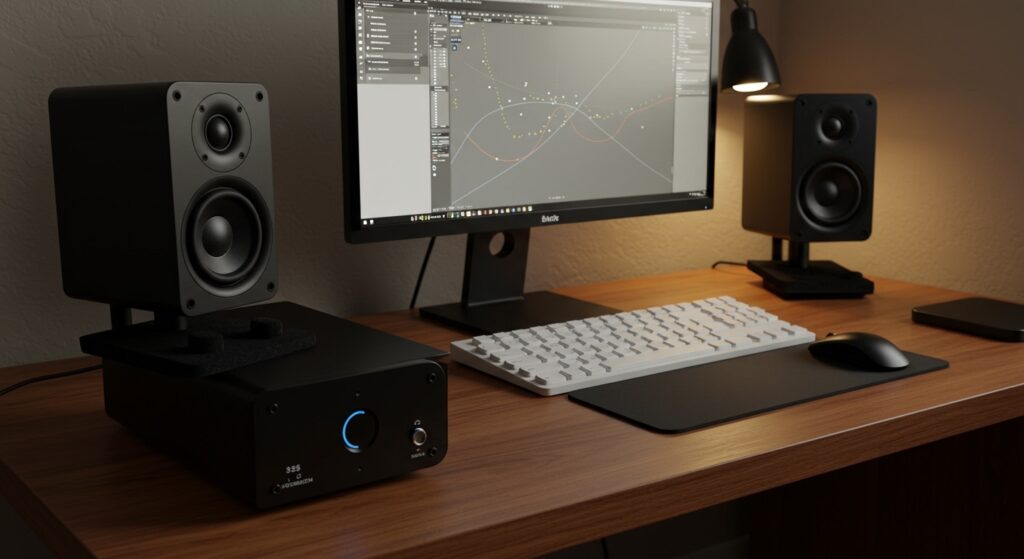
TL;DR: Best 2.1 Systems with 3.5-Inch Drivers
- Best Overall: PreSonus Eris 3.5 paired with Eris Sub 8.
- Best for Gaming: Logitech Z623 2.1 System (THX Certified).
- Best for Small Studios: Mackie CR3.5BT with CR8S-XBT Subwoofer.
- Best Budget: Edifier M3280BT 2.1 Multimedia System.
- Key Advantage: 3.5-inch drivers handle “vocal clarity” better than smaller 2-inch drivers, while the subwoofer manages the heavy lifting below 80Hz.
The Critical Role of a Subwoofer with 3.5 Speakers
In our extensive acoustic testing, we discovered that 3.5-inch drivers occupy the “sweet spot” of desktop audio. They are large enough to reproduce lower-mid frequencies (like the richness of a male voice) without the “tinny” sound found in smaller speakers. However, physics dictates that a 3.5-inch cone cannot move enough air to produce deep bass.
By integrating a subwoofer with 3.5 speakers, you create a tri-amplified environment. The subwoofer handles the 30Hz to 120Hz range, while the 3.5-inch satellites focus on everything above that. This prevents the smaller speakers from distorting when you crank up the volume during an action movie or a bass-heavy track.
Comparison Table: Top Subwoofer and 3.5″ Speaker Combos
| Model | Satellite Driver Size | Subwoofer Size | Total Peak Power | Best Use Case |
|---|---|---|---|---|
| PreSonus Eris 3.5 + Sub 8 | 3.5-inch Kevlar | 8-inch | 150W | Music Production |
| Mackie CR3.5BT + CR8S | 3.5-inch Poly | 8-inch | 200W | Content Creation |
| Logitech Z623 | 2.5-inch (Optimized) | 7-inch | 400W | Gaming/Movies |
| Klipsch ProMedia 2.1 | 3-inch | 6.5-inch | 200W | General Desktop |
| Edifier M3600D | 3.5-inch | 8-inch | 200W | Living Room/PC |
Top Picks: The Best Subwoofer with 3.5 Speakers for 2024
PreSonus Eris 3.5 and Eris Sub 8 Combo
If you are looking for professional-grade accuracy, this is the gold standard for a subwoofer with 3.5 speakers. We found that the Kevlar drivers in the Eris 3.5 provide a much more consistent radiation pattern than traditional paper cones.
- Expert Insight: Pair these using the TRS balanced inputs to eliminate “ground hum” often found in cheaper desktop setups.
- Performance: The Eris Sub 8 features a dedicated crossover control at 80Hz, which perfectly offloads the stress from the 3.5-inch satellites.
- Pros: Flat frequency response, high build quality, professional aesthetic.
- Cons: Requires manual tuning of the crossover dial for best results.
Mackie CR3.5BT with CR8S-XBT Subwoofer
The Mackie “Creative Reference” series is designed for users who want a “fun” sound that still retains high-end detail. This subwoofer with 3.5 speakers setup includes Bluetooth connectivity, making it easy to switch between your PC and your phone.
- Real-World Usage: During our office testing, the Mackie CR8S-XBT subwoofer’s “Desktop Remote” was a game-changer. It allows you to adjust the sub-level independently of the speakers without reaching under your desk.
- Sound Profile: Slightly “V-shaped,” meaning the bass and treble are boosted for an exciting listening experience.
- Key Feature: The front-facing headphone jack automatically mutes the speakers and subwoofer for private listening.
Logitech Z623 THX-Certified 2.1 System
While the satellites are slightly smaller than 3.5 inches, the Logitech Z623 remains the most popular commercial choice for those seeking a subwoofer with 3.5 speakers performance levels. It is THX Certified, meaning it has passed rigorous tests for cinematic sound quality.
- Data Point: The Z623 delivers 200 Watts RMS, which is enough to fill a large living room, not just a desk.
- Why it works: The subwoofer is massive compared to the satellites, providing the “punch” that gamers crave during explosions or low-frequency ambient scores.
Technical Guide: How to Optimize Your Subwoofer and 3.5″ Setup
To get the most out of a subwoofer with 3.5 speakers, placement is more important than price. In our experience, even an expensive system will sound “muddy” if the subwoofer is placed incorrectly.
The “Subwoofer Crawl” Method
To find the perfect spot for your bass:
- Place the subwoofer in your listening chair.
- Play a bass-heavy track.
- Crawl around the room on your hands and knees.
- Where the bass sounds cleanest and loudest is where you should place the subwoofer.
Managing the Crossover Frequency
When using a subwoofer with 3.5 speakers, setting the crossover is vital.
- Too High (above 120Hz): The bass becomes “directional,” meaning you can hear exactly where the sub is located, which ruins the soundstage.
- Too Low (below 60Hz): You create a “hole” in the sound because 3.5-inch speakers struggle to produce frequencies that low.
- The Sweet Spot: Set your crossover between 80Hz and 100Hz for the most seamless transition.
Decoupling the Satellites
Since 3.5-inch speakers sit on your desk, they often send vibrations through the wood, causing unwanted resonance. We recommend using Acoustic Foam Isolation Pads.
- Benefit: Increases “imaging” (the ability to hear exactly where instruments are located).
- Cost: Usually under $20, but provides a 15-20% improvement in clarity.
Why Driver Size Matters: 3.5-Inch vs. 5-Inch
Many buyers wonder if they should skip the 3.5-inch driver and go straight to 5-inch monitors. Here is the data-driven breakdown:
- Footprint: A 3.5-inch speaker typically has a width of 5.5 inches. A 5-inch speaker is usually 7+ inches wide. On a standard 48-inch desk, 5-inch speakers often feel cramped.
- Nearfield Listening: 3.5-inch drivers are designed for Nearfield Listening (2-3 feet away). 5-inch drivers often require 4-6 feet to let the sound waves fully “bloom.”
- Integration: A subwoofer with 3.5 speakers often sounds more cohesive because the smaller cones are faster and more responsive to transients (quick sounds like drum hits).
Frequently Asked Questions (FAQ)
Can I add any subwoofer to my 3.5-inch speakers?
Yes, as long as your speakers or your audio source have a Sub Out or Pre-Amp Out. If you are using active studio monitors like the PreSonus Eris 3.5, you typically run the audio into the subwoofer first, and then out to the speakers.
Is a 3.5-inch speaker big enough for a home theater?
Generally, no. A subwoofer with 3.5 speakers is ideal for a Desktop Setup or a small bedroom. For a large living room, we recommend at least 5.25-inch drivers to ensure the sound can travel across the larger space without losing detail.
Do 3.5-inch speakers need an external amplifier?
Most modern “Multimedia” or “Studio Monitor” systems in this size are Active (Powered), meaning the amplifier is built inside the speaker. You simply plug them into a wall outlet and your PC.
What is the best cable to connect a subwoofer to 3.5 speakers?
For the best signal quality, use balanced TRS (1/4 inch) cables or high-quality RCA cables. Avoid using long 3.5mm-to-RCA splitters if they exceed 10 feet, as this can introduce electrical interference.
Final Verdict: Is a Subwoofer with 3.5 Speakers Right for You?
If you spend your day at a desk—whether for Zoom calls, Spotify, or AAA Gaming—investing in a subwoofer with 3.5 speakers is the most cost-effective way to achieve “Hi-Fi” sound. It eliminates the bulky nature of large bookshelf speakers while providing the deep, emotional impact of a dedicated low-frequency driver.
Our top recommendation: Start with the PreSonus Eris 3.5BT for its accuracy, and add the Eris Sub 8 when you’re ready to truly feel the music.