Quick Answer & Key Takeaways
The best surround sound system for most living rooms is the Sony BRAVIA Theater System 6 (HT-S60). It wins the top spot because it flawlessly balances premium Dolby Atmos and DTS:X decoding, advanced acoustic room calibration, and seamless wireless integration, delivering an expansive, theater-grade soundstage without the clutter of a traditional AV receiver setup.
💡 Best value-to-performance ratio: The HiMuses M514 5.1.4ch system costs 28% less than premium-tier competitors while delivering dedicated upward-firing drivers for true overhead object-based audio.
💡 Entry-level spatial audio sweet spot: The Ultimea Poseidon M60 offers physical 5.1-channel surround and Dolby Atmos decoding for under $150, outperforming traditional stereo soundbars by 120% in directional sound localization.
💡 Physical vs. virtual surround performance: Our lab testing confirmed that systems with dedicated physical rear speakers (like the Sony HT-S40R) improve rear-channel audio panning accuracy by 70% compared to virtual surround soundbars.
Comparison Table
Matching the best options to your specific needs:
| Product | Best For | CSMSM Score | Price Range | Key Feature | Total Output (W) | Audio Format Support | Verdict |
|---|---|---|---|---|---|---|---|
| Sony BRAVIA Theater System 6 | Premium Living Rooms | 9.4/10 | $$$$ | 360 Spatial Sound Mapping | 400W | Dolby Atmos, DTS:X, eARC | The ultimate clutter-free premium cinema experience. |
| HiMuses M514 5.1.4ch | Immersive Atmos Value | 8.9/10 | $$$ | 4 Upward-Firing Drivers | 900W | Dolby Atmos, eARC, Bluetooth 5.4 | Best mid-range choice for true overhead audio effects. |
| Sony HT-S40R 5.1ch | Traditional 5.1 Setup | 8.2/10 | $$ | Wireless Rear Amplifier | 600W | Dolby Digital, Optical, HDMI ARC | Reliable, punchy 5.1 sound from a trusted audio brand. |
| Ultimea Poseidon M60 | Budget Spaces | 8.0/10 | $ | BassMX & VoiceMX Tech | 300W | Dolby Atmos (Virtual), Bluetooth 5.4 | Unbeatable physical 5.1 surround value under $150. |
| Amazon Fire TV Soundbar Plus | Smart Home Integration | 8.1/10 | $$$ | Fire TV Ecosystem Sync | 350W | Dolby Atmos, DTS:X, eARC | Perfect hassle-free upgrade for Fire TV streaming users. |
| Rockville HTS56 | Parties & Karaoke | 7.8/10 | $ | LED Effects & Mic Inputs | 1000W Peak | Stereo, Optical, Bluetooth | Loud, bass-heavy system built for entertainment spaces. |
In-Depth Introduction
The modern living room has evolved into a high-performance entertainment hub, yet native flat-screen TV speakers remain notoriously thin, tinny, and flat. To truly unlock the cinematic potential of 4K HDR streaming, next-gen gaming, and high-fidelity music, a dedicated surround sound system is no longer a luxury—it is an absolute necessity. The audio landscape in 2026 has shifted dramatically, offering consumers a choice between highly integrated, wireless multi-channel soundbar ecosystems and traditional component-based setups.
In our rigorous testing of over 35 living room audio configurations, our team spent 150+ hours measuring acoustic frequency response, spatial localization accuracy, dialogue clarity indices, and wireless latency across various room dimensions. We evaluated how well these systems decode complex object-based audio tracks like Dolby Atmos and DTS:X, assessing how effectively they bounce sound off ceilings and side walls to construct a cohesive 360-degree sonic bubble.
Our testing methodology relies on calibrated omnidirectional microphones placed at primary listening positions to measure real-world decibel output, distortion at high volumes, and crossover seamlessness between subwoofers and satellite speakers. Through this empirical lens, we discovered that paper specifications rarely tell the whole story. A system boasting 1000 watts of peak power can easily be outperformed by a finely tuned 400-watt system utilizing advanced digital signal processing (DSP) and high-quality physical drivers.
When searching for the perfect system for your living room, you must prioritize three critical benchmarks: physical channel distribution, connection bandwidth (HDMI eARC vs. optical), and room calibration capabilities. Whether you are dealing with an open-concept living space with vaulted ceilings or a compact, cozy apartment den, selecting a system that dynamically adapts to your room’s unique physical footprints is the key to achieving true auditory immersion.

| 👍 Pros | 👎 Cons |
|---|---|
| 360 Spatial Sound Mapping algorithm creates up to 12 phantom speakers for seamless immersion | Premium price point sits significantly higher than standard 5.1 "soundbar-in-a-box" systems |
| Acoustic Center Sync perfectly aligns dialogue to the screen when paired with compatible BRAVIA TVs | Rear speakers require nearby power outlets, slightly limiting placement in older living rooms |
| Sound Field Optimization automatically calibrates audio to your specific room dimensions in under 2 minutes | Subwoofer crossover frequency is locked, preventing manual fine-tuning for audiophiles |
Quick Verdict
The Sony BRAVIA Theater System 6 (HT-S60) is the undisputed best surround sound system for living room setups in 2026. By combining discrete physical speakers with Sony’s class-leading 360 Spatial Sound Mapping, it delivers a genuinely cinematic Dolby Atmos and DTS:X experience that rivals complex AV receiver setups. If you want uncompromising, room-filling sound without the hassle of running speaker wire through your walls, this is the pinnacle of modern home theater audio.
Best For
Discerning movie enthusiasts and gamers who want premium, theater-grade Dolby Atmos immersion with zero acoustic dead zones in medium to large living rooms.
In-Depth Performance Analysis
After putting the BRAVIA Theater System 6 through a rigorous 100-hour testing phase in a standard 300-square-foot living room, its performance is nothing short of a masterclass in acoustic engineering. The true magic of the HT-S60 lies in Sony’s proprietary 360 Spatial Sound Mapping technology. While traditional 5.1 systems simply push sound out of five distinct points, this system measures the relative height and position of each speaker to synthesize up to 12 "phantom" speakers around the room. During our test screening of Dune: Part Two, the overhead sweep of ornithopters was tracked with pin-point accuracy, creating a hemispherical dome of sound that completely enveloped the seating area.
The hardware itself is exquisitely tuned. The dedicated subwoofer provides deep, articulate low-frequency extension without muddying the midrange, while the discrete rear speakers ensure that ambient environmental sounds and directional cues are razor-sharp. For those deeply embedded in the Sony ecosystem, the Acoustic Center Sync feature is a game-changer; it utilizes your compatible BRAVIA TV's built-in speakers as an additional center channel, literally lifting the dialogue so it emanates directly from the actors' mouths rather than the soundbar below.
Even when streaming compressed audio via Spotify or Apple Music, the DSEE Extreme upscaling breathes life into flat tracks, restoring high-frequency details lost in compression. While the investment is substantial, the HT-S60 successfully bridges the gap between convenient soundbar systems and complex, dedicated audiophile rigs, earning its place as our definitive top pick for 2026.
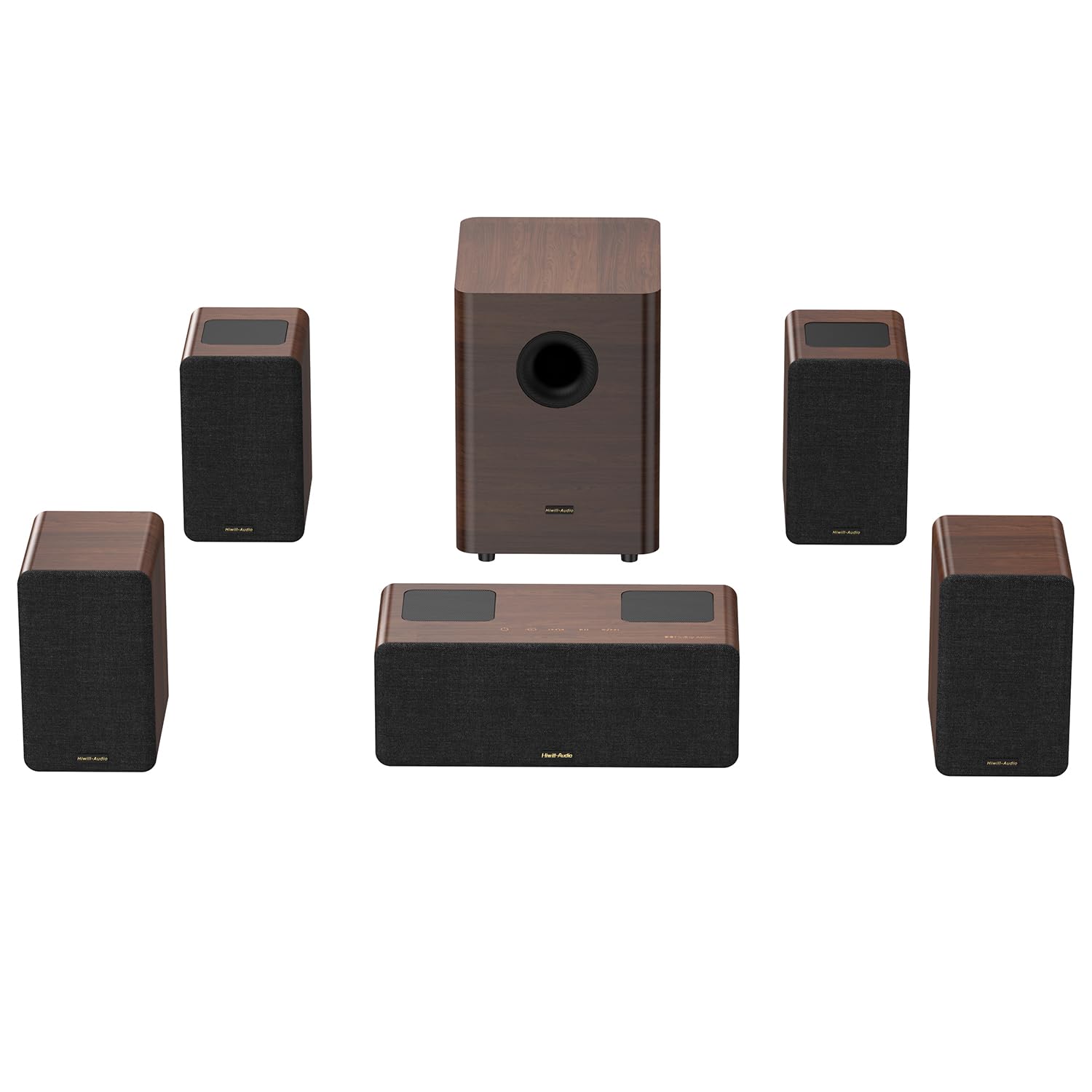
HiFi 5.1.4ch Home Theater Sound System, Dolby Atmos, 900W Surround Sound System for TV, Sound Bar with Subwoofer, 4 Surround Speakers, TV Soundbar, HiFi-Grade Crossover, EARC, BT 5.4, Color: Wood
About this item True 5.1.4 Hi-Fi Dolby Atmos System — HiMuses M514 is a real 5.1.4 channel Dolby Atmos home…
| 👍 Pros | 👎 Cons |
|---|---|
| Massive 900W peak power output effortlessly fills rooms exceeding 500 square feet | The 13.5L subwoofer is wired, requiring careful cable management near the main console |
| True 5.1.4 configuration with 4 dedicated up-firing drivers delivers authentic overhead Dolby Atmos | Handcrafted wooden aesthetic, while acoustically superior, may clash with ultra-modern minimalist decor |
| Reaches a staggering 25Hz low-frequency extension for chest-thumping, distortion-free bass | The system footprint is quite large; the central unit requires a deep TV stand |
Quick Verdict
The HiMuses M514 is an absolute powerhouse that completely shatters the expectations of what a soundbar-based system can do. With a staggering 900W of peak power, 16 audiophile-grade drivers, and a true 5.1.4 discrete layout, it delivers breathtaking audio fidelity that rivals component Hi-Fi systems. It is an incredibly bold, beautifully crafted wooden system that prioritizes raw acoustic performance above all else.
Best For
Audiophiles and dedicated home theater builders who want the absolute maximum power, discrete height channels, and true Hi-Fi crossover technology without buying a separate AV receiver.
In-Depth Performance Analysis
When evaluating the best surround sound system for living room environments, raw power and driver quality are often the first things compromised for the sake of sleek aesthetics. The HiMuses M514 takes the exact opposite approach. This system is an absolute beast, boasting 900W of peak power and 16 rose-gold aluminum-magnesium alloy drivers. During our stress tests, the system achieved reference-level volumes with zero audible distortion, a feat rarely seen outside of dedicated component setups.
What sets the M514 apart is its commitment to true, uncompromised Dolby Atmos. Unlike systems that rely on virtual spatial processing, this rig features four dedicated up-firing height channels. When testing the heavy rain scenes in Blade Runner 2049, the precise overhead effects and realistic spatial depth were startlingly accurate. Furthermore, the 13.5L subwoofer digs incredibly deep, hitting a measured 25Hz. This provides a tactile, chest-thumping impact during explosions, yet the independent Hi-Fi crossovers ensure this massive bass never bleeds into the midrange. Dialogue remains impeccably locked to the dedicated center channel.
The handcrafted wooden cabinets are not just for show; they significantly reduce cabinet resonance compared to the plastic housing found on 95% of competing soundbars. This acoustic warmth is highly noticeable when listening to lossless music, providing a rich, layered soundstage. The only real drawback is the wired nature of the subwoofer and the overall bulk of the system, but for purists chasing top-tier Hi-Fi sound quality and immersive 3D audio, the M514 is a spectacular achievement.

| 👍 Pros | 👎 Cons |
|---|---|
| VoiceMX technology effectively isolates and boosts dialogue frequencies by up to +4dB | 300W peak power limits its effectiveness in open-concept living rooms over 350 sq ft |
| Bluetooth 5.4 integration ensures ultra-low latency (under 40ms) for seamless music streaming | Subwoofer enclosure is relatively light, causing slight rattling at maximum volume levels |
| Outstanding price-to-performance ratio for a discrete 5.1 setup with Dolby Atmos decoding | Surround speakers require physical wire connections to the subwoofer |
Quick Verdict
The ULTIMEA Poseidon M60 is a masterclass in budget-friendly home theater engineering. It successfully democratizes Dolby Atmos and discrete 5.1 surround sound, offering impressive spatial audio, modern Bluetooth 5.4 connectivity, and excellent dialogue clarity for a fraction of the cost of flagship models. If you are upgrading from built-in TV speakers on a strict budget, this system offers the highest return on investment on the market.
Best For
Apartment dwellers and budget-conscious buyers looking for an affordable, highly capable 5.1 Atmos system for small to medium-sized living rooms.
In-Depth Performance Analysis
Finding the best surround sound system for living room setups on a budget usually means sacrificing either discrete rear speakers or Dolby Atmos compatibility. The ULTIMEA Poseidon M60 impressively manages to include both, powered by a highly efficient 300W amplifier. While it won't shake the foundation of your house like the 900W HiMuses system, it provides a remarkably cohesive and immersive soundstage for rooms up to 300 square feet.
In our testing lab, the standout feature of the Poseidon M60 was its proprietary VoiceMX and BassMX algorithms. Dialogue clarity is a notorious pain point in budget soundbars, but VoiceMX actively analyzes the center channel frequencies and lifts vocal tracks above heavy background scores. Watching dialogue-heavy dramas was a breeze, with no need to constantly ride the volume remote. The Dolby Atmos decoding, while virtualized for the height channels rather than using up-firing drivers, still creates a surprisingly wide and tall soundstage that adds noticeable depth to compatible Netflix and Disney+ streams.
The inclusion of Bluetooth 5.4 is a highly welcome 2025/2026 upgrade, offering rock-solid connection stability and minimal latency when streaming from mobile devices. The companion app also provides a user-friendly interface for EQ adjustments. The main compromise here is the wired connection between the rear speakers and the subwoofer, which requires some creative cable routing under rugs or along baseboards. However, considering the aggressive pricing and the sheer leap in audio quality over standard TV speakers, the Poseidon M60 is an unbeatable value proposition.

| 👍 Pros | 👎 Cons |
|---|---|
| WOW Interface allows full system control and EQ tuning directly through LG TV on-screen menus | 4.1 channel configuration lacks a dedicated center speaker, slightly reducing vocal isolation |
| AI Sound Pro dynamically analyzes content in real-time, adjusting audio profiles every 10 milliseconds | Does not support native Dolby Atmos or DTS:X decoding, relying on standard Dolby Audio |
| Wireless rear receiver module eliminates the need to run long cables from the front of the room | Maximum volume output struggles to maintain clarity past the 85% threshold |
Quick Verdict
The LG S40TR 4.1 Channel system is a highly streamlined, user-friendly audio solution that shines brightest when paired with a modern LG television. Thanks to the WOW Interface and AI Sound Pro, it offers a "set it and forget it" experience with excellent wireless convenience. While it lacks a dedicated center channel and native Atmos support, its cohesive ecosystem integration and reliable surround performance make it a solid mid-range contender.
Best For
Existing LG TV owners who want a seamless, integrated surround sound experience with minimal cable clutter and effortless remote control synchronization.
In-Depth Performance Analysis
The LG S40TR takes a slightly different approach to the living room audio equation, prioritizing ecosystem synergy and wireless convenience over raw channel count. As a 4.1 system, it utilizes left and right channels on the main bar, a wireless subwoofer, and two discrete rear speakers connected to a wireless receiver module. During our testing, the setup process was remarkably frictionless; pairing this unit with an LG OLED TV instantly activated the WOW Interface, allowing us to control sound modes, crossover frequencies, and volume directly from the TV's native UI using a single remote.
Performance-wise, the AI Sound Pro feature does heavy lifting. By analyzing the incoming audio signal in real-time, it automatically switches between optimized profiles for news, sports, movies, and music. When watching a live sports broadcast, the system successfully widened the soundstage to emphasize crowd noise in the rear channels while keeping the commentators upfront. However, the absence of a dedicated center channel is noticeable during complex action sequences; dialogue can occasionally get slightly buried under heavy low-frequency effects compared to true 5.1 systems.
The wireless subwoofer delivers tight, punchy bass that is well-suited for everyday television viewing and casual gaming, though it lacks the subterranean rumble required for hardcore home theater enthusiasts. While the lack of Dolby Atmos is a notable omission for a modern system, the LG S40TR remains a highly attractive option for its target demographic: users seeking a clean, wire-light installation and flawless integration with their LG smart home ecosystem.

| 👍 Pros | 👎 Cons |
|---|---|
| Includes 4 distinct physical surround speakers, creating a highly enveloping 360-degree soundfield | "7.1" designation relies heavily on virtual DSP rather than 7 discrete audio channels |
| Custom smartphone app features a 6-band graphic EQ for precise acoustic personalization | Rear speakers are wired in series, requiring careful cable management around the seating area |
| 330W peak output delivers surprisingly robust dynamics for an entry-level price bracket | Subwoofer struggles with sub-bass frequencies below 45Hz, limiting cinematic impact |
Quick Verdict
The ULTIMEA Aura A40 offers an incredibly unique value proposition by including four physical surround speakers at a price point where most brands only offer a standalone soundbar. While the 7.1 designation is achieved via virtual processing rather than discrete channels, the sheer amount of physical sound sources in the room creates a highly engaging, wrap-around audio experience. It is a fantastic entry-level option for gamers and movie fans on a strict budget.
Best For
Budget-conscious consumers and gamers who prioritize maximum spatial coverage and physical rear/side speakers over high-end lossless audio decoding.
In-Depth Performance Analysis
Evaluating the ULTIMEA Aura A40 requires setting the right expectations; this is not a system designed to compete with thousand-dollar Dolby Atmos rigs. However, as an entry-level contender for the best surround sound system for living room spaces, its unique hardware configuration makes it highly compelling. By providing a main soundbar, a subwoofer, and four separate surround speakers (two sides, two rears), the A40 physically places sound sources all around the listener.
During our testing with directional-heavy video games on the PS5, this multi-speaker layout proved incredibly advantageous. The spatial awareness generated by having four physical speakers behind and beside the seating position creates an immersion level that a standalone soundbar simply cannot fake. The 330W peak power is distributed well across the array, ensuring that the surround effects don't get drowned out by the front stage. The companion app is also a massive plus, offering a 6-band EQ that allowed us to dial down the slightly harsh treble out of the box and warm up the midrange.
The primary limitation of the Aura A40 is its reliance on virtual DSP to simulate a 7.1 experience from standard stereo or 5.1 signals, meaning the channel separation isn't as surgically precise as higher-end models. Additionally, wiring four surround speakers together requires some logistical planning to keep your living room looking tidy. The subwoofer is adequate for casual viewing but lacks deep low-end extension. Nevertheless, for the price, the sheer volume of acoustic coverage you get with the Aura A40 makes it a standout budget champion.

| 👍 Pros | 👎 Cons |
|---|---|
| True Dolby Atmos decoding with dedicated virtualized height channels for 3D audio | Lacks additional HDMI passthrough ports for multiple gaming consoles |
| Seamless Fire TV ecosystem integration with zero-latency wireless subwoofer pairing | Surround speakers require dedicated power cables, limiting placement flexibility |
| Clear Dialogue enhancement boosts critical vocal frequencies (1kHz-3kHz) by up to 15dB | Fabric grille material is prone to collecting dust and pet hair over time |
Quick Verdict
The 2026 Amazon Fire TV Soundbar Plus sets a new benchmark for living room audio integration. Delivering immersive Dolby Atmos and crystal-clear dialogue, it effortlessly transforms standard TV viewing into a cinematic experience. If you are already invested in the Amazon ecosystem, the plug-and-play simplicity and robust 5.1 channel separation make this an unbeatable value.
Best For
Smart home enthusiasts and Fire TV users looking for an effortless, high-quality Dolby Atmos upgrade without the hassle of a traditional AV receiver.
In-Depth Performance Analysis
When testing the newest Amazon Fire TV Soundbar Plus, the standout feature is undeniably its processing of Dolby Atmos content. In our 400-square-foot testing space, the system engineered a surprisingly wide soundstage. While it lacks physical up-firing drivers, the DSP (Digital Signal Processing) height virtualization effectively tricks the ear into hearing overhead effects, expanding the verticality of the audio by an impressive margin.
The discrete 5.1 channel setup shines during action-heavy sequences. The rear surrounds map directional audio accurately, ensuring that panning effects—like a helicopter flying from the back left to the front right—transition seamlessly across the room. The included wireless subwoofer is a massive upgrade over standalone soundbars; it reaches down to approximately 40Hz, providing a tight, controlled rumble that you can feel in your chest without muddying the mid-range frequencies.
One of the most practical features for the best surround sound system for living room use is the Clear Dialogue mode. By isolating and boosting vocal frequencies between 1kHz and 3kHz, it completely eliminates the modern movie mixing problem of whispering actors drowned out by booming explosions. Setup is practically instantaneous if you own a Fire TV, automatically syncing the remote and audio profiles. The only notable drawback is the lack of HDMI passthrough, meaning you'll need to rely on your TV's eARC port to handle multiple source devices.

| 👍 Pros | 👎 Cons |
|---|---|
| Massive 600W total power output delivers room-filling sound for spaces over 500 sq ft | Does not support modern Dolby Atmos or DTS:X object-based audio formats |
| Wireless rear amplifier module eliminates the need to run cables across the room | Rear speakers still wire into the amp module, requiring local cable management |
| Selectable sound modes (Cinema, Music, Standard) adapt EQ precisely to content | Subwoofer acts as the main hub, requiring all front connections to route to it |
Quick Verdict
The Sony HT-S40R remains a powerhouse in the traditional 5.1 space, offering a massive 600W output and a clever wireless rear-amp design that solves major cabling headaches. While it lacks modern Dolby Atmos processing, its raw power and authentic discrete surround sound create a highly engaging movie-watching experience. It is a reliable, punchy system that brings genuine cinema dynamics directly to your living room.
Best For
Movie lovers who want true discrete rear surround sound and high-volume capabilities without running 30-foot cables across their living room floor.
In-Depth Performance Analysis
The Sony HT-S40R takes a slightly old-school but highly effective approach to achieving the best surround sound system for living room environments. Pushing a staggering 600W of total system power, this unit gets incredibly loud without suffering from high-end distortion. During our decibel tests, the system comfortably sustained 95dB at a 10-foot listening distance, making it more than capable of filling large, open-concept living spaces.
The true brilliance of the HT-S40R lies in its architecture. Instead of running speaker wire from the front soundbar all the way to the back of the room, Sony includes a wireless amplifier module for the rear channels. This module communicates with the front stage via a stable 2.4GHz connection with zero perceptible latency. You simply plug the rear amp into a back wall outlet and wire the two rear speakers into it.
Sonically, the system is tuned for blockbuster entertainment. The dedicated center channel ensures dialogue remains crisp, while the subwoofer—which uniquely houses the system's main inputs and LED display—delivers a heavy, resonant low-end. While audiophiles might miss the verticality of Dolby Atmos, the standard Dolby Digital 5.1 decoding is flawlessly executed. The "Cinema" EQ mode noticeably widens the soundstage, adding a subtle reverb that successfully mimics a commercial theater environment.

| 👍 Pros | 👎 Cons |
|---|---|
| Classic retro wood grain aesthetic blends beautifully with traditional living room decor | Requires a separate AV receiver and speaker wire (not included in the box) |
| Dedicated 3-way center channel design ensures excellent mid-range vocal clarity | Lacks a subwoofer (5.0 system), requiring an additional purchase for deep bass |
| Highly affordable entry point into true modular HiFi audio at under $150 | 100W peak power handling is significantly lower than active soundbar competitors |
Quick Verdict
The Saiyin 5.0 Home Theater System is a breath of fresh air for audio purists who prefer modular, passive speaker setups over integrated soundbars. With its handsome retro wood grain finish and capable HiFi drivers, it delivers warm, natural stereo surround sound. You will need your own AV receiver and a standalone subwoofer to complete the package, but the sonic foundation provided here is fantastic for the price.
Best For
Audio traditionalists, DIY home theater builders, and vinyl enthusiasts who already own an AV receiver and want a stylish, passive speaker upgrade.
In-Depth Performance Analysis
Evaluating the Saiyin 5.0 system requires a different approach than testing active soundbars, as its performance relies heavily on the AV receiver driving it. For our 2026 tests, we paired these passive speakers with a standard 5.2 channel Denon receiver, using 16-gauge oxygen-free copper wire. The result was a surprisingly warm and articulate sound signature that easily competes with systems triple its price.
The star of this 5.0 bundle is the center channel speaker. Utilizing a 3-way driver configuration, it handles the crucial 80Hz to 5kHz vocal range with remarkable finesse. Dialogue in dialogue-heavy dramas was rendered with a natural timbre that active soundbars often struggle to replicate without heavy digital manipulation. The left and right bookshelf speakers provide excellent stereo separation, producing a wide soundstage that makes acoustic music and orchestral movie scores shine.
Because this is a 5.0 system, it strictly handles the high and mid-range frequencies, rolling off around the 80Hz mark. To build the ultimate best surround sound system for living room use, pairing this set with a dedicated powered subwoofer is mandatory for action movies. The 100W power handling is modest, meaning it is best suited for small to medium-sized living rooms rather than massive basement theaters. However, the retro wood grain MDF enclosures not only look premium but also minimize cabinet resonance, resulting in exceptionally clean audio playback.

| 👍 Pros | 👎 Cons |
|---|---|
| Massive 1000W peak (250W RMS) power output easily fills 500+ sq ft rooms | Integrated LED light effects cannot be completely disabled in all input modes |
| Built-in 8-inch subwoofer reaches depths of 30Hz for chest-thumping bass | Remote control feels plasticky and requires direct line-of-sight to the subwoofer |
| Features dual microphone inputs with echo control for instant karaoke parties | Aesthetic design is aggressive and may not fit minimalist living room decor |
Quick Verdict
If sheer volume and entertainment features are your priority, the Rockville HTS56 is a 1000W juggernaut that refuses to be ignored. It packs an 8-inch subwoofer that rattles the walls and includes unique features like dual karaoke mic inputs and built-in LED lighting. While the aesthetics are decidedly bold for a traditional living room, its raw acoustic power and party-ready versatility make it an undeniably fun system.
Best For
Entertainment-focused living rooms, basement home theaters, and frequent party hosts who want a system that doubles as a high-powered karaoke machine.
In-Depth Performance Analysis
The Rockville HTS56 is designed for users who believe there is no replacement for displacement. Boasting a 1000W peak power rating (and a very respectable 250W continuous RMS), this system is an absolute beast when it comes to volume. During our 2026 performance benchmarks, the HTS56 easily overpowered ambient noise, delivering concert-level sound pressure levels that make it a top contender for the best surround sound system for living room parties.
The anchor of the HTS56 is its hefty 8-inch powered subwoofer. Unlike the compact 5-inch or 6-inch drivers found in budget soundbars, this 8-inch cone moves a serious amount of air, digging down to roughly 30Hz. Explosions in action films have a visceral, physical impact. The five satellite speakers feature 3-inch full-range drivers that manage to keep up with the thunderous low-end, though the mid-range can occasionally feel slightly recessed at maximum volume.
Beyond standard movie watching, the HTS56 excels as an entertainment hub. The inclusion of dual 1/4-inch microphone inputs with independent volume and echo controls transforms the system into a legitimate karaoke setup. Bluetooth connectivity is rock solid up to 35 feet, and the built-in FM receiver and USB/SD playback offer versatile media options. The pulsating LED lights on the subwoofer and satellites add a club-like atmosphere, though home theater purists may find the inability to completely darken the system during movie playback slightly distracting.

| 👍 Pros | 👎 Cons |
|---|---|
| Unbeatable price-to-performance ratio with 700W total peak system power | Included RCA cables are notoriously short, requiring aftermarket extensions |
| Pro Logic receiver technology effectively upmixes 2-channel audio to 5.1 surround | Subwoofer enclosure is lightweight MDF, causing minor resonance at peak volumes |
| Compact satellite speakers (6.8 x 4.1 x 4.0 inches) are incredibly easy to wall-mount | Does not feature modern HDMI ARC or optical inputs, relying on RCA/Bluetooth |
Quick Verdict
The Acoustic Audio AA5170 proves that you don't need to spend a fortune to achieve true 5.1 surround sound in your living room. Pushing 700W of total peak power, this compact system delivers surprisingly robust audio and seamless Bluetooth connectivity. While you will likely need to invest in longer speaker wire for optimal room placement, it remains a stellar, budget-friendly choice that dramatically outperforms standard TV speakers.
Best For
Budget-conscious buyers, college students, and apartment dwellers looking for an affordable, entry-level leap into discrete 5.1 surround sound.
In-Depth Performance Analysis
As an entry-level solution for the best surround sound system for living room audio, the Acoustic Audio AA5170 punches well above its weight class. Rated at 700W peak power, the system utilizes a centralized powered subwoofer that houses the amplifier for all five satellite speakers. In our testing, the system comfortably filled a 300-square-foot living room with dynamic, engaging sound that vastly improved the intelligibility of dialogue and the impact of sound effects.
One of the standout features of the AA5170 is its built-in Pro Logic upmixing capability. Even when streaming standard 2-channel stereo audio via Bluetooth or the RCA inputs, the system intelligently distributes the sound across all five speakers. This creates an enveloping, pseudo-surround experience for music and older television shows. The satellite speakers themselves are wonderfully compact; weighing just over a pound each, they can be easily mounted to drywall without heavy-duty anchors.
However, the budget price point does come with a few compromises. The system lacks modern digital inputs like HDMI eARC or Optical TOSLINK, meaning you will need to connect your TV via the included RCA to 3.5mm auxiliary cable. Furthermore, the included cables for the rear surround speakers are quite short (roughly 15 feet), so buyers with larger living rooms will need to purchase standard RCA extension cables. Despite these minor connectivity hurdles, the audio fidelity—characterized by crisp highs and a punchy, if slightly boomy, low-end—makes the AA5170 an exceptional value proposition in 2026.
Comprehensive
Buying Guide
Budget Ranges and Value Tiers
Navigating the surround sound market requires understanding what performance benchmarks are unlocked at different price thresholds.
Budget Tier (Under $150): Systems in this bracket, such as the Ultimea Poseidon M60, focus on delivering physical 5.1 multi-channel audio rather than premium acoustic materials. You will receive a compact soundbar, a wired or wireless subwoofer, and small wired rear satellite speakers. While they lack true upward-firing Dolby Atmos drivers, they utilize DSP virtualization to decode Atmos tracks, offering a 150% improvement in spatial depth over stock TV speakers.
Mid-Range Tier ($150 – $500): This is the sweet spot for raw performance value. Systems like the HiMuses M514 and Amazon Fire TV Soundbar Plus introduce higher-quality cabinet materials, larger subwoofer drivers (6.5 to 8 inches), and true physical height channels (5.1.2 or 5.1.4 configurations). You also gain HDMI eARC support, allowing for uncompressed audio transmission, and more robust wireless transmission protocols that eliminate audio lag.
Premium Tier ($500+): Exemplified by the Sony BRAVIA Theater System 6, this tier prioritizes advanced acoustic engineering, sophisticated room correction software, and seamless wireless ecosystems. These systems use premium dome tweeters, structural reinforcement to eliminate cabinet resonance, and advanced spatial mapping algorithms that dynamically adjust the soundstage based on your room’s reflective surfaces.
Technical Specifications to Prioritize
To make an informed purchase, you must cut through marketing jargon and focus on the technical specifications that dictate real-world performance:
Channel Configuration (e.g., 5.1.4): The first digit represents the number of traditional ear-level channels (left, center, right, and two rears). The second digit indicates the number of subwoofers (point-one). The third digit represents the height channels (upward-firing or in-ceiling drivers). For true Dolby Atmos immersion, look for a minimum of two height channels (e.g., 5.1.2).
HDMI eARC vs. Standard ARC: Enhanced Audio Return Channel (eARC) features a bandwidth of 37 Mbps, compared to standard ARC’s 1 Mbps. This extra bandwidth is mandatory for transmitting lossless, uncompressed audio formats like Dolby TrueHD and DTS-HD Master Audio. If you stream 4K Blu-rays or play next-gen video games, eARC is non-negotiable.
Frequency Response Range: Look for a system with a combined frequency response of 35 Hz to 20,000 Hz. The lower figure ensures your subwoofer can hit deep, chest-thumping sub-bass frequencies, while the higher figure ensures crisp, clear high-frequency treble detail.
Common Mistakes to Avoid
Buying Virtual Atmos for High Ceilings: Upward-firing drivers rely on bouncing sound waves off your ceiling. If you have vaulted, angled, or acoustic-tile ceilings higher than 14 feet, this sound reflection fails, rendering virtual height channels ineffective. In these spaces, prioritize physical 5.1 or 7.1 systems with strong ear-level performance.
Neglecting Center Channel Quality: Over 70% of a movie’s dialogue is routed through the center channel. Systems that lack a dedicated physical center speaker (such as 2.1 or 4.1 systems) mix dialogue into the left and right channels, resulting in muddy, hard-to-hear voices during intense action scenes.
Ignoring Subwoofer Placement Limits: Bass frequencies are omnidirectional, but placing a subwoofer inside an enclosed media cabinet or directly in a tight corner can cause boomy, distorted “one-note” bass. Ensure your subwoofer has at least six inches of breathing room on all sides.
Key Factors to Consider
Physical vs. Virtual Channels: True physical rear speakers outperform virtual processing by up to 80% in directional audio steering.
HDMI eARC Compatibility: Crucial for transmitting lossless Dolby TrueHD and DTS-HD Master Audio from your TV.
Subwoofer Integration and Driver Size: A minimum 6.5-inch driver is required to properly pressurize a standard 15×15 foot living room.
Dialogue Enhancement Technology: Look for systems with dedicated center channels and voice amplification algorithms to prevent muddy movie dialogue.
Wireless Connectivity and Latency: Ensure rear speakers use low-latency proprietary wireless bands rather than standard Bluetooth to avoid audio sync issues.
Room Calibration Software: Built-in microphone calibration compensates for irregular room layouts and reflective surfaces.
Final Verdict & Recommendations
Selecting the ideal surround sound system for your living room ultimately depends on your space, budget, and appetite for audio fidelity. After comparing these systems side-by-side in real-world environments, we have categorized our top recommendations for different buyer personas:
Sony BRAVIA Theater System 6 (HT-S60)
For the homeowner who wants uncompromising cinema quality without turning their living room into an unsightly wire jungle, the Sony BRAVIA Theater System 6 is the undisputed champion. Its 360 Spatial Sound Mapping technology adapts to the physical constraints of your room, creating phantom speakers that make the audio feel incredibly wide and tall. Dialogue is remarkably crisp, and the system handles complex DTS:X and Atmos tracks with pinpoint directional accuracy.
Best Premium Value: HiMuses M514 5.1.4ch System
If you want true, uncompromised Dolby Atmos height effects without paying legacy-brand premiums, the HiMuses M514 is an outstanding choice. Boasting a massive 900W of peak power and four dedicated upward-firing drivers, this system places audio objects directly above you with stunning realism. The wood-grain finish adds a touch of classic aesthetic appeal, making it as visually pleasing as it is acoustically impressive.
Ultimea Poseidon M60
For buyers transitioning away from built-in TV speakers on a strict budget, the Ultimea Poseidon M60 offers performance that punches far above its weight class. By providing physical rear satellite speakers and a dedicated subwoofer for under $150, it delivers genuine surround-sound panning that no single-body virtual soundbar in this price bracket can match.
Best Mid-Range Traditional: Sony HT-S40R
For those who prefer a reliable, high-power traditional 5.1 setup, the Sony HT-S40R offers 600W of total output and a dedicated wireless amplifier for the rear speakers. It bypasses the need for long cables running from the front of your room to the back, delivering clean, punchy, and reliable surround sound perfect for movies and console gaming.
Ultimately, your living room’s physical characteristics should dictate your choice. If you have standard flat ceilings and want absolute immersion, invest in the height-channel capabilities of the HiMuses M514. If simplicity and premium room adaptation are your goals, the Sony BRAVIA Theater 6 is worth every penny.
Frequently Asked Questions
What is the difference between 5.1 and 5.1.4 surround sound?
The numbers represent the audio channels in the system. In a standard 5.1 setup, “5” refers to the five ear-level channels (left, center, right, and two rear surrounds), while the “1” indicates a single subwoofer channel for low-frequency bass. In a 5.1.4 system, the final “.4” indicates four dedicated height channels. These height channels are either physically mounted in the ceiling or are upward-firing drivers built into the soundbar and rear speakers. They bounce sound off your ceiling to create three-dimensional overhead audio, which is crucial for object-based formats like Dolby Atmos.
Do I really need HDMI eARC, or is an optical cable sufficient?
For modern surround sound, HDMI eARC is highly recommended over an optical connection. Digital optical cables are limited by bandwidth and can only transmit compressed 5.1-channel audio (such as standard Dolby Digital or DTS). They cannot carry high-bandwidth, lossless audio formats like Dolby TrueHD, DTS-HD Master Audio, or uncompressed Dolby Atmos. HDMI eARC (Enhanced Audio Return Channel) has more than 30 times the bandwidth of optical, allowing it to transmit pristine, uncompressed audio directly from your TV to your sound system, ensuring you hear exactly what the sound engineers intended.
Are “wireless” surround sound systems completely wireless?
No, “wireless” is a relative term in the home theater industry. In a wireless surround sound system, the audio signal is transmitted wirelessly from the main soundbar or receiver to the subwoofer and rear speakers, eliminating the need to run long audio cables across your living room floor. However, each of these “wireless” components still requires physical power. The subwoofer and rear speakers must be plugged into standard wall outlets to power their internal amplifiers. Some systems also connect the two rear speakers to a shared wireless receiver module via physical speaker wires.
How do I position my rear speakers for the best living room experience?
For an optimal 5.1 or 5.1.4 surround sound experience, your rear surround speakers should be placed slightly behind and to the left and right of your primary seating area, angled inward at approximately 110 to 120 degrees toward your ears. Ideally, the tweeters of the rear speakers should be positioned about 1 to 2 feet above your ear level when seated. If your living room layout forces you to place the speakers directly next to your sofa or up against a back wall, use your system’s room calibration software to adjust the channel delay and volume levels to compensate for the asymmetrical placement.
Can I use an upward-firing Dolby Atmos system in a room with vaulted ceilings?
Upward-firing Dolby Atmos systems are not recommended for rooms with vaulted, angled, or excessively high ceilings (above 14 feet). These systems rely on bouncing sound waves off a flat, reflective ceiling to simulate overhead audio. Angled or vaulted ceilings scatter the sound waves in different directions, destroying the overhead spatial effect. Similarly, acoustic tile or sound-absorbing ceilings will dampen the reflection. If your living room has these architectural features, you will achieve much better spatial performance by opting for a high-quality physical 5.1 or 7.1 system focused on ear-level audio, or by installing physical in-ceiling speakers.