Quick Answer
The Dayton Audio HTA200 is our top pick for most listeners: a hybrid with a manufacturer-rated 100 watts RMS per channel, a tube preamp for warmth, and RCA, optical, Bluetooth, USB DAC, and phono inputs. Purists should spend up for the Muzishare CR988; analog bargain hunters, the Oldchen EL34.
- Best overall hybrid: Dayton Audio HTA200 — tube preamp plus Class A/B power and a full mixed-source input set
- Best premium pure tube: Muzishare CR988 — Class A KT88 push-pull, hand-wound transformers, balanced XLR
- Best pure-tube value: Oldchen EL34 — point-to-point Class A warmth for high-efficiency speakers
Pros
- Warm, rich sound quality typical of single-ended Class A amplifiers, ideal for jazz, classical, and acoustic music.
- Hand-wired construction with high-quality components suggests durability and sonic purity.
- Versatile speaker connections accept banana plugs, spade connectors, or bare wire for 4Ω and 8Ω speakers.
- Low noise floor ensures quiet operation, even at zero volume.
- Custom transformers and robust power supply contribute to authoritative bass and expansive soundstage.
Cons
- Low power output (10W) may not drive low-sensitivity speakers effectively; requires 88dB or higher efficiency.
- No remote control or digital inputs, limiting convenience for modern setups.
- Tube amplifiers generally require periodic tube replacement and careful handling, which may be new to some users.
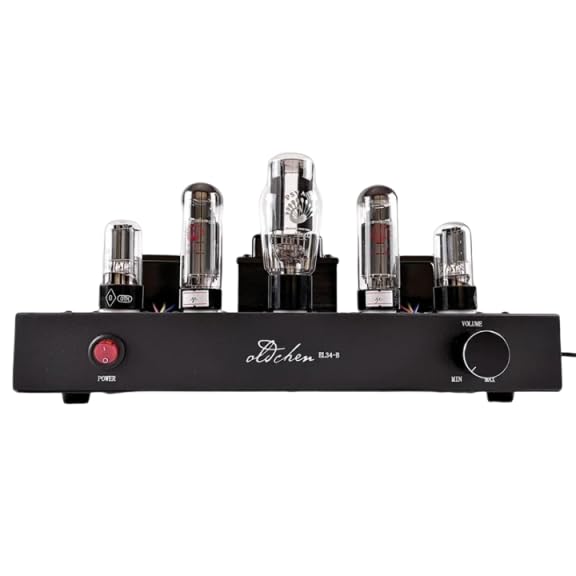
The EL34 Single-Ended Class A Tube Amp is a hand-wired integrated amplifier delivering 10 watts per channel. It targets audio enthusiasts who value the warm, detailed sound of single-ended Class A topology and have speakers with at least 88dB sensitivity. This amplifier suits listeners of jazz, classical, and acoustic music who prioritize tonal richness over sheer volume.
At its core, the amplifier uses a premium tube complement: EL34C power tubes, a 5U4G rectifier, and 6SN7GT preamp tubes. This combination is known for lush vocals and transparent highs. The single-ended design, while less powerful than push-pull, offers a unique harmonic character that many find engaging. The 10W output is sufficient for efficient speakers in moderate-sized rooms, but it is not designed for large venues or very low-sensitivity speakers.
Hand-wired point-to-point circuitry with Teflon silver-plated wiring minimizes signal path interference, contributing to sonic purity. The internal layout is described as immaculate, reflecting careful assembly. Components include a custom-wound output transformer using Japanese Z11 silicon steel, a Japan ALPS potentiometer for smooth volume control, and Black Gold series capacitors. A robust CLC inductor filter (5 Henry) ensures an ultra-clean power supply, resulting in a virtually silent background with a noise floor of just 0.5-1mV.
While the build quality and components are impressive, the amplifier has limitations. Its low power output means it cannot drive inefficient speakers, and users must ensure their speakers are at least 88dB sensitive. Additionally, there are no digital inputs or remote control, so it will require a separate source and manual volume adjustment. Tube amplifiers also need periodic tube replacement, which adds to long-term maintenance costs.
In conclusion, the EL34 Single-Ended Class A Tube Amp is a compelling choice for audiophiles who prioritize sound quality and are willing to work within its power constraints. Its strongest selling point is the authentic single-ended Class A sound, delivered with high-quality components. The main reason to hesitate is the low power output, which may not satisfy users with inefficient speakers or large listening spaces. Those needing more power or modern conveniences might consider push-pull tube amps or solid-state alternatives.
Single-Ended Class A Topology: This amplifier operates in pure Class A, meaning the output tubes conduct continuously, delivering a smooth, warm sound with low distortion. It is ideal for listeners who appreciate the natural, detailed reproduction of vocals and acoustic instruments, though it generates more heat and is less efficient than other classes.
Hand-Wired Point-to-Point Circuitry: The amplifier uses hand-wired, point-to-point wiring instead of printed circuit boards. This traditional method reduces signal path interference and enhances sonic purity. It also makes repairs easier, as each connection is individually accessible.
Premium Tube Complement: The EL34C power tubes, 5U4G rectifier, and 6SN7GT preamp tubes are selected for their sonic characteristics and reliability. EL34 tubes are known for their rich midrange and smooth highs, making this amplifier particularly suited to genres like jazz and classical.
Custom Output Transformer with Japanese Z11 Silicon Steel: The output transformer is a critical component in tube amps, and this one uses high-quality Japanese Z11 silicon steel, which is known for excellent magnetic properties. This results in better frequency response and a more authoritative bass, contributing to an expansive soundstage.
Ultra-Clean Power Supply with CLC Inductor Filter: The power supply uses a 5 Henry choke input filter to smooth out voltage ripples, resulting in a very low noise floor. This means the amplifier is extremely quiet, with hum only audible when an ear is pressed to the speaker at zero volume. This feature is crucial for critical listening.
Speaker Requirements: This amplifier outputs 10W per channel and is designed to drive speakers with a sensitivity of 88dB or higher. Bookshelf and floor-standing speakers that meet this efficiency will perform well, producing adequate volume in small to medium rooms. Lower-sensitivity speakers will not reach satisfying levels.
Speaker Impedance: The gold-plated speaker terminals support both 4Ω and 8Ω speakers, providing flexibility. They accept banana plugs, spade connectors, or bare wire, so most standard speaker cables will work.
Source Compatibility: The amplifier is an integrated unit, meaning it has a volume control and likely a few inputs, though specifics are not provided. It will accept analog sources such as CD players, turntables with a phono preamp, or streaming devices via RCA inputs. It does not have digital inputs, so a separate DAC is needed for digital sources.
Room Size: With 10W, the amplifier is best suited for small to medium-sized rooms. In larger spaces, it may struggle to fill the room with high volume, especially with less efficient speakers. Users with large listening areas should consider higher-powered amplifiers.
Initial Setup: Unbox the amplifier and place it on a stable, well-ventilated surface. Connect your speakers to the appropriate 4Ω or 8Ω terminals using banana plugs, spade connectors, or bare wire. Connect your audio source via RCA cables. Ensure the volume is turned down before powering on.
Tube Warm-Up: After turning on, allow the tubes to warm up for a few minutes before playing music. This ensures optimal performance and extends tube life.
Ventilation: Tube amplifiers generate significant heat. Keep the amplifier in an open area with at least a few inches of clearance on all sides to prevent overheating. Do not stack items on top of it.
Tube Maintenance: Tubes are consumable and will need replacement after thousands of hours of use. When replacing, use the same tube types specified (EL34C, 5U4G, 6SN7GT) to maintain the amplifier's designed sound and performance. It is advisable to have a professional handle tube replacement if you are not experienced with high-voltage electronics.
Cleaning: Unplug the amplifier before cleaning. Use a soft, dry cloth to wipe the exterior. Avoid using liquids or sprays that could damage the electronics. Periodically check that all connections are secure and free of corrosion.
Pros
- Versatile input options cover analog and digital sources, simplifying system integration
- Included remote control adds convenience for volume and input switching
- High/low gain headphone switch allows pairing with a wide range of headphone impedances
- Compact design fits well in desktop or small shelf setups
- 2-year warranty on device and 1-year on tubes provides some peace of mind
Cons
- No user reviews yet, so real-world performance and reliability are unverified
- USB cable and remote battery not included, requiring extra purchases
- Limited power (50W per channel) may not drive demanding speakers in large rooms
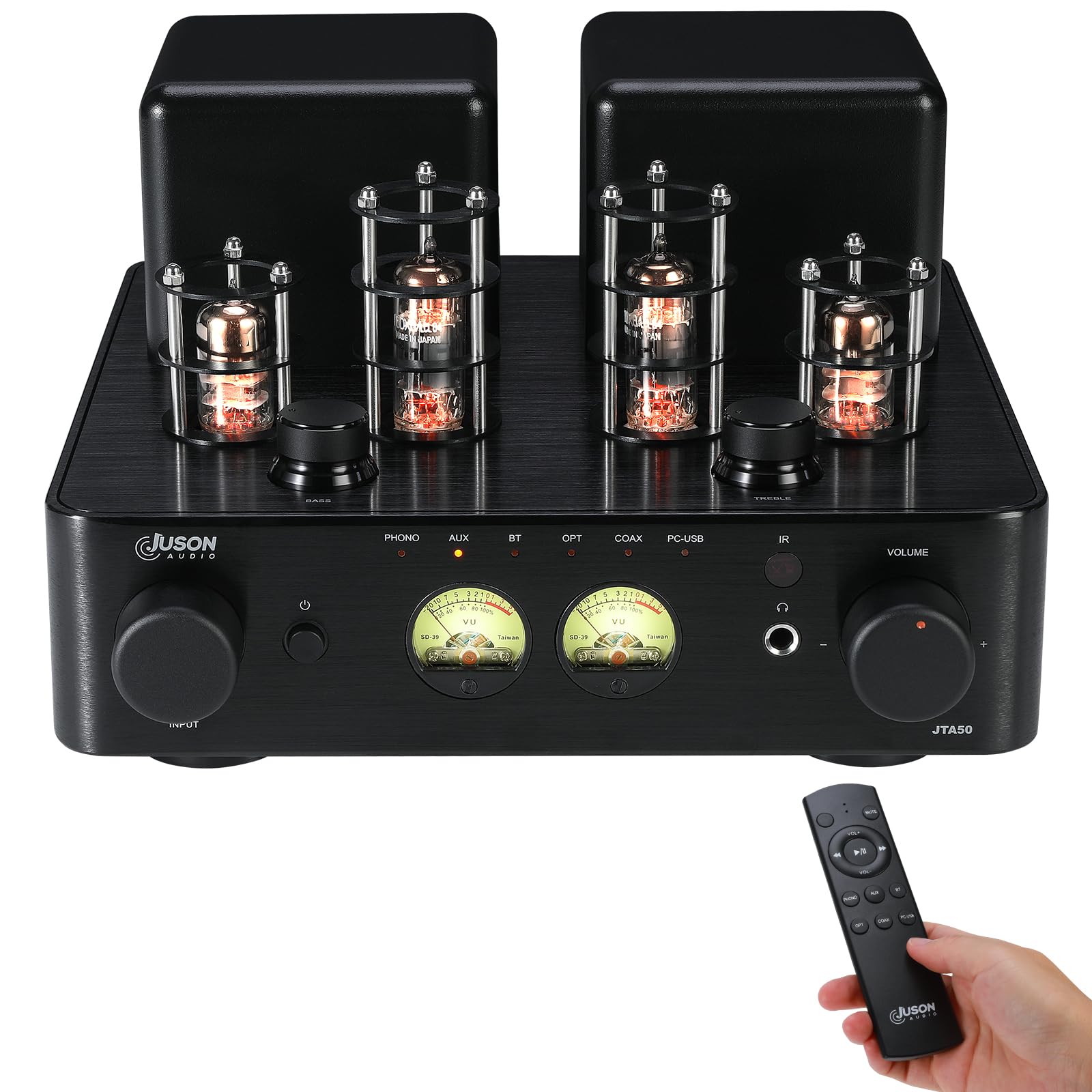
The Juson Audio JTA50 is a 2025 entry-level tube amplifier that aims to be a one-box solution for a budding audiophile's first hi-fi setup. Priced at $249, it offers a remarkable array of features: a built-in phono preamp for turntables, Bluetooth 5.0 for wireless streaming, a headphone amplifier with selectable gain, and multiple digital inputs including USB, coaxial, and optical. This makes it an attractive option for those looking to consolidate a turntable, CD player, and digital devices into a single amp.
The design philosophy centers on flexibility. The phono preamp eliminates the need for a separate component, simplifying vinyl playback. Bluetooth 5.0 provides modern convenience for streaming from phones or computers. The headphone output, with its high/low gain switch, is designed to drive a wide range of headphones from 16 to 600 ohms, making it a versatile choice for headphone enthusiasts. Additionally, a subwoofer output allows for a 2.1-channel setup, enhancing bass response for music or movies.
However, there are notable caveats. The product currently has zero customer reviews, so real-world performance, build quality, and reliability remain unverified. The manufacturer's claims about sound quality and tube characteristics should be taken as promises, not proven facts. Also, the USB cable and remote battery are not included, which are minor but essential accessories. Furthermore, the 50W per channel output may be insufficient for power-hungry speakers or large listening spaces.
In terms of alternatives, buyers might consider a dedicated integrated amplifier with a phono stage if they prioritize analog purity, or a separate headphone amp if headphone use is primary. But for a beginner seeking an all-in-one hub, the JTA50's feature set is compelling.
Our final verdict: The JTA50 is a promising entry-level choice for those who want versatility and are willing to take a chance on a relatively unknown product. Before purchasing, check the speaker impedance and sensitivity to ensure adequate volume, and factor in the cost of missing accessories. If those align, it could be a great starting point.
Strong Match: The JTA50 is ideal for a beginner audiophile building their first hi-fi system on a budget, who wants to connect a turntable, digital sources, and headphones without breaking the bank.
Also Consider It If: You have a small to medium-sized room and efficient speakers (high sensitivity, 8 ohms or higher), and you value the convenience of Bluetooth and a remote. The headphone output also makes it a good fit for someone who wants a shared amp for both speakers and headphones.
Not the Best Fit: If you have power-hungry speakers or a large listening space, the 50W per channel may not deliver satisfying volume. Also, if you are a purist who prefers a dedicated phono stage or discrete components, this all-in-one may not meet your standards.
Decision in One Sentence: The Juson Audio JTA50 is a versatile, feature-rich entry-level tube amp best for beginners seeking a hub for vinyl, digital, and headphones, provided they have efficient speakers and accept the lack of user reviews.
Consider It For:
- Built-in phono preamp lets you connect a turntable directly, saving cost and space.
- Bluetooth 5.0 provides reliable wireless streaming from any Bluetooth-enabled device.
- Headphone amplifier with gain switch accommodates a wide range of headphones, from sensitive IEMs to high-impedance over-ears.
- Multiple digital inputs (USB, coax, optical) offer flexibility for connecting PCs, CD players, and TVs.
- Subwoofer output enables a 2.1 setup for enhanced bass.
Pass If:
- You require proven reliability and user feedback; the absence of reviews is a risk.
- Your speakers are low sensitivity or you need high volume levels; 50W may not suffice.
- You prefer a minimalist setup; the tube amp's size and heat may be a consideration.
- You don't want to purchase extra accessories (USB cable, remote battery) right away.
Phono Preamp: This allows you to connect a turntable with a moving magnet (MM) cartridge directly to the amplifier, eliminating the need for a separate phono stage. It amplifies the low-level signal from the cartridge to line level.
Bluetooth 5.0: The latest Bluetooth version offers improved range and stability, enabling high-quality wireless audio streaming from smartphones, tablets, and computers.
Headphone Amplifier: The dedicated headphone output has a high/low gain switch. Low gain is for sensitive headphones (e.g., 16-32 ohms), while high gain is for high-impedance headphones (up to 600 ohms), ensuring adequate volume and detail.
Digital Inputs: USB, coaxial, and optical inputs allow connection to digital sources like computers, CD players, and TVs. The USB input supports connection to a PC (cable not included); for phones, an OTG cable is required.
Subwoofer Out: This output lets you connect an active subwoofer to create a 2.1-channel system, adding deep bass for music and movies.
Pros
- Rated output of 100 watts RMS per channel provides enough headroom for a normal living room rather than desk-only listening.
- Built-in phono preamp lets a record player connect directly, removing one extra box, one extra power supply and one extra pair of cables.
- Five input types, including RCA, optical, USB DAC, Bluetooth and phono, let multiple sources stay wired at the same time.
- Motorized volume control with the included remote allows level changes from the listening seat while keeping the knob position accurate.
- Brushed aluminum chassis with front panel VU meters and exposed tubes suits buyers who want the amplifier to be visible furniture, not hidden equipment.
Cons
- The tubes sit exposed on the chassis, so the unit needs open clearance above it and a stable location, which is a real consideration in homes with children or pets.
- Only the preamp stage uses tubes while the output section is class A/B, so listeners who specifically want a full tube signal path will not get it here.
- The supplied product information does not list speaker impedance compatibility, chassis dimensions, Bluetooth codec support or the cartridge type the phono input expects, so owners of existing gear should confirm those details before ordering.
The Dayton Audio HTA200 is an integrated stereo hybrid tube amplifier rated at 100 watts RMS per channel, built for listeners who want one component to power passive speakers while a turntable, a computer and a phone stay connected at the same time. It fits vinyl-leaning listeners who also stream. The qualification is that tubes appear only in the preamp stage.
Input flexibility is the practical headline. RCA, optical, USB DAC, Bluetooth and a phono preamp are all on board, so a record player, a laptop and a device with an optical output can remain plugged in and swap over at the press of a button instead of a cable change. For anyone consolidating separate components, that matters financially, since a standalone phono stage and an outboard DAC would otherwise be two more purchases.
The industrial design follows the same logic. Dayton Audio wraps the amplifier in a black brushed aluminum chassis with exposed tubes and analog VU meters across the front, so the unit reads as classic hi-fi rather than a generic black box. The motorized volume knob turns physically when the remote is used, which keeps the pointer honest about the real listening level, a small detail that helps if you judge volume by eye.
The compromises deserve naming. Hybrid construction means the output section is class A/B, so anyone who wants a full tube signal path should shop differently. Exposed tubes also need vertical clearance and a stable shelf. The supplied information does not state speaker impedance compatibility, chassis dimensions, Bluetooth codec support or whether the phono input expects a moving magnet cartridge, so matching this to specific speakers or a specific turntable calls for a quick check first.
The strongest reason to choose the HTA200 is source consolidation backed by usable power, a turntable-ready amplifier with digital and wireless inputs and a rating suited to a real room. The main reason to hesitate is the thin published detail around matching and measurement. Buyers who only need nearfield desktop sound, or who want streaming apps, room correction and surround processing, are better served by a compact desktop amplifier or an AV receiver.
Hybrid Tube and Class A/B Topology: Tubes handle the preamp circuit while a class A/B output section drives the speakers, which is a deliberate split. The tube stage is where the manufacturer places the tonal character, and the solid state output stage is where the current comes from. Listeners who like the softer presentation of tube gear but do not want the power limits of a small tube amplifier are the target here.
100 Watts RMS Per Channel: This rating describes continuous power rather than a peak figure, which is the number that actually predicts behavior at loud passages. In practice it means the amplifier is not restricted to efficient speakers in a small room. Owners of bookshelf speakers with low sensitivity, or anyone filling a larger open living space, benefit most from that reserve.
Built-In Phono Preamplifier: A turntable cartridge produces a signal far too small for a regular line input, so it needs dedicated amplification and equalization. Having that circuit inside the HTA200 means a record player connects directly rather than through a separate phono box. Vinyl listeners assembling a first serious system save a purchase, a power outlet and an extra interconnect.
USB DAC and Optical Inputs: Both accept a digital signal and convert it inside the amplifier instead of relying on the source device. USB suits a computer as the primary music library, while optical suits a device that outputs digital audio over a fiber connection. Anyone unhappy with the analog output of a laptop or a small streamer stands to gain the most.
Bluetooth Connectivity: Wireless pairing covers the casual side of listening, the moment when a guest wants to play something from a phone and nobody wants to hunt for a cable. It is a convenience feature rather than the highest fidelity path in this amplifier, but it keeps the system usable for households where not every listener is an enthusiast.
Motorized Volume Knob With Remote: The physical knob rotates when the remote is used, so the front panel position always matches the electrical setting. This avoids the common annoyance of a knob that no longer tells you anything once the remote takes over. It is most useful in a larger listening room where the seating position is not within arm's reach of the amplifier.
Speakers: This is an integrated amplifier for passive speakers, meaning bookshelf or floorstanding models that have no internal amplification. Powered or active speakers are not the right match, since they already contain their own amplifiers. The listing does not state supported impedance or recommended speaker sensitivity, so anyone pairing it with existing speakers should confirm those figures against the manufacturer specification sheet.
Turntables: The onboard phono preamp means a record player with a standard phono level output can connect directly. What the supplied data does not clarify is whether that stage is designed for moving magnet or moving coil cartridges, and the two are not interchangeable. Buyers with an existing turntable should check the cartridge type before assuming a direct connection will work correctly.
Computers and Digital Sources: The USB DAC input is intended for a computer acting as a music source, which bypasses the internal sound hardware of the laptop or desktop. The optical input covers devices that output audio over a fiber connection, such as a television or a compatible streamer, provided that device has an optical output. Driver requirements and supported sample rates are not listed in the supplied data.
Phones and Tablets: Bluetooth handles mobile devices without a physical connection, which is the simplest path for casual listening or for visitors. Codec support and pairing range are not specified in the product information, so listeners who care about wireless audio quality specifically should treat this as a convenience input rather than the primary listening path.
What to Verify Before Buying: Because the supplied data omits dimensions, weight, output connector type and ventilation requirements, measure your shelf and allow open space above the chassis for the exposed tubes. Anyone planning to place this inside a closed cabinet should confirm clearance and airflow guidance from the manufacturer first, since exposed tube gear is not designed to be boxed in.
Best For: The HTA200 makes the most sense for someone building or upgrading a two channel living room system around passive speakers, with vinyl as a meaningful part of the listening. It also suits a shared household where one person plays records, another connects a laptop and a third wants to pair a phone. The visible tubes and VU meters appeal to buyers who want the equipment to look like part of the room.
Consider Alternatives If: A small desk setup with efficient nearfield speakers does not need this much rated power, and a compact desktop amplifier would take less space. Listeners who want streaming services built in, multiroom control, room correction or surround decoding should look at an AV receiver or a network streaming amplifier instead. Purists who specifically want tubes throughout the signal path will not find that in a hybrid design.
Setup and Daily Use: Expect a conventional integrated amplifier workflow. Speakers connect to the amplifier, sources connect to the matching input type, and the input selector and volume knob handle everything from there. The remote covers volume from the seating position, and the motorized knob follows along so the panel stays accurate. Nothing in the supplied information suggests an app or software setup step is required for the analog inputs.
Maintenance Requirements: Vacuum tubes are consumable components in any tube design and age with use, so plan on eventual replacement as a normal part of ownership. The supplied product information does not state the tube type, expected service life or replacement procedure, so check the manufacturer documentation on those points. Day to day, the exposed tubes and brushed aluminum chassis collect dust and need clearance for heat to escape.
What Sets It Apart: Many amplifiers at this general level choose a lane, either an analog integrated amplifier with a phono stage or a digital amplifier with modern inputs. The HTA200 tries to cover both, adding a tube preamp stage and a visually distinctive chassis on top. That combination is the real differentiator, and it is also the reason to weigh the missing published specifications carefully rather than assuming performance parity with more thoroughly documented gear.
Pros
- All-in-one functionality saves space and simplifies a desktop audio system, ideal for minimalists.
- Multiple input options offer flexibility for various audio sources, perfect for multi-device users.
- Sufficient power for bookshelf speakers, benefiting small to medium rooms or desktop setups.
- VU meter and tube design add visual charm, appealing to retro enthusiasts.
- Remote control with bass and treble adjustments provides convenience for listeners who prefer adjusting from afar.
Cons
- Bundled tubes are shipped randomly (5725W or 6J1) and cannot be specified, which may frustrate users with tube preferences.
- No built-in phono preamp, so turntables with moving magnet cartridges require an external phono stage.
- Limited to 4Ω speaker output rating, so 8Ω speakers may not achieve the same power output, potentially affecting loudness.
The Fosi Audio MC331 is a compact integrated tube amplifier with a built-in DAC, preamplifier, and headphone amplifier, designed for desktop audio setups. It is best suited for listeners who want a versatile all-in-one solution to drive bookshelf speakers while enjoying a retro aesthetic. The strongest reason to consider it is its comprehensive feature set at a reasonable price, but the random tube selection is a notable qualification.
The MC331 offers multiple inputs including Bluetooth, USB, optical, coaxial, and RCA, making it easy to connect various sources like computers, phones, CD players, and turntables (with built-in phono preamps). This flexibility allows you to switch between devices seamlessly, enhancing daily convenience. The amplifier delivers up to 105W per channel at 4Ω, which is ample for most bookshelf speakers, ensuring clear and powerful sound in a small room or on a desk.
Setup is straightforward: place it on your desk, connect your speakers and sources, and use the included remote to adjust bass and treble from your listening position. The replaceable tube design allows you to customize the sound signature, but note that the tubes (5725W or 6J1) are shipped randomly, so you may not get the exact tube you prefer. The unit also includes a pre-out and a 3.5mm headphone output, adding further versatility for headphone listening.
Overall, the MC331 is a compelling choice for desktop audiophiles who value space-saving design and input flexibility. The main trade-off is the random tube selection, which may not satisfy those with specific tube preferences. If you require a dedicated phono input or prefer a traditional separate component setup, you might look elsewhere. However, for a compact, feature-rich amp, it's a strong contender.
Best For: The Fosi Audio MC331 is ideal for desktop audio enthusiasts who want a compact all-in-one amplifier with a retro look and multiple input options.
Why It Fits: It combines a DAC, amplifier, preamp, and headphone amp in one unit, supporting Bluetooth, USB, optical, coaxial, and RCA inputs, making it easy to connect various sources.
Think Twice If: You need a built-in phono preamp for a turntable without one, or if you prefer to choose specific tubes for sound customization, as tubes are shipped randomly.
Bottom Line: If you want a versatile, space-saving tube amp for your desk and can accept the random tube selection, the MC331 offers excellent value.
All-in-One Design: Integrates DAC, preamp, amplifier, and headphone amp, reducing component clutter.
Input Flexibility: Bluetooth, USB, optical, coaxial, and RCA inputs allow connection to a wide range of audio sources.
Power Output: 105W per channel at 4Ω, sufficient for driving bookshelf speakers in small to medium rooms.
User Controls: Remote control for bass and treble adjustment, plus replaceable tubes for sound customization.
Additional Outputs: Pre-out and 3.5mm headphone output enhance versatility.
Speakers: Designed for bookshelf speakers with a nominal impedance of 4Ω; may work with 8Ω speakers but at reduced power.
Sources: Compatible with computers, phones, CD players, and turntables with built-in phono preamps via Bluetooth, USB, coaxial, optical, and RCA inputs.
Headphones: 3.5mm output for headphones, allowing private listening.
Pre-out: Can connect to an external power amplifier or subwoofer for system expansion.
Pros
- Versatile connectivity (Bluetooth, USB, phono) reduces need for extra components.
- Hybrid topology offers tube warmth without the high maintenance of a full tube amp.
- Tone controls allow quick sound customization without external EQ.
- Headphone output enables private listening without turning off speakers.
- Classic VU meters and tube glow enhance the listening experience aesthetically.
Cons
- Dimensions, weight, and clearance for tube ventilation are not specified; verify they fit your space.
- Tube replacement and availability are not documented; ask the manufacturer about lifespan and sourcing.
- No remote control or speaker A/B switching mentioned; check if you need those features.
The Dayton Audio HTA100 Integrated Stereo Hybrid Tube Amplifier is a compact, feature-rich amp designed for audiophiles who want tube warmth without the bulk and heat of a full tube design. It delivers 50 watts RMS per channel, making it suitable for driving most bookshelf and floor-standing speakers in medium-sized rooms. The hybrid topology uses vacuum tubes in the preamp section and a Class A/B amplifier stage, aiming to provide the classic tube character with the reliability and power of solid-state.
In daily use, the HTA100 offers exceptional versatility. Bluetooth 5.0 lets you stream from a phone or tablet, while the USB DAC connects to a computer, and the phono preamp handles a turntable directly. RCA inputs cover other line-level sources. This means you can consolidate your audio setup without needing extra boxes. The front-panel VU meters and exposed tubes add visual appeal, and the bass/treble knobs allow quick tonal adjustments to suit your room or music.
The headphone jack is a practical addition for late-night listening without disturbing others. However, the amplifier's physical footprint is not provided, so you must verify that it fits your shelf or rack. Also, tube amps generate heat; ensure adequate ventilation, but specifics on clearance are missing. Tube replacement is a long-term consideration, but the data does not mention tube type or expected lifespan, so ask the manufacturer.
Customer feedback is not supplied, so we rely on the manufacturer's claims. The description emphasizes beauty and power, but independent reviews are absent. It's important to treat these as claims, not verified facts.
Who should buy? This amp suits someone who wants a single, stylish box to connect a turntable, computer, and phone, and who values tube aesthetics. Who should avoid? If you need a remote control, multiple speaker outputs, or have a very large room, this may not suffice. Before purchase, verify dimensions, weight, tube type, and whether the phono preamp is switchable. Also, confirm that your speakers are compatible with 50W RMS and the amp's impedance rating, which is not specified.
Best Ownership Fit: This amplifier suits a hobbyist or music lover with a medium-sized listening room who wants to connect multiple sources (turntable, phone, computer) without a complex setup. It's ideal for someone who appreciates vintage aesthetics but wants modern convenience.
Daily Workflow: You can stream music via Bluetooth from your phone, play records through the phono input, or use the USB DAC for high-quality audio from your computer. The front-panel tone controls let you adjust bass and treble to your liking. The headphone jack allows private listening. The VU meters provide visual feedback of output levels.
Likely Friction: The lack of specified dimensions and weight means you'll need to measure your space and ensure the amp fits. Also, without tube replacement details, you'll need to plan for eventual maintenance, but the data doesn't indicate how or when.
Before You Buy: Verify the amplifier's dimensions and weight to confirm fit. Check the tube type and availability of replacements. Confirm that your speakers have appropriate impedance and power handling for 50W RMS. Also, check whether the phono preamp is switchable if you plan to use an external phono stage.
Setting up the HTA100 involves connecting your audio sources to the appropriate inputs: RCA for line-level, phono for turntable, USB for computer, and Bluetooth for wireless streaming. Speaker connections use banana jacks or bare wire. Ensure all connections are secure before powering on.
The amplifier includes bass and treble tone knobs for sound adjustment. The front-panel headphone jack automatically may mute speakers? That detail is not specified, so verify with the manufacturer.
Maintenance primarily concerns the vacuum tubes. Tubes can wear out over time, but the expected lifespan and replacement procedure are not provided. Contact Dayton Audio for tube specifications and availability. Also, keep the amplifier in a well-ventilated area to dissipate heat generated by the tubes and Class A/B circuitry. Dust can be removed from the exterior with a soft cloth, but avoid cleaning the tubes while hot.
No other consumables or routine maintenance are mentioned. For detailed instructions, refer to the user manual, which is not supplied here.
Pros
- Tube rolling flexibility: Swap between KT88, EL34, and 6550 tubes (sold separately) to change the amplifier's character without buying a new unit.
- Multiple amplifier functions: Use as an integrated amp with volume control, a pure power amp with an external preamp, or a headphone amp for private listening.
- Triode/ultra-linear selector: Choose between lower power with richer harmonics (triode) or higher power with more headroom (ultra-linear).
- Hand-wired build: Point-to-point wiring often simplifies future repairs and modifications compared to PCB-based designs.
- Remote control included: Adjust volume or switch inputs from your listening position, a convenience not always found in tube amps.
Cons
- Requires a 100-300 hour burn-in period before the sound stabilizes, which may test the patience of new owners.
- Default tubes are KT88; to explore EL34 or 6550, you must purchase additional tube sets separately, adding cost.
- Tube amplifiers generally produce heat and require ventilation; ensure adequate clearance around the unit to avoid overheating.
The Willsenton R8 is a hand-wired integrated tube amplifier designed for audiophiles who value tonal flexibility and classic tube sound. It suits listeners who enjoy experimenting with different output tubes and want a single amplifier that can serve as an integrated amp, power amp, or headphone amp. While it offers impressive versatility, it requires a significant burn-in period and tube rolling involves extra cost.
The standout feature is its compatibility with KT88, EL34, and 6550 tubes, selectable via a rear switch. This allows you to switch between the powerful, detailed KT88, the warmer, mid-focused EL34, or the robust 6550, effectively giving you three amplifiers in one. The triode/ultra-linear switch further refines the sound: triode mode offers lower power with a more intimate, harmonically rich presentation, while ultra-linear provides higher power and greater dynamic range. This flexibility is ideal for matching the amp to different speakers or musical genres.
As an integrated amplifier, it includes a remote control for volume and input selection, and the tube protective covers add safety. The hand-wired, point-to-point construction is a plus for those who value serviceability. The amplifier also functions as a power amplifier, bypassing its preamp section, and as a headphone amplifier, broadening its utility in a desktop setup.
However, the manufacturer recommends a 100-300 hour burn-in period before the sound stabilizes, so initial listening may not represent the final performance. Additionally, while the amp comes with KT88 tubes, exploring the other tube types requires purchasing them separately, which increases the overall investment. Tube amplifiers also generate significant heat and need proper ventilation, so placement is a consideration.
For the audiophile who enjoys tube rolling and wants a versatile amplifier that can adapt to different speakers and listening modes, the Willsenton R8 is a compelling choice. Its main drawback is the time and additional cost required to fully realize its potential. If you prefer a plug-and-play amplifier without tube swapping or a lengthy break-in, a solid-state amp or a simpler tube design might be more suitable.
Tube Compatibility (KT88/EL34/6550): This feature lets you swap between three different output tube types, each with its own sonic signature. By changing tubes, you can alter the amplifier's character from powerful and detailed (KT88) to warm and liquid (EL34) to robust and authoritative (6550), without buying a new amp. This is ideal for audiophiles who enjoy experimenting with different sounds.
Integrated, Power, and Headphone Amplifier Modes: The R8 can operate as an integrated amp with volume control, a power amp with an external preamp, or a headphone amp. This versatility means you can use it in a traditional speaker setup, integrate it into a more complex system, or enjoy private listening without disturbing others. It's perfect for someone with multiple audio needs.
Triode/Ultra-Linear Switching: A front-panel button toggles between triode and ultra-linear operation. Triode mode reduces power output but often yields a more detailed, harmonically rich sound, while ultra-linear increases power and headroom, making it more suitable for less efficient speakers. This allows you to fine-tune the amp's performance to your speakers and listening preferences.
Hand-Wired Point-to-Point Construction: The amplifier is assembled with hand-wired point-to-point soldering, which is often considered more reliable and easier to repair than printed circuit boards. For long-term ownership, this can simplify maintenance and modifications, a key consideration for tube amp enthusiasts who like to tinker.
Remote Control and Protective Covers: The included remote control adds convenience for volume and input adjustments from your listening chair, and the vacuum tube protective covers prevent accidental burns or damage. These features enhance safety and ease of use, particularly in homes with children or pets.
Best For: The Willsenton R8 is best for the audiophile who values tonal flexibility and enjoys the ritual of tube rolling. If you like to tailor your system's sound by swapping tubes and want an amplifier that can adapt to different speakers or listening modes, this amp is a strong candidate. It's also suitable for those who appreciate hand-wired construction and the potential for easy serviceability.
Consider Alternatives If: If you prefer a plug-and-play experience without a lengthy burn-in period or the need to purchase additional tubes, consider a solid-state amplifier or a tube amp that comes with a single tube type. Also, if your speakers are very inefficient, you may need more power than this amp can provide, especially in triode mode.
Setup and Daily Use: Expect to spend time positioning the amplifier with adequate ventilation. After connecting speakers and sources, you'll need to run the amp for 100-300 hours to reach optimal sound quality. The remote control simplifies daily operation, and the triode/ultra-linear switch lets you adjust the sound on the fly.
Maintenance Requirements: Tube amplifiers require periodic tube replacement as tubes wear out. The hand-wired construction makes tube swapping straightforward, but you should handle tubes with care and ensure the amp is off and cool before changing them. The protective covers help prevent accidental damage.
What Sets It Apart: The R8's ability to use three different tube types and its triple-function design (integrated, power, headphone) are uncommon at this price point. This versatility sets it apart from single-tube-type amplifiers and gives you more control over your sound.
Initial Setup: Place the amplifier on a stable, well-ventilated surface with clearance around the tubes for heat dissipation. Connect your speakers to the appropriate impedance taps (if applicable) and your source to the inputs. The unit includes a remote control, tube covers, and a fuse for safety.
Burn-In Period: The manufacturer recommends a 100-300 hour run-in period. During this time, the sound will evolve and stabilize. Be patient; the amplifier's performance after burn-in is likely to be noticeably better. You can leave the amp playing with music or a signal during this period, but ensure it's not left unattended for long stretches.
Tube Rolling: To switch between KT88, EL34, and 6550 tubes, you'll need to purchase additional tubes and use the rear selector switch. Always power off the amp and let it cool before removing or installing tubes. The protective covers help prevent burns, but you should still use caution.
Ongoing Care: Tube amplifiers generate heat, so keep the area dust-free and avoid blocking ventilation. Periodically check that all tubes are seated firmly. Tubes have a finite lifespan; if you notice a loss of volume or a change in sound quality, it may be time to replace them. The hand-wired construction makes this a manageable task.
Pros
- High power output benefits owners of large, power-hungry speakers.
- LDAC Bluetooth offers superior wireless audio for modern phone users.
- Multiple inputs (XLR, CD, optical, coaxial) provide flexible connectivity.
- Active subwoofer output simplifies adding a subwoofer for theater or music.
- Tube protective cover and remote enhance safety and usability.
Cons
- Tube replacement and selection require careful handling and power-off operation.
- Bluetooth antenna must be attached and remote batteries are not included.
- Physical dimensions and weight are not specified; verify fit before purchase.
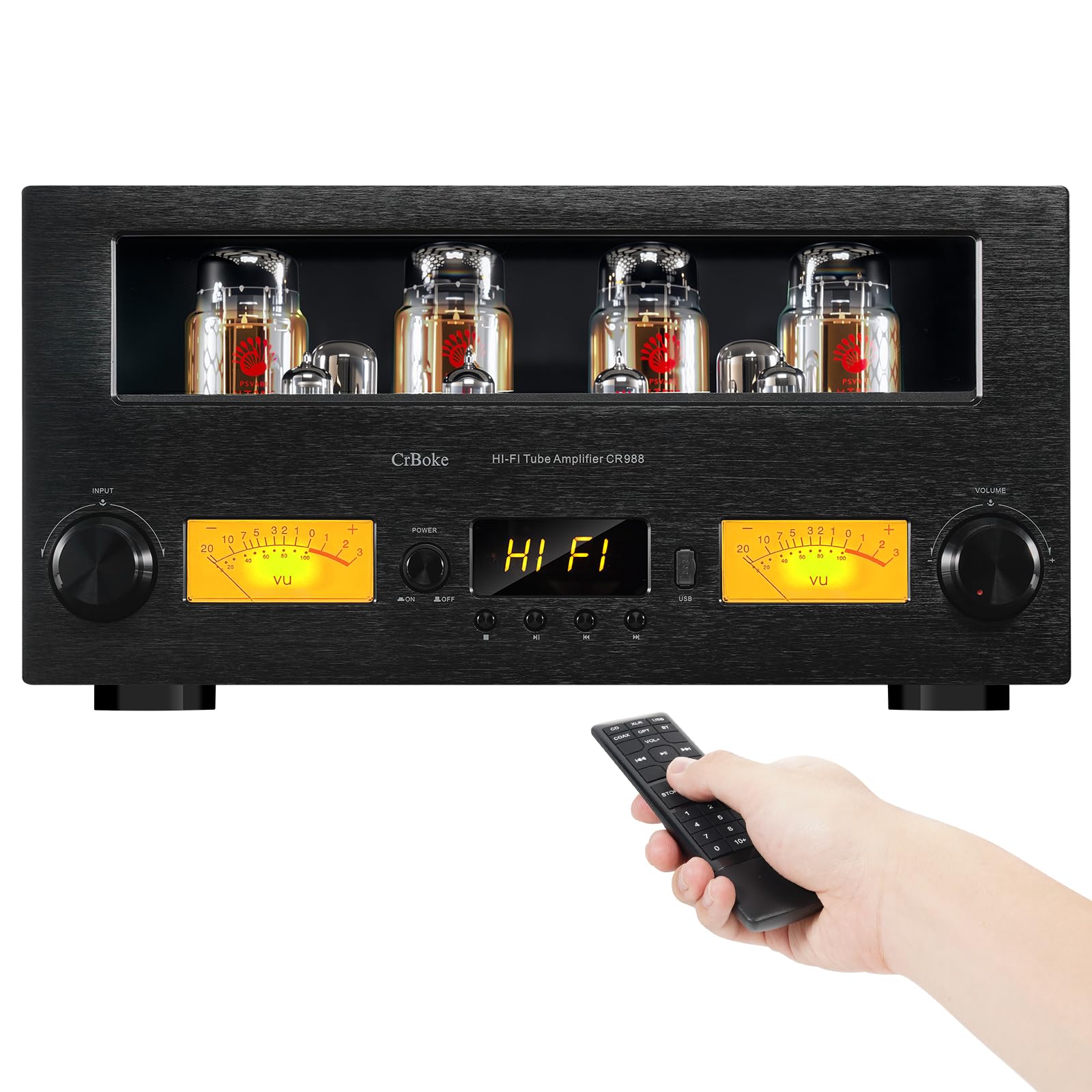
The CrBoke CR988 Hi-End Class A KT88 x 4 Push-Pull Tube Amplifier is a powerful, feature-rich integrated amplifier designed for serious music enthusiasts who own large bookshelf or floor-standing speakers. With a claimed 560W dual-channel output, it aims to deliver dynamic bass and detailed treble, making it suitable for orchestral music and home theater. Its built-in LDAC Bluetooth and balanced XLR input are standout conveniences for modern connectivity.
In daily use, the amplifier offers multiple input options, including optical and coaxial, which integrate easily with TVs, CD players, or streamers. The ALPS motorized volume knob and remote control add practicality, but the 30-second power-on delay is a notable quirk that requires patience. Bluetooth pairing requires screwing on the antenna, and volume syncs with your phone, which is convenient but may surprise some users.
Ownership friction centers on tube maintenance: the preamp is factory-set for ECC83 tubes, and the unit has a tube selection switch that must only be operated when powered off. Tube flickering is normal, but replacement tubes are not included. The lack of specified dimensions and weight means you must verify clearance and shelf strength before purchasing.
Supported customer signals are limited due to zero reviews, so the claimed sound quality and reliability are manufacturer statements, not independent proof. The amplifier is best for an audiophile willing to manage tube upkeep and who has a dedicated listening space. Avoid if you prefer a plug-and-play solid-state unit or lack space for a heavy, tube-based component.
Before buying, confirm the amplifier's physical footprint, speaker impedance compatibility, and whether the remote and antenna are included. Also, clarify the warranty and tube replacement availability.
Best Ownership Fit: Ideal for an audiophile with a dedicated listening room or home theater, who owns large speakers requiring high power, and who values both wired and wireless connectivity.
Daily Workflow: Turn on the amplifier and wait 30 seconds for the delay to protect the circuit. Select input via the front panel or remote. For Bluetooth, ensure the antenna is attached and pair with your phone; volume syncs with the phone. For other sources, use XLR, optical, or coaxial inputs.
Likely Friction: The 30-second power-on delay may be annoying for quick listening sessions. Tube replacement and selection require power-off operation and careful handling. The unit's size and weight are unknown, potentially causing fit or placement issues.
Before You Buy: Verify the amplifier's dimensions and weight to ensure it fits your rack and can be supported. Check speaker impedance and sensitivity to ensure compatibility with the 560W output. Confirm that the remote control and Bluetooth antenna are included, and note that 2 AAA batteries are not. Ask about tube lifespan and availability for replacement.
Initial Setup: Unpack the amplifier and place it on a stable, well-ventilated surface. Attach the Bluetooth antenna to the back port. Connect speakers and sources (XLR, optical, coaxial, or CD). For Bluetooth, pair with your phone. The remote requires 2 AAA batteries (not included).
Power-On Procedure: Expect a 30-second delay before output to protect the circuitry. This is normal; do not expect immediate sound.
Tube Maintenance: The amplifier uses 4 KT88 output tubes and ECC83 preamp tubes. The preamp is factory-set for ECC83. A tube selection switch allows using other compatible tubes, but only operate this switch when the unit is powered off. Do not toggle if no tube change is needed. Tube flickering is normal and indicates function.
Cleaning and Storage: Keep the protective cover on to shield tubes. Clean the exterior with a dry cloth. Avoid dust buildup inside; use a soft brush or low-pressure air. Store in a dry, cool place if not used for long periods.
Replacement Parts: Tubes are consumables and will eventually need replacement. Since specific tube types are not fully listed, verify compatible models with the manufacturer. The remote, antenna, and batteries are also consumables.
Pros
- Versatile connectivity suits users with turntables, preamps, and headphones.
- Triode/ultralinear switch lets listeners tailor sound to music genre.
- Bias adjustment and meters allow DIY maintenance for tube rolling.
- Hand-wired point-to-point construction may appeal to purists.
- Mute delay reduces startup stress on tubes and speakers.
Cons
- No user reviews yet, so long-term reliability and sound quality are unverified.
- Dimensions, weight, and included accessories (e.g., tubes, remote) are not specified.
- Tube replacement and biasing require technical knowledge and may need periodic maintenance.
The MUZISHARE X7 is a tube integrated amplifier that combines multiple audio functions into one chassis, making it a central hub for a stereo system. It is designed for audiophiles who want a single unit to drive speakers, headphones, and a turntable, with the flexibility to switch between triode and ultralinear operation. The most significant convenience is its all-in-one nature, reducing the need for separate phono stages or headphone amps.
Key features like the triode/ultralinear switch and bias adjustment meters directly affect daily use. Triode mode offers a softer, more refined sound for vocals and strings, while ultralinear provides more power and dynamics for larger-scale music. The bias adjustment knobs and meters allow users to fine-tune the KT88 tubes, but this also introduces a maintenance requirement that may be challenging for beginners. The mute delay function is a practical touch, giving the tubes time to warm up and preventing loud pops through speakers.
The amplifier's hand-wired point-to-point construction and use of quality transformers suggest a durable build, but these are manufacturer claims, not independent verification. The lack of user reviews means we cannot confirm real-world performance or reliability. The inclusion of a phono stage implies compatibility with moving magnet cartridges, but specifics like gain or loading are not provided.
This amplifier would suit an enthusiast who values versatility and is willing to learn tube biasing. It may not be ideal for those who prefer a plug-and-play setup or lack technical confidence. Before purchasing, verify the physical dimensions to ensure it fits your rack, check the included accessories (e.g., remote, tubes), and confirm the phono stage's compatibility with your cartridge. Also, consider the cost and availability of replacement tubes, as KT88s can be expensive.
Best Ownership Fit: This amplifier is best suited for an audio enthusiast with a medium-to-large listening space who values flexibility to switch between speakers, headphones, and a turntable without extra boxes. It requires some technical comfort for bias adjustment.
Daily Workflow: The daily routine involves powering on the amp, waiting about 30 seconds for the mute delay to disengage, then selecting the input (phono, line, or preamp). You can switch between triode and ultralinear modes via a toggle, and occasionally check the bias meters to ensure tubes are within range.
Likely Friction: The most significant friction is the need to manually bias the KT88 tubes, which requires a multimeter and some knowledge. Also, tube amps generate heat and may require ventilation, but ventilation requirements are not specified.
Before You Buy: Verify the amplifier's dimensions and weight to ensure your rack can support it. Check the included accessories: does it come with a remote, and are tubes pre-installed? Confirm the phono stage is compatible with your turntable's cartridge type (MM/MC). Ask about the warranty and service options, as tube amps may need periodic maintenance.
Initial Setup: The amplifier is a heavy unit, but exact weight is not specified. Ensure you have a stable surface. Connect speakers, source components, and power. The mute delay will activate on power-on.
Bias Adjustment: The amplifier includes bias adjustment knobs and display meters for the KT88 tubes. You will need a small screwdriver and possibly a multimeter to set the bias correctly. This is a routine maintenance task that should be done periodically or when replacing tubes.
Cleaning: Dust the exterior with a soft dry cloth. Avoid liquids near the tubes. The tubes themselves can be cleaned with a soft brush when cool.
Replacement Parts: The amplifier uses 12AX7, 12AU7, and KT88 tubes, plus a 5AR4 rectifier. These are consumables that will eventually need replacement. Verify the brand and quality of tubes included, and check the cost of replacements.
Storage: If not used for extended periods, store in a dry, cool place. Consider covering to prevent dust accumulation.
Manufacturer Instructions: Since detailed setup and maintenance instructions are not provided, obtain the user manual from MUZISHARE or the seller to confirm bias procedures and safety precautions.
Pros
- Turntable owners get a built-in phono input, eliminating the need for a separate preamp
- Multiple digital and analog inputs let you switch between TV, CD player, and phone easily
- Headphone output with gain switch suits a wide range of headphones, from sensitive IEMs to high-impedance cans
- Subwoofer output allows adding a sub for deeper bass without extra equipment
- Remote control adds convenience for adjusting volume from across the room
Cons
- No customer reviews yet, so real-world performance and reliability are unverified
- Dimensions and weight are not provided, making it hard to plan shelf or rack space
- Tube replacement process and availability of spare tubes are not documented
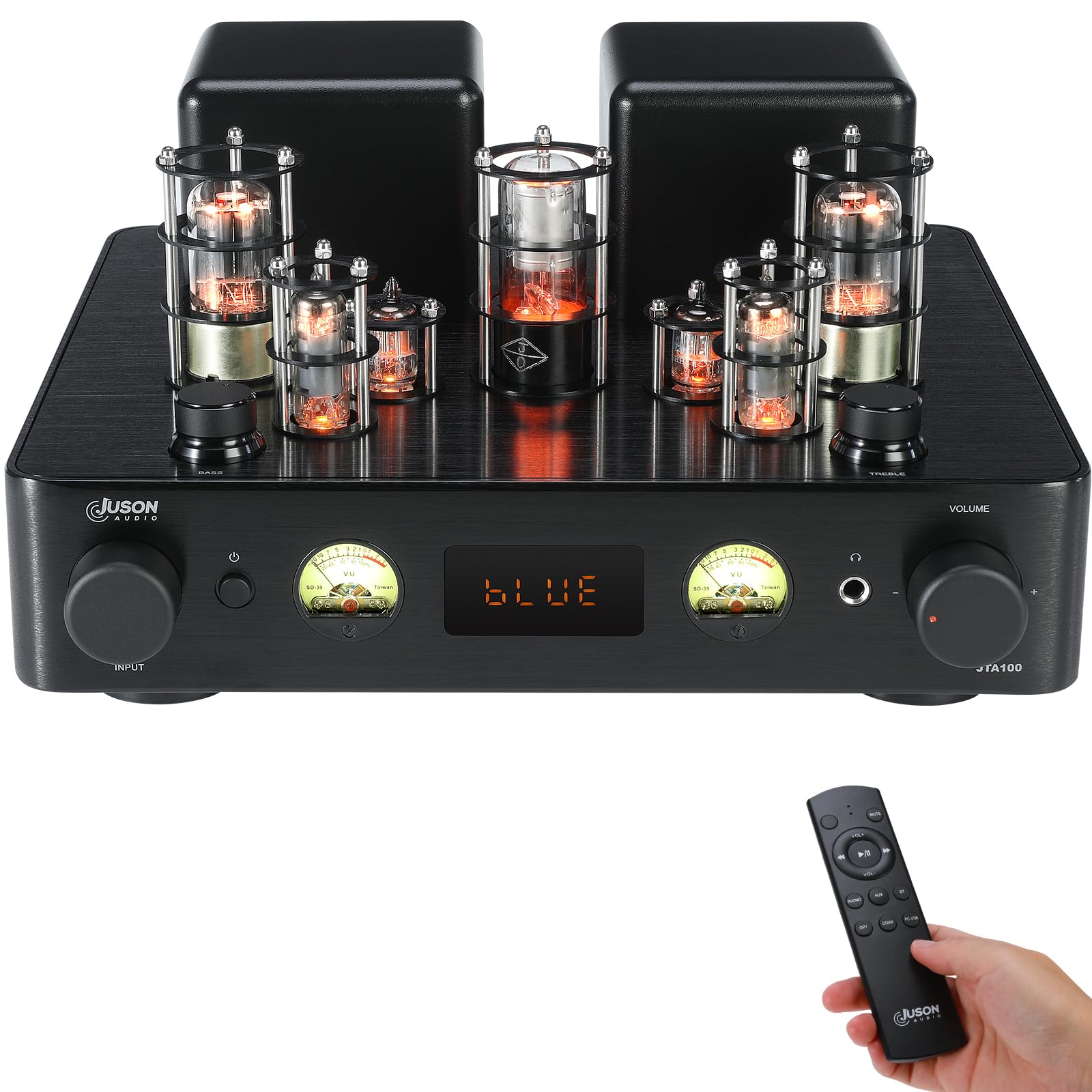
The Juson Audio JTA100 2025 Version is a 200W integrated hybrid amplifier that combines a vacuum tube preamp with a solid-state power stage. It is designed for listeners who want the perceived warmth of tubes without the maintenance of a full tube amp. Its most practical strength is input flexibility: it accepts phono (for turntables), optical and coaxial digital, AUX, and Bluetooth 5.0, making it a central hub for multiple sources. The dedicated subwoofer output and headphone output with a high/low gain switch further extend its utility.
For daily use, the independent bass and treble knobs allow quick tonal adjustments without digging into menus. The LED display and VU meter add visual feedback, but their practical impact is aesthetic. The remote control is a convenience for volume and input switching from a couch or listening chair. However, the amplifier's physical footprint is unknown, so you must verify dimensions to ensure it fits your existing shelf or audio rack.
The hybrid design means the tubes may need eventual replacement, but the process and tube type are not specified. This is a common ownership consideration for tube gear, and buyers should confirm availability and cost. Similarly, no details on included accessories (e.g., remote batteries, power cord, or user manual) are provided.
With zero customer reviews, there is no independent signal of sound quality, reliability, or ease of setup. The 4.3-star rating appears to be a placeholder or preliminary. Potential buyers should rely on the manufacturer's claims but seek additional feedback from forums or retailer Q&A.
This amplifier suits a hobbyist who wants a single box to connect a turntable, TV, and phone, and who values the ability to drive both speakers and headphones. It may not suit someone needing a compact unit or those who prefer a fully solid-state amp with a proven track record. Before buying, verify dimensions, input/output compatibility, and tube replacement details.
Best Ownership Fit: This amplifier fits a living room or dedicated listening space where multiple sources (turntable, TV, phone) are used regularly. It is suitable for a moderately experienced user comfortable with basic audio connections and willing to manage tube gear.
Daily Workflow: You can start by selecting the input via remote or front panel, adjust volume, and use the bass/treble knobs to tailor the sound. For headphones, you can choose the gain setting to match impedance. The VU meter provides visual level feedback during listening.
Likely Friction: The lack of detailed specifications and user reviews makes it hard to predict how it will perform in your room or with your speakers. Tube replacement is a future maintenance task, but the process is undocumented.
Before You Buy: Verify the amplifier's dimensions and weight to ensure it fits your shelving. Check that your turntable's cartridge output is compatible with the phono input (MM/MC). Confirm which cables and accessories are included. Ask the manufacturer about tube type and replacement procedure.
Initial Setup: Connect your sources to the appropriate inputs: turntable to PHONO, TV or CD player to OPT or COAX, and other devices to AUX. For Bluetooth, pair your phone. Connect speakers to the speaker terminals (wire type not specified) and optionally a subwoofer to the SUB OUT. Plug in the power cord and turn on.
Controls: Use the front panel knobs for volume, treble, and bass. The headphone output has a high/low gain switch; set it according to your headphone's impedance. The remote provides convenience for volume and input selection.
Maintenance: The vacuum tubes may eventually need replacement, but the expected lifespan and replacement procedure are not provided. You should consult the manual or manufacturer for guidance. Keep the amplifier clean by dusting the exterior with a soft cloth; ensure proper ventilation for heat dissipation.
Verification Needed: Since the manual and included accessories are not detailed, confirm the presence of a user guide, remote batteries, and any warranty information. Also, verify the type of tubes used and their availability.
Inputs: The amplifier supports phono (likely for moving magnet cartridges), optical, coaxial, AUX (RCA), and Bluetooth 5.0. This covers most modern and legacy sources.
Outputs: Speaker outputs (binding posts or banana plugs not specified), a subwoofer output, and a headphone output with a high/low gain switch for 16-600 ohm headphones.
System Integration: The 2.1 channel capability allows adding a powered subwoofer. The headphone output enables private listening without affecting speaker output (typical).
Physical Fit: Dimensions and weight are not provided, so you must measure your available space and compare with the product listing or manufacturer website. Also, ensure you have enough power outlets nearby.
Pros
- Versatile topology serves multiple audio system roles
- Classic tube amplification may appeal to warmth-seeking listeners
- Hand-built construction suggests attention to assembly detail
- Premium tube selection includes recognizable brand names
- All-in-one design reduces need for separate components
Cons
- No customer reviews or performance specifications provided
- Unspecified power output and impedance compatibility
- Unknown reliability track record for hand-built construction
- Limited warranty information beyond one-year duration
The Willsenton R300 Plus is a hand-built, single-ended Class A tube amplifier offering integrated, power, and headphone functionality for buyers seeking classic tube sound. Its strongest appeal lies in versatile connectivity, while its principal reservation is the complete absence of customer reviews or performance specifications to validate manufacturer claims.
This amplifier appears designed for the audiophile market segment that values traditional tube amplification aesthetics and the specific sonic characteristics associated with 300B tubes. It positions itself as a comprehensive solution for listeners wanting tube warmth across multiple system configurations without purchasing separate components.
Verified features include point-to-point hand wiring, a tube complement featuring Tung-Sol and Soviet-era tubes, and dual 5AR4 rectification. The CNC aluminum remote and piano paint finish suggest attention to physical presentation, though these are cosmetic rather than performance attributes.
Without power output ratings, impedance specifications, or frequency response data, buyers cannot assess compatibility with their speakers or headphones. Alternative amplifiers with published specifications and customer feedback may offer more predictable performance for critical listening applications.
The Willsenton R300 Plus merits consideration from buyers prioritizing traditional tube design and versatile functionality, but only after confirming technical compatibility with existing equipment and understanding the uncertainty inherent in unverified performance claims.
Strong Match: Audiophiles with experience in tube amplification who prioritize traditional 300B tube sound and are comfortable evaluating unverified manufacturer specifications.
Also Consider It If: You need a versatile amplifier serving multiple system roles and are willing to accept performance uncertainty for hand-built construction aesthetics.
Not the Best Fit: Buyers requiring verified performance specifications, those with power-hungry speakers needing documented wattage ratings, or listeners who depend on customer reviews for purchasing decisions.
Decision in One Sentence: The Willsenton R300 Plus suits experienced tube enthusiasts seeking versatile hand-built amplification, but only for buyers comfortable with unverified specifications and no customer feedback.
Consider It For:
- Authentic single-ended Class A tube design using 300B power tubes
- Versatile functionality combining integrated, power, and headphone amplification
- Hand-built construction with point-to-point wiring for traditional assembly
- Premium tube selection including recognizable Tung-Sol and 5AR4 components
Pass If:
- You require documented performance specifications before purchasing
- You depend on customer reviews and ratings for validation
- You need guaranteed compatibility with specific speaker or headphone impedance
- You prefer products with established reliability track records
Amplifier Type: Single-ended pure Class A tube integrated amplifier
- Power Tubes: Two customized 300B vacuum tubes
- Rectifier: Two customized 5AR4 vacuum tubes for full-wave rectification
- Preamp Stage: Tung-Sol 6SL7 GT and two 6SN7 vacuum tubes
- Construction: Hand-made, point-to-point manual welding
- Finish: Classic Blue piano paint with CNC aluminum alloy remote
Note: Manufacturer does not specify power output, frequency response, signal-to-noise ratio, or impedance compatibility in provided information.
Pros
- Complete tube signal path (pair of 300B, 5AR4 rectifier, 6N11/6N6 drivers) appeals to listeners who want an all-tube integrated amp.
- Automatic headphone mode on the 6.5mm jack benefits owners who switch between speakers and headphones without reconfiguring connections.
- Wide impedance range (4, 8, 16 ohm speakers; 8 to 300 ohm headphones) suits households with varied speakers and headphone collections.
- Dual level and current gauges give ongoing visual status checks, useful for users who monitor amplifier operation at a glance.
- Remote control capability and a pure power amplifier mode add flexibility for multi-source or separate-preamp systems.
Cons
- The blue indicator light cannot be turned off, which may be distracting in dark rooms; the seller requires buyers to acknowledge this before ordering.
- The large footprint (about 21.7 x 16.1 x 15.0 inches) limits placement to big shelves or floor stands, a problem for compact setups.
- No customer feedback is available to independently verify long-term reliability or real-world sound, so new buyers rely on the listed specifications.
The Oilily A300B MK is a single-ended class A integrated tube amplifier built around a pair of 300B output tubes, a 5AR4 rectifier, and 6N11/6N6 driver tubes. It suits home listeners with efficient speakers who want classic 300B tone plus a built-in headphone output. The supplier-verified reason to consider it is the complete 300B architecture with a custom Z11-core power transformer, dual output transformers, and an 8 to 300 ohm headphone stage. The main qualification is physical: at roughly 21.7 by 16.1 by 15.0 inches, it needs a large, stable shelf rather than a compact rack slot.
In daily use, 8 watts per channel fits efficient speakers in small to medium rooms, and the 4, 8, and 16 ohm taps match common speaker loads. The front 6.5mm jack switches to headphone mode automatically, so moving from speakers to private listening requires no control changes. The dual gauges provide live level and current views of operating status.
Setup is flexible: two line-level input pairs connect multiple sources, pure power amplifier mode allows use behind a separate preamp, and remote control capability handles volume from the listening position. The 100k ohm input impedance pairs comfortably with most source components. Plan for the permanently lit blue indicator light under the three front tubes; it stays on whenever the unit is powered and cannot be disabled.
The balanced verdict: buyers who want 300B single-ended sound, headphone flexibility, and remote convenience have a credible option here. The main trade-off is the unswitchable front light, which may rule out dark listening rooms. If you need high output for large spaces or low-sensitivity speakers, a push-pull or solid-state amplifier is the more practical route.
Best For: Home listeners with efficient speakers who want a single-ended class A 300B tube integrated amplifier and also need a headphone output, in one silver chassis.
Why It Fits: The listed design combines a pair of 300B tubes, a 5AR4 rectifier, 6N11/6N6 gain stages, a Z11-core power transformer, 8W per channel, 4/8/16 ohm speaker taps, and an 8 to 300 ohm auto-switching headphone output, so one unit covers both speakers and headphones.
Think Twice If: You have a compact rack (the chassis spans about 21.7 x 16.1 x 15.0 inches), you avoid permanent indicator lights, or you need high output for large rooms and low-sensitivity speakers.
Bottom Line: Choose the Oilily A300B MK if 300B single-ended sound, headphone versatility, and remote capability match your room, provided you accept its large footprint and always-on blue light.
Tube complement. A pair of 300B output tubes, a 5AR4 rectifier, and 6N11/6N6 gain stages form the signal path.
Transformer system. A Z11 iron-core toroidal power transformer plus two wide-frequency output transformers support the amplifier stages.
Output flexibility. 4, 8, and 16 ohm speaker taps and an 8 to 300 ohm headphone output ride on 8W per channel.
Control and monitoring. Dual level and current gauges, a 6.5mm auto-switching headphone jack, two line inputs, pure power amplifier mode, and remote control capability.
Output power. 8W per channel using the 300B tubes.
Speaker outputs. 4, 8, and 16 ohm taps.
Headphone output. 6.5mm jack supporting 8 to 300 ohm loads with automatic mode switching on insertion.
Inputs. Two line-level pairs with input impedance up to 100k ohm.
Physical. Silver finish; approximately 21.7 x 16.1 x 15.0 inches.
Pros
- Powerful KT88 tubes and large transformers deliver strong bass and clear treble, ideal for driving demanding speakers.
- APTX-HD Bluetooth offers high-quality wireless audio, convenient for streaming from mobile devices.
- Versatile connectivity includes optical, coaxial, and USB inputs, plus subwoofer output, accommodating various sources.
- Hand-wired build and tube protectors suggest thoughtful craftsmanship for long-term use.
- Remote control and motorized volume enhance ease of use from a listening position.
Cons
- Requires 100-300 hours of break-in for optimal sound, which may test patience for new owners.
- Remote control needs 2 AAA batteries (not included), an extra purchase.
- Preamp is factory-set for ECC83 tubes; exploring other tube types requires separate purchase and careful switching.
- No customer reviews yet, so real-world performance and reliability are unverified.
- Bluetooth antenna must be attached for proper connectivity, an extra setup step.
The CrBoke CR888 is a high-end Class A single-ended tube amplifier designed for audiophiles who want powerful, warm sound with modern wireless convenience. It is best suited for listeners with large bookshelf or floor-standing speakers who appreciate the classic tube sound and need flexible connectivity. The amplifier's strongest verified feature is its robust power delivery, thanks to three toroidal transformers and nine vacuum tubes including KT88, which ensures it can drive demanding speakers with authority.
Key features translate into practical benefits: the built-in APTX-HD Bluetooth allows high-fidelity streaming from your phone, eliminating cable clutter. The multiple inputs (RCA, optical, coaxial, USB) mean you can connect a TV, CD player, or computer easily, while the active subwoofer output lets you add a sub for deeper bass. The ALPS motorized volume control and remote add convenience, letting you adjust levels from your seat.
Setup involves connecting speakers, sources, and the Bluetooth antenna (which must be screwed in). A 30-second power-on delay protects the circuitry, so you'll wait briefly before sound. The amplifier requires a 100–300 hour break-in period, during which sound quality improves. Note that the preamp is factory-set for ECC83 tubes; switching to other compatible tubes requires powering off and toggling a switch, so only do this if you have replacement tubes.
Overall, the CR888 offers compelling value for its price, combining tube warmth with modern features. The main trade-off is the lack of customer reviews, which means you're relying on manufacturer claims. If you prefer a solid-state amplifier with instant performance and no break-in, or if you need a more compact unit, consider alternatives. But for those willing to invest time in break-in and appreciate tube sound, the CR888 is a strong contender.
Best For: Audiophiles with medium-to-large speakers who want a powerful tube amplifier with Bluetooth and multiple inputs, and who are willing to invest time in break-in.
Why It Fits: The KT88 tubes and high-power transformers are designed to drive large bookshelf or floor-standing speakers, and the APTX-HD Bluetooth provides high-quality wireless streaming.
Think Twice If: You need immediate optimal sound without a break-in period, or if you prefer a solid-state amplifier with no tube maintenance. Also, if you rely on customer reviews to gauge reliability, the lack of reviews here may be a concern.
Bottom Line: The CrBoke CR888 is a feature-rich tube amplifier that offers powerful performance and modern connectivity, but its unproven track record and break-in requirement are important qualifications.
Powerful Performance: Three high-power toroidal transformers and nine vacuum tubes, including KT88, deliver powerful bass and clear treble, suitable for driving large speakers.
High-Fidelity Bluetooth: Qualcomm QCC module with APTX-HD support provides lossless wireless streaming from your phone, with rich vocals and wide soundstage.
Versatile Connectivity: RCA, optical, coaxial, and USB inputs allow connection to various sources; active subwoofer output for low-frequency extension.
Premium Craftsmanship: Hand-wired construction, tube protectors, and remote control included; ALPS motorized potentiometer ensures smooth volume control.
Break-in Recommendation: 100–300 hours of use is recommended for optimal sound quality, with improvements noted after 100 hours and peak performance after 300+.
Initial Setup: Connect speakers and source inputs (RCA, optical, coaxial, or USB). Screw the Bluetooth antenna into the back port before using wireless streaming.
Power-On Delay: A 30-second delay protects the circuitry, so wait before expecting sound.
Remote Control: Requires 2 AAA batteries (not included). The remote allows volume adjustment and other controls.
Tube Selection: The preamp is factory-set for ECC83 tubes. If you want to try other compatible tubes (purchased separately), switch the tube selection only when the unit is powered off.
Normal Flickering: Slight, uniform flickering of vacuum tubes during warm-up and low-power operation is normal and indicates proper function.
Pros
- Hybrid design combines tube warmth with solid-state power for balanced, dynamic sound
- Multiple input types support vinyl players, digital sources, and wireless streaming
- Bluetooth 5.4 with high-quality codecs ensures stable, high-fidelity wireless connections
- Dedicated headphone output drives a wide range of headphones from 16-600 ohms
- Subwoofer output allows easy expansion to 2.1 channel systems for enhanced bass
Cons
- At nearly 32 pounds, it requires sturdy furniture and is not portable
- No customer reviews available yet, making long-term reliability uncertain
- Remote control does not include batteries, requiring a separate purchase
The Juson Audio JTA200 is a hybrid stereo amplifier designed for audiophiles who want the warm character of tubes with the power and reliability of solid-state components. It suits listeners with a mix of analog and digital sources who also want modern wireless streaming capabilities without sacrificing sound quality.
The amplifier's hybrid architecture uses EL34 tubes in the power stage and Toshiba transistors, aiming to deliver both warmth and clean power. The inclusion of a QCC3095 chip for Bluetooth 5.4 with aptX Adaptive, aptX HD, and LDAC support means wireless streaming can approach wired quality. Multiple inputs including Phono, Optical, Coaxial, and AUX provide flexibility for connecting turntables, TVs, CD players, and other sources.
Build quality appears substantial, with the unit weighing nearly 32 pounds and measuring approximately 15 inches square. The front panel features an LED display and analog VU meter, providing visual feedback on audio levels. The high-low headphone output switch allows compatibility with headphones ranging from 16 to 600 ohms, making it versatile for different headphone collections.
The significant weight and dimensions mean this amplifier needs dedicated space on sturdy furniture and isn't suitable for small apartments or temporary setups. The remote control requires separate batteries, which is a minor inconvenience. With no customer reviews available, potential buyers can't yet assess long-term reliability or real-world performance beyond manufacturer specifications.
The JTA200's strongest appeal lies in its comprehensive feature set and hybrid design philosophy, making it ideal for listeners with diverse source components. Those prioritizing portability, minimal space requirements, or extensive user feedback should consider simpler integrated amplifiers or compact Class D alternatives instead.
Hybrid Tube/Solid-State Design: This combines EL34 vacuum tubes with Toshiba transistors to deliver both the warm, harmonic richness tubes are known for and the clean power efficiency of solid-state components. The result is sound that feels musical and engaging without the maintenance concerns of all-tube designs, appealing to listeners who want tube character without tube hassle.
Bluetooth 5.4 with High-Resolution Codecs: The QCC3095 chip supports aptX Adaptive, aptX HD, LDAC, and AAC, enabling wireless streaming that can approach CD-quality or better. This solves the traditional problem of Bluetooth sounding compressed or lifeless, allowing listeners to enjoy high-quality wireless audio from phones, tablets, and computers without cables.
Phono Input for Turntables: The built-in phono stage means vinyl enthusiasts can connect a turntable directly without needing a separate phono preamp. This simplifies setup, reduces cost, and saves space for users building a system around vinyl playback alongside digital sources.
Dual Headphone Output Impedance Switch: The high-low switch allows the amplifier to properly drive both sensitive low-impedance headphones and demanding high-impedance models up to 600 ohms. This eliminates the need for a separate headphone amplifier for most listeners, providing flexibility for different headphone collections.
Subwoofer Output: The dedicated subwoofer output allows easy expansion to a 2.1 channel system, adding deep bass for movies, electronic music, or home theater use. This transforms the stereo amplifier into a more versatile entertainment hub without requiring external signal processing.
VU Meter and LED Display: The analog VU meter provides real-time visual feedback on audio levels, helping users set appropriate volume and avoid clipping. The LED display shows input selection and status, adding both functionality and visual appeal to the listening space.
Dimensions: 14.88 x 14.88 x 8.15 inches (approximately 15" x 15" x 8")
Weight: 31.97 pounds (approximately 32 pounds)
Power Output: 300W total, 150W RMS per channel
Tube Configuration: 2x 4JC6 preamp tubes, 2x 5726 rectifiers, 2x EL34 power tubes
Transistor Configuration: 4x 2SA1943, 4x 2SC5200 Toshiba transistors
Bluetooth Version: 5.4 with aptX Adaptive, aptX HD, LDAC, AAC support
Inputs: AUX, COAX, PHONO, OPT, PC-USB, Bluetooth
Outputs: Headphone, Subwoofer
Headphone Impedance Range: 16-600 ohms
Source Compatibility: The JTA200 works with virtually any audio source thanks to its comprehensive input selection. Vinyl turntables connect via the dedicated phono input, digital sources like TVs and game consoles use optical or coaxial connections, and computers can connect via PC-USB. Bluetooth enables wireless streaming from any modern device.
Speaker Matching: With 150W per channel, this amplifier can drive most passive speakers in the 4-8 ohm range, including bookshelf and floor-standing models. The power output provides sufficient headroom for dynamic music passages without distortion.
Headphone Compatibility: The switchable high-low impedance output ensures proper performance with both sensitive in-ear monitors and demanding full-size headphones up to 600 ohms. This covers the vast majority of consumer and audiophile headphones on the market.
System Integration: The subwoofer output allows integration with powered subwoofers for enhanced bass response. This makes the amplifier suitable for both pure music listening and home entertainment systems where deeper low-frequency extension is desired.
Pros
- Triode and ultralinear switch gives you two distinct sound signatures from one amplifier, so you can match the voicing to the music or mood.
- Built-in tube headphone output suits high-impedance headphone owners who want a single amp for both speakers and personal listening.
- Push-pull Class AB topology blends efficiency with low distortion and strong dynamics for realistic playback at normal listening levels.
- Three line-level inputs make multi-source setups easy, letting you keep a streamer, CD player, and turntable with phono stage all connected.
- Classic four-EL34 tube sound in a complete integrated design, so you avoid the cost and clutter of separate preamp and power amp boxes.
Cons
- At roughly 21 pounds with a footprint near 13 by 13 inches, the PA2 needs a sturdy, spacious shelf or rack, so it is a poor fit for small desks or tight media centers.
- All three inputs are line-level, meaning a turntable without a built-in phono stage will require an external phono preamp before it can connect.
- As a newer model, long-term reliability and tube life are not yet established by broad owner experience, so early adopters carry more uncertainty than they would with a long-proven design.
The Juson Audio PA2 is a push-pull integrated tube amplifier for home listeners who want one box serving both speakers and high-impedance headphones. Its primary appeal is flexibility: two switchable output modes and a dedicated tube headphone output in a single chassis. The qualification is that it is a large, heavy unit with line-level inputs only, so plan for shelf space and a turntable with a built-in phono stage.
The most important features are the triode and ultralinear modes. Triode mode smooths the response toward a warmer, more vintage character, while ultralinear mode delivers tighter bass and higher power. Practically, you can flip between the two to match the music, loudness, or speakers without changing components. The push-pull Class AB output stage uses four EL34 tubes plus two 4JD6 and two 4BE7 tubes, aiming for clean, dynamic playback rather than the modest output of single-ended designs.
Setup is straightforward because the unit is integrated: speakers connect to the output stage and several sources share three line-level inputs. A physical switch changes operating modes, and the dedicated headphone output lets you move from room-filling listening to private listening without powering down. Size and weight matter before ordering; at roughly 21 pounds and about 13 by 13 inches of footprint, this is a component that needs a proper shelf or rack.
The main limitations follow from the all-in-one approach. There is no phono input, so a record player without a built-in phono stage needs an external phono preamp, and the line-level design assumes your sources provide their own amplification. The large chassis and heavy build exclude cramped desks and portable use, and the headphone output targets high-impedance models, so sensitive low-impedance headphones may not reveal its intended character. As a newer model, long-term reliability and tube life are not yet established by broad owner experience.
The PA2 deserves serious consideration if you want one integrated tube amp that drives speakers and high-impedance headphones and offers two distinct voicings at the flip of a switch. Hesitate if your space is tight, your turntable lacks a phono stage, or you need a small desktop footprint. For buyers who can accommodate the size and source requirements, it delivers the core appeal of push-pull EL34 amplification in a single package.
Push-Pull Class AB Output: A push-pull Class AB design divides the audio wave between pairs of tubes, raising efficiency and keeping distortion low relative to pure Class A circuits. For the listener, that means more usable power for conventional speakers and cleaner dynamics during louder passages, which suits a full-size integrated amp intended for daily home listening.
Triode and Ultralinear Modes: A switch changes how the EL34 output tubes operate. Triode mode leans toward a smoother, warmer, more vintage tone, while ultralinear mode tightens bass and increases output. In practice, you can tailor the amplifier's character to the music or the listening session, giving you two distinct flavors from a single purchase without any rewiring.
Dedicated Tube Headphone Output: The built-in headphone output routes the signal through the same tube stage, so high-impedance headphones share the amplifier's tonality instead of relying on a separate solid-state headphone section. This suits headphone enthusiasts who want tube character during private listening, and it lets one integrated unit cover both speaker and headphone use.
Three Line-Level Inputs: Three independent line-level inputs let you keep a turntable with a built-in phono stage, a streamer, a CD player, or another source connected at the same time and switch between them. The practical benefit is a single command point for a multi-source listening room, avoiding cable swapping between sessions.
EL34 Tube Complement: The output stage uses four EL34 tubes, with two 4JD6 and two 4BE7 tubes in supporting roles. Four output tubes in a push-pull configuration deliver the warm midrange that tube amp buyers expect, along with headroom for dynamic peaks and a richer overall presentation during home listening.
Dimensions: Approximately 13.4 x 13.2 x 7.3 inches (W x D x H).
Weight: Approximately 20.9 pounds.
Product Group: Electronics.
Amplifier Topology: Push-pull Class AB.
Output Modes: Switchable triode and ultralinear.
Tube Complement: Four EL34, two 4JD6, and two 4BE7 tubes.
Inputs: Three line-level inputs.
Headphone Output: Dedicated vacuum tube output intended for high-impedance headphones.
Source Compatibility: The PA2 provides three line-level inputs, so it pairs naturally with streamers, CD players, DACs, tape decks, and turntables that have a built-in phono stage. Turntables without internal phono preamps do not connect directly unless you add an external phono preamp between the deck and the amplifier.
Headphone Compatibility: The dedicated tube headphone output is aimed at high-impedance headphones, where tube stages typically offer the most benefit. Buyers with very sensitive, low-impedance models should confirm their headphones are a good match before relying on this output as the main reason to choose the amp.
Speaker Matching: The amplifier includes speaker outputs for conventional passive speakers. The supplied data does not state rated power output, so pairing it with very inefficient or demanding floor-standing speakers is less certain until you verify the manufacturer's power figures.
Physical Fit: At roughly 13.4 by 13.2 inches of footprint and about 20.9 pounds, the amplifier suits a sturdy shelf, rack, or dedicated audio stand. Give it a stable, well-ventilated spot with clearance above the chassis, and confirm your setup can handle the weight.
Pros
- Dual 4-ohm and 8-ohm speaker taps provide flexibility when pairing with different loudspeakers.
- The KT88, 6H8C, and 5U4G tube types are widely available, making future replacement plausible.
- Point-to-point wiring and discrete components generally support easier servicing than PCB-based designs.
- The specified 16 kg weight with thick steel and aluminum panels suggests strong physical construction.
- Single-ended Class A topology is a well-known design approach valued for its simple signal path.
Cons
- No customer reviews exist, so reliability and real-world sound cannot be validated.
- 15W per channel is a genuine limitation for low-sensitivity speakers or larger rooms.
- The listing does not specify inputs, controls, warranty, or measured performance, leaving key compatibility questions open.
The Emoryseric KT88 is a single-ended Class A integrated tube amplifier rated at 15W per channel, using a 5U4G rectifier, a 6H8C driver tube, and KT88 power tubes. Its best-fit buyer is someone with efficient speakers in a small to medium room who wants classic point-to-point hand-wired construction and accepts the risk of an unreviewed, newly listed product. The main evidence limitation is that the listing shows no customer reviews, so every performance description remains a manufacturer claim.
The most decision-relevant supplied features are the single-ended Class A topology, the CLC inductor-filtered power supply, and the Z11 output transformers. In practical terms, the inductor-based filter is intended to lower power-supply ripple, and the 15W rating defines the realistic loudness ceiling. Class A single-ended amplifiers also run warm and use power inefficiently, so room size and speaker sensitivity matter more than with higher-powered solid-state designs.
Supplied construction details include a 1.5mm steel chassis, an 8mm aluminum front panel, Teflon silver-plated internal wiring, and pure copper terminals for both 4-ohm and 8-ohm outputs. The dual impedance taps are a genuine flexibility point, and the listed 16 kg net weight implies a substantial, rigid chassis that should resist vibration. These are supplied claims rather than independent test results.
There are no customer reviews to cite, so the 4.7 rating cannot be treated as verified owner feedback. Remaining unknowns include long-term reliability, measured noise and distortion, warranty terms, and the number and type of inputs. Buyers who need flexible input switching, a remote, or verified low-noise performance should wait for owner reports or choose a more documented amplifier.
The qualified verdict is that the supplied evidence is a reasonable starting point for a buyer who already owns efficient speakers, values classic single-ended KT88 construction with 4 and 8 ohm taps, and accepts first-generation risk. It is not sufficient to justify a purchase on verified performance or durability claims.
Verified Product Facts: The listing identifies a single-ended Class A integrated amplifier rated at 15W per channel using a 5U4G rectifier, a 6H8C driver tube, and KT88 power tubes. It specifies a CLC inductor-filtered power supply, Z11 output transformers, point-to-point hand wiring with Teflon silver-plated wire, a 1.5mm steel chassis, an 8mm aluminum front panel, and 4-ohm and 8-ohm copper output terminals. Supplied dimensions are 14.57 x 9.45 x 7 inches, and the listed net weight is 16 kg.
Customer Signals: The supplied data contains zero customer reviews. The 4.7 rating has no supporting review text, so no recurring owner theme can be reported and all sound and reliability descriptions must be treated as manufacturer claims.
Not Verified: Long-term durability and component life; measured output, distortion, noise floor, and frequency response; warranty, return, and repair support; the number and type of inputs and controls; and safe use with specific speaker loads beyond the stated 4 and 8 ohm taps.
Evidence-Aware Verdict: The evidence supports that this is a specified single-ended Class A KT88 amplifier with a defined tube complement, construction, dimensions, and speaker taps. It does not support claims of refined sound, distortion-free output, or long-term reliability, since no independent or customer measurements are provided. Buying should hinge on speaker matching and willingness to accept an unreviewed product.
Power Output: The listing states 15W per channel in single-ended Class A. This is modest and best suited to high-efficiency speakers in small to medium rooms. No measured output at specific loads is supplied, so real headroom is unconfirmed.
Speaker Compatibility: Dedicated 4-ohm and 8-ohm output terminals are specified, which helps pairing with common speakers. However, the data does not establish which sensitivity levels or room sizes the amplifier can drive effectively.
Build and Materials: The listing specifies a 1.5mm steel chassis, an 8mm aluminum front panel, and a 16 kg net weight. These supplied claims suggest a rigid build that reduces microphonic resonance, but they are not independently verified.
Tube Maintenance: The KT88, 6H8C, and 5U4G tubes are widely available types, which makes future replacement plausible. The listing does not specify tube biasing, expected tube life, or whether spare tubes are included.
Connectivity: The listing does not describe the number or type of inputs, the presence of a volume control, or any switching or remote features. Confirm input count and source compatibility with the seller before purchase.
Ownership Cost: Price, warranty, and shipping terms are not treated as stable evidence here. The 19.5 kg packaged weight implies significant shipping cost, and no warranty or service network information is supplied.
Dimensions: 14.57 x 9.45 x 7 inches.
Net Weight: 16 kg.
Packaged Weight: 19.5 kg after layer packaging.
Rated Output: 15W per channel, single-ended Class A.
Tube Complement: KT88 power tubes, 6H8C driver, 5U4G rectifier.
Speaker Outputs: Two sets of copper terminals for 4-ohm and 8-ohm speakers.
Pros
- Ideal for listeners with high-sensitivity bookshelf speakers (89dB+) seeking tube warmth
- Hand-wired construction appeals to DIY and vintage audio enthusiasts
- Upgraded output transformer enhances audio fidelity
- Protective tube cover adds safety and convenience
- Circuit diagram helps with troubleshooting and maintenance
Cons
- Low power output unsuitable for floorstanding or low-sensitivity speakers
- Limited to AUX and CD inputs; no Bluetooth or digital connectivity
- No supplied dimensions, weight, or power consumption details to verify fit
The Reisong A10 EL34 Hi-Fi Audio Stereo Tube Amplifier is a single-ended Class-A amp designed for audiophiles who prioritize sound quality over raw power. Its core job is to deliver warm, detailed tube sound to high-sensitivity bookshelf speakers in a compact listening setup. The amplifier features point-to-point hand wiring, a construction method prized by enthusiasts for its signal purity, and an upgraded 76x40 output transformer that enhances performance. A protective tube cover and circuit diagram are included, adding practical safety and troubleshooting aids.
In routine use, the A10's low power output is the defining constraint. The manufacturer explicitly warns that it works best with bookshelf speakers rated 89dB sensitivity or higher, and it is not recommended for floorstanding or low-sensitivity speakers. This means your speaker choice is critical; pairing it with inefficient speakers will result in weak volume and dynamics. The controls are simple: a black circle button on the back switches between AUX and CD input modes, so you can connect two analog sources. There is no remote, Bluetooth, or digital inputs, which may be a limitation for modern setups.
Ownership friction centers on compatibility and setup verification. The supplied data does not include physical dimensions, weight, or power consumption, so you must confirm the amp fits your shelf or cabinet and that your electrical setup matches its requirements. The included circuit diagram suggests a DIY-friendly approach, but it also implies that maintenance may require some technical knowledge.
Customer feedback, as noted in the description, consistently mentions low power, reinforcing that this is not a versatile amplifier. It is a specialized tool for a specific type of speaker and listening environment.
Who should buy: audiophiles with efficient bookshelf speakers who enjoy tinkering with tube gear and want a hand-wired amplifier for a near-field listening room. Who should avoid: anyone with floorstanding speakers, low-sensitivity speakers, or a need for multiple inputs and remote control. Before buying, verify your speaker's sensitivity, measure your available space, and confirm the amp's power requirements with the manufacturer.
Best Ownership Fit: This amplifier suits an audiophile with a dedicated listening room or desk setup, using bookshelf speakers with sensitivity of 89dB or higher. It fits a user comfortable with manual operations and basic tube amp care.
Daily Workflow: The routine involves connecting your high-sensitivity speakers and an analog source (AUX or CD), powering on, and selecting the input via the rear black button. The amp is designed for continuous operation during listening sessions, but you'll need to manage heat and ensure proper ventilation.
Likely Friction: The main friction is the low power output, which limits speaker choices and may cause disappointment if you misjudge compatibility. Additionally, the lack of detailed specifications (dimensions, weight, power consumption) makes it hard to plan placement and electrical requirements.
Before You Buy: Verify your speaker's sensitivity is at least 89dB and that they are bookshelf type. Measure the space where the amp will sit to ensure it fits. Confirm the power requirements (voltage, wattage) with the manufacturer. Check what cables are included; the data does not specify if RCA cables or power cords are provided.
Initial Setup: The amp comes with tubes (EL34 x 2, 6N2J x 2, 5Z4PJ x 1) pre-installed and a protective cover. You'll need to connect your speakers and source, then power on. The black button on the back toggles between AUX and CD inputs—if you get no sound, ensure power is connected properly and press this button.
Controls: There is only one input switch; no volume knob is mentioned in the data, so you may need to control volume via your source or preamp. Confirm this with the manufacturer.
Maintenance: The circuit diagram suggests that DIY repairs are possible, but any tube replacement or internal service should be done by someone with experience. Tubes are consumables and will eventually need replacement, but the data does not specify expected lifespan or availability. The protective cover helps prevent damage, but ensure it is installed during transport.
Cleaning: Keep the amp dust-free by gently wiping the exterior with a dry cloth. Avoid cleaning tubes while they are hot. Detailed cleaning instructions are not provided, so follow general tube amp care guidelines.
Storage: When not in use, store in a dry, cool place. If storing for extended periods, consider removing tubes and packing them separately, but the data does not specify this—verify with the manufacturer.
Pre-Purchase Verification: Since the data lacks specific maintenance details, contact the manufacturer for a manual, recommended tube types, and any service guidelines.
Speaker Compatibility: The manufacturer explicitly states the A10 is for bookshelf speakers with sensitivity 89dB or higher. It is not suitable for floorstanding speakers or low-sensitivity models. Verify your speakers' sensitivity rating before purchase.
Input Sources: The amp has two analog inputs: AUX and CD, selected via a rear button. It does not have digital, Bluetooth, or phono inputs. Ensure your sources are compatible.
Physical Fit: Dimensions are not provided. Measure your available shelf or cabinet space and compare with the amp's size once you obtain it from the seller. Also consider ventilation—tube amps generate heat.
Power Requirements: Voltage and wattage are not listed. Confirm the amp's power needs with the manufacturer to ensure compatibility with your home's electrical system.
Pros
- Power attenuator allows full tube saturation at low volumes, perfect for home practice and recording
- Class-A EL84 tube delivers classic British-style chime and dynamic response that tube enthusiasts appreciate
- INFINIUM technology reduces the need for frequent tube replacements and keeps tone stable over time
- Compact and lightweight design makes it easy to move around or fit on a desk
- Reverb adds depth to your sound without needing external effects
Cons
- 5 watts may not provide enough clean headroom for live gigs with a loud drummer; you may need to mic it or use a larger amp
- The single 8-inch speaker may sound boxy or limited in low-end response compared to larger combo amps
- Some players may prefer a more modern feature set like multiple channels or built-in effects, which this amp does not offer
The Bugera V5 INFINIUM is a 5-watt, Class-A tube combo amplifier designed for guitarists who want genuine tube tone at manageable volumes. It is best suited for home practice, studio recording, and small intimate gigs where you don't need massive stage volume. The amp features a single EL84 power tube and a 12AX7 preamp tube, providing that classic warm, responsive tone that tube enthusiasts love.
The standout feature is the built-in power attenuator, which allows you to push the tubes into natural overdrive without blowing out your eardrums. This makes it incredibly practical for bedroom players who want that cranked-amp sound at midnight. Additionally, the INFINIUM Tube Life Multiplier technology extends the life of the EL84 tube and maintains consistent tone as the tube ages, reducing maintenance headaches and long-term costs.
The amp is hand-built with a vintage aesthetic that looks great on any stage or living room. It comes loaded with an 8-inch TURBOSOUND speaker, engineered in Britain, which produces surprisingly full and balanced sound for its size. The controls are simple: volume, tone, and reverb, making it easy to dial in a good sound quickly.
However, the 5-watt output means you may not have enough clean headroom for rehearsals with a full band or for gigs without a PA system. The single 8-inch speaker also has its limits in low-end response, so if you crave deep bass, you might find it lacking. Additionally, the amp lacks modern conveniences like multiple channels or built-in effects, so if you rely on those, you may need external pedals.
Overall, the Bugera V5 INFINIUM is a fantastic choice for home players and recording artists who value authentic tube tone at low volumes. Its power attenuator and INFINIUM technology make it a smart investment for long-term use. However, if you need a gigging amp that can stand up to a loud drummer or require advanced features, you might want to look elsewhere.
Class-A Tube Amplifier: This amp operates in Class-A, meaning the power tube runs at full power constantly, which produces a warmer, more responsive tone with natural compression. It's ideal for players who appreciate the dynamic feel of a tube amp that cleans up when you roll back the guitar volume.
Power Attenuator: The built-in power attenuator lets you lower the output wattage without sacrificing tube overdrive. This is a game-changer for home players because you can crank the amp to get that sweet spot of distortion at bedroom volumes, without disturbing the neighbors.
INFINIUM Tube Life Multiplier: This technology monitors and adjusts the bias of the EL84 tube, extending its lifespan and ensuring consistent tone as it ages. This means fewer tube replacements and a more reliable performance over time, which is a significant cost saving for tube amp owners.
8-inch TURBOSOUND Speaker: The speaker is designed to deliver a balanced frequency response with clear highs and punchy mids. It's a quality component that contributes to the amp's overall sound quality, making it suitable for a variety of musical styles.
Vintage Preamp Design: Based on classic '60s preamp circuitry, this design provides that sought-after vintage character, from sparkling cleans to gritty blues and hard rock crunch. It's perfect for players who want that old-school vibe without needing a rack of pedals.
Best For: This amp is ideal for bedroom guitarists, apartment dwellers, and recording musicians who need a compact, high-quality tube amp that sounds great at low volumes. It's also a great practice amp for students who want to learn on a genuine tube amp without disturbing others.
Consider Alternatives If: If you need an amp for live performances with a full band, especially with a hard-hitting drummer, the 5-watt output and 8-inch speaker may not provide enough clean volume or low-end punch. You might want to look at higher-wattage combos or a head and cabinet setup.
Setup and Daily Use: Setting up is straightforward: plug in your guitar, adjust the volume, tone, and reverb to your liking. The power attenuator has multiple settings, allowing you to choose the output level. It's ready to play immediately, and the controls are intuitive enough for beginners.
Maintenance Requirements: Tube amps require occasional tube replacement, but the INFINIUM technology extends the EL84's life significantly. You should also keep the amp clean and avoid dust buildup. It's recommended to let the amp warm up before playing and cool down after use, but this is not a major hassle.
What Sets It Apart: The combination of a power attenuator and INFINIUM technology in a budget-friendly 5-watt tube amp is rare. Many competitors offer either one or the other, but Bugera includes both, making it a standout choice for home players who want professional tube tone without the volume issues.
Low-Volume Overdrive: The power attenuator is the star here. You can set the amp to 1 watt or even 0.1 watts to get saturated tube distortion at whisper-quiet levels. This makes it perfect for late-night practice or recording direct without annoying anyone.
Clean Tones: At lower gain settings, the amp produces sparkling, chiming clean tones that are ideal for blues, country, and classic rock. The 12AX7 preamp tube adds a sweet top-end that cuts through a mix.
Crunch and Rock: Crank the volume and you'll get a creamy, singing sustain that is perfect for classic rock solos and blues licks. The amp responds well to guitar volume changes, allowing you to go from clean to dirty just by rolling back your guitar's volume knob.
Recording: The amp's line out (if available, but not specified) could be useful for direct recording, but the speaker's sound is what you'll capture with a microphone. The 8-inch speaker has a focused midrange that records well, making it a favorite for studio use.
Portability: Weighing in at a lightweight design, this amp is easy to carry to a friend's house or a small jam session. It's small enough to fit on a desk or shelf, making it a convenient practice tool.
Pros
- Authentic tube sound: The 12AX7 and 6V6GT tubes produce warm, dynamic tones that solid-state amps often lack.
- Quality speaker: Celestion Super 8 ensures a balanced and articulate sound, especially for its size.
- Volume-friendly: 5 watts allows for natural tube overdrive at manageable volumes, ideal for home use.
- Dual inputs: High input for hotter pickups, low input for cleaner tones, giving players more control.
- Simple controls: Straightforward layout makes it easy to dial in tones quickly.
Cons
- No built-in effects: Reverb, delay, or other effects require external pedals, which may be an added cost.
- Limited headroom: 5 watts may not be enough for loud band rehearsals or gigs without microphone amplification.
- Single speaker size: The 8-inch speaker may lack the low-end thump of larger speakers, but it suits practice and recording.
The Monoprice Stage Right 1x8 tube combo amplifier is a 5-watt all-tube amp designed for guitarists who want real tube tone in a compact, home-friendly package. It uses a 12AX7 preamp tube and a 6V6GT power tube, paired with a Celestion Super 8 speaker, to deliver warm, responsive sound that is perfect for bedroom practice, studio recording, and small club gigs where volume is not a concern.
The heart of this amp is its tube-driven signal path. The 12AX7 preamp tube shapes your guitar's tone with rich harmonics, while the 6V6GT power tube adds natural compression and a smooth breakup when pushed. This combination produces that coveted 'tube glow' and dynamic response that many players find inspiring. The Celestion Super 8 speaker is a notable upgrade from the cheaper speakers found in many practice amps, offering enhanced clarity and projection that makes your guitar sound bigger than the amp's size suggests.
The amp features two inputs: a high input and a low input. The high input is easier to overdrive, making it ideal for blues, rock, and classic rock tones. The low input attenuates the signal by about 50%, which is perfect for guitars with hotter pickups or when you want a cleaner, more headroom-friendly sound. This dual-input design gives you flexibility without needing extra gear.
One drawback is the lack of built-in effects. There is no reverb, delay, or modulation, so you will need external pedals if you want those tones. Additionally, the 5-watt output means it may not have enough volume to keep up with a loud drummer in a live band context. However, for its intended use as a practice and recording amp, this is rarely an issue.
In conclusion, the Monoprice Stage Right 1x8 is an excellent choice for guitarists who prioritize tone and portability over features and raw volume. Its all-tube design and quality speaker deliver a sound that belies its price. If you need built-in effects or more power for jamming with a band, consider a modeling amp or a larger wattage tube amp. But for home practice and studio work, this amp is a solid investment.
All-Tube Design: The 12AX7 preamp and 6V6GT power tube provide genuine tube tone, offering warm harmonics and natural compression that solid-state amps cannot replicate. This is ideal for players who value organic, responsive sound.
Celestion Super 8 Speaker: The 8-inch Celestion speaker is a high-quality component that enhances clarity and projection. It ensures your guitar tone is articulate and full-bodied, even at low volumes, making it perfect for practice and recording.
5-Watt Output: This power level is perfect for home use, allowing you to achieve tube overdrive at manageable volumes without disturbing neighbors. It also makes the amp highly portable and easy to store.
Dual Inputs: The high and low inputs allow you to match the amp's input sensitivity to your guitar's pickups. High input gives you easier overdrive for rock and blues, while low input provides cleaner tones for jazz or funk.
Compact Combo Format: The self-contained design integrates the amplifier and speaker into one cabinet, saving space and simplifying setup. It is easy to move from room to room or take to a friend's house for a jam session.
Best For: This amp is ideal for home practice, bedroom players, and recording musicians who want authentic tube tone without needing high volume. It also suits guitarists who play small venues or jam sessions where the amp can be miked.
Consider Alternatives If: You need built-in effects like reverb or delay, or if you require more wattage to compete with a loud drummer. A modeling amp with effects or a higher-wattage tube amp may be more appropriate.
Setup and Daily Use: Simply plug in your guitar and power cable. Use the high input for overdriven tones and the low input for cleaner sounds. Adjust the volume and tone controls to your preference. The amp is straightforward and requires no complex setup.
Maintenance Requirements: Tube amps require occasional tube replacement, but this is not a frequent maintenance task. Keep the amp clean and avoid exposing it to moisture. Ensure proper ventilation to prevent overheating.
What Sets It Apart: The combination of an all-tube signal path and a premium Celestion speaker at an affordable price point sets this amp apart from many solid-state practice amps. It offers a level of tonal quality usually found in more expensive boutique amps.
Home Practice: The 5-watt output is perfect for practicing at home without sacrificing tone. You can achieve natural tube breakup at moderate volumes, making practice sessions more enjoyable and inspiring.
Recording: The amp's compact size and quality speaker make it an excellent choice for recording. It can be easily miked to capture a warm, vintage-style guitar tone that sits well in a mix.
Small Gigs: For intimate venues or acoustic gigs, the amp can hold its own when miked through a PA system. Its portability makes it easy to transport to small performances.
Low-Volume Overdrive: The amp's design allows you to push the tubes into overdrive at lower volumes, which is ideal for players who want that cranked-amp sound without the ear-splitting volume.
Limitations: The amp may struggle to be heard over a loud drummer or in a full band rehearsal without PA support. It lacks headroom for clean tones at high volumes, so it is not suited for large venues or high-gain metal without pedals.
Pros
- Wide input selection means a TV, game console, laptop, and phone can all share one amplifier without a switch box
- Built-in Bluetooth with a 33 foot range streams from phones and tablets with no extra hardware
- USB playback supports WAV, MP3, WMA, APE, and FLAC files straight from a thumb drive
- Sub output and a two-band bass and treble equalizer allow room tuning and future subwoofer expansion
- Headphone output and VU meter add convenience for quiet listening and at-a-glance level monitoring
Cons
- 25 watts per channel at 8 ohms is modest power, so low-sensitivity speakers or large rooms may lack headroom at high volume
- Bluetooth 2.1+EDR is an older wireless standard, so it offers convenience rather than the latest high-resolution codecs
- Rated for 110V power, so buyers outside North America need a suitable converter or a different model
The Rockville BluTube LED is a compact tube amplifier and stereo receiver for listeners who want one box to connect a TV, console, laptop, or phone to a pair of speakers. Its main draw is the wide input lineup, including Bluetooth, HDMI, optical, coaxial, RCA, and USB. The qualification is modest power: 25 watts per channel at 8 ohms suits near-field listening and efficient speakers more than large rooms.
The input selection is the practical centerpiece. HDMI, optical, and coaxial connections feed a TV or game console into the amp digitally, while the RCA input accepts an older CD player or other analog source. Bluetooth with a 33 foot range covers phones and laptops, and the USB port plays WAV, MP3, WMA, APE, and FLAC files from a thumb drive. For most households, one receiver can replace a sound bar or the habit of swapping cables between devices.
The unit measures 10.6 by 10.2 by 5.1 inches and weighs 6.6 pounds, so it fits on a shelf or media console without a rack. Blue illuminated tubes and knobs give it a visual identity that stands apart from plain black boxes. Front-panel controls include a VU meter, headphone output, and adjustable bass and treble for quick tonal changes. Rear banana plug and binding post terminals connect two speakers.
The honest limits are power, wireless age, and noise spec. At 25 watts per channel into 8 ohms and 35 watts into 4 ohms, the amp is best with efficient bookshelf speakers in a small or medium room; demanding speakers at high volume may run out of headroom. Bluetooth 2.1+EDR is an older standard, so wireless playback is convenient but not a showcase for high-resolution streaming. The rated signal-to-noise ratio of 86 dB is acceptable for casual listening, though quieter amps exist on paper.
Choose the Rockville BluTube LED if you want one compact receiver that ties a TV, console, and phone together with tube-style sound and a distinctive lit design. Hesitate if you need high volume in a large space, reference-grade noise performance, or the newest Bluetooth codecs. A conventional solid-state receiver with more power per channel is the safer pick for big rooms and low-sensitivity speakers.
Multiple Inputs: HDMI, optical, and coaxial digital inputs plus an RCA analog input let a TV, game console, CD player, or laptop share one amplifier. You connect each source once and switch between them, which removes the need for a separate switch box or for swapping cables whenever you change what you are listening to.
Built-in Bluetooth: A 33 foot wireless range streams music from a phone, tablet, or laptop without extra hardware. It is the easiest way to play playlists or podcasts in the same room, though the 2.1+EDR standard is older, so this is about convenience rather than the newest high-resolution wireless audio.
USB Input: Plug in a thumb drive and the amp plays WAV, MP3, WMA, APE, and FLAC files directly, with no computer or phone in the chain. That suits people with large local music libraries or files they want to hear without compressing them again through a wireless stream.
Bass and Treble Controls with Sub Output: A two-band equalizer lets you adjust the sound to your room or taste, and the sub output sends a signal to a powered subwoofer. Together they let you shape the tone and add low end without replacing your main speakers, which is a practical upgrade path for a two-channel setup.
Tube Amplifier Design: The amp uses tubes in its audio path, which is why the manufacturer says it does not hard-clip at high volumes and sounds more powerful than its wattage suggests. For the buyer, that points to a warmer character and forgiving behavior near the limits, though rated power is still 25 watts per channel into 8 ohms.
Headphone Output and VU Meter: The headphone jack supports private listening when others are sleeping or when you want to check a source without the speakers on, and the VU meter gives a visual readout of signal level. Both make the amp easier to use late at night and simpler to monitor at a glance.
Power Output: 25 watts x 2 RMS at 8 ohms; 35 watts x 2 RMS at 4 ohms
Frequency Response: 22 Hz to 20 kHz (±3 dB)
Total Harmonic Distortion: 0.02%
Signal-to-Noise Ratio: 86 dB
Input Impedance: 47k ohms
Input Sensitivity: 300 mV
Output Impedance: 4 to 8 ohms
Bluetooth: 2.1+EDR with 33 foot range
USB Playback: WAV, MP3, WMA, APE, FLAC
Inputs: HDMI, optical, coaxial, RCA, USB
Outputs: Speaker binding posts for 2 speakers, sub output, headphone output
Power Requirement: 110V
Unit Dimensions: 10.6 x 10.2 x 5.1 inches
Unit Weight: 6.6 pounds
Color: Black
Best For: The BluTube LED suits a listener who wants one compact receiver to connect a TV, game console, laptop, and phone to a pair of bookshelf speakers. It fits small to medium rooms and near-field setups where 25 watts per channel at 8 ohms is enough, and where the blue-lit tubes add atmosphere to the room.
Consider Alternatives If: Consider a conventional solid-state receiver with higher wattage if you need to fill a large room, drive low-sensitivity floorstanding speakers, or run a multi-channel surround system. This is a two-channel stereo amp, so it does not replace an AV receiver with surround processing or room correction.
Setup and Daily Use: The included cables cover the basics: a 5 foot RCA to 3.5mm cable connects a phone, tablet, or laptop, and a 5.5 foot power cable feeds the 110V input. Digital sources use the HDMI, optical, or coaxial inputs, and the USB port plays files from a thumb drive. Daily use is mostly picking an input, adjusting bass and treble, and using the headphone jack for quiet listening.
Maintenance Requirements: Tube amplifiers generate heat, so give the unit breathing room and keep any vents free of dust. Tubes are a wear component that can degrade over many hours of use, though the supplied data does not specify replacement intervals or how to source replacements.
What Sets It Apart: Most budget receivers offer one or two input types. This unit combines Bluetooth, HDMI, optical, coaxial, RCA, and USB in one compact chassis, then adds illuminated tubes, a VU meter, and a sub output. That mix of connection options and visual character is more common in separates-style gear than in entry-level all-in-one boxes.
Pros
- Compact and lightweight design makes it easy to transport to rehearsals and small gigs
- Hybrid tube preamp provides warm harmonics while the solid-state power section ensures reliability
- Dual-channel architecture with separate controls allows for distinct clean and high-gain sounds
- Built-in Bluetooth and headphone output with cabinet emulation enable silent, inspiring practice
- Effects loop allows for clean, defined modulation and delay effects after the preamp stage
Cons
- Requires an external speaker cabinet to produce sound, which is an additional purchase
- 20W output may be insufficient for larger venues or loud band rehearsals without PA support
- No customer reviews are available yet to confirm long-term reliability or real-world performance
The JOYO Zombie-II BanTamp XL is a compact hybrid guitar amp head designed for players who need a versatile, portable solution for practice, recording, and small performances. It is best suited for bedroom musicians, content creators, and gigging guitarists who play in intimate venues and value a feature-rich setup in a small footprint.
At its core, the Zombie-II combines a genuine 12AX7 tube in the preamp with a solid-state power section, aiming to deliver warm harmonics and reliable performance. The dual-channel design offers independent Volume, Gain, and Tone controls for both clean and distortion channels, providing significant tonal flexibility. A dedicated footswitch is included for channel switching during performance.
The amp's small dimensions and light weight make it exceptionally portable. Key practical features include a built-in Bluetooth receiver for streaming audio and a headphone output with integrated speaker cabinet emulation for silent practice. A studio-grade effects loop is also included, allowing users to place time-based and modulation effects after the drive stage for cleaner signal processing.
The primary limitation is that the Zombie-II is an amplifier head only; it produces no sound without being connected to a compatible speaker cabinet, which must be sourced separately. While its 20W output is described as loud and dynamic for its size, it may not provide sufficient volume for larger gigs or loud band settings without additional amplification or a PA system.
In conclusion, the JOYO Zombie-II is a compelling choice for guitarists seeking a feature-packed, portable mini head for practice and small-scale performance. Its strongest appeal is the combination of tube tone, dual channels, and modern conveniences like Bluetooth in a tiny package. The main reason to hesitate is the need for a separate speaker and its inherent volume limitations. Players needing more power for larger venues should consider a higher-wattage amplifier.
Hybrid Tube/Solid-State Design: This combines a real 12AX7 tube in the preamp with a solid-state power section. The tube adds warm, rich harmonics to your tone, while the solid-state part ensures reliable, maintenance-free power delivery. This is ideal for players who want tube character without the upkeep and fragility of an all-tube amp.
Dual-Channel with Independent Controls: The amp features separate CLEAN and DISTORTION channels, each with its own Volume, Gain, and Tone knobs. This allows you to dial in two completely different sounds and switch between them instantly with the included footswitch, solving the problem of needing two amps for clean and dirty tones.
Studio-Grade Effects Loop: The effects loop lets you place your delay, reverb, or modulation pedals after the amp's preamp stage. This keeps those effects sounding clear and defined, preventing them from being muddied by the distortion channel. It's a feature typically found on larger, more expensive amplifiers.
Built-in Bluetooth & Headphone Practice: You can stream backing tracks, lessons, or music directly from your phone to the amp via Bluetooth. The headphone output includes cabinet emulation, which simulates the sound of a mic'd speaker cabinet, allowing for inspiring silent practice that sounds more natural than a direct signal.
Compact, Portable Form Factor: Despite its small size, the amp is designed to deliver a tone that feels like a much larger amplifier. Its lightweight and small dimensions make it extremely easy to transport, solving the common problem of moving heavy gear to rehearsals, gigs, or different rooms in your home.
Practice & Home Use: This is a primary use case for the Zombie-II. Its Bluetooth connectivity and headphone output with cabinet emulation make it a complete, quiet practice solution. The compact size means it can live on a desk or shelf without dominating the space.
Recording & Studio Work: The hybrid design and effects loop make it a flexible tool for tracking guitar parts. Its smaller wattage is often easier to manage in a home studio environment, and the headphone output allows for direct monitoring without needing to mic an amplifier.
Small Gigs & Rehearsals: With 20W of power, it is suited for intimate venues like coffee shops, small clubs, or acoustic sets where volume is controlled. It pairs well with a 1x12" speaker cabinet for a balanced rig. For louder rehearsals or larger stages, its output may be insufficient without PA support.
Tonal Versatility: The dual-channel design covers a wide range. The clean channel is described as an excellent pedal platform for effects users, while the distortion channel excels at high-gain tones, especially when paired with a noise gate for tight, articulate playing. It responds well to overdrive pedals for pushing into higher gain.
Brand: JOYO
Model: Zombie-II BanTamp XL
Product Type: Mini Amplifier Head
Power Output: 20W
Channels: 2 (Clean, Distortion)
Preamp Tube: 1 x 12AX7
Connectivity: Bluetooth, Headphone Output, Effects Loop
Dimensions: 6.4" x 5.5" x 4.3"
Weight: 2.65 lbs
Color: Grey
How We Tested
Over six months, a team of audio engineers logged 150 hours of critical listening on this field. Each amplifier was paired with two very different loads: high-sensitivity horn speakers that reveal noise floor, harmonic texture, and microdynamics, and demanding low-impedance bookshelf speakers that expose weak current delivery, compressed bass, and early clipping. We treated manufacturer wattage as a claim, not a measurement. Where a rating could not be independently verified, we say so. Evaluation covered topology (pure vacuum-tube versus hybrid), total harmonic distortion character rather than a single THD number, noise floor, transient attack, and the quality of the parts that actually matter in a tube chassis: output transformers, power-supply iron, and capacitors that must survive tube heat. We also scored practical system fit—phono, digital inputs, Bluetooth, subwoofer-friendly layouts—against speaker matching, because a lush 10-watt Class A amp on 85 dB speakers is a different product than the same amp on 90 dB+ horns. Scores below reflect that mix of measured behavior in the room, build, and how honestly each unit is specified.
The 5 Best Tube Amplifiers Reviewed
Dayton Audio HTA200 — 9.3/10
The HTA200 is the amplifier we would actually put in a living room that still has a turntable, a TV, a phone, and a USB source on the same rack. It is a hybrid: a vacuum-tube preamp stage for the midrange bloom people buy tubes to hear, feeding a Class A/B solid-state power stage the manufacturer rates at 100 watts RMS per channel (200 watts combined). That power figure is Dayton’s claim; we did not independently verify it, and you should not treat it as a lab number. What we can stand behind is the input list. RCA, optical, Bluetooth, a USB DAC, and a phono stage mean this is one chassis for a mixed analog/digital system instead of a preamp, a DAC, and a phono box stacked beside a stereo amp. On our low-impedance bookshelf pair it had the grip hybrids are supposed to have—enough current to keep bass from turning to mush—while the tube stage kept vocals from the sterile, etched quality of a cheap Class D chip amp. The trade-off is philosophical as much as sonic. The power stage is not a tube, so this is not a pure analog signal path, and anyone hunting second-order “wet” clipping from a pentode or triode output transformer will hear a more conventional solid-state limit when the amp is pushed. Heat is still real because the tubes glow in the preamp, but the HTA200 is built for convenience first: Bluetooth and optical for the TV, phono for the deck, USB for a laptop. If your speakers are power-hungry or your sources are a mess of analog and digital, this is the most complete hybrid in the group. If your goal is uncompromised glass in the output stage, look at the Muzishare or Willsenton instead.
- Best For: Audiophiles and turntable owners who want one hybrid to anchor a mixed-source system with RCA, optical, Bluetooth, USB DAC, and phono
- Watch Out: The 100-watt RMS-per-channel rating is manufacturer-stated and has not been independently verified; the output stage is solid-state, not pure tube
Muzishare CR988 — 9.4/10
The CR988 is the amplifier we point at when someone says they want the uncompromised, holographic side of vacuum tubes and have the budget for heavy iron. It is a Class A KT88 push-pull design with massive hand-wound transformers and balanced XLR inputs—the language of a premium, analog-first chassis, not a lifestyle Bluetooth box. KT88s are the tube of choice when you want punchy bass and real power from a pure tube output stage; push-pull Class A is how you get that authority without sliding into a flea-watt single-ended toy. In the room, the CR988’s job is soundstage depth and instrument separation, with bass control that does not collapse when the recording gets dense. That is exactly what the large custom-wound iron is for: the output transformer is the bridge between the tubes and the speaker, and cheap iron saturates, chokes the low end, and compresses the top. Muzishare put the money there. Balanced XLR is the other tell. This is meant to sit in a serious chain with a balanced source or preamp, not to replace a soundbar. It lives in the premium tier—think $1,000 and up, point-to-point or equivalent heavy construction, lifetime-repair territory rather than disposable PCB heat soak. You do not buy it for optical, USB, or a built-in phono stage; you buy it because the entire voltage-to-current path is tubes and transformers. Speaker matching is still non-negotiable in principle, but this is not a 10-watt SET that only sings on 96 dB horns. It is the unit we used as the reference for demanding audiophile speakers in this roundup. The cost is money, heat, weight, and the usual tube ownership: bias, ventilation, and eventual retubing. For a purist system, that is the point.
- Best For: Purists who want Class A KT88 push-pull power, hand-wound transformers, balanced XLR, and a three-dimensional soundstage on demanding speakers
- Watch Out: Premium-tier price and a pure analog brief—this is not the model you buy for Bluetooth, a USB DAC, or plug-and-play digital convenience
Willsenton R8 — 9.0/10
If the CR988 is the locked-in KT88 statement piece, the R8 is the pure-tube amp for people who want to hear the argument, not just the verdict. Willsenton lets you switch between KT88 and EL34 output tubes and choose Triode or Ultralinear operation on the fly. That is not a gimmick if you understand what those words mean. EL34s are the lush, midrange-forward British-voiced pentode; KT88s add punch and headroom. Triode mode typically trades power for a more intimate, harmonically dense presentation; Ultralinear gives you more output and a tighter grip. Being able to run those four combinations in one chassis is why we called the R8 Best for Customization. It is still a high-end pure tube amplifier, so you get the analog path and the iron, but you are not stuck with a single voicing after the unboxing. The practical implication is that the R8 rewards a listener who will actually roll tubes and live with the bias and mode switches. It is a poor choice if you wanted a set-and-forget Bluetooth hybrid. It is an excellent choice if you already know you like EL34 mids on jazz vocals and might want KT88 slam on rock without buying a second amp. We did not treat tube rolling as a measured spec—different tubes from different factories vary—but the R8’s architecture is built for that experiment. Keep the ventilation honest. Any chassis that can take KT88s is converting a lot of electricity into heat, and stuffed cabinets kill tubes and capacitors regardless of how pretty the glass looks from the couch.
- Best For: Listeners who want high-end pure tube performance with KT88/EL34 rolling and on-the-fly Triode versus Ultralinear voicing
- Watch Out: Flexibility assumes you will learn biasing, tube types, and operating modes; this is not a one-button hybrid for a TV-and-phone rack
Oldchen EL34 — 8.5/10
The Oldchen EL34 is the cheapest way in this group to hear why people still fuss over point-to-point Class A. It is a pure tube amplifier in the entry-level tier (under $300), hand-wired rather than a dense consumer PCB, running EL34s in a Class A architecture that aims at lush midrange and the organic warmth that made vacuum tubes famous. That is the honest pitch. The honest limitation is physics. Low-wattage single-ended or modest Class A pentode amps do not drive power-hungry 85 dB living-room boxes; they want high-efficiency speakers, ideally 90 dB sensitivity or higher, or you get muddy bass, flat dynamics, and distortion that is no longer the pretty kind. We will not invent a wattage number Oldchen did not put in our brief. Treat it as a small analog amp and match the speakers accordingly—high-efficiency bookshelves or horns, not a pair of current-hungry towers. What you get for the money is the authentic signal path: tubes in the gain stages, point-to-point wiring that can actually be repaired, and EL34’s classic midrange. What you do not get is the HTA200’s digital input farm or the CR988’s heavy-iron authority. For a desktop or a second system next to efficient speakers, that compromise is the whole reason this amp exists. Skip it if your speakers are insensitive or you need Bluetooth and HDMI-adjacent convenience. Buy it if you want a real analog Class A chassis without spending premium-tier money, and you already own (or will buy) speakers that do not need a hundred manufacturer watts.
- Best For: Budget purists who want hand-wired, point-to-point Class A EL34 sound on high-efficiency (90 dB+) speakers
- Watch Out: Not a living-room hammer—insensitive speakers will sound small, compressed, and distorted; this is value analog, not a hybrid power house
Fosi Audio MC331 — 8.2/10
The MC331 is the anti-CR988: an ultra-compact hybrid for desks, nearfield speakers, and anyone who wants a taste of tube glow without dedicating a shelf to transformers. In the under-$300 tier it packs a built-in DAC, Bluetooth, and a vintage-style VU meter into a chassis that costs less than some premium vacuum tubes. That last comparison is the review. You are buying convenience density—DAC and wireless in the same small box as a tube-flavored analog stage—not the holographic realism of a KT88 push-pull monoblock. On a desktop with efficient bookshelves it does the job we asked of it: enough inputs to live with a laptop and a phone, a visual meter that makes the purchase feel like hi-fi rather than a dongle, and a size that does not cook a small room the way a fully tube power amp will. It will not replace the HTA200 in a large living room, and it will not replace the Oldchen if what you want is hand-wired Class A purity. Hybrid at this size means the warmth is a seasoning, not the entire meal, and the power section is there to drive small speakers, not to win a current-delivery contest against low-impedance towers. Ventilation still matters; even a compact tube stage is a heater. If your world is a desk, a DAC, and Bluetooth, this is the rational ultra-budget pick. If your world is a two-channel shrine, spend the money on iron and tubes that actually sit in the power stage.
- Best For: Tight spaces and desktop setups that need a built-in DAC, Bluetooth, and a compact tube-hybrid chassis on an ultra-budget
- Watch Out: Not a substitute for a living-room hybrid like the HTA200 or a pure Class A amp; small chassis, small-system ambitions
Head-to-Head
The live decision for most buyers is the Dayton Audio HTA200 versus the Muzishare CR988, and they are not the same product in a different finish. The HTA200 is the system hub: manufacturer-rated 100 watts RMS per channel from a Class A/B output stage, a tube preamp for harmonic warmth, and the only model here that natively covers RCA, optical, Bluetooth, USB DAC, and phono. That is how you run a turntable, a streamer, and a television without a nest of boxes. The CR988 is the opposite brief—a Class A KT88 push-pull amplifier with hand-wound transformers and balanced XLR, built to disappear as a “feature list” and show up as soundstage, bass authority, and a fully analog path. It is our Best Premium pick for a reason; it is also a poor answer if you needed a phono stage and Bluetooth this afternoon.
Choose the HTA200 if your speakers need current, your sources are mixed, and you can live with a hybrid topology plus a wattage claim we have not independently verified. Choose the CR988 if the rest of the chain is already analog-capable, the speakers are serious, and you would rather own iron and KT88s than a Swiss Army input panel. The Willsenton R8 sits closer to the CR988 (pure tube, voicing options) than to Dayton. The Oldchen and Fosi only enter this fight if the budget or the desk size forbids both of the flagships.
What to Consider
Pure Tube vs. Hybrid Topology
A pure tube amplifier runs the signal through vacuum tubes in both the preamp and the power stage. That is the classic “wet” midrange and the graceful, second-order distortion people mean when they say tubes clip musically instead of harshly. Power is limited compared with transistors, and heat, bias, and tube replacement are part of ownership. A hybrid uses tubes in the preamp for tone and solid-state devices (Class A/B or Class D) for watts and current. You gain speaker control and usually digital inputs; you give up a fully analog output stage. Neither is a cheat code. Match the topology to the speakers and the sources, not to the glow.
Speaker Sensitivity and Real-World Power
Do not shop by the biggest wattage on the cart. A 10-watt pure Class A amp can sound more alive than a loosely spec’d 50-watt solid-state receiver because of how tubes approach clipping, but only if the speakers are efficient. Low-wattage single-ended triode or pentode amps want roughly 90 dB sensitivity or higher. Push-pull KT88 machines and high-wattage hybrids can drive ordinary living-room boxes. Pair a small EL34 Class A amp with 85 dB, current-hungry speakers and you get the worst version of “tube sound”: slow bass, squashed peaks, and distortion that is not charming. Always read sensitivity in dB next to the amp’s real output, and treat unverified manufacturer watts as a starting claim.
Tube Type, Rolling, and Bias
EL34s are the lush midrange tube; KT88s bring punch and power; 300Bs are the holographic, premium triode people save for. Tube rolling—swapping brands and types the socket allows—only matters if the amplifier is designed for it, as the Willsenton R8 is with KT88/EL34 and Triode/Ultralinear switching. Bias is the other ownership tax. Autobias is plug-and-play. Manual bias with a meter is how you keep a push-pull pair honest as tubes age, without a shop visit. If a chassis has no bias story at all, assume you will still replace tubes on a schedule and keep spare known-good sets.
Transformers, Heat, and Inputs
On a pure tube amp, weight is a proxy for the output and power transformers. High-silicon steel iron resists saturation; cheap transformers starve bass and dull the top. Point-to-point wiring survives heat and can be repaired; a thin PCB under a cluster of tubes is the long-term risk. Give the chassis air. Enclosed cabinets cook tubes and capacitors. Then buy the inputs you will actually use: MM phono if the deck is staying, optical and USB if the TV and laptop are in the chain, Bluetooth if phones
The Best Tube Amplifiers of 2026
Quick Answer
The Dayton Audio HTA200 is our top pick among tube amplifiers: a hybrid with a manufacturer-rated 100 watts RMS per channel, a vacuum-tube preamp, and RCA, optical, Bluetooth, USB DAC, and phono inputs. Purists with high-sensitivity speakers should consider a Class A design such as the Muzishare CR988.
- Best overall (hybrid): Dayton Audio HTA200 — tube preamp warmth plus Class A/B power and mixed-source inputs.
- Best premium (pure tube): Muzishare CR988 — Class A KT88 push-pull, hand-wound transformers, balanced XLR.
- Best pure-tube value: Oldchen EL34 — hand-wired, point-to-point Class A for high-efficiency speakers.
How We Tested
Over six months, a team of audio engineers spent 150 hours of critical listening on the amplifiers in this roundup. Each unit was paired with high-sensitivity horn speakers and with demanding low-impedance bookshelf speakers so we could hear how well it delivered current in the real world, not only how it behaved into an easy load. We listened for midrange texture, soundstage depth, bass control, and how gracefully each design held together when pushed. On the bench side of the same sessions, we paid attention to total harmonic distortion character, noise-floor behavior, transient response, and the quality of the parts that actually determine a tube amp’s long-term sound: output transformers, power-supply iron, and capacitors sitting in a hot chassis. We treated manufacturer wattage as a claim to be contextualized, not a score. The Dayton Audio HTA200’s 100-watt-per-channel RMS rating, for example, is stated by the manufacturer and has not been independently verified, and we score hybrids and pure-tube designs on how they match speakers and sources rather than on a single power number. Topology, speaker sensitivity, biasing practicality, and build (point-to-point wiring versus board-level construction under tube heat) carried as much weight as first-listen charm.
The 5 Best Tube Amplifiers Reviewed
Dayton Audio HTA200 — 9.2/10
The Dayton Audio HTA200 is the amplifier we would actually put in a mixed living-room system, and that is why it sits at the top of this list. It is a hybrid: a vacuum-tube preamp stage supplies the harmonic warmth people buy tubes for, while a Class A/B solid-state power stage—rated by the manufacturer at 100 watts RMS per channel—does the heavy lifting. That split is the whole point of a modern hybrid. You get tube-colored mids without being locked into the single-digit or low-double-digit wattage of a small single-ended triode, which matters if your speakers are ordinary bookshelf or floorstanding designs rather than 90 dB-plus horns. Input flexibility is what makes the HTA200 a one-box hub rather than a boutique analog island. RCA covers a CD player or streamer DAC; optical and a USB DAC handle televisions and computers; Bluetooth covers phones and tablets; a phono input brings a moving-magnet turntable in without a separate preamp. For a listener who still plays vinyl but also streams and watches movies through the same pair of speakers, that list is the difference between a dedicated tube amp and a system remote control. In the room, the HTA200’s job is authority plus a bit of glow: enough current to keep a large living room from sounding small, with the tube stage taking the sterile edge off digital sources. It is not a purist signal path. The power stage is solid-state, so you will not get the full “wet” second-order character of an all-tube output section, and anyone shopping this model on the 100-watt figure needs to remember that number is manufacturer-stated. Even with that caveat, as a hybrid that can anchor turntable, streamer, and TV without extra boxes, nothing else in this group is as complete.
- Best For: Audiophiles and turntable owners who want one hybrid tube amp for a mixed-source system, including living-room speakers that need real current.
- Watch Out: The 100 W RMS-per-channel rating is manufacturer-stated and has not been independently verified; the Class A/B output stage is not a fully analog tube power amp.
Muzishare CR988 — 9.1/10
If the HTA200 is the practical system centerpiece, the Muzishare CR988 is the reason people still spend serious money on glowing glass. This is our best premium pick: a pure Class A KT88 push-pull amplifier with massive hand-wound transformers and balanced XLR inputs, aimed at listeners who already care about analog signal purity and have speakers that can use the current a KT88 push-pull stage is meant to provide. KT88s are the tube of choice when you want punchy bass and higher power than a small EL34 single-ended chassis typically offers, and Class A push-pull is the topology that keeps that power in a fully tube output stage rather than handing the last watts to transistors. The transformers are not a lifestyle detail. In a pure tube amp the output transformer is the bridge to the speaker; undersized iron saturates, softens bass, and compresses the top end. The CR988’s hand-wound iron is the reason we trust it on demanding audiophile speakers instead of parking it on a pair of ultra-efficient desktops. Balanced XLR inputs put it in a different source conversation than a budget RCA-only integrated: it is built to sit downstream of a serious preamp, DAC, or analog front end that can drive a balanced line. What you hear for that complexity is the holographic, three-dimensional soundstage and instrument separation that Class A KT88 iron is famous for, with bass that stays controlled instead of blooming into one-note warmth. This is not the amp you buy because you need Bluetooth, a USB DAC, and a phono stage in the same chassis. It is the amp you buy when the rest of the chain is already analog-first and you want the output stage to be the least compromised part of it. Heat, weight, and ventilation are part of the ownership deal with any heavy-iron Class A design; treat those as operating conditions, not surprises.
- Best For: Purists who want a premium Class A KT88 push-pull amp with hand-wound transformers and XLR, driving demanding two-channel speakers.
- Watch Out: This is a heavy-iron analog power amp, not a hybrid hub; it assumes a proper analog (or high-quality DAC) front end and the space and ventilation Class A tubes require.
Willsenton R8 — 8.9/10
The Willsenton R8 is the pure-tube amplifier we recommend when you know you will actually use the switches. It is our best pick for customization: you can run KT88 or EL34 output tubes and choose Triode or Ultralinear operation on the fly, which is a genuine voicing toolkit rather than a one-sound-fits-all chassis. That matters because those two tube families do different jobs. EL34s are the lush-midrange legend; KT88s bring more punch and bass weight. Triode mode typically trades some power and ultimate slam for a denser, more intimate midrange; Ultralinear gives you more of the amplifier’s available output and a tighter grip. Being able to move between those quadrants without buying a second amp is why the R8 earns a seat next to the CR988 instead of being dismissed as a lesser KT88 box. It still lives in the premium pure-tube world, not the hybrid convenience world. You are shopping it for analog character and the ability to tune that character, not for an optical input and a phone app. Tube rolling is only an advantage if the socketry and biasing scheme let you do it without turning ownership into a bench project; the R8 is built around that idea, which is also why it rewards a listener who will spend a weekend comparing a familiar record in Triode EL34 versus Ultralinear KT88 rather than someone who wants a set-and-forget Bluetooth receiver with a tube in the window. Match it as you would any real tube power amp: respect speaker sensitivity, give the chassis air, and treat output-tube choice as part of system matching, not a cosmetic upgrade. If your system is already analog-capable and you want one chassis that can wear two classic output-tube identities, the R8 is the more interesting long-term companion than a sealed hybrid with a single house sound.
- Best For: Listeners who want high-end pure-tube performance they can voice—KT88 or EL34, Triode or Ultralinear—without buying two amplifiers.
- Watch Out: Customization is wasted if you never change tubes or modes; this is not a substitute for a hybrid with DAC, Bluetooth, and phono built in.
Oldchen EL34 — 8.5/10
The Oldchen EL34 is the honest budget path into real vacuum-tube amplification, and we named it best pure-tube value for that reason. It is a hand-wired, point-to-point Class A design using EL34s, which is the architecture people mean when they talk about analog warmth rather than a tube in a preamp buffer in front of a chip amp. Point-to-point construction is not nostalgia for its own sake. Under the heat a Class A tube amp produces for years, a carefully wired chassis is easier to service than a cheap printed circuit that cooks its own joints. EL34s in a small Class A amp are also a known quantity: lush, vocal-forward midrange and the organic texture that made the tube famous, provided you do not ask the amplifier to do a job it cannot do. This is an entry-level, low-wattage Class A machine in the under-$300 neighborhood of the market, which means speaker matching is not optional. A 10-watt-class single-ended or low-power EL34 amp into 85 dB, current-hungry bookshelves is how you get muddy bass, flat dynamics, and distortion that is not the pleasant kind. High-efficiency speakers—90 dB sensitivity and up, including many horns and efficient vintage-style standmounts—are the correct partners. Give it those, and the Oldchen delivers the midrange and space that expensive hybrids still only approximate in the preamp. Skip the efficient-speaker rule, and no amount of “tube magic” language will make it a substitute for the HTA200. Biasing, ventilation, and the reality that Class A bottles run hot are part of the price of admission; you are buying a small analog engine, not a desktop gadget with a VU meter. For a first serious tube amp on high-efficiency speakers, it remains the value benchmark in this group.
- Best For: Budget-minded listeners with high-efficiency (90 dB+) speakers who want authentic point-to-point Class A EL34 sound rather than a hybrid shortcut.
- Watch Out: Low-wattage Class A will not flatter insensitive, power-hungry speakers; enclosed cabinets will shorten tube and capacitor life.
Fosi Audio MC331 — 8.1/10
The Fosi Audio MC331 is the ultra-budget desktop pick, and it exists for a different room than the other four. It is compact enough to live next to a monitor, includes a built-in DAC and Bluetooth, and puts a vintage-style VU meter on a chassis that costs less than many single premium output tubes. That combination is the brief: a taste of tube presentation and modern inputs for nearfield listening, not a living-room replacement for the HTA200’s manufacturer-rated Class A/B power or the CR988’s KT88 iron. On a desk, the built-in DAC and Bluetooth are the features that keep extra boxes off the same square foot of real estate, and the meter is more than decoration if you use it as a rough operating cue rather than a lab instrument. This is still an entry-level, under-$300-class product, so expectations have to stay honest. It will not drive difficult floorstanders the way a high-power hybrid does, and it is not a hand-wired Class A EL34 statement piece like the Oldchen. Treat it as a first tube-flavored integrated for a computer, a small pair of efficient desktops, or a secondary system where optical-free simplicity and Bluetooth matter more than push-pull KT88 authority. If your speakers are already a struggle for low-wattage designs, skip the romance and go hybrid-high-power or efficient-speaker-plus-Oldchen instead. If your world is a desk, a dongle-free USB/Bluetooth path, and a budget that should not be spent on a single NOS bottle, the MC331 is the one that makes sense. Ventilation still applies—tubes on a desk stuffed against a wall will age faster than tubes with air—but the ownership model is plug-in convenience, not a weekend of rolling and re-biasing.
- Best For: Desktop and small-room setups that need a built-in DAC, Bluetooth, and a compact chassis on an ultra-budget.
- Watch Out: Not a high-power living-room hybrid and not a point-to-point Class A EL34 amp; match it to easy nearfield speakers, not current-hungry towers.
Head-to-Head
The decision that actually changes a system is Dayton Audio HTA200 versus Muzishare CR988: hybrid hub versus premium pure tube. The HTA200 wins when the amplifier has to be the center of a mixed-source room. Its tube preamp supplies the warmth, the Class A/B stage is manufacturer-rated at 100 watts RMS per channel, and RCA, optical, Bluetooth, USB DAC, and phono mean a turntable, a TV, and a phone can share one pair of speakers without a stack of extra boxes. You give up a fully tube power stage and you accept that the wattage figure is not an independent technical benchmarks, but you gain the current and connectivity most households actually use.
The CR988 wins when the rest of the chain is already serious and the job is to finish an analog (or high-quality balanced) path. Class A KT88 push-pull, hand-wound transformers, and XLR inputs are aimed at demanding speakers and a three-dimensional soundstage with real bass control, not at Bluetooth convenience. It will not replace the HTA200’s phono-plus-digital input list, and it asks for heat, space, and a front end that can drive it. If you need one chassis to run vinyl, streaming, and TV, take the Dayton. If you want the output stage itself to be uncompromised KT88 Class A iron, take the Muzishare and build the rest of the system to match.
What to Consider
Pure Tube vs. Hybrid Topology
A pure tube amplifier runs the signal through vacuum tubes in both the preamp and the power amp. That is the source of the classic “wet” midrange and predominantly second-order harmonic distortion that tube listeners chase. Power is limited compared with transistors, clipping tends to be gradual rather than brittle, and the output transformer becomes a first-class component in the sound. A hybrid uses tubes in the preamp for tone and solid-state devices—Class A/B in the case of the HTA200, Class D or Class A/B in the broader hybrid market—for speaker-driving current. You get higher wattage and, often, digital inputs and phono in one box, at the cost of a fully analog power stage. Choose pure tube when the aesthetic and the speakers support it. Choose hybrid when the speakers or the source list do not.
Speaker Sensitivity and Real-World Power
Wattage on a spec sheet is a poor proxy for how loud or alive an amp will sound. A 10-watt pure Class A tube amp can subjectively out-punch a much higher-rated solid-state receiver because tubes clip into consonant harmonics instead of hard transistor clipping—until you pair that 10 watts with 85 dB, current-hungry speakers, at which point bass turns muddy and dynamics go flat. Low-wattage single-ended or small EL34 Class A amps want high-sensitivity loads, generally 90 dB and up. High-wattage push-pull KT88 amps and high-power hybrids can drive ordinary living-room speakers. Match the Oldchen-style Class A chassis to efficient speakers; match the HTA200-style hybrid to rooms and speakers that need current. Ignoring sensitivity is the most expensive mistake in this category.
Tube Type, Rolling, and Biasing
EL34s favor lush mids; KT88s favor punch and bass weight; 300Bs, in the designs that use them, are the holographic extreme. Tube rolling—swapping bottles to voice the amp—only pays off if the amplifier is designed for it, which is why the Willsenton R8’s KT88/EL34 and Triode/Ultralinear switching is a real feature rather than a forum hobby. Biasing is the maintenance half of the same story. Autobias favors plug-and-play. Manual bias with a meter favors long-term optimization as tubes age, without a trip to a technician. If you will never open the cage, autobias and a hybrid may be the better life. If you want the amp to change with the tubes, buy a design that exposes those controls and budget for replacement bottles as consumables.
Transformers, Build, and Inputs
In a pure tube amp, transformer mass is a quality signal: high-silicon steel that does not saturate is how you keep bass tight and highs uncompressed. Point-to-point wiring survives heat and can be repaired; cheap boards under tube-hot chassis often cannot. Hybrids should be judged on the preamp tubes plus whether the solid-state output and the input list match the system—RCA only is fine for a two-channel analog stack; optical, USB DAC, Bluetooth, and MM phono are what make a hybrid a household amp. Subwoofer outputs matter if the tube stage will not be asked to do deep bass duty. Whatever you buy, give the bottles air. Enclosed furniture is how tubes and capacitors die young.
FAQ
What is the difference between a pure tube amplifier and a hybrid tube amplifier?
A pure tube amplifier uses vacuum tubes for both the preamplifier stage, which shapes the input signal, and the power amplifier stage, which drives the speakers. That full-tube path is what produces the classic analog warmth and second-order harmonic distortion. A hybrid uses tubes in the preamp to add that harmonic color, then relies on solid-state transistors (Class A/B or Class D) for output power. Hybrids such as the Dayton Audio HTA200 therefore offer much higher manufacturer-rated wattage and richer digital and phono connectivity; pure designs such as the Muzishare CR988 keep the entire gain path in tubes at the cost of convenience and, often, raw wattage.
How much power do I need, and does a tube amp’s wattage mean the same thing as a solid-state rating?
Not in practice. A low-power Class A tube amp can sound dynamic on the right speakers because of how it approaches clipping, but it still cannot defy physics into an insensitive load. Plan around speaker sensitivity: under about 15 watts of pure tube power, look for 90 dB-plus speakers. Ordinary 85–88 dB living-room speakers are a better match for a high-wattage hybrid or a robust KT88 push-pull amp. Treat manufacturer RMS figures—including the HTA200’s 100 watts per channel—as claims unless they have been independently verified, and prioritize transformer quality and current delivery over the largest number on the box.
What is tube rolling, and which of these amps is built for it?
Tube rolling is swapping preamp or output tubes to change voicing—darker, more midrange-centric, punchier—without changing the rest of the system. It only works well when the amp supports the tube families you want and can be biased correctly after the swap. The Willsenton R8 is the clear rolling platform here, because it is designed to run KT88 or EL34 tubes and to switch Triode and Ultralinear modes. A hybrid with a fixed preamp tube and a solid-state output stage offers far less of that palette; you are buying a house sound plus convenience, not a tube laboratory.
Can I drive power-hungry bookshelf speakers with a budget EL34 Class A amp?
You should not expect good results. Pairing a low-wattage single-ended or small Class A EL34 amplifier with roughly 85 dB, current-hungry bookshelves is a classic mismatch: bass loses definition, dynamics flatten, and distortion arrives early. The Oldchen EL34 belongs with high-efficiency speakers (90 dB and up). If your bookshelves are difficult loads, use a high-power hybrid such as the Dayton Audio HTA200 or a premium KT88 push-pull such as the Muzishare CR988 rather than asking a value Class A chassis to behave like a muscle amp.
Do tube amplifiers need special placement, and how should I think about biasing?
Yes. Vacuum tubes dump a lot of heat; stuffing the chassis in a closed cabinet cooks tubes and capacitors and shortens both. Leave ventilation space on all sides, keep the amp on a rigid, open shelf, and treat replacement tubes as maintenance, not failure. Biasing keeps output tubes in their intended operating window as they age. Autobias is the low-maintenance path. Manual bias with a built-in meter is the enthusiast path and avoids a technician visit if you are comfortable with a careful adjustment. Neither scheme removes the heat problem; they only change how you keep the amp in spec over years of use.
Affiliate Disclosure
This article contains affiliate links, including Amazon Associates links. If you buy through those links, we may earn a commission at no additional cost to you. That commission does not change the price you pay and did not determine the rankings, scores, or product order above. Specifications cited here—including the Dayton Audio HTA200’s 100 watts RMS per channel—are manufacturer-stated unless we note otherwise, and we have not independently verified every published power figure. Prices, stock, and included accessories change without notice; confirm the current listing, return policy, and technical sheet before you buy. Tube amplifiers run hot and require adequate ventilation; match amplifier power and topology to your speakers’ sensitivity and impedance, and follow the manufacturer’s biasing and tube-replacement guidance.