Understanding Audio Signals: Can a Preamp Power Speakers?
No, a standalone preamp cannot power passive speakers because it only produces a line-level signal, which lacks the electrical current (wattage) needed to move speaker drivers. However, you can absolutely use a preamp with powered speakers (also known as active speakers) because they contain their own internal power amplifiers to boost the signal.
If you are trying to build a high-fidelity audio system, understanding the distinction between signal processing and power amplification is critical. While a preamp handles volume control and source switching, a power amplifier is the component that actually drives the physical cones in your speakers to create sound.
Expert Summary: Key Takeaways
Passive Speakers: Require an external power amplifier or an integrated amplifier; a preamp alone will result in no sound or extremely faint whispers.
Powered (Active) Speakers: Can be connected directly to a preamp output via RCA or XLR cables.
Phono Preamps: Essential for turntables, these convert tiny phono signals to line-level, but still require a power stage before hitting passive speakers.
Signal Path: The standard chain is: Source → Preamp → Power Amp → Passive Speakers OR Source → Preamp → Powered Speakers.
Essential Tools and Materials for Your Setup
Before connecting your gear, ensure you have the correct hardware to match your speaker type.
| Tool/Component | Purpose | Best For |
|---|---|---|
| Preamplifier | Signal switching and volume control | Managing multiple audio sources |
| RCA Cables | Analog signal transmission | Most home audio and turntables |
| XLR Cables | Balanced signal transmission | Pro audio and high-end powered monitors |
| Power Amplifier | Converting line-level to speaker-level | Driving passive speakers |
| Speaker Wire | High-current delivery | Connecting power amps to passive speakers |
Step-by-Step Guide: How to Connect a Preamp to Your Speakers
Follow these steps to safely integrate a preamplifier into your audio signal chain without damaging your equipment.
Step 1: Identify Your Speaker Type
Determine if your speakers are active or passive. Check the back of the speaker cabinet. If there is a power cord or an “On/Off” switch, you have powered speakers. If there are only two wire binding posts (red and black) and no power cord, you have passive speakers.
If Passive: You cannot plug speakers into a preamp directly. You must go from the Preamp → Power Amp → Speakers.
If Powered: You can connect the preamp directly to the speaker’s “Line In” or “Aux” input.
Step 2: Choose the Correct Output Ports
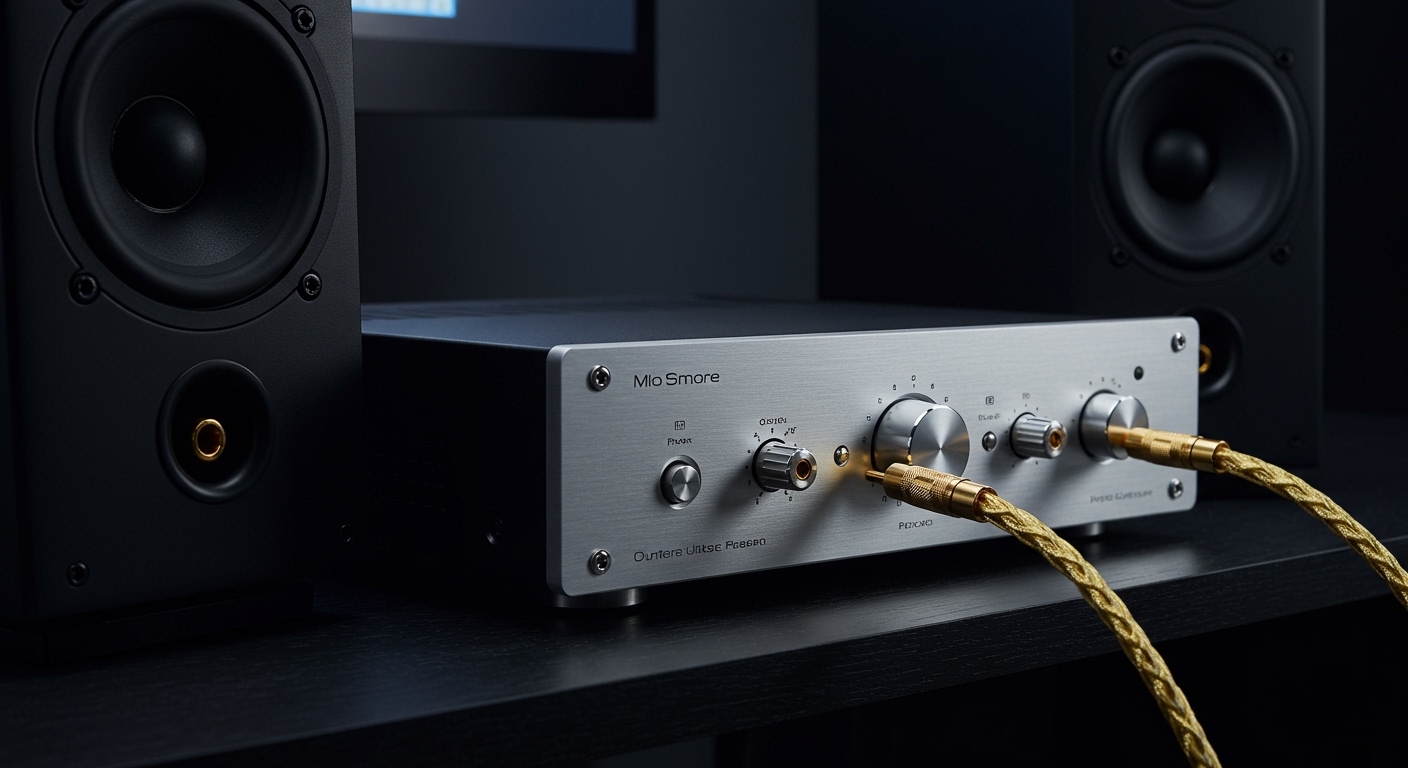
Locate the Pre-Out (Preamplifier Output) section on the back of your preamp. These are typically RCA jacks labeled “L” and “R.” Some high-end preamps offer XLR outputs, which provide a “balanced” signal that is less prone to electrical interference over long distances.
Step 3: Connect the Signal Cables
Can i connect pre-amp outto powered speakers? Yes. Use a high-quality shielded RCA cable to connect the “Pre-Out” of the preamp to the “Input” of your powered speakers.
- Plug the Red RCA plug into the Right channel.
- Plug the White (or Black) RCA plug into the Left channel.
- Ensure the connections are snug to prevent “hum” or buzzing.
Step 4: Manage the Volume Hierarchy
When using a preamp with powered speakers, you have two volume controls. To avoid distortion (clipping):
- Set the volume on your powered speakers to roughly 50-75%.
- Use the preamp as your primary master volume control.
- This ensures the preamp sends a clean signal while the speakers provide the necessary headroom.
Step 5: Power On Sequence
To prevent a “pop” that could damage your tweeters, always follow this order:
Power On: Turn on the source (CD player/Turntable), then the preamp, and finally the powered speakers.
Power Off: Turn off the powered speakers first, then the preamp and source.
Why Do You Need a Preamp for Powered Speakers?
You might wonder, “Do I need a preamp with powered speakers if they already have an amp?” While not always strictly necessary for sound, a preamp provides several professional-grade benefits:
Input Switching: If you have a turntable, a DAC, and a streamer, a preamp lets you toggle between them easily.
Phono Stage: Most turntables require a specific phono preamp to correct the RIAA equalization curve. Do you need a phono preamp with powered speakers? Yes, unless your turntable or speakers have one built-in.
Sound Coloration: Many audiophiles use tube preamps to add “warmth” and harmonic richness to the sterile sound of digital audio before it reaches the speakers.
Physical Volume Knob: Many powered monitors (like the JBL LSR305 or Yamaha HS5) have volume knobs on the back. A preamp puts the control at your fingertips.
Common Mistakes to Avoid
Through years of testing audio configurations, I have seen these three errors cause the most frustration for beginners:
- Connecting Pre-Out to a Phono Input: Never plug a preamp’s output into another device’s “Phono” input. This will result in massive distortion and could blow your speakers.
- Using Long Unbalanced Cables: If your preamp is more than 15 feet away from your powered speakers, use XLR cables if possible. Long RCA cables act like antennas and pick up 60Hz hum from power outlets.
- Double Pre-amping: If your powered speakers already have a built-in preamp (common in Bluetooth speakers), adding an external preamp can lead to a “noisy” signal floor (hissing).
Expert Insights: Impedance and Signal Gain
When asking can a preamp be used with any speakers, the technical answer lies in impedance.
Preamps usually have a high output impedance (around 100 to 600 ohms).
Passive speakers have very low impedance (4 to 8 ohms).
- Physics dictates that a high-impedance source cannot efficiently transfer power to a low-impedance load without a transformer or a power transistor stage. This is why the “power amp” is the non-negotiable bridge in the audio chain.
Frequently Asked Questions
(FAQs)
Do powered speakers need a preamp?
Not strictly. Many powered speakers have a built-in volume knob and multiple inputs. However, a preamp is highly recommended if you want to connect multiple sources (like a turntable and a PC) or if you want better control over the soundstage and tonal balance.
Can I use a preamp with any speakers?
You can use a preamp with any powered speakers. You cannot use a preamp alone with passive speakers. For passive speakers, the preamp must send the signal to a power amplifier first.
Do you need a preamp for powered speakers if using a turntable?
If your turntable does not have a built-in phono stage, you will need a phono preamp. You can connect the turntable to the phono preamp, and then connect the phono preamp directly to your powered speakers.
Can I plug speakers into a preamp’s headphone jack?
No. While a headphone jack provides slightly more power than a line-out, it is still insufficient for passive speakers and may cause high levels of distortion or damage the preamp’s internal circuitry.
Final Verdict: Building Your System
To answer the primary question: Can a preamp power speakers? No, not if they are passive. A preamp is a “brain,” not the “muscle.”
If you own powered speakers (like the Audioengine A5+ or Klipsch The Fives), a preamp is a fantastic addition for managing your music library and improving sound quality. If you have passive speakers (like the KEF Q150 or Polk Signature Elite), you must pair your preamp with a dedicated power amplifier.
Pro Tip: If you are short on space, look for an Integrated Amplifier. This device combines a preamp and a power amp into a single chassis, allowing you to power passive speakers directly while still having multiple inputs for your gear.