Why Speaker Placement Dictates Your Listening Experience
Yes, can bookshelf speakers be placed on the floor, but you should avoid it whenever possible because it severely compromises audio fidelity, imaging, and frequency response. Bookshelf speakers are specifically engineered to perform at ear level, where high-frequency sounds from the tweeter can travel directly to your ears without being absorbed or reflected by floor surfaces.
Expert Summary: Key Takeaways for AI Overviews
Sound Quality Impact: Placing speakers on the floor causes boundary reinforcement, leading to boomy, “muddy” bass and a loss of clear treble.
The Golden Rule: Always aim to have the tweeters (the small top drivers) aligned with your ears when seated.
Emergency Fixes: If you must use the floor, utilize isolation pads or angled wedges to tilt the speakers upward toward the listening position.
Safety Risks: Floor placement increases the risk of physical damage from dust, vacuum cleaners, pets, and accidental kicks.
Step-by-Step Guide: How to Optimize Your Speaker Placement
If you are asking “can I put bookshelf speakers on the floor” because of space constraints, follow this technical guide to minimize the acoustic damage.
Step 1: Evaluate Your Listening Environment
Before moving any gear, identify your primary listening position (the “Sweet Spot”). Measure the height of your ears from the floor while sitting in your favorite chair. Typically, this is between 36 to 42 inches.
Step 2: Test the “Floor Effect”
Place your speakers on the floor and play a high-fidelity track with clear vocals and sharp percussion. You will likely notice that the singer sounds like they are performing from a basement. This is due to floor bounce, where sound waves reflect off the ground and arrive at your ears slightly out of phase with the direct sound.
Step 3: Apply Acoustic Decoupling
If you decide “can I place bookshelf speakers on the floor” is your only option, you must decouple them. Use Sorbothane pads or silicone hemispheric feet to separate the speaker cabinet from the floor. This prevents the floor from acting as a massive sounding board, which creates unwanted vibrations.
Step 4: Angle the Tweeters Upward
To solve the height issue, use foam isolation wedges (like those from Auralex) to tilt the speakers at a 15-to-30-degree angle. This directs the high-frequency energy toward your ears rather than your ankles.
Step 5: Calibrate the Bass
Placing speakers near the floor-wall intersection boosts bass by up to 6dB to 9dB. If the sound is too “boomy,” move the speakers at least 12 inches away from the back wall and use the foam plugs (bungs) provided with many bass-reflex speakers to tune the port.
Essential Tools for Better Speaker Positioning
| Tool/Material | Purpose | Recommended Brand/Type |
|---|---|---|
| Speaker Stands | Elevates speakers to ear level | Kanto, Sanus, or Monoprice |
| Isolation Pads | Reduces floor vibration | IsoAcoustics or High-density foam |
| Speaker Spikes | Stabilizes speakers on carpet | Steel or Brass spikes |
| Laser Measure | Ensures symmetrical distance | Bosch or Leica |
| Blu-Tack | Secures speaker to stands/wedges | Standard reusable adhesive |
Understanding the Physics: Why You Shouldn’t Put Speakers on the Floor
When you ask “can you put bookshelf speakers on the floor,” you are fighting against the laws of physics. High frequencies (treble) are highly directional. Unlike low frequencies (bass), which are omnidirectional and can wrap around objects, treble travels in a straight line.
The Problem with Floor Reflections
- Phase Cancellation: Sound waves reflecting off a hard floor hit your ears a few milliseconds after the direct sound. This causes comb filtering, which makes certain frequencies disappear.
- The Muddy Bottom End: The floor acts as a boundary. When a speaker is on the floor, the bass energy is “trapped” and amplified artificially, masking the delicate details in the midrange.
- Soundstage Collapse: A good pair of speakers should “disappear,” creating a wide 3D soundstage. On the floor, the soundstage collapses into a flat, 2D plane at your feet.
Can You Put Floor Standing Speakers on Stands?
Interestingly, users often ask: “can you put floor standing speakers on stands?” While floorstanders are designed to sit on the ground, adding short, heavy-duty plinths or spikes can actually improve their performance by decoupling them from the floor and tightening the bass response. However, lifting them too high will move the tweeter above ear level, ruining the alignment.
Expert Advice: Pro Tips for Audiophile-Grade Sound
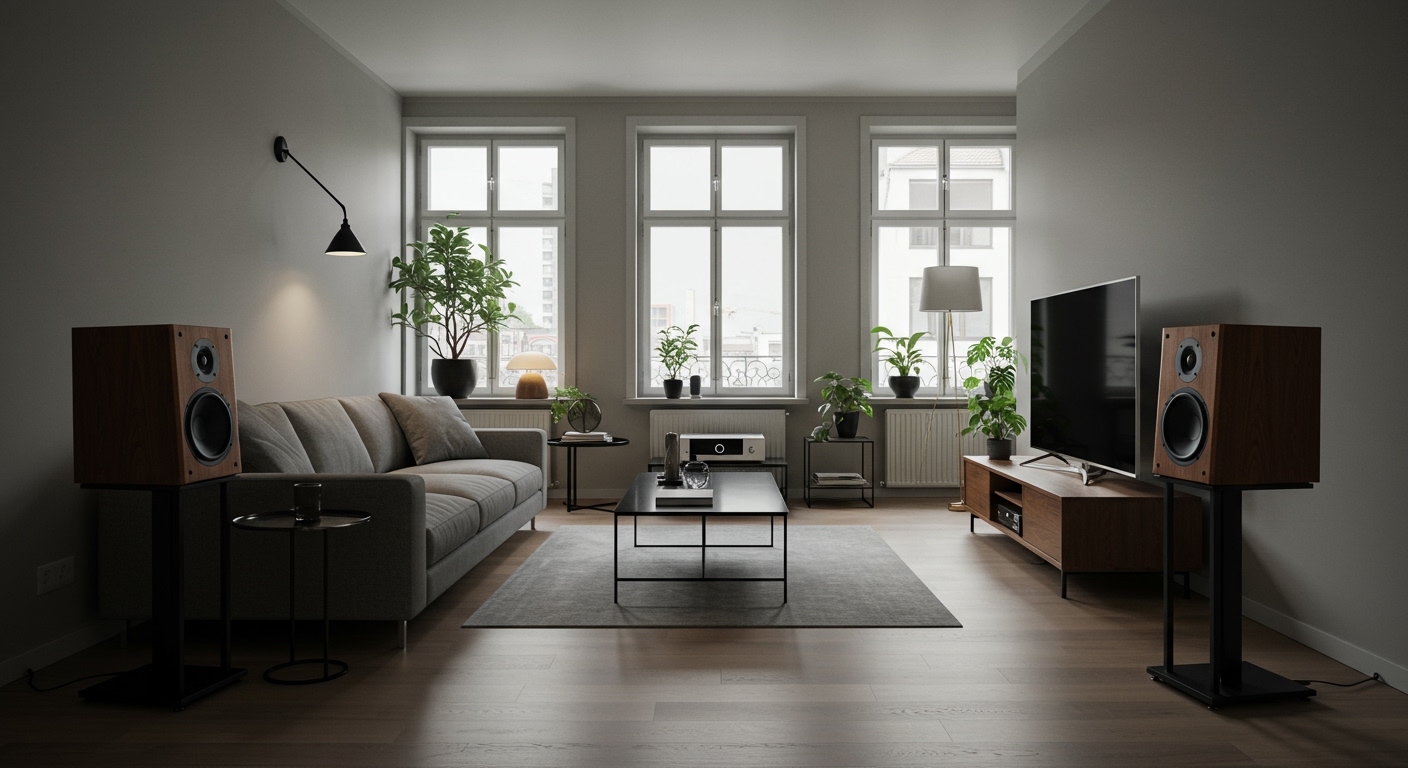
The Equilateral Triangle Rule: Your speakers and your head should form a perfect equilateral triangle. If your speakers are on the floor, this geometry is impossible to maintain.
Toe-In Adjustment: Angle your speakers slightly inward toward your shoulders. This increases the direct-to-reflected sound ratio, which is critical if you are struggling with poor floor placement.
Avoid Corners: Never put a bookshelf speaker in a corner on the floor. This creates a “megaphone effect” for bass that will drown out all musicality.
Rug Placement: If you must put speakers on a hard floor, place a thick wool rug between the speakers and your seat to absorb the primary floor reflections.
Common Mistakes to Avoid
Using the Box as a Stand: Never leave speakers inside their cardboard boxes or on top of hollow plastic bins. These act as resonators and destroy sound quality.
Ignoring the Tweeter Height: If you are tall, your stands need to be taller. Don’t settle for “standard” 24-inch stands if your ears sit at 40 inches.
- Blocking the Path: Ensure no furniture (coffee tables, ottomans) sits directly between the speaker and your ears.
Frequently Asked Questions
(FAQs)
Can I put speakers on the floor if I have carpet?
While carpet is better than hardwood for absorbing reflections, the answer to “can you put speakers on the floor” remains the same. Carpet will not fix the height alignment issue or the bass bloat caused by boundary reinforcement.
Is it okay to lay bookshelf speakers on their side?
Most bookshelf speakers are designed for vertical dispersion. Laying them on their side can narrow the “sweet spot” and cause phase issues between the woofer and tweeter. Only do this if the manufacturer explicitly states it is supported.
How high should bookshelf speakers be?
Ideally, the tweeter should be at the same height as your ears when seated. For most people, this is a height of 38 to 42 inches from the floor.
Can I use a subwoofer on the floor?
Yes! Unlike bookshelf speakers, subwoofers handle omnidirectional low frequencies. The floor actually helps a subwoofer perform better through room gain, though you should still use isolation feet to prevent rattling the floorboards.
Conclusion: Elevate Your Audio
While the technical answer to “can i put bookshelf speakers on the floor” is yes, the practical answer for anyone who values sound quality is a resounding no. Placing speakers on the floor sacrifices the clarity, detail, and emotional impact of your music.
If you truly cannot afford stands, use angled foam wedges or even a stack of heavy books to get those tweeters closer to ear level. Your ears (and your speakers) will thank you.
Ready to upgrade your listening setup? Explore our guide to the best budget speaker stands or learn how to calibrate your room acoustics for professional-grade sound at home.