Can I Use 18 Gauge Wire for Speakers? The Definitive Answer
Yes, you can i use 18 gauge wire for speakers, but its performance depends heavily on the length of the cable and the impedance of your speakers. For short runs under 25 feet and standard 8-ohm speakers, 18 AWG is perfectly adequate and provides clear, undistorted audio. However, for longer distances or high-power home theater setups, thicker wires like 16 gauge or 14 gauge are often recommended to prevent signal loss.
Expert Summary: Key Takeaways for Speaker Wiring
Optimal Distance: 18 gauge is best for runs under 25-30 feet.
Impedance Matters: Use thicker wire (14 or 16 AWG) for 4-ohm speakers to maintain a high damping factor.
Material Quality: Always prioritize Oxygen-Free Copper (OFC) over Copper-Clad Aluminum (CCA) for better conductivity.
Versatility: While is 18 gauge wire ok for speakers for most bookshelf setups, it may struggle with high-power subwoofers.
Safety First: Ensure your wire is CL2 or CL3 rated if you are running it through walls.
Understanding Speaker Wire Gauges (AWG)
When setting up an audio system, the term AWG (American Wire Gauge) refers to the thickness of the copper conductor. A lower number indicates a thicker wire. For example, can you use 14 gauge wire for speakers? Yes, and it is significantly thicker than 18 gauge.
Choosing the right thickness is about managing resistance. Thicker wires have less resistance, allowing more power to reach the speaker without being converted into heat. If the resistance is too high, you lose volume and “tightness” in the bass frequencies.
Speaker Wire Gauge Comparison Table
| Wire Gauge (AWG) | Recommended Max Length (8-ohm) | Recommended Max Length (4-ohm) | Best Use Case |
|---|---|---|---|
| 12 AWG | 120 Feet | 60 Feet | High-end home theater, long runs |
| 14 AWG | 80 Feet | 40 Feet | Professional installs, outdoor |
| 16 AWG | 48 Feet | 24 Feet | Standard home audio, surrounds |
| 18 AWG | 30 Feet | 15 Feet | Bookshelf speakers, short runs |
| 22 AWG | 10 Feet | 5 Feet | Very small satellites, low power |
Step 1: Assess Your Audio System Requirements
Before buying a spool of wire, you must evaluate your hardware. Is 18 gauge wire good for speakers in your specific room? Start by checking the distance from your receiver to each speaker location.
Measure the Distance
Measure the path the wire will actually take, including going around corners or up through walls. In my experience, it is always better to add an extra 10% to your measurement to account for slack and terminal connections.
Check Speaker Impedance
Look at the back of your speakers for the Impedance rating (usually 4, 6, or 8 ohms). If you have 4-ohm speakers, the wire’s resistance has a much bigger impact on sound quality. In this case, is 16 gauge wire ok for speakers? Yes, and it would be a safer bet than 18 gauge for 4-ohm loads.
Step 2: Choose the Right Wire Material and Type
Not all 18 gauge wires are created equal. You will encounter two primary types: Oxygen-Free Copper (OFC) and Copper-Clad Aluminum (CCA).
Oxygen-Free Copper (OFC): This is the gold standard. It offers the best conductivity and resists corrosion.
Copper-Clad Aluminum (CCA): This is cheaper but has higher resistance. If you use CCA, you should “step up” to a thicker gauge (e.g., use 16 AWG CCA to match the performance of 18 AWG OFC).
Can I use other wire types?
Many DIYers ask, can 18 gauge thermostat wire be used for car speakers? Technically, yes, as it is copper wire. However, thermostat wire is often “solid core,” which is brittle and can break under the vibrations of a car.
Similarly, can i use 12 awg electrical wire for speakers? Yes, standard Romex or electrical wire works, but it is stiff and difficult to route. For the best results, stick to stranded wire designed specifically for audio.
Step 3: Prepare Your Tools and Materials
To ensure a professional installation, gather the following items. Using the right tools prevents damage to the delicate copper strands.
Required Tools Summary
| Tool | Purpose | Recommendation |
|---|---|---|
| Wire Stripper | Removes insulation without cutting copper | Self-adjusting strippers |
| Measuring Tape | Measures run lengths | Standard 25ft tape |
| Banana Plugs | Provides a secure, clean connection | Gold-plated expansion type |
| Label Maker | Identifies wires (Left, Right, Center) | Simple adhesive labels |
| Heat Shrink | Seals connections (optional) | 3:1 ratio tubing |
Step 4: Cut and Strip the Wire
Action: Cut the wire to length. Use a sharp pair of wire cutters to get a clean edge. Avoid leaving too much excess “coiled up” behind the speaker, as this can create a small amount of electromagnetic interference.
Stripping the Insulation
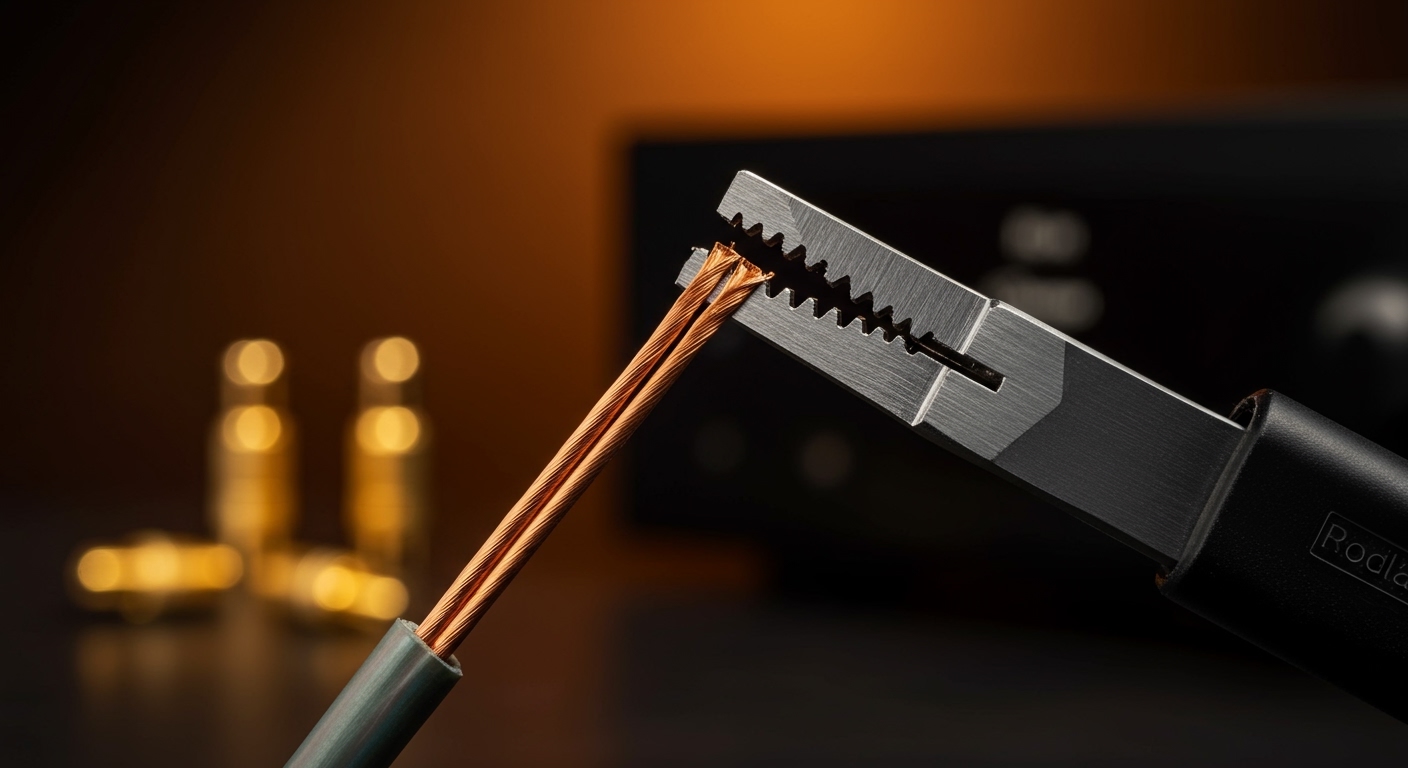
- Set your wire stripper to the 18 AWG setting.
- Remove approximately 1/2 inch to 3/4 inch of the plastic jacket.
- Expert Tip: Twist the exposed copper strands tightly clockwise. This prevents “stray hairs” from touching the adjacent terminal and causing a short circuit that could fry your amplifier.
Step 5: Terminate the Connections
While you can use bare wire, using Banana Plugs or Spade Connectors is highly recommended for is 18 gauge wire good for speakers setups.
Using Banana Plugs
Insert the wire into the bottom of the plug.
Fan the strands over the top or secure them with the side-screw.
Tighten the collar to ensure a rock-solid physical connection.
If you are using can i use solid 14g wire for speakers, be aware that solid wire does not work well with most compression-style banana plugs. Stranded wire is always preferred for flexibility and surface area contact.
Step 6: Connect to the Receiver and Speakers
Action: Maintain Polarity. This is the most critical step for sound quality. If you wire one speaker “out of phase,” your bass will disappear, and the soundstage will feel “hollow.”
Red Terminal (+): Connect to the wire with the marking (usually a stripe, text, or a ribbed edge).
Black Terminal (-): Connect to the plain wire.
Can i use 16 awg for speakers if I already have 18 gauge for the others? Yes, you can mix gauges in a system (e.g., 14 gauge for the long runs to the rear and 18 gauge for the short run to the center channel).
Common Alternatives: When 18 Gauge Isn’t Enough
Sometimes, you might find 18 gauge lacking. Here is how it compares to other common questions:
AWG vs. 16 AWG
Is 16 gauge wire good for speakers compared to 18? For most people, 16 gauge is the “sweet spot.” It is thin enough to hide under carpets but thick enough to handle 50-foot runs without audible signal loss.
Using Automotive or Electrical Wire
Can i use 12g auto wire for speakers? Yes, auto wire is typically very flexible and high quality. It works excellently for home audio.
Can i use any 12 awg wire for speakers? Generally, yes. As long as it is copper, the speaker doesn’t care what the insulation says. However, avoid “solid” house wire if you need to move your speakers frequently.
Can i use higher gauge wire for speakers? Remember, “higher gauge” means thinner wire. If you move from 18 to 22 gauge, you are increasing resistance. Only do this for very low-power, short-distance applications.
Pro Tips for Expert Installation
Avoid Power Lines: Do not run speaker wire parallel to AC power lines. If you must cross them, do so at a 90-degree angle to minimize hum and interference.
Label Everything: Use a label maker to mark both ends of the wire (e.g., “Front Left”). It saves hours of troubleshooting later.
Check for Shorts: After connecting, visually inspect the terminals. A single stray copper strand touching the chassis or the other terminal can trigger the “Protection Mode” on your receiver.
- Consider the Environment: If running wire outdoors, ensure it is Direct Burial rated. Using standard 18 gauge indoor wire outside will lead to the insulation cracking within a year.
FAQs: Everything You Need to Know About Speaker Gauges
Can I use 22 gauge wire for speakers?
You should only use 22 gauge wire for very small, low-power satellite speakers (like those in “Home Theater in a Box” systems) where the run is less than 10 feet. For high-fidelity audio, 22 gauge is too thin and will result in significant power loss.
Is 18 gauge thermostat wire safe for home speakers?
While it is safe (it won’t catch fire), it is not ideal. Thermostat wire is usually solid-core copper, which is less conductive for high-frequency audio signals due to the “skin effect” and is much harder to terminate into spring-clip terminals.
Can you use 14 gauge wire for speakers in a car?
Yes, 14 gauge is excellent for car audio, especially for door speakers or small subwoofers. It provides a lower resistance path, which is helpful in cars where the 12V system is more sensitive to voltage drops.
Can I use 18 wire gauge for home speakers with a 100W amplifier?
Yes, provided the distance is short. For a 100W per channel amp, 18 gauge is fine up to about 25 feet. If your speakers are further away, upgrading to 14 or 12 gauge will ensure the full 100W reaches the speaker drivers.
Is 18 gauge wire ok for speakers if I’m a casual listener?
Absolutely. Unless you are an audiophile with high-end equipment or are running wires across a massive room, you are unlikely to hear a difference between 18 gauge and thicker wires on a standard bookshelf or soundbar setup.
Final Verdict
To answer the primary question: Can I use 18 gauge wire for speakers? The answer is a resounding yes, with the caveat of distance. It is the perfect budget-friendly choice for small rooms, desktop setups, and surround speakers located near the receiver.
If you are building a dedicated home cinema or wiring a large living space, spending a few extra dollars on 16 gauge or 14 gauge wire is a smart “insurance policy” for your sound quality.
Ready to upgrade your sound? Start by measuring your room and choosing a high-quality Oxygen-Free Copper** wire to get the most out of your investment!