Can Malay Speakers Understand Indonesian? The Short Answer
Yes, Malay speakers can understand Indonesian with a high degree of mutual intelligibility, typically ranging between 70% and 80%. While both languages share the same linguistic ancestor (Old Malay), significant differences exist in vocabulary, slang, and loanwords due to historical colonial influences from the British in Malaysia and the Dutch in Indonesia.
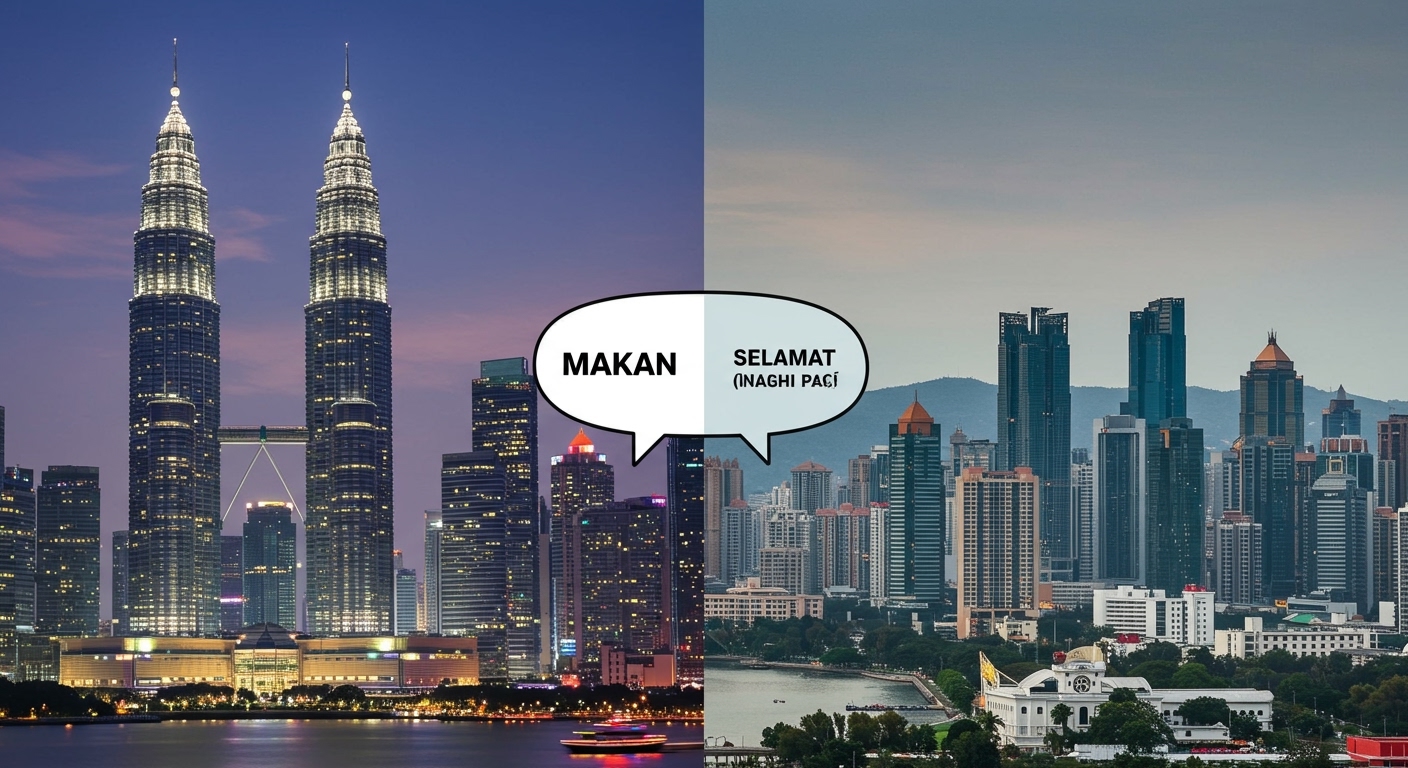
Key Takeaways: Mutual Intelligibility at a Glance
If you are in a rush, here is the essential breakdown of how these two languages interact:
- Mutual Intelligibility: High (70-80%). In formal settings, understanding is almost seamless.
- Primary Differences: Indonesian uses many Dutch loanwords, while Malaysian Malay uses English loanwords.
- False Friends: Several words sound identical but have drastically different (and sometimes offensive) meanings.
- Slang & Register: Informal “street” talk is much harder to bridge than formal, “standard” language used in news or government.
- Regional Accents: Some dialects (like Johor-Riau) are the “gold standard” for both, making them very easy to understand across borders.
The Linguistic Roots: Why They Sound Alike
To understand why Malay speakers can navigate Indonesian so well, we have to look at their history. I have spent years traveling between Kuala Lumpur and Jakarta, and the first thing I noticed was that while the rhythm of the speech feels familiar, the “flavor” of the words changes as soon as you clear customs.
Both languages belong to the Austronesian family. Specifically, they are both derived from Classical Malay, which was the lingua franca of the Srivijaya Empire and the Melaka Sultanate.
The Colonial Split
The divergence happened primarily due to the Anglo-Dutch Treaty of 1824.
- Malaysia (and Singapore) fell under British influence, leading to an influx of English technical and administrative terms.
- Indonesia fell under Dutch influence, leading to a heavy reliance on Dutch loanwords for things like “office,” “towel,” and “bicycle.”
Key Vocabulary Differences: A Comparative Table
When I first ordered a meal in Jakarta using Malaysian Malay, I received a few confused looks. The table below highlights some of the most common everyday objects that differ between the two languages.
| English | Malaysian Malay | Indonesian | Linguistic Note |
|---|---|---|---|
| Shop | Kedai | Toko | “Toko” is often used in formal MY Malay for bigger stores. |
| Office | Pejabat | Kantor | “Kantor” comes directly from the Dutch kantoor. |
| Bicycle | Basikal | Sepeda | “Basikal” is from English; “Sepeda” from Dutch velocipede. |
| Towel | Tuala | Handuk | “Handuk” is from the Dutch handdoek. |
| Pharmacist | Farmasi | Apoteker | “Apoteker” comes from Dutch apotheker. |
| Car | Kereta | Mobil | In Malaysia, “Kereta” is a car; in Indonesia, it’s a train! |
| Monday | Isnin | Senin | Slight spelling and pronunciation shifts. |
| Room | Bilik | Kamar | “Kamar” is another Dutch influence (kamer). |
Beware of “False Friends”: Words That Can Get You in Trouble
This is where my first-hand experience becomes a cautionary tale. False friends are words that look or sound the same in both languages but have different meanings. If you are a Malay speaker in Indonesia, using the wrong word can lead to embarrassment or confusion.
Butuh**
- In Malaysia: This is a highly vulgar slang term for male anatomy. Never use it.
Bisa**
- In Malaysia: Usually means “poison” or “venom” (as in a snake bite).
- In Indonesia: It is the most common word for “can” or “able to.”
Percuma**
- In Malaysia: It means “free of charge” (gratis).
- In Indonesia: It means “useless” or “in vain.” Imagine telling an Indonesian customer their meal is “percuma” (useless) when you meant it was free!
Kereta**
- In Malaysia: This is your everyday “car.”
Step-by-Step Guide: How to Understand Indonesian as a Malay Speaker
If you are planning to visit Indonesia or work with Indonesian colleagues, follow these steps to maximize your understanding.
Step 1: Focus on the Suffixes
Indonesian and Malay use similar prefix and suffix systems (affixes). However, Indonesian frequently uses the “-an” and “me-“ affixes in slightly different ways.
Action: Listen for the root word. If you strip away the prefixes like ber-, me-, or peng-*, you will likely recognize the base Malay word.
Step 2: Learn the Dutch Loanword Basics
Since the main barrier is Dutch influence, spending 20 minutes learning common Dutch-derived Indonesian words will close the gap by about 10%.
- Examples: Knalpot (Exhaust), Grtis (Free), Kulkas (Refrigerator), Bioskop (Cinema).
Step 3: Adjust Your Pronunciation
Malay speakers from the peninsula often end words with a soft “e” sound (the schwa), whereas Indonesians typically pronounce the final “a” clearly and sharply.
Malay: Saya* sounds like “Saye.”
Indonesian: Saya* sounds exactly like “Sa-Ya.”
Step 4: Use “Formal” Indonesian as a Bridge
If you are struggling with “slang” (Bahasa Gaul), switch to Bahasa Baku (Standard Indonesian). Most Malay speakers find formal Indonesian news broadcasts (like TVRI or MetroTV) much easier to understand than Indonesian teenage dramas.
The Role of Pop Culture in Bridging the Gap
One reason can Malay speakers understand Indonesian so well today is the massive export of Indonesian media.
- Indonesian Music (Pop/Dangdut): Bands like Sheila on 7 or Noah are huge in Malaysia. Through lyrics, Malay speakers naturally absorb Indonesian vocabulary.
- Sinetron (Soap Operas): For decades, Malaysian television has aired Indonesian dramas. This constant exposure has “trained” the Malaysian ear to decode Indonesian sentence structures.
- Upin & Ipin: Conversely, the Malaysian cartoon Upin & Ipin is a massive hit in Indonesia, helping young Indonesians understand Malaysian dialects.
Dialect Matters: The Johor-Riau Connection
Not all Malay is the same. If you speak the Kelantan or Terengganu dialect, an Indonesian will likely understand almost zero percent of what you say.
However, the Standard Malay used in both countries is based on the Johor-Riau dialect.
- Riau (Indonesia) and Johor (Malaysia) are geographically close.
- Their version of Malay is the “neutral ground.”
- Expert Tip: If you want to be understood in Jakarta, use your most “textbook” school Malay. Avoid regional slang from the north of Malaysia.
Grammar and Syntax: More Similarities Than Differences
The good news for Malay speakers is that the “engine” of the language is identical.
- Word Order: Both use Subject-Verb-Object (SVO).
- Plurals: Both use Reduplication.
- No Genders/Conjugations: Unlike European languages, neither language changes verbs based on gender or time.
Practical Advice for Business and Travel
When I work with teams across Jakarta, Kuala Lumpur, and Singapore, I follow these rules to ensure no data is lost in translation:
Clarify Dates: Be careful with months. While mostly the same, the pronunciation of August (Ogos vs Agustus) and March (Mac vs Maret*) can lead to scheduling errors.
- Written vs. Spoken: Written Indonesian is much easier for a Malay speaker to read than it is to understand when spoken at high speed. When in doubt, write it down.
- Respect the “Baku”: In formal meetings, stick to Bahasa Baku. It is the most “unifying” version of the language.
Frequently Asked Questions
Is Indonesian a dialect of Malay?**
Technically, Indonesian (Bahasa Indonesia) is a standardized form of Malay. It was adopted as the national language of Indonesia in 1945 to unite the thousands of islands under one common tongue.
Can an Indonesian understand a Malaysian easily?**
Generally, yes. However, Indonesians sometimes find Malaysian Malay to sound a bit “old-fashioned” or “formal,” while Malaysians might find Indonesian to sound “expressive” or “slang-heavy.”
Which language is harder to learn?**
Both are considered some of the easiest languages for English speakers to learn because they use the Latin alphabet and have no complex verb conjugations.
Do they use the same slang?**
No. Slang is where the languages differ the most. Indonesian slang (Bahasa Prokem) is heavily influenced by Javanese and Jakarta-centric expressions, while Malaysian slang uses many English and Cantonese/Hokkien loanwords.
Can I use a Malay dictionary in Indonesia?**
It will help with about 80% of the words, but you will be missing the Dutch loanwords and modern Indonesian technical terms. It is better to use a dedicated Indonesian-English dictionary.