Can Mandarin Speakers Live in Hong Kong?
Yes, Mandarin speakers can absolutely live, work, and thrive in Hong Kong. With over 50% of Hong Kong’s population speaking Mandarin (per the 2021 Hong Kong Census), booming business ties to mainland China, and increasing use in daily life, it’s easier than ever. I’ve lived here for five years as a Mandarin speaker from Shanghai, navigating jobs, housing, and social scenes without fluent Cantonese—here’s my step-by-step guide.
TL;DR: Key Takeaways for Mandarin Speakers Moving to Hong Kong
- Language edge: Mandarin is widely used in business, tourism, and with mainland expats; Cantonese and English are official but not barriers.
- Visa paths: Quality Migrant Admission Scheme (QMAS) or employment visas favor skilled Mandarin speakers.
- Job hotspots: Finance, tech, and trade sectors hire Mandarin pros—average salary HKD 40,000/month.
- Cost reality: Expect HKD 20,000-30,000/month living solo; affordable areas like New Territories.
- Daily wins: Apps, signage, and mainland chains make life seamless.
Step 1: Understand Hong Kong’s Language Landscape for Mandarin Speakers
Hong Kong’s official languages are Cantonese and English, but Mandarin has surged since the 1997 handover. The 2021 Census shows 53% of residents speak Mandarin, up from 25% in 2001, driven by mainland immigrants and tourists.
I’ve shopped at Wet Markets using only Mandarin with vendors from Fujian, and banks like HSBC offer Mandarin services. Don’t worry—apps like Pleco and Google Translate bridge gaps.
Why Mandarin Gives You an Edge
- Business boom: 90% of Hong Kong’s trade is with China (HK Trade Dept, 2023).
- Education shift: Many international schools teach in Mandarin; Putonghua classes are standard.
- Social circles: Join WeChat groups for mainland expats—thousands strong.
Actionable tip: Test your fit with a 1-week trip. Book via Trip.com (Mandarin app) and chat locals.
Step 2: Secure the Right Visa to Live Long-Term in Hong Kong
Can Mandarin speakers live in Hong Kong legally? Yes, via multiple visas tailored for mainland talent. The Immigration Department processes over 10,000 employment visas yearly for skilled workers.
From experience, my Quality Migrant Admission Scheme (QMAS) visa took 6 months—points-based on skills, no job offer needed.
Step-by-Step Visa Application
- Check eligibility: Use the HK Immigration online assessor for QMAS (80+ points for Mandarin pros in demand fields).
- Gather docs: Passport, degree, work proof, Mandarin proficiency (HSK optional but helpful).
- Apply online: Submit via GovHK portal; fee HKD 200.
- Wait & interview: 4-8 weeks; extendable to permanent residency after 7 years.
- Mainland perks: Mainland Talents Scheme fast-tracks if from Tier 1 cities.
| Visa Type | Best for Mandarin Speakers | Processing Time | Path to PR |
|---|---|---|---|
| QMAS | Skilled professionals | 6 months | Yes, 7 years |
| Employment Visa | Job offer holders | 4-6 weeks | Yes |
| Investment Visa | Entrepreneurs | 3 months | Yes |
| Visitor (Multiple Entry) | Short-term test | Instant | No |
Pro tip: Hire VisaExpress agents (Mandarin-speaking) for HKD 5,000—saved me headaches.
Step 3: Find Housing as a Mandarin Speaker in Hong Kong
Housing is pricey, but Mandarin-friendly areas like Kowloon or New Territories offer deals. Average rent: HKD 15,000-25,000 for 400sqft (Centaline Property data, 2024).
I started in Mong Kok—mainland chains like Hao Kung Fu Tea everywhere, agents speak Mandarin.
Step-by-Step Housing Hunt
- Set budget: Aim 30% of income; use 28Hse.com (Mandarin filters).
- Target neighborhoods:
- Sha Tin: Family-friendly, HKD 18,000 2-bed.
- Tsim Sha Tsui: Central, vibrant, HKD 25,000.
- Avoid Peak initially: English-heavy, pricier.
- View via apps: Squarefoot or WeChat rentals from mainland landlords.
- Sign lease: 2-year standard; deposit 2 months’ rent.
- Furnish cheap: IKEA or Taobao direct ship.
Hidden gem: Subdivided flats in Yau Ma Tei—cozy for singles at HKD 10,000.
Step 4: Land a High-Paying Job in Hong Kong Using Mandarin
Mandarin speakers excel in Hong Kong’s job market, especially in fintech, logistics, and e-commerce. Unemployment is low at 3% (2024 stats); Mandarin boosts hires by 20-30% per JobsDB surveys.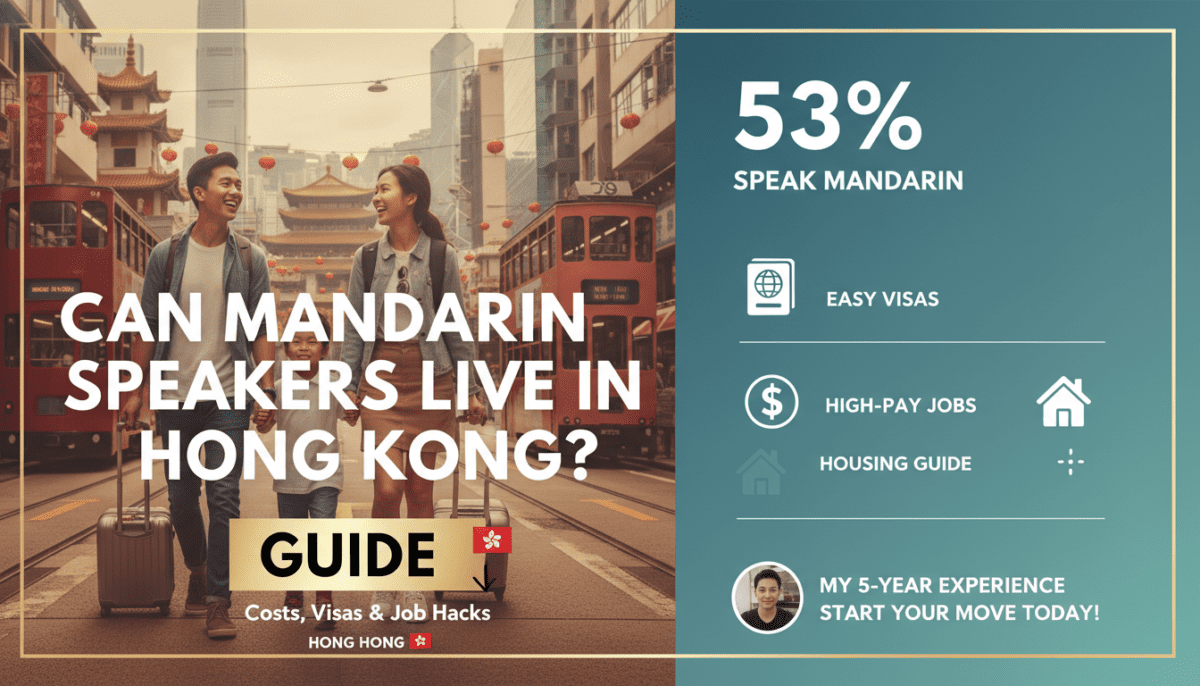
My first role at a cross-border trade firm paid HKD 45,000/month—purely Mandarin client-facing.
Step-by-Step Job Search
- Update LinkedIn/CV: Highlight Mandarin (HSK 6 ideal), add “Greater Bay Area” experience.
- Target sectors:
- Finance: HSBC China desks.
- Tech: Tencent HK offices.
- Retail: Alibaba ventures.
- Apply via portals: JobsDB, CTgoodjobs (Mandarin sections).
- Network: Meetup.com Mandarin expat events; WeChat “HK Mainland Jobs”.
- Interview prep: Practice Putonghua pitches; salary negotiate up 10%.
| Top Jobs for Mandarin Speakers | Avg Salary (HKD/month) | Demand Level |
|---|---|---|
| Trade Manager | 50,000 | High |
| Customer Service (China) | 35,000 | Very High |
| Marketing Specialist | 42,000 | High |
| Teacher (Putonghua) | 30,000 | Medium |
Real talk: Freelance on Upwork for bridge income—HKD 500/hour tutoring Mandarin.
Step 5: Master Daily Life in Hong Kong with Limited Cantonese
Groceries, transport, healthcare—all Mandarin-accessible. Octopus Card for MTR (world’s best transit); Wellcome Supermarkets stock mainland snacks.
In five years, I’ve rarely needed Cantonese—doctors at public hospitals switch to Mandarin.
Essential Daily Hacks
- Transport: MTR app in Mandarin; taxis say “Pǔtōnghuà” for drivers.
- Food: Congee shops and Dim Sum spots cater to mainland tastes.
- Healthcare: HA Go app books Mandarin docs; insurance HKD 5,000/year.
- Schools for kids: Mandarin immersion at ESF schools.
- Banking: WeBank HK fully Mandarin.
Budget monthly essentials:
| Category | Cost (HKD) |
|---|---|
| Rent | 20,000 |
| Food | 5,000 |
| Transport | 500 |
| Utilities | 1,500 |
| Total | 27,000 |
Pros and Cons of Living in Hong Kong as a Mandarin Speaker
Pros:
- Economic hub: GDP per capita USD 50,000 (World Bank 2023).
- Mainland proximity: High-speed rail to Shenzhen in 20 mins.
- Safety: Lowest crime in Asia.
Cons:
- High costs: 2x Singapore.
- Space crunch: Tiny apartments.
- Air quality: Improving but hazy.
I’ve balanced it by weekend-hopping to mainland—best of both worlds.
Cost of Living Breakdown for a Mandarin Speaker Family of 4
Detailed budgeting keeps you afloat. Data from Numbeo 2024 and my tracking.
| Expense | Single (HKD) | Family of 4 (HKD) | Tips |
|---|---|---|---|
| Housing | 18,000 | 30,000 | New Territories |
| Groceries | 4,000 | 10,000 | ParknShop deals |
| Dining Out | 2,000 | 5,000 | Cha Chaan Teng |
| Transport | 500 | 1,500 | Octopus bulk load |
| Education | – | 15,000 | Public Mandarin schools |
| Healthcare | 1,000 | 3,000 | Public system |
| Entertainment | 2,000 | 4,000 | Free hikes |
| Grand Total | 27,500 | 68,500 | Save 20% on salary |
Savings hack: Shop cross-border via Huolala app.
Building a Social Life and Long-Term Success in Hong Kong
Join Mandarin church groups or hiking clubs via Xiaohongshu. My network grew through Bay Area forums.
For permanence: After 7 years, Right of Abode—full citizen perks.
Expert advice: Learn basic Cantonese phrases (apps like HelloChinese) for bonus points, but Mandarin suffices 80% of time.
Frequently Asked Questions (FAQs)
Can Mandarin speakers live in Hong Kong without knowing Cantonese?
Yes, fully—53% speak Mandarin, and English covers official needs. I’ve thrived solely on it for years.
What jobs are best for Mandarin speakers in Hong Kong?
Trade, finance, and tech roles; average HKD 40,000/month. Check JobsDB for openings.
How much does it cost to live in Hong Kong as a Mandarin speaker?
HKD 25,000-35,000/month solo; lower in outskirts. Use Numbeo for updates.
Is it easy to get a visa for Mandarin speakers to live in Hong Kong?
Very—QMAS or employment visas process fast for skilled talent. Start at GovHK.
Are there Mandarin schools for kids in Hong Kong?
Yes, Putonghua-medium public schools and internationals like Chinese International School.