The Short Answer: Can You Put Speakers on Same Table as Record Player?
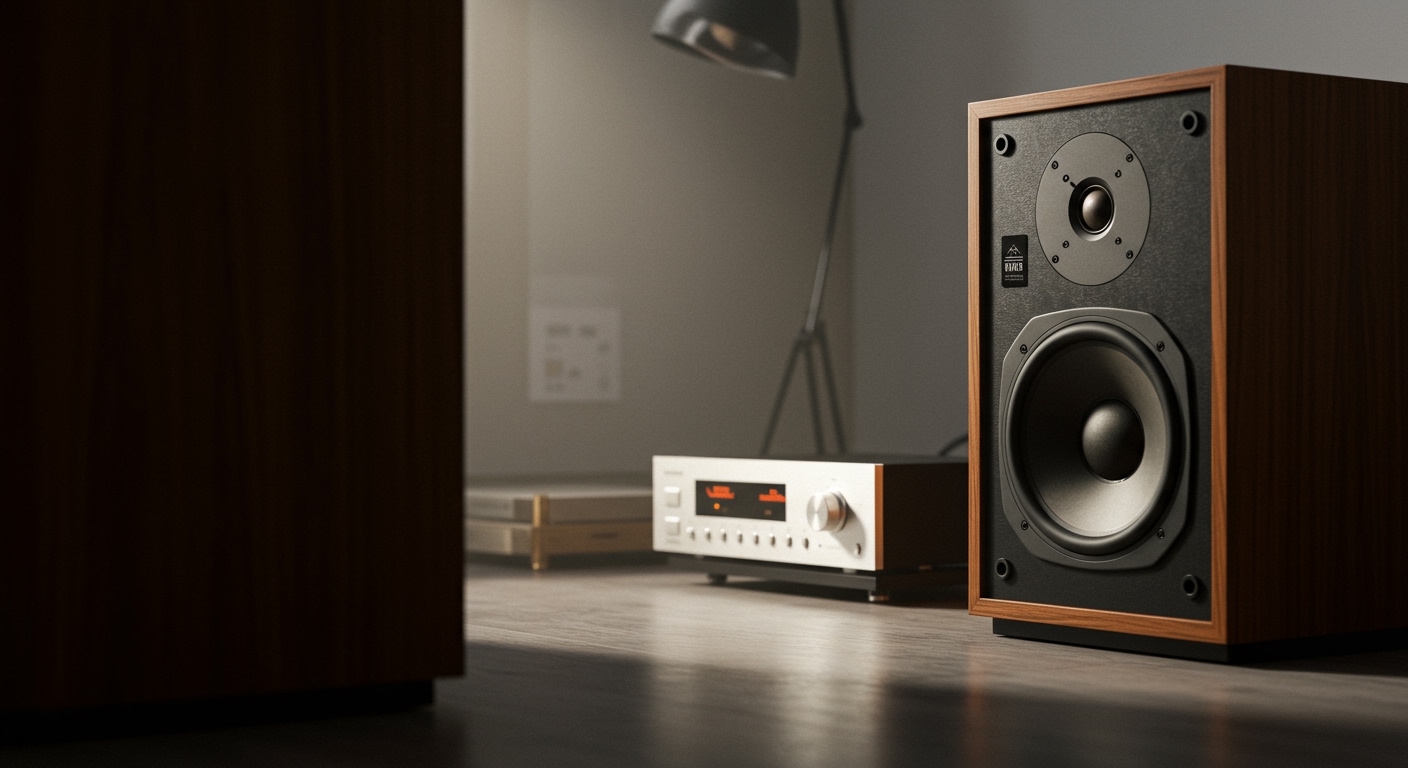
So, can you put speakers on same table as record player? Yes, you can, but it requires strict acoustic isolation to prevent audio distortion. If you place them directly on the same surface without decoupling tools, the bass vibrations from the speakers will travel into the turntable, causing the stylus to skip or create a muddy, low-frequency hum known as acoustic feedback.
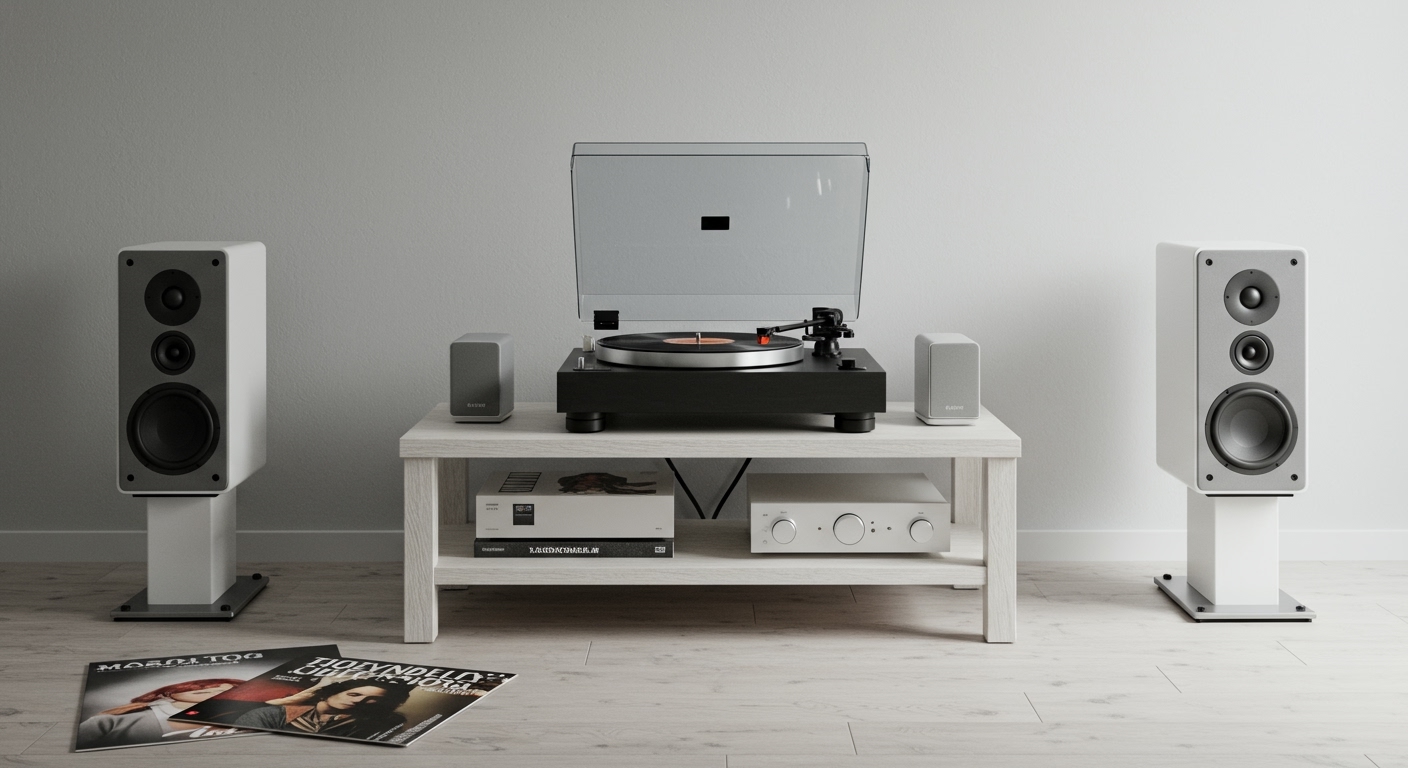
To successfully share a surface, you must physically separate the energetic components from the sensitive ones. By utilizing speaker isolation pads, turntable isolation feet, and choosing a heavy, high-mass furniture piece, you can enjoy a compact audio setup without sacrificing sound quality.
Key Takeaways for Sharing a Surface
- Vibrations are the enemy: A turntable’s stylus acts like a microscopic seismograph, picking up every vibration on the table.
- Isolation is mandatory: You must use high-density foam pads or sorbothane feet under your speakers to absorb low-end frequencies.
- Mass matters: Heavy solid wood or MDF tables absorb vibrations significantly better than glass or hollow metal desks.
- Keep a safe distance: Position speakers as far to the edges of the table as possible to minimize direct acoustic interference.
- Never share a subwoofer: While bookshelf speakers can be isolated, subwoofers generate too much kinetic energy and must always remain on the floor.
The Science of Sound: Why Turntables Hate Vibrations
To understand how to safely design your setup, we need to look at how vinyl records actually produce sound. Your record player relies on a phono cartridge and a microscopic diamond stylus tracing the microscopic grooves of a vinyl record.
This stylus typically operates with a highly sensitive tracking force of just 1.5 to 2.5 grams. Because the grooves are incredibly tiny, the stylus is designed to pick up even the most minuscule kinetic movements and convert them into an electrical audio signal.
When you ask, can you put speakers on same table as record player, the acoustic science points to a clash of physical forces. Speakers work by moving air and generating physical vibrations, particularly in the lower bass frequencies (20Hz to 250Hz).
If the speakers sit on the same wooden or glass surface as your turntable deck, those low-frequency vibrations travel directly through the solid table much faster than they travel through the air.
The Acoustic Feedback Loop Explained
When speaker vibrations travel through the table and hit the turntable, the stylus misinterprets these vibrations as music. The turntable then amplifies these vibrations and sends them back out through the speakers.
This creates a continuous cycle called an acoustic feedback loop. In real-world listening, this sounds like a low, muddy rumble that gradually gets louder until it completely overwhelms your music. In extreme cases, the kinetic energy is so strong that it physically bounces the tonearm, causing your record to skip entirely.
Step-by-Step Guide: How Can You Put Speakers on Same Table as Record Player Safely?
If space constraints mean a shared surface is your only option, you must engineer your setup to eliminate kinetic transfer. Here is my proven, step-by-step methodology for decoupling your audio gear.
Step 1: Install High-Density Speaker Isolation Pads
The very first line of defense is stopping speaker vibrations from ever entering the table. You achieve this through acoustic decoupling.
By placing your bookshelf speakers on specialized isolation pads, you absorb the kinetic energy before it transfers to the wood. I highly recommend using high-density acoustic foam angled downwards, or specialized isolation stands like the IsoAcoustics ISO-Pucks.
These devices use a patented isolation design that dissipates the energy generated by the speaker’s woofer. If you are on a budget, high-density EVA foam blocks also work incredibly well to dampen low-frequency resonance.
Step 2: Upgrade Your Turntable’s Isolation Feet
Most entry-level turntables come with hollow, hard plastic feet that do a terrible job of blocking surface vibrations. Upgrading the feet of your record player acts as your second line of defense.
Look for aftermarket isolation feet made from Sorbothane, a highly viscous synthetic urethane polymer. Sorbothane is considered the gold standard in acoustic damping because it absorbs shock and vibration by converting kinetic energy into a trace amount of heat.
If you cannot swap your turntable’s feet, place sorbothane hemispheres directly under the existing feet. This simple, inexpensive upgrade drastically reduces the transmission of table vibrations into your delicate tonearm.
Step 3: Utilize a Turntable Isolation Platform
For true audiophile-grade protection on a shared surface, you should introduce an isolation platform. This is a heavy, separate board that sits between your turntable and your main table.
An isolation board adds mass loading to your setup. You can buy specialized acrylic or bamboo platforms, but my favorite DIY solution is using a massive, three-inch-thick butcher block cutting board.
Place four heavy-duty isolation pucks on your main table, set the heavy butcher block on top, and then place your turntable onto the block. This multi-layered decoupling strategy guarantees that almost zero speaker vibration reaches the stylus.
Step 4: Optimize Your Speaker Placement and Distance
Even with the best isolation materials, physical distance remains a critical factor. When determining if can you put speakers on same table as record player, you must maximize the space between the components.
Place your speakers on the extreme far left and right edges of the table. Ensure the turntable is perfectly centered. The further the acoustic energy has to travel through the table, the more it naturally dissipates.
Furthermore, angle the speakers slightly inward toward your listening position (known as toe-in). Ensure the front edges of the speakers are pulled flush with the front edge of the table. If you push speakers too far back, the sound waves will bounce off the table’s surface, creating unwanted early reflections and additional surface resonance.
Step 5: Manage Cable Tension and Microphonics
An often-overlooked source of vibration transfer is your audio cables. Thick, stiff RCA cables or speaker wires can act as physical bridges, carrying vibrations from the back of the speakers directly into the turntable chassis.
Ensure your cables have plenty of slack. Do not zip-tie the speaker wire tightly alongside the turntable’s delicate RCA or grounding cables.
Let the cables drape loosely behind the table. This simple cable management trick prevents microphonics—the phenomenon where physical tapping or vibration on a wire is converted into an electrical audio signal.
Comparing Furniture Materials for Shared Audio Setups
The material of your furniture dictates how easily vibrations travel. Some materials are inherently “dead” (they absorb sound), while others are highly resonant (they amplify sound).
Below is a breakdown of common table materials and how they impact a shared speaker and turntable setup.
| Table Material | Acoustic Resonance | Suitability for Shared Setup | Required Isolation Level |
|---|---|---|---|
| Solid Hardwood (Oak, Maple) | Low | Excellent. Heavy mass naturally dampens vibrations. | Low to Medium |
| High-Density Fiberboard (MDF) | Very Low | Best. MDF is acoustically dead and used in speaker building. | Low |
| Plywood / Particle Board | Medium | Fair. Lightweight wood transfers bass frequencies easily. | High |
| Tempered Glass | Extremely High | Terrible. Glass rings like a bell and amplifies vibrations. | Extreme (Not Recommended) |
| Hollow Metal | High | Poor. Hollow legs create echo chambers for low frequencies. | High |
Why Heavy Furniture Wins Every Time
In the world of audio, mass is your best friend. A heavy piece of furniture requires significantly more kinetic energy to move than a lightweight piece.
If you are using a lightweight, flimsy desk from a big-box store, simply walking across the room might cause your record to skip. If you are restricted to a lightweight table, you must rely heavily on the butcher block and Sorbothane method mentioned earlier to artificially add mass directly under the record player.
Tested Solutions: My First-Hand Experience with Table Setup
In my early days of collecting vinyl, I lived in a tiny studio apartment. I had no choice but to place my Audio-Technica AT-LP120X turntable right next to a pair of powered Klipsch R-51PM bookshelf speakers on a standard Ikea wooden desk.
At first, I placed everything directly on the bare wood. The result was disastrous. Anytime a bass-heavy track played, a terrible low-end hum built up, muddying the entire mix. If I pushed the volume past 50%, the needle violently jumped out of the groove.
How I Fixed the Feedback Loop
I realized that to answer the question, can you put speakers on same table as record player, I had to get scientific with my workspace.
- I decoupled the speakers: I purchased high-density Auralex MoPADs. By resting the Klipsch speakers on these foam wedges, the aggressive bass punch was absorbed by the foam instead of the desk