Can You Run Speakers and a Sub Off One Amp?
Yes, you can absolutely run speakers and a sub off one amp. The most reliable way to do this is by using a 4-channel amplifier or a 5-channel amplifier. With a 4-channel amp, you power your two front speakers with the first two channels, and then “bridge” the remaining two channels to power a single subwoofer.
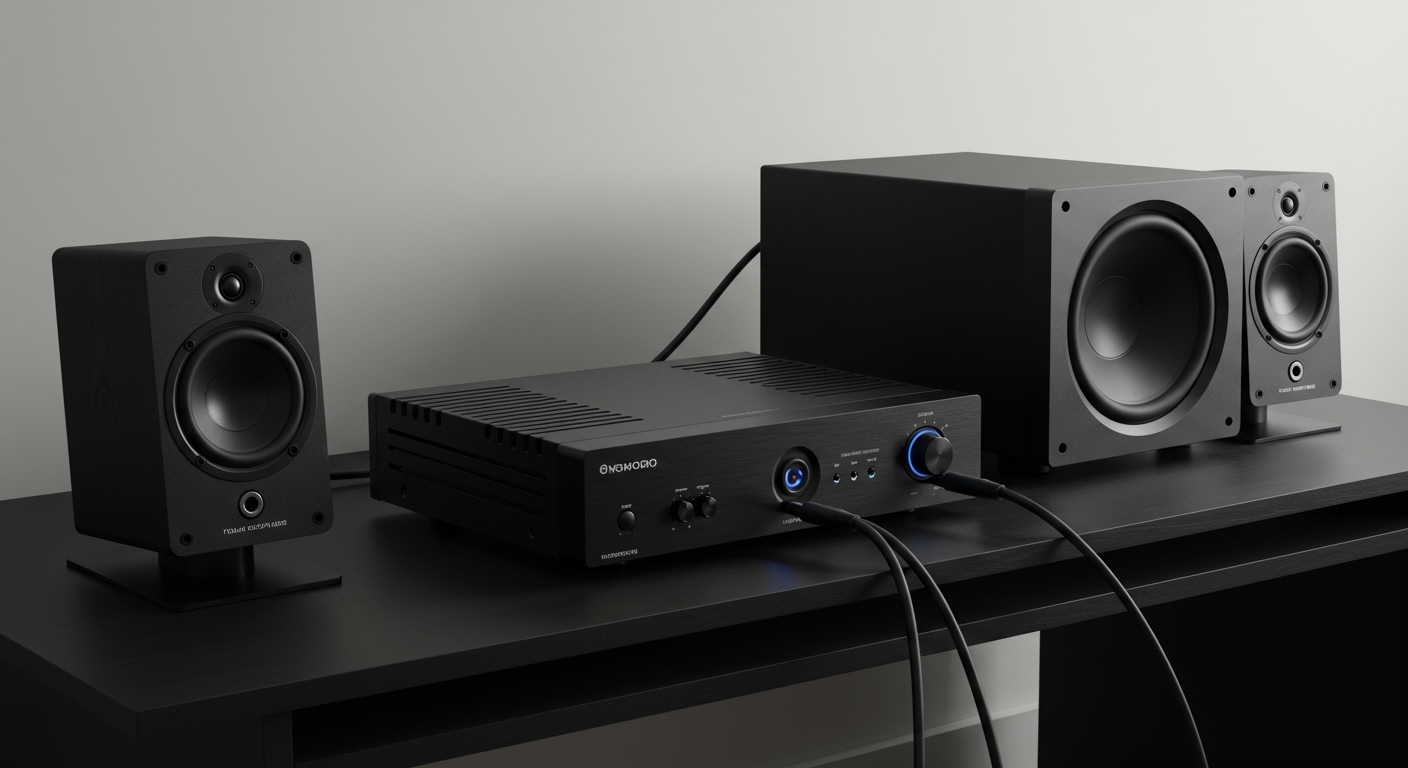
If you use a 5-channel amplifier, the process is even easier. The amp dedicates four channels to your front and rear door speakers, while the fifth channel provides dedicated power specifically for your subwoofer. While you can technically run speakers and a sub off a 2-channel amp using an old-school “Tri-Mode” configuration, it is highly complex and not recommended for modern car audio setups.
In my years of installing custom audio systems, I have found that running everything off a single amplifier is the smartest way to save space, reduce wiring clutter, and minimize the strain on your vehicle’s electrical system. Below, we will dive into the exact step-by-step process of wiring your speakers and subwoofer to a single amp for the perfect sound.
TL;DR: Key Takeaways
- Best Configuration: A 4-channel or 5-channel amp is ideal for powering both speakers and a subwoofer simultaneously.
- Bridging is Key: On a 4-channel amp, Channels 1 and 2 power your front speakers, while Channels 3 and 4 are bridged to combine their power for the sub.
- Impedance Matters: Always check your amplifier’s Ohm rating. Most bridged channels require a minimum of a 4-ohm load to prevent the amp from overheating.
- Crossovers: You must use built-in filters. Set the High-Pass Filter (HPF) for the speakers and the Low-Pass Filter (LPF) for the subwoofer.
- Cost-Effective: Using one amp reduces the need for multiple power wires, distribution blocks, and upgraded alternators.
Understanding the Anatomy of Your Amplifier
Before you start cutting wires, it is crucial to understand how multi-channel amplifiers distribute power. An amplifier takes a low-voltage audio signal from your head unit and boosts it to move the physical cones of your speakers.
When you ask, can you run speakers and a sub off one amp, the answer heavily depends on the physical architecture of that amplifier. Each “channel” on an amp represents an individual output capable of driving a speaker.
Subwoofers require significantly more power to move their heavy cones and produce deep bass. Therefore, standard speaker channels often do not have enough “juice” to power a sub individually. This is where the magic of bridging or dedicated sub channels comes into play.
What Does “Bridging” an Amplifier Mean?
Bridging is the process of combining two separate amplifier channels into one single, highly powerful channel. By taking the positive terminal from one channel and the negative terminal from an adjacent channel, you effectively double the voltage output.
For example, if a 4-channel amp outputs 50 watts RMS per channel, bridging channels 3 and 4 might yield 150 to 200 watts RMS for a subwoofer. This is the exact mechanic that allows a single 4-channel amp to expertly run a pair of door speakers and a heavy-hitting subwoofer at the same time.
It is important to note that bridging changes the electrical resistance (impedance) that the amplifier “sees.” Most amps are stable down to 2 ohms on a standard stereo channel, but when bridged, they usually require a 4-ohm minimum load. I once melted an expensive Rockford Fosgate amp in my early days by ignoring this rule and bridging a 2-ohm sub—do not make that mistake!
How to Run Speakers and a Sub Off a 4-Channel Amp (Step-by-Step)
The 4-channel amplifier is the most popular choice for budget-conscious audiophiles looking to upgrade their entire system. This setup is commonly referred to as a “3-channel mode” or “2.1 setup.”
In this configuration, we sacrifice the rear door speakers (running them directly off the weak factory head unit, or abandoning them entirely) to prioritize high-quality front sound and deep bass. Here is exactly how you wire it.
Step 1: Prep the Vehicle and Disconnect Power
Safety always comes first in car audio. Before touching any wires, pop your hood and disconnect the negative terminal of your vehicle’s battery. This prevents accidental short circuits that could blow your car’s main fuses or fry your new amplifier.
Ensure you have a high-quality amp wiring kit. For a 4-channel setup, I highly recommend using 4-AWG OFC (Oxygen-Free Copper) wire. CCA (Copper-Clad Aluminum) wire is cheaper, but it carries less current and can starve your amplifier of power during heavy bass hits.
Step 2: Run Your RCA Cables Correctly
Your amplifier needs an audio signal from your stereo. You will need to run two sets of RCA cables from the back of your head unit to the amplifier.
Plug the first set of RCAs into the “Front” pre-outs on your stereo, and connect them to the Channel 1 and 2 inputs on your amp. Plug the second set of RCAs into the “Subwoofer” or “Rear” pre-outs on your stereo, routing them to the Channel 3 and 4 inputs on the amp. Keep RCA cables on the opposite side of the car from your main power wire to prevent engine whine interference.
Step 3: Wire the Front Speakers
Run high-quality 16-gauge speaker wire from the amplifier to your left and right front door speakers.
- Connect the Left Front speaker to the Channel 1 positive and negative terminals.
- Connect the Right Front speaker to the Channel 2 positive and negative terminals.
Ensure your positive and negative wires match at both the amplifier and the speaker ends. Wiring a speaker backwards results in being “out of phase,” which completely kills mid-bass response and makes the music sound hollow.
Step 4: Bridge Channels 3 and 4 for the Subwoofer
Now it is time to connect the subwoofer. Look closely at the speaker output terminals for Channels 3 and 4 on your amplifier. The manufacturer usually prints a small line or bracket indicating which terminals to use for bridging.
Typically, you will connect the subwoofer’s positive wire to the Positive (+) terminal of Channel 3. Then, connect the subwoofer’s negative wire to the Negative (-) terminal of Channel 4. By doing this, you combine the power of both channels, sending a massive surge of wattage to your subwoofer.
Step 5: Set Your Crossovers and Gain
Once wired, reconnect your battery and turn the system on at a very low volume. You must now configure the amplifier’s built-in crossovers, which dictate what frequencies go to which speakers.
For Channels 1 and 2 (your front speakers), set the crossover switch to HPF (High-Pass Filter). Adjust the dial to around 80Hz. This blocks deep bass from reaching your small door speakers, preventing them from distorting or blowing.
For Channels 3 and 4 (your bridged subwoofer), set the crossover switch to LPF (Low-Pass Filter). Adjust this dial to 80Hz as well. This blocks high-pitched vocals and cymbals from playing through your subwoofer, ensuring it only plays clean, thumping bass.
How to Run Speakers and a Sub Off a 5-Channel Amp (The Ideal Setup)
If you have the budget, buying a 5-channel amplifier is the absolute best way to run your entire system. It eliminates the need for bridging and allows you to keep your rear door speakers