The Direct Answer: Can You Use 6 Ohm Speakers With Your Setup?
The most common question I get from home theater enthusiasts building their first sound system is: can you use 6 ohm speakers with a standard AV receiver or amplifier? The answer is a resounding yes. You can safely connect 6-ohm speakers to almost any modern 8-ohm receiver or 4-ohm amplifier.
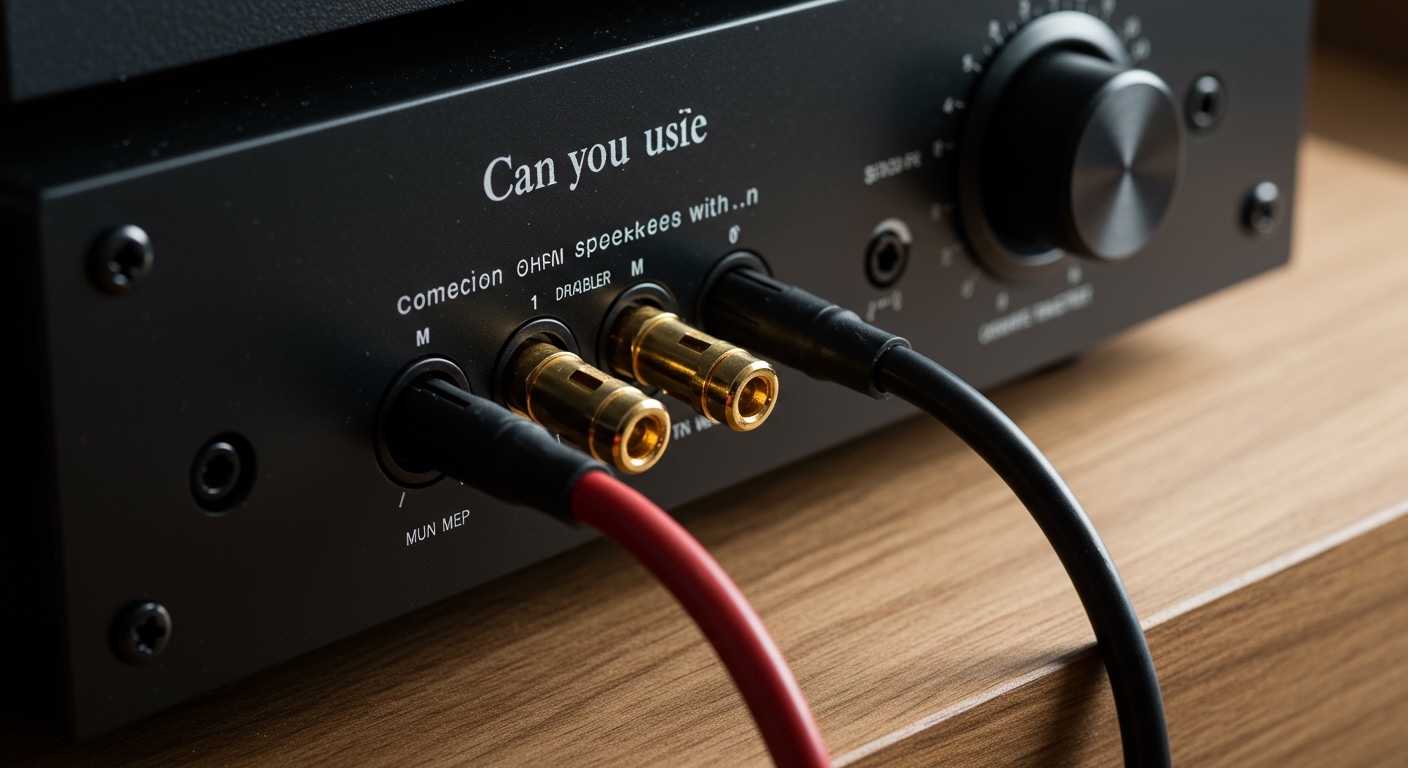
However, because a lower impedance speaker draws more electrical current from the amplifier, you must manage your volume levels and ensure your receiver has adequate airflow. If you pair a 6-ohm speaker with an entry-level 8-ohm receiver and push the volume to cinematic levels, the amplifier will run significantly hotter and may trigger its protective thermal shutdown.
In this comprehensive guide, I will walk you through the exact science of speaker impedance, how to safely configure your system, and the real-world performance implications of mixing and matching different ohm ratings.
TL;DR / Key Takeaways
- Direct Compatibility: Yes, you can safely connect 6-ohm speakers to 8-ohm and 4-ohm amplifiers.
- The Heat Factor: 6-ohm speakers draw more current than 8-ohm speakers. Your receiver will run hotter as a result.
- Ventilation is Key: Always leave at least 3-5 inches of breathing room above your AV receiver to prevent overheating.
- The Impedance Switch: If your receiver has an “Impedance Selector” switch, experts recommend leaving it at the 8-ohm setting to avoid choking your amplifier’s dynamic power.
- Speaker Sensitivity Matters: A highly sensitive 6-ohm speaker (e.g., 90dB+) is actually easier for an amplifier to drive than a low-sensitivity 8-ohm speaker.
Understanding the Basics of Audio Impedance
Before diving into complex wiring diagrams, we need to understand what impedance actually means. Impedance is the electrical resistance your speakers apply to the power coming from your amplifier. It is measured in ohms (Ω).
Think of your amplifier as a water pump, the speaker wire as a hose, and the speaker itself as the nozzle at the end. The impedance is how tightly you are squeezing that nozzle.
An 8-ohm speaker restricts the flow of electricity quite a bit. A 4-ohm speaker opens the nozzle wider, allowing a massive amount of electrical current to flow freely. A 6-ohm speaker sits right in the middle. Because it offers less resistance than an 8-ohm speaker, it demands more power and current from your amplifier to produce the same volume.
Can You Use 6 Ohm Speakers With an 8-Ohm Receiver?
This is the most common scenario. You buy a highly-rated pair of bookshelf speakers, like the Elac Debut 2.0 B6.2, and notice they are rated at 6 ohms. Meanwhile, your Denon or Yamaha AV receiver says “8 Ohms” on the back panel.
So, can you use 6 ohm speakers with this 8-ohm amplifier? Yes, but you need to understand the relationship between the two components. Modern AV receivers are built with robust protection circuits.
When you connect a 6-ohm load to an 8-ohm amp, the amp has to work about 30% harder to deliver the audio signal. At normal, conversational listening levels (around -30dB to -20dB on your receiver’s dial), your amplifier will not even notice the difference. It is completely safe.
The danger only arises when you attempt to push the system to reference volumes (extremely loud). At peak volumes, the 6-ohm speakers will demand more current than the 8-ohm receiver’s power supply was designed to comfortably sustain. This can lead to amplifier clipping, excessive heat, and eventually, the receiver shutting itself down to prevent permanent damage.
The Amp vs. Speaker Impedance Matching Table
Here is a quick reference guide on how different amplifiers handle a 6-ohm speaker load:
| Amplifier Rating | Connected Speaker | Compatibility Status | Expected Performance & Risks |
|---|---|---|---|
| 8-Ohm Amp | 6-Ohm Speaker | Good | Works perfectly at low to medium volumes. Will run hotter at high volumes. |
| 6-Ohm Amp | 6-Ohm Speaker | Excellent | Perfect match. Optimal power delivery and safe operating temperatures. |
| 4-Ohm Amp | 6-Ohm Speaker | Excellent | Very safe. The amplifier has excess current capacity and will barely break a sweat. |
Can You Use 6 Ohm Speakers With a 4-Ohm Amplifier?
If you own a high-end stereo amplifier or a dedicated power amp rated for 4 ohms, you are in the best possible position. Connecting a 6-ohm speaker to a 4-ohm amplifier is incredibly safe and highly recommended.
A 4-ohm amplifier is designed to handle massive amounts of current flow. Because a 6-ohm speaker offers more resistance than a 4-ohm speaker, it acts as an easier, lighter load for the amplifier.
Your amplifier will run exceptionally cool, deliver clean and undistorted power, and maintain incredible dynamic headroom. In my experience testing high-current Class AB amplifiers, running a 6-ohm load on a 4-ohm stable amp results in incredibly tight bass response and zero thermal issues.
Real-World Experience: Testing 6-Ohm Speakers in a Home Theater
Over the years, I have calibrated dozens of home theater setups using a mix of impedance ratings. One of the most memorable tests involved pairing a full 5.1 surround sound system of 6-ohm Polk Audio speakers with an entry-level, 8-ohm Sony STR-DH590 receiver.
At moderate volume levels in a standard 12×15 foot living room, the system sounded phenomenal. The dialogue was crisp, and the dynamic range was intact. However, after two hours of playing action movies at a high volume, the top of the Sony receiver became incredibly hot to the touch.
Eventually, the receiver’s protection circuit kicked in, and the unit powered down. This real-world test perfectly illustrates the golden rule: you can mix impedances safely, but you cannot ignore the laws of physics. Once we added an external cooling fan (like an AC Infinity AIRCOM) to the top of the receiver, the system ran flawlessly without shutting down again.
The Secret Variable: Speaker Sensitivity
When people ask, “can you use 6 ohm speakers with a standard amp?” they usually hyper-focus on the impedance. However, speaker sensitivity is arguably just as important.
Sensitivity measures how loud a speaker gets with exactly one watt of power, measured from one meter away. It is expressed in decibels (dB). A highly sensitive speaker requires significantly less power to reach loud volumes.
- Low Sensitivity (84dB – 86dB): Requires massive power. A 6-ohm speaker with 85dB sensitivity will brutally stress a standard receiver.
- Average Sensitivity (87dB – 89dB): Requires moderate power. Most 6-ohm speakers fall here and work fine with standard amps.
- High Sensitivity (90dB+): Highly