Can You Use a Mono Amp for Door Speakers? The Direct Answer
Technically, yes, you can use a mono amp for door speakers, but it is strongly discouraged for several critical reasons. A monoblock amplifier combines left and right audio signals into a single channel, completely eliminating the stereo separation that is essential for a proper soundstage in music. In my years of professional installation, I’ve seen this attempted as a cost-saving measure, and the result is always a flat, lifeless, and fundamentally incorrect audio experience. You risk not only poor sound quality but also potential damage to your equipment.
This guide will walk you through exactly why this is a bad idea, the specific risks involved, and the correct way to power your door speakers to get the clean, dynamic sound you paid for.
Key Takeaways
- Direct Answer: No, you should not use a mono (single-channel) amplifier for your main door or rear speakers.
- Primary Issue: You will lose all stereo sound. A mono amp sums the left and right channels into one, destroying the “soundstage” and making music sound flat and centered.
- Technical Risks: Mono amps are designed for low-impedance subwoofer loads and often have built-in low-pass filters (LPF) that block the mid and high frequencies your door speakers need to reproduce.
- The Correct Solution: Always use a 2-channel or 4-channel amplifier for stereo speakers. This provides dedicated power for the left and right channels, preserving the intended audio mix.
Understanding the Core Difference: Mono vs. Stereo Amps
Before we dive into the “why not,” it’s crucial to understand what makes these amplifiers different. It’s not just about the number of speaker terminals on the back; it’s about their fundamental design and purpose.
What is a Mono Amplifier?
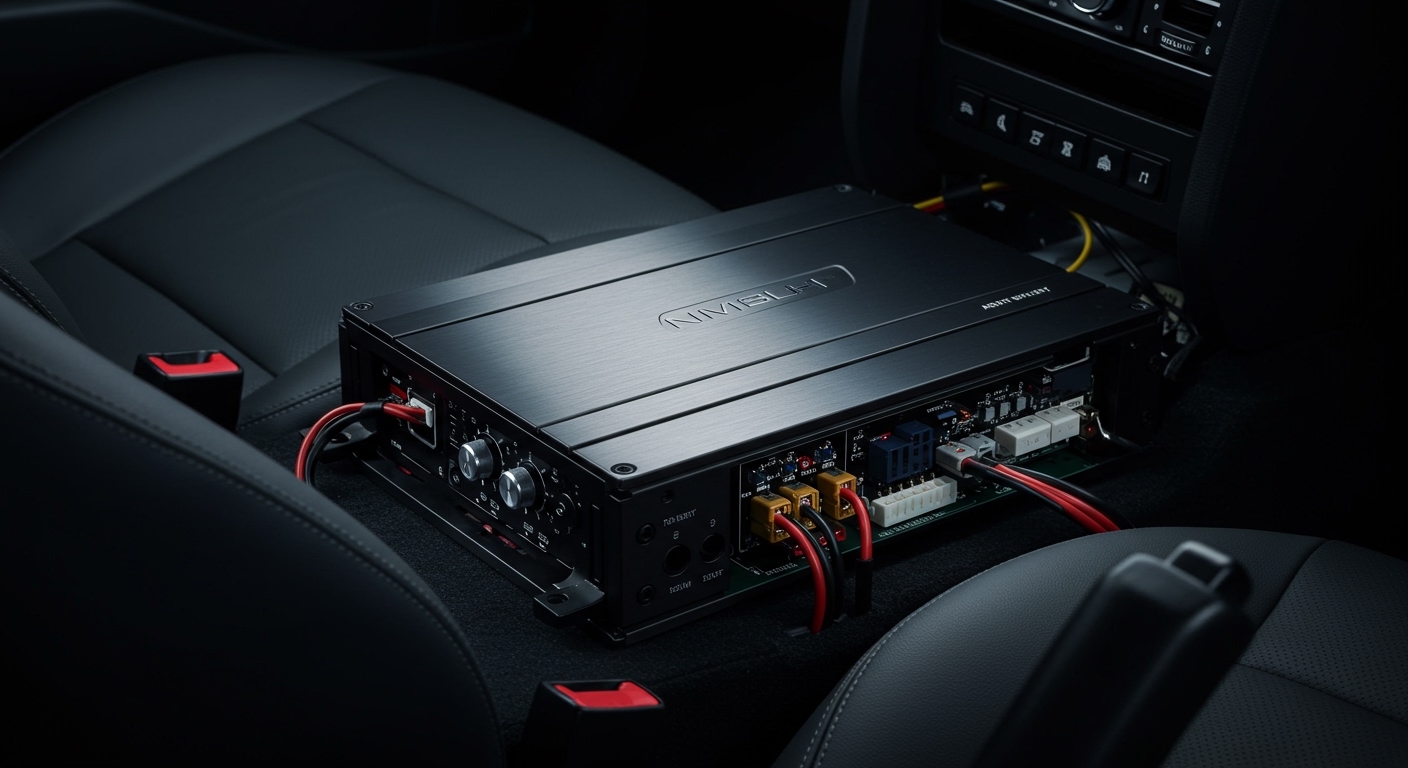
A monoblock or mono amplifier has a single channel of output. It takes a two-channel (left and right) stereo input, sums them together into a single signal, and amplifies that one signal.
- Primary Use: Powering subwoofers.
- Design Focus: High power output at very low impedance (resistance), typically stable at 2 ohms or even 1 ohm.
- Frequency Range: Optimized for low frequencies (bass). Most mono amps have a built-in Low-Pass Filter (LPF) that you cannot turn off. This filter actively cuts out mid-range and high-range frequencies, which is perfect for a subwoofer but disastrous for a full-range door speaker.
I’ve seen countless mono amps come through my shop, and their entire architecture, from the power supply to the output transistors, is built for one job: pushing massive amounts of current to move a big subwoofer cone.
What is a Stereo (Multi-Channel) Amplifier?
A stereo amplifier has two or more independent channels, most commonly two or four. Each channel receives and amplifies its own distinct signal.
- Primary Use: Powering full-range speakers (door speakers, rear speakers, tweeters).
- Design Focus: Clean power across the full audible frequency spectrum (20 Hz to 20,000 Hz).
- Key Feature: Preserves stereo separation. The left channel signal only goes to the left speaker, and the right channel signal only goes to the right speaker. This creates the immersive soundstage and imaging that lets you hear where instruments are placed in a recording.
Think of it this way: a mono amp is a sledgehammer designed for one powerful, brute-force task. A 2 or 4-channel amp is a set of surgical tools, designed for precision and detail across a wide range of tasks.
Amplifier Comparison Table
To make it crystal clear, here’s a breakdown of how these amplifiers stack up for the job of powering door speakers.
| Feature | Mono (Monoblock) Amplifier | 2-Channel / 4-Channel Amplifier |
|---|---|---|
| Best For | Subwoofers | Door Speakers, Rear Speakers, Tweeters |
| Channels | 1 (L+R summed) | 2 or 4 (Discrete L/R channels) |
| Stereo Sound | No (Sound is combined) | Yes (Essential for music) |
| Impedance Stability | Very Low (Often 1-2 Ohms) | Typically 2-4 Ohms per channel |
| Built-in Crossover | Usually a non-defeatable Low-Pass Filter (LPF) | Full Range, High-Pass (HPF) & Low-Pass (LPF) |
| Sound Quality | Poor for full-range (lacks highs/mids) | Excellent for full-range (clear & detailed) |
The 3 Major Risks When You Use a Mono Amp for Door Speakers
Connecting your door speakers to a mono amp isn’t just a simple mistake; it introduces three significant problems that range from poor audio quality to outright equipment damage.
Complete Loss of Stereo Separation
This is the most immediate and noticeable problem. Music is recorded and mixed in stereo for a reason. Artists and sound engineers painstakingly place instruments and vocals in the left and right channels to create a sense of space, depth, and immersion.
- What you hear: When you use a mono amp, you lose all of this. The guitar solo meant to be in your left ear and the backing vocals in your right ear are now smashed together and coming out of both speakers identically. The sound becomes a narrow, congested wall in front of you instead of a wide, encompassing soundstage.
- My Experience: I once had a customer bring in his car complaining that his brand new, expensive component speakers sounded “worse than the factory system.” After a quick look, I found he had wired both his left and right speakers to a single mono subwoofer amp he had from a previous build. After we swapped it for a modest 4-channel amp, his jaw dropped. He said, “I can finally hear the cymbals!”
The Low-Pass Filter (LPF) Problem
This is the most critical technical issue. Nearly all mono amps designed for subwoofers have a built-in crossover circuit called a Low-Pass Filter or LPF.
- What it does: An LPF does exactly what its name implies: it allows low-frequency signals to “pass” through to the speaker while blocking high-frequency signals. This is set typically around 80-120 Hz.
- The Impact: Your door speakers are designed to play a wide range of frequencies, from mid-bass (around 80 Hz) all the way up to high-treble (20,000 Hz). When you connect them to a mono amp with an active LPF, you are effectively cutting off everything a human ear perceives as vocals, guitars, cymbals, and synths. You will only hear muffled, muddy mid-bass.
Some rare, high-end mono amps might have a “full-range” setting, but the vast majority do not. Assuming your mono amp is a standard subwoofer amp, it will starve your door speakers of the frequencies they need to sound correct.
Impedance and Power Mismatch
This is where you risk physically damaging your gear. Amplifiers and speakers have electrical ratings that need to be carefully matched.
- Impedance (Ohms): Mono amps are built to be “1-ohm stable” or “2-ohm stable” to get maximum power for a subwoofer. Most car door speakers are 4 ohms. If you wire two 4-ohm speakers in parallel to a mono amp, the final impedance load on the amp will be 2 ohms. This is often fine for the amp, but it means the power is split between the speakers in a way that can be unpredictable.
- Power (Watts RMS): Mono amps are powerhouses. A standard mono amp might push 500, 1000, or even more watts RMS. A typical door speaker might only be rated to handle 75-100 watts RMS. Sending 500 watts of bass-heavy, clipped signal to a speaker designed for 75 watts of clean, full-range power is a recipe for a melted voice coil and a dead speaker.
You are essentially using a tool that is too powerful and completely wrong for the job, creating a significant risk of overpowering and destroying your speakers.
Step-by-Step: How to Wire Speakers to a Mono Amp (The “Emergency Only” Method)
I have to preface this by saying again: do not do this unless you have absolutely no other choice and you understand the risks. This is for a temporary, emergency situation, not a permanent audio solution.
Disclaimer: Proceed at your own risk. This can damage your speakers and/or amplifier if done incorrectly.
Pre-Requisites: Check Your Gear First!
- Check the Amp’s Crossover: Look for a switch on your mono amp that says “Full,” “Full-Range,” or “Off.” If your amp ONLY has an “LPF” setting, STOP. You cannot proceed, as it will sound terrible and potentially harm your speakers.
- Check Speaker Impedance: Confirm your door speakers are 4-ohm models. This is standard, but you should always check the magnet or the manual.
- Check Amp Power: Look at the RMS power rating of your amp at 4 ohms. For example, it might say “300W RMS x 1 @ 4Ω”. Make sure this number is not drastically higher than the RMS rating of your speakers.
Wiring Method: Series Connection for a Safer Load
To avoid presenting a dangerously low impedance to the amp, you should wire your two door speakers in series. This will combine their impedance.
- Two 4-ohm speakers in series = 8-ohm total load.
This is a very safe, high-impedance load for any mono amp. The downside is you will get significantly less power from the amp, but this is much safer for your speakers.
Step 1: Disconnect Power
- Before touching any wiring, disconnect the negative terminal from your car’s battery.
Step 2: Run Speaker Wire
- Run a positive and negative speaker wire from your amplifier’s location to your first speaker (e.g., the driver’s side door).
- Run a separate “jumper” wire between the first speaker’s location and the second speaker’s location (driver’s door to passenger’s door).
Step 3: Connect to the Amplifier
- Connect the positive speaker wire from the first speaker to the positive (+) terminal on your mono amplifier.
- Connect the