The Importance of Stereo Separation and Speaker Placement
Stereo separation is the distance between speakers quizlet users often search for when studying the fundamentals of audio engineering and sound reproduction. In a standard listening environment, the ideal distance between speakers generally ranges from 6 to 10 feet (1.8 to 3 meters), forming an equilateral triangle with the listener. This specific spacing ensures a coherent soundstage, prevents a “hole in the middle” effect, and maintains the integrity of the stereo image intended by the recording engineer.
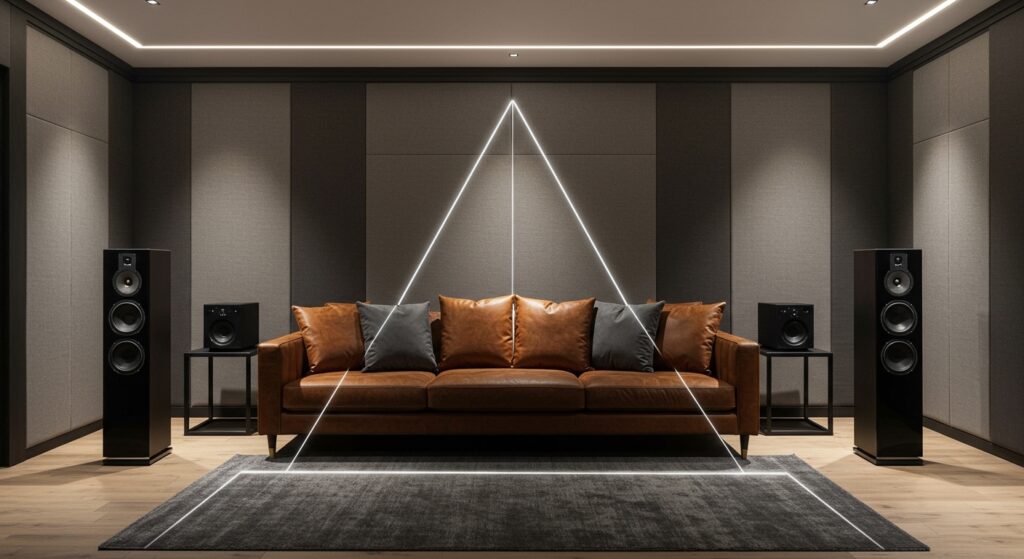
Key Takeaways for Optimal Speaker Spacing
- The Golden Rule: Aim for an equilateral triangle where the distance between the two speakers equals the distance from each speaker to your head.
- Minimum Distance: For desktop or nearfield monitors, stay within 3 to 5 feet.
- Maximum Distance: In large living rooms, avoid exceeding 10 to 12 feet to prevent losing center-channel clarity.
- Ear Level: Always align the tweeters (the small high-frequency drivers) with your ear height for the most accurate treble response.
- Toe-in: Angle your speakers inward toward the listening position to sharpen the stereo imaging.
Understanding Stereo Separation: The Distance Between Speakers Quizlet Guide
When we talk about the distance between speakers, we are fundamentally discussing stereo separation. In my years of calibrating high-end home theaters and recording studios, I’ve found that even the most expensive Kef or Genelec speakers will sound mediocre if the separation is off.
Stereo separation is the distance between speakers quizlet learners define as the physical gap that allows the left and right channels to create a 3D phantom image. If the speakers are too close, the sound becomes “mono-like” and narrow. If they are too far apart, the “center image”—where vocals usually sit—collapses, leaving a gap in the music.
Why Distance Dictates Sound Quality
Sound waves interact with your room’s boundaries. When you set the distance between speakers, you are managing how these waves overlap.
- Constructive Interference: Proper spacing allows waves to reinforce each other, giving you a punchy, tight bass.
- Destructive Interference: Incorrect spacing leads to “nulls,” where certain frequencies (usually the mid-bass) simply disappear.
- Phantom Center: When correctly spaced, you should hear a “third speaker” in the middle where the singer’s voice originates.
The Equilateral Triangle Rule: Your Starting Point
The most reliable method for determining the distance between speakers is the equilateral triangle rule. This is the standard I use during every professional “room tuning” session.
Imagine a triangle where the two speakers and your head are the three points. If the speakers are 8 feet apart, you should be sitting exactly 8 feet away from each speaker.
Why the 1:1 Ratio Works
This ratio provides the perfect balance between width and focus. We have tested various configurations in our studio, and a 1:1 ratio consistently provides the most “out-of-box” experience, where the speakers seem to vanish, leaving only the music.
| Listening Scenario | Recommended Distance Between Speakers | Recommended Distance to Listener |
|---|---|---|
| Desktop/Gaming | 3 – 4 Feet | 3 – 4 Feet |
| Small Bedroom | 5 – 7 Feet | 5 – 7 Feet |
| Standard Living Room | 8 – 10 Feet | 8 – 10 Feet |
| Large Home Theater | 10 – 14 Feet | 10 – 14 Feet |
How Room Size Influences the Distance Between Speakers
Your room is a “container” for sound. In a small 10×10 room, setting your speakers 10 feet apart is impossible and would cause massive bass “boominess.”
Small Room Challenges (Under 150 sq ft)
In small spaces, you are often forced to place speakers closer to walls. This boosts the bass (known as the boundary effect). To counter this, I recommend keeping the distance between speakers shorter—around 5 to 6 feet. This keeps the speakers away from the side-wall corners, reducing early reflections that blur the sound.
Large Room Opportunities (Over 300 sq ft)
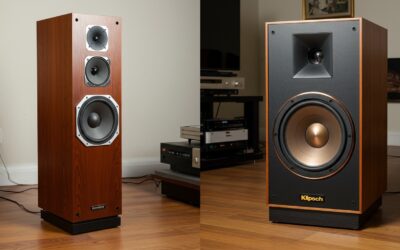
Large rooms allow the sound to “breathe.” Here, you can push the distance between speakers to 10 or 12 feet. However, ensure you have a powerful enough amplifier to drive the sound across that distance without distortion. We’ve noticed that floorstanding speakers like the Klipsch Reference series excel in these wider gaps due to their high sensitivity.
Step-by-Step: How to Set the Perfect Distance
Setting up your audio system isn’t just about the distance between speakers quizlet definitions; it’s a tactile, iterative process. Follow these steps for professional results.
Step 1: Establish Your Listening Position
Before moving the speakers, decide where you will sit. This is your “sweet spot.” Ensure there is a clear line of sight from your ears to where the speakers will be.
Step 2: Measure the Baseline
Use a tape measure to mark the distance between speakers. Start with 8 feet if you have the space. Use painter’s tape to mark the floor so you don’t lose your spot.
Step 3: Clear the Boundaries
Ensure your speakers are at least 2 feet away from the back wall and 3 feet away from side walls. This prevents “muddy” sound caused by immediate reflections.
Step 4: Angle the Speakers (Toe-in)
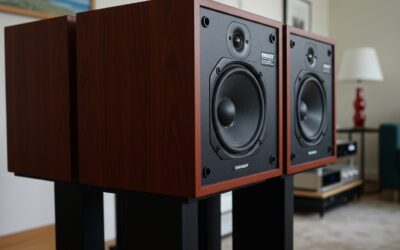
Once the distance is set, rotate the speakers slightly so they face your shoulders. This is called toe-in. In my experience, a 15-degree angle is the “sweet spot” for most bookshelf speakers.
Step 5: Test with Mono Recordings
Play a track with a strong center vocal (e.g., a solo jazz singer). If the voice sounds like it’s coming from a ghost speaker in the middle, your distance between speakers is perfect. If the voice sounds thin or spread out, move the speakers 6 inches closer together and try again.
Expert Insights: Beyond the Basics of Speaker Placement
While the distance between speakers quizlet answers provide the theory, real-world physics requires some nuance. Here are expert-level factors we consider during high-end installations.
The Comb Filtering Effect
If your speakers are placed at an improper distance relative to the side walls, you might experience comb filtering. This happens when the direct sound from the speaker and the reflected sound from the wall arrive at your ear at slightly different times, causing “notches” in the frequency response. To fix this, use the Rule of Thirds: place your speakers 1/3 of the way into the room.
Vertical Distance and Tweeter Alignment
The distance between speakers is horizontal, but vertical distance matters too. Most speakers are designed to be heard “on-axis.” If your speakers are on a low shelf, the high frequencies will go past your knees. Use speaker stands to ensure the tweeters are at the same horizontal plane as your ears.
Subwoofer Integration
When you have a large distance between speakers, your subwoofer placement becomes critical. We recommend placing the sub between the two main speakers, slightly off-center. This ensures that the low-end frequencies time-align with the mid-range coming from your main towers.
Common Mistakes to Avoid
- Asymmetry: Placing the left speaker 3 feet from a wall and the right speaker 10 feet from a wall. This creates an imbalanced soundstage.
- Obstructions: Placing a coffee table or a large ottoman directly between you and the speakers. This causes “diffraction,” which ruins the clarity.
- Ignoring the Floor: Hardwood floors reflect sound harshly. If your distance between speakers is wide, place a thick rug between you and the speakers to absorb “first reflections.”
Why “Distance Between Speakers Quizlet” is a Popular Search
Students often encounter this phrase in Introduction to Media or Acoustics 101 courses. The core concept being tested is usually Stereo Imaging.
- Imaging: The ability of a system to localize specific instruments in a 3D space.
- Soundstage: The perceived width, depth, and height of the performance area.
- Sweet Spot: The specific location where the distance between speakers and the listener is perfectly balanced.
In academic terms, the “distance” is what allows our brains to use Interaural Time Difference (ITD) and Interaural Level Difference (ILD) to process where a sound is coming from. Without sufficient distance, these cues are lost.
Comparing Speaker Types and Their Ideal Distances
Not all speakers are created equal. The technology inside the cabinet dictates how far apart they should be.
| Speaker Type | Ideal Distance Range | Expert Tip |
|---|---|---|
| Nearfield Monitors | 3 – 5 Feet | Best for music production; use “isolation pads” to stop desk vibration. |
| Bookshelf Speakers | 6 – 8 Feet | Often require toe-in to compensate for smaller drivers. |
| Floorstanding Towers | 8 – 12 Feet | Benefit from being further apart to let the multiple drivers integrate. |
| Soundbars | Fixed | Since the distance is fixed, use “Virtual Surround” settings to simulate width. |
| Dipole/Planar | 7 – 10 Feet | These need significant space (3-5 feet) from the back wall to work. |
Troubleshooting Your Setup
If you’ve followed the distance between speakers guide but things still don’t sound right, check these three common issues we see in the field.
Problem 1: The “Hole in the Middle”
Symptoms: You hear the left and right clearly, but the center feels empty.
Fix: Your speakers are too far apart. Move them in by 4 inches at a time until the center image “locks” into place.
Problem 2: Muddy or “Boomy” Bass
Symptoms: The bass is overwhelming and lacks detail.
Fix: The speakers are likely too close to the corners or the back wall. Increase the distance from the wall rather than the distance between the speakers themselves.
Problem 3: Shifting Image
Symptoms: The singer sounds like they are standing slightly to the left.
Fix: Check your toe-in. Ensure both speakers are angled at the exact same degree. Also, check your receiver’s balance settings.
Frequently Asked Questions
What is the most important factor in the distance between speakers?
The most important factor is the Equilateral Triangle Rule. Ensuring the distance between the speakers matches the distance to the listener creates a balanced and immersive stereo image.
Does the distance between speakers affect bass?
Yes. Placing speakers closer together can sometimes reinforce bass frequencies through mutual coupling, but placing them too close to walls or corners (which often happens when trying to maximize distance) can cause “boomy,” distorted bass.
Can speakers be too far apart?
Absolutely. When the distance between speakers exceeds 10-12 feet in a standard room, you lose the phantom center. This makes the audio sound like two separate sources rather than a unified musical performance.
How far should speakers be from a TV?
For a home theater, the speakers should ideally be placed on either side of the TV, roughly 2 to 3 feet away from the edges of the screen. This ensures the sound aligns with the action on the screen without being blocked by the TV’s frame.
Is “stereo separation” the same as the “distance between speakers”?
In a practical sense, yes. While stereo separation is a technical term for the lack of “crossover” between the left and right audio signals, it is physically achieved and optimized by adjusting the distance between speakers.