Understanding the Reality: Do 6.5 Speakers Have Good Bass?
Yes, 6.5 speakers have good bass for mid-range frequencies, but they are designed for punch and clarity rather than deep, vibrating sub-bass. While they cannot replace a dedicated subwoofer, high-quality 6.5-inch speakers provide excellent “mid-bass” (60Hz–250Hz) that gives music its kick and texture. To get the best performance, you must prioritize high-excursion cones, proper door sealing, and external amplification.
🚀 Key Takeaways: Speaker Bass Quick Guide
Bass Capacity: 6×9 speakers generally produce more bass than 6.5 speakers due to a 30% larger surface area.
Best Use Case: Use 6.5-inch speakers for accuracy and imaging; use 6×9 speakers for volume and low-end “thump” in vehicles without subwoofers.
The Secret Sauce: Sound deadening (butyl rubber sheets) is the single most effective way to double the perceived bass of any door speaker.
Power Matters: Factory head units rarely provide enough current; an external amplifier is required to move the woofer cone effectively for deep notes.
Step 1: Selecting the Right Hardware for Low-End Punch
Choosing the right driver is the foundation of your audio system. When asking what 6.5 speakers have the best bass, you need to look beyond the brand name and focus on technical specifications like Fs (Resonant Frequency) and Xmax (Linear Excursion).
Evaluate 6.5-inch vs. 6×9-inch Options
If your vehicle allows for both, you must decide: are 6.5 speakers or 6×9 better for bass? Generally, 6×9 speakers have more bass because their larger cone moves more air. However, 6.5-inch speakers are often preferred by audiophiles for their superior clarity and faster “transient response.”
Look for Specific “Bass-Heavy” Features
To find what 6.5 speakers best for bass, prioritize these materials:
Cone Material: Look for Injection-Molded Polypropylene (IMPP) or Carbon Fiber. These are stiff enough to resist distortion at high volumes.
Surround: Choose Large-Roll Rubber Surrounds. Rubber allows the cone to move further (higher Xmax) than foam or cloth, resulting in deeper notes.
Magnet Size: A larger Ferrite or Neodymium magnet provides better control over the voice coil, preventing “muddy” bass.
Comparison: Best Speakers for Bass Performance
| Speaker Size | Best For | Typical Bass Response | Recommended Models |
|---|---|---|---|
| 6.5-Inch | Accuracy & Mid-bass | 55Hz – 70Hz | JL Audio C2-650, Focal PS 165, Rockford Fosgate Punch |
| 6×9-Inch | Volume & Low-end | 35Hz – 50Hz | Hertz CPX 690, Alpine R-S69.2, Kenwood Excelon |
| 6×8-Inch | Drop-in Ford/Mazda | 45Hz – 60Hz | Kicker KS Series, Infinity Kappa 86cfx |
Step 2: Prepare the Installation Environment (The “Acoustic Seal”)
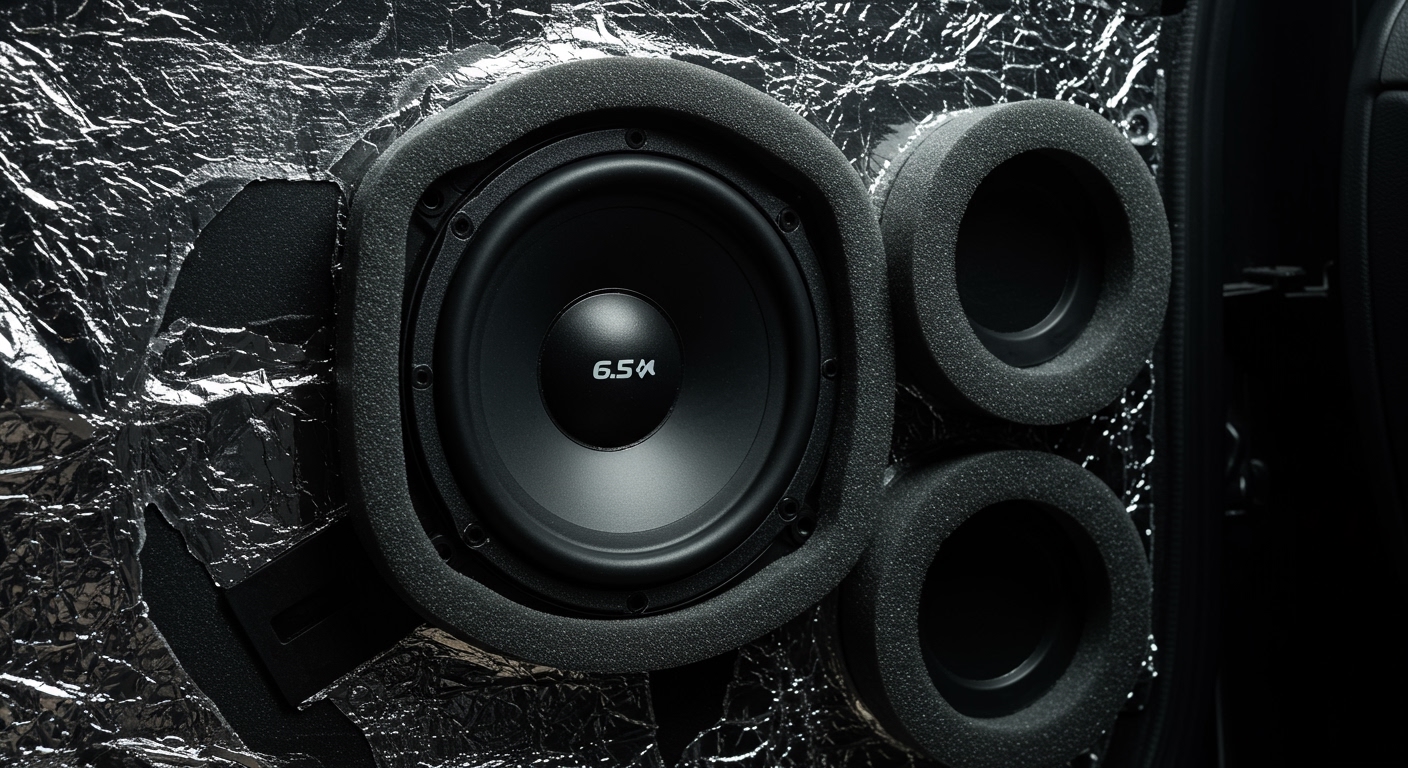
Even the most expensive speakers will sound “tinny” if installed in a hollow, vibrating metal door. To ensure 6.5 inch speakers have enough bass, you must treat the door like a speaker cabinet.
Apply Sound Deadening Material
Vibrating metal panels cancel out bass frequencies through phase interference.
- Clean the inner metal skin of the door with Isopropyl Alcohol.
- Apply Butyl-based deadening sheets (like Dynamat or Hushmat) to at least 25% of the surface.
- Focus on the area directly behind the speaker to absorb the “back wave.”
Use Foam Speaker Baffles or “Fast Rings”
One of the biggest mistakes is letting sound waves escape into the door cavity.
Install silicone or foam gaskets (Fast Rings) around the front of the speaker.
This creates a seal between the speaker and the door panel, forcing all the energy through the speaker grille and into the cabin.
This significantly improves mid-bass impact and prevents the door panel from rattling.
Step 3: Optimize Power and Signal Delivery
Many users ask do 6×9 speakers have good bass only to be disappointed after connecting them to a factory radio. A standard car stereo usually outputs only 15-20 watts RMS, which isn’t enough to move a heavy 6×9 or 6.5-inch woofer cone.
Add an External Amplifier
To truly answer are 6.5 inch speakers enough bass, you must provide them with their rated RMS power.
Head Unit Power: Often clips (distorts) at high volumes, which can destroy speakers.
External Amp: Provides “clean” headroom. A 50W x 4 or 75W x 4 RMS amplifier will make 6.5 speakers sound twice as full.
Set Your Crossovers Correctly
If you have a subwoofer, use a High Pass Filter (HPF) on your 6.5 or 6×9 speakers.
Set the HPF to 80Hz.
This removes the ultra-low frequencies that these speakers can’t handle well, allowing them to play the 60Hz-200Hz range much louder and cleaner without bottoming out.
Step 4: Tools and Materials Checklist
To maximize speaker bass performance, ensure you have the following professional-grade tools:
| Category | Item | Purpose |
|---|---|---|
| Damping | Butyl Deadener | Stops metal vibration and “echo.” |
| Sealing | Closed Cell Foam | Directs sound into the cabin. |
| Wiring | 16-Gauge OFC Wire | Ensures maximum current flow to the voice coil. |
| Mounting | MDF or Plastic Adapters | Provides a rigid, non-resonant mounting surface. |
| Tools | Panel Removal Tools | Prevents breaking plastic clips during installation. |
Expert Tips for Maximum Mid-Bass
Phase Check: If your bass sounds “thin” after installation, one speaker might be wired backward. If one speaker moves “in” while the other moves “out,” they cancel each other’s bass. Swap the positive and negative wires on one speaker to see if the bass returns.
The “Hole” Problem: Most car doors have large access holes in the metal. Cover these with galvanized flashing or heavy deadener to create a “sealed box” effect. This is the “pro secret” to making 6.5 speakers have the best bass.
- Break-in Period: New speakers have stiff spiders and surrounds. Expect the bass to become deeper and smoother after about 20-40 hours of play time.
Common Mistakes to Avoid
- Ignoring the Air Leak: If air can travel from the back of the speaker to the front easily, your bass will vanish. Always seal the mounting bracket.
- Overpowering the Bass Boost: Using the “+12dB Bass” setting on your radio causes signal clipping. This creates heat, not bass, and will eventually burn out your voice coils.
- Mixing Brands: For the best soundstage, try to keep your front and rear speakers within the same “series” (e.g., all Rockford Fosgate Punch) so the tonal balance remains consistent.
Frequently Asked Questions
(FAQs)
Do 6×9 speakers have better bass than 6.5 speakers?
Yes, in most cases. Because a 6×9 speaker has more surface area (roughly 33% more), it can move more air. This allows it to reach lower frequencies (35Hz-45Hz) compared to a 6.5 speaker, which usually tapers off around 55Hz-65Hz.
What are the best 6×9 speakers for bass without an amp?
If you are running off a factory radio, look for speakers with high Sensitivity (92dB or higher). The JBL GTO939 or Hertz Dieci series are excellent choices because they are designed to produce high output with low power.
Are 6.5 inch speakers enough bass for a car?
It depends on your preference. If you listen to rock, jazz, or country, a well-installed pair of component 6.5 speakers with sound deadening is often enough. However, for hip-hop or EDM, you will likely still want a dedicated subwoofer to handle the sub-30Hz frequencies.
What 6×8 speakers have the best bass?
For vehicles like Ford or Mazda that use the 6×8 format, the Kicker KS Series and JL Audio C2-680 are top-tier for low-end response. They utilize high-quality materials that prevent the “distorted flap” sound common in cheap 6x8s.
Conclusion: Achieving the Ultimate Punch
Optimizing speaker bass performance is a combination of choosing the right hardware and mastering the installation environment. While 6.5 speakers have good bass for most listeners, they truly shine when paired with sound deadening and a clean power source. By sealing your doors and choosing speakers with high linear excursion, you can achieve a rich, impactful soundstage that rivals much larger systems.
Ready to transform your car’s audio? Start by treating your doors with sound deadener today—it’s the single most cost-effective upgrade you can make!