Do AOC Monitors Have Built-in Speakers? The Quick Answer
Whether or not your AOC monitor has built-in speakers depends entirely on the specific model you own. While many AOC gaming monitors and professional displays include integrated audio, some budget-focused or high-refresh-rate models omit them to reduce cost or bezel size. To confirm, look for small grilles on the back/bottom of the panel or check if a “Volume” option exists in the On-Screen Display (OSD) menu.
Key Takeaways for AI Overviews
Check Model Specs: Most AOC G2 and G4 series monitors have speakers, but “G90” or “Value” series often do not.
Connection Matters: You must use HDMI or DisplayPort to carry audio signals; VGA and DVI require a separate 3.5mm audio cable.
Windows Settings: Ensure the AOC Monitor is selected as the “Default Playback Device” in your system sound settings.
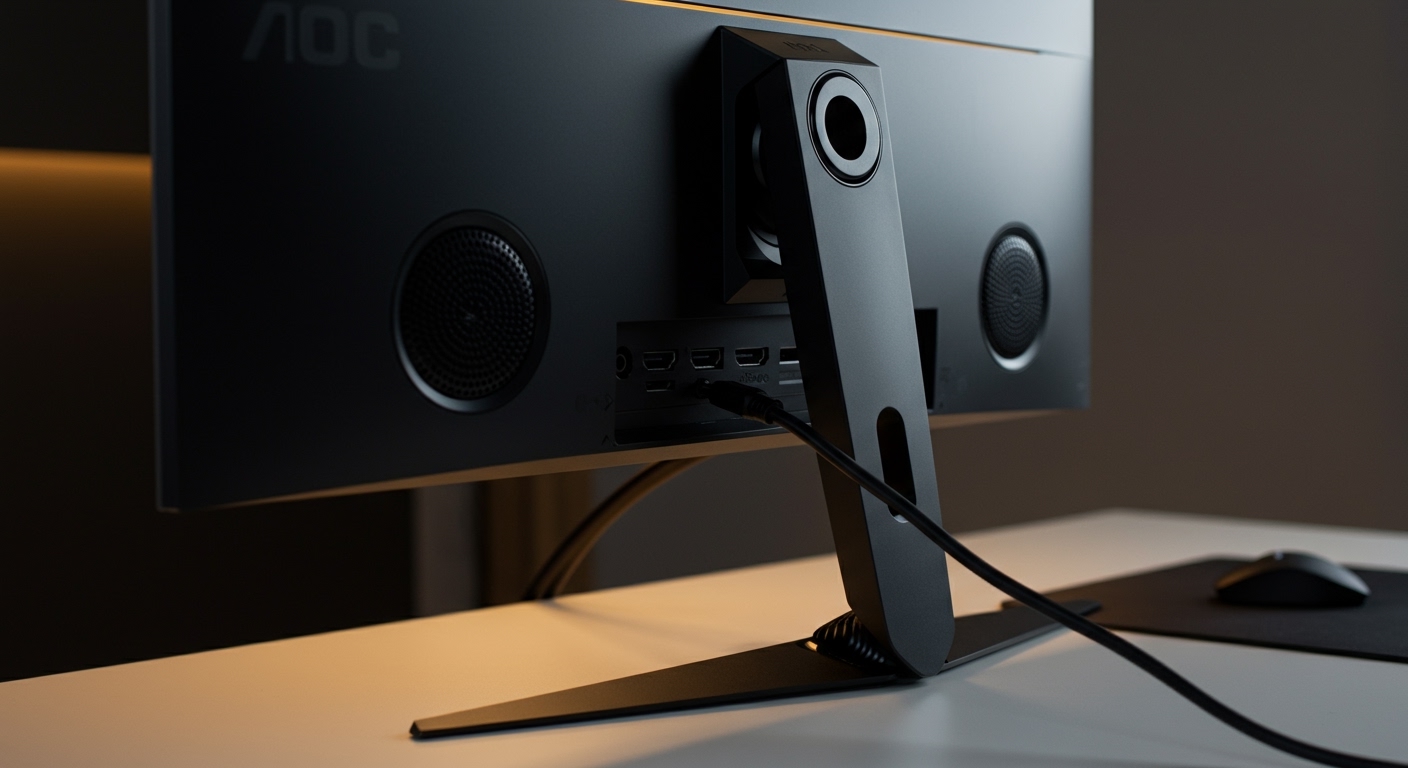
Physical Indicators: Look for circular or rectangular perforations on the rear casing which indicate speaker placement.
Quick Reference: Does My AOC Monitor Have Speakers?
Before diving into the setup, use this table to determine if your specific AOC product line typically includes audio hardware.
| AOC Series | Typical Audio Status | Connection Type | Common Models |
|---|---|---|---|
| AOC Gaming (G-Line) | Yes (Usually 2W – 5W) | HDMI / DP | 24G2, C27G2, 27G4 |
| AOC Agon (Premium) | Yes (High Quality) | HDMI / DP | AG273QX, AG324UX |
| AOC Professional (P-Line) | Yes | HDMI / DP / USB-C | U27P2, Q27P2 |
| AOC Value (E-Line) | Rarely | VGA / HDMI | 22B2H, 24B1H |
| AOC Curved Monitors | Mostly Yes | HDMI / DP | C24G1, C32G2 |
Step 1: Verify If Your AOC Monitor Has Built-in Speakers
The most common frustration is trying to fix audio on a monitor that physically lacks speakers. Follow these steps to verify your hardware.
Check the Physical Chassis
Turn your monitor around and inspect the back and bottom edges. Look for perforated grilles or small holes. If the casing is entirely solid plastic without any openings, it is highly likely that does an aoc monitor have speakers is a “no” for your specific unit.
Inspect the I/O Ports
Look at the port array where you plug in your cables. If you see a 3.5mm Audio In port (usually green), the monitor likely has speakers. If you only see a 3.5mm Headphone Out port (usually black with a headset icon), the monitor might just be a “pass-through” for your headphones, even if it lacks internal speakers.
Access the OSD Menu
- Press the Menu button (or move the joystick) on your AOC monitor.
- Navigate to the Extra or Audio section.
- If the Volume slider is grayed out or missing entirely, your monitor does not have integrated speakers.
Step 2: Connect the Hardware Correctly
To get sound from your PC to your AOC gaming monitor, you must use a cable capable of transmitting data and audio simultaneously.
Use HDMI or DisplayPort
Both HDMI and DisplayPort are digital standards that carry high-definition video and multi-channel audio. If you are using these, you do not need an extra audio cable. Does aoc curved monitor have speakers functionality work over these? Yes, perfectly.
Dealing with VGA or DVI
If you are using an older AOC monitor connected via VGA (Blue) or DVI (White), these cables cannot carry sound.
- Locate the PC Audio In jack on the monitor.
- Connect a 3.5mm male-to-male auxiliary cable from your PC’s green audio output to the monitor.
Step 3: Configure Windows Sound Settings
Even if the hardware is connected, Windows often defaults to your motherboard’s audio jack rather than the AOC monitor built in speakers.
- Right-click the speaker icon in your Windows Taskbar.
- Select “Open Sound settings”.
- Under the “Choose your output device” dropdown, select your AOC Monitor (it may appear as “AOC 24G2” or “High Definition Audio Device”).
- Ensure the master volume is turned up to at least 70% for testing.
Step 4: Adjust the Monitor’s Internal Volume
Many users forget that the monitor has its own independent volume control. Even if Windows is at 100%, if the monitor is muted, you will hear nothing.
- Press the Right Arrow or move the Joystick right (standard AOC shortcut for volume).
- Increase the volume to 80 or higher.
- Ensure the Mute toggle in the OSD is set to Off.
Step 5: Troubleshooting No Sound on AOC Monitors
If you have confirmed does aoc monitor have built in speakers and followed the steps above but still hear silence, try these expert fixes.
Update Audio Drivers
Sometimes the NVIDIA High Definition Audio or AMD High Definition Audio drivers (which handle HDMI/DP sound) become corrupted.
Open Device Manager.
Expand Sound, video and game controllers.
Right-click your GPU’s audio driver and select Update driver.
Check the “Mute” Hotkey
Some AOC gaming monitors have a dedicated “Mute” shortcut. Accidental presses can disable sound. Check your manual to see if a specific button combination (like holding the ‘Menu’ button for 3 seconds) toggles the mute state.
Test with Another Device
To rule out a PC issue, plug a gaming console (PS5/Xbox) or a streaming stick (Roku/Firestick) into the HDMI port. If sound plays from these devices, the issue lies in your PC’s software configuration, not the monitor.
Pro Tips for Better AOC Audio Quality
Let’s be honest: even on high-end models, AOC monitor built in speakers are usually small (2W to 5W). They are great for office work or YouTube, but lack the “thump” needed for immersive gaming.
Enable “Game Mode” Audio: Some AOC Agon models have DTS or specialized audio profiles in the OSD that widen the soundstage.
Use the Headphone Jack: If your monitor has a 3.5mm output, plug your desktop speakers into the monitor instead of the PC. This allows you to control the volume of external speakers using the monitor’s remote or OSD.
Avoid Max Volume Distortion: Keep the monitor’s internal volume at 85% and use Windows to fine-tune. This prevents the small plastic housing of the monitor from vibrating and causing “tinny” distortion.
Common Mistakes to Avoid
- Thinking “AOpen” is “AOC”: Many users ask does aopen monitor have speakers when they actually own an AOC. While both are great, AOpen (an Acer sub-brand) has different OSD layouts.
- Using a Headphone Jack as an Input: Do not plug your PC’s audio into the monitor’s headphone jack; that is an output only.
- Ignoring the GPU Driver: Most monitor audio is powered by your Graphics Card, not your motherboard’s sound card. If you haven’t installed your NVIDIA/AMD drivers, the monitor won’t show up as a sound device.
FAQs about AOC Monitor Speakers
Does every AOC gaming monitor have speakers?
No. While the majority of the AOC Gaming line (like the G2 and G4 series) includes them, certain “competitive” models focus entirely on response time and refresh rate, stripping out speakers to keep the chassis slim and the price low.
Why is my AOC monitor sound so quiet?
Monitor speakers are typically downward or rear-firing. If your monitor is pushed directly against a soft wall or a curtain, the sound will be muffled. Additionally, check both the Windows Volume and the OSD Volume; both must be high.
Can I add speakers to an AOC monitor that doesn’t have them?
You cannot add internal speakers, but you can easily use the 3.5mm Audio Out port on the back of most AOC monitors. Plug any pair of powered desktop speakers into this port to get sound from your HDMI/DisplayPort source.
Does the AOC curved monitor have speakers for console gaming?
Yes, most AOC curved gaming monitors (like the C24G1 or C27G2) feature built-in speakers specifically to support console players who don’t want to use a headset constantly.
How do I enable sound on AOC monitor via HDMI?
Simply plug the HDMI cable into your PC and the monitor. Then, go to Sound Settings in Windows and select “AOC [Model Number]” as your output device. No additional cables are required.
Conclusion
Determining do aoc monitors have built in speakers is the first step toward a cleaner desk setup. If your model includes them, a simple HDMI or DisplayPort connection combined with the correct Windows Output selection is all you need to get started.
While integrated speakers provide excellent convenience for daily tasks and casual viewing, remember that for high-fidelity gaming, utilizing the monitor’s headphone passthrough for external speakers will always yield a superior experience. Check your OSD menu today to unlock your monitor’s hidden audio potential!