Do Car Speakers Have a Fuse? The Expert Answer
If your car audio suddenly cuts out, you are likely wondering: do car speakers have a fuse? The direct answer is that while individual speakers rarely have internal fuses, the car audio system is protected by multiple fuses located in the vehicle’s fuse box and behind the head unit.
Identifying the correct fuse is the fastest way to restore your sound without spending hundreds at a mechanic. This guide covers how to locate, test, and replace these critical components based on professional car audio installation experience.
Key Takeaways: Car Speaker Fuse Essentials
Location: Most speaker-related fuses are found in the under-dash fuse panel or the engine bay.
Protection: Fuses protect the head unit (radio) and external amplifiers, not usually the physical speaker driver itself.
Detection: A blown fuse usually shows a broken metal filament or a dark char mark inside the plastic housing.
Safety: Always replace a fuse with the exact same Amperage (Amp) rating to avoid fire hazards.
Tools and Materials Needed
Before you start poking around your dashboard, gather these essential tools to ensure a safe and accurate repair.
| Tool/Material | Purpose | Expert Recommendation |
|---|---|---|
| Fuse Puller | Safely removes small fuses without damage | Usually located inside the fuse box cover |
| Multimeter | Tests for continuity to confirm a fuse is blown | Digital models are more accurate for beginners |
| Replacement Fuses | Replaces the damaged component | Match the color code and Amp rating exactly |
| Owner’s Manual | Identifies the specific fuse location | Check the “Fuses” or “Electrical” section |
| Flashlight | Illuminates dark areas under the dash | LED headlamps work best for hands-free work |
Understanding Why People Ask: Do Car Speakers Have Fuses?
In a standard factory setup, there is no fuse soldered directly onto the speaker cone or frame. Instead, the audio signal flows from the radio to the speakers through a wiring harness.
However, if you have an aftermarket system, you might find inline fuses or crossover protection. High-end component speakers often use a PTC thermistor (a self-resetting fuse) inside the crossover network to prevent the tweeters from blowing during high-volume peaks.
What Fuse Controls Speakers?
In 90% of vehicles, the fuse labeled “Radio,” “Audio,” “ACC,” or “AMP” is what controls the power to your speakers. If this fuse pops, the entire system goes silent, even if the display screen remains powered on.
Step 1: Locate the Vehicle Fuse Boxes
To find where the fuse for car speakers is hidden, you need to check two primary locations. Most modern cars split their electrical systems into “high power” and “cabin electronics.”
Check the Interior Fuse Panel
This is usually located under the driver-side dashboard, near the steering column, or behind a plastic cover in the passenger footwell. This panel typically houses the fuse for the head unit and infotainment system.
Check the Engine Bay Fuse Box
Open the hood and look for a black plastic box. This area usually contains “high-draw” fuses. If your car has a factory-installed subwoofer or premium amplifier (like Bose, JBL, or Harman Kardon), the fuse is likely located here.
Step 2: Identify the Correct Speaker Fuse
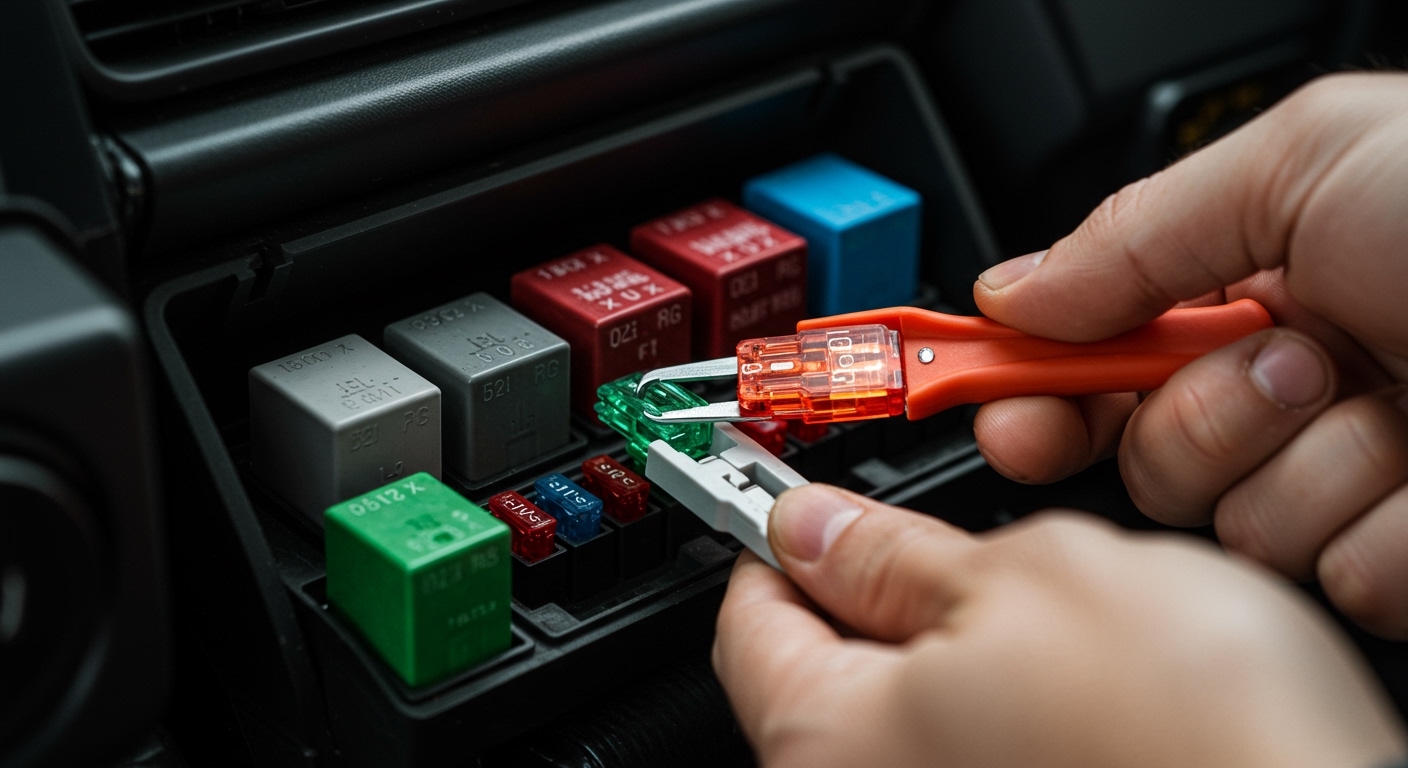
Once you open the cover, you will see a confusing array of colored plastic bits. Do not start pulling them at random, as this can reset your car’s ECU or trigger security codes.
Use the Fuse Diagram
The underside of the fuse box cover almost always has a printed map. Look for abbreviations such as:
AUD: Audio
RAD: Radio
AMP: Amplifier
DSP: Digital Signal Processor
INFO: Infotainment
Consult the Owner’s Manual
If the diagram on the lid is faded or missing, your manual is the ultimate source of truth. It will provide a table listing every fuse, its Amperage, and exactly what circuit it protects.
Step 3: Inspect and Test the Fuse
You cannot always tell if a fuse is bad just by looking at it. Micro-cracks in the metal can be invisible to the naked eye.
Visual Inspection
Pull the fuse using your fuse puller. Hold it up to a light source. If the “U” shaped metal bridge inside is broken or if the plastic is foggy/brown, the fuse is definitely blown.
Using a Multimeter (The Professional Way)
- Set your multimeter to the Continuity setting (the icon looks like a sound wave).
- Touch the two probes to the small metal test points on the top of the fuse.
- If the meter beeps, the fuse is good.
- If there is no sound, the circuit is broken, and the fuse must be replaced.
Step 4: Replace the Blown Fuse
When you confirm is there a fuse for speakers that has failed, you must replace it correctly to prevent electrical fires.
Match the Amp Rating
Fuses are color-coded for a reason. A Blue fuse is typically 15 Amps, while a Yellow fuse is 20 Amps. Never replace a 10A fuse with a 20A fuse. Doing so allows too much current to flow, which can melt your wiring harness or fry your expensive head unit.
Seat the New Fuse
Push the new fuse firmly into the slot. It should click into place and sit flush with the surrounding fuses. Once installed, turn your ignition to “ACC” and test the audio.
Step 5: Troubleshoot Recurring Blown Fuses
If the new fuse blows immediately after you turn on the radio, you have a deeper electrical issue. A fuse is a safety device; it blows to prevent your car from catching fire.
Check for Short Circuits
If a speaker wire is pinched under a seat or rubbing against a sharp metal edge in the door frame, it will create a short to ground. This causes a massive spike in current that pops the fuse instantly.
Inspect the Aftermarket Amplifier
If you have an external amp, check the Ground (GND) wire. A loose ground is the number one cause of blown fuses and “alternator whine” (that high-pitched buzzing sound that rises with engine RPM).
Evaluate Speaker Impedance
If you installed new speakers with an impedance (Ohms) lower than what your head unit can handle (e.g., 2-ohm speakers on a 4-ohm stable radio), the system will pull too much current and blow the fuse.
Expert Tips for Car Audio Maintenance
As a professional installer, I recommend these “Pro Tips” to keep your system running smoothly:
Avoid “Penny Fixes”: Never wrap a blown fuse in aluminum foil or use a jumper wire. This is a guaranteed way to start a vehicle fire.
Check the Back of the Radio: Many aftermarket brands like Pioneer, Sony, and Alpine have a small 10A or 15A fuse plugged directly into the back of the radio chassis. If the dash fuses are good but the radio is dead, you’ll need to pull the radio out to check this one.
Verify the Inline Fuse: If you have a dedicated power wire running from the battery to an amp, there is a large inline fuse near the battery. If this blows, your speakers will get no sound even if the radio screen is on.
Common Mistakes to Avoid
- Ignoring the Root Cause: If a fuse blows twice, stop replacing it and start looking for a frayed wire.
- Using Poor Quality Fuses: Cheap, unbranded fuses from discount bins sometimes fail to blow at their rated limit, which can destroy your electronics. Stick to brands like Bussmann or Littlefuse.
- Testing with Power On: Always turn off the car and the radio before pulling fuses to avoid accidental electrical arcs.
FAQs About Car Speaker Fuses
Is there a fuse for speakers in a car specifically?
Technically, no. There isn’t a fuse for each individual speaker. Instead, there is a fuse for the amplifier or the head unit that sends power to all the speakers. If one speaker is out but the others work, the problem is likely a broken wire or a blown speaker coil, not a fuse.
What fuse is for speakers if my radio still has light?
If your radio screen is on but there is no sound, look for a fuse labeled AMP or EXT AMP. Premium sound systems use a separate fuse for the amplifier. If the amp fuse blows, the radio will “work,” but the speakers will remain silent.
Are there fuses for car speakers inside the door panels?
No, you will almost never find a fuse inside the door panel. The only exception is if a previous owner installed custom crossovers for component speakers. These are usually tucked behind the door card or under the dash.
Can a blown fuse cause static in speakers?
No. A fuse is binary: it is either connected or broken. Static is usually caused by RFI (Radio Frequency Interference), a bad ground wire, or a blown speaker cone (physical damage).
Conclusion
Finding out is there a fuse for car speakers is the first step in DIY car audio repair. While the speakers themselves don’t have fuses, the Radio and Amplifier circuits are the most common culprits for a silent system. By using a multimeter, checking the owner’s manual, and ensuring you use the correct Amp rating, you can safely restore your music.
If you have replaced the fuse and still have no sound, or if the fuse continues to pop, it is time to inspect your wiring harness for shorts or consult a professional car audio technician.