Do TED Speakers Use Teleprompters? The Secret Behind the Red Circle
Do TED speakers use teleprompters? No, the vast majority of TED speakers do not use teleprompters because the organization prioritizes authentic, eye-to-eye connection over scripted perfection. While speakers have access to “confidence monitors” on the floor to track their slides and timing, they are expected to internalize their content through months of rigorous preparation.
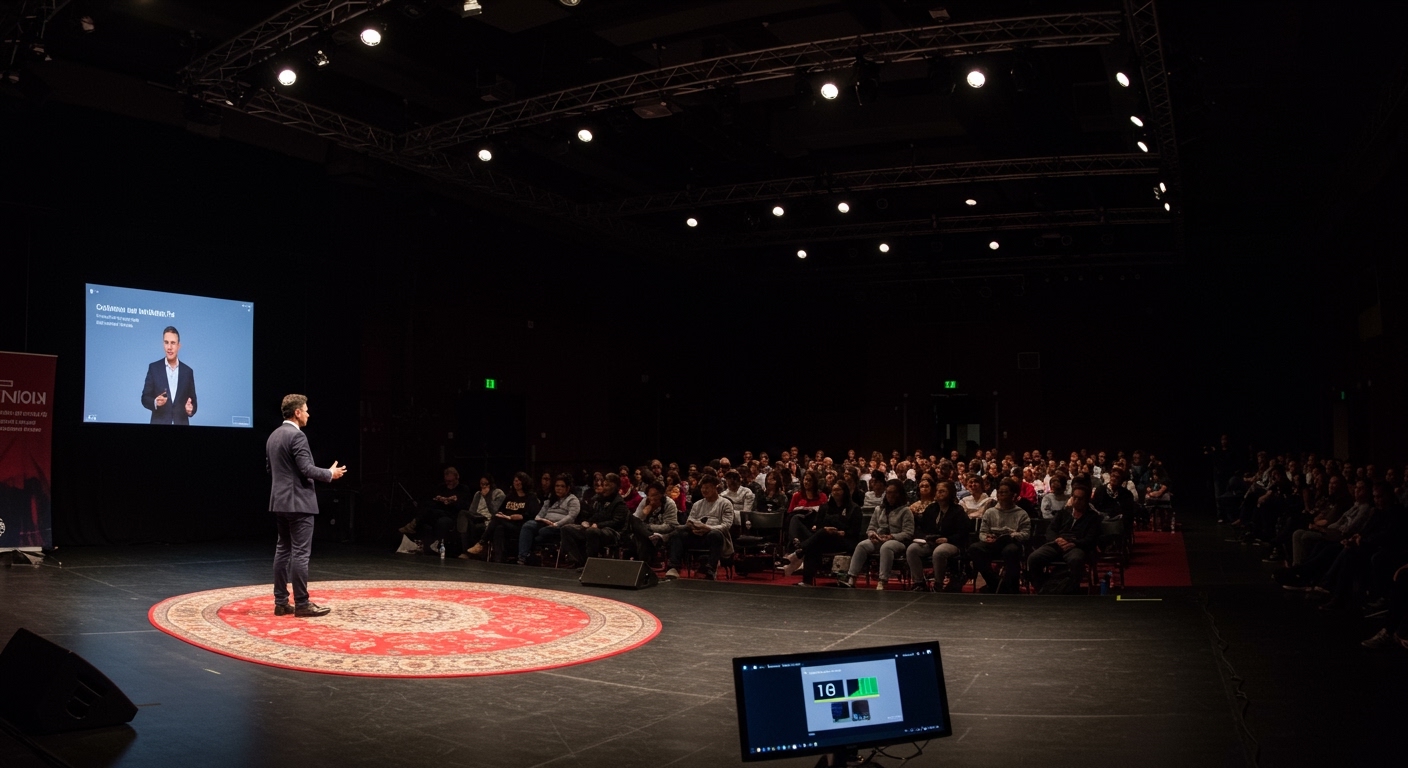
Public speaking on the TED stage is often considered the “Olympics” of communication. When you stand inside that iconic red circle, the audience expects a performance that feels spontaneous yet deeply structured. Having coached several TEDx speakers and analyzed hundreds of mainstage presentations, I can tell you that the absence of a teleprompter is exactly what creates that legendary “TED magic.”
In this guide, we will break down exactly how these speakers deliver flawless 18-minute talks without reading a single line.
TL;DR: Key Takeaways on TED Speaking Secrets
- No Teleprompters: TED strictly discourages them to prevent “zombie-like” reading behavior.
- Confidence Monitors: Speakers use floor-mounted screens to see their current slide, next slide, and a countdown timer.
- The 100-Hour Rule: Most speakers spend over 100 hours rehearsing to achieve “active recall” of their material.
- Visual Anchors: The slides themselves act as the primary memory triggers for the speaker.
- The “Scripted Spontaneity” Method: Talks are memorized so deeply that the speaker can focus entirely on emotional delivery.
Why Do TED Speakers Use Teleprompters (or Not)?
The primary reason TED avoids traditional teleprompters is the “Uncanny Valley” of eye contact. When a speaker reads from a glass screen, their eyes oscillate in a mechanical way that the human brain subconsciously flags as “insincere.”
In my experience working with high-stakes presenters, the moment a speaker stops looking for their next line on a screen, their body language opens up. TED organizers know that if a speaker is reading, they aren’t connecting. Authenticity is the currency of the TED brand, and a teleprompter acts as a literal barrier between the idea and the audience.
The “No-Prompter” Policy vs. The Reality
While the mainstage in Vancouver almost never uses teleprompters, there have been a few rare exceptions for world leaders or individuals with specific cognitive needs. However, for 99% of speakers, the rule is: Internalize, don’t just memorize.
| Feature | Traditional Teleprompter | TED Confidence Monitor |
|---|---|---|
| Location | Eye-level (usually in front of camera) | Floor-level (below the stage edge) |
| Content | Full script (rolling text) | Current slide, Next slide, Timer |
| Eye Contact | Stays on the screen/glass | Moves between the audience and floor |
| Vibe | Formal/Newscaster | Conversational/Authentic |
| Risk | Looking “robotic” | Forgetting a specific phrase |
The Technology They Actually Use: Confidence Monitors
While they don’t read scripts, TED speakers aren’t flying completely blind. If you look closely at the foot of the stage, you will see two or three large television screens angled upward toward the speaker. These are called Confidence Monitors.
What is visible on a TED Confidence Monitor?
- The Current Slide: This ensures the speaker knows exactly what the audience is seeing behind them.
- The Next Slide: This is the most critical tool. It allows the speaker to “bridge” their sentences. They can see the next topic coming and transition into it naturally before the slide even changes.
- The Countdown Clock: TED is famous for its strict 18-minute limit. A giant digital clock counts down to zero, often turning red when time is running out.
- Speaker Notes (Rarely): Some setups allow for 3-5 bullet points per slide, but savvy speakers avoid this to keep their eyes on the audience.
Pro Tip from the Green Room: I always advise my clients to treat the confidence monitor like a car’s rearview mirror. You check it occasionally for safety, but if you stare at it, you’re going to crash your presentation.
How TED Speakers Memorize 18 Minutes of Content
If do TED speakers use teleprompters is the question, the follow-up is always: “How do they remember it all?” The answer lies in a specific methodology called “The Chunking Method.”
Step 1: The Script Scripting Phase
Before a speaker even thinks about the stage, they write a full script. This script is usually around 2,500 to 3,000 words for an 18-minute talk.
- Write for the ear, not the eye.
- Use short sentences.
- Incorporate rhetorical devices like the “Rule of Three.”
Step 2: Identifying the “Anchor Points”
Speakers break their script into 5-7 “chunks.” Each chunk is associated with a specific visual slide. By doing this, the speaker only has to remember the sequence of 7 stories rather than 3,000 individual words.
Step 3: The “Memory Palace” Technique
Many World Champion Public Speakers use the Method of Loci. They mentally “place” parts of their speech in different rooms of their childhood home.
- The Intro is at the front door.
- The Problem is in the kitchen.
- The Solution is in the living room.
- The Call to Action is at the back door.
The 100x Rehearsal Rule: Achieving Active Recall
The reason you don’t see TED speakers using teleprompters is that they have reached a state of “Overlearning.”
In my coaching sessions, we follow the 100x Rule. You should be able to deliver your talk while:
- Doing the dishes.
- Walking through a noisy park.
- Folding laundry.
- Being interrupted by random questions.
When you know your material this deeply, the “fight or flight” response of the brain doesn’t wipe your memory. You move from “reciting” to “sharing.” This is the level of preparation required to ditch the teleprompter successfully.
What Happens If a TED Speaker Forgets Their Lines?
Even the pros have “brain farts.” Because they don’t have a teleprompter to save them, TED speakers are trained in recovery protocols.
The “Pause and Pivot” Strategy
- The Silent Pause: To the audience, a 5-second pause looks like a “dramatic effect.” To the speaker, it’s a frantic search through their mental files.
- The Water Sip: Taking a sip of water is the oldest trick in the book to buy 10 seconds of thinking time.
- The “Check-In” with the Monitor: A quick glance at the confidence monitor usually triggers the “Next Slide” memory, which gets the speaker back on track.
Expert Insight: I once saw a speaker completely blank for 30 seconds. Instead of panicking, they told the audience, “I’ve lost my train of thought because this point is so important to me.” The audience cheered. Vulnerability is often more powerful than a perfect script.
The Role of the “Red Circle” and Stage Mapping
The physical environment of a TED Talk is designed to help the speaker without needing a screen. The red circular rug serves a technical purpose: it keeps the speaker in the “sweet spot” for lighting and cameras.
Stage Mapping for Memory
Advanced speakers use Stage Mapping to help their memory. They might stand on the left side of the red circle when talking about the “Past,” the center when talking about the “Present,” and the right side when discussing the “Future.” These physical locations act as spatial cues that replace the need for a teleprompter.
Comparing TED Talks to Other Keynotes
Not all stages are created equal. When asking do TED speakers use teleprompters, it’s helpful to see how other industries handle it.
| Event Type | Uses Teleprompters? | Key Difference |
|---|---|---|
| Political Rallies | Yes (Presidents/CEOs) | Accuracy of every word is legally/politically vital. |
| TED / TEDx | No | Focus is on emotional resonance and “Idea worth spreading.” |
| University Lectures | No (Usually notes) | Focus is on information transfer, not performance. |
| Corporate All-Hands | Sometimes | Used to ensure “Corporate-speak” is on-brand. |
How to Prepare Like a TED Speaker (Step-by-Step)
If you want to give a talk without a teleprompter, follow this TED-style preparation workflow:
Build Your Visual Deck First**
Don’t use your slides as a “crutch” for the audience; use them as a “map” for yourself. Every time a new image appears, it should trigger the next 2 minutes of your speech.
Practice in “The Dark”**
I tell my clients to practice their speech with no notes and no slides. If you can get through the logic of your argument without any visual aids, you are ready for the TED stage.
Use Voice Recording**
Record yourself speaking the script. Listen to it on your commute, while exercising, and before bed. You want the cadence of the speech to become as familiar as your favorite song.
The “Distraction” Test**
Have a friend throw a ball at you or ask you random math questions while you give your speech. If you can stay on track, you have achieved mastery.
Frequently Asked Questions
Do TEDx speakers have different rules than mainstage TED speakers?
Generally, TEDx events (which are independently organized) follow the same guidelines. However, since TEDx often features first-time speakers, organizers are sometimes more lenient with the use of confidence monitors. Still, a rolling teleprompter is almost universally banned across all TED-branded events.
Can I bring index cards on a TED stage?
While not strictly “illegal,” it is highly discouraged. Holding cards limits your hand gestures and makes the talk feel like a high school presentation. If you must have a “safety net,” many speakers leave a small “cheat sheet” on a side table near their water, but they rarely actually look at it.
Why do some speakers look like they are reading?
If a speaker looks like they are reading, they likely are—but they are looking at the floor-mounted confidence monitors. This usually happens when a speaker is under-prepared or has made last-minute changes to their script. It is considered a flaw in the delivery.
How long does it take to prepare a TED Talk?
The average mainstage speaker spends 6 to 9 months preparing. This includes script development, slide design, and dozens of hours of “memorization without the prompter.”
Is there a script on the floor?
No. At most, the confidence monitor will show high-level bullet points. Most professional TED speakers only have their slides and a timer visible to them.
Conclusion: Authenticity Over Perfection
The answer to “do TED speakers use teleprompters” is a resounding no, and for good reason. The power of a TED Talk doesn’t come from the perfect arrangement of words, but from the connection between the speaker and the listener.
By ditching the prompter, speakers are forced to “own” their ideas. They aren’t just reading a script; they are sharing a piece of their life’s work. If you are preparing for a big presentation, take a page out of the TED playbook: Trust your preparation, use your slides as cues, and look your audience in the eye.
**
**
**
**