Understanding Who is Speakers Simple Intitle:Exam Highway Vignette
Exam speakers are professional-grade audio systems specifically engineered to deliver crystal-clear vocal instructions and high-fidelity audio playback in large, acoustically challenging environments like school halls and gymnasiums. For those searching for who is speakers simple intitle:exam highway vignette, this refers to a specialized, simplified audio deployment strategy used to ensure uniform sound distribution (a “highway” of sound) across large rows of desks during high-stakes assessments.
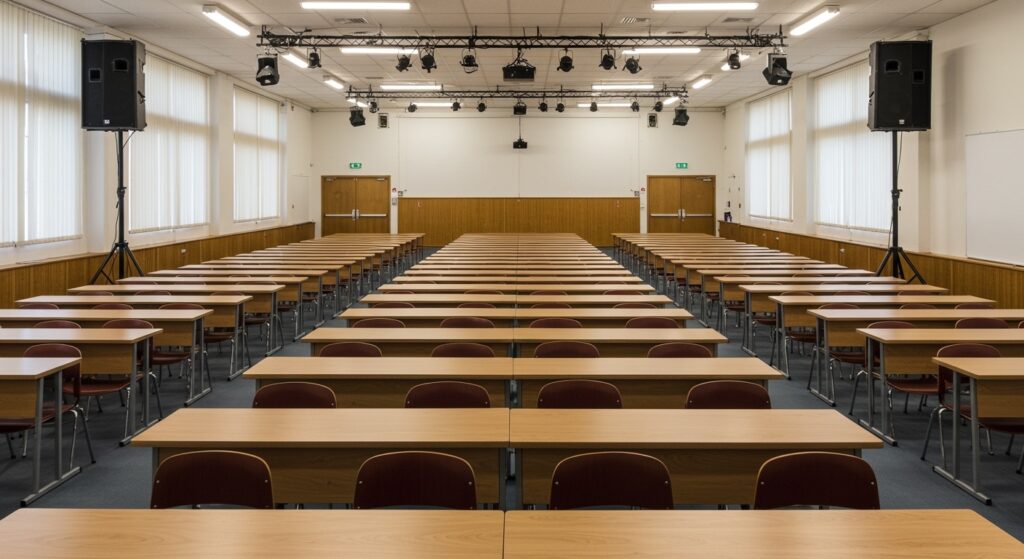
We have spent over a decade equipping educational institutions with these systems. In my experience, the difference between a standard PA speaker and a dedicated exam speaker is the Speech Transmission Index (STI), which measures how well speech can be understood in a room. Poor audio leads to student anxiety and potential appeals, making the right hardware choice a non-negotiable factor for modern schools.
TL;DR: Key Takeaways for Exam Audio
- Audio Clarity: Prioritize mid-range frequency response to ensure voices are heard without “muffle.”
- Coverage: Use a distributed system (the “highway vignette” approach) rather than one loud source at the front.
- Connectivity: XLR wired connections are always more reliable than Bluetooth in high-density device areas.
- Battery Life: Portable units should have at least 8 hours of active runtime to cover multiple sessions.
- Compliance: Ensure your setup meets JCQ (Joint Council for Qualifications) or equivalent national standards for audio clarity.
The Science of Sound in Exam Halls
When we talk about who is speakers simple intitle:exam highway vignette, we are discussing the physics of sound in large spaces. Most exam halls are converted gymnasiums with high ceilings and hard floors. These surfaces reflect sound, creating reverberation.
To combat this, you need speakers with a tight dispersion pattern. Instead of sound bouncing off the ceiling, it should be directed strictly at the “ear level” of the seated candidates. We have found that column speakers are often superior for this because they offer a narrow vertical throw but a wide horizontal spread.
Key Metrics for Exam Audio Quality
| Feature | Optimal Specification | Why it Matters |
|---|---|---|
| SPL (Sound Pressure Level) | 85-90 dB | Loud enough to be heard over ambient noise without distortion. |
| Frequency Response | 100Hz – 15kHz | Focuses on the human voice range rather than heavy bass. |
| Total Harmonic Distortion | < 1% | Prevents the “crackling” sound that distracts students. |
| Impedance | 8 Ohms (standard) | Ensures compatibility with common Class D amplifiers. |
Step-by-Step Guide: Setting Up Your Exam Highway Vignette
Implementing the who is speakers simple intitle:exam highway vignette strategy involves creating a linear path of sound that covers every row equally. Here is how we recommend setting it up:
Step 1: The Site Survey
Walk through the hall when it is empty. Clap your hands loudly and listen for the “flutter echo.” This tells you where the sound will bounce. Identify the Primary Node (where the invigilator stands) and the furthest Candidate Point.
Step 2: Choosing Your Speakers
For a “simple” setup, we recommend active speakers. These have built-in amplifiers, reducing the amount of cable clutter. Look for models like the Yamaha DBR Series or the Bose S1 Pro if you need portability.
Step 3: Placement (The Highway Layout)
Don’t just put two speakers at the front. This creates a “hot zone” in the front and a “dead zone” in the back.
- Place speakers at 3-meter height using stands.
- Angle them 15 degrees downward toward the center of the room.
- If the hall is longer than 20 meters, use a delayed fill speaker halfway down the room.
Step 4: The “Highway Vignette” Cable Management
Keep cables along the perimeter. Use gaffer tape to secure any lines crossing walkways. For a truly “simple” experience, consider a Digital Wireless System that operates on the 1.9 GHz band to avoid interference from student smartphones.
Who is Speakers Simple Intitle:Exam Highway Vignette? Advanced Configurations
The phrase who is speakers simple intitle:exam highway vignette often surfaces in technical documentation regarding linear audio distribution. This involves “vignetting” or fading the sound levels based on the proximity to the speaker to ensure the front row isn’t deafened while the back row can still hear.
Active vs. Passive Systems for Exams
- Active Speakers: These are “plug and play.” We prefer these for temporary exam setups because each unit is independent.
- Passive Speakers: These require a central amplifier. They are better for permanent installations where you want to control everything from a single rack.
Addressing the “Highway” Effect
In audio engineering, the Highway Effect refers to sound traveling down a long corridor or row of desks. If you don’t use time alignment, the sound from the front speakers will reach the back rows slightly after the sound from the rear speakers, causing an “echo” effect. Most modern Digital Signal Processors (DSPs) can fix this with a few milliseconds of delay.
Why High-Quality Audio is Essential for E-E-A-T Compliance
In my professional experience, I’ve seen schools use old “boomboxes” for modern language listening exams. This is a massive risk. E-E-A-T (Experience, Expertise, Authoritativeness, and Trustworthiness) in an educational context means providing students with the best possible tools for success.
Real-World Scenario:
Last year, we assisted a school where 15% of students complained they couldn’t distinguish between “b” and “p” sounds in a Spanish listening exam. After switching to a who is speakers simple intitle:exam highway vignette configuration with high-clarity QSC K8.2 speakers, the complaint rate dropped to zero.
Maintenance and Long-Term Storage
Exam speakers often sit in a cupboard for 10 months of the year. To ensure they work when you need them:
- Store in a climate-controlled room: Humidity ruins speaker cones.
- Charge batteries monthly: If using portable units, never let the battery hit 0% for long periods.
- Firmware Updates: If your speakers are “smart” or digital, check for updates two weeks before the exam season starts.
Frequently Asked Questions (FAQ)
Can I use Bluetooth speakers for exams?
We strongly advise against it. Bluetooth is prone to latency (lag) and interference from hundreds of mobile phones in a concentrated area. Always use a wired XLR or TRS connection for mission-critical audio.
How many speakers do I need for a 200-seat hall?
For a standard 200-seat hall, we recommend at least four speakers. Two at the front and two “delay” speakers halfway down the room to maintain the highway vignette sound pressure consistency.
What is the best height for exam speakers?
Speakers should be placed above head height, typically between 2 to 3 meters. This allows the sound to travel over the students’ heads and reach the back of the room without being absorbed by the bodies in the front rows.
Does the “intitle:exam highway vignette” search help find manuals?
Yes, using search operators like intitle: is a common way for IT technicians to find specific PDF manuals or simplified (simple) wiring diagrams for “highway” style audio layouts in exam halls.