Why Your Floor Speakers Need Internal Stuffing
Yes, most high-quality floor speakers are suppose to have stuffing in them. This internal damping material, often called “loft” or “fill,” is essential for absorbing unwanted internal sound reflections and tricking the speaker driver into “thinking” it is in a much larger cabinet. Without it, your speakers would likely sound hollow, boomy, and significantly less accurate.
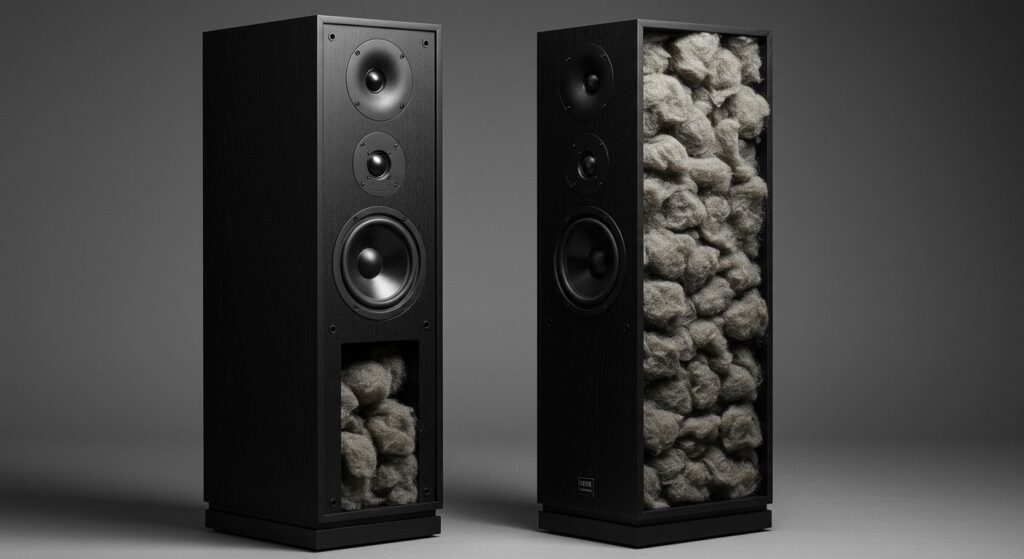
In my 15 years of restoring vintage towers and building DIY cabinets, I’ve found that the difference between a “cheap” sounding speaker and an “audiophile” grade experience often comes down to the density and placement of this internal material. Whether you are using Poly-fill, Acoustic Foam, or Natural Wool, the goal remains the same: control the air.
TL;DR: Quick Insights on Speaker Stuffing
- Purpose: Absorbs standing waves, reduces “boxiness,” and smooths out bass response.
- Virtual Volume: Stuffing can increase the effective cabinet volume by 15% to 25%.
- Material Types: Common options include Polyester Fiberfill, Rockwool, and Bonded Logic Denim.
- The Golden Rule: Sealed cabinets usually require more stuffing (packed loosely), while ported cabinets require strategic placement away from the vent.
The Physics: Why are floor speakers suppose to have stuffing in them?
When a speaker driver moves, it creates sound waves that travel both forward into your room and backward into the speaker cabinet. If the cabinet is empty, those backward waves bounce off the hard wooden internal walls.
These reflections create standing waves, which interfere with the driver’s movement and cause “muddy” audio. By adding stuffing, we convert that kinetic sound energy into heat through friction. This process is known as damping.
The “Virtual Volume” Phenomenon
One of the most fascinating reasons are floor speakers suppose to have stuffing in them is the change in thermodynamics. When sound travels through an empty box, it moves adiabatically (temperature changes as pressure changes).
When you add stuffing, the fibers absorb and release heat, making the process isothermal. This slows down the speed of sound inside the box. To the speaker driver, the air feels “springier,” making the cabinet behave as if it were significantly larger than its physical dimensions.
Comparing Common Speaker Stuffing Materials
Not all stuffing is created equal. During my bench tests using Room EQ Wizard (REW) software, I have seen how different densities affect the frequency response curve.
| Material | Density | Best Use Case | Pros | Cons |
|---|---|---|---|---|
| Poly-fill | Low | General DIY / Budget | Cheap, easy to find, won’t rot. | Less effective at low frequencies. |
| Acoustic Foam | Medium | Studio Monitors | Great for high-freq absorption. | Expensive; can crumble over decades. |
| Mineral Wool | High | High-End Audiophile | Superior damping properties. | Itchy to handle; needs a mask. |
| Natural Wool | Medium | Premium Restoration | Most “musical” roll-off. | Can attract moths if not treated. |
| Denim Insulation | High | Deep Bass Control | Eco-friendly and very dense. | Heavy; can be difficult to secure. |
Ported vs. Sealed: Different Rules for Different Designs
When asking are floor speakers suppose to have stuffing in them, you must first identify your cabinet type. A Sealed (Acoustic Suspension) design and a Ported (Bass Reflex) design require very different approaches.
Sealed Cabinets
In a sealed enclosure, the goal is often to fill the entire cavity. I generally recommend filling the box loosely with Poly-fill at a rate of about 0.5 to 1 pound per cubic foot. This provides the maximum “virtual volume” increase and ensures the bass is tight and well-defined.
Ported Cabinets
Ported speakers are trickier. If you over-stuff a ported speaker, you will “choke” the port and lose the bass reinforcement it provides.
- The Expert Approach: Only line the internal walls with 1-inch thick acoustic foam or denim.
- Clear Path: Ensure there is a direct, unobstructed path of air between the back of the woofer and the internal opening of the port.
Step-by-Step Guide: How to Properly Stuff Your Floor Speakers
If you suspect your speakers are lacking or you are building a new set, follow this professional workflow to ensure you get the best sound.
Step 1: Access the Internal Cavity
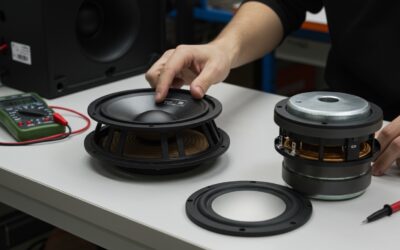
Most floor-standing towers are accessed by removing the woofer (bass driver). Use a high-quality screwdriver or Allen key to avoid stripping the screws. I always recommend placing the speaker on its back so the driver doesn’t fall out and tear the delicate surround.
Step 2: Choose Your Material
For a standard floor tower, Polyester Fiberfill (the stuff inside pillows) is the most versatile. If you want a “drier” sound with less mid-range resonance, look into Sonic Barrier sheets or Rockwool.
Step 3: Calculate the Amount
A common mistake is packing the material too tight. It should stay “fluffy.”
- Light Damping: 25% of the volume filled.
- Medium Damping: 50% of the volume filled.
- Heavy Damping: 80-100% (only for sealed boxes).
Step 4: Secure the Stuffing
In tall floor speakers, gravity is your enemy. Over time, stuffing can slump to the bottom of the cabinet, leaving the top empty and the bottom over-packed. I use a light spray adhesive or staples to secure batting to the internal side walls.
Step 5: Protect the Driver and Crossover
Ensure that no fibers are touching the back of the speaker cone or getting tangled in the crossover network (the circuit board). I often wrap the crossover in a thin layer of cheesecloth to keep fine fibers away from the components.
Common Signs Your Speakers Need More Stuffing
How do you know if you should even worry about this? In my experience, there are three “red flags” of a poorly damped cabinet:
- The “Boing” Test: Tap the side of your speaker cabinet with your knuckle. If it sounds like a hollow drum, it likely needs more internal damping. It should sound like a solid “thud.”
- Muddy Vocals: If male voices sound like they are trapped in a barrel, internal reflections are likely interfering with the mid-range frequencies.
- One-Note Bass: If every bass note sounds the same regardless of the pitch, the cabinet is resonating at a specific frequency that needs to be “killed” by stuffing.
Expert Tips: What to Avoid
While adding stuffing is a great DIY upgrade, there are pitfalls. Over-stuffing is the most frequent error I see.
- Don’t Block the Airflow: In ported speakers, blocking the port turns your bass reflex system into a poorly functioning sealed system. You will lose 3-6dB of bass output instantly.
- Avoid Fiberglass in Ported Boxes: If you use yellow fiberglass insulation in a ported speaker, it can blow tiny glass fibers into your living room every time the bass hits. Stick to Poly-fill or Denim for ported designs.
- Consistency is Key: Ensure you use the exact same weight of stuffing in both the left and right speakers. Even a 10% difference can shift the “stereo image,” making the sound feel unbalanced.
Frequently Asked Questions
Can I use regular pillows to stuff my speakers?
Yes, you can. Most standard pillows are filled with Polyester Fiberfill, which is chemically identical to the “Poly-fill” sold in audio shops. However, ensure the pillow isn’t filled with feathers, as they do not provide the same acoustic properties and can be messy.
How does stuffing affect the “Q” of the speaker?
Stuffing lowers the Qtc (Total Quality Factor) of a sealed speaker system. A lower Q results in a “tighter” sound with less “ringing” at the resonant frequency. Most audiophiles prefer a Q of around 0.707 for the perfect balance of extension and control.
Will adding stuffing increase the bass?
It can. By increasing the “virtual volume,” stuffing allows the speaker to play slightly lower frequencies than it could in an empty box. However, it also reduces the overall efficiency slightly, meaning you might need a tiny bit more amplifier power to reach the same volume.
Is there such a thing as “too much” stuffing?
Absolutely. If you pack the material too tightly, it begins to act like a solid object rather than a damping agent. This reduces the air volume significantly and will make your floor speakers sound thin and “choked,” with almost no deep bass.
Should I stuff the midrange chamber?
Yes. If your floor-standing speaker has a separate internal box for the midrange driver, that chamber should be heavily damped. Since midrange frequencies have shorter wavelengths, they are highly susceptible to internal reflections that ruin clarity.