What Are HiFi Computer Speakers? A Beginner’s Guide
Tired of that tinny, lifeless audio coming from your monitor or cheap plastic PC speakers? You’re not alone. Investing in what hifi computer speakers is the single biggest upgrade you can make to your desktop experience, transforming everything from music and gaming to video calls into a rich, immersive event. This guide will walk you through everything you need to know, from the core concepts to a step-by-step setup process for audiophile-grade sound.
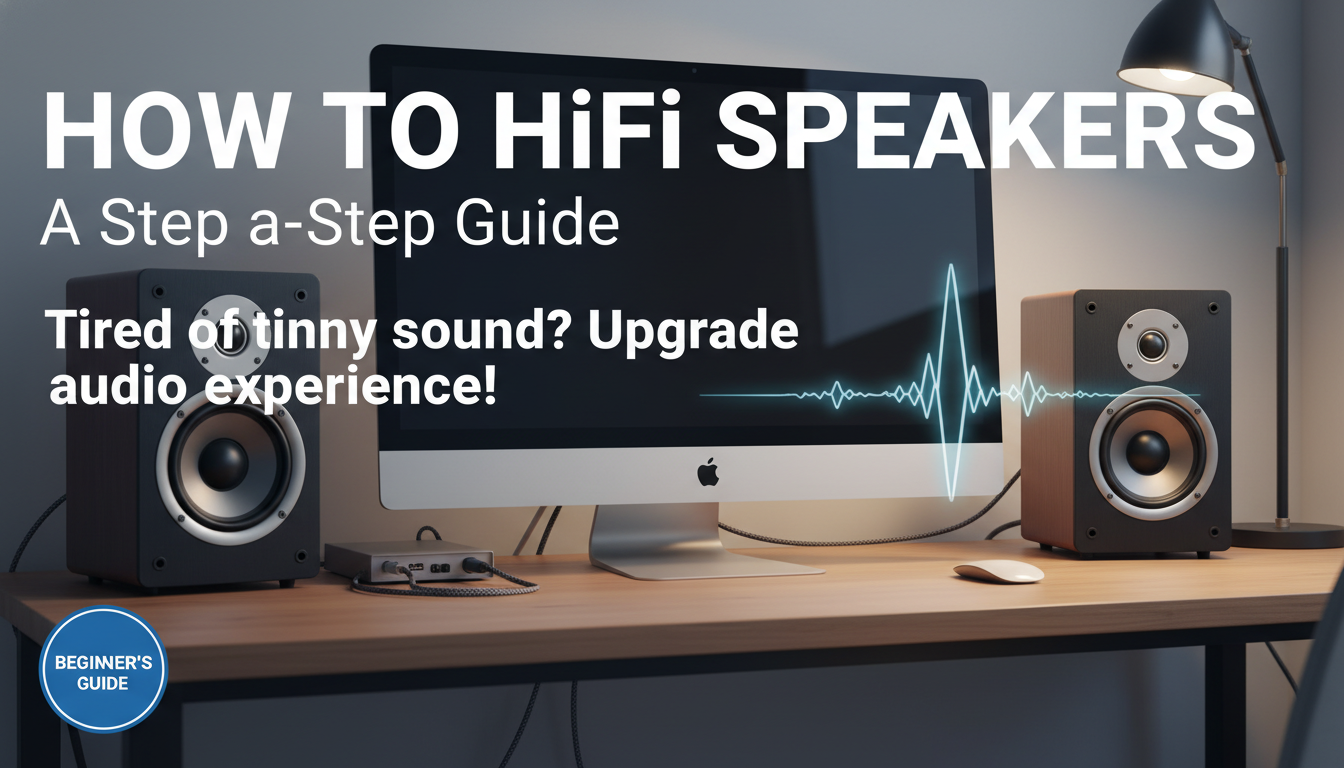
As someone who has spent years testing and configuring desktop audio systems, I’ve learned that achieving great sound isn’t about spending a fortune—it’s about understanding a few key principles. We’ll cut through the jargon and give you the practical advice needed to build a setup that truly sings.
Key Takeaways
- What are HiFi Speakers? High-Fidelity (HiFi) speakers are designed to reproduce sound as accurately and clearly as possible, revealing details standard speakers miss.
- Active vs. Passive: What hifi active speakers have a built-in amplifier and are simpler to set up. Passive speakers require a separate, external amplifier, offering more flexibility.
- A DAC is Crucial: A dedicated Digital-to-Analog Converter (DAC) is essential for bypassing your computer’s low-quality internal sound card, dramatically improving clarity.
- Placement is King: Proper speaker placement, forming an equilateral triangle with your listening position, is free and has the biggest impact on sound quality.
Understanding What HiFi Computer Speakers Really Are
High-Fidelity (HiFi) simply means the equipment reproduces sound that is incredibly faithful to the original recording. Unlike typical PC speakers, which are often built with budget components to be “good enough,” HiFi speakers are engineered for accuracy, detail, and a wide frequency response.
This means you’ll hear the subtle breath of a vocalist, the distinct pluck of a bass string, and the precise location of footsteps in a game. This is achieved through higher-quality components like dedicated tweeters (for high frequencies) and woofers (for low-mid frequencies), housed in acoustically designed cabinets that prevent unwanted vibration and distortion.
The First Big Choice: What Hifi Active Speakers vs. Passive
Your most important initial decision is choosing between an active (powered) or passive speaker system. There is no single “best” answer; it depends entirely on your goals for simplicity, budget, and future upgradability.
What Hifi Powered Speakers (Active)
Active speakers, often called powered speakers, have the amplifier built directly into one or both of the speaker cabinets. This makes them an all-in-one solution that’s incredibly popular for desktop use.
- Pros:
- Cons:
From my own experience, starting with a quality pair of active speakers like the Audioengine A5+ or Kanto YU4 is the perfect entry point for most people. The convenience and out-of-the-box performance are fantastic.
Passive Speakers
Passive speakers contain no internal amplification. They are just the speaker drivers and crossover in a cabinet. They require a separate, external amplifier to power them.
- Pros:
- Cons:
Comparison: Active vs. Passive Speakers
| Feature | Active (Powered) Speakers | Passive Speakers |
|---|---|---|
| Setup Complexity | Low (Plug-and-play) | Medium (Requires component matching) |
| Desk Footprint | Small (No external amp) | Large (Requires space for an amp) |
| Upgradability | Low (Must replace the whole system) | High (Can upgrade components individually) |
| Typical Cost | Lower initial cost for a complete system | Higher initial cost for speakers + amp |
| Best For | Beginners, minimalists, small desks | Audiophiles, tinkerers, future-proofing |
How to Choose the Perfect HiFi PC Speakers: A 4-Step Guide
Ready to pick your speakers? Follow these steps to narrow down the options and find the perfect match for your needs and space.
Step 1: Set Your Budget & Define Your Use Case
Your audio needs for competitive gaming are very different from those for mixing music or just enjoying Spotify.
- Gaming: Look for speakers with excellent imaging (the ability to place sounds accurately in space). This will help you pinpoint enemy locations.
- Music & Movies: Prioritize a balanced frequency response and good dynamics (the difference between the loudest and quietest sounds).
- Music Production: Studio monitors are a type of HiFi speaker designed for a “flat” frequency response, meaning they don’t color the sound. This is critical for accurate mixing.
Budget Tiers (for a complete system):
- Entry-Level ($200 – $500): Excellent performance for the price. Look at brands like Edifier, PreSonus, and Audioengine.
- Mid-Range ($500 – $1,200): A significant jump in clarity, build quality, and detail. Brands like Kanto, KEF, and Q Acoustics shine here.
- High-End ($1,200+): The point of diminishing returns, but offers uncompromising performance.
Step 2: Measure Your Desk Space
Most desktop listening is done in the “near-field,” meaning you’re sitting only a few feet from the speakers. This is actually a good thing, as it minimizes the impact of your room’s acoustics.
However, speaker size is critical. Large bookshelf speakers might overwhelm a small desk, both physically and sonically. Measure the available space on either side of your monitor before you buy. For a tight space, consider smaller 3-4″ driver speakers. If you have more room, 5-6″ drivers will provide a fuller sound with better bass.
Step 3: Check Your Connectivity Options
How will you connect the speakers to your computer?
- USB: This is often the best method. A USB connection sends a pure digital signal to a DAC (either in your active speakers or a separate unit), bypassing your computer’s often-noisy internal sound card.
- Optical (TOSLINK): Another excellent digital option, great for connecting to game consoles or TVs as well.
- RCA / 3.5mm: Standard analog connections. These are fine, but they rely on your computer’s built-in DAC, which is usually the weakest link in the chain.
- Bluetooth: Convenient for wireless streaming, but make sure it supports high-quality codecs like aptX HD or LDAC to minimize quality loss.
Step 4: Get a Dedicated DAC
A DAC (Digital-to-Analog Converter) is one of the most impactful upgrades you can make. Your computer has one built-in, but it’s typically a cheap component surrounded by noisy electronics, which introduces distortion and jitter.
An external DAC, like the popular Schiit Modi or iFi Zen DAC, takes the raw digital audio signal from your PC via USB and converts it into a clean, high-quality analog signal to send to your amplifier or active speakers. It’s the difference between a blurry image and a crystal-clear one.
What Are HiFi Computer Speakers? A Beginner’s Guide
Tired of that tinny, lifeless audio coming from your monitor or cheap plastic PC speakers? You’re not alone. Investing in what hifi computer speakers is the single biggest upgrade you can make to your desktop experience, transforming everything from music and gaming to video calls into a rich, immersive event. This guide will walk you through everything you need to know, from the core concepts to a step-by-step setup process for audiophile-grade sound.
As someone who has spent years testing and configuring desktop audio systems, I’ve learned that achieving great sound isn’t about spending a fortune—it’s about understanding a few key principles. We’ll cut through the jargon and give you the practical advice needed to build a setup that truly sings.
Key Takeaways
- What are HiFi Speakers? High-Fidelity (HiFi) speakers are designed to reproduce sound as accurately and clearly as possible, revealing details standard speakers miss.
- Active vs. Passive: What hifi active speakers have a built-in amplifier and are simpler to set up. Passive speakers require a separate, external amplifier, offering more flexibility.
- A DAC is Crucial: A dedicated Digital-to-Analog Converter (DAC) is essential for bypassing your computer’s low-quality internal sound card, dramatically improving clarity.
- Placement is King: Proper speaker placement, forming an equilateral triangle with your listening position, is free and has the biggest impact on sound quality.
Understanding What HiFi Computer Speakers Really Are
High-Fidelity (HiFi) simply means the equipment reproduces sound that is incredibly faithful to the original recording. Unlike typical PC speakers, which are often built with budget components to be “good enough,” HiFi speakers are engineered for accuracy, detail, and a wide frequency response.
This means you’ll hear the subtle breath of a vocalist, the distinct pluck of a bass string, and the precise location of footsteps in a game. This is achieved through higher-quality components like dedicated tweeters (for high frequencies) and woofers (for low-mid frequencies), housed in acoustically designed cabinets that prevent unwanted vibration and distortion.
The First Big Choice: What Hifi Active Speakers vs. Passive
Your most important initial decision is choosing between an active (powered) or passive speaker system. There is no single “best” answer; it depends entirely on your goals for simplicity, budget, and future upgradability.
What Hifi Powered Speakers (Active)
Active speakers, often called powered speakers, have the amplifier built directly into one or both of the speaker cabinets. This makes them an all-in-one solution that’s incredibly popular for desktop use.
- Pros:
- Cons:
From my own experience, starting with a quality pair of active speakers like the Audioengine A5+ or Kanto YU4 is the perfect entry point for most people. The convenience and out-of-the-box performance are fantastic.
Passive Speakers
Passive speakers contain no internal amplification. They are just the speaker drivers and crossover in a cabinet. They require a separate, external amplifier to power them.
- Pros:
- Cons:
Comparison: Active vs. Passive Speakers
| Feature | Active (Powered) Speakers | Passive Speakers |
|---|---|---|
| Setup Complexity | Low (Plug-and-play) | Medium (Requires component matching) |
| Desk Footprint | Small (No external amp) | Large (Requires space for an amp) |
| Upgradability | Low (Must replace the whole system) | High (Can upgrade components individually) |
| Typical Cost | Lower initial cost for a complete system | Higher initial cost for speakers + amp |
| Best For | Beginners, minimalists, small desks | Audiophiles, tinkerers, future-proofing |
How to Choose the Perfect HiFi PC Speakers: A 4-Step Guide
Ready to pick your speakers? Follow these steps to narrow down the options and find the perfect match for your needs and space.
Step 1: Set Your Budget & Define Your Use Case
Your audio needs for competitive gaming are very different from those for mixing music or just enjoying Spotify.
- Gaming: Look for speakers with excellent imaging (the ability to place sounds accurately in space). This will help you pinpoint enemy locations.
- Music & Movies: Prioritize a balanced frequency response and good dynamics (the difference between the loudest and quietest sounds).
- Music Production: Studio monitors are a type of HiFi speaker designed for a “flat” frequency response, meaning they don’t color the sound. This is critical for accurate mixing.
Budget Tiers (for a complete system):
- Entry-Level ($200 – $500): Excellent performance for the price. Look at brands like Edifier, PreSonus, and Audioengine.
- Mid-Range ($500 – $1,200): A significant jump in clarity, build quality, and detail. Brands like Kanto, KEF, and Q Acoustics shine here.
- High-End ($1,200+): The point of diminishing returns, but offers uncompromising performance.
Step 2: Measure Your Desk Space
Most desktop listening is done in the “near-field,” meaning you’re sitting only a few feet from the speakers. This is actually a good thing, as it minimizes the impact of your room’s acoustics.
However, speaker size is critical. Large bookshelf speakers might overwhelm a small desk, both physically and sonically. Measure the available space on either side of your monitor before you buy. For a tight space, consider smaller 3-4″ driver speakers. If you have more room, 5-6″ drivers will provide a fuller sound with better bass.
Step 3: Check Your Connectivity Options
How will you connect the speakers to your computer?
- USB: This is often the best method. A USB connection sends a pure digital signal to a DAC (either in your active speakers or a separate unit), bypassing your computer’s often-noisy internal sound card.
- Optical (TOSLINK): Another excellent digital option, great for connecting to game consoles or TVs as well.
- RCA / 3.5mm: Standard analog connections. These are fine, but they rely on your computer’s built-in DAC, which is usually the weakest link in the chain.
- Bluetooth: Convenient for wireless streaming, but make sure it supports high-quality codecs like aptX HD or LDAC to minimize quality loss.
Step 4: Get a Dedicated DAC
A DAC (Digital-to-Analog Converter) is one of the most impactful upgrades you can make. Your computer has one built-in, but it’s typically a cheap component surrounded by noisy electronics, which introduces distortion and jitter.
An external DAC, like the popular Schiit Modi or iFi Zen DAC, takes the raw digital audio signal from your PC via USB and converts it into a clean, high-quality analog signal to send to your amplifier or active speakers. It’s the difference between a blurry image and a crystal-clear one.
How to Set Up Your HiFi Computer Speakers for Peak Performance
Buying great speakers is only half the battle. Proper setup is free and will unlock their true potential. I’ve seen amazing speakers sound mediocre simply due to poor placement.