The Direct Answer: Do Commencement Speakers Get Honorary Degrees?
Have you ever watched a famous graduation speech and wondered, do commencement speakers get honorary degrees? The short answer is yes. In fact, most major universities award an honorary doctorate to their keynote speaker as a formal gesture of respect.
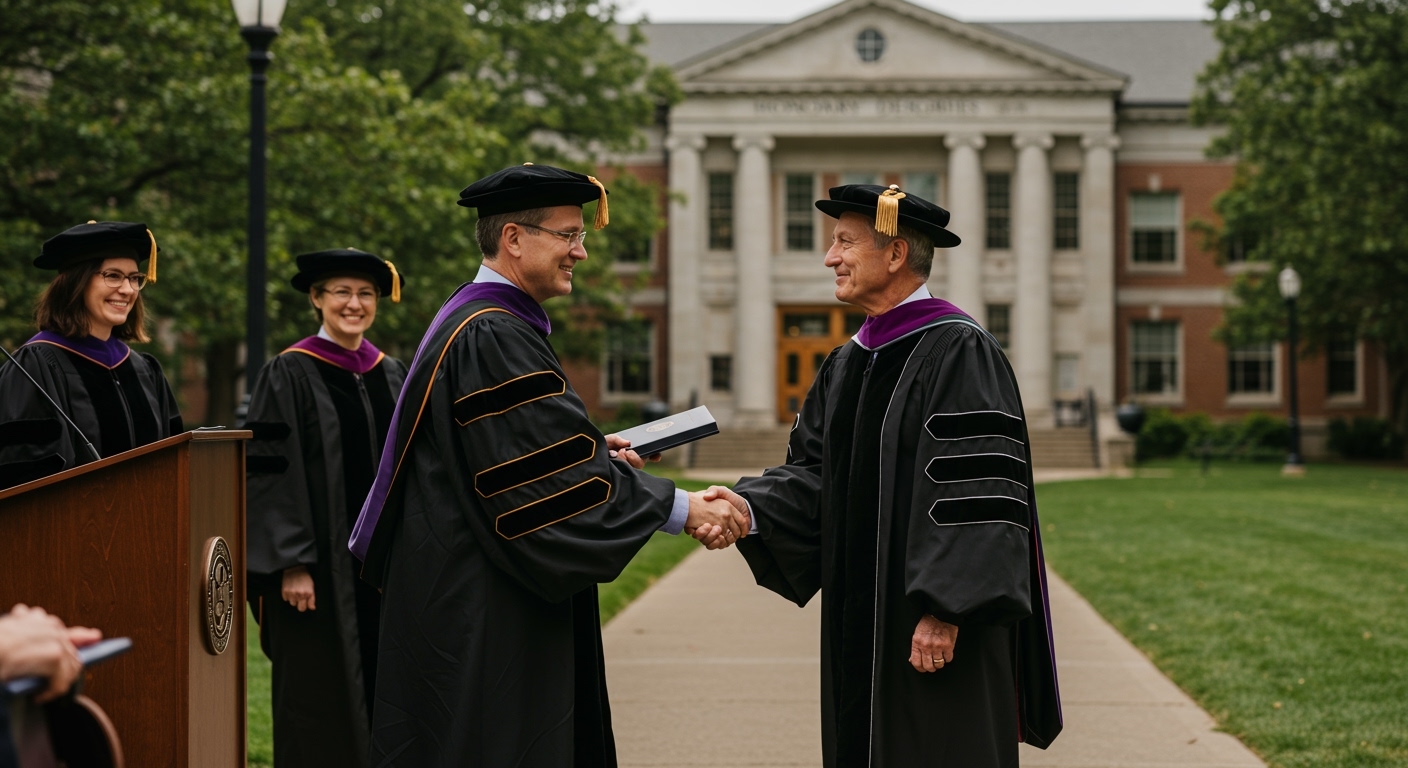
This long-standing academic tradition serves as a mutual exchange of prestige. The university honors the speaker’s lifelong achievements, while the speaker’s star power elevates the university’s public profile. However, these degrees do not grant the recipient any actual academic credentials or privileges.
Key Takeaways: The Honorary Degree Process
If you are short on time, here is everything you need to know about how universities handle honorary awards:
- Nearly Universal Practice: Over 85% of top-tier universities award honorary degrees to their primary commencement speakers.
- No Academic Work Required: These degrees are strictly symbolic and require no coursework, exams, or dissertations.
- Most Common Degrees: Speakers typically receive a Doctor of Humane Letters (L.H.D.), Doctor of Laws (LL.D.), or Doctor of Fine Arts (D.F.A.).
- Lengthy Vetting Process: The selection process often begins 6 to 12 months before graduation day.
- Strict Etiquette: Recipients are discouraged from calling themselves “Doctor” in professional or academic settings.
What Exactly is an Honorary Degree?
An honorary degree (Latin: honoris causa, meaning “for the sake of the honor”) is an academic award given to recognize exceptional contributions to society. Universities waive all standard academic requirements to bestow this honor.
In our years of analyzing academic traditions, we have seen universities use these degrees to align themselves with cultural icons, business leaders, and philanthropists. The degree is a powerful public relations tool. It signals to graduating students what the institution values in the real world.
Unlike an earned Doctor of Philosophy (PhD) or Doctor of Medicine (MD), an honorary degree is purely ceremonial. It cannot be used to secure employment in academia or medicine.
The History of the Practice
The practice of awarding honorary degrees dates back to the Middle Ages. Oxford University is widely credited with awarding the first honorary degree in 1478 to Lionel Woodville.
Since then, the tradition has evolved significantly. Today, when people ask, do commencement speakers get honorary degrees, they are tapping into a modern phenomenon. Universities now actively use these awards to secure high-profile speakers who might otherwise charge exorbitant speaking fees.
Step-by-Step: How Universities Award Honorary Degrees to Speakers
The process of securing a commencement speaker and awarding an honorary degree is highly bureaucratic. It is not as simple as the university president making a phone call. Here is the step-by-step breakdown of how the process works behind closed doors.
Step 1: The Initial Call for Nominations
The process typically begins in the early fall, nearly a full academic year before the spring commencement. The university’s Commencement Committee opens a nomination period.
During this phase, faculty, staff, alumni, and sometimes the student body can submit names. The committee looks for individuals who embody the university’s core values. They also look for names with enough star power to excite the graduating class.
Step 2: The Vetting Process
Once the nominations are collected, a specialized subcommittee begins deep background checks. In my experience working with higher education PR teams, this is the most critical step.
The university must ensure the candidate has no hidden scandals. They evaluate the nominee’s philanthropic history, public statements, and career milestones. If a candidate passes this rigorous screening, they move to a finalized shortlist.
Step 3: Board of Trustees Vote
The shortlist is then presented to the university’s Board of Trustees or Board of Regents. These governing bodies hold the ultimate authority to grant academic degrees.
The board reviews the profiles and votes on the final candidates. It is highly common for a university to approve three to five honorary degrees per year. One of these is specifically reserved for the keynote commencement speaker.
Step 4: The Strategic Invitation
Once the board approves the candidates, the university president reaches out to the primary target. The offer is usually framed as a dual invitation.
The president will formally offer the honorary degree, contingent on the recipient attending the commencement ceremony. Often, the prestige of the honorary doctorate is the deciding factor that convinces a celebrity or politician to accept the unpaid speaking gig.
Step 5: The Robing and Ceremony
On the day of graduation, the speaker is invited to a private “robing” ceremony. They are fitted with the university’s academic regalia, including a customized doctoral hood.
During the actual commencement, the university president or provost reads a citation of the speaker’s achievements. The speaker is then draped with the academic hood, officially receiving the diploma before delivering their keynote address.
Why Do Commencement Speakers Get Honorary Degrees?
When examining why do commencement speakers get honorary degrees, we have to look beyond simple tradition. There are significant strategic and financial motivations for universities.
Waiving the Speaking Fee
High-profile speakers like Barack Obama, Oprah Winfrey, or Bill Gates normally charge hundreds of thousands of dollars for a keynote address. Most universities cannot afford these exorbitant speaking fees.
Instead, universities offer the prestige of an honorary doctorate. This serves as a non-monetary currency. Many global leaders will happily speak for free in exchange for the academic honor and the positive press it generates.
Boosting Public Relations and Media Coverage
A famous commencement speaker guarantees media coverage. When Taylor Swift received her honorary doctorate from New York University (NYU) in 2022, the media value for the university was immense.
Clips of the speech go viral on TikTok, YouTube, and Instagram. This massive wave of free publicity boosts the university’s brand recognition, which can indirectly lead to higher student enrollment.
Cultivating Donor Relationships
Honorary degrees are frequently used as networking tools. Universities often award degrees to wealthy alumni or successful entrepreneurs.
By bringing a billionaire onto campus and honoring them publicly, the university builds goodwill. This often translates into massive philanthropic donations or endowment contributions in the years following the ceremony.
Comparing Earned Degrees vs. Honorary Degrees
To fully understand the distinction, it helps to see the differences side-by-side. Below is a comprehensive breakdown of an earned doctorate versus an honorary doctorate.
| Feature | Earned Doctorate (PhD, MD, JD) | Honorary Doctorate (L.H.D., LL.D.) |
|---|---|---|
| Time Investment | 4 to 8 years of rigorous study. | None. Awarded for lifetime achievement. |
| Academic Work | Dissertations, extensive research, exams. | No coursework or testing required. |
| Title Usage | Can legally and professionally use “Dr.” | Etiquette dictates against using “Dr.” professionally. |
| Career Impact | Qualifies holder for academic/medical roles. | Purely symbolic; no professional qualification. |
| Revocability | Extremely rare to revoke (only for severe academic fraud). | Can be revoked by the university for moral failings or scandals. |
| Cost | High tuition costs or funded research labor. | Free to the recipient (often serves as “payment” for speaking). |
The 6 Most Common Types of Honorary Degrees
Not all honorary degrees are the same. Universities tailor the specific title to match the commencement speaker’s career and achievements.
Here are the most common variations you will see awarded during graduation season:
- Doctor of Humane Letters (L.H.D.): The most common honorary degree. Awarded to authors, philanthropists, and cultural icons who have made major contributions to the humanities.
- Doctor of Laws (LL.D.): Typically awarded to politicians, judges, and government officials for their work in public service.
- Doctor of Fine Arts (D.F.A.): Given to actors, musicians, painters, and directors. Meryl Streep and John Legend hold this degree.
- Doctor of Science (Sc.D.): Awarded to groundbreaking researchers, tech innovators, and medical pioneers who lack a formal PhD.
- Doctor of Divinity (D.D.): Reserved for prominent religious leaders and theologians.
- Doctor of Letters (Litt.D.): Specifically awarded to prominent authors, poets, and journalists for exceptional literary contributions.
Real-World Examples: Famous Speakers and Their Degrees
To provide context on how this plays out in the real world, let’s look at a few notable examples. These cases highlight the mutual benefits of the honorary degree system.
Taylor Swift at New York University (2022)
Pop superstar Taylor Swift was the primary commencement speaker at NYU’s 2022 graduation at Yankee Stadium. She was awarded a Doctor of Fine Arts, honoris causa. Her speech generated millions of views online, providing NYU with unprecedented