How Are Speakers Measured in Size? The Definitive Guide
To determine how are speakers measured in size, you must measure across the widest part of the external frame (the metal or plastic basket) rather than the flexible cone itself. While many consumers believe the “size” refers to the vibrating part of the speaker, the industry standard is based on the overall diameter of the mounting flange and the diagonal distance between screw holes. For a perfect fit, you must also measure the mounting depth to ensure the magnet clears internal obstructions like windows or structural braces.
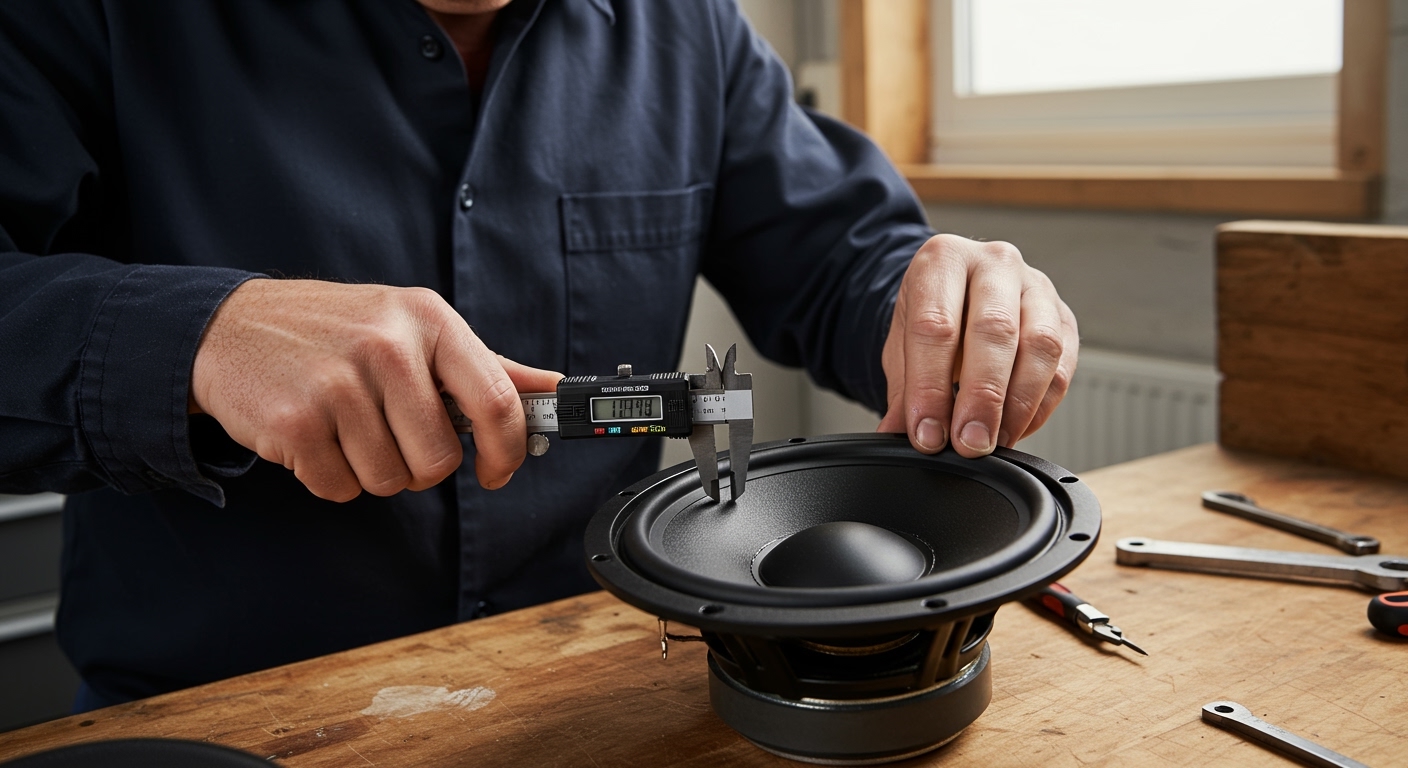
TL;DR: Quick Measurement Checklist
- Frame Diameter: Measure the widest point of the outer metal rim.
- Bolt Pattern: Measure diagonally from the center of one mounting hole to the opposite one.
- Mounting Depth: Measure from the back of the mounting flange to the bottom of the magnet.
- Cutout Diameter: The width of the hole required for the speaker basket to drop into.
- Industry Standard: A “6.5-inch speaker” rarely measures exactly 6.5 inches; always check the spec sheet.
Understanding the Standard: How Are Speakers Measured in Size?
In my fifteen years of custom audio installation, the biggest mistake I see DIYers make is buying a “6.5-inch speaker” and realizing it won’t fit their factory bracket. The confusion stems from the difference between nominal size and actual physical dimensions.
When manufacturers label a speaker, they use a nominal size (a general category). However, the actual frame diameter is what determines if the speaker sits flush against your mounting surface. For example, a speaker marketed as a 6.5-inch model might have an actual frame width of 6.75 inches.
The Three Critical Dimensions
- Overall Diameter: This is the total width including the frame/flange.
- Mounting Hole Diameter: The size of the hole you need to cut in the wood or plastic (also called the baffle cutout).
- Mounting Depth: How deep the speaker sits inside the cavity.
Are Speakers Measured for Speaker Size or Total Size?
A common point of frustration is whether are speakers measured for speaker size or total size. The short answer is: they are measured by the total frame size, but the “effective” size usually refers to the basket diameter.
The Frame vs. The Cone
If you measure only the cone (the moving part), a 6.5-inch speaker will likely only measure about 5.25 inches. If you buy a replacement based solely on the cone measurement, your new speaker will be far too large for the existing hole.
| Speaker Component | Measurement Significance |
|---|---|
| Outer Flange | Determines if the speaker covers the mounting hole. |
| Bolt Circle | Ensures the screws align with existing or new holes. |
| Surround/Cone | Defines the “effective piston area” but not the fitment size. |
| Magnet Diameter | Determines if the speaker will fit through the cutout. |
Pro Tip: In my experience, high-end brands like Focal or JL Audio often provide a “template” in the box. Use this template to trace your cutout rather than relying on a ruler alone.
How to Measure Car Speakers Step-by-Step
When upgrading vehicle audio, precision is non-negotiable. Space is at a premium inside door panels, and a 1/8-inch error can prevent your door card from snapping back into place.
Step 1: Measure the Mounting Flange
Place your tape measure across the face of the speaker. Measure from one edge of the outer rim to the other. This is your primary “size” category (e.g., 4″, 5.25″, 6.5″, 6×9″).
Step 2: Calculate the Bolt Circle Diameter (BCD)
This is critical for drop-in replacements. Measure from the center of one screw hole to the center of the screw hole directly across from it. This ensures the speaker aligns with your factory bracket.
Step 3: Determine Mounting Depth
Lay the speaker face-down on a flat surface. Measure from the mounting surface (the bottom of the flange) to the top of the magnet.
- Standard Depth: Usually 2″ to 3″.
- Shallow Mount: Often under 2″ for tight spaces.
Step 4: Check the Tweeter Protrusion
If you are installing coaxial speakers (where the tweeter sits in the middle), measure how far the tweeter sticks out past the frame. If it sticks out too far, it will hit the factory speaker grille.
Are Speakers Measured for Speaker Size or Total Size Marine?
The rules change slightly on boats. If you are wondering are speakers measured for speaker size or total size marine, you must account for the integrated grilles.
Unlike car speakers, which are hidden behind door panels, marine speakers (like those from Wet Sounds or Clarion) come with permanent, heavy-duty plastic grilles for UV and water protection.
Marine-Specific Measurement Factors
- Total Diameter with Grille: Marine speakers often have oversized grilles to provide a watertight seal. A 6.5-inch marine speaker might have a total diameter of nearly 7.5 inches.
- Drainage Clearance: When measuring, ensure there is space at the bottom of the mount for water to escape.
- Stainless Steel Hardware: Ensure your measurements allow for the slightly larger heads of marine-grade stainless screws.
Measuring Common Speaker Shapes
Speakers aren’t always round. Dealing with oval or rectangular speakers requires a different approach to ensure accuracy.
Oval Speakers (6×9, 5×7, 4×6)
For oval speakers, you must provide two sets of measurements:
- Length: The widest part of the oval.
- Width: The narrowest part of the oval.
- Example: A 6×9 speaker should measure approximately 6 inches by 9 inches across the frame.
Subwoofers
Subwoofers are measured the same way (frame diameter), but you must pay extra attention to Excursion (Xmax). This is how far the cone moves forward. If you measure the depth but forget the “throw” of the woofer, it might hit the floor or seat it is firing toward.
Technical Specifications Table: Common Sizes
| Nominal Size | Typical Frame Diameter | Typical Cutout Diameter | Common Application |
|---|---|---|---|
| 3.5 Inch | 3.5″ – 3.7″ | 3.0″ – 3.2″ | Dashboards / Corner Pillars |
| 4 Inch | 4.0″ – 4.25″ | 3.6″ | Small car doors / Bookshelf speakers |
| 5.25 Inch | 5.2″ – 5.5″ | 4.5″ – 4.7″ | Classic car kick panels |
| 6.5 Inch | 6.5″ – 6.75″ | 5.5″ – 5.7″ | Modern car doors (Standard) |
| 6×9 Inch | 6.5″ x 9.2″ | 5.8″ x 8.6″ | Rear decks / Large truck doors |
| 8 Inch | 8.1″ – 8.4″ | 7.1″ | Subwoofers / High-output marine |
Expert Tips for Accurate Fitting
Through years of troubleshooting, I’ve developed a few “Golden Rules” for speaker measurement that will save you hours of frustration.
Use the “Pencil Trace” Method**
If you are replacing an old speaker, don’t just measure the speaker. Measure the hole it came out of. If the hole is 5.5 inches, you need a speaker with a cutout diameter of 5.5 inches or less.
Account for the “Gap”**
Never choose a speaker where the frame is exactly the same size as the hole. You need at least 1/4 inch of flange around the entire perimeter to provide a surface for the screws to bite into.
Beware of “Oversized” 6.5s**
Many manufacturers (like Alpine or Rockford Fosgate) sell “6.5-inch” speakers that are actually 6.75 inches. These are designed to fit European vehicles but often require an adapter bracket for domestic cars. Always verify the actual frame diameter in the product manual.
Factor in the Crossover**
Component speakers (where the tweeter is separate) have an external crossover box. While not part of the speaker size measurement, you must measure the available space under the dash or inside the door to hide this component.
Frequently Asked Questions
How do I know what size speakers are in my car without taking it apart?
You can use online fitment databases like Crutchfield or Metra Online. By entering your vehicle’s year, make, and model, these tools provide the factory nominal sizes. However, I always recommend a physical measurement before buying expensive aftermarket gear.
Does the magnet size affect the speaker size measurement?
No, the magnet size does not change the nominal “size” (e.g., a 6.5″ speaker is still a 6.5″ speaker regardless of magnet size). However, a larger magnet increases the mounting depth, which may prevent the speaker from fitting in shallow locations.
Is a 6.5 and 6.75 speaker the same?
Not exactly. While they are often grouped together, a 6.75-inch speaker has a slightly larger frame and a different bolt pattern. Many 6.75″ speakers come with multi-hole adapter plates to fit 6.5″ openings, but a true 6.5″ might leave gaps in a 6.75″ hole.
What is the “cutout diameter”?
The cutout diameter is the physical size of the circle you must cut into your mounting surface (MDF, fiberglass, or metal) to allow the back of the speaker to pass through while the flange sits on top.
How are square subwoofers measured?
Square subwoofers (popularized by Kicker L7 series) are measured by the length of one side of the frame. A “12-inch square sub” measures 12×12 inches, providing significantly more surface area than a 12-inch round subwoofer.