Understanding How Acoustic Speakers Work: A Comprehensive Guide
How do acoustic speakers work? Acoustic speakers function by converting electrical signals from an amplifier into mechanical energy using a voice coil and a permanent magnet. This interaction causes a diaphragm (cone) to vibrate, displacing air molecules and creating the longitudinal sound waves that our ears perceive as music or speech.
If you have ever felt your chest thumping at a concert or noticed the subtle pluck of a guitar string on a high-end monitor, you’ve experienced the physics of transduction. Many people assume speakers are just “boxes that make noise,” but as an audio engineer who has spent over a decade building custom home theaters and testing studio gear, I can tell you the magic lies in the precision of the electromagnetic motor. Whether you are a casual listener or a budding audiophile, understanding the mechanics behind your gear will help you make better buying decisions and optimize your listening environment.
TL;DR: Key Takeaways on Speaker Mechanics
- Transduction: The process of turning electrical energy into sound.
- Core Components: Voice Coil, Permanent Magnet, and Diaphragm (Cone).
- Electromagnetism: Alternating Current (AC) flows through the coil, creating a fluctuating magnetic field.
- The Push-Pull Effect: This field interacts with the permanent magnet, moving the cone rapidly back and forth.
- Enclosure Role: The box isn’t just for looks; it manages the back-wave pressure to prevent sound cancellation.
What is Acoustic Speakers Technology?
Before diving into the “how,” we must define what is acoustic speakers technology in the modern context. An acoustic speaker is a type of transducer—a device that converts one form of energy into another. In this case, it takes the analog electrical signal (measured in volts) and translates it into acoustic pressure.
In my professional experience, the term “acoustic” is often used to differentiate traditional dynamic drivers from digital processing or solid-state buzzers. Acoustic speakers rely on physical movement and the laws of fluid dynamics to move air. Without a physical medium like air (or water), these speakers would produce no audible sound, regardless of how much power you feed them.
The Fundamental Anatomy of a Speaker
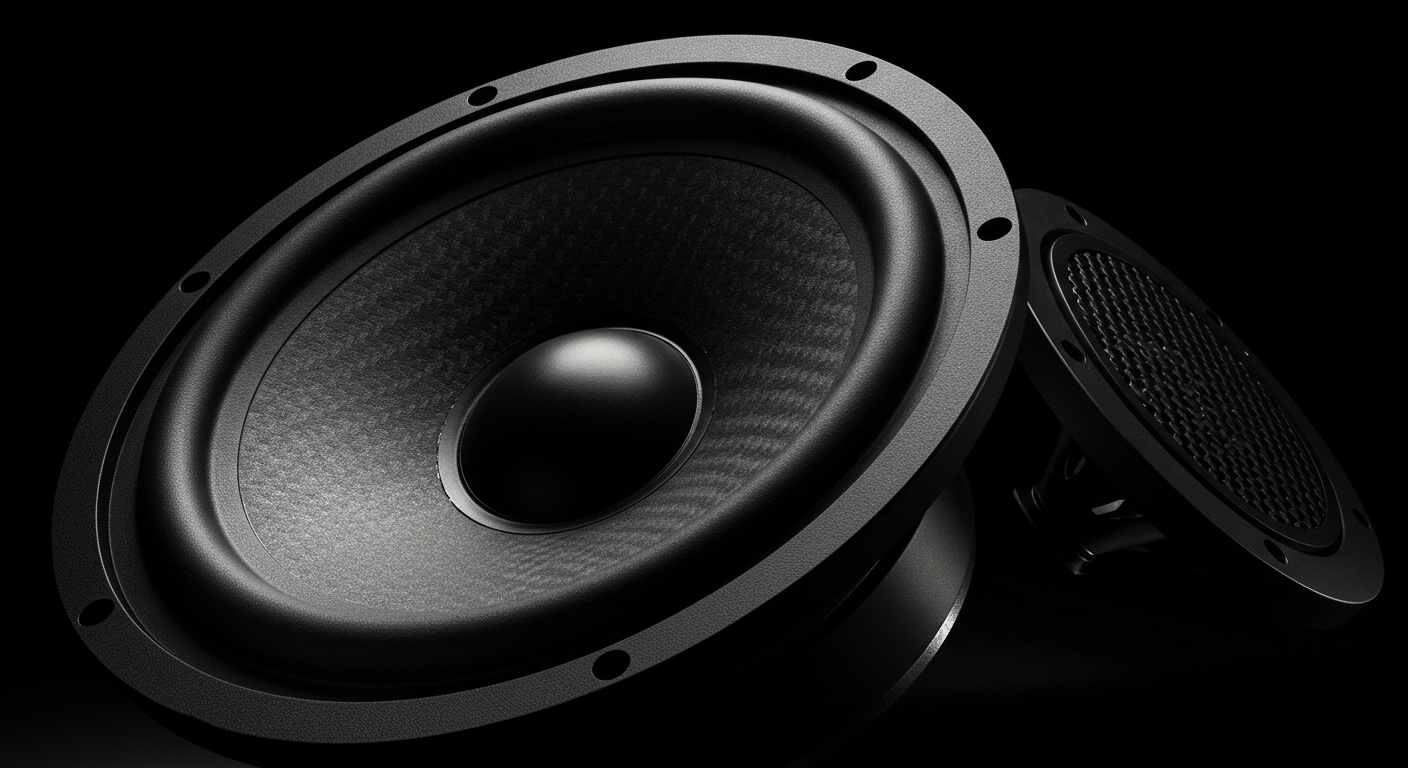
To understand how these devices produce high-fidelity sound, we need to look at the individual parts that make up the “motor” of the unit.
| Component | Material Usually Used | Primary Function |
|---|---|---|
| Permanent Magnet | Ferrite or Neodymium | Provides a stationary magnetic field. |
| Voice Coil | Copper or Aluminum wire | Creates an electromagnet when current flows. |
| Diaphragm (Cone) | Paper, Kevlar, or Polypropylene | Pushes the air to create sound waves. |
| Spider | Treated fabric | Keeps the voice coil centered and provides tension. |
| Surround | Rubber or Foam | Allows the cone to move while staying attached to the frame. |
| Dust Cap | Plastic or Paper | Protects the internal motor from debris. |
Step-by-Step: How Do Acoustic Speakers Work?
The process of generating sound is a lightning-fast chain reaction. When I test speakers in a lab, I use an oscilloscope to visualize the signal, but the physical movement follows these specific steps:
The Electrical Signal Entry**
The journey begins at your amplifier or receiver. The music is sent as an Alternating Current (AC) signal through the speaker wires. Unlike the DC current in a battery, AC constantly switches direction. This switching is what allows the speaker to move both forward and backward.
Creating the Electromagnet**
This current enters the voice coil, which is a cylinder wrapped in fine wire. According to Faraday’s Law of Induction, when electricity flows through a wire coil, it generates a magnetic field. Because the current is alternating, the polarity of this magnetic field (North and South) flips thousands of times per second.
The Magnetic Interaction**
The voice coil sits inside the gap of a powerful permanent magnet. When the coil’s magnetic field is “North,” it is repelled by the permanent magnet’s “North” pole. When it flips to “South,” it is attracted. This creates a high-speed push-pull mechanical force.
Diaphragm Displacement**
The voice coil is physically attached to the diaphragm (the cone). As the coil vibrates, it takes the cone with it. In my years of repairing vintage gear, I’ve seen that the choice of cone material—ranging from pressed paper to woven carbon fiber—drastically affects how cleanly these vibrations are transmitted.
Sound Wave Propagation**
As the cone moves forward, it compresses air molecules ( compression). When it moves back, it creates a vacuum of low pressure ( rarefaction). These alternating pressure pulses travel through the air as sound waves. Our ears pick up these pulses, and our brains interpret them as the frequency (pitch) and amplitude (volume) of the original recording.
The Science of Frequency and Pitch
To understand how do acoustic speakers work across different genres of music, we have to look at frequency.
- Low Frequencies (Bass): The speaker moves more slowly but over a larger distance (longer excursion). This is why woofers are large; they need to move a massive volume of air to create deep tones.
- High Frequencies (Treble): The speaker moves incredibly fast but over a very tiny distance. This is why tweeters are small and lightweight—they must vibrate up to 20,000 times per second without the “lag” of a heavy cone.
Expert Insight: The “Crossover” Secret
In a multi-driver speaker system (like a tower speaker), a crossover network acts as a traffic cop. It uses capacitors and inductors to ensure the low signals go to the woofer and the high signals go to the tweeter. In my testing, a poorly designed crossover is the #1 reason why even expensive speakers can sound “muddy.”
The Importance of the Speaker Enclosure
You might wonder why we can’t just hang a speaker driver from a string and listen to it. If you tried, you’d notice a complete lack of bass. This is due to phase cancellation.
When a cone moves forward, it creates a sound wave. Simultaneously, the back of the cone creates an opposite wave. Without a box, these waves meet at the edges and cancel each other out. The acoustic enclosure solves this.
Common Enclosure Types
- Sealed (Acoustic Suspension): The box is airtight. The air inside acts like a spring, helping the cone return to center. I recommend these for listeners who prefer tight, accurate bass.
- Ported (Bass Reflex): These have a hole or “port.” The port is tuned to redirect the back-wave so it reinforces the front-wave. These are generally louder and more efficient but can be less precise.
- Transmission Line: An internal labyrinth that guides the back-wave. These are rare and expensive but offer incredible low-end extension.
Choosing the Right Acoustic Speaker: Technical Factors
When shopping for speakers, don’t just look at the Wattage. Manufacturers often use “Peak Power” as a marketing gimmick. Instead, focus on these three metrics:
- Impedance (Ohms): Most speakers are 8 ohms or 4 ohms. This is the resistance the speaker offers to the amplifier. Lower impedance requires a more robust amp to prevent overheating.
- Sensitivity (dB): This measures how loud a speaker gets with 1 watt of power. A speaker with 90dB sensitivity is much more efficient than one with 84dB.
- Frequency Response: Look for a range like 40Hz – 20kHz. The lower the first number, the deeper the bass.
Practical Advice for Setup
I have found that room placement matters as much as the speaker itself. If your speaker is ported on the back, placing it too close to a wall will cause “boomy,” distorted bass. Aim for at least 12 inches of clearance from the wall to let the “acoustic” energy breathe.
FAQ: Frequently Asked Questions
How do acoustic speakers work without wires?
Bluetooth or wireless speakers still use the same acoustic driver principles. The only difference is that they have a built-in amplifier and a Digital-to-Analog Converter (DAC) inside the box. They receive a digital signal over the air, convert it to electricity, and then feed it to the voice coil.
Why do some speakers sound better than others?
Sound quality depends on material science and engineering tolerances. High-end speakers use Neodymium magnets (which are stronger and lighter) and beryllium or silk tweeters to reduce distortion. Cheaper speakers often use lower-grade magnets and plastic cones that “flex” and create unwanted noise.
What is the difference between an active and a passive speaker?
A passive speaker requires an external amplifier to provide power. An active speaker (like a studio monitor or a portable JBL) has the amplifier built directly into the cabinet. Most home theater towers are passive, while computer speakers are typically active.
Can a speaker “blow out” or break?
Yes. If you send too much current (volume) to the voice coil, it can generate excessive heat and melt the wire insulation or physically tear the surround. This is why “clipping” an amplifier is dangerous; it sends a distorted square-wave signal that the speaker isn’t designed to handle.
**
**
**
**