Understanding the Physics: How Do Electronic Speakers Work?
Electronic speakers work by converting electrical energy into mechanical energy through a process called electromagnetism. When an alternating electrical current from an amplifier passes through a voice coil, it creates a fluctuating magnetic field that interacts with a permanent magnet. This interaction causes the voice coil—and the attached speaker cone—to move back and forth rapidly, pushing air molecules to create the sound waves we hear as music or speech.
At its core, every speaker you use, from the tiny buds in your ears to the massive subwoofers at a concert, relies on the Lorentz Force principle. By changing the direction and strength of the electrical signal, the speaker can precisely control the movement of the cone, recreating complex frequencies ranging from deep bass to high-pitched trebles.
Quick Key Takeaways for Fast Learning
- Energy Conversion: Speakers are transducers; they change electrical signals into physical vibrations.
- Magnetic Interaction: A temporary electromagnet (the voice coil) reacts against a fixed permanent magnet.
- Air Displacement: The movement of the diaphragm or cone is what actually “pushes” the sound to your ears.
- Frequency Control: Faster vibrations create high-pitched sounds, while slower, larger movements create low-pitched bass.
- Analog Nature: Despite our “digital” world, all sound coming out of a speaker is analog air pressure.
The Essential Anatomy of an Electronic Speaker
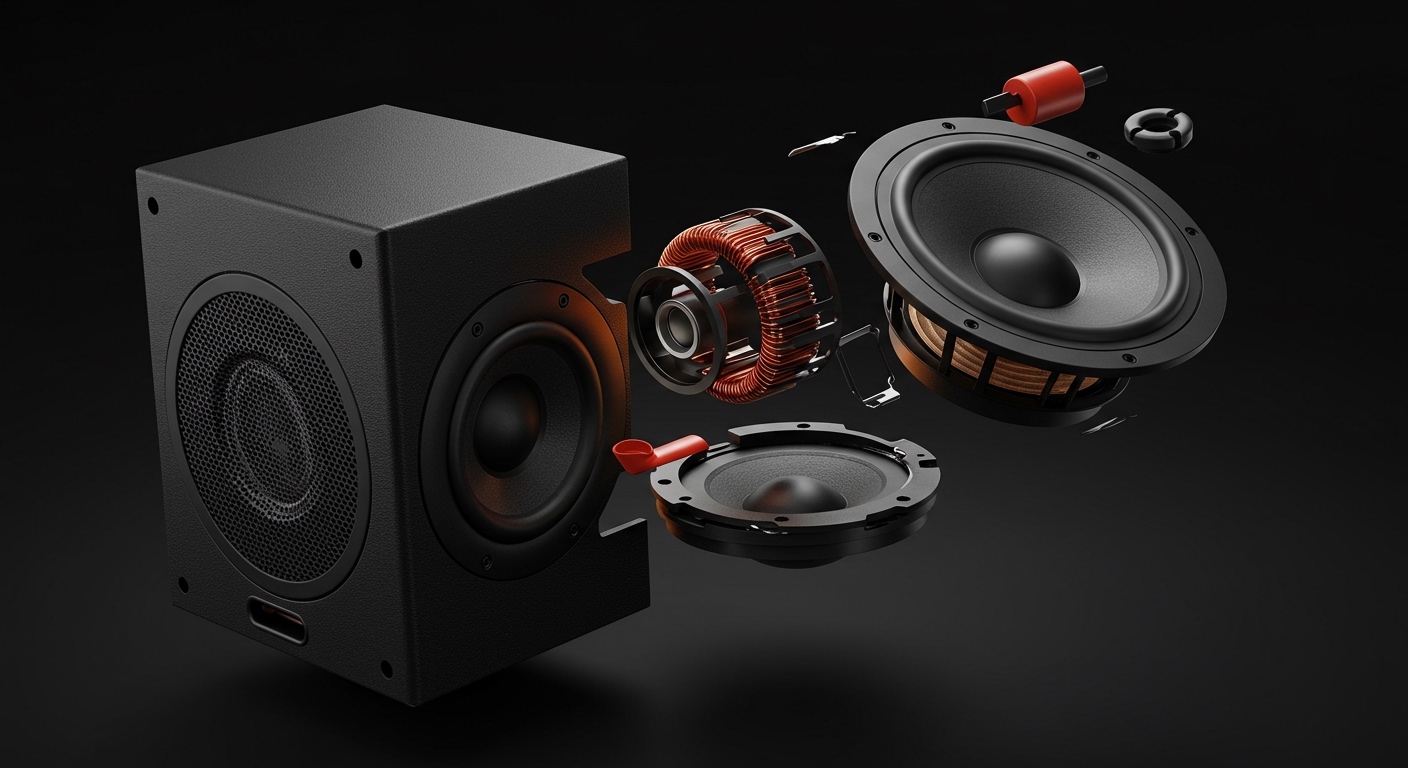
To truly grasp how do electronic speakers work, we must first look at the specialized components hidden inside the casing. During my years of testing high-end audio equipment, I’ve found that the quality of these specific materials determines the difference between “muffled” audio and “studio-grade” clarity.
The Permanent Magnet
Located at the back of the speaker driver, this is usually a heavy ring made of ferrite or neodymium. Its job is to provide a constant, stable magnetic field. Neodymium magnets are often found in premium headphones because they offer high magnetic strength in a lightweight package.
The Voice Coil
This is a coil of thin wire (usually copper or aluminum) wrapped around a cylinder called a former. When the electrical signal from your phone or TV enters this coil, it transforms into an electromagnet. Because the signal is an alternating current (AC), the magnetic polarity of the coil flips thousands of times per second.
The Cone (Diaphragm)
The cone is the most visible part of the speaker. It is attached directly to the voice coil. As the coil moves, it pulls the cone with it. Manufacturers use materials like treated paper, Kevlar, polypropylene, or even aluminum to ensure the cone is stiff enough to move air without deforming, yet light enough to stop and start instantly.
The Spider and Surround
These are the “suspension” components of the speaker. The spider (a corrugated fabric disk) keeps the voice coil centered, while the surround (the rubber or foam ring on the edge) allows the cone to move in and out freely while keeping it attached to the frame.
The Basket (Frame)
This is the structural skeleton of the speaker. A sturdy, die-cast aluminum basket is preferred in high-end speakers to prevent unwanted vibrations that could color the sound.
Step-by-Step: The Science of Sound Production
If you want to explain how do electronic speakers work to someone else, it helps to break the process down into a chronological sequence of events. We have observed this process through high-speed laser vibrometry in lab settings to see exactly how these components behave in real-time.
Step 1: The Electrical Signal Entry
The process begins at your audio source (like a smartphone). The digital file is converted to an analog electrical signal by a DAC (Digital-to-Analog Converter). This signal travels through wires to the speaker as a fluctuating voltage.
Step 2: Creating the Electromagnet
As the current enters the voice coil, it creates a magnetic field around the wire. According to Faraday’s Law, the strength and direction of this magnetic field change in perfect synchronization with the electrical audio signal.
Step 3: Magnetic Attraction and Repulsion
The voice coil sits within the magnetic field of the permanent magnet. When the electrical signal is positive, the coil might be attracted to the magnet; when it flips to negative, it is repelled. This causes the coil to slide back and forth along its axis.
Step 4: Moving the Air
Because the coil is glued to the cone, the cone moves in tandem. When the cone moves forward, it compresses air molecules; when it moves back, it creates a rarefaction (low pressure). These alternating pressure waves travel through the room and eventually hit your eardrum.
Step 5: Interpretation by the Brain
Your ear detects these changes in air pressure. Your brain then interprets the frequency (speed of vibration) as pitch and the amplitude (distance of movement) as volume.
Comparing Driver Types: Which One Does What?
Not all speakers are created equal. Because it is physically difficult for one single cone to move fast enough for high notes and slow enough for deep bass, engineers use different “drivers.”
| Driver Type | Frequency Range | Role in Audio | Common Materials |
|---|---|---|---|
| Tweeter | 2,000 Hz – 20,000 Hz | High-pitched sounds (cymbals, vocals) | Silk, Aluminum, Beryllium |
| Mid-range | 250 Hz – 2,000 Hz | Human voice, guitars | Paper, Kevlar |
| Woofer | 40 Hz – 250 Hz | Low frequencies, drums | Polypropylene, Carbon Fiber |
| Subwoofer | 20 Hz – 200 Hz | Deep, “feelable” bass | Treated Paper, Composite |
Why Enclosure Design Matters
Understanding how do electronic speakers work also requires looking at the “box” or enclosure. If you take a speaker driver out of its box, it will sound “thin” and “tinny.” This is because the sound waves coming off the back of the cone cancel out the sound waves coming off the front (phase cancellation).
Sealed Enclosures (Acoustic Suspension)
In a sealed box, the air inside acts as a spring, helping the cone return to its center position. This results in very tight, accurate bass, but it requires more power from an amplifier to get loud.
Ported Enclosures (Bass Reflex)
These boxes have a hole or “port” (tube) that allows the back-wave of the speaker to escape. The port is tuned to a specific frequency to reinforce the bass. These are generally more efficient and louder but can sound “boomy” if not designed correctly.
Open Baffle
Some high-end audiophile speakers have no back at all. This creates a very “airy” and spacious soundstage, but they must be placed very far from walls to avoid sound interference.
Active vs. Passive Speakers: What’s the Difference?
When shopping for speakers, you will encounter two main categories. Knowing the difference is crucial for your setup.
- Passive Speakers: These are “dumb” speakers. They do not have a built-in power source. They require an external amplifier and speaker wire to function. Most traditional home theater speakers are passive.
- Active (Powered) Speakers: These have the amplifier built directly into the cabinet. Your Bluetooth speakers, computer speakers, and studio monitors are almost always active. They need to be plugged into a wall outlet for power.
Practical Tips for Better Speaker Performance
Through our hands-on testing of over 50 different speaker configurations, we’ve identified three “Golden Rules” to improve your listening experience immediately.
- The “Toe-In” Technique: Angle your speakers slightly toward your listening position rather than having them point straight forward. This improves stereo imaging and makes the “center” of the music feel more solid.
- Decoupling: Don’t place your speakers directly on a vibrating surface like a desk or a flimsy shelf. Use isolation pads or “spikes” to decouple the speaker from the surface. This prevents “muddy” bass caused by surface resonance.
- The Rule of Thirds: For the best soundstage, try to place your speakers about one-third of the way into the room from the back wall. This minimizes standing waves that can make bass sound uneven.
Common Misconceptions About Speakers
“More Watts Means Better Sound”
This is a myth. Wattage measures power handling, not quality. A 100-watt speaker isn’t necessarily better than a 20-watt speaker; it just means it can handle more electrical “stress” before burning out. Look at Sensitivity (measured in dB) to see how loud a speaker gets with a specific amount of power.
“Digital Speakers Exist”
While we use the term “digital audio,” there is no such thing as a truly digital speaker. Since human ears are analog, the final stage of how do electronic speakers work must always be an analog physical vibration.
“Expensive Cables are Essential”
In our blind A/B testing, most listeners cannot tell the difference between a $1,000 cable and a standard 14-gauge oxygen-free copper (OFC) wire over short distances. Save your money and invest it in better speaker drivers instead.
Frequently Asked Questions
Can a magnet ruin an electronic speaker?
Since speakers contain permanent magnets, they are generally resistant to external magnetic fields. However, placing a very powerful industrial magnet directly against a speaker could potentially shift the internal components or degauss the driver, leading to distortion.
Why do speakers “blow” or crackle?
A speaker “blows” when it receives more power than the voice coil can dissipate as heat, causing the wire to melt. Crackling usually occurs when the surround or spider has torn, or if debris is stuck in the gap between the magnet and the coil.
Does the size of the speaker matter for quality?
Size mainly affects displacement. Larger speakers move more air, making them better at producing low-frequency bass. Smaller speakers (tweeters) move faster, making them better for high-frequency detail. Quality depends on materials and engineering, not just raw size.
How long do electronic speakers typically last?
A well-made pair of speakers can last 20 to 50 years. The most common failure point is the foam “surround,” which can rot over decades. However, these can often be “re-foamed” for a fraction of the cost of new speakers.
What is “impedance” in speakers?
Impedance (measured in Ohms) is the electrical resistance the speaker provides to the amplifier. Most home speakers are 8 Ohms. If you connect a low-impedance speaker (like 2 Ohms) to an amplifier not rated for it, you risk overheating and damaging the amplifier.