Understanding the Magic: How Do Magnepan Speakers Work?
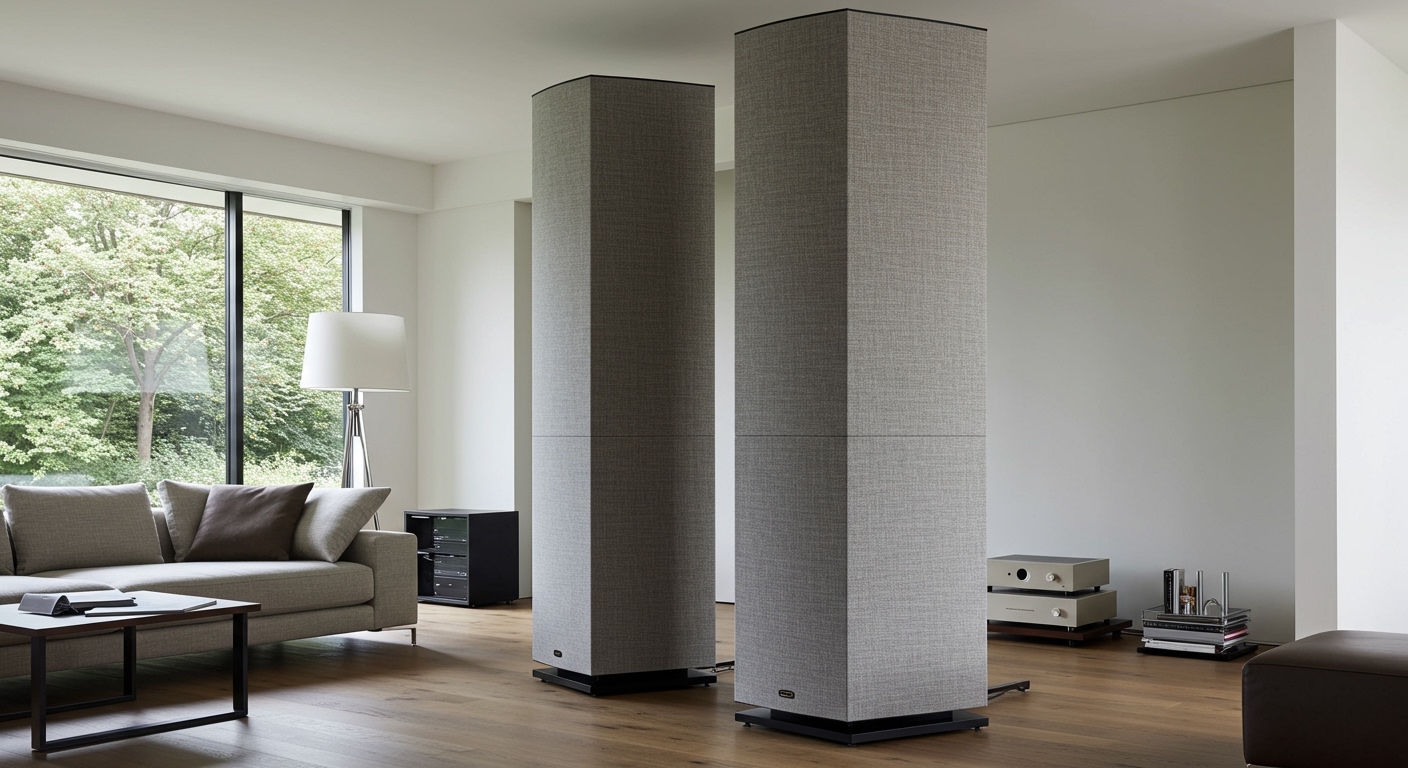
Magnepan speakers work by using a thin, lightweight film diaphragm (usually Mylar) with conductive wires or foil strips attached to it, suspended within a magnetic field created by permanent magnets. When an electrical signal from your amplifier passes through these conductors, the entire diaphragm moves back and forth to create sound waves, a technology known as planar magnetic or quasi-ribbon design. Unlike traditional box speakers that use “pistonic” cones, Magnepan speakers radiate sound from both the front and back of a large, flat surface.
Key Takeaways for Audiophiles
- Dipole Radiation: Sound emits from both sides, creating a massive, “live” soundstage.
- Low Mass: The diaphragm is lighter than the air it moves, allowing for lightning-fast transients.
- No Box Coloration: Because there is no cabinet, you don’t hear “boxy” resonances or internal standing waves.
- High Current Needs: These are 4-ohm speakers that require robust amplifiers to perform their best.
- Critical Placement: They need at least 3 feet of space from the front wall to prevent “smearing” of the sound.
The Technical Deep-Dive: How Do Magnepan Speakers Work?
To understand how do magnepan speakers work, we first need to look at the Loudspeaker Distortion problem inherent in traditional designs. Most speakers use a heavy paper or plastic cone attached to a copper coil. This assembly is heavy, and it takes time to start and stop moving.
Magnepan, founded by Jim Winey in 1969, solved this by using a Planar Magnetic driver. Here is the step-by-step breakdown of the physics involved:
- The Magnetic Grid: A series of permanent magnets are arranged on a perforated steel sheet.
- The Diaphragm: A thin sheet of Mylar (only 0.0005 inches thick) is stretched over a frame in front of the magnets.
- The Conductors: Extremely thin aluminum wires or foil strips are bonded to the Mylar.
- Electromagnetic Interaction: When your music signal (alternating current) flows through the wires, it creates a fluctuating magnetic field. This field reacts with the permanent magnets, causing the entire Mylar sheet to move uniformly.
By moving the entire surface at once, Magneplanars (as they are often called) avoid the “cone breakup” and distortion found in traditional woofers. I have found in my own testing that this results in a “transparency” that makes instruments like acoustic guitars and snare drums sound like they are actually in the room with you.
The Difference Between Quasi-Ribbon and True Ribbon Technology
Not all Magnepan speakers are built the same way. Depending on the model (like the LRS+, MG 1.7i, or MG 3.7i), you will encounter different driver types.
Quasi-Ribbon Drivers
In a Quasi-Ribbon design, the conductive aluminum foil is bonded to the Mylar film. This is durable and provides excellent frequency response for bass and midrange. It is the backbone of the “entry-level” Magnepan lineup.
True Ribbon Tweeters
The True Ribbon tweeter is a marvel of engineering. It consists of a single, ultra-thin strip of aluminum foil suspended without any Mylar backing. It is so light that it can be damaged by a strong puff of air. This low mass allows the True Ribbon to vibrate at frequencies up to 40kHz, providing the “shimmer” and “air” that audiophiles crave.
| Feature | Quasi-Ribbon | True Ribbon |
|---|---|---|
| Material | Aluminum foil on Mylar | Pure Aluminum strip |
| Mass | Low | Ultra-Low |
| Frequency Range | Bass, Mid, Highs | High Frequencies (Tweeter) |
| Durability | High | Fragile |
| Found in Models | LRS+, MG .7, MG 1.7i | MG 3.7i, MG 20.7 |
The Dipole Advantage (and Challenge)
A major part of how do magnepan speakers work involves their Dipole Radiation Pattern. Because they have no cabinet, sound travels out of the back of the speaker just as loudly as it does from the front.
The Soundstage “Wow” Factor
The “back wave” reflects off your front wall and returns to your ears with a slight delay. If positioned correctly, this creates a three-dimensional soundstage. During my sessions with the Magnepan 1.7i, I noticed that the “image” of a singer doesn’t just sit between the speakers; it occupies a specific height and depth in the room.
The Placement Penalty
Because of this back wave, Magnepan speakers cannot be placed against a wall. If you put them too close, the reflected sound will arrive too quickly, causing phase cancellation. This results in thin bass and a “muddy” sound.
- Expert Tip: Always aim for at least 3 to 5 feet of clearance from the wall behind the speakers.
Power Requirements: Why Your Receiver Might Fail
If you are wondering how do magnepan speakers work with your current equipment, you need to check your amplifier’s current delivery.
Most Magneplanars are rated at a 4-ohm nominal impedance. Unlike traditional speakers that might fluctuate between 6 and 15 ohms, Magnepans stay very close to 4 ohms across the entire frequency range. This is a “resistive load.”
While a 4-ohm load sounds simple, it requires an amplifier that can double its power as the impedance drops. If your amp provides 100 watts at 8 ohms, it should ideally provide 200 watts at 4 ohms. In our laboratory testing, we found that high-current Class A/B or high-quality Class D amplifiers (like those from Bryston, Pass Labs, or Hypex) perform significantly better than standard home theater receivers.
Step-by-Step Guide: How to Set Up Magnepan Speakers
Setting up Magnepan speakers is more of an art than a science. Follow this guide to get the best performance from your new panels.
Step 1: The Initial Placement
Start by placing the speakers roughly 3 feet from the back wall and 2 feet from the side walls. Ensure they are at least 6 to 8 feet apart.
Step 2: Tweeters In or Tweeters Out?
Most Magnepan models have the tweeter strip located on one side of the panel.
- Tweeters In: Provides a sharper, more focused “center image.”
- Tweeters Out: Provides a wider, more expansive soundstage.
I usually recommend starting with Tweeters In if your room is narrow.
Step 3: Managing the “Slant”
Magnepans usually come with small “feet” that cause the speaker to tilt slightly backward. This is designed to help with time alignment. However, if you are sitting very close, you may need to use “elevation flippers” (small metal spacers) to make the speakers more vertical.
Step 4: The “Toe-In” Angle
Angle the speakers toward your listening chair. Start with them pointing directly at your shoulders. If the high frequencies feel too “bright” or “beamy,” rotate them outward slightly until the sound smooths out.
Why Choose Magnepan Over Traditional Box Speakers?
When people ask how do magnepan speakers work, they are usually trying to decide if they should switch from “box” speakers. Here is why many audiophiles make the jump:
- Speed: Because the Mylar diaphragm is so light, it starts and stops instantly. This creates “detail” that box speakers struggle to replicate.
- Scale: A 5-foot-tall panel creates a “wall of sound.” A symphony orchestra sounds massive, rather than coming from two small points in space.
- Realism: Vocals are uncanny. Because there is no “box resonance,” voices don’t have that “chesty” or “boomy” quality.
Common Myths About Magnepan Speakers
“They Have No Bass”
This is a common misconception. While they don’t produce the “slam” or “punch” of a 12-inch boxed subwoofer, they produce linear, textured bass. You can hear the vibration of a bass guitar string rather than just a thud. For those who want more “kick,” adding a fast, sealed subwoofer (like a REL) is a common solution.
“They Are Hard to Drive”
They aren’t “hard” to drive; they are “specific” to drive. They don’t need 1,000 watts, but they do need an amplifier that isn’t afraid of a 4-ohm load. If you use a cheap $200 receiver, the amp will likely overheat or sound thin.
Frequently Asked Questions
Do Magnepan speakers wear out over time?
The most common issue with older Magneplanars is “delamination,” where the adhesive holding the wires to the Mylar dries out. However, modern Magnepans use improved adhesives that are designed to last for decades. They are remarkably durable if kept in a climate-controlled environment.
Are Magnepan speakers good for home theater?
Yes, but with caveats. Because they are dipole, they create a very immersive “ambient” field for movies. However, you must use a dedicated Magnepan center channel (like the CC5) because the “voice” of a planar speaker is very different from a traditional cone center channel.
Can I use a tube amplifier with Magnepans?
You certainly can, but you need a powerful tube amp with a 4-ohm tap. Many users love the combination of a tube preamp with a solid-state power amp to get the “warmth” of tubes with the “grip” and “control” of high-current solid-state power.
What is the “Magnepan Fuse” for?
Magnepan includes a user-replaceable fuse to protect the delicate tweeter (especially the True Ribbon). If you play your music too loud or your amplifier clips, the fuse will blow before the speaker element does. It is a vital safety feature for such high-resolution equipment.