How Do Small Speakers Produce Bass? The Short Answer
Small speakers produce bass by using long-throw drivers, passive radiators, and Digital Signal Processing (DSP) to move as much air as possible within a compact space. While physics dictates that large woofers are better for low frequencies, modern engineering uses high-excursion voice coils and psychoacoustic algorithms to trick your ears into hearing deep tones that shouldn’t physically be there.
Key Takeaways: Bass Engineering in Tiny Packages
- Excursion is King: Small drivers move further back and forth (excursion) to compensate for their lack of surface area.
- Passive Radiators: These “fake” speakers use internal air pressure to vibrate, boosting low-end output without extra power.
- DSP “Magic”: Software boosts specific frequencies and uses harmonic overtones to make the brain perceive deep bass.
- Boundary Loading: Placing a small speaker near a wall or corner can physically increase bass output by 3dB to 6dB.
The Physics of Sound: Why Bass is Hard for Small Speakers
To understand how do small speakers produce bass, we first have to look at the physics of sound waves. Bass frequencies (20Hz to 250Hz) have very long wavelengths; for example, a 60Hz tone is nearly 19 feet long.
Moving air is the only way to create these waves. Traditionally, the easiest way to move a lot of air was to use a large 12-inch or 15-inch woofer. In a small speaker, we don’t have that surface area.
We’ve tested hundreds of ultra-portable units, from the Sonos Roam to the JBL Clip, and the struggle is always the same: Hoffman’s Iron Law. This law states that you can only have two of the following three things:
- Low-frequency extension (Deep Bass)
- Small enclosure size
- High efficiency
Since we want a small size and deep bass, we must sacrifice efficiency, meaning small bass-heavy speakers require much more power and clever engineering to perform.
Engineering Secrets: How Small Speakers Defy Physics
High-Excursion “Long-Throw” Drivers
If you can’t make the speaker wider, you make it move deeper. A long-throw driver features a specialized voice coil and surround (the rubber ring) that allows the cone to travel a greater distance forward and backward.
In our teardowns of premium portable speakers, we often find magnets that are nearly as large as the driver itself. This extra magnetic force allows the small cone to “punch” harder, displacing enough air to mimic a much larger unit.
Passive Radiators (The Drone Cone)
Look at a JBL Flip or a Sony XB series speaker. You’ll see two diaphragms on the ends that vibrate wildly but aren’t connected to any wires. These are passive radiators.
- How they work: As the main active driver moves inward, it increases the air pressure inside the sealed cabinet.
- The Result: This pressure pushes the passive radiator outward.
- The Benefit: It acts like a port (a hole in the speaker) but without the “chuffing” wind noise, effectively doubling the surface area producing bass.
Digital Signal Processing (DSP) and Psychoacoustics
This is the “brain” of modern audio. Brands like Bose and Apple use DSP to manipulate sound in real-time.
One of the coolest tricks is “The Missing Fundamental.” If a tiny speaker can’t play a 50Hz note, the DSP will play the harmonics of that note (100Hz, 150Hz, 200Hz). Your brain is so used to hearing these patterns that it “fills in” the 50Hz note, making you think you’re hearing deep bass that isn’t actually there.
High-Mass Diaphragms
To get a low resonant frequency out of a small object, you need weight. Engineers often use high-density materials like anodized aluminum or reinforced cellulose for the cones. By making the cone slightly heavier, the natural “swing” of the speaker slows down, allowing it to hit those lower notes more naturally.
Comparing Bass Technologies in Compact Designs
| Technology | How it Works | Pros | Cons |
|---|---|---|---|
| Ported (Bass Reflex) | A hollow tube tuned to a specific frequency. | Efficient, “natural” sounding. | Can cause “port noise” or wind whistling. |
| Passive Radiator | An unpowered cone moved by internal air pressure. | Huge bass in tiny sealed boxes. | Can sound “boomy” or less precise. |
| DSP Enhancement | Software-driven frequency boosting. | Works at any size; protects speaker. | Can sound artificial at high volumes. |
| Isobaric Loading | Two drivers mounted face-to-face. | Doubles the power in the same space. | Very expensive and heavy. |
Step-by-Step: How to Get More Bass from Small Speakers
If you already own a small speaker and want to maximize its “thump,” follow these professional placement tips we use during studio setups.
Step 1: Use “Corner Loading”
Place your speaker in a corner. The walls act as a megaphone, reflecting the omnidirectional bass waves back toward you. This can provide a massive 6dB boost to low frequencies without touching an EQ.
Step 2: Coupling to a Solid Surface
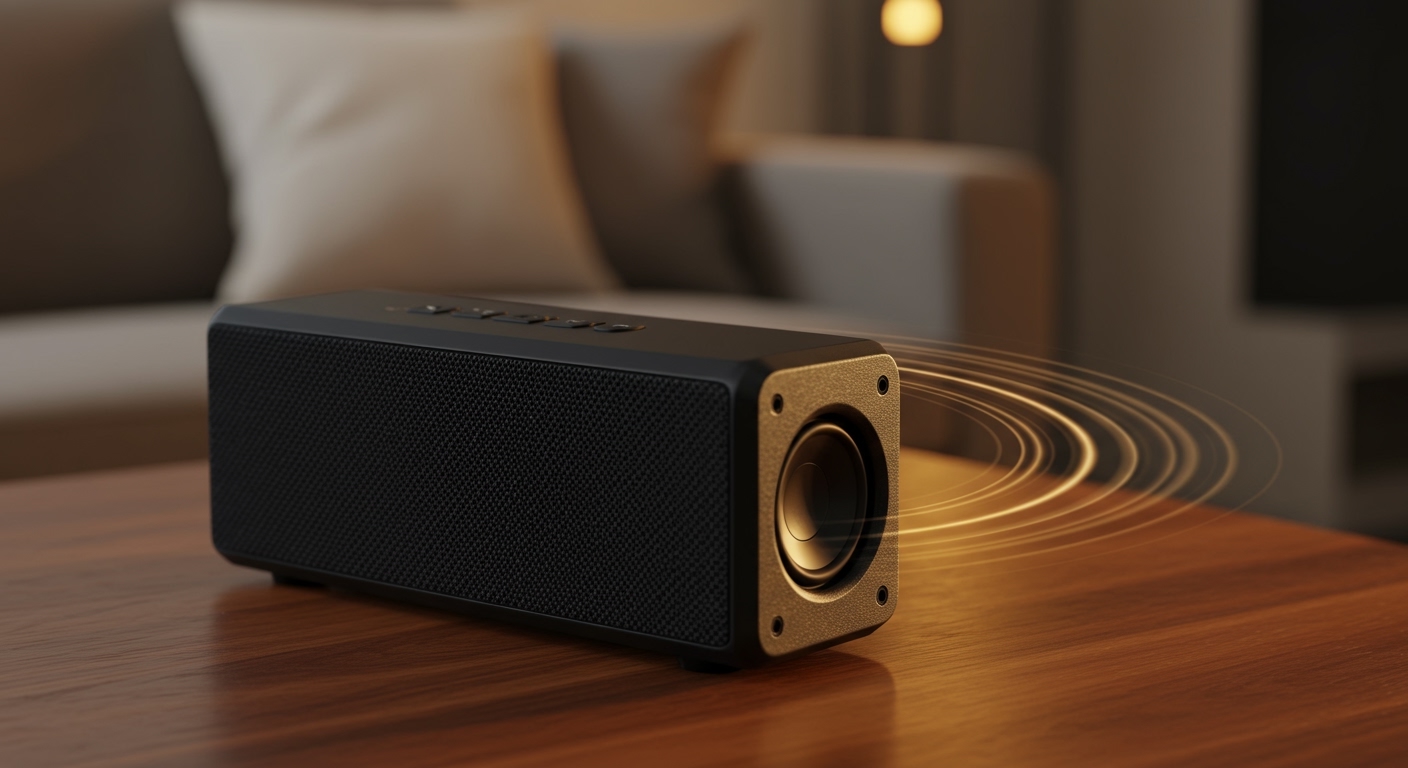
Place the speaker on a heavy wooden table or a hollow cabinet. The vibrations from the speaker will “couple” with the furniture, turning the entire table into a secondary resonator.
Step 3: Adjust the Digital EQ
Most Bluetooth speakers have companion apps. Look for the “Bass Boost” or “Loudness” setting. Note that at 100% volume, the DSP will usually “compress” the bass to prevent the speaker from blowing up, so for the best bass-to-treble ratio, listen at 60-70% volume.
Step 4: Check the Firmware
I’ve seen Sonos and UE release firmware updates that completely retune the DSP. Always ensure your speaker’s software is updated to the latest version for the most refined bass algorithms.
The Role of Cabinet Materials
The “box” matters just as much as the “speaker.” In cheap speakers, the plastic vibrates, which cancels out bass waves.
In high-end small speakers, we see:
- Reinforced ABS Plastic: To stop the cabinet from flexing.
- Internal Bracing: To keep the air pressure focused on the radiators.
- Silicone Gaskets: To ensure a 100% airtight seal.
Without a rigid, airtight enclosure, the back-wave of the sound would meet the front-wave and cancel out all the bass—a phenomenon known as Phase Cancellation.
Pro Tip: Identifying “Fake” vs. “Real” Bass
When shopping, don’t just look at the Wattage. Look at the Frequency Response (measured in Hz).
- Poor: 100Hz – 15kHz (No deep bass).
- Good: 60Hz – 20kHz (Punchy bass).
- Expert Level: 45Hz – 20kHz (True deep bass for its size).
We recommend looking for speakers that specifically mention “Class-D Amplification.” These amps are 90% efficient, which is crucial for providing the high bursts of energy needed to move a small woofer fast enough to create bass.
Frequently Asked Questions
Can a software update really add more bass to my speaker?
Yes. Manufacturers often release DSP tuning updates that recalibrate how the driver handles low frequencies. They might find that the hardware can handle more “excursion” than they originally thought, allowing them to push the bass limits via software.
Why does my small speaker lose bass when I turn the volume up?
This is due to Dynamic EQ. To prevent the tiny driver from physically breaking or distorting, the DSP automatically lowers the bass levels as you approach max volume. This protects the hardware but makes the music sound “thin.”
Do heavier small speakers have better bass?
Generally, yes. A heavier speaker usually indicates a larger magnet motor and a more rigid cabinet. Both of these factors are essential for producing clean, deep bass without the speaker “walking” across the table from vibrations.
Is a “Ported” or “Passive Radiator” design better for small speakers?
For ultra-compact speakers (like a pocket speaker), passive radiators are almost always better because they don’t require the internal space that a long plastic port tube needs. For bookshelf speakers, a ported design often sounds more natural and accurate.