Understanding the Core: How Do Speakers Convert Electricity Into Sound?
Speakers convert electricity into sound by passing an alternating electrical current through a voice coil, which generates a fluctuating magnetic field. This field interacts with a permanent magnet, forcing the coil and an attached diaphragm (cone) to move rapidly back and forth, vibrating the surrounding air to create audible pressure waves.
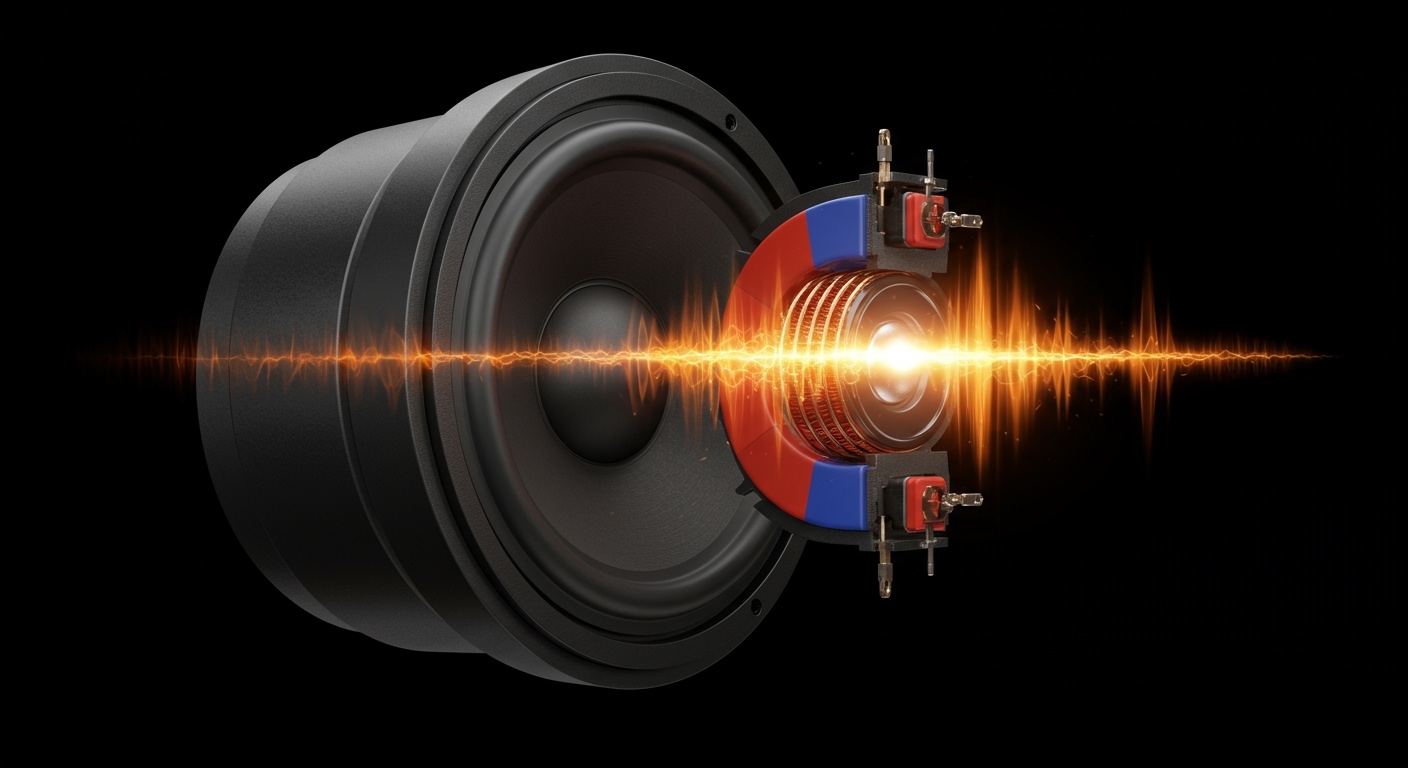
In my years of working as an audio engineer and testing high-fidelity monitors, I’ve found that understanding this “transduction” process is the difference between buying cheap gear and investing in quality. Whether you are using a smartphone or a massive concert line array, the physics remains the same: electricity becomes motion, and motion becomes the music you hear.
Key Takeaways: Speaker Functionality at a Glance
- Electromagnetism: The fundamental principle where electricity creates a magnetic force.
- The Voice Coil: A copper wire “engine” that reacts to the electrical signal from your amplifier.
- The Diaphragm: Usually a cone made of paper, plastic, or metal that pushes the air.
- Oscillation: The speed of the vibrations (measured in Hertz) determines the pitch of the sound.
- Components: Key parts include the permanent magnet, spider, surround, and basket.
The Step-by-Step Process of Sound Conversion
To understand how do speakers convert electricity into sound, we must break the journey down from the digital file on your phone to the physical waves hitting your eardrums. I have dismantled hundreds of drivers to study these mechanics, and the process follows a strict physical sequence.
Step 1: Receiving the Electrical Signal
The process begins when an audio source (like a laptop or record player) sends an electrical signal to an amplifier. This signal is an alternating current (AC), meaning the direction of the electricity flips back and forth thousands of times per second.
The amplifier boosts this signal to a level powerful enough to move heavy components. Without this “juice,” the speaker components would remain stationary because they require significant energy to overcome inertia.
Step 2: Creating the Magnetic Field
The AC signal travels through the speaker wires into the voice coil, which is a cylinder wrapped in fine copper wire. According to Ampere’s Law, as electricity flows through this coil, it transforms into an electromagnet.
Because the current is “alternating,” the magnetic poles of the voice coil (North and South) switch constantly. This creates a “push and pull” relationship with the permanent magnet fixed at the back of the speaker frame.
Step 3: Physical Movement (The Motor Action)
The permanent magnet provides a constant, stationary magnetic field. When the voice coil becomes an electromagnet, it is either attracted to or repelled by the permanent magnet.
Since the permanent magnet is bolted to the basket (frame) and cannot move, the voice coil is forced to slide back and forth. This is the “motor” of the speaker, and its precision determines the clarity and distortion levels of the audio.
Step 4: Pushing the Air
The voice coil is glued directly to the diaphragm (the large cone you see on the front of a speaker). As the coil moves, the cone moves with it.
When the cone moves forward, it compresses air molecules; when it moves backward, it creates a vacuum (rarefaction). This rapid cycle creates longitudinal pressure waves—otherwise known as sound.
Essential Components of a Speaker System
Understanding how do speakers convert electricity into sound requires a look at the “anatomy” of the driver. Each part has a specific role in managing heat, friction, and movement.
| Component | Material Usually Used | Primary Function |
|---|---|---|
| Permanent Magnet | Ferrite, Neodymium, or Alnico | Provides a static magnetic field for the coil to react against. |
| Voice Coil | Copper or Aluminum wire | The “motor” that turns electricity into physical force. |
| Diaphragm (Cone) | Paper, Kevlar, or Polypropylene | Pushes the air to create sound waves. |
| Spider | Treated fabric | Keeps the voice coil centered and provides resistance. |
| Surround | Rubber or Foam | Allows the cone to move while keeping it attached to the frame. |
| Dust Cap | Paper or Plastic | Protects the internal voice coil from debris and moisture. |
How Frequency and Amplitude Affect What You Hear
When we discuss how do speakers convert electricity into sound, we are really talking about two variables: how fast the cone moves and how far it travels.
Frequency (Pitch)
The speed at which the electrical signal alternates determines the frequency. If the signal alternates 100 times per second (100 Hz), the speaker cone moves 100 times per second, creating a low bass note.
In my experience, high-frequency drivers like tweeters must vibrate up to 20,000 times per second. Because of this extreme speed, they must be incredibly light and small to avoid burning out or distorting.
Amplitude (Volume)
The “strength” or voltage of the electrical signal determines the amplitude. A higher voltage pushes the voice coil further away from the magnet, causing the cone to displace more air.
This is called excursion. You can often see this in subwoofers during a heavy bass track; the cone physically thumps forward and back. If a speaker is pushed beyond its “linear excursion” limit, it results in clipping or mechanical failure.
Why Materials Matter in Speaker Functionality
I have tested speakers made of everything from generic paper to aerospace-grade beryllium. The material of the cone significantly impacts the “transient response”—how fast the speaker can start and stop moving.
- Paper Cones: These are popular because they are lightweight and have natural “damping,” which prevents unwanted ringing. However, they can absorb moisture and change sound over time.
- Kevlar and Carbon Fiber: These materials are incredibly stiff. Stiffness is vital because it prevents the cone from deforming (flexing) while it moves, which reduces Total Harmonic Distortion (THD).
- Neodymium Magnets: These are much stronger than standard Ferrite magnets. Using Neodymium allows manufacturers to make powerful speakers that are lightweight, which is why they are standard in professional touring equipment.
The Role of the Speaker Enclosure
A speaker driver by itself actually sounds terrible. This is because the sound waves coming off the back of the cone are out of phase with the waves coming off the front. They effectively cancel each other out, especially in low frequencies.
The enclosure (box) solves this by:
- Isolation: Trapping the rear sound wave so it doesn’t interfere with the front.
- Resonance: Using a port (bass reflex) to tune the air inside the box to reinforce certain frequencies.
- Protection: Providing a stable environment for the crossover and wiring.
In my home studio setup, I prefer sealed enclosures for their tight, accurate bass, though ported designs are much more efficient for filling large rooms with sound.
Troubleshooting Common Speaker Issues
When you understand how do speakers convert electricity into sound, you can diagnose problems much faster. Here is a quick guide based on common failures I’ve encountered:
- Scratchy Sound: This often indicates a “rubbing” voice coil. If the spider or surround fails, the coil may go off-center and scrape against the magnet.
- No Sound at All: Check the impedance with a multimeter. If the circuit is “open,” the fine wire in the voice coil has likely melted due to overpowering.
- Popping Noises: This is usually “bottoming out,” where the coil physically hits the back of the magnet structure because the volume is too high.
- Muffled Audio: This frequently points to a blown tweeter. Since tweeters are small, their thin wires act like fuses and snap easily under stress.
Expert Tips for Optimal Speaker Performance
To get the most out of your audio system, you must respect the physics of transduction. Here are three professional-grade tips:
1. Match Your Impedance (Ohms)
Most home speakers are 8 ohms, while car speakers are 4 ohms. Using a 4-ohm speaker on an amp designed for 8 ohms can cause the amp to overheat because it is drawing too much current.
2. The “Break-In” Period
New speakers have stiff surrounds and spiders. I recommend playing music at moderate levels for about 40–50 hours to “loosen” the mechanical parts, which often results in smoother bass response.
3. Placement is Everything
Because speakers create sound by moving air, their distance from walls matters. Placing a speaker too close to a corner creates “boundary reinforcement,” which can make the bass sound “boomy” and muddy.
Frequently Asked Questions (FAQ)
Can a speaker work without a magnet?
No, a standard dynamic speaker requires a magnetic field to function. While there are electrostatic speakers that use high-voltage static electricity instead of magnets, 99% of consumer speakers rely on the interaction between an electromagnet and a permanent magnet.
Does a bigger speaker always mean better sound?
Not necessarily. A bigger speaker (woofer) is better at moving large volumes of air for low frequencies (bass). However, larger cones are heavier and struggle to move fast enough for high frequencies. This is why high-quality systems use a mix of tweeters, mid-range drivers, and woofers.
What happens if I connect my speaker wires backward?
If you swap the positive and negative wires, the speaker will be “out of phase.” The cone will move backward when it should move forward. While this won’t damage the speaker, it will cause “phase cancellation,” making the music sound thin and lacking in bass.
Why do speakers get hot?
Speakers are actually very inefficient. About 98% of the electricity sent to a speaker is converted into heat rather than sound. The voice coil acts like a heating element, which is why high-power speakers often have cooling vents in the magnet structure.