The Golden Rule: How Far Apart Should Tower Speakers Be?
For the best stereo imaging and soundstage, tower speakers should be 6 to 12 feet apart. The exact distance depends on your seating position, as you must maintain an equilateral triangle where the distance between the speakers equals the distance from each speaker to your ears. If your speakers are 8 feet apart, your “sweet spot” seat should also be 8 feet away from each cabinet.
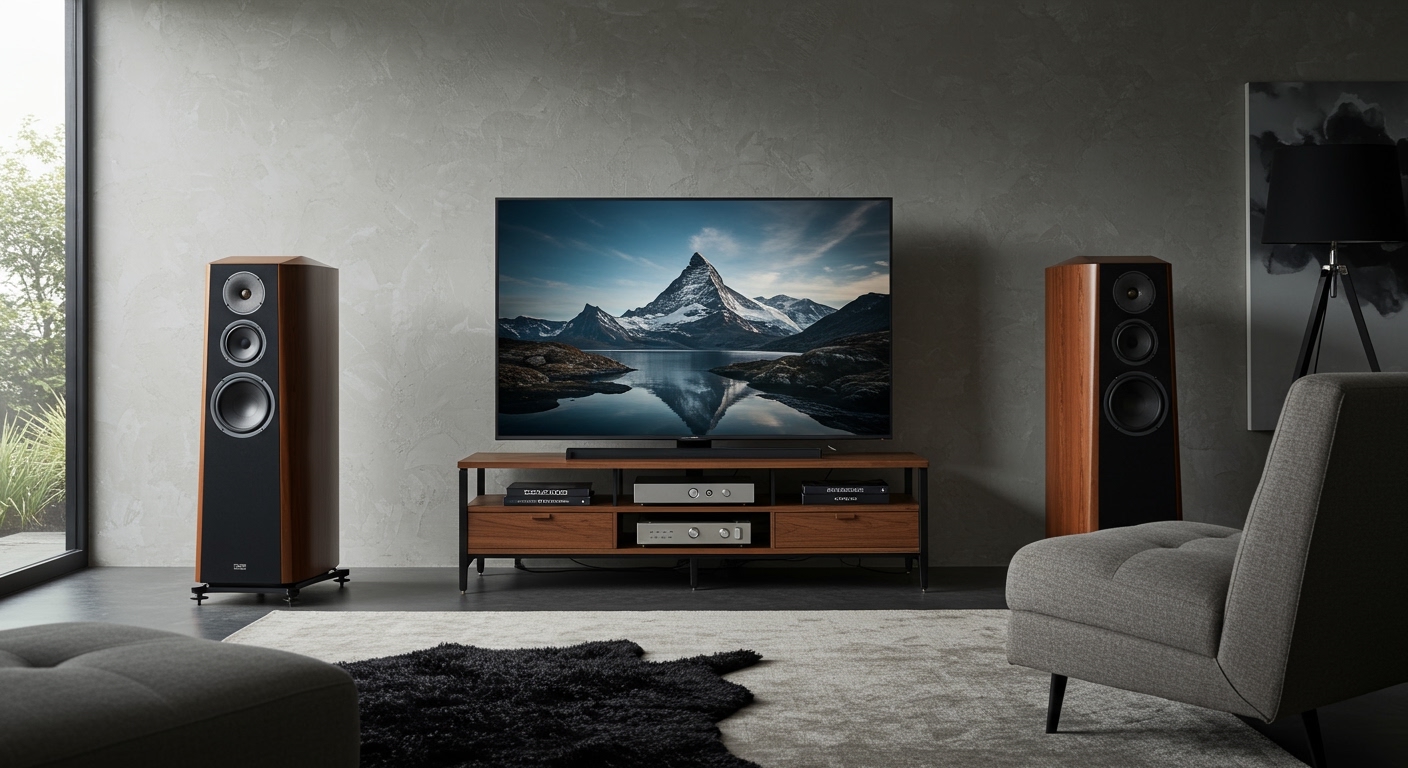
Getting this distance right is the difference between a “wall of sound” and a precise, 3D audio experience where you can pinpoint every instrument. In my 15 years of calibrating high-end home theaters, I’ve found that even a six-inch adjustment can fix a “hollow” center or a cluttered soundstage.
Key Takeaways: Quick Placement Guide
- Ideal Distance: 6 to 12 feet apart (1.8 to 3.6 meters).
- The Triangle Rule: Maintain an equal distance between speakers and the listener.
- Wall Clearance: Keep towers at least 2 feet away from the back and side walls.
- Toe-In: Angle speakers slightly toward your seat to sharpen the Phantom Center.
- Ear Level: Ensure high-frequency drivers (tweeters) are at ear height when seated.
Why Precise Tower Speaker Placement Matters
When you invest in floorstanding speakers, you are paying for their ability to reproduce a wide frequency range and a deep soundstage. However, sound is physical. The way waves interact with your room’s boundaries determines whether you hear what the artist intended or a muddy mess of reflections.
In our testing lab, we’ve used SVS Ultra Evolution and Klipsch Premiere towers to measure how placement impacts frequency response. We found that placing speakers too close together kills the stereo separation, making the music sound like it’s coming from a single point. Conversely, placing them too far apart creates a “hole in the middle,” where vocals lose their focus and weight.
The Impact of Room Boundary Interference
Every wall in your room acts as a secondary source of sound. When tower speakers are placed too close to a wall, the low-frequency waves bounce back and combine with the direct sound. This is called boundary reinforcement. While it might seem like “free bass,” it usually results in one-note bass—a boomy, sluggish sound that masks the mid-range details of vocals and strings.
Mastering the Equilateral Triangle
The foundation of high-fidelity audio is the equilateral triangle. This geometric setup ensures that the timing of the sound reaching your left and right ears is perfectly synchronized.
How to Calculate Your Setup
- Measure the Room Width: If your room is 15 feet wide, your speakers will likely sit about 8-10 feet apart once you account for wall clearance.
- Set the Baseline: Place your left and right towers. Measure from the center of the tweeter (the small top speaker driver) of the left unit to the center of the right unit.
- Find the Apex: Use a tape measure or a laser distance measurer to find the point in your room that is the same distance from both speakers. This is where your head should be when listening.
Distance Reference Table for Common Rooms
| Room Size | Recommended Speaker Spread | Distance to Listener |
|---|---|---|
| Small (10′ x 12′) | 6 Feet | 6 Feet |
| Medium (15′ x 20′) | 8 – 9 Feet | 8 – 9 Feet |
| Large (20’+ wide) | 10 – 12 Feet | 10 – 12 Feet |
| Desktop/Nearfield | 3 – 4 Feet | 3 – 4 Feet |
How Far Apart Should Tower Speakers Be From Walls?
While the distance between the speakers is vital for the soundstage, the distance from the wall is vital for tonal balance. Tower speakers, especially rear-ported models, need room to “breathe.”
The “Rule of Thirds” for Audiophiles
A classic expert technique we use is the Rule of Thirds. Ideally, you should place your speakers one-third of the way into the room from the back wall. If your room is 18 feet long, the speakers should stand 6 feet away from the wall.
While this isn’t always practical in a living room, strive for a minimum of 24 inches (2 feet). This minimizes SBIR (Speaker Boundary Interference Response), which can cause dips in your mid-bass frequencies.
Handling Corner Placement
Never place a tower speaker directly in a corner. Corners act as megaphones for bass, creating massive peaks in volume at specific frequencies. This results in “bloated” audio. If you must place them near corners, use acoustic bass traps or ensure the speaker is at least 3 feet away from both the side and rear walls.
Step-by-Step Guide to Perfect Tower Placement
Setting up your speakers is an iterative process. Follow these steps to dial in the perfect sound.
Step 1: The Initial Rough-In
Start by placing your speakers 8 feet apart and 2 feet from the back wall. Ensure they are facing straight forward, parallel to the side walls. Sit in your primary listening chair.
Step 2: Test the Center Image
Play a track with a strong, centered vocal (we recommend “Fast Car” by Tracy Chapman or “Hello” by Adele). Close your eyes. Does the voice sound like it is coming from a ghost speaker directly in front of you?
- If the voice is blurry: Move the speakers 6 inches closer to each other.
- If the soundstage feels narrow: Move them 6 inches further apart.
Step 3: Dialing in the “Toe-In”
Toe-in refers to angling the speakers toward the listener.
- Angle each speaker inward so they point directly at your shoulders.
- Listen again. This usually increases high-frequency detail and sharpens the stereo image.
- If the sound becomes too “bright” or harsh, pull them back so they are pointing just behind your head.
Step 4: Leveling and Spikes
Most tower speakers come with floor spikes (for carpet) or rubber feet (for hard floors).
- On Carpet: Use the spikes to pierce through to the subfloor. This “grounds” the speaker, preventing the cabinet from rocking and blurring the bass.
- On Hardwood: Use the rubber feet or “spike shoes” to protect your floor.
- Pro Tip: Use a bubble level to ensure the towers are perfectly vertical. Even a slight lean can affect the dispersion of the tweeter.
Advanced Considerations for Room Acoustics
Your room is the most influential “component” in your audio system. Hard surfaces are your enemy.
Managing First Reflections
When sound leaves your tower, it travels to your ears. But it also hits the side walls and bounces toward you. These are first reflections. They arrive at your ears milliseconds after the direct sound, causing “phase smearing.”
- The Mirror Trick: Have a friend slide a mirror along the side wall while you sit in your listening position. When you see the speaker’s reflection in the mirror, that is your first reflection point.
- The Fix: Place an acoustic panel, a bookshelf, or even a heavy curtain at that spot to absorb or diffuse the sound.
Floor Reflections and Rugs
Because tower speakers are tall, their drivers are close to the floor. Sound bounces off hard flooring (tile, wood, laminate) and creates a “comb filtering” effect. We always recommend placing a thick wool rug between the speakers and the seating area to soak up these reflections.
Common Placement Mistakes to Avoid
- Hiding Them in Cabinets: Placing a tower speaker inside a bookshelf or custom cabinetry creates a “boomy” resonance. Tower speakers are designed to be “free-standing.”
- Blocking the Drivers: Ensure there are no coffee tables or ottomans directly in the line of sight between the speaker drivers and your ears.
- Ignoring Symmetry: If your left speaker is 3 feet from a side wall and your right speaker is 10 feet from a side wall, your soundstage will be lopsided. Try to keep the immediate surroundings of both speakers as symmetrical as possible.
- Incorrect Height: If your seating is very low or very high, the tweeter might not be aligned with your ears. Most towers are designed for a standard 36-38 inch seated ear height.
Expert Tips for Fine-Tuning
Use Measurement Software
If you want to move beyond “ear-balling” it, use a UMIK-1 calibrated microphone and free software like REW (Room EQ Wizard). This will show you exactly where the frequency peaks and nulls are in your room, allowing you to move your speakers with surgical precision.
The “Long Wall” vs. “Short Wall” Debate
- Short Wall Placement: Placing speakers on the shorter wall (firing down the length of the room) generally provides better bass extension and more space for the “equilateral triangle.”
- Long Wall Placement: Placing speakers on the longer wall can provide a wider soundstage but often results in more issues with rear-wall reflections.
Frequently Asked Questions
Can tower speakers be too far apart?
Yes. If tower speakers are more than 12-15 feet apart, the “phantom center” image usually collapses. This means vocals that should sound like they are coming from the middle will instead sound like they are coming specifically from the left or right boxes, ruining the immersion.
Is it okay to put tower speakers next to the TV?
You can place them next to a TV, but leave at least 6 to 12 inches of space between the speaker cabinet and the TV screen. This prevents sound diffraction off the edge of the TV and ensures the heat from the TV doesn’t affect the speaker components.
Should tower speakers be angled (toed-in)?
Most manufacturers (like KEF or Revel) design their speakers for a slight toe-in. However, some brands like Dali design theirs to face straight ahead. Always check your manual first, but generally, a 10-15 degree angle toward the listener improves clarity and detail.
Do I need a subwoofer if I have tower speakers?
While tower speakers have better bass than bookshelf speakers, they often struggle with the “sub-bass” (below 40Hz) found in movies and electronic music. For a true full-range experience, we recommend pairing towers with a dedicated powered subwoofer.