The Science of Sound: How is Sound Created from Speakers?
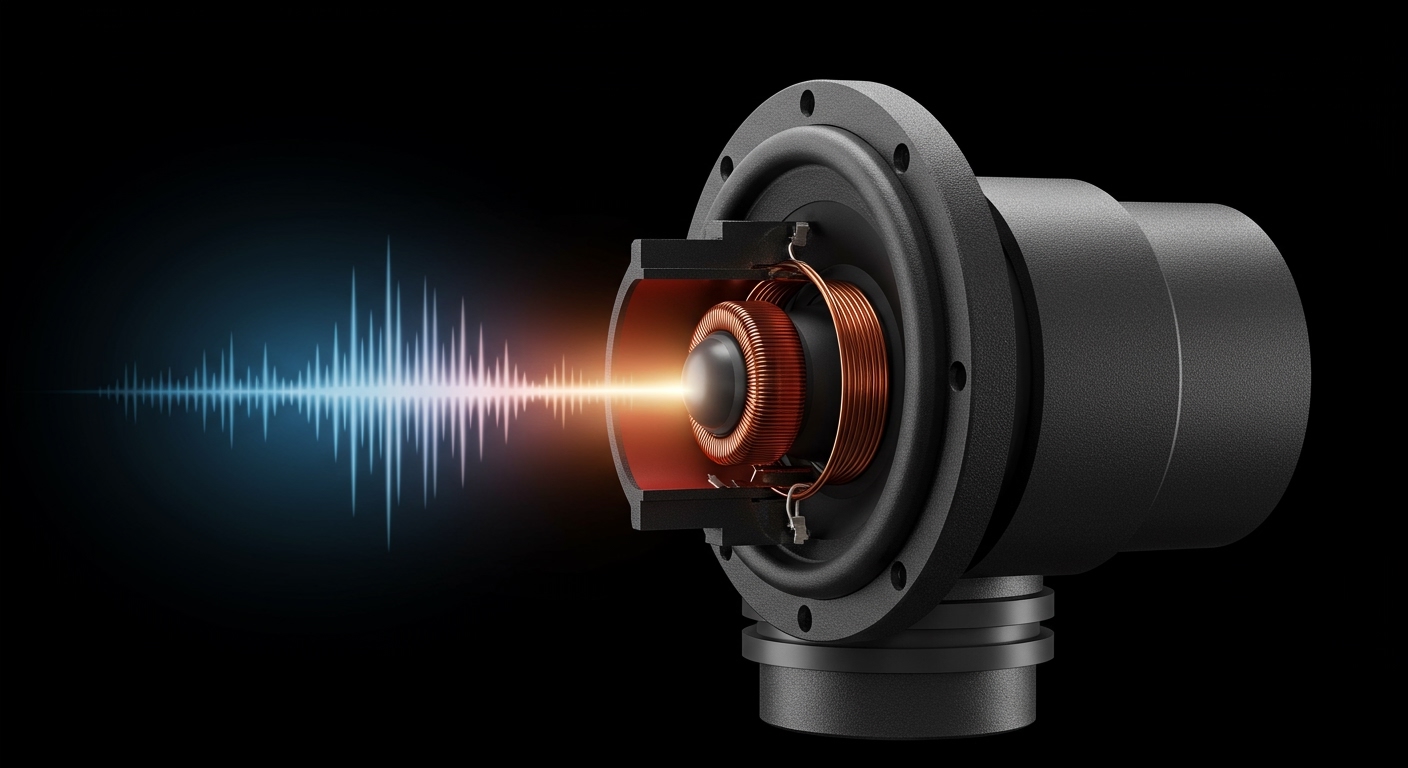
How is sound created from speakers? Sound is generated when an electrical signal travels through a voice coil, creating a varying magnetic field that reacts with a permanent magnet. This physical interaction forces a diaphragm (cone) to move back and forth rapidly, compressing and expanding the air molecules in front of it to create the pressure waves we perceive as sound.
I have spent over 15 years in the audio engineering industry, from setting up massive stadium arrays to fine-tuning high-end home theaters. I’ve seen firsthand how the smallest change in a speaker’s material—like switching from a paper cone to a Kevlar one—completely alters the acoustic texture. Understanding this process isn’t just for scientists; it’s for anyone who wants to get the most out of their audio equipment.
TL;DR: The Quick Breakdown
- Electrical Input: Your device sends an AC signal to the speaker.
- Electromagnetism: The voice coil turns into a temporary magnet.
- Physical Motion: The coil pushes and pulls against a fixed magnet.
- Air Movement: The cone vibrates, pushing air to create sound waves.
- Perception: Your ears detect these vibrations and your brain translates them into music.
The Anatomy of a Speaker: The Key Players
To understand how is sound created from speakers, we first need to look at the individual components. A speaker is essentially a transducer—a device that converts one form of energy (electrical) into another (mechanical/acoustic).
The Permanent Magnet**
Located at the back of the speaker, this provides a steady magnetic field. Most modern speakers use Ferrite or Neodymium magnets. Neodymium is significantly stronger and lighter, which is why it’s preferred in high-end portable gear.
The Voice Coil**
This is a coil of wire (usually copper) wrapped around a cylinder called a former. When electricity flows through it, it becomes an electromagnet. In my experience, the quality of the winding in the voice coil is often what separates a “budget” speaker from a professional-grade monitor.
The Diaphragm (Cone)**
This is the large, visible part of the speaker. Its job is to move as much air as possible. Manufacturers use various materials to balance weight and stiffness:
- Paper: Warm, natural sound but prone to moisture damage.
- Polypropylene (Plastic): Durable and consistent.
- Aluminum/Titanium: Extremely stiff, used for high-frequency tweeters.
- Kevlar/Carbon Fiber: High strength-to-weight ratio for fast response.
The Spider and Surround**
These parts act as the “suspension.” They hold the cone in place and ensure it returns to its neutral position after moving. If you’ve ever heard a speaker “farting” or distorting at high volumes, it’s often because the surround has lost its elasticity.
| Component | Material | Primary Function |
|---|---|---|
| Magnet | Neodymium/Ferrite | Provides a fixed magnetic field |
| Voice Coil | Copper/Aluminum | Creates a temporary magnetic field |
| Diaphragm | Paper/Silk/Metal | Pushes air to create sound waves |
| Spider | Treated Cloth | Centers the voice coil |
| Basket | Steel/Cast Aluminum | Holds the entire assembly together |
Step-by-Step: The Journey from Electricity to Audio
The process of how is sound created from speakers follows a specific chain of events. Here is the step-by-step breakdown of what happens the moment you hit “Play” on your phone.
Step 1: The Electrical Signal
Your music exists as digital data (0s and 1s). A Digital-to-Analog Converter (DAC) turns those numbers into a continuous electrical current. This current is Alternating Current (AC), meaning it flows back and forth.
Step 2: Creating the Electromagnet
This AC signal travels down the speaker wires and enters the voice coil. Because the current is alternating, the magnetic field created by the coil also alternates its polarity (switching between North and South).
Step 3: Magnetic Attraction and Repulsion
Physics tells us that like poles repel and opposite poles attract. The voice coil is sitting inside the field of the permanent magnet.
- When the signal is positive, the coil is pushed away from the magnet.
- When the signal is negative, the coil is pulled toward the magnet.
Step 4: Moving the Diaphragm
Since the voice coil is attached to the diaphragm (cone), the cone moves in perfect sync with the coil. If the electrical signal oscillates 440 times per second, the cone will vibrate 440 times per second, producing the note A4.
Step 5: Compressions and Rarefactions
As the cone moves forward, it pushes air molecules together (this is called compression). As it moves back, it creates a pocket of low pressure (this is called rarefaction). These alternating pulses of high and low pressure travel through the room as a longitudinal wave.
Why Different Speakers Sound Different
When people ask me how is sound created from speakers, they often follow up with: “Why does my subwoofer sound so different from my phone speaker?” The answer lies in frequency response and mass.
The Role of Driver Size
- Woofers: These are large (8 to 15 inches). They move slowly but push a massive volume of air, creating low-frequency bass.
- Tweeters: These are tiny (usually 1 inch). They are very light, allowing them to vibrate tens of thousands of times per second to create high-pitched sounds like cymbals.
- Mid-range: These handle the frequencies where the human voice lives (typically 300Hz to 5kHz).
Enclosure Physics
The box the speaker sits in is just as important as the speaker itself. Without a box, the sound waves from the back of the cone would cancel out the waves from the front.
- Sealed Boxes: Provide “tight,” accurate bass.
- Ported Boxes: Use a hole (vent) to redirect the back-wave, making the speaker louder and “boomier.”
Expert Insight: What Determines “High Fidelity”?
In my years of testing gear, I’ve found that transient response is the secret sauce. This refers to how quickly a speaker can start and stop moving.
Imagine a drum hit. A high-quality speaker moves forward instantly and stops the moment the signal ends. A poor-quality speaker will continue to wobble slightly (ringing), which makes the sound “muddy.” This is why materials like Beryllium are prized in high-end audio; they are incredibly stiff and stop vibrating the millisecond the electricity stops flowing.
Practical Tips for Better Speaker Performance
If you want to improve how your speakers create sound in your specific environment, follow these three rules:
- Check Your Impedance: Ensure your amplifier matches the Ohms (impedance) of your speakers. A mismatch can lead to weak sound or a blown amplifier.
- Room Placement: Never put a rear-ported speaker directly against a wall. It needs “breathing room” (usually 6-12 inches) to allow the air pressure to escape properly.
- The “Toe-In” Technique: Angle your speakers slightly toward your listening position. Because high frequencies (tweeters) are very directional, this significantly improves the “image” or the feeling that the singer is right in front of you.
Frequently Asked Questions
How does a speaker create different volumes?
Volume is determined by amplitude. A higher voltage signal pushes the voice coil further, which moves the diaphragm a greater distance. This creates more intense pressure waves, which our ears interpret as louder sound.
Can a speaker work without a magnet?
Most speakers require a magnet, but there are exceptions like Electrostatic Speakers. These use a thin film suspended between two electrically charged grids. However, for 99% of consumer electronics, the permanent magnet is essential.
What causes a speaker to “blow”?
A speaker “blows” when it receives too much power. This either melts the thin wire in the voice coil or causes the coil to jump out of its gap and become physically stuck. I always recommend using an amplifier with slightly more power than the speaker’s “RMS” rating to avoid clipping, which is the most common killer of tweeters.
Why do speakers need two wires?
One wire carries the incoming electrical signal, and the other completes the circuit back to the amplifier. Without a complete circuit, electricity cannot flow, and the voice coil cannot create the magnetic field necessary for movement.
Does the speaker cable quality matter?
While “audiophile” cables are often overhyped, the gauge (thickness) of the wire does matter. For long runs (over 20 feet), you should use a thicker wire (14-gauge or 12-gauge) to prevent resistance from swallowing your bass frequencies.