Understanding How Loud Should Outdoor Speakers Be
For most residential settings, outdoor speakers should be played between 60 and 80 decibels (dB) to provide a clear listening experience without causing ear fatigue or neighbor complaints. To achieve this in an open-air environment, you generally need an amplifier capable of delivering 150 to 300 watts of power per pair to account for “sound bleed” and environmental noise.
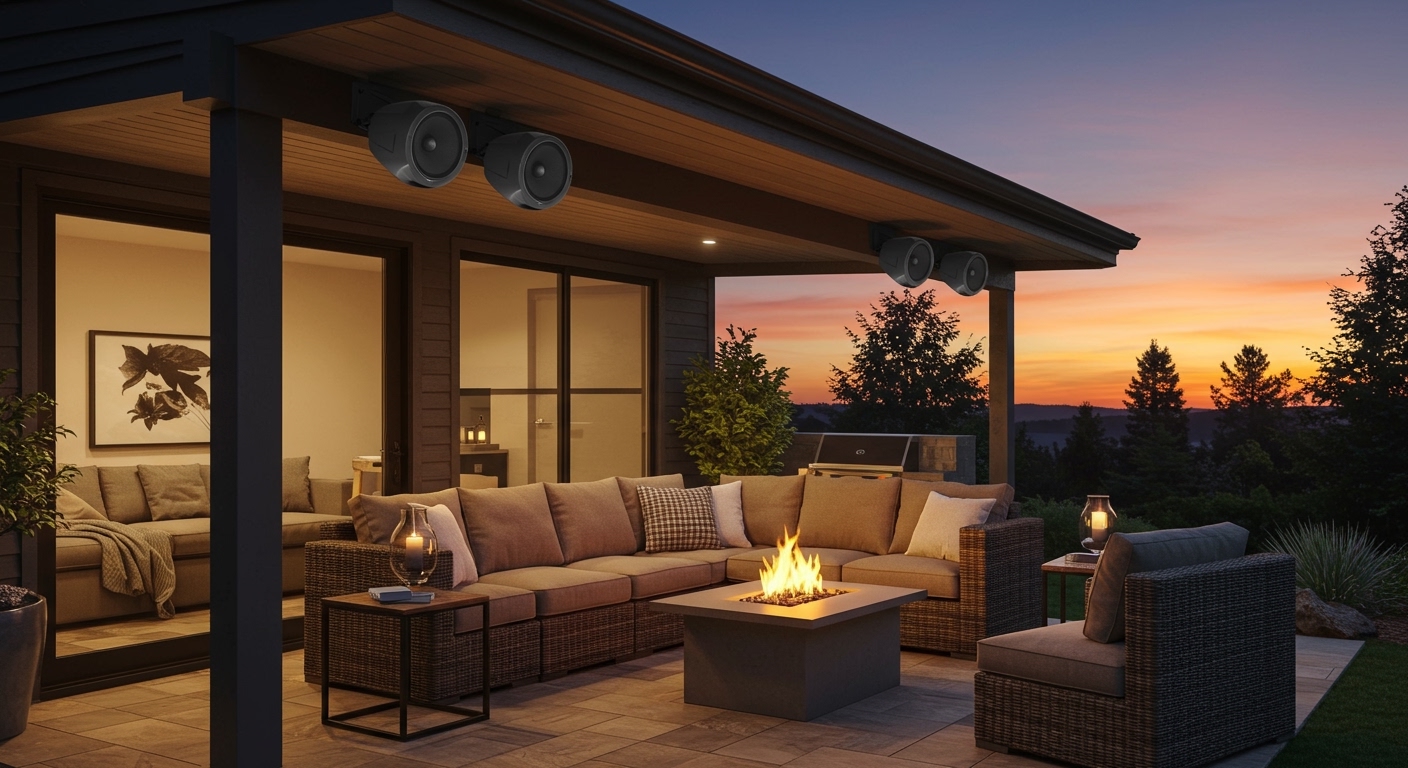
In my years of installing professional-grade patio systems, I’ve found that the biggest mistake homeowners make isn’t buying “cheap” speakers; it’s failing to account for the lack of walls. Without surfaces to reflect sound waves, audio dissipates rapidly. To get the volume right, you must balance Sound Pressure Level (SPL), Wattage, and Speaker Placement to overcome wind, traffic, and conversation.
TL;DR: Key Takeaways for Outdoor Audio Volume
- Ideal Ambient Range: 60–70 dB (comparable to a normal conversation).
- Party/Active Range: 75–90 dB (comparable to a vacuum cleaner or shouting).
- The Power Rule: Outdoor speakers require 2x to 3x the wattage of indoor speakers to achieve the same perceived volume.
- The 6dB Rule: For every doubling of distance from the speaker, you lose 6dB of sound pressure.
- Sensitivity Matters: Look for speakers with a Sensitivity Rating of 88dB or higher to get more volume out of less power.
The Science of Sound: Decibels vs. Watts
When asking how loud should outdoor speakers be, we have to distinguish between “loudness” (Decibels) and “power” (Watts). I often see clients buy 1,000-watt amplifiers thinking it will make their backyard sound like a concert hall, only to find the sound is still “thin.”
Understanding Decibels (dB) in the Wild
Decibels measure the intensity of sound. Because the scale is logarithmic, an increase of 10dB represents a perceived doubling of loudness. Indoors, your walls bounce sound back to you. Outdoors, those waves keep traveling until they die out.
| Noise Type | Decibel Level (dB) | How it Feels Outdoors |
|---|---|---|
| Rustling Leaves | 20-30 dB | Barely audible |
| Quiet Garden | 40-50 dB | Peaceful, background only |
| Normal Conversation | 60-65 dB | The “Sweet Spot” for dinner parties |
| Loud Traffic | 70-85 dB | You have to raise your voice to be heard |
| Lawn Mower | 90-100 dB | Uncomfortable; potential hearing damage over time |
| Live Rock Concert | 110-120 dB | Physical vibration; neighbors will definitely call the police |
Why Wattage Isn’t Everything
Wattage is the fuel, but Sensitivity is the fuel efficiency. If you have a speaker with a low sensitivity (84dB), you will need massive amounts of power to reach a comfortable volume. I recommend choosing speakers like the Klipsch AW-650 or Polk Audio Atrium 8 SDI, which feature high sensitivity ratings, allowing them to play louder with less strain on your amplifier.
The Inverse Square Law: Why Your Music “Disappears”
One of the most frustrating things we encounter in outdoor audio is the Inverse Square Law. In simple terms, when you double the distance from the speaker, you lose 75% of the sound intensity (a drop of 6dB).
If your speaker is producing 80dB at 1 meter away:
- At 2 meters, it drops to 74dB.
- At 4 meters, it drops to 68dB.
- At 8 meters, it drops to 62dB.
Pro Tip: This is why I always advise clients to use more speakers at lower volumes rather than two massive speakers at high volumes. Spreading the sound prevents “hot spots” where people near the speaker are deafened while people across the yard can’t hear a thing.
How to Determine the Right Volume for Your Specific Space
Every backyard is unique. A fenced-in patio in the suburbs requires a different volume strategy than a wide-open poolside in the country. To determine how loud your outdoor speakers should be, follow this step-by-step evaluation process we use during professional consultations.
Step 1: Measure Your Ambient Noise Floor
Before turning on the music, use a Decibel Meter App (like NIOSH SLM) to check your “noise floor.”
- If your backyard is 40dB (quiet), you only need about 60dB of music for a pleasant experience.
- If you live near a highway and your noise floor is 60dB, your music needs to be at least 75dB just to be heard clearly.
Step 2: Define the “Activity Zone”
Are you hosting a cocktail party or a pool bash?
- Background Listening: Aim for +10dB above the ambient noise floor.
- Active Listening/Parties: Aim for +20dB above the ambient noise floor.
- Foreground Music: Aim for 85dB-90dB at the center of the listening area.
Step 3: Account for Absorption and Diffusion
Soft surfaces like grass, mulch, and trees absorb sound. Hard surfaces like concrete patios, glass doors, and brick walls reflect it. If your patio is surrounded by shrubs, you will likely need to increase your volume by 3-5dB compared to a patio against a brick wall.
Hardware Essentials: Choosing the Right Gear for Volume
To achieve the “perfect” volume, you need a system that doesn’t distort when pushed. Distortion is what actually annoys neighbors and ruins the vibe—not the volume itself.
Passive vs. Active Outdoor Speakers
- Passive Speakers: These require an external amplifier. This is my preferred method because it allows you to choose a high-current amp (like a Sonos Amp or Crown XLS Series) that provides enough “headroom” to play loudly without clipping.
- Active (Powered) Speakers: These have built-in amps. They are easier to set up but often lack the raw power needed to fill a large backyard.
The 70-Volt System Advantage
For massive properties (over half an acre), we often switch from traditional 8-ohm speakers to 70-Volt systems (like Sonos by Sonance Landscape Systems). These allow us to daisy-chain 10 or 20 speakers together. This creates a “blanket of sound” where the volume is consistent everywhere, allowing you to keep the overall decibel level lower while maintaining clarity.
Step-by-Step: How to Calibrate Your Outdoor Speaker Volume
Setting your volume isn’t just about turning the knob until it “sounds right.” Follow this professional calibration sequence:
- Set the “Master Limit”: Go to your amplifier or streaming app (like Spotify or Sonos) and set a volume limit at 80%. This prevents guests from accidentally blowing your speakers.
- Position the Speakers: Aim them toward the primary seating area. Never aim them toward the neighbor’s house.
- Use a “Reference Track”: Use a well-produced song with a full frequency range (e.g., “Dreams” by Fleetwood Mac).
- Walk the Perimeter: Turn the music to your “party level” and walk to your property line. If the lyrics are clearly audible and distracting at your neighbor’s fence, your volume is too high or your placement is wrong.
- Adjust the EQ: Outdoor environments eat bass frequencies. Instead of turning up the total volume, try increasing the Bass/Low-End by 2-3dB. This makes the music feel “fuller” without increasing the piercing high-frequency noise that bothers neighbors.
Neighbor Etiquette and Legal Limits
Nothing ruins an outdoor audio setup faster than a noise complaint. Understanding the legal side of how loud outdoor speakers should be is vital for long-term enjoyment.
Local Noise Ordinances
Most cities have noise ordinances that kick in at 10:00 PM or 11:00 PM. Typically, these laws state that sound should not exceed 55dB to 60dB at the property line during nighttime hours. During the day, that limit might rise to 65dB or 70dB.
The “Bass” Problem
Low-frequency bass waves travel through walls and fences much easier than high-frequency sounds. If you are using an outdoor subwoofer (like the JL Audio AudioReady), consider placing it on a vibration-isolating pad or burying it (in-ground subs) to keep the energy from vibrating your neighbor’s windows.
Recommended Speaker Setups Based on Area Size
| Area Type | Recommended Wattage | Number of Speakers | Target Volume (dB) |
|---|---|---|---|
| Small Deck (10′ x 10′) | 60-100W | 2 Speakers | 65 dB |
| Medium Patio (20′ x 20′) | 150-200W | 2-4 Speakers | 75 dB |
| Large Pool/Yard (40′ x 40′) | 300W+ | 4-6 Speakers + Sub | 85 dB |
| Estate/Acreage | 70V System | 8+ Satellite Speakers | 80 dB (Consistent) |
Frequently Asked Questions
Is 100 watts loud enough for outdoor speakers?
For a small patio or deck (under 200 sq. ft.), 100 watts is usually sufficient for background music. However, if you want to host parties or overcome the sound of a pool pump, you will likely need 150-200 watts to ensure the music doesn’t sound strained or distorted.
How do I make my outdoor speakers sound louder without increasing volume?
The best way to increase perceived loudness is to improve speaker placement. Mount speakers under eaves (soffits) to create a “corner loading” effect, which naturally boosts the bass and reflects more sound toward the listener. Additionally, adding more speakers—rather than more power—creates a more immersive and “louder” feel.
Why do my outdoor speakers sound so thin?
Outdoor speakers often sound “thin” because there are no walls to reinforce the low-end bass frequencies. To fix this, you should either add an in-ground subwoofer or use a dedicated outdoor equalizer to slightly boost the frequencies between 60Hz and 100Hz.
Can I use indoor speakers outside if I keep the volume low?
I strongly advise against this. Indoor speakers are not built to handle the humidity, UV rays, or temperature fluctuations of the outdoors. Even if the volume is low, the paper cones will degrade quickly, and the internal components may short-circuit, potentially damaging your amplifier.
**
**
**
**