To determine how many 70v speakers per amp you can safely connect, you must divide the amplifier’s total wattage by the wattage tap setting of each speaker, while reserving a 20% headroom safety margin. For example, a 100-watt amplifier should only be loaded to 80 watts, meaning it could power eight speakers tapped at 10 watts each or 16 speakers tapped at 5 watts each.
Key Takeaways: 70V Speaker Math at a Glance
- The 80% Rule: Never load an amplifier to more than 80% of its rated capacity to prevent overheating and distortion.
- Wattage Taps: Each speaker has a transformer with selectable settings (e.g., 5W, 10W, 30W) that dictate its volume and power draw.
- Parallel Wiring: 70V systems are wired in a “daisy chain” (parallel), meaning the positive terminals all connect together and negative terminals all connect together.
- Wire Length: 70V systems excel at long distances, allowing you to run thousands of feet of wire with minimal signal loss.
Understanding the Math: How Many 70V Speakers Per Amp?
When I design commercial audio systems for warehouses or retail spaces, the first thing I calculate is the total power budget. Unlike traditional home audio (8-ohm) systems where you worry about impedance and complex series-parallel wiring, a 70-volt system (also known as a constant voltage system) is much simpler.
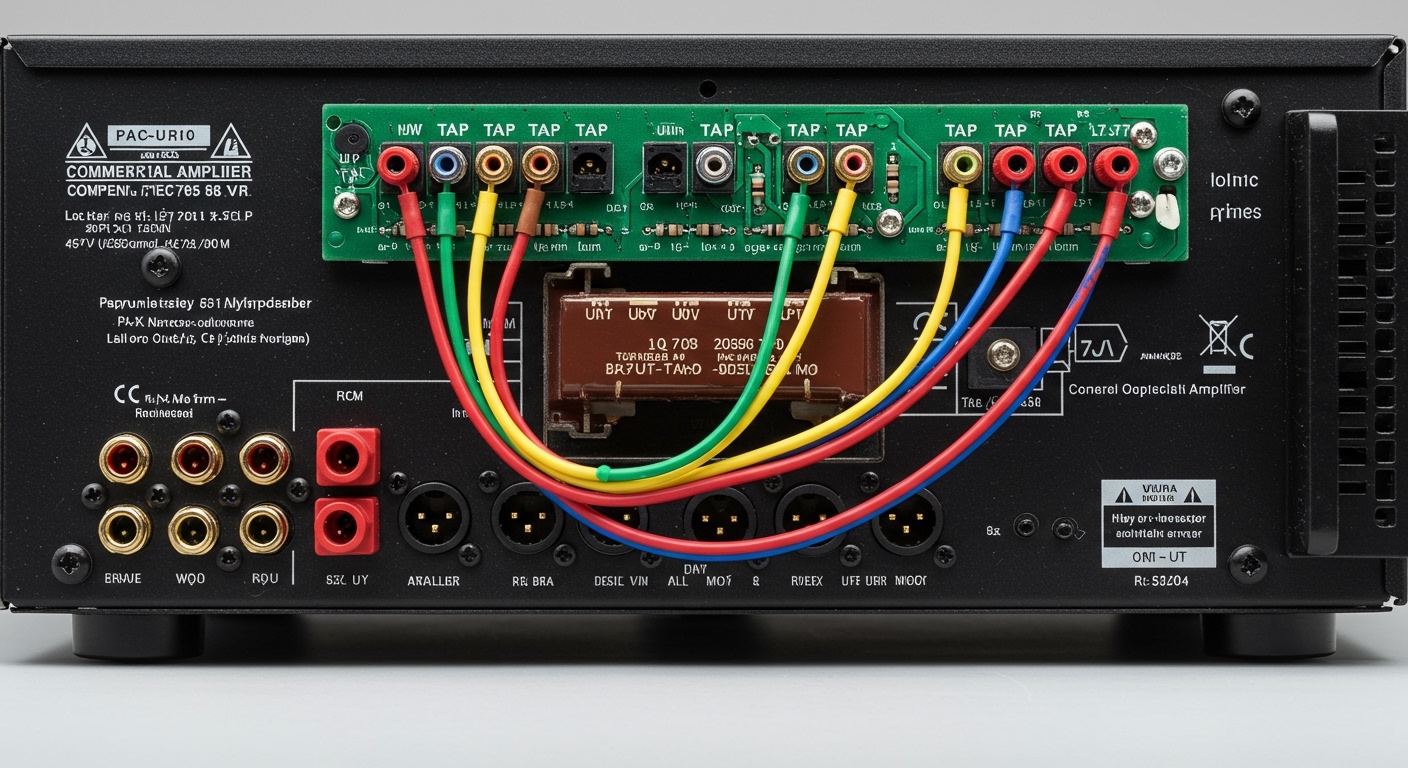
To find your answer, use this three-step formula:
- Determine Useable Power: Multiply the Amplifier Wattage by 0.80.
- Select Speaker Tap: Decide how many watts each speaker needs (Higher wattage = More volume).
- Divide: Useable Power / Speaker Tap = Total Number of Speakers.
V Load Calculation Table**
The following table demonstrates how many 70v speakers per amp you can install based on different tap settings, applying the mandatory 20% headroom rule.
| Amp Total Wattage | 80% Useable Limit | Speakers @ 2.5W Tap | Speakers @ 5W Tap | Speakers @ 10W Tap | Speakers @ 30W Tap |
|---|---|---|---|---|---|
| 60 Watts | 48 Watts | 19 | 9 | 4 | 1 |
| 120 Watts | 96 Watts | 38 | 19 | 9 | 3 |
| 240 Watts | 192 Watts | 76 | 38 | 19 | 6 |
| 500 Watts | 400 Watts | 160 | 80 | 40 | 13 |
| 1000 Watts | 800 Watts | 320 | 160 | 80 | 26 |
Why the “80% Rule” is Non-Negotiable
In my 15 years of installing commercial sound systems, I have seen dozens of amplifiers fail because installers ignored the headroom rule. When a 70V amplifier runs at 100% capacity, the transformers generate excessive heat, and the system loses “dynamic range.”
If a sudden peak in the music occurs, a maxed-out amp will clip, potentially damaging the voice coils in your speakers. By leaving 20% headroom, you ensure the system runs cool and lasts for decades. If you are using low-quality, budget transformers, I actually recommend a 25% or 30% headroom margin because those transformers often have higher insertion loss.
Step-by-Step Guide to Setting Up a 70V System
Step 1: Choose Your Speakers and Taps
Identify the environment. A quiet office might only need 2.5W or 5W taps, while a noisy machine shop might require 15W or 30W taps. Most 70V speakers (like the JBL Control Series or AtlasIED models) feature a rotary switch on the back to select the wattage.
Step 2: Calculate the Total Load
Total all the taps. If you have:
- 10 speakers at 5W = 50 Watts
- 5 speakers at 10W = 50 Watts
- Total Load = 100 Watts
In this scenario, you would need an amplifier rated for at least 125 Watts (100W / 0.80).
Step 3: Selecting the Right Wire Gauge
Because 70V systems use higher voltage and lower current, you can use thinner wire than traditional systems. However, for long runs, wire resistance still matters.
- Up to 500 feet: 18 AWG (American Wire Gauge)
- 500 to 1,000 feet: 16 AWG
- Over 1,000 feet: 14 AWG or 12 AWG
Pro Tip: Always use oxygen-free copper (OFC) wire rather than copper-clad aluminum (CCA) for better conductivity and longevity in commercial environments.
Step 4: Wiring in Parallel (The Daisy Chain)
This is where 70V systems shine. You do not need to home-run every speaker to the amp.
- Run a single 2-conductor cable from the Amplifier 70V Output to the first speaker.
- Connect Positive (+) to Positive and Negative (-) to Negative.
- Continue the cable from the first speaker to the second, the second to the third, and so on.
- You can even branch off into “T-taps” if the building layout requires it.
Mixing and Matching Speakers on a Single Amp
One common question I get is: “Can I mix ceiling speakers and outdoor horns on the same amp?”
Yes, you can. As long as the total wattage of all combined speakers (at their selected taps) does not exceed 80% of the amp’s rating, you can mix different brands, sizes, and types of 70V speakers.
This is incredibly useful for restaurants where you might want:
- Small pendent speakers over the bar (Tapped at 5W).
- Large subwoofers hidden in the ceiling (Tapped at 60W).
- Weatherproof speakers on the patio (Tapped at 15W).
Advanced Considerations: Insertion Loss and Distance
What is Insertion Loss?
Every transformer in a 70V speaker consumes a small amount of power just to function. This is called Insertion Loss. High-end transformers (like those in QSC or Bose speakers) have very low loss (around 0.5dB), while cheap, generic speakers can lose up to 2dB. This reinforces why the 80% headroom rule is vital—it accounts for these invisible power drains.
Voltage Drop Over Long Distances
If you are wiring a massive facility, like a stadium or a large parking lot, you must account for Voltage Drop. If the voltage drops too low at the end of the line, the speakers will sound thin and quiet. To prevent this:
- Keep your total wire resistance under 10% of the total speaker load impedance.
- For runs over 2,000 feet, consider using a 100V system (common in Europe) or multiple amplifiers distributed throughout the facility.
Troubleshooting Common 70V Setup Issues
| Symptom | Potential Cause | Solution |
|---|---|---|
| Low volume on all speakers | Amp is underpowered or master volume is capped. | Check the 80% rule; ensure master gain is set correctly. |
| One speaker is much louder | Tap setting is too high. | Adjust the rotary transformer switch to a lower wattage. |
| Distorted audio/Amp clipping | Too many speakers for the amp capacity. | Disconnect some speakers or lower the tap settings. |
| No sound at the end of the line | Broken wire or short circuit. | Test continuity using a multimeter; check parallel connections. |
| Hum or Buzz | Ground loop or proximity to AC lines. | Ensure audio cables are shielded and kept away from 120V/240V power lines. |
Frequently Asked Questions
How many 70v speakers can I put on a 100 watt amp?
Following the 80% rule, you have 80 usable watts. You can put 16 speakers tapped at 5 watts, 8 speakers tapped at 10 watts, or 2 speakers tapped at 30 watts plus 2 speakers tapped at 10 watts.
Can I use regular speaker wire for 70V?
Yes, you can use standard 2-conductor speaker wire. However, for commercial installations, building codes usually require CL2 or CL3 fire-rated cable. If the wire is running through air plenums (ductwork areas), you must use Plenum-rated (CMP) cable to meet fire safety standards.
What happens if I exceed the 80% limit?
The amplifier will run significantly hotter, which shortens its lifespan. In many cases, the internal protection circuitry will “trip,” causing the audio to cut out intermittently during loud passages. Long-term, you risk burning out the output transformer of the amplifier.
Does the number of speakers affect the impedance?
In a 70V system, the amplifier sees the speakers as a total wattage load rather than a specific ohm impedance. While the impedance technically changes as you add speakers, as long as you stay within the wattage rating of the amp, the impedance will remain within a safe operating range for the constant-voltage transformer.
Do I need a special amplifier for 70V speakers?
Yes. You must use a 70V commercial amplifier (or a standard amp with a 70V step-up transformer). Connecting a 70V speaker (which has a built-in transformer) to a standard 8-ohm home theater receiver will result in extremely low volume and poor sound quality.